University of Mazandaran, Iran
http://cjms.journals.umz.ac.ir
ISSN: 1735-0611
CJMS.6(2)(2017), 77-86
Collocation Method using Compactly Supported Radial Basis Function for Solving volterra’s Population Model
Kourosh Parand1 and Mohammad Hemami
1 Department of Computer Sciences, Shahid Beheshti University, G.C.
Tehran 19697-64166, Iran
Abstract. In this paper, indirect collocation approach based on compactly supported radial basis function (CSRBF) is applied for solving Volterras population model. The method reduces the solu-tion of this problem to the solusolu-tion of a system of algebraic equa-tions. Volterras model is a non-linear integro-differential equation where the integral term represents the effect of toxin. To solve the problem, we use the well-known CSRBF:W endland3,5. Numerical results and residual norm (∥R(t)∥2) show good accuracy and rate of convergence.
Keywords: Volterras population model, Compact support radial basis functions, Collocation method.
2000 Mathematics subject classification: 65L05, 65L60.
1. Introduction
The Volterras model for population growth of a species within a closed system is given in [1, 2] as
dp
dt =ap−bp
2−cp
∫ t
0
p(x)dx, p(0) =p0, (1.1)
1Corresponding author:Member of research group of Scientific Computing. Fax: +98 2122431653.( k [email protected])
Received: 9 October 2015 Revised: 27 November 2017 Accepted: 7 December 2017
wherea >0 is the birth rate coefficient,b >0 is the crowding coefficient andc >0 is the toxicity coefficient. the coefficientcindicates the essen-tial behaviour of the population evolution before its level falls to zero in the long term. p0is the initial population andp=p(t) denotes the
pop-ulation at timet. This model includes the well-known terms of a logistic equation, and in addition it, includes an integral termcp∫0tp(x)dxthat characterizes the accumulated toxicity produced since time zero[2, 3]. We apply scale time and population by introducing the non-dimensional variables
t= tc
b, u= pb
a, (1.2)
to obtain the non-dimensional problem
κdu
dt =u−u
2−u
∫ t
0
u(x)dx, u(0) =u0, (1.3)
whereu(t) is the scaled population of identical individuals at timetand
κ= abc is a prescribed non-dimensional parameter. The only equilibrium solution of Eq. (1.3) is the trivial solution u(t) = 0 and the analytical solution [2]
u(t) =u0exp(
1
κ
∫ t
0
[1−u(τ)− ∫ τ
0
u(x)dx]dτ) (1.4)
shows thatu(t)>0 for allt ifu0 >0.
The solution of Eq. (1.1) has been of considerable concern. Although a closed form solution has been achieved in [1, 4], it was formally shown that the closed form solution cannot lead to any insight into the be-haviour of the population evolution [1]. Some approximate and numer-ical solutions for Volterras population model have been reported. the successive approximations method was suggested for the solution of Eq. (1.3), but was not implemented. In this case, the solution u(t) has a smaller amplitude compared to the amplitude ofu(t) for the caseκ≪1. TeBeest [2] obtained several numerical algorithms namely the Euler method, the modified Euler method, the classical fourth-order Runge-Kutta method and Runge-Runge-Kutta-Fehlberg method for the solution of Eq. (1.3). Moreover, a phase-plane analysis is implemented. In [2], the numerical results are correlated to give insight on the problem and its solution without using perturbation techniques. However, the per-formance of the traditional numerical techniques is well-known in that it using provides grid points only, and in addition, it requires a large amounts of calculations.
are used in the analysis to capture the essential behaviour of the pop-ulations u(t) of identical individuals and approximation of umax and exact value ofumax for different κ were compared. Small [4] solved the Volterras population Model by the singular perturbation method. This author scaled out the parameters of Eq. (1.1) as much as possible and considered four different ways to do this. He considered two casesκ= abc small andκ= abc large.
It is shown in [4] that for the case κ ≪ 1, where populations are weakly sensitive to toxins, a rapid rise occurs along the logistic curve that will reach a peak and then is followed by a slow exponential decay. And, for largeκ, where populations are strongly sensitive to toxins, the solutions are proportional to sech2(t).
Adomian decomposition method and Sinc-Galerkin method were com-pared for the solution of the same integral equation in [5]. This showed that Adomian decomposition method is more efficient and easier to use for the solution of Volterras Population Model.
Ramezani [7] applied an approach based upon composite spectral functions approximations. The properties of composite spectral func-tions consisting of few terms of orthogonal funcfunc-tions utilized to reduce the solution of the Volterras model to the solution of a system of alge-braic equations.
Rational Chebyshev and Hermite functions collocation approach were compared for the solution of Volterras Population Model growth model of a species within a closed system by Parand et al. [6]. They reduced the solution of this problem to the solution. of a system of algebraic equations.
Parand et al. [8] applied two common collocation approaches based on radial basis functions to solve Volterras Population Model.
Marzban et al. [9] proposed a numerical method based on Hybrid function approximations to solve Volterras Population Model. These Hybrid functions consist of block-pulse and Lagrange-interpolating poly-nomials.
Also, in [10] Volterras population growth model of a species within a closed system is approximated by collocation method based on two orthogonal functions, Sinc and Rational Legendre functions. Momani et al. [11] and Xu [12] used a numerical and analytical algorithm for approximate solutions of a fractional population growth model, respec-tively. The first algorithm is based on Adomian decomposition method (ADM) with Pad approximants and the second algorithm is based on homotopy analysis method (HAM).
2.1. CSRBF. The use of the RBF [13, 14] is an one of the popular meshfree method for solving the differential equations [15, 16]. For many years the global radial basis functions such as Gaussian, Multi quadric, Thin plate spline, Inverse multiqudric and etc was used. These functions are globally supported and generate a system of equations with ill-condition full matrix.To convert the ill-condition matrix to a well-condition matrix, CSRBFs can be used instead of global RBFs. CSRBFs[17] can convert the global scheme into a local one with banded matrices, Which makes the RBF method more feasible for solving large-scale problem [18].
Wendland’s functions. The most popular family of CSRBF are Wend-land functions. This function introduced by Holger WendWend-land in 1995 [19]. Wendland starts with the truncated power functionϕl(r) = (1−r)l+
which be strictly positive definite and radial onRs forl≥ ⌊2s⌋+ 1 , and then he walks through dimension by repeatedly applying the operator I.
Definition [20] withϕl(r) = (1−r)l+ we define
ϕs,k =Ikϕ⌊s
2⌋+k+1, (2.1)
it turns out that the functionsϕs,k are all supported on [0,1].
Theorem 1 [20] The function ϕs,k are strictly positive definite (SPD) and radial on Rs and are of the form
ϕs,k(r) = {
ps,k(r) r∈[0,1],
0 r >1,
with a univariate polynomial ps,k of degree ⌊2s⌋ + 3k+ 1. Moreover,
ϕs,k ∈C2k(R) are unique up to a constant factor, and the polynomial degree is minimal for given space dimensions and smoothness 2k [20]. Wendland gave recursive formulas for the functionsϕs,k for all s, k. We instead list the explicit formulas of [21].
Theorem 2 [20] The function ϕs,k,k= 0, 1, 2, 3,have form
ϕs,0= (1−r)l+,
ϕs,1= (1. −r)+l+1[(l+ 1)r+ 1],
ϕs,2= (1. −r)l++2[(l2+ 4l+ 3)r2+ (3l+ 6)r+ 3],
ϕs,3= (1. −r)l++3[(l3+ 9l2+ 23l+ 15)r3+ (6l2+ 36l+ 45)r2
+(15l+ 45)r+ 15],
where l = ⌊s2⌋ +k + 1, and the symbol = denotes equality up to a. multiplicative positive constant.
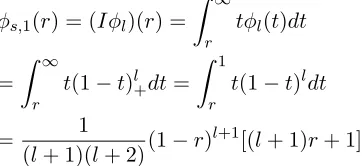
definition for the casek= 1 yields
ϕs,1(r) = (Iϕl)(r) = ∫ ∞
r
tϕl(t)dt
= ∫ ∞
r
t(1−t)l+dt= ∫ 1
r
t(1−t)ldt
= 1
(l+ 1)(l+ 2)(1−r)
l+1[(l+ 1)r+ 1],
where the compact support ofϕlreduces the improper integral to a def-inite integral which can be evaluated using integration by parts. The other two cases are obtained similarly by repeated application of I.[20] We showed the most of wendland functions in table 1 . Wu’s and
Buh-Table 1. Wendland’s compactly supported radial function for various choices of k and s=3.
ϕs,k smoothness SPD
ϕ3,0(r) = (1−r)2+ C0 R3
ϕ3,1(r)= (1. −r)4+(4r+ 1) C2 R3
ϕ3,2(r)= (1. −r)6+(35r2+ 18r+ 3) C4 R3
ϕ3,3(r)= (1. −r)8+(32r3+ 25r2+ 8r+ 1) C6 R3
ϕ3,4(r)= (1. −r)10+(429r4+ 450r3+ 210r2+ 50r+ 5) C8 R3
ϕ3,5(r)= (1. −r)12+(2048r5+ 2697r4+ 1644r3+ 566r2+ 108r+ 9) C10 R3
mann’s functions are the other kind of CSRBFs[22, 23]. For obtaining Wu’s functions operatorD is used on convolution function
ϕ(r) = (1−r2)l+, l∈N
and Buhmann’s functions contain a logarithmic term in addition to a polynomial. Buhmann’s functions have the general form
ϕ(r) = ∫ ∞
0
(1−r
2
t )
λ
+tα(1−tδ)
ρ
+dt.
where 0 < δ ≤ 0.5 and ρ ≥ 1. α and λ values change on construting SPD functions onRs for different s[20].
2.2. Interpolation by CSRBFs. The one-dimensional functiony(x) to be interpolated or approximated can be represented by an CSRBF as
y(x)≈yn(x) = N ∑
i=1
where
ϕi(x) =ϕ(∥
x−xi∥ rω
),
ΦT(x) = [ϕ1(x), ϕ2(x),· · · , ϕN(x)],
Ξ = [ξ1, ξ2,· · · , ξN]T,
(2.2)
x is the input, rω is the local support domain and ξis are the set of coefficients to be determined. By using the local support domain, we mapped the domain of problem to CSRBF local domain. By choosing
N interpolate nodes (xj, j = 1,2,· · · , N) in domain:
yj = N ∑
i=1
ξiϕi(xj)(j = 1,2,· · ·, N).
To summarize the discussion on the coefficients matrix, we define
AΞ =Y, (2.3)
where :
Y = [y1, y2,· · · , yN]T,
A= [ΦT(x1),ΦT(x2),· · ·,ΦT(xN)]T
=
ϕ1(x1) ϕ2(x1) · · · ϕN(x1)
ϕ1(x2) ϕ2(x2) · · · ϕN(x2)
..
. ... . .. ...
ϕ1(xN) ϕ2(xN) · · · ϕN(xN) .
Note that ϕi(xj) = ϕ(∥
xi−xj∥
rω
), by solving the system (2.3), the
un-known coefficientsξi will be achieved.
2.3. ICSRBF method. In the indirect method, the formulation of the problem starts with the decomposition of the highest order derivative under consideration into CRBF. The obtained derivative expression is then integrated to yield expressions for lower order derivatives and finally for the original function itself.
We approximate dudt for solving the model by ICSRBF:
du
dt ≃uˆN(t) =
N ∑
i=1
by using integral operatorIϑf(t) = ∫t
0 f(x)dx we have
∫ t
0
du≃
∫ t
0
ˆ
uN(v)dv=IϑΦT(t)Ξ,
u(t) =IϑΦT(t)Ξ +u0, (2.5)
Iϑu=Iϑ2ΦT(t)Ξ +u0t. (2.6)
Now, to obtain{ξi}Ni=1 we define the residual functions by substituting Eqs. (1.4)-(2.6) in Eq. (1.3)
ˆ
R(t) =κΦT(t)Ξ−(IϑΦT(t)Ξ +u0)(1−IϑT(t)Ξ−u0−Iϑ2ΦT(t)Ξ−u0t).
(2.7) The set of equations for obtaining the coefficients {ξi}Ni=1 come from equalizing Eq. (2.6) to zero at N interpolate nodes {ti}N
j=1 from tj =
L(Nj)ρ, j = 1,2,· · · , N where L is a last interpolate node and ρ is a arbitrary parameter.
ˆ
R(tj) = 0, j = 1,2,· · · , N. (2.8)
3. Application
We applied the method presented in this paper to examine the math-ematical structure of u(t). Table (2) shows the maximum of u(x) for some κ and u0 = 0.1 by using in comparison with exact solution and
ADM solution by Wazwaz [3]. The resulting graph of Eq. (1.3) is shown in Fig. (1).
Table 2. A comparison of ADM[3] and the present method with exact values forumax.
κ umax rω ρ N ICSRBF ADM
0.02 0.9234271 1 1.766000 15 0.92342716 0.9234270 0.04 0.8737199 1 1.780000 18 0.8737193 0.8612401 0.1 0.7697414 1 1.811000 18 0.7697414 0.7651130 0.2 0.6590503 2 1.032770 18 0.6590493 0.6579123 0.5 0.4851902 2 1.114035 27 0.4851903 0.4852823
The local support domainrω and arbitrary parameterρmust be spec-ified by the user.An important unsolved problem is to find a approach to determine the optimal size ofrω[18]. The accuracy of these CSRBF depends on the choice ofrω andρ. By the meaning of residual function in case of Eq. (2.6), we try to minimize ∥R(t)∥2 by choosing good rω and ρ parameters. We define∥R(t)∥2 as
∥R(t)∥2 = ∫ L
0
R2(t)dt≃ L
2 m ∑
j=0
ωjR2(
L
2sj+
L
Figure 1. Plot of approximate solutions of Eq. (1.3) for
u0 = 0.1 andκ= 0.02,0.04,0.1,0.2,0.5.
Table 3. Minimum value of ∥Res∥2 which is obtained
withrω and ρ for ICSRBF.
κ ∥Res∥2-ICSRBF 0.5 2.11e−08 0.2 2.87e−07 0.1 1.34e−07 0.04 7.86e−05 0.02 4.41e−05
were
ωj =
L
(1−s2
j)(dxdPm+1(s)|s=sj)2
, j= 0,1,· · ·, m, Pm+1(sj) = 0, j= 0,1,· · · , m,
Pm+1(x) is (m+ 1)th-order Legendre polynomial. Table (3) show the
minimum of ∥R(t)∥2 which is obtained with local support domain rω and arbitrary parameter ρ.
4. Conclusion
model without converting it to an ordinary differential equation. We used W endland3,5 function. This function are proposed to provide an
effective but simple way to improve the convergence of the solution by collocation method. As appeared from the Figures, we have shown that, when the constant κ= abc is small, this type of population is relatively insensitive to toxins, and whenc =ab is large, population of this type are extremely sensitive to toxins. Additionally, through the compari-son with ADM, we have showed that the ICSRBF approach have good reliability and efficiency.
5. References References
[1] F. Scudo , Vito Volterra and theoretical ecology, Theor Popul Biol 2 (1971), 1–23.
[2] K. TeBeest, Numerical and analytical solutions of Volterras population model,
SIAM Rev 39(1997),484-493.
[3] A. M. Wazwaz, Analytical approximations and Pad approximants for Volterras population model,Appl Math Comput 100(1999),13–25.
[4] R. Small, Population growth in a closed system,SIAM Rev 25(1983) 93–95. [5] K. Al-Khaled, Numerical approximations for population growth models, Appl
Math Comput 160(2005) 865–873.
[6] K. Parand , A. Rezaei, A. Taghavi, Numerical approximations for population growth model by Rational Chebyshev and Hermite functions collocation ap-proach: a comparison.,Math Methods Appl Sci33(2010) 2076–2086.
[7] M. Ramezani, M. Razzaghi, M. Dehghan, Composite spectral functions for solv-ing Volterras population model,Chaos Soliton Fract34(2007) 588–593. [8] K. Parand, S. Abbasbandy, S. Kazem, J. A. Rad, A novel application of radial
basis functions for solving a model of first-order integro-ordinary differential equation,Commun Nonlinear Sci Numer Simulat16(2011) 4250–4258. [9] HR. Marzban, S. Hoseini, M. Razzaghi, Solution of Volterras population model
via block-pulse functions and Lagrange-interpolating polynomials,Math Methods Appl Sci 32(2009) 127–134.
[10] K. Parand, Z. Delafkar, N. Pakniat, MK. Haji Collocation method using Sinc and Rational Legendre functions for solving Volterras population model, Commun Nonlinear Sci Numer Simul 16(2011) 1811–1819.
[11] S. Momani, R. Qaralleh, N. Pakniat, MK. Haji, Numerical approximations and Pad approximants for a fractional population growth model, Appl Math Model 31(2007) 1907–1914.
[12] H. Xu, Analytical approximations for a population growth model with fractional order,Commun Nonlinear Sci Numer Simul 14(2009) 1978–1983.
[13] J. A. Rad, K. Parand, L. V. Ballestra Pricing European and American options by radial basis point interpolation,Appl Math Comput 251(2015) 363–377. [14] J. A. Rad, S. Kazem, K. Parand Optimal control of a parabolic distributed
[15] S. Kazem, J. A. Rad, K. Parand, M. Shaban, H. Saberi The numerical study on the unsteady flow of gas in a semi-infinite porous medium using an RBF collocation method,Int J Comp Math 89(2012) 2240–2258.
[16] S. Kazem, J. A. Rad, K. Parand, A meshless method on non-Fickian flows with mixing length growth in porous media based on radial basis functions: A com-parative study,Comp Math Applic64(2012) 399–412.
[17] M. D. Buhmann, Radial basis functions: theory and implementations,New York: Cambridge University Press(2004).
[18] S. M. Wong, Y. C. Hon, M. A. Golberg , Compactly supported radial basis function for shallow water equations,Appl Math Comput 127(2002) 79–101. [19] H. Wendland, Piecewise polynomial, positive definite and compactly supported
radial functions of minimal degree,Adv Comput Math 4(1995) 389–396. [20] G. E. Fasshauer, Meshfree Approximation Methods With Matlab,World
Scien-tific Publishing Co. (1995) Pte, Ltd 4389–396.
[21] G. E. Fasshauer, On smoothing for multilevel approximation with radial basis functions, An approximation theory IX, Vol. II: Coputational Aspects, CharlesK. Chui and L. L. Schumakher.,Vanderbilt University Press. (1999) Pte, Ltd4389– 396.
[22] Z. Wu, Compactly supported positive definite radial functions,Adv Comput Math 4283–292.