Basic Sciences
NMDA RECEPTOR ANTAGONISTS ATTENUATE
TOLERANCE INDUCED BY MORPHINE AND
NERVE LIGATION IN MICE
G.R. TAGHIZADEH-JAHROMI, M. REZAYAT,
ANDM.R.
ZARRINDAST
From the Department of Pharmacology, School of Medicine, Tehran University of Medical Sciences,
Tehran, f.R. fran.
ABSTRACT
The effect of NMDA (N-methyl-D-aspartate) receptor antagonists on toler ance to morphine antinociception was investigated in mice. Daily subcutaneous administration of 50 mg/kg of morphine hydrochloride for three days induced tolerance to different (3,6 and
9
mg/kg) test doses of morphine. The tolerance obtained was decreased by pretreatment of animals with single or repeated dosesof competitive NMDA receptor antagonists D-( -)-2-amino-5-phosphonovaleric acid (DAP5; 0.1-0.3 mg/kg) and D-(-)-2-amino-7-phosphonoheptanoic acid (DAP7; 0.1-0.3 mg/kg).
Tolerance to morphine response was also obtained 7, 14, 21 and 30 days after unilateral sciatic nerve ligation. Single or repeated doses (0.2 mg/kg) of DAP5 or DAP7 increased the antinociceptive response induced by morphine
(9
mg/kg) in the nerve ligated animals. We report that these agents attenuate the development of morphine tolerance, and increase the antinociceptive effect of morphine on sciatic neuropathic pain in mice.MlIRl, Vol. 15, No.1, 41-47, 2001.
Spring 1380
May 2001
INTRODUCTION
Opiate drugs such as morphine are widely used in the clinical management of pain. One major problem in the use of opiate analgesic drugs is the development of tolerance during their administration. The lack of efficacy against neu ropathic pain, produced by diseases or damage to the ner vous system, not only reduces their effectiveness but also complicates the management of patients with persistent
pain. 10 Both laboratory animals20,26,27 and humans7 can show the development of tolerance and lack of effectiveness to morphine analgesia,
Correspondence: M.R. Zarrindast, Professor, Department of Phalmacol ogy, School of Medicine, Tehran University of Medical Sciences, P.O. Box: 13145-784, Tehran, LR. Iran .
In addition, nerve damage that affects peripheral nerves leads to abnormal pain states referred to as neuropathic pain. The well-established animal model of peripheral mononeuropathy produced by persistent moderate constric tion of the common sciatic nerve, has been studied exten sively.15.19 The excitatory amino acids have been suggested to be involved in endogenous pain inhibitory mechanism(s).2 Excitatory amino acid systems exert a wide variety of pharmacological effects. In paIticular, the NMDA receptor may be involved in neural development, long-term potentiation, kindling, learning, and memory.24
NMDA Receptor Antagonists Attenuate Tolerance 10
A
8 6 4 2 0� 10
U
B
Cl) 8
rJJ '-" 6
�
4U 2
�
Cl) 0
�
ro 10
�
8c
6 4 2 0 0 ** •
o Non-tolerant • Tolerant
**
i
** • ** •** **
* I **
-.
-
----
.�--1I
.,-
--e** • 15 ** • 30 **
i
45Time (min)
**
i
60
Fig. 1. Comparison ofantinociception in non-tolerant and toler ant mice to morphine. Mice were administered morphine 50 mg/ kg daily for a period of three days in order to develop tolerance to morphine antinociception. Non-tolerant animals received only daily administration of saline instead of morphine injection. Non tolerant or tolerant animals were injected subcutaneously (s.c.) with test doses of morphine; 3 (graph A), 6 (graph B) or 9 mg/kg (graph C). Each point is mean ± SEM of 8 animals. *p<O.OI, **p<O.OOI, different from the non-tolerant group.
It has been suggested that the NMDA receptors play a major role in the development of morphine toleranceY In hibition of morphine tolerance and dependence by NMDA receptor antagonists has been shown.24 NMDA antagonists have also been shown to attenuate mechanical allodynia in some animal models of nerve injury;21 therefore, EAA an tagonists may provide a new treatment application.
In the present study we examined the effect of the
spe-42
12
10
,-...
() tl.) 8 CZl
'-"
� 6
() � tl.) ... 4 cIj � 2 o
8
SalAP5
t2Sa
AP73 9
Morphine (mg/kg)
+ Mor
+ Mor + Mor
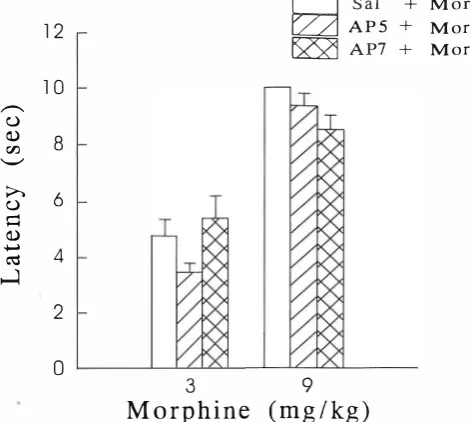
Fig. 2. Effects of NMDA receptor antagonists on non-toler ant mice. The non-tolerant animals were treated (s.c.) with saline (10 mLlkg), DAP5 or DAP7 (0.2 mg/kg) 30 min p rior to test doses of 3 or 9 mg/kg of morphine. Antinociception was recorded 30 min. after morphine injection. Each point is mean ± SEM of 7 animals.
cific NMDA antagonist DAP5 and DAP7 on the develop ment of morphine tolerance, and effectiveness of the opioid drug on neuropathic pain.
MATERIAL AND METHODS
Subjects
Male adult albino mice (weighing 20-25g at the begin ning of experiments) were used in the experiments. The animals were housed in groups of lOin conditions of con stant temperature (21 ±2°C) and a light controlled room (light period, 07:00-19:00). Animals had free access to food and water except during the experiments. Each animal was used only once, and was euthanized immediately after experi ments.
Surgical procedure for nerve ligation
The animals were anesthetized with ether. After an ad equate depth of anesthesia was verified by lack of response to tail pinch, an incision was made from the right sciatic notch to the distal thigh. The subcutaneous tissue was bluntly dissected under the skin to expose the biceps femoris muscle, a cut was made into the muscle at the sciatic nvtch, then the muscle fibers were bluntly spread, and a 2-3 rom long nerve segment was then dissected. One ligature (fine metal wire) was made around the dissected nerve. Mice in sham opera tion groups underwent the same surgical procedures except for sciatic nerve ligation. All animals received cephalexin
10
•Sham
� v
Ligate 3
<) 8
� 0
Ligate
7rJJ.
6.
Ligate 14
'--'6
<>
Ligate 21
�
0
Ligate 30
<)
4
�
�
-+-I 2
�
�
0
0
15
30
45
60
Time
(min)
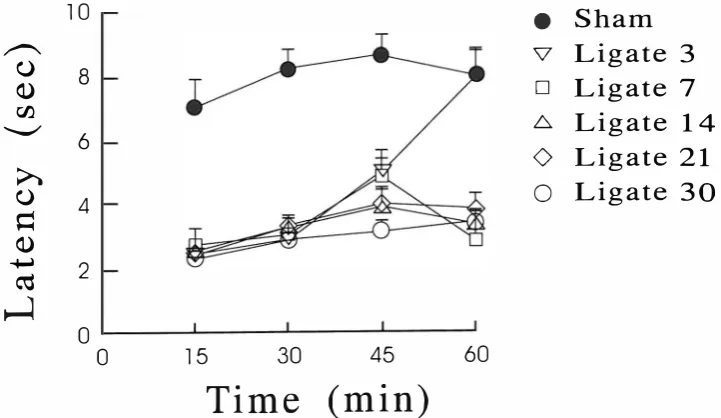
Fig. 3. Effect of sciatic nerve-ligation on morphine antinociception in mice. Animals were either sham operated or unilateral nerve ligated (on the right sciatic) and anti nociceptive response ofa test dose of morphine (9 mg/kg, s.c.) was tested 3, 7, 14,21 and 30 days after ligation. Each point is mean ± SEM of
7 animals. All points are significant with sham-operated animals except for the effect of morphine 3 days after ligation and 60 min after morphine injection.
der at the site of nerve ligation, in order to prevent in fection.
D evelopment of tolerance to morphine
Tolerance was achieved as we previously described.20,26,27 Mice were treated subcutaneously (s.c.) with a daily dose of morphine (50 mglkg) for 3 days. To assess the degree of tolerance, the antinociceptive response to different test doses of morphine (3, 6 and 9 mg/kg) was measured on the 4th day (a day after the last morphine injection).
Tail-flick assay
A day after tolerance induction, and on day 3 , 7, 14, 21 and 3 0 after nerve ligation of animals, the antinociception of test doses of morphine was measured.
Antinociception was determined in the tail-flick test, wherein noxious stimulation is effected by a beam of high intensity light focused on the animal's tail with a tail-flick apparatus (model 81 2, Hugo Sachs Electronic, Germany). The mean response of latency period before the drug ad ministration was 2-3 sec. in non-tolerant and 1-2 sec. in tolerant or ligated animals. A 1 0 sec. cut offwas imposed to avoid excessive tissue damage.
D rugs
The following drugs were used: D-(-)-2-amino-5-phosphonovaleric acid (DAP5) and D-(-)-2-amino-7-phosphonoheptanoic acid (DAP7) (Institute of Physi ologically Active Compounds, Russia), morphine hydro chloride (T & H Smith Ltd, England), and diethylether
(Merck, Germany). DAP5, DAP7 and morphine were dissolved in saline and were administered subcutane ously. The drugs were prepared immediately before use and were administered in a volume of 10 mL/kg.
D rug treatment
Animals in experiment 1 received a subcutaneous (s.c.) injection of morphine (50 mg/kg) once daily for three days, in order to induce tolerance to morphine antinociception, and the antinociceptive response of the test doses of opioid (3, 6 and 9 mg/kg) was measured by tail flick tested on the 4th day. Animals in experiment 2 received dail)' DAP5 or DAP7 (0.1, 0.2 and 0.3 mg/kg) 3 0 min before a daily dose of mor phine 50 mg/kg (during induction of tolerance to morphine) and a test dose of morphine (9 mglkg) was tested on the 4th day.
Animals in experiment 3 received normal saline for three days instead of morphine, and on the 4th day (3 0 min prior to test doses of morphine; 3, 6 and 9 mglkg) either DAP5 or DAP7 (0.2 mg/kg; s.c.) was injected and the response of the test doses of morphine was recorded 3 0 min after the opioid administration.
Animals in experiment 4 (to test the effect of morphine on nerve-ligation) were sciatic nerve-ligated and the anti nociceptive response of morphine (9 mg/kg, s.c.) was tested 7, 14, 21 and 30 days after ligation.
Animals in experiment 5 were sciatic nerve-ligated and the antinociceptive response of morphine (9 mg/kg, s.c.) was tested in intact animals, sham-operated or 14 days af ter nerve-ligation.
NMDA Receptor Antagonists Attenuate Tolerance
12
A
10
***
8
6
4
2
0
12
B
,,-.. 10
U
8
Cl.)
00
6
'-"
�
4U
2�
Cl.)
0�
12
�
c
�
108
6
4
2
0 ...l...lV"lr-...l >-.>-.>-.>-.>-. >-. >-. >-. >-. >-.
<t:<t:o..o..<t:
ro ro ro ro ro ro ro ro ro ro (/)(/)<t:<t:(/) "0"0"0"0"0 "0"0 "0 "0 "0
�:I::I:��
�-5-5-5-= � -5 -= -5 :::�<'lr<l'<tr<l -("f")("'f'")...q ('f"")
z(/)(/)(/)Z -- -- --- ..-,
r-
r-SAL
DAPS DAP7
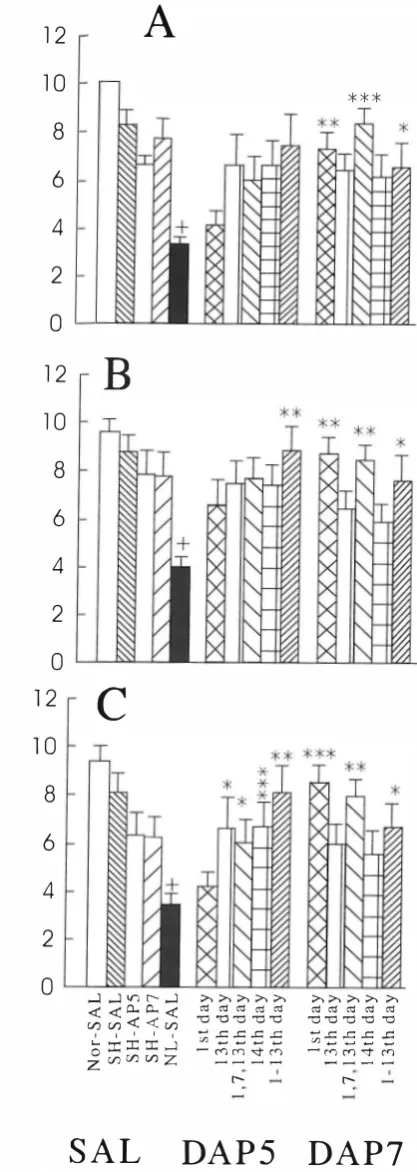
Fig.4. Effect ofNMDA receptor antagonists on tolerance induced by sciatic nerve ligation. Intact mice (Nor), Sham-operated (SH) or nerve-ligated animals (NL) were treated (s.c.) with saline (SAL), DAP5 or DAn and antinociception of a test dose of morphine (9 mglkg) wa� tested l4days after nerve ligation. Antinociception was recorded 30 (A), 45 (B) and 60 min (e) after morphine adminstralion. Each point is mean ± SEM of 7 animals.
*p<O.05, **p<O.Ol, ***p<O.OOI, different from the nerve ligated-group. +p<O.OO I, different from sham-operated or intact animals.
44
Statistical analysis
Analysis of variance (ANOYA) followed by Newman Keul's test were used to evaluate the significance of the results. A value of p<0.05 was considered significant.
RESULTS
Induction of tolerance to morphine
Daily subcutaneous (s.c.) administration of morphine hydrochloride (50 mg/kg) for three days resulted in the de velopment of tolerance. Antinociception of test doses of morphine (3, 6 and 9 mg/kg) was recorded on the 4th day after drug injection (24 h after the last dose of morphine). The antinociceptive effect to test doses of 3 mg/kg [F(7, 56)= 25.7,p<0.0001)], 6 mg/kg [F(7, 56)= 40.9,p<0.0001)] and 9 mg/kg [F(7, 56)= 1 93.8,p<0.000 1 )] of morphine was significantly decreased in tolerant mice (Fig. 1 ).
Effects of NMDA receptor antagonists on morphine-in duced tolerance
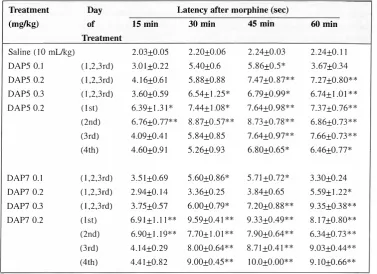
Table I indicates the time course of development of mor phine tolerance in the presence or absence of NMDA re ceptor antagonists. The animals were treated with daily doses of 50 mg/kg of morphine for three days in order to induce tolerance and were tested 24h after the last daily dose of the opioid. In these animals, the antinociceptive response of a test dose of 9 mg/kg of morphine was re duced. When animals were treated daily with DAP5 or DAP7 (0.1,0.2 and 0.3 mgkg) 30 min before daily doses of morphine (50 mg/kg), tolerance to a test dose of morphine (9 mg/kg) was reduced. The response to a test dose of mor phine (9 mg/kg) was also increased when animals were administered DAP5 or DAP7 (0.2 mg/kg) on the 1st, 2nd or 3rd day of daily morphine administration (50 mg/kg) or on the 4th day, 30 min prior to a test dose of morphine injection. It is worth notice that tolerance was less promi nent when NMDA receptor antagonists were administered on the 1 st or 2nd day rather than the 3rd or 4th day. The difference between time course response of morphine may indicate that chronic treatment with the antagonists elicits more response .
Effects of NMDA receptor antagonists on morphine antinociception in non-tolerant mice
Animals received normal saline for three days instead
of a daily administration of morphine, and on the 4th day
(30 min before test doses of morphine; 3 and 9 mg/kg), either DAP5 or DAP7 (0.2 mg/kg,. s.c.) was administered and the response of test doses of morphine was recorded. ANOYA did not show any difference between the response induced in saline-treated with those obtained in NMDA receptor antagonist-treated animals, for the test doses of 3 [F(2, 18)= 2.5, p>0.05] or 9 mg/kg [F(2, 18)= 3.5, p>0.05] (Fig. 2).
Antinociceptive effect of morphine in sciatic nerve-li gated mice
Fig. 3 indicates antinociception of morphine in sham operated and nerve ligated animals. The antinociceptive re sponse of morphine was decreased significantly in the nerve ligated as compared with the sham-operated animals. Con sistently, antinociception induced by the test dose of mor phine was decreased 3, 7, 14,2 1 and 30 days after sciatic nerve ligation [F(23, 1 68)= 20.2, p<O.OOO I). Further analy sis showed that tbe effect of morphine after 3 days ligation tends to decrease 4S min and become abolished 60 min after administration of a test dose of morphine. Animals which had nerve ligation for 1 4 days, and a test dose of morphine (9 mg/kg) were used for the rest of the experi ments.
Effects of NMDA receptor antagonists on morphine-in duced antinociception in sciatic nerve ligated animals
Fig. 4 presents the effects of DAPS and DAP7 on sham operated and nerve-ligated animals. ANOYA indicated a difference between antinociception induced by a test dose of morphine (9 mg/kg) in sham-operated and nerve-ligated animals, 30 min [F(4, 30)= 26, p<O.OOOI], 4S min [F(4, 30)= 7.8, p<O.OOI] or 60 min [F(4, 30)= 8.7, p<O.OOOl] after morphine administration. Further analysis showed that sciatic nerve ligation reduced the antinociception of mor phine as compared with normal or sham-operated groups. There was no difference between normal and sham-oper ated animals, moreover DAPS and DAP7 did not elicit any effect on sham-operated animals. ANOYA also indicated a difference between the response of a test dose of morphine in the nerve-ligated animals which received saline with those which received single or multiple doses of DAPS, 30 min [F(S, 36)= 2.7, p<O.OS], 4S min [F(S, 36)= 3.4, p<O.OS] and 60 min [F(S, 36)= S.8, p<O.OOI] after morphine injec tion. Further analysis showed that DAPS is capable of re versing nerve ligation-reduced morphine antinociception. However, analysis showed that response to DAPS was maxi mally induced 4S min after morphine administration.
In the same way also reversed ligation decreased mor phine antinociception, 30 min [F(S, 36)=S,p<0.0l], 4S min [F(S, 36)= S.7,p<O.001] and 60 min [F(S, 36)= S.2,p<0.01]
after injection of a test dose of morphine. Analysis indi cated that the response of DAP7 starts IS min after mor phine injection.
DISCUSSION
The measurement of antinociception by the tail-flick test may be predominantly spinally controlled8,9 and activation of spinal cord NMDA receptors has been shown to be criti cal for tolerance to the antinociceptive effects of mor phine.12.16,18.23.24 In the present study, the effects of NMDA r eceptor antagonists on tolerance to morphine antinociception induced by repeated administration of
mor-phi ne and also the effects of the antagonists on hyperalge sia induced by ligation have been investigated in the tail flick test. Our data showed that daily administration of morphine (SO mg/kg, subcutaneously) for a period of 3 days to mice induced tolerance to morphine antinociception i n the tail-flick test. This is i n agreement with our previous studies.2o.26.27 The results indicate that NMDA receptor an tagonists decrease the development of morphine tolerance and increased morphine antinociception in nerve Iigated animals.
The present study indicates that low doses of competi tive NMDA receptor antagonists D APSI3 or DAP711 re duce morphine tolerance. The data are in agreement with that obtained by others24.2s and may support the suggestion that the NMDA receptor mechanism may have an impor tant role in opiate tolerance.23
Our data also indicate that administration of the NMD A antagonists DAPS and DAP7, either during development of tolerance or in the animals in which tolerance had al ready been acquired, increases morphine's response. How ever, the response to DAPS was maximally induced 4S min after morphine administration, while that of DAP7 began IS min after morphine injection. Thus it appears that the effect of DAP7 begins earlier than DAPS, possibly due t o early absorption of the drug. The lack o f increase in mor phine analgesia in non-tolerant mice by the NMDA recep tor antagonists DAPS and DAP7, which is supported by other investigatorsl7 may confirm this conclusion that the antagonists increased opioid analgesia in tolerant animals by inhibition of the development or by inhibition of the expression of morphine tolerance, possibly-through block ade of NMDA receptor antagonists. Development of mor phine tolerance has been shown to be relateq to NMDA receptor activation and subsequent intracellular changes, and the expression of tolerance is likely due to the decreased effectiveness of mu opioid receptors to morphine. IS The electrophysiological link between mn receptor occupancy and an increase in Ca++ conductance by ion channels regu lated by NMDA receptors has been proposed.} There is also a suggestion that NMDA receptor-activated, calcium dependent processes may be involved in the development of opiate tolerance.25 Because of the well-described role of calcium ions in NMDA receptor-mediated neural and behavioural plasticity,4.s the possibility may exist that the NMDA receptor antagonists DAPS and DAP7 inhibit the development of opiate tolerance through such a mechanism. Whether this mechanism is involved in the response of acute and/or subchronic administration of the antagonists requires further experiments.
Our data also showed that sciatic nerve-ligation reduces the antinociceptive effect of morphine. This was in agree ment with recent studies using an animal model of neuro
pathic pain.I.23 There is evidence that ligation of the sciatic
nerve induces hyperalgesia in animals.19 The release of NMDA in the presence of excitatory activity resulting from
NMDA Receptor Antagonists Attenuate Tolerance
Table I. Effects of NMDA receptor antagonists on tolerance induced to morphine
antinociception.
Treatment Day Latency after morphine (sec)
(mg/kg) of 15 min 30 min 45 min 60 min
Treatment
Saline (10 mL/kg) 2.03±0.OS 2.20±0.06 2.24±0.03 2.24±0.11
DAPS 0.1 (1,2,3rd) 3.01±0.22 S.40±0.6 S.86±0.S* 3.67±0.34
DAPS 0.2 (I,2,3rd) 4.16±0.61 S.88±0.88 7.47±0.87** 7.27±0.80** DAPS 0.3 (1,2,3rd) 3.60±0.S9 6.S4±1.2S* 6.79±0.99* 6.74±1.01 ** DAPS 0.2 (Ist) 6.39±1.31 * 7.44±1.08* 7.64±0.98** 7.37 ±0.76**
(2nd) 6.76±0.77** 8.87±0.S7** 8.73±0.78** 6.86±0.73** (3rd) 4.09±0.41 S.84±0.8S 7.64±0.97** 7.66±0.73**
(4th) 4.60±0.91 S.26±0.93 6.80±0.6S* 6.46±0.77*
DAP7 0.1 (1,2,3rd) 3.SI±0.69 S.60±0.86* S.7 1±0.72* 3.30±0.24
DAP7 0.2 (1,2,3rd) 2.94±0.14 3.36±0.2S 3.84±0.6S S.S9±1.22*
DAP7 0.3 (1,2,3rd) 3.7S±0.S7 6.00±0.79* 7.20±0.88** 9.3S±0.38** DAP7 0.2 (Ist) 6.91±1.11 ** 9.S9±0.41 ** 9.33±0.49** 8.17±0.80**
(2nd) 6.90±1.19** 7.70±1.01 ** 7.90±0.64** 6.34±0.73** (3rd) 4. 14±0.29 8.00±0.64** 8.71±0.41** 9.03±0.44**
(4th) 4.41±0.82 9.00±0.4S** 10.0±0.00** 9.1O±0.66**
Mice received a daily injection of 50 mg/kg of morphine subcutaneously for three days, in order to
induce tolerance to morphine. Different groups of the animals subjected to tolerance were injected with either saline, DAPS or DAP7 on the I st, 2nd or 3rd day or for three days 30 min prior to daily
injection of morphine (50 mg/kg) during tolerance induction, or 30 min before a test dose of morphine (9 mg/kg). The antinociceptive response to a test dose of morphine (9 mg/kg) was recorded 15, 30,45 and 60 min after morphine injection on the 4th day (a day after tolerance to morphine). Each value is mean ± SEM of 8 mice. *p<O.OS, **p<O.OI, different from control group.
nerve injury yields central sensitivity, manifested as aUodynia and hyperalgesia, and presumed development of tolerance. 6.14 The reduced morphine antinociception induced
by nerve injury may share a mechanism similar to that of morphine tolerance. The basis of interaction between mechanisms of reduced morphine response in morphine tolerance and nerve injury is believed to be related to com mon neural substrates and the site of action involved in both phenomena. IS
The present results showed that daily administration of the specific NMDA receptor antagonists DAP5 and DAP7 can increase morphine induced antinociception in neuro pathic animals. If reduction of the antinociceptive effect of morphine develops in animals with nerve injury or mor phine tolerance results from the activation of spinal cord NMDA receptors and consequent intracellular cascades, this view is strongly supported by our observation that (1) both the development of morphine tolerance and reduced mor phine antinociception in nerve injured mice could be
pre-46
vented by daily treatment with selective NMDA receptor antagonists, (2) three, two or even a single injection of the NMDA antagonists prevented the development of tolerance and reduction of morphine antinociception in nerve-injured mice, and (3) a single injection ofNMDA receptor antago nists in tolerant animals (on the 4th day, 30 min before a test dose of morphine) or in neuropathic animals (on the 14th day) could increase morphine induced analgesia. It means that the expression of morphine tolerance and neu ropathic pain could be reversed by a single dose of DAP5 or DAP7, and this emphasized the existence of a common cellular and intracellular mechanism for both phenomena. This commonality has not been shown by other non-com petitive NMDA receptor antagonists 15 and the reason(s) may
be due to involvement of different subtypes of NMDA re ceptors. These findings would help to develop new opioid treatment approaches for improved treatment of at least some pathophysiological pain syndromes and opiate toler ance.
ACKNOWLEDGEMENTS
We would like to thank Dr. Ghazi-Khansari for his ex cellent assistance and Dr. Ragulin for providing the NMDA antagonists.
REFERENCES
1. Advokatk C, Rhein FQ: Potentiation of morphine-induced antinociception in acute spinal rats by the NMDA antagonist dextorphan. Brain Res 699: 157-160, [995.
2. Behbahani MM, Fields HL: Evidence that excitatory connec tion between the periaqueductal gray and the nucleus raphe magnus mediates stimulation produced analgesia. Brain Res 170: 85-93, 1979.
3. Chen L, Huang LYM: Sustained potentiation of NMDA re ceptor mediated glutamate responses through activation of protein kinase C by a f.1. opioid. Neuron 7: 319-326, 1991. 4. CoIlingridge GL, Lester RAJ: Excitatory amino acids and re
ceptors in the vertebrate central nervous system. Pharmacol Rev 41: 143-210, 1989.
5. Collingridge GL, Singer W: Excitatory amino acids and syn aptic plasticity. Trends Pharmacol Sci 11: 290-294, 1990. 6. Davies SN, Lodge 0: Evidence for involvement of N-methyl
aspartate receptors in "wind up" of class 2 neurons in the dor sal horn of the rat. Brain Res 424: 402-406,1987.
7. Foley KM: Clinical tolerance to opioids. In: Bashaum AI, Besson JM, (eds), Towards a New Pharmacology of Pain. Chicester: John Wiley, pp. 181-204, 1991.
8. Hill RG, Hughes J, Pittaway KM: Antinociceptive action of cholecystokinin octapeptide (CCK-8) and related peptides in rats and mice: effects of naloxone and peptidase inhibitors. Neuropharmacology 26: 289-300, 1987.
9. Holladay MK, Lin CW: CCK agonist: a summary of structure activity relationships with a focus on A-71378, a potent se lective CCK-A agonist. Drug Future 17: 197-206, 1992. 10. Inturrisi CE: Opioid analgesic therapy in cancer pain. In: Foley
KM, Bonica JJ, Ventafridds V, (eds.), Advances in Pain Research
and Therapy. New York: Raven Press, pp. 133-154, 1990. 11. Jacquet YF: The NMDA receptor: central role in pain inhibi
tion in rat periaqueductal gray. Eur J Pharmacol 154: 271-276, 1988.
12. Kolesnikov YA, Pick CG, Ciszewska G, Pasternak GW:
Blockade of tolerance to morphine but not to k opioids by a nitric oxide synthase inhibitor. Proc Nat! Acad Sci USA 90: 5162-5166, 1993.
13. MacDonald JF, Nowak LM: Mechanisms of blockade of ex citatory amino acid receptor channels. Trends Pharmacol Sci 11: 167-172, 1990.
14. Mao J, Price DO, Hayes RL, Lu J, Mayer 01: Differen tial roles of NMDA and non-NMDA receptor activation i n in duction and maintenance of thermal hyperalgesia in rats with painful peripheral mononeuropathy. Brain Res 598: 271-278, 1992.
15. Mao J, Price DD, Mayer OJ: Experimental mononeuropathy reduces the antinociceptive effects of morphine: implications for common intracellular mechanisms involved in morphine tolerance and neuropathic pain. Pain 61: 353-364, 1995. 16.Marek P, Ben-Eliyahu SH, Gold M, Liebeskind JC: Excita
tory amino acid antagonists (kynurenic acid and MK-801) attenuate the development of morphine tolerance in the rat. Brain Res 547: 77-81, 1991a.
17.Marek P, Ben-Eliyahu SH, Gold M, Liebeskind JC: Delayed application of MK-801 attenuates development of morphine tolerance in rats. Brain Res 558: 163-165, 1991b.
18. Mayer DJ, Mao J, Price DO: The development of morphine tolerance is associated with changes in membrane-bound pro tein kinase C in the rat spinal cord. Soc Neurosci Abst 19: 1796, 1993.
19. Ossipov MH, Nichols ML, Bian D, Porreca F: Inhibition b y spinal morphine of the tail-flick response i s attenuated i n rats with nerve ligation injury. Neurosci Lett 199: 1-4, 1995. 20. Rezayat M, Nikfar SH: Zarrindast MR: CCK receptor acti
vation may prevent tolerance to morphine in mice. Eur J Pharmacol 254: 21-26, 1994.
21. Seltzer Z, Beilin BZ, Ginzburg R, Paran Y, Shimko T: The role of injury discharge in the induction of neuropathic pain behavior in rats. Pain 46: 327-336, 1991.
22. Tiseo PJ, Inturrisi CE: Attenuation and reversal of morphine tolerance by the competitive N-methyl-D-aspartate receptor antagonism, LY274614. J Pharmacol Exp Ther 264: 1090-1096, 1993.
23. Tiso PJ, Cheng J, Pasternak GW, Inturrisi CE: Modulation of morphine tolerance by the competitive N-methyl-D-aspartate receptor antagonist LY274614: assessment of opioid receptor changes. J Pharmacol Exp Ther 268: 195-201, 1994.
24. Trujillo KA, Akil H: Inhibition of morphine tolerance and dependence by the NMDA receptor antagonist MK-80l. Sci ence 251: 85-87, 1991a.
25. Trujillo KA, Akil H: Opiate tolerance and dependence: re cent findings and synthesis. New BioI 3: 915-923, 1991b.
26. Zarrindast MR, Sajedian M, Rezayat M, Ghazi-Khansari M:
Effects of 5-HT receptor antagonists on morphine-induced tolerance in mice. Eur J Pharmacol 173: 203-207, 1995. 27. Zarrindast MR, Zabihi A, Rezayat M, Rakhshandeh H, Ghazi
Khansari M, Hosseini R: Effects of caerulein and CCK an tagonists on tolerance induced to morphine antinociception in mice. Pharmacol Biochem Behav 58: 173-178, 1997.