Patient Experience Journal
Volume 1 | Issue 2
Article 5
2014
Hindsight is 20/20: Lessons learned after
implementing experience based design
Kate Bak
Cancer Care Ontario, [email protected]
Laura Macdougall
Cancer Care Ontario, [email protected]
Esther Green
Cancer Care Ontario, [email protected]
Lesley Moody
Cancer Care Ontario, [email protected]
Genevieve Obarski
The Change Foundation, [email protected]
See next page for additional authors
Follow this and additional works at:
https://pxjournal.org/journal
Part of the
Health and Medical Administration Commons
,
Health Policy Commons
,
Health
Services Administration Commons
, and the
Health Services Research Commons
This Article is brought to you for free and open access by Patient Experience Journal. It has been accepted for inclusion in Patient Experience Journal by an authorized editor of Patient Experience Journal.
Recommended Citation
Bak, Kate; Macdougall, Laura; Green, Esther; Moody, Lesley; Obarski, Genevieve; Hale, Lori; Boyko, Susan; and Devitt, Deborah (2014) "Hindsight is 20/20: Lessons learned after implementing experience based design,"Patient Experience Journal: Vol. 1 : Iss. 2 , Article 5.
Hindsight is 20/20: Lessons learned after implementing experience based
design
Authors
Kate Bak, Laura Macdougall, Esther Green, Lesley Moody, Genevieve Obarski, Lori Hale, Susan Boyko, and
Deborah Devitt
Patient Experience Journal
Volume 1, Issue 2 – Fall 2014, pp. 12
Patient Experience Journal, Volume 1, Issue 2 - Fall 2014
© The Author(s), 2014. Published in association with The Beryl Institute a Downloaded from www.pxjournal.org
Patient Experience Practices
Hindsight is 20/20: Lessons
design
Kate Bak,
Cancer Care Ontario, [email protected]
Laura Macdougall,
Cancer Care Ontario
Esther Green,
Cancer Care Ontario,
[email protected]
Lesley Moody,
Cancer Care Ontario, [email protected]
Genevieve Obarski,
The Change Foundation
Lori Hale,
The Change Foundation, [email protected]
Susan Boyko,
Northeast Cancer Centre, Health Sciences North
Deborah Devitt,
Durham Regional Cancer Centre
Abstract
Experience Based Design (EBD) uses patient and staff experiences to identify quality improvement opportunities in healthcare settings. An EBD Collaborative was established to share successes and challenges related to the EBD projects. This paper summarizes the various lessons lea
minutes and audio recordings, email communications, newsletters, project updates surveys and interviews. A total of ten key themes were identified. While EBD t
experience led to successful quality improvement initiatives. In particular, staff gained new insights from the patients’ perspective, which enhanced their understanding of patient experience.
improve the patient experience requires work, commitment, time and leadership. There are several strategies that the EBD teams found effective as outlined in th
listen and act on what is heard.
Keywords
Experience based design, experience based co
Introduction
Cancer Care Ontario (CCO), a government agency that oversees cancer services in Ontario, launched several initiatives to promote the development of a culture of active patient involvement in system improvement. Among these initiatives is Experience Based Design (EBD) (also called the Experience Based Co
which uses patient and staff experiences to identify quality improvement opportunities. EBD involves the gathering of experiences from patients and staff through in
interviewing, observations and group discussions. Negative and positive emotionally significant points are identified and captured in short films, which are shown individually to staff and patients. All participants are then brought together for a co-design event to explore findings and work in small groups to identify and implement activities that will improve services as well as patient and staff experiences. This approach to patient and staff engagement has been used across a number of countries and in various contexts. 3-10
Fall 2014, pp. 12-19
Fall 2014
© The Author(s), 2014. Published in association with The Beryl Institute and Patient Experience Institute
essons learned after implementing experience based
[email protected]
Cancer Care Ontario, [email protected]
[email protected]
[email protected]
The Change Foundation,
[email protected]
[email protected]
Northeast Cancer Centre, Health Sciences North, [email protected]
Durham Regional Cancer Centre, [email protected]
(EBD) uses patient and staff experiences to identify quality improvement opportunities in healthcare settings. An EBD Collaborative was established to share successes and challenges related to the EBD projects. This paper summarizes the various lessons learned. A document analysis was conducted that examined meeting minutes and audio recordings, email communications, newsletters, project updates, project spotlights and evaluation
A total of ten key themes were identified. While EBD teams encountered challenges, overall the experience led to successful quality improvement initiatives. In particular, staff gained new insights from the patients’ perspective, which enhanced their understanding of patient experience. Engaging patients in the work to co
improve the patient experience requires work, commitment, time and leadership. There are several strategies that the EBD teams found effective as outlined in this paper; however, the most important element of success is the ability
Experience based design, experience based co-design, patient engagement, person-centred care
Cancer Care Ontario (CCO), a government agency that oversees cancer services in Ontario, launched several initiatives to promote the development of a culture of active patient involvement in system improvement.
Experience Based Design (EBD) (also called the Experience Based Co-Design) which uses patient and staff experiences to identify quality improvement opportunities. EBD involves the gathering of experiences from patients and staff through in-depth
wing, observations and group discussions.1,2 Negative and positive emotionally significant points are identified and captured in short films, which are shown individually to staff and patients. All participants are then
vent to explore findings and work in small groups to identify and implement activities that will improve services as well as patient and staff experiences. This approach to patient and staff engagement has been used across a number of countries
Recognizing the potential of this approach, CCO created an EBD Collaborative in June 2012, following an EBD training session for 110 multidisciplinary participants from across Ontario. The EBD Collaborative is a provincial platform for EBD teams to connect and share successes and challenges. It consists of over 100 members and approximately 20 EBD teams. Table 1 provides an overview of the diverse types of participants who took part in the EBD Collaborative.
EBD teams are currently at various stages; some have completed multiple initiatives, others are only at the beginning stages. Projects address various issues, such as process improvement (e.g. streamlining patient bookings, improving the patient experience), resource/tool development (e.g. toolkits, videos, screening tools) and establishing patient advisory boards and committees ( patient councils and hospital renovation committees). Teams are implementing EBD projects in diverse settings, including chronic kidney disease clinics, systemic or radiation oncology departments and
such as CCO or the Ministry of Health and Long
12
experience based
(EBD) uses patient and staff experiences to identify quality improvement opportunities in healthcare settings. An EBD Collaborative was established to share successes and challenges related to the EBD
A document analysis was conducted that examined meeting spotlights and evaluation eams encountered challenges, overall the experience led to successful quality improvement initiatives. In particular, staff gained new insights from the patients’
he work to co-design and improve the patient experience requires work, commitment, time and leadership. There are several strategies that the
paper; however, the most important element of success is the ability to
Recognizing the potential of this approach, CCO created an EBD Collaborative in June 2012, following an EBD training session for 110 multidisciplinary participants from across Ontario. The EBD Collaborative is a provincial
or EBD teams to connect and share successes and challenges. It consists of over 100 members and approximately 20 EBD teams. Table 1 provides an overview of the diverse types of participants who took
ly at various stages; some have completed multiple initiatives, others are only at the beginning stages. Projects address various issues, such as
streamlining patient bookings, improving the patient experience), resource/tool
. toolkits, videos, screening tools) and establishing patient advisory boards and committees (e.g. patient councils and hospital renovation committees). Teams are implementing EBD projects in diverse settings,
Lessons Learned After Implementing Experience Based Design, Bak et al.
13 Patient Experience Journal, Volume 1, Issue 2 - Fall 2014
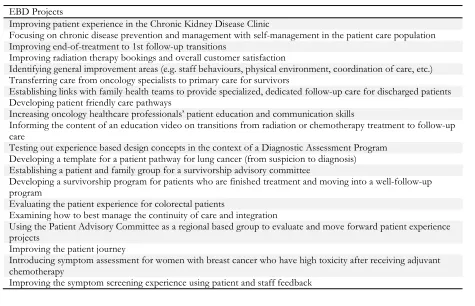
Care. Table 2 provides examples of some of the EBD projects that were undertaken in the province. The results from a recent evaluation11 show that most respondents are satisfied with the EBD approach and would engage in another EBD project in the future, since the approach is effective at improving the patient
experience. Some of the common changes that have been
implemented as a result of the EBD projects included increased communication between patients and healthcare staff (e.g., around appointment delays), taking patient preferences into consideration (e.g., when booking or changing appointments), providing support services for patients as well as families and caregivers (e.g., social workers, psychologists or spiritual guidance), creating
Table 1. Examples of participants involved in the EBD Collaborative
Members of the EBD Collaborative*
25 Program Managers /Patient Care Managers
15 Directors/Regional Vice Presidents/Executive Leads 13 Patient, Family and Caregiver Representatives
10 Coordinators
9 Nurses/Nurse Managers
7 Quality Leads/Quality Improvement Representatives/ Analysts
5 Patient Centred Care Leads/ Patient Experience Leads/ Special Projects Leads 2 Patient Care Specialists
2 Social Workers 2 Co-op Students
1 Senior Transformational Specialist
1 Quality Improvement and Education Consultant 1 Radiation Therapist
7 Other (title not available)
Note: Participants were considered members if they participated in at least one conference call
Table 2. Examples of EBD projects
EBD Projects
Improving patient experience in the Chronic Kidney Disease Clinic
Focusing on chronic disease prevention and management with self-management in the patient care population Improving end-of-treatment to 1st follow-up transitions
Improving radiation therapy bookings and overall customer satisfaction
Identifying general improvement areas (e.g. staff behaviours, physical environment, coordination of care, etc.) Transferring care from oncology specialists to primary care for survivors
Establishing links with family health teams to provide specialized, dedicated follow-up care for discharged patients Developing patient friendly care pathways
Increasing oncology healthcare professionals’ patient education and communication skills
Informing the content of an education video on transitions from radiation or chemotherapy treatment to follow-up care
Testing out experience based design concepts in the context of a Diagnostic Assessment Program Developing a template for a patient pathway for lung cancer (from suspicion to diagnosis) Establishing a patient and family group for a survivorship advisory committee
Developing a survivorship program for patients who are finished treatment and moving into a well-follow-up program
Evaluating the patient experience for colorectal patients
Examining how to best manage the continuity of care and integration
Using the Patient Advisory Committee as a regional based group to evaluate and move forward patient experience projects
Improving the patient journey
Introducing symptom assessment for women with breast cancer who have high toxicity after receiving adjuvant chemotherapy
Lessons Learned After Implementing Experience Based Design, Bak et al.
Patient Experience Journal, Volume 1, Issue 2 - Fall 2014 14
patient information and education materials (e.g., pamphlets, binders, websites, videos) as well as providing follow-up and transitional services.
Methods
An ethnographic case study approach was used to gain a better understanding of EBD and to identify the successes and challenges related to undertaking EBD projects in various healthcare settings in Ontario, Canada. Over the last two years members of the EBD Collaborative have shared the successes and challenges of their EBD projects with each other, along with suggestions for change and ideas that provided insight on ways to improve the process and outcomes. EBD Collaborative members exchanged information through regular teleconference discussions (documented via meeting minutes and recordings), email communications, a monthly EBD newsletter, project updates and in-depth ‘spotlight’ presentations of completed EBD projects.
Data were gathered through a number of surveys intended to gauge participant satisfaction, involvement and resource needs. Finally, an evaluation was undertaken (via surveys and interviews) to establish the effectiveness of EBD, highlight facilitators and barriers to implementation and determine resource needs.11 A document analysis was conducted as well as a review of the conference call audio recordings. One reviewer carried out the document analysis, summarizing the data into key themes, which were then circulated to the EBD Collaborative for review and additional comments. The purpose of this paper is to summarize the existing tacit knowledge (knowledge gathered through practice and experience12) that has been presented, shared and gathered at the EBD Collaborative, with the objective of sharing the findings and insights with others who may undertake similar patient and staff engagement initiatives.
Results
A total of ten themes emerged from the data analysis; these themes are presented as lessons learned in the section below.
Lesson 1: Include patients, family members and caregivers from start to finish of the project.
The EBD approach suggests having patients, family members or caregivers participate on the core EBD team and be involved in all aspects of the project. While a number of EBD teams successfully involved patients from the early stages of project design all the way to the final evaluations, other teams had more difficulty incorporating patients into their work. A number of patients stated that they were involved in the early stages of the project but were later less engaged by the team for various reasons. For example, one patient recalled being involved in a one
day input session that was supposed to be followed up by a series of monthly 3-hour conference calls; however it turned out that the patients had limited opportunities for collaboration.
“The concept was great, and I thought the product would help so many cancer patients. But there was little participation, as far as I know by the patient members. … When I asked the people in charge, they indicated that it was decided it would be more efficient to do it without the patient input as the focus of the document had changed. … That may have been the intent from the beginning, but from my recollection, I was going to be part of a group that was going to help in its development. Is the definition of development, feedback on the work?” – Patient, EBD Collaborative
Patients also mentioned that they appreciated being updated on the progress of the projects, even after they were completed, as one patient suggested:
“… you could say that … we will keep you on the mailing list and at any time that you don’t wish to receive the updates just cancel yourself off the list. … That keeps the patient part of the hospital program. You might not see your pet project change things as rapidly as you want, but at least you are part of the loop. It’s also a good base to say, you know, we’re looking for 5 more people to join this project.”- Patient, EBD Evaluation
Another patient similarly encouraged staff to keep communication channels open and provide regular updates on the EBD projects since:
“…many of the improvements [patients] suggest will not affect them (they will affect future patients) so they don't necessarily have a feel for the changes that are made. They contribute to the solutions but don't necessarily see the fruits of their labour.” – Patient, EBD Evaluation
As projects progress and timelines loom, it is tempting to fast-track by skipping steps; however these experiences demonstrated that patients who were invited to participate on a project are waiting to be engaged and updated on the ongoing, as well as completed work.
Lesson 2: Clarify the patient’s role.
While patient engagement is being embraced across various healthcare settings, it is important to remember that patients should not be thrust into committees or projects without first receiving an orientation or some form of training. Furthermore, it is imperative that patients have a full understanding of their roles and responsibilities as well as the project goals. Checking in with patient representatives to gauge their experience and needs was also suggested as important. A patient from the EBD Collaborative provided insights on what he is looking for when asked to participate on a group:
Lessons Learned After Implementing Experience Based Design, Bak et al.
15 Patient Experience Journal, Volume 1, Issue 2 - Fall 2014
into the group? This requires the group to have a clear image of what the patient (good or bad) could contribute. The roles and
responsibilities should be presented to the patient member, and they should be adhered to. I would also like a regular review of patient involvement and if my input as a patient is being of value.” – Patient, EBD Collaborative
There were several ideas from patients about how to ensure that they are being adequately engaged in projects. For example: telephone calls to check in or clarify their roles on the group; a comprehensive manual outlining the patient roles and responsibilities; enquiring about the patient’s experience and knowledge base in the specific area and sharing this information with the group; and undertaking surveys to gauge the patient’s experience were some of the strategies proposed by patients. One patient further elaborated on his experience, explaining that:
“Shortly after my day on the panel, I was asked to complete a survey about my experience. One interesting question was “Did you feel your comments and presence was valued by the other panel members?” I replied an outstanding “Yes”. Later in the year, I was asked for feedback on the manual for the next group of Community Representatives. [Asking] What did I find helpful? What would I like improved upon and how? Again, I felt my role as being of value.” – Patient, EBD Collaborative
Lesson 3: Engage physicians.
As Table 1 shows, the EBD Collaborative did not have an active physician member, although a number of physicians attended the two day EBD training workshop. EBD Collaborative members have commented that it was difficult to gain physician buy-in on some of their projects. This may or may not reflect a lack of enthusiasm or desire to be involved on the part of the physician. It is also possible that finding time away from busy practices to participate effectively in these types of projects may be difficult for physicians.
Lesson 4: Promote the EBD project.
Successful EBD teams stated that they made presentations to staff, management and senior leadership to introduce them to the EBD approach, share the objectives of their project and to recruit participants. Other strategies to raise awareness about the project included email
communication from senior staff, such as the Vice President, encouraging participation, setting up information tables and having direct one-on-one
conversations with staff regarding the project and need for participants. One group arranged to have a patient prepare a presentation for staff detailing their experience and encouraging healthcare providers to participate in the project. Promotion is about raising awareness of the work on patient engagement, as well as outlining the process and successes, in order to engage staff and leaders to
experience the benefits of EBD.
Lesson 5: Allot extra time for patient recruitment.
Patient recruitment can be a time intensive activity. There is no optimal number of patients to aim for, however, it should be noted that some EBD teams had a 50% drop off rate for the co-design sessions. Often times the teams had to broaden their recruitment criteria in order to get the number of patients required. One team who recruited patients via organizations such as the Canadian Cancer Society and medical professional bodies offered a link to a website page where the patient could find out more information about the project.
Another innovative group used a travelling cart to recruit patients. A key aspect of this strategy was to talk with patients directly to gauge their interest in participating. The cart contained goodies (cookies, apples, juice, etc.), application forms, consent forms and a brochure that explained the project and outlined the duties and time commitments. The staff member went to waiting rooms and chemotherapy suites to engage patients. Table 3 offers additional examples of recruitment strategies that the EBD teams used. Thinking ‘outside the box’ and having multiple recruitment strategies often resulted in larger participant numbers.
Lesson 6: Prepare and train staff prior to patient interviews.
“Interviewing patients and staff for Experience-Based Design (EBD) projects is a unique skill. Training and adequate prep work (for yourself as well as the interviewee) is necessary for a successful interview.” - Excerpt from an interview guide developed by one of the EBD teams.
Lessons Learned After Implementing Experience Based Design, Bak et al.
Patient Experience Journal, Volume 1, Issue 2 - Fall 2014 16
projects, who may have had interview training via other research work or have taken courses on the topic.
One EBD team held a workshop to improve their interview skills. They were shown a video compilation of their “good” and “bad” interviews to determine how to ask better questions and how to improve the interview setting. They then practiced on each other and picked up tips for improvement, for example letting people finish their thoughts, not suggesting answers, paying attention to non-verbal communication, eliminating background noise and so on. One of the key lessons they learned and shared with the Collaborative was that silence is okay.
“It is human nature to want to contribute to the conversation or verbally show support but it’s important to remember that that will impact the quality of the video. You want to avoid accidentally chipping in mid-sentence or mid-story. If the patient or staff member pauses to collect their thoughts, it’s okay to sit there in silence.” -Excerpt from an interview guide developed by one of the EBD teams.
The main purpose of the interview is to capture the story of the patient’s care journey. As the interviewer, it is important to refrain from over-contributing to avoid any assumptions as to what the interviewee is trying to convey. If the interviewee understands the process, they will understand the use of silence and appreciate your role as an interviewer. Table 4 presents additional interview tips gathered from the EBD teams’ first hand experiences as well as the EBD interview guide, newsletters and discussions during teleconferences with the EBD Collaborative.
Lesson 7: Allot extra time for videotaping and editing.
A common barrier to completing the EBD projects is the videotaping and editing requirements. Many members found that this stage takes a lot more time than expected, especially when there is no one in-house to assist with it. In terms of editing, one team explained that they sent the raw video to each patient to indicate what parts they wanted included or excluded. The project team was then assigned a patient video to review and pick out key points,
which were shared again with the group and the patients for review. This process helped eliminate some of the
repetitive comments and ensured that the patient was thoroughly engaged. However, some commented that sharing the videos with patients was challenging since there was no secure website where the patient could watch their own video. It may be necessary to work with the organization’s Privacy Office to ensure that proper ways of sharing are used and that appropriate consent is given to use and share the videos.
There was unanimous agreement that the patient videos were a very powerful tool and had a profound impact on healthcare staff, which often resulted in positive changes in attitude. As one person explained:
“The video interviews are key, both in terms of documenting the experience and in terms of buy-in when implementing change. Interviewing however is an art form that took time to develop, both for the interviewer and in terms of preparing the interviewees.” – EBD Evaluation
One EBD team explained that they used the videos beyond the co-design event, showing them to leadership and management teams as well as staff members. They have about 12 different compilations of EBD videos, which tend to focus on behaviours regarding respect and dignity (e.g., how people are treating each other, how staff is perceived by patients and families or how patients are treated, spoken to, acknowledged, etc.). Depending on the issues raised, the videos are shown to different audiences (e.g., clerical staff, nursing, radiation therapists, physicians, social workers, supportive care, etc.). They are mostly shown in special meetings or staff meetings. In addition, the group created videos that introduced the concept of EBD and various videos that apply to a general audience since they discuss issues such as the coordination of care or improvements to the physical environment.
While everyone agreed that the patient videos were very compelling, the staff videos were more difficult to produce
Table 3: Examples of patient recruitment strategies
Posters in common areas of the hospital or clinic
Advertisement in hospital newsletters, intranet, community websites, local newspaper Personal letter, phone call, email, invitation attached to patient’s weekly appointment schedule Social media (e.g. Facebook and Twitter posts)
Staff (e.g. clinicians, nurses, social workers, nurse navigators, etc.) approached patients to participate Staff asked if they themselves knew of any family or friends who wanted to participate
Patients asked if they had family or friends who wanted to participate
Information night for patients and family (with clinicians available to answer questions) Patient information travelling cart (see description in text)
Lessons Learned After Implementing Experience Based Design, Bak et al.
17 Patient Experience Journal, Volume 1, Issue 2 - Fall 2014
and share, especially since the team had to ensure that comments were not pointed at any individuals or
programs and that they were fair. One team explained that they did not end up using the staff video as some of the comments were pointed and not necessarily about the experience. Instead they used ‘sanitized’ quotes from the videos and showed them to the staff to make sure that they got the ‘flavour’ of the received feedback. For these reasons, a number of teams indicated that they may not do a staff video in the future.
Lesson 8: Consider observation, shadowing or a walk-about.
Observing the clinical setting, “shadowing” a patient, or doing a walk-about with a patient are simple, low cost and high impact approaches to gaining a better understanding of the patient experience. They provide a perspective of the care provided through the patient’s eyes. The EBD team gets a real-time view of what works and what doesn't, and the process offers insights on where patients go, what they see or feel and how long they wait. It is a way of gaining a better understanding of frustrations, confusion or anxiety that patients and caregivers may experience.
Based on the feedback gathered, these tactics are not widely used by the EBD teams. However, those who have tried them speak very highly of the information gathered, especially when it comes to making improvements to the care setting.
“Again most of it was signage, it’s too small, it’s too cluttered, it’s too many signs … maybe it is colours, maybe it’s furniture and maybe it’s all these nice flower pots in the waiting area, they have been there for 25 years, maybe it’s time to upgrade those or take them out and make room for a wheelchair” - Patient, EBD Evaluation One patient described his experience with a walkabout team and suggested that it is helpful to invite someone on the team who has not spent a great deal of time in the setting to provide a “fresh eye” perspective:
“I suggested that we invite my son along because he is not a patient and is really just an observer [so that] you can go ‘ok what confuses you at this point or what doesn’t make sense?’” - Patient, EBD Evaluation
From the healthcare staff perspective, one team member explained that:
“…the observations for us were very important since this was how we got the real background from the patient and family, because you could see facial expressions or their attitude in the waiting room, things that they weren’t willing to speak about.” – Project Leader
Other tips that were suggested included: collecting materials (pamphlets, forms, handouts, etc.) for review that the patient may encounter; bringing an audio recorder to collect comments or have a dedicated note taker; providing cameras to the team members as a tool for gathering information; insuring that the full team is present for the discussion following the session and that
Table 4: Patient interview tips
Send out a brief introduction and the interview questions beforehand to help the patient prepare. Allow the patient to decide where the interview should take place.
Ensure that the interview space is comfortable and quiet. Consider providing water and tissues.
The room should be fairly small, away from distractions and noises (including loud background noise such as air conditioning units or clocks).
Start the interview with friendly, general questions that make the interviewee feel comfortable. Allow people to tell their story in their way. It’s okay if you don’t follow your prepared questions.
Do not interrupt the interviewee or talk over them. Provide non-verbal encouragement such as nodding your head, smiling or showing concern instead.
Prepare the interviewee on what to expect – explain that it is a one-sided conversation and that you will not be contributing verbally, it may get emotional and that’s okay, the camera can be stopped at any time.
Pause at the end of a story and wait 3 to 5 seconds before verbally prompting or asking a follow-up question. Verbally reply if the interviewee asks a question.
Follow-up on things said (if necessary) with open ended, non-leading questions (when the person has completed all their thoughts).
Don’t rush the patient’s story by chipping in too soon. Avoid asking ‘yes/no’ questions.
Avoid saying “mhm” throughout the interview.
Avoid verbally prompting the interviewee by suggesting words or emotions.
Lessons Learned After Implementing Experience Based Design, Bak et al.
Patient Experience Journal, Volume 1, Issue 2 - Fall 2014 18
patients and caregivers are part of implementation strategies.
Lesson 9: Recruit students to work on the EBD project.
A number of EBD teams were fortunate to have an opportunity to bring in students to assist with aspects of the EBD project. Students helped with tasks such as literature searches, surveys, interviews and video editing. One team explained that they were working with patients who were not very mobile and they ended up using students as a proxy for patients during their walkabout, since the students were not very familiar with the hospital setting. Students in media design and recording might be useful in video editing and development.
Lesson 10: Spend time planning the co-design meeting.
The co-design meeting, where staff, patients and caregivers are brought together to watch the videos and brainstorm ideas for change, requires planning and co-ordination. Many EBD teams held the patient and staff meetings separately, in the morning, for example, and then brought both groups together for an afternoon session. Teams found that this approach worked well because it carried the momentum from the first meetings.
Some of the strategies shared by the EBD Collaborative included: taking extra time to plan the meeting; taking the patients’ travel time into account when booking the meeting and introducing everyone who is in the room for the meetings, as some patients later commented that they were confused about who was in the room and what their role was. It was also pointed out that some patients were reluctant to point out areas for improvement as they were simply grateful for the care they received. However, the caregivers who accompanied them were much more open about pointing out areas which were a challenge for the patients. Finally, communication around the event is suggested to ensure both patient and staff attendance and a clear understanding of the purpose, as one person explained:
“Some participants were keen while others were not sure as to why they were there”. – EBD Collaborative
Discussion
The EBD approach uses creative techniques to capture stories from patients, caregivers and staff. As the EBD resources explain, “storytelling is at the heart of the EBD approach and centres on giving patients and staff the time, encouragement and help they need to describe their personal experiences in their own words.” 2 The technique places the patient at the centre of decision-making and engages them as an equal partner in the process of service improvement. Overall the experience of the EBD
Collaborative and that of others 3-10 has demonstrated that the EBD approach has been successful at improving the quality of care and improving patient experience. Patient engagement in healthcare service improvement and the sharing of patient stories and experiences should be continuously encouraged to highlight its various benefits and impacts on the system. Furthermore, the sharing of experiences with the EBD approach and the lessons learned along the way will help guide others who are embarking on similar projects.
Our findings suggested many positive outcomes and benefits to staff, patients and caregivers. While there were challenges encountered by the EBD teams, overall the experience led to successful quality improvement
solutions. In particular, staff gained new insights from the patients’ perspective, which enhanced their understanding of the patient experience. Too often in healthcare, staff and professionals tend to make decisions and initiate change because, from our perspective, we assume we know what is in the best interest of the patients. It is enlightening to see the impact of those assumptions on patients and caregivers.
Conclusion
This paper summarized the existing tacit knowledge gathered over two years of the EBD Collaborative, presenting 10 lessons learned for consideration by those who are embarking on similar projects. Engaging patients in projects to co-design and improve the patient
experience requires work, commitment, time and leadership. There are several strategies that the EBD teams found effective as outlined in the paper; however, the most important element of success is the ability to listen and act on what is heard.
In addition to the advice offered above, the authors would like to recommend that the EDB tools are applied to ongoing quality improvement projects and that additional research is undertaken to identify how services can be transformed to improve the patient experience. Giving patients a strong voice in both the design and the delivery of their care will enable them to be active participants in their care, and will result in health systems that deliver better outcomes and value.
References
1. Bate, P. & Robert, G., Bringing User Experience to Healthcare Improvement: the concepts, methods and practices of experience-based design, Abingdon: Radcliffe Publishing (2007).
2. King's Fund. (2012). Experience-based co-design toolkit. Available at
http://www.kingsfund.org.uk/projects/point-Lessons Learned After Implementing Experience Based Design, Bak et al.
19 Patient Experience Journal, Volume 1, Issue 2 - Fall 2014
care/ebcd. London: The King's Fund. Last accessed July 2014.
3. Bowen, S., Dearden, A., Wright, P., Wolstenholme, D., & Cobb, M. (2010). Co-designing better outpatient services for older people: Inspiration stories for participatory design with health and social care institutions workshop. Paper presented at the 11th Biennial Participatory Design Conference (PDC), Sydney, Australia. Available at:
http://www.uchd.org.uk/wp-content/uploads/2010/09/PDCworkshopStoriesUC HD.pdf. Last accessed July 2014.
4. Bowen, S., McSeveny, K., Lockley, E., Wolstenholme, D., Cobb, M., & Dearden, A. (2013). How was it for you? Experiences of participatory design in the UK health service. CoDesign: International Journal of CoCreation and Design and the Arts, 9(4), 230-246. 5. Boyd, H., McKernon, S., Mullin, B., & Old, A. (2012).
Improving healthcare through the use of co-design. The New Zealand Medical Journal, 125(1357), 76-87. 6. Dewar, B., Mackay, R., Smith, S., Pullin, S., & Tocher,
R. (2010). Use of emotional touch points as a method of tapping into the experience of receiving
compassionate care in a hospital setting. Journal of Research in Nursing, 15(1), 29-41.
7. Pickles, J, Hide, E, Maher, L (2008), Experience based design: a practical method of working with patients to redesign services, Clinical Governance: An
International Journal, Vol. 13 Iss: 1 pp. 51 – 58 8. Hodgkiss, F., Barrie, K., & Sinclair, C. (2011). Better
Together. Experience Based Design Cancer pilots. Interim reflection report. March 2011. Scotland Patient Experience Programme. Available at: http://www.knowledge.scot.nhs.uk/media/CLT/Res ourceUploads/1008115/EBD%20CancerPilots%20In terimReflection%20Report%20Version1.0.pdf. Last accessed February 2014.
9. Tsianakas, V., Robert, G., Maben, J., Richardson, A., Dale, C., & Wiseman, T. (2012). Implementing patient-centred cancer care: using experience-based co-design to improve patient experience in breast and lung cancer services. Supportive Care in Cancer, 20, 2639-2647.
10. Donetto, S., Tsianakas, V. & Robert, G. (2014). Using Experience-based Co-design to improve the quality of healthcare: mapping where we are now and
establishing future directions. London: King’s College London.
11. EBD Evaluation Report. 2014