Texture Segmentation Approach Based on Entropy Based Local Binary Pattern Operator
Dr.Sreeja Mole S.S.
Professor, Department of ECE, CJITS, Janagon, India. Email: [email protected]
Article Received: 27 May 2018 Article Accepted: 30 August 2018 Article Published: 07 October 2018
1. INTRODUCTION
Textures have attracted attention both from the computer vision community and the computer graphics community. Indeed to
understand the processed behind the human perception of an image as a pattern or texture involves deep questions about human
brain organizations that are relevant for those that key to stimulate the human vision mechanism. Only rarely have real world
objects surfaces of uniform intensity most of the time they are textured. The word texture is used to refer to a number of
commonly encountered visual patterns in natural scenes such as forlage, grass, pebbles, clouds etc., while there is no proper
definition of texture, it is widely accepted that the term generally refers to a reputation of certain basic elements sometimes
called texels. Texture is an important spatial feature, useful for identifying objects or regions of interest in an image. The
gray-level co-occurrence matrix approach is one of the most popular statistical methods used in practice to measure the textural
information of images.. Texture analysis may require the solution of two different problems i.e., Segmentation of a given
image according to the different texture and Classification of a given texture with respect to a set of known textures.
Texture Segmentation is the fundamental process which partitions a data space into meaningful salient regions. Image
segmentation essentially affects the overall performance of any automated image analysis system thus its quality is of the
utmost importance. Image regions, homogeneous with respect to some usually textural or color measure, which result from a
segmentation algorithm are analyzed in subsequent interpretation steps. Texture based image segmentation is an area of intense
research activity in the past thirty years and many algorithms were published in consequence of all this effort, starting from
simple threshold methods up to the most sophisticated random field type methods. Unsupervised methods which do not assume
any prior scene knowledge which can be learned to help segmentation process are obviously more challenging than the
supervised ones.
Texture classification is a key field in many computer vision applications ranging from quality control to remote sensing. The
problem of feature selection is defined as follows given a set of candidate features; select a subset that performs the best under
classification system. The procedure can reduce the cost of recognition and provide better classification accuracy. Image
classification systems have received a recent boost from methods using local features generated over interest points, delivering
higher robustness against partial occlusion and cluttered backgrounds A B S T R A C T
In this paper an efficient approach for unsupervised Texture Segmentation is proposed, based on features extracted from Entropy Based Local Binary Pattern Operator using Fuzzy-c-Means and K-Means clustering with spatial information. In this approach, the texture mosaic image is reconstructed using LBP. After the reconstruction, the entropy values are extracted from the LBP image. Finally, FCM and K-Means are used to cluster the entropy values. The proposed method is tested with different texture databases .The results are compared with the existing approach and it shows that the efficiency of the proposed outperforms well. This makes the algorithm ideally suited for texture image segmentation and extracts the textural information of an image with a more complete respect of texture characteristics.
There are two widely used approaches to describe the texture of a region, these are statistical and structural. The statistical
approach consolers that the intensities are generated by a two dimensional random field and examples of statistical approaches
of texture analysis are auto correlation function, gray level co-occurrence methods, Fourier texture analysis, edge frequency
and law’s texture energy measures. The co-occurrence matrix is found a fairly good texture analysis method. The structural
techniques deal with the arrangement of image primitives such as the description of texture based on regularly spaced parallel
lines. Statistical methods analyze the spatial distribution of gray values by computing local features at each point in the image
and deriving a set of statistics from the distributions of the local features (Ojala and Pietikyinen, 2004). The use of statistical
features is one of the early methods proposed in the research literature (Tuceryan and Jain, 1998). The reason behind is the fact
that the spatial distribution of gray values is one of the defining qualities of texture. Statistical methods can be classified into
first-order (one pixel), second-order (two pixels) and higher-order (three or more pixels) statistics based on the number of
pixels defining the local feature (Ojala and Pietikyinen, 2004).
The first-order statistics estimate properties like the average and variance of individual pixel values, ignoring the spatial
interaction between image pixels, second- and higher-order statistics on the other hand estimate properties of two or more pixel
values occurring at specific locations relative to each other. Co-occurrence features and gray level differences (Weszka et al.,
1976) are the most widely used statistical methods, which inspired a variety of modifications later on (Ojala and Pietikyinen,
2004) including signed differences (Ojala et al., 2001) and the Local Binary Pattern (LBP) operator (Ojala et al., 1996). LBP
operator combines statistical and structural approaches to texture analysis by incorporating occurrence statistics of simple local
microstructures. Autocorrelation function, which has been used for analyzing the regularity and coarseness of texture (Kaizer,
1955; Emerson et al., 1999; Lam et al., 2002; Al-Hamdan, 2004), and gray level run lengths (Galloway, 1975) are examples of
other statistical approaches (Ojala and Pietikyinen, 2004). . The method involves weighting each pixel by the surrounding
entropy such that each element in the final image is in high relief but lacks abrupt contrast changes due to the different light
sources that might introduce spurious lines and other artifacts. The method also allows for fast addition and removal of images
from the collective images (A. German, M. R. Jenkin, and Y. Lesp´erance, 2005).
In this paper Entropy based LBP operator method is used to extract the features from the images to perform Unsupervised
Segmentation. This paper is organized as follows. In section 2, the Entropy operator is discussed. The LBP operator is
explained in section 3. In section 4, Unsupervised Entropy based LBP operator segmentation algorithm is reviewed.
Experiments results are shown in section 5 and finally conclusion is on section 6.
2. ENTROPY OPERATOR
Entropy, as defined by Clausius, is the true cornerstone of equilibrium thermodynamics. Entropy was chosen as a measure of
the detail provided by each picture. The word “entropy” was created by Rudolf Clausius and it appeared in his work “Abhandlungen uber die mechanische Warmetheorie” published in 1864. The word has a Greek origin, its first part reminds us of “energy” and the second part is from “tropos” which means turning point. Clausius’ work is the foundation stone of classical
thermodynamics. According to Clausius, the change of entropy of a system is obtained by adding the small portions of heat
quantity received by the system divided by the absolute temperature during the heat absorption. This definition is satisfactory
from a mathematical point of view and gives nothing other than an integral in precise mathematical terms. Clausius postulated
The entropy is defined as the average number of binary symbols necessary to code a given input given the probability of that
input appearing on a stream. High entropy is associated with a high variance in the pixel values, while low entropy indicates
that the pixel values are fairly uniform, and hence little detail can be derived from them. Therefore, when applied to groups of
pixels within the source images, entropy provides a way to compare regions from the different source images and decide which
provides the most detail. The method developed for this task, though simple, is both flexible and powerful. Every pixel in the
final image is computed as the weighted average of the corresponding pixels in the source images where each value is weighted
by the entropy of the surrounding region. For each pixel p = (u, v) in the final image there are corresponding pixels p1, p2. . .
pN, one for each source image. For each pixel pi in each image, the local entropy (measured within a fixed window) vi is
computed, and the weighted average p is computed .The entropy for the pixel window is computed as,
8
1
log
i i
i
Entropy
P
P
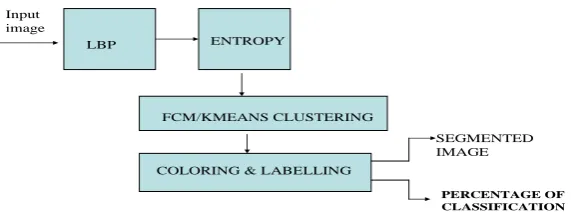
( 1)Where Pi – Probability value if the ith pixel in the window. The block diagram of texture segmentation is shown in Fig. 1
Input image
LBP ENTROPY
FCM/KMEANS CLUSTERING
COLORING & LABELLING
SEGMENTED IMAGE
PERCENTAGE OF CLASSIFICATION
Fig. 1 Block Diagram of Texture Segmentation
2.1
Algorithm for Entropy with FCM/K-Means Clustering1. Input the texture mosaic image with size m x n.
2. Take a window of size 30 x 30 in the image and find the value of Entropy using the equation,
Entropy= - ∑ pi log (pi)
Pi – Probability value if the ith pixel in the window
3. Move the window towards the whole image by using overlapping method and find the Entropy for all the
windows.
4. Cluster the all Entropy values using FCM clustering.
5. Label the different clusters and Colour the different labels.
6. Output the segmented image.
3. LOCAL BINARY PATTERN OPERATOR
The original LBP method was first introduced as a complementary measure for local image contrast. It operated with eight
neighboring pixels using the center as a threshold. The final LBP code was then produced by multiplying the threshold values
by weights given by powers of two. By definition LBP is invariant to any monotonic transformation of the gray scale and its
to some extent by considering only a subset of that codes one approach is to use so called uniform patterns representing the
statistically most LBP code. With them the size of the feature histogram generated by an LBP operator can be reduced without
significant loss in its discrimination.
LBP is described with 28 possible texture units. The texture unit is obtained by applying the threshold operation using the
following rule
0 , 0,1, 0
i i i
E VV V V (2)
Where V0 is the center pixel. The LBP is determined as
8 1 1
2
i i iLBP
E
(3)LBP does not take into account the contrast of texture which is the measure of local variations present in an image and is
important in the description of some textures. Texture spectrum operator is similar to LBP but it uses three levels ie two
thresholds instead of two levels used in LBP. This leads to a more efficient representation and implementation than with LBP
and according to our tests the three level operator does not perform any better that LBP. The LBP histogram computed over a
region used for texture description. LBP provides as with knowledge about the spatial features.
4. ENTROPY BASED LBP OPERATOR
The input image is reconstructed using LBP. After reconstruction, Entropy values of reconstructed image are taken as the
texture features. The algorithm for Entropy based Local Binary Operator with FCM/K Means Clustering methods are
explained in the following steps as
1. Input the texture mosaic image with size m x n.
2. Take a window of size 30 x 30 in the image and reconstruct the window by LBP using the following steps.
i. Take a sub-window of size 3 x 3 in the window image.
ii. Compare the all pixel values of the window with the center pixel.
iii. Note the difference: If pixel value less than center pixel value, note the difference is 0. If pixel value
greater than or equal to center pixel value, note the difference is 1.
iv. Form a eight digit binary value from the noted difference values (totally 8 pixels except center pixel).
v. Find the gray value of the eight digit binary value.
vi. Replace the pixel of the window image using the gray value.
vii. Move the sub-window towards the whole window image using overlapping method and find the gray
value of the all sub-windows using above mentioned LBP method and replace the all pixels of the window
image using these gray values.
viii. Return the Reconstructed LBP window image.
3. Find the value of Entropy for reconstructed LBP window using the below equation, Entropy= - ∑ pi log (pi),
where Pi – Probability value if the ith pixel in the window.
4. Move the window towards the whole image by using overlapping method and find the LBP-Entropy value for all
the windows.
5. Cluster the all LBP-Entropy values using FCM clustering.
7. Output the segmented image.
5.
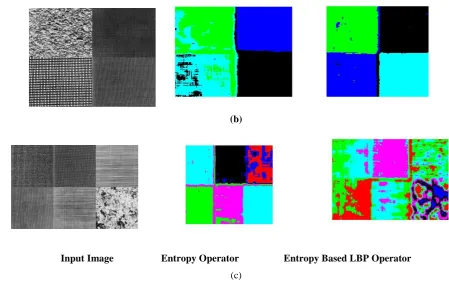
EXPERIMENTAL RESULTSThe experimental results for 2 images, 4 images and 6 images for Entropy Based Local Operator for FCM and K means
clustering output is shown in Figure 2 and 3.In Figure 2, (a) is the combination of D1 and D2 images, (b) is the combination of
D5, D6, D20 and D21 and (c) is the combination of D17, D21, D49, D53, D55 and D60.
(a)
(b)
(C)
Input Image Entropy Operator Entropy Based LBP Operator
Figure 2 Unsupervised Texture Segmentation of Brodatz Images using Entropy based LBP method with FCM Clustering
In Figure 3 (a) is the combination of D1 and D2 images, (b) is the combination of D5, D6, D20 and D21 and (c) is the
combination of D17, D21, D49, D53, D55 and D60.
(b)
Input Image Entropy Operator Entropy Based LBP Operator
(c)
Figure 3 Unsupervised Texture Segmentation of Brodatz Images using Entropy based LBP method with K-Means Clustering
6. CONCLUSION
In this paper, Entropy based LBP features are extracted and successfully implemented for unsupervised segmentation. This
method is tested with publicly available Brodatz images. The results of the proposed method are compared with the existing
method. The Entropy based LBP method gives the better efficient results for segmentation. The experiments show that the
proposed method can achieve better results than existing unsupervised texture segmentation approaches. The effect of
changing textures on the texture classification system performance is under current investigation and the research work is
under progress.
ACKNOWLEDGEMENTS
The authors are more thankful to the Principal and Management of Electronics and Communication Engineering of our College
for their constant support and encouragement. The authors also extend their gratitude to the anonymous reviewers who have
given very good suggestions for this better presentation of our manuscript.
REFERENCES
1.
Shannon, C. E., “A Mathematical Theory of Communication,” Bell System Technical Journal, Vol. 27, 379-423, 623-656,1948.
2.
T. Ojala, M. Pietik¨ainen, and D. Harwood. A comparative study of texture measures with classification based on featureddistribution. Pattern Recognition, 29(1):51–59, 1996.
3.
T. Ojala, M. Pietik¨ainen, and T. M¨aenp¨a¨a. Multiresolution gray-scale and rotation invariant texture classification withlocal binary patterns. IEEE Transactions on Pattern Analysis and Machine Intelligence, 24(7):971–987, 2002.
4.
Sreeja Mole, S.S. and Ganesan, L. “Pixel Based Classification On Color Images In Statistical Texture Analysis”,5.
T. Reed and J. Buf. A review of recent texture segmentation and feature extraction techniques. Computer Vision, ImageProcessing and Graphics, 57(3):359–372, 1993.
6.
Sreeja Mole, S.S. and Ganesan, L. “Statistical Approach for Supervised Texture Classification”, International journal ofimage processing and network technology, Vol. 3, No. 1, pp. 54-61, 2010.
7.
M. Niskanen, O. Silv´en, and H. Kauppinen. Color and texture based wood inspection with nonsupervised clustering. InProceedings of the 12th Scandinavian Conference on Image Analysis, pages 336–342, 2001.
8.
P. Ohanian and R. Dubes. Performance evaluation for four classes of textural features. Pattern Recognition,25(8):819–833, 1992.
9.
M. Pietikainen, T. Maenpaa, and J. Viertola. Color texture classification with color histograms and local binary patterns.In International Workshop on Texture Analysis and Synthesis, pages 109–112, 2002
10.
M. Tuceryan and A. Jain. Texture analysis. In Handbook of Pattern Recognition and Computer Vision, chapter 2, pages235–276. World Scientific, 1998.