
A Simple Validated RP-HPLC Method for Quantification of Azilsartan Medoxomil in Bulk and Pharmaceutical Dosage Forms
5
0
0
Full text
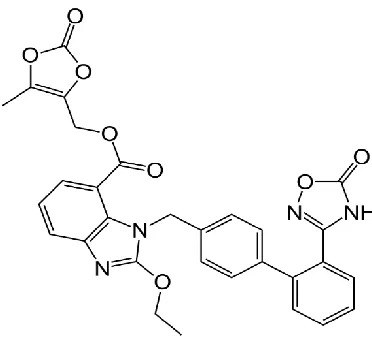
(2) Jampala B et. al / Int. J. of Pharmacy and Analytical Research Vol-4(3) 2015 [381-385]. Figure 1: Azilsartan Medoxomil mixed well then filtered through 0.45 µm Millipore filter paper and sonicated using sonicator up to 15min.. MATERIALS AND METHODS APPARATUS HPLC (Model: Alliance 2695 separation module with UV-Visible detector, Make: Waters, Software: Empower-2), Digital pH meter (Model: LP-1393, Make: POLMAN), Sonicator (Model: Soltec, Make: Sonica), Electronic Weighing Balance (Model: ML204 Ia01, Make: Mettler Toledo).. PREPARATION OF STANDARD SOLUTION Prepared 20mg of Azilsartan Medoxomil working standard in 100mL diluent for standard stock solution. Transferred 10mL of the standard stock solution in to 100mL volumetric flask and made up to the mark with diluent. This standard solution used to sample analysis.. CHEMICALS AND REAGENTS Acetonitrile (HPLC grade, Make: Qualigens fine chemicals), Potassium dihydrogen orthophosphate (AR grade, Make: S.D Fine Chem. Ltd), Dipotassium hydrogen phosphate (AR grade, Make: S.D Fine Chem. Ltd), Water (HPLC grade), Potassium hydroxide (AR grade, Make: Rankem), Azilsartan Medoxomil (Richer Pharmaceuticals, Hyderabad, India). CHROMATOGRAPHIC CONDITIONS This separation of analytes achieved by isocratically using Zodiac C18 column (100 X 4.6mm, 3µm), column oven temperature 30 ∘C, flow rate 1.0mL/min, UV at 243 nm. Mobile phase was mixed phosphate buffer (pH: 6.8 ± 0.1) and acetonitrile at 80:20 ratio. Diluent was mobile phase. Run time was 10min. PREPARATION OF MOBILE PHASE 0.3 g of potassium dihydrogen orthophosphate and 1.36 g of dipotassium hydrogen phosphate weighed and transferred to 1000 mL volumetric flask and make up to the mark with water and adjusted pH: 6.8 (±0.1)with diluted potassium hydroxide solution. This mixed buffer and acetonitrile were taken in the ratio of 80:20 and. PREPARATION OF SAMPLE SOLUTION BULK AZILSARTAN MEDOXOMIL ANALYSIS 20 mg of bulk sample weighed and transferred in to 100 mL volumetric flask then made up to the mark with diluent then used as a sample stock solution. Transferred 10mL of the sample stock solution in to 100 mL volumetric flask and made up to the mark with diluent. This sample solution used to sample analysis. PHARMACEUTICAL FORMULATIONS ANALYSIS 10 tablets of Azilsartan Medoxomil (80mg) powdered using mortar. 101 mg of this powder sample weighed and transferred in to 100 ml volumetric flask and dissolved in 50 mL diluent then made up to the mark with diluent . This sample solution filtered then used for sample analysis. SAMPLE ANALYSIS Injected 20µL of blank (diluent), standard solution and sample solution in HPLC for sample analysis.. METHOD VALIDATION. www.ijpar.com. ~ 382~.
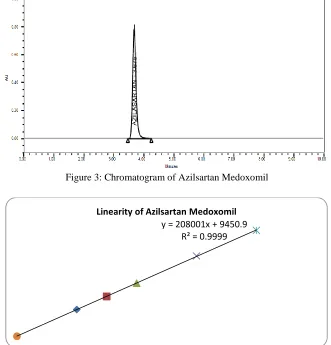
(3) Jampala B et. al / Int. J. of Pharmacy and Analytical Research Vol-4(3) 2015 [381-385]. SPECIFICITY AND SELECTIVITY The specificity of the method was checked by injecting blank solution and sample solution. There was no interference from blank and excipients at the retention time of analyte peak. SYSTEM SUITABILITY Injected the system suitability solution and checked the system suitability. The tailing factor value was less than 2.0 and theoretical plate’s value was more than 2000. LINEARITY Linearity was checked by preparing five concentrations of the substance ranging from 50% to 200% level of the target. A concentration of 20 ppm solution was proposed in the procedure as a 100%. Hence, the test substance was prepared at concentrations of 10 ppm, 15 ppm, 20 ppm, 30 ppm and 40 ppm for determination of linearity. Estimations were carried out as per the procedure mentioned. Observations were recorded and a linearity curve was prepared using regression analysis. The correlation coefficient was 0.9999. Linearity graph was shown in Figure 4. ACCURACY. The accuracy of the method was determined by % of recovery method for the spiked concentration levels of 10 ppm (50%), 20 ppm (100%) and 30 ppm (150%). The accuracy results were shown in table1. PRECISION The method precision and system precision were performed. The results were within limits. The results were shown in table2. ROBUSTNESS OF THE METHOD Changing with the flow rate (±0.1mL/minute) and column oven temperature (±2ºC) and calculated RSD. The results were within limits. RUGGEDNESS OF THE METHOD The ruggedness of the method was performed with different analyst and different day analysis and calculated RSD. The results were within limits. RESULTS AND DISCUSSIONS The developed method was validated as per ICH guidelines for specificity, linearity, accuracy, precision, robustness and ruggedness. The results were within limits.. Figure 2: Chromatogram of Blank. www.ijpar.com. ~ 383~.
(4) Jampala B et. al / Int. J. of Pharmacy and Analytical Research Vol-4(3) 2015 [381-385]. Figure 3: Chromatogram of Azilsartan Medoxomil Linearity of Azilsartan Medoxomil y = 208001x + 9450.9 R² = 0.9999. Figure 4: Linearity graph for Azilsartan Medoxomil analysis Table1: Accuracy Concentration Level (spike). Recovery. 50%. 99.53%. 100%. 100.05%. 150%. 99.68% Table2: Precision. Precision. %RSD. System Precision. 0.05%. Method Precision. 0.19%. Intermediate Precision. 0.43%. CONCLUSION The developed Reverse Phase HPLC method was very simple, selective and reproducible method for analysis of Azilsartan Medoxomil in bulk and pharmaceutical dosage forms. This method was having very low run. time. It was accurate, precise, linear, robust and ruggedness method. As per best of my knowledge this method was very simple method for determination of Azilsartan Medoxomil in both bulk and pharmaceutical dosage forms.. www.ijpar.com. ~ 384~.
(5) Jampala B et. al / Int. J. of Pharmacy and Analytical Research Vol-4(3) 2015 [381-385]. REFERENCES [1]. Paras P. Vekariya and Hitendra S. Joshi, “Development and Validation of RP-HPLC Method for Azilsartan Medoxomil Potassium Quantitation in Human Plasma by Solid Phase Extraction Procedure”, Hindawi Publishing Corporation, ISRN Spectroscopy, Volume 2013, Article ID 572170, 2013. [2]. Madhu Babu Kasimala, Bikshal Babu Kasimala, “Reverse phase HPLC Method Development and Validation for the Simultaneous Estimation of Azilsartan Medoxomil and Chlortalidone in Pharmaceutical Dosage Forms”, Journal of Atoms and Molecules, 2(1),117–126, 2012. [3]. S. Naazneen, A. Sridevi, “Stability indicating RP-HPLC Method for the Simultaneous Estimation of Azilsartan Medoxomil and Chlorthalidone in Solid Dosage Forms”, International Journal of Pharmacy and Pharmaceutical Sciences, Volume 6, Issue 6, 2014. [4]. P. Sravani, S. Rubesh Kumar, N. Duganath, N. Devanna, “Method Development and Validation for the Simultaneous Estimation of Azilsartan and Chlorthalidone by RP-HPLC in Pharmaceutical Dosage Form”, International Journal of Pharma Sciences, Vol. 4, No. 5, 725-729, 2014.. www.ijpar.com. ~ 385~.
(6)
Figure
Related documents
Conclusions: As the size of the subscapularis tendon tear increased, the passive ranges of horizontal abduction and external rotation of the glenohumeral joint after repair
Most parents felt it was better to discuss the possibility of death early in the course of the disease. If handled openly, there were no instances of a sibling using this information
As expected based on the absence of a globular head domain in the vaccine constructs, the pooled sera from mice immunized with Gag alone, the HK68 4G headless HA, or the PR8 4G
The objectives of the study were to promote healthy lifestyle, by implementing school based intervention program (physical activity and nutrition education) for healthy body
Principal, Dr.Mahalingam College of Engineering and Technology, Pollachi, Tamilnadu, India. Abstract : A time series database is a collection of well-defined data sets
Discrete wavelet transform (DWT) of given image is done using Haar wavelet, Daubechies wavelet, Symlet and Coiflet. Thereafter using global thresholding inverse wavelet transform
Repeated measures of analysis of variance (RM-ANOVA) was performed to see the effect of various independent variables (frequency of stimulus, azimuths of loudspeakers, noise
The results showed that SAIFI for embedded supply had 15 less interruptions and the customer also experienced 11 hours overall improvement in SAIDI and a 39%
