25
INTERNATIONAL JOURNAL OF ADVANCES IN ENGINEERING RESEARCH
CONTINUOUS VARIABLE TRANSMISSION
Kartik Kaushik
Mechanical Department, Vellore Institute of Technology Vellore, India
ABSTRACT
Automotive engineers are continuously researching new technology in the field of engine, transmission and suspension to improve fuel efficiency, power output and safety of automotive vehicles. Continuously Variable transmission (CVT) is one of the important steps towards it. CVT is an infinite gear system as it provides infinite gear ratio and it also helps in decreasing power loss. It helps in providing jerk free transmission, which can be observed in manual as well as in automatic gear transmission. There are different types of CVT available and one of the types is Pulley driven CVT. Primary aim of this project is to study various parameters like fly mass, drive pulley spring, driven pulley spring, cam angles and their effect on engagement rpm of CVT and also design manually operated model of CVT. As it is difficult to get the actual design specifications of CVT from the companies, some of the dimensions are assumed. The dimensions of other parts have been calculated based on the assumed dimensions. Experimentation is done on a Baja SAE vehicle which shows the effects of changing different parameters on engaging rpm of driven shaft. A static analysis as well as motion analysis is done on the CVT model.
Keywords: - Efficiency, Infinite gear ratio, CVT, Experimentation, Baja SAE, rpm
1. INTRODUCTION`
1.1. Background: -
Continuously Variable Transmission design have been developed in 14th century by Da Vinci. But CVT have become a focused topic recently. It is very useful tool in decreasing mass of heavy transmission vehicles and also increasing their power transmission. Using CVT in automotive and all locomotives reduce the complications. It eliminates complicated gear system by replacing it with a single, self-contained package. It requires little maintenance and no background to operate. There are four major factors on which the engagement rpm or transmission of power by a CVT depends :- 1) centrifugal force which is generated by flying masses in driver pulley. 2) Springs attached to the flying masses. 3) Torsional spring attached on driven pulley. 4) Cam attached to driven shaft.
1.2. Assumptions:-
26
INTERNATIONAL JOURNAL OF ADVANCES IN ENGINEERING RESEARCH RPM=1400.
2. LITERATURE SURVEY
2.1. Theory & types of CVT
2.1.1. Leonardo da Vinci sketched his idea for a CVT in 1490 [3]. The continuously variable transmission replaces discrete gear ratios with infinitely adjustable gearing through one of several basic CVT designs. Some of them are mentioned below.
I. Push Belt [1]:-
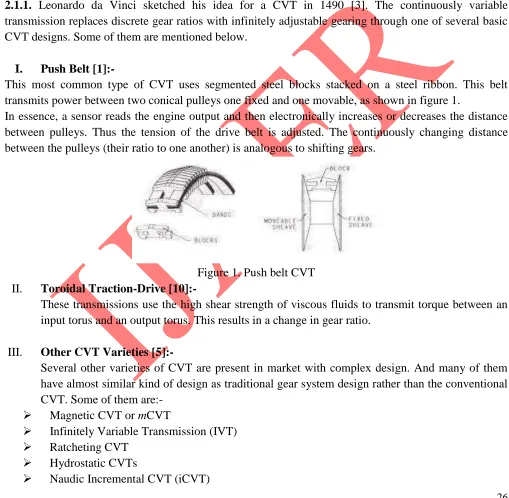
This most common type of CVT uses segmented steel blocks stacked on a steel ribbon. This belt transmits power between two conical pulleys one fixed and one movable, as shown in figure 1.
In essence, a sensor reads the engine output and then electronically increases or decreases the distance between pulleys. Thus the tension of the drive belt is adjusted. The continuously changing distance between the pulleys (their ratio to one another) is analogous to shifting gears.
Figure 1. Push belt CVT II. Toroidal Traction-Drive
[10]:-These transmissions use the high shear strength of viscous fluids to transmit torque between an input torus and an output torus. This results in a change in gear ratio.
III. Other CVT Varieties
[5]:-Several other varieties of CVT are present in market with complex design. And many of them have almost similar kind of design as traditional gear system design rather than the conventional CVT. Some of them are:-
Magnetic CVT or mCVT
Infinitely Variable Transmission (IVT)
Ratcheting CVT
Hydrostatic CVTs
27
INTERNATIONAL JOURNAL OF ADVANCES IN ENGINEERING RESEARCH High frictional losses
Shock and durability
Torque transfer ability and reliability
Cone CVTs
Radial roller CVT
2.2. Components of CVT
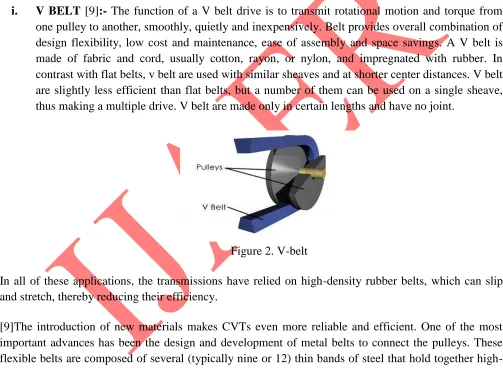
i. V BELT [9]:- The function of a V belt drive is to transmit rotational motion and torque from one pulley to another, smoothly, quietly and inexpensively. Belt provides overall combination of design flexibility, low cost and maintenance, ease of assembly and space savings. A V belt is made of fabric and cord, usually cotton, rayon, or nylon, and impregnated with rubber. In contrast with flat belts, v belt are used with similar sheaves and at shorter center distances. V belt are slightly less efficient than flat belts, but a number of them can be used on a single sheave, thus making a multiple drive. V belt are made only in certain lengths and have no joint.
Figure 2. V-belt
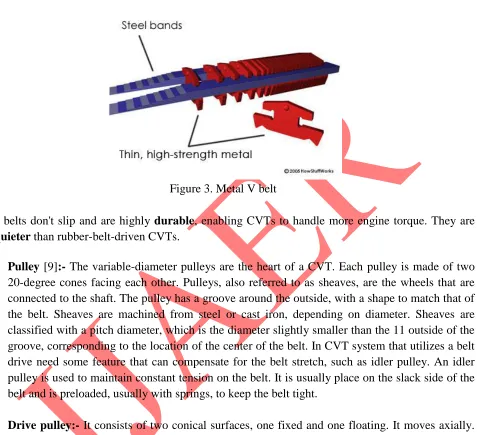
In all of these applications, the transmissions have relied on high-density rubber belts, which can slip and stretch, thereby reducing their efficiency.
28
INTERNATIONAL JOURNAL OF ADVANCES IN ENGINEERING RESEARCH
Figure 3. Metal V belt
Metal belts don't slip and are highly durable, enabling CVTs to handle more engine torque. They are also quieter than rubber-belt-driven CVTs.
ii. Pulley [9]:- The variable-diameter pulleys are the heart of a CVT. Each pulley is made of two 20-degree cones facing each other. Pulleys, also referred to as sheaves, are the wheels that are connected to the shaft. The pulley has a groove around the outside, with a shape to match that of the belt. Sheaves are machined from steel or cast iron, depending on diameter. Sheaves are classified with a pitch diameter, which is the diameter slightly smaller than the 11 outside of the groove, corresponding to the location of the center of the belt. In CVT system that utilizes a belt drive need some feature that can compensate for the belt stretch, such as idler pulley. An idler pulley is used to maintain constant tension on the belt. It is usually place on the slack side of the belt and is preloaded, usually with springs, to keep the belt tight.
29
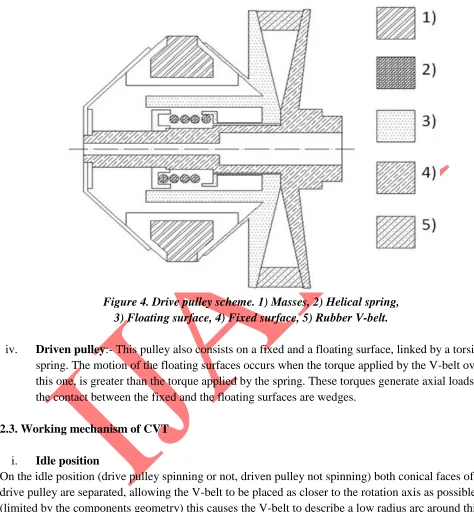
INTERNATIONAL JOURNAL OF ADVANCES IN ENGINEERING RESEARCH Figure 4. Drive pulley scheme. 1) Masses, 2) Helical spring,
3) Floating surface, 4) Fixed surface, 5) Rubber V-belt.
iv. Driven pulley:- This pulley also consists on a fixed and a floating surface, linked by a torsional spring. The motion of the floating surfaces occurs when the torque applied by the V-belt over this one, is greater than the torque applied by the spring. These torques generate axial loads since the contact between the fixed and the floating surfaces are wedges.
2.3. Working mechanism of CVT
i. Idle position
30
INTERNATIONAL JOURNAL OF ADVANCES IN ENGINEERING RESEARCH ii. Engagement
When the drive pulley raises its angular speed, the centrifugal force on the masses increase, as well as the axial loads on the helical spring. This results in a narrowing of the pulley's surfaces thus creating friction between those and the V-belt. At the moment that this friction generates a higher tensile load on the V-belt than the one generated by the brake loads on the driven pulley, the engagement occurs (the driven pulley begins to spin).
iii. Continuously Variable
Once the engagement occurs and the drive pulley keeps increasing its angular speed, the friction on the V-belt will increase as well, causing the drive pulley's surfaces to get closer while the driven pulley's surfaces get away from each other. This is reflected in the belt as a continuous change on the radius described on each pulley. The radius increases on the drive pulley while decreases on the driven one, finally getting the maximum transmission ratio.
3.TECHNICAL SPECIFICATIONS
While the overall goals and objectives have been stated, the specifications of the components need to be determined for their applicability in the project. The overall system will meet the specifications stated in Table 1.
Table:1-Specification of CVT (used for experimentation)[7]
Parts Values
Driver pulley
Driven Pulley
Center to Center distance (mm)
Belt Number
Minimum Transmission ratio
Maximum Transmission ratio
31
INTERNATIONAL JOURNAL OF ADVANCES IN ENGINEERING RESEARCH
4. DESIGN APPROACH AND DETAILS
4.1. Design of parts for CVT:- i. V-Belt (Rubber):-
V-belt is chosen for CVT because:-
i. They are less expensive than gear or chain drives.
ii. They have flexible shaft center distances, where gear drives are restricted. iii. They operate smoothly and with less noise at high speed.
iv. They can design to slip when an overload occurs in the machine. Type of V-belt used for CVT is WG 420.
ii. Shaft:-
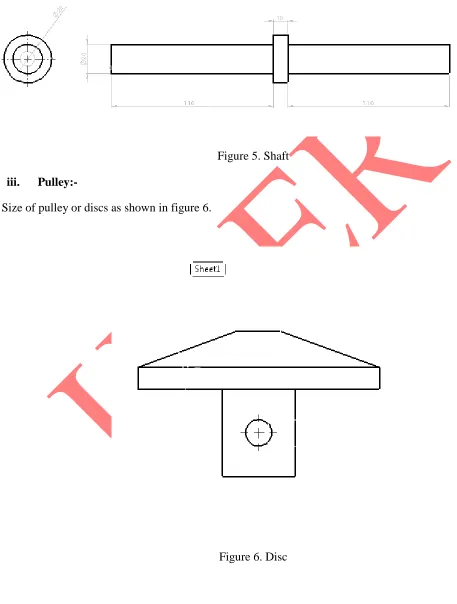
Shaft dimensions are calculated according to material used and also according to the weight of the pulleys.
Calculation for shaft:-
Weight of disc =13.572N (Calculated from the soliworks tool)
Weight of Pulley, W =13.573 *2= 27.146 N
This weight of pulley acts as a point load on shaft (neglecting the weight of other components).
Length of shaft taken, L=230 mm
Bending Moment, M = WL/4= (27.146*0.23)/4= 1.59
Power of the motor used, P = 1 HP = 746 watt
Speed of the motor, N = 1400 rpm
Torque produced by motor T =
= (746*60)/(2*π*1400)
T = 5.09 Nm
32
INTERNATIONAL JOURNAL OF ADVANCES IN ENGINEERING RESEARCH
Me = 3.46 Nm
For mild steel,
Allowable bending stess = 56 Mpa
Allowable shear stress = 42 Mpa
Factor of safety = 6
Now,
Me = (π/32)*(σb/6 ) *d3
3.46 = (π/32)*(56*106/6 ) *d3
d = 15.86 mm
Equivelent torque Te = (M2+T2)1/2
Te = (1.592+5.092)1/2
Te = 5.33 Nm
Now,
Te = (π/16)*(τ/6)*d3
5.33 = (π/16)*(42*106/6)*d3
d = 15.87 mm
For the safe design of shafts we take the larger diameter i. e. d = 15.87 mm
33
INTERNATIONAL JOURNAL OF ADVANCES IN ENGINEERING RESEARCH
Figure 5. Shaft
iii. Pulley:-
Size of pulley or discs as shown in figure 6.
34
INTERNATIONAL JOURNAL OF ADVANCES IN ENGINEERING RESEARCH
6. EXPERIMENTATION
Basic Theory:- The experimentation is done for the 780 series of the CVT and the material or parts taken are the general part used by Baja teams for CVT. These parts are available in CVT kit. The engagement rpm of CVT changes with the change in any of the four parameters.
General effect of change in engagement rpm of CVT with the change of parameters:-
Fly mass:- As the fly mass in the driver pulley changes centrifugal force on the driver pulley changes and hence engagement rpm changes. So, if the fly mass is increased then the engagement rpm of pulley decreases as the centrifugal force increases.
Spring on fly mass:- It has opposite effect than the fly mass. The lower the stiffness of the spring, lower will be the engagement rpm of the CVT and vice-Aversa. As the opposite force on the masses increases.
Cam angle:- As the cam angle increases the effect on upshift of the driven pulley increases and vice-Aversa.
Torsion spring:- Higher the stiffness of the torsional spring more power needed for CVT to reach maximum gear ratio. As there will be more force on the driven pulley in opposite direction.
Constants: - Torsion spring and cam is kept constant at the driven pulley side.
Instruments used:-
I. Tachometer: - To measure RPM. II. Baja SAE car installed with CVT. III. Engine: - Engine power- 10HP. IV. Ribbed V-belt- B3211AA1008
V. Driver Pulley VI. Driven Pulley
VII. Fly Masses used: - 68 gm, 71 gm, 78 gm ,91 gm.
VIII. Spring used in driver pulley :- 703548/49(Green), 703064/65 (Blue), 703066/67(Yellow), 703242/43(Purple), 703028/29 (Plain)
IX. Driven Cam:- 703703 32 DEGREE CAM
X. Torsion Spring:- 702970 PLAIN DRIVEN SPRING.
The experiment conducted for the projects consists of the following steps:-
I. The engine was selected. Power of the engine was 10 HP.
35
INTERNATIONAL JOURNAL OF ADVANCES IN ENGINEERING RESEARCH
III. Fly mass of 68 gm was installed in it with green springs. IV. The driver pulley moving part was again installed.
V. The engine is switched on.
VI. Acceleration was given to the car engine.
VII. As soon as the CVT driver pulley engages the belt then the RPM of the engine at that point was calculated using tachometer.
VIII. And the value is noted.
IX. Same procedure from step- I to VIII are followed to for different masses and different springs.
7. RESULTS AND DISCUSSIONS
7.1. Experimentation results
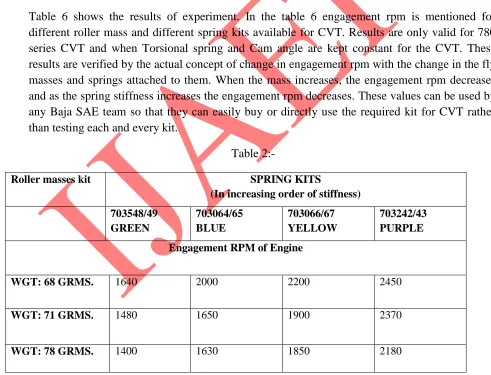
Table 6 shows the results of experiment. In the table 6 engagement rpm is mentioned for different roller mass and different spring kits available for CVT. Results are only valid for 780 series CVT and when Torsional spring and Cam angle are kept constant for the CVT. These results are verified by the actual concept of change in engagement rpm with the change in the fly masses and springs attached to them. When the mass increases, the engagement rpm decreases and as the spring stiffness increases the engagement rpm decreases. These values can be used by any Baja SAE team so that they can easily buy or directly use the required kit for CVT rather than testing each and every kit.
Table 2:-
Roller masses kit SPRING KITS
(In increasing order of stiffness) 703548/49 GREEN 703064/65 BLUE 703066/67 YELLOW 703242/43 PURPLE Engagement RPM of Engine
WGT: 68 GRMS. 1640 2000 2200 2450
WGT: 71 GRMS. 1480 1650 1900 2370
36
INTERNATIONAL JOURNAL OF ADVANCES IN ENGINEERING RESEARCH
WGT: 91 GRMS. 1200 1480 1760 1950
7.3. Motion Analysis of CVT (Solidworks) 7.3.1. Model Information
Figure 7. Solidworks model for analysis
Index: yellow- Variable disc, light blue- fixed disc, black- V- belt, pink- key, green- driver shaft, blue- driven shaft, brown- base.
The design model of CVT is prepared on solidworks as shown in figure 7. Dimensions of parts such as disc and shaft have been discussed earlier. Base is 300*300 mm (assumed). Belt is drawn such that it fits between pulleys. The shaft and pulley are connected via 4*4 key so that when shaft moves pulley also rotates. Materials selected in solidworks are mild steel SI 1020 for CVT model and natural rubber for belt.
37
INTERNATIONAL JOURNAL OF ADVANCES IN ENGINEERING RESEARCH
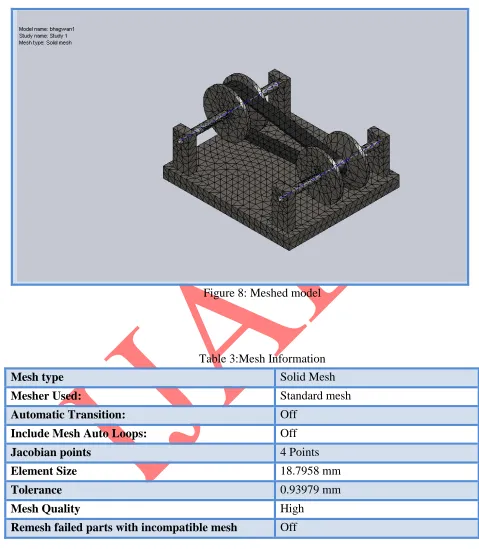
Figure 8: Meshed model
Table 3:Mesh Information
Mesh type Solid Mesh
Mesher Used: Standard mesh
Automatic Transition: Off
Include Mesh Auto Loops: Off
Jacobian points 4 Points
Element Size 18.7958 mm
Tolerance 0.93979 mm
Mesh Quality High
38
INTERNATIONAL JOURNAL OF ADVANCES IN ENGINEERING RESEARCH
Table 4: Mesh Information - Details
Total Nodes 19226
Total Elements 10104
Maximum Aspect Ratio 14.786
% of elements with Aspect Ratio < 3 90.6
% of elements with Aspect Ratio > 10 0.544
% of distorted elements(Jacobian) 0
Time to complete mesh(hh;mm;ss): 00:00:10
Force applied on the model (as shown in figure 9):-
Details of the model about rpm and forces applied on the model are mentioned below.
Motor on driver shaft:- rpm=1400.
Force on driver pulley:- 100N (For half process).
Spring attached to Driven pulley=15 N/mn
Length of spring=20mm
Gravity.
39
INTERNATIONAL JOURNAL OF ADVANCES IN ENGINEERING RESEARCH 7.3.2. V-belt:-
Stress analysis of V-belt:-
The figure 10 shows the stress analysis of the belt. It indicates that belt has safe design as most part of the belt is in blue in color. There are some parts on belt which are having green color. This indicates that the belt on those position have high stress. But not high enough which can break the belt.
Figure 10: Stress analysis of belt
Factor Of Safety for V-belt:-
40
INTERNATIONAL JOURNAL OF ADVANCES IN ENGINEERING RESEARCH
Figure 11: Factor of Safety for belt
7.3.3. Driver Shaft:-
FOS for driver shaft:-
The figure 12 represents that the minimum value of the FOS for driver shaft is 90. The color red represents the FOS of shaft is around 90.90 FOS for design is considered as safe. Hence shaft design is safe.
41
INTERNATIONAL JOURNAL OF ADVANCES IN ENGINEERING RESEARCH Stress and deformation in drive
shaft:-Figure 13 and 14 represents stress and deformation in the drive shaft respectively. The value of stress as well as deformation is in the safe zone. Because color of drive shaft is blue in both the figure. Hence, drive shaft design is safe.
Figure 13: Stress on Shaft
Figure 14: Deformation of Shaft
42
INTERNATIONAL JOURNAL OF ADVANCES IN ENGINEERING RESEARCH
8. CONCLUSION AND FUTURE WORK
The points which can be concluded from the experimentation on CVT and the motion analysis of the CVT design are:-
Experimentation:-
Table 6 shows the relation between fly mass and spring kits and their effects on engagement rpm. These results are only valid for 780 series CVT.
The results are obtained by changing fly mass and springs attached to variator.
The results are verified by the actual values obtained from team Kshatriya for some of the fly masses already in use.
It is noted that when the mass increases the engagement rpm decreases and as the spring stiffness increases the engagement rpm decreases. These increase or decrease of engagement rpm is verified theoretically.
These values can be used by any Baja SAE team so that they can easily buy or directly use the required kit for CVT rather than testing each and every kit, which can be equally hectic and cumbersome process.
Motion analysis:-
The analysis of belt and driver shaft shows the design of the CVT is safe.
The figure 11 and 12 shows FOS for the belt and shaft are in safe range respectively.
The minimum FOS for belt is 4e+5 which is a safe value.
The stress analysis of the parts represents that the assumptions and dimensions of the CVT calculated are correct and safe.
The von misses stress represent the distortion in different parts due to stresses. The result shows it is in safe zone for both belt and driver shaft.
The displacement of shaft due to forces applied in analysis is zero. Hence there will be no distortion on the design.
Future application:-
More dynamic analysis can be done on the other parts of CVT .
The experimentation can be done by varying driven pulley variable and keeping driver pulley variable constant which can be used by BAJA SAE teams.
43
INTERNATIONAL JOURNAL OF ADVANCES IN ENGINEERING RESEARCH
REFERENCES
[1].Brandsma, A., van Lith, Hendriks, E, Push belt CVT developments for high power applications 1999.
[2]. C. Kim, E. NamGoong, S. Lee, T. Kim and H. Kim: “Fuel Economy Optimization for Parallel Hybrid Vehicles with CVT” SAE Paper No. 1999-01-1148, in SAE SP-1440, Transmission and Driveline Systems Symposium, pp. 337-343 SAE, 1999.
[3]. Fischetti, Mark (January 2006). "No More Gears". Scientific American 294: 92. doi:10.1038/scientificamerican0106-92.
[4]. http://auto.howstuffworks.com/cvt.htm Retrieved 2007-12-03.
[5]. Kevin R. Lang 21W ,Continuously Variable Transmissions ,An Overview of CVT Research Past, Present, and Future. 732, May 3, 2000.
[6]. N. Hattori, S. Aoyama, S. Kitada and I. Matsuo: “Functional Design of a Motor Integrated CVT for a Parallel HEV” SAE Paper No. 1999-01-0753, in SAE SP-1440, Transmission and Driveline Systems Symposium, pp. 161-167 SAE, 1999.
[7]. SAE International, “2009 Baja SAE Competition Rules”, Nov. 2008.
[8]. S. Birch: “Audi takes CVT from 15th century to 21st century”. Automotive Engineering International, January 2000.
[9]. T. F. CHEN, D. W. LEE and C. K.SUNG, An experimental study on transmission efficiency of Rubber V-belt in CVT, 1996.
![Table:1-Specification of CVT (used for experimentation)[7]](https://thumb-us.123doks.com/thumbv2/123dok_us/8849183.1799847/6.612.39.553.220.705/table-specification-of-cvt-used-for-experimentation.webp)