June 2017, Vol. 2, No. 1 [1-26] ISSN Online 2616-7093 Emoji Usage by Android Consumers: A Gender-Based Inquiry
Muhammad Shahbaz1Tabassum Razzaq2
Muhammad Riaz Gohar3
Abstract
In recent years, android apps have achieved unbelievable popularity and turn out to be a new source for Computer-Mediated Communication (CMC). There is gender-based imbalance of language use. This paper specifically aims to explore the gender-based differences in the use of Emoji. Several research studies have been done to identify behaviour of male and female toward emoji usage. Gender-specific studies are always meaningful for understanding how much males and females vary in their communication styles. However, until now not much is known that to what extant both genders have difference in the use of emoji. To fill such a gap, this study attempts to explore the use of Emoji in conversation through gender lens. The analysis depends on the data collected from android app with the help of Kika keyboard. For this purpose, 144,478 users from 180 countries, and their 510 million messages are selected as data set.A multi-dimensional statistical analysis has been conducted from many view pointsin the use of Emoji, taking account of the differencesand preferences. The findings demonstrate that the use of emoji can noticeably differ between males and females. Consequently, various implications are purposed that can help in creating better understanding about gender-based use of emoji and for keyboard layout developers.
Keywords: Gender, Kikaboard, Consumerand Emoji
Introduction
1
Assistant Professor, Department of English, GC Women University Sialkot 2
Emoji Usage by Android Consumers: A Gender-Based Inquiry
Every researcher has a purpose behind choosing an area for
research work or investigation. For carrying out this study, researcher
has a personal reason to choose this area. The researchers study about
the gender-based differences in the use of verbal and non-verbal
communication and started to explore the non-verbal differences in
conversations. This work is an effort to provide answers
aboutgender-based use of emoji, preferences and their frequency.
Emoji have gained astonishing popularity in recent years and are
interwoven in our daily communication. Text messages and pictures are
considered typical traditional representation of information but emoji
are taken as more communicative, realistic and rich in meaning so more
preferred by smart-phone users. Some people prefer to use emoji to
share information instead of typing a text, for instance, on April 11,
2015, Andy Murry, announced his wedding on twitter by using 51
emoji. Some current research have paid attention to understand the use
of emoji across app and cultures but no significant effort is made to
conversational differences, gender-based differences also exist in
non-verbal cues. When it comes to the study of gender-based non-non-verbal
differences, Some researchers claim that very little is known whereas
other argue that there is enough work relating to gender-based
differences but not systematically based on sociolinguistic variables.
This study seeks out some of this gap in previous research. This study
adds to the field of sociolinguistics as well as pragmatics and the focus
is on usage of emoji by women and men in text conversation.
Numerous studies relating to gender speech styles have been
conducted using real life conversations (Coates, 1986; Tannen, 1991;
Githens, 1991), but little has been done in other frameworks through
different methods. Several recent works exposed that language and
conversational patterns from online source are useful to understand and
explore gender-based conversational differencesin individuals and
populations. This effort includes utilizing android apps of
communication to understand the use of emoji related to gender-based
conversation. With the growing popularity of communication
Emoji Usage by Android Consumers: A Gender-Based Inquiry
computer mediated communication. However,little research is based on
the usage ofinternet conversation from gender perspective. Motivated
by the preceding literature about gender differences, android apps are
consideredas new communication messenger and researcher
investigates the use of emoji in mobile conversation.
Study of language and gender is an important field and one of
the hot issues in this field is how male and female use their
communication skill to interact with one another. It has so far been
observed that men and women have many differences at every level of
the language organization. There is no doubt that men and women are
different biologically as well as in many other aspects of life.No doubt,
the investigation about this copious and ancient issue of language and
gender is triggered by the hypothesis that women language is powerless
language and this supposition challenged the entire concept of ‘gender’
by underlining the performance of male and female.
Language usage is influenced by many factors such as setting,
However, the most influential factor is society. The men and women
have many differences in their communication strategies however, in
this paper, the main focus is on the gender-based use ofemoji. The
present study contributes in the existing literature of Language and
Gender and Feminist Linguistics. This work is unique from two
perspectives; firstly, the data set is largest, from a renowned app named
Kika. The data set encompasses180 countries (144479 consumers)and
their messages (510 million)assembled in90 days that make the result
more comprehensive. Secondly, various descriptive and inferential
statistical analyses helped in understanding different facets of emoji
usage.
Following findings are made:Gender-based differences are
found in frequency of emoji. Female users use one emoji or more than
one emoji in one message, in contrast, maleuse multiple emojis.Both
genders have different preferences; female use face related emojis
Emoji Usage by Android Consumers: A Gender-Based Inquiry
Literature Review
This section starts with brief discussion of the related
background and literature. With the rapid use of emojis, various
researchers have shown curiosity to know more about the usage of
emoji but very little is known about emoji usage from gender
perspective. The researchers investigate the impact of gender on emoji
usage in text conversation.
Emotions, emoticons and Emojis
Facial expressions and body language are part of our daily
communication to enhance effects of our sentiments and emotions. In
93% of everyday communication, people use symbolic representation
of their messages and emotions. Emoji is a set of pictographic Unicode
characters that use to express humour, irony, and sarcasms and
intimacy. Emojis were created and introduced in Japan for the first time
in late 90s.All common mobile platforms now support emojis. Emoji
were first specified by Unicode standard in version 6.0. 722 emoji are
Tossell et al. (2012) investigated how emoticons are exercised,
in text messaging and in particular, how much gender differences exist
in the frequency and variety of emoticons used. For analysis, data from
twenty-one smart phones was taken for last six months. He observed
that females are more likely to use emoticons where as males use a
more distinct range of emotions. Hwang (2014) reported from data set
of 126 students from Korea, female students used emoticons to express
feeling and intimacy than male. For them, emoticons played a role as a
facilitator. Wolf (2000) explored emoticon practices among different
gender groups and concluded that there were significant differences
among same and different gender groups.
Emoticons have limited morphological variation of symbols,
non-standard formation and their use bring in some questions to data
analysis where as emoji has standard creation. They not only express
emotion but also able to represent other objects as well. There exist
prior research on emoji usage across culture and boundaries but there
exist limited work on emoji usage from gender perspectives. Some prior
Emoji Usage by Android Consumers: A Gender-Based Inquiry
Nishimura (2015) examines sample that consists of200 participants
from a Japanese blog site established in 2004, having 121 major
categories and some 7000 sub-categories. He finds that women are
more inclined to send emojis compared to men. Similarly, however, we
could not find any study with largest sample about emoji usage from
gender perspectives except Chen et al (2017). To overcome this
research gap, the researchers explore the gender-based use of emoji on
large-scale through Android users.
Lu et. al (2016) study the data set consisting of 400 emoji
containing messages of 3.87 million active users from 212 countries
and find gender of user can be predicted through the emoji usage. Chen
et.al (2017) efforts to explore the gender-based use of emoji, for these
purpose 134419 active participants from 183 countries are selected and
401 million messages are saved in 90 days. The findings show that
there is a difference in emoji usage between both genders.
Kika keyboard is a major Google Play app for input. In 2015, it
was ranked as one of the top downloaded apps for Google play store.
Kika assists 82 languages and has input of 1281 emojis.For research
purposes, Kika collects the necessary data, e.g. the language, country
information and content of the text. Kika records no personal or
unethical data from the user input.
Research Methodology
This section provides overview of research methodology,
approach, dependent and independent variables, population, specified
group, sample, tool of research, procedure of data analyses and ethical
considerations for this research.
Data collection and description
Unlike the other studies about non-verbal differences, this paper
makes use of the sample gathered through Kika keyboard that is an
input app in Google play. It secured millions of downloads across the
globe and support 82 languages having more than 3000 emojis and
Emoji Usage by Android Consumers: A Gender-Based Inquiry
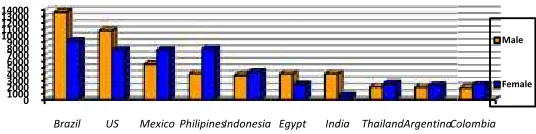
Figure 1: Top 10 Countries with in Action Consumers
Procedure of data analyses
Information is collected from only those users who are agreed to
Kika's Privacy Policy that no secret codes or hypersensitive data are
noted down. All the information has been anonym zed before the
examination. As an input technique, Kika is not limited to only one
application such as twitter; it can attain the contexts of different apps
where allowed and introduced. Having this feature, Kika enable the
researcher to have thorough study of emoji usage. The sample consist of
0 1000 2000 3000 4000 5000 6000 7000 8000 9000 10000 11000 12000 13000 14000
Brazil US Mexico PhilipinesIndonesia Egypt India ThailandArgentinaColombia
Emoji Usage by Android Consumers: A Gender-Based Inquiry
Figure 1: Top 10 Countries with in Action Consumers
Procedure of data analyses
Information is collected from only those users who are agreed to
Kika's Privacy Policy that no secret codes or hypersensitive data are
noted down. All the information has been anonym zed before the
examination. As an input technique, Kika is not limited to only one
application such as twitter; it can attain the contexts of different apps
where allowed and introduced. Having this feature, Kika enable the
researcher to have thorough study of emoji usage. The sample consist of ArgentinaColombia
Male
144, 479 participants from 180 countries, and 510 million
text-messages from November 4, 2017 to January18, 2018. An anonym zed
consumer identifier will be used to signify every active user who
communicated through Kika keyboard (at least one message).
Demographic information of every participant is given and the number
of messages typed by him/her. From there the researchers report the
demographic division ratio of both genders in data-set. Data from top
ten world regions with highest proportion of usage is(Brazil, US,
Mexico, Philippines, Indonesia, Egypt, India, Argentina and Colombia)
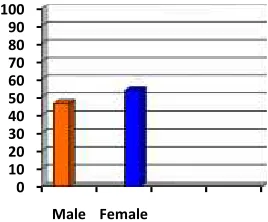
presented in Figure 1. Almost seventy-one percent of overall consumers
are from these 10 countries. However, as a whole, male and female
distribution is not equal. As illustrated in Figure2, 46.5% are male and
Emoji Usage by Android Consumers: A Gender-Based Inquiry
Figure 2: Gender Distribution
Ethical Consideration
As a matter of fact, this research enclosed sensitive personal
facts of users; hence cautious measures are taken to uphold the ethics in
this research as it is a critical concern for the researchers. Kika
exchanges the device ID of each participant and it is made sure that no
sensitive data is saved and all the data through which a participant can
be identified had been anonymized before the analysis. Data is securely
saved (HIPPA-complaint cloud server) that is strictly sanctioned by the
organization. For ethical considerations, all words are removed and
only emojis are extracted for analysis. The message length was
calculated and emojis were labeled with sentiment by studding the
0 10 20 30 40 50 60 70 80 90 100 Male Female
Emoji Usage by Android Consumers: A Gender-Based Inquiry
Figure 2: Gender Distribution
Ethical Consideration
As a matter of fact, this research enclosed sensitive personal
facts of users; hence cautious measures are taken to uphold the ethics in
this research as it is a critical concern for the researchers. Kika
exchanges the device ID of each participant and it is made sure that no
sensitive data is saved and all the data through which a participant can
be identified had been anonymized before the analysis. Data is securely
saved (HIPPA-complaint cloud server) that is strictly sanctioned by the
organization. For ethical considerations, all words are removed and
only emojis are extracted for analysis. The message length was
calculated and emojis were labeled with sentiment by studding the
contexts. Kika employees constantly governed the entire procedure to
make sure the agreement with the public secrecy policy acknowledged
by Kika. The researchers tried hard to provide original, authentic
knowledge and truth without any kind of error. It was verified on the
part of researchers that there is no forgery, fabrication and
misrepresentation of any finding which could alter a real scenario.
Limitations
Like other studies, this study also has some limitations which
can potentially affect the analysis and derived results. The data set of
this study only includes the participants who freely reveal the gender
information and the user allocation is not consistent between all
countries, consequently, there could be some prejudice. Furthermore,
this work is not based on gender differences among limited or
controlled user group because of large and bulky sample size. To the
best possible knowledge of researchers, sample of this study is the
largest. The larger data set of this study makes the analysis broader and
Emoji Usage by Android Consumers: A Gender-Based Inquiry
Data Presentation and Analyses
This empirical study means to search whether there are some
gender-based differences in emoji usage and which emoji is used most
by males and females. This study mainly focuses on the Usage Pattern
Analysis. Emojis are considered semantically rich even without words.
For this purpose, macro level descriptive analysis is done by making
use of two-tailed z -test. This research focuses on usage patterns
analysis.
Usage pattern analysis
The researchers focus on gender-based analysis of emoji usage
pattern from several aspects, including frequency, choice, and
consecutive/discrete pattern and frequently use emojis.From the sample,
researchers examine 31 million messages comprising minimum one
emoji, crediting for 7.5% of all messages. Beyond the extensive use of
emojis, the researchers are probing whether there is any difference in
participants utilize emojis in messages? Which emoji is more frequently
used by male and female users, respectively?
Frequency of emojis in Messages
Previous studies (Ablon et.al, 2013; Marianne & Mahzarin,
1992; Briton & Hall, 1995) show that female are more non-verbal
expressive than male. Prior studies (Dresner & Herring, 2010; Daantje
& Jasper, 2007) have also noticed the gender differences in the
frequency of emojiusage. Emojis are also considered as non-verbal cue,
the researchers are interested to know whether a similar difference is
there in emoji usage frequency. The researchers begin with exploring
which gender frequently uses emojis in their messages.
Table 1: Gender-based occurrence of emoji (\**": p-value <0.01)
Gender % of Emoji in total
Emoji% (2017-11)
Emoji% (2017-12)
Emoji% (2018-1)
Male 7.03 6.9 7.00 7.50
Female 8.00 8.0 7.80 8.5
Emoji Usage by Android Consumers: A Gender-Based Inquiry
Table 2: Emoji usage pattern
Male % Female % z-score
Pat 1 40.00 41.00 -60.81
Pat 2 57.85 56.00 78.00
Pat 2.1 38.00 37.00 56.01
Pat 3 10.07 10.00 -34.98
The gender-based percentage of messages containing emoji is
compared as whole and monthly. As displayed in Table 1, the 7.03% of
messages post by male participants consist of minimum one emoji;
where as 7.96% of female messages contain at least one emoji. A
significant difference is found under two tail z-test so it represents that
females have higher percentage in using emojis.
Finding (F1): In general, the analysis of data set reflected that
emojis are more frequently used by female than male.
We have seen the frequency of emoji usage in the above section.
Some messages have only one emoji while others have more than one
emoji. Now the researchers want to discover whether both genders have
different input patterns for emoji.
Typically, there are three input patterns.
Pattern (Pat1):Message having one emoji, e.g., I am happy.
Pattern (Pat2): Use of more than one emojis in one message, e.g.
I am happy .
Pattern (Pat3): Posting of multiple emojis in one message, e.g., I am
happy .
In pattern 2, the use of this type of pattern is an emphasis to show
stronger impact. Here the proportion of these three patterns are
identified and counted then by performing z-test, gender difference in
usage pattern is measured. Bonferroni correction is applied to regulate
p-values for multi-hypothesis testing. The results are succinctly
summarized below. Interesting gender-based differences are shown in
Emoji Usage by Android Consumers: A Gender-Based Inquiry
emojis in a message whereas male participants’ tend to use
consecutively multiple emojis in one message.
Finding (F2):
Both genders use emoji patterns differently. Females utilize one
emoji or discretely use more than emoji in single message. On the other
hand, male use multiple emojis consecutively.
Frequently Used Emojis
We have found the gender-based frequency of emoji usage. Yet
little is known about which emojis are more likely to use. Do men and
women use same emojis? To find out the answer, favourite emojis used
by both genders are listed. For all emoji, the percentage of its
occurrence is counted in male and female messages. Ten most
commonly use emojis are listed in figure 3. No significant difference is
found in the usages of these ten emojis, first five have same frequency
Figure 3: top ten frequently typed emojis
However, there is difference for particular emojis, emoji with
tears of joy is most popular emoji among male and female but its usage
is found 18% in males’ messages where as in female 22% with a
difference of 4%.
Finding (F3): both genders impart the same top 5 most used emojis.
However, there is a sharp difference in usage proportion of some
emojis.
Summary of Findings
Until now, the researchers have explored the usage behaviours
for emojisand reported several gender-exclusive differences. From the
0
5
10
15
20
25
30
1
2
3
4
5
6
7
8
9 10
Figure 3: top ten frequently typed emojis
However, there is difference for particular emojis, emoji with
tears of joy is most popular emoji among male and female but its usage
is found 18% in males’ messages where as in female 22% with a
difference of 4%.
Finding (F3): both genders impart the same top 5 most used emojis.
However, there is a sharp difference in usage proportion of some
emojis.
Summary of Findings
Until now, the researchers have explored the usage behaviours
for emojisand reported several gender-exclusive differences. From the
Emoji Usage by Android Consumers: A Gender-Based Inquiry
findings F1-F3derive from our descriptive analysis, basic understanding
is developed how emojis are used by females and males. Statistically,
there is quite significant difference in behaviour of female and male
users in using emojis. These findings confirm the initial hypothesis of
this study.
Implications
Following the previous findings, some implications are given;As
there are found some gender -specific differences in the use of emojis,
the most practical implication in the field of software development for
software developers is to provide some hints of problems while
searching right or left for emojis so they may design new features in
keyboard layoutto improve the users experience on smart phone
keyboard. Keyboards' layout should be design in such a way to make
users aware about gender. Based on our interpretations, keyboard
developers can improve situation-related and temporal-related emoji
This research work enlightens some observations and findings to
distinguish users' gender through their emoji usage that will be useful in
daily life. This study adds to field of socio-linguistics.
Above all, this study links with the key subject matter of
feminism. In addition to that, this thesis will incorporate much of the
work to the field which will be useful for future researchers in
perspective of gender studies.
Limitation and Future work.
Like every empirical study, this study has its own potential
threats and limitations that can influence the overview of results. One
major threat may arise in data collection. For this purpose only, active
users in sample are considered by the Kika keyboard whereas there are
many other input methods. Hopefully, such a threat could not affect the
results, as the sample size encloses a huge mass of real-world users
from several countries that make this study statistically comprehensive.
However, in addition to gender, there are many other perplexing
Emoji Usage by Android Consumers: A Gender-Based Inquiry
Due to time and space restrictions, this study is based on only usage
pattern analysis and analyses from other aspects are excluded, for
example CMC scenario and sentiment analysis. The researchers suggest
the future researchers to integrate such information along with gender
that make up the gender difference more visible.
Conclusion and future Work
This work is based on gender-based empirical study of emoji
usage by making use of large sample size gathered through Kika.The
data set consistof510 million messages posted by 144,479participants
from 180countries in duration of three months. Data set comprise of
46.5% of males and 53.5% females. A multi-dimensional statistical
analysis is conduct from several aspects, including the frequency, input
patterns and preference. Various statistical tests are employed to verify
the findings. In actual fact, various differences are reported and gender
differences are found in the usage of emoji. On the basis of
observations and findings some implications are introduced, such as
To the best of our knowledge, the sample of this study is the largest to
Emoji Usage by Android Consumers: A Gender-Based Inquiry
References:
Ablon, S. L., Brown, D. P., Khantzian, E. J., & Mack, J. E. (Eds.).
(2013). Human feelings: Explorations in affect development and
meaning. Routledge.
Briton, N. J., & Hall, J. A. (1995). Beliefs about female and male
nonverbal communication. Sex Roles, 32(1-2), 79-90.
Chen, Z., Lu, X., Shen, S., Ai, W., Liu, X., & Mei, Q. (2017). Through
a Gender Lens: An Empirical Study of Emoji Usage over
Large-Scale Android Users. arXiv preprint arXiv:1705.05546.
Derks, D., Bos, A. E. R., & von Grumbkow, J. (2008). Emoticons and
online message interpretation. Social Science Computer Review,
26(3), 379-388.
Dresner, E., & Herring, S. C. (2010). Functions of the nonverbal in
CMC: Emoticons and illocutionary force. Communication
Hwang, H. S. (2014). Gender differences in emoticon use on mobile
text messaging: evidence from a Korean sample. International
Journal of Journalism & Mass Communication, 2014.
LaFrance, M., &Banaji, M. (1992). Toward a reconsideration of the
gender-emotion relationship. Emotion and social behaviour, 14,
178-201.
Lu, X., Ai, W., Liu, X., Li, Q., Wang, N., Huang, G., & Mei, Q. (2016,
September). Learning from the ubiquitous language: an
empirical analysis of emoji usage of smartphone users.
In Proceedings of the 2016 ACM International Joint Conference
on Pervasive and Ubiquitous Computing (pp. 770-780). ACM.
Nishimura, Y. (2016). A sociolinguistic analysis of emoticon usage in
Japanese blogs: Variation by age, gender, and topic. AoIR
Selected Papers of Internet Research, 5.
Pohl, H., Domin, C., &Rohs, M. (2017). Beyond Just Text: Semantic
Emoji Similarity Modeling to Support Expressive
Communication. ACM Transactions on Computer-Human
Emoji Usage by Android Consumers: A Gender-Based Inquiry
Tossell, C. C., Kortum, P., Shepard, C.,Barg-Walkow, L. H., Rahmati,
A., &Zhong, L. (2012).A longitudinal study of emoticon use in
text messaging from smartphones. Computers in Human