T
eachingis an increasingly important aspect of librarianship, both in terms of job requirements and as an integral part of our professional values. But many librarians do not feel prepared by their master’s programs for the level of teaching required in academic libraries (Julien & Genuis, 2011). While many of us turn to professional development and informal learning oppor-tunities to help us develop our craft, on-the-job training must also play a role in filling this perceived gap. Just as we hope to train our students to be information literate – and understand that, without guidance, many of them will find it challenging to learn these skills on their own – many library administrators and information literacy coordinators hope to provide support and training for staff. This paper outlines our library’s ap-proach to helping instruction librarians develop their teaching craft while simultaneously serving broader program needs. The goal of this project was to create a peer-mentorship training tool rooted in evidence-based practice that is able to measure our departmental goal of having trained, skilled instructors. It was important that this tool be flexible to suit the needs of indi-vidual librarians and the dynamic nature of university libraries but, most importantly, its development and implementation could not be too time-intensive. While we wanted to help our instruction librarians develop their teaching confidence we also wanted a tool that could be used in conjunction with our exist-ing assessment projects.Background
When researching possible models, we first looked to the formal teacher induction programs mandated for public and high school teachers in the province of Ontario, Canada (Ontario Ministry of Education, 2010a). While many examples of teacher induction programs exist, Ontario’s was chosen both for its familiarity and its flexibility. During induction, new teachers are assigned to a peer-mentor upon being hired by a school board. The parameters of the mentorship relationship are flexible; however, there are a number of required elements including: teaching observation by both the mentor and the mentee, self-reflection and goal setting, and professional devel-opment (Ontario Ministry of Education, 2010a). We also re-viewed the province’s Teacher Performance Appraisal system, which takes over from teacher induction once teachers are no longer considered new to the profession (Ontario Ministry of Education, 2010b). Working more with principals, the perfor-mance appraisals have similar components to teacher induction including teaching observation, professional development, per-sonal goal setting, and competency statements.
Induction mirrors many established best-practices for teacher development. McGuinness (2011), for example, lists a number of personal and professional development strategies librarians can use to develop their teaching skills and knowledge, including:
1. Evaluation of teaching performance 2. Student evaluation of teaching 3. Self-reflection
4. Peer evaluation 5. Mentoring
6. Creating and sustaining communities of practice (McGuinness, 2011)
Like teacher induction, much of the literature stresses the need for a multi-dimensional approach to developing librarians as teachers. As mentioned earlier, library and information science programs have received attention for how little they prepare new librarians for the rigours of the classroom (Saunders, 2015). Other authors emphasize that librarians must take per-sonal responsibility for developing their craft, whether by at-tending conferences, following instruction-related listservs and journals, or engaging in formal assessment of their students’ learning (Walter, 2005). We felt the onus is also on library ad-ministration to provide opportunities for professional develop-ment related to teaching and learning; as McGuinness (2011) points out, we would not expect cataloguing librarians to com-plete their work without proper training. A culture shift, there-fore, is needed to readjust our expectations of teaching librari-ans who may not have the training in educational theory and pedagogy.
In developing our information literacy mentorship tool, we also looked beyond teacher induction and existing library pro-grams to common business practices, such as the 360-degree review process (Thach, 2002). This was important because our librarians do not have faculty status and also because, like other Canadian academic libraries, we teach a mix of one-shot and embedded classes in combination with information literacy courses (Julien & Genuis, 2011). Although libraries share simi-larities with traditional teaching environments, we are also re-sponsible to other stakeholders when we teach, including our adult students and classroom faculty. As a result, the 360-degree feedback model was chosen as the foundation of our mentorship tool because it allowed us to involve all of these stakeholders in meaningful ways.
The Model
A hybrid tool was developed that combined the fundamen-tal aspects of teacher induction programs with the value of an on-going, 360-degree review process. After completing and evaluating a pilot test, our teacher assessment program now has five elements which are completed over the course of two years: self-reflection and personal goal setting; peer mentorship and observation; student feedback and assessment; faculty evaluations; and performance plan integration. The teacher assessment cycle is achieved over four main stages:
pre-Using Teacher Induction and 360-Reviews to Build Confidence and
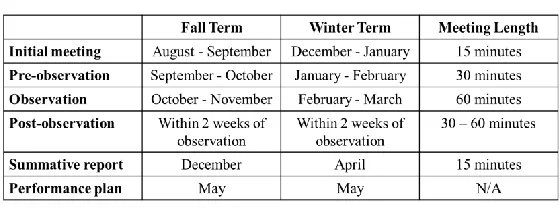
observation, observation, post-observation, and performance planning. See Table 1 for our typical timeline for implementing these four stages.
Pre-Observation
An initial meeting between the instructor and their mentor is set up for the beginning of the observation term. This first meeting is used to confirm when the mentor will be observing the instructor in the classroom and to discuss the unique ele-ments of that class (e.g., disciplinary concerns, typical research experience of the students, etc.). If the instructor is new to our library, the other elements of the teacher assessment plan are reviewed at this time; experienced instructors instead review their performance goals from the previous year. A second meeting is also held prior to the observation, usually in the week or two leading up to the date of the class. This meeting is used to review the instructor’s lesson plan, learning outcomes, and teaching tools and to go through the instructor’s personal learning goals that they have for the lesson. The mentor’s re-sponsibility is to provide coaching, feedback on the lesson de-sign, and clarify what type of faculty and student feedback will be used during the observation (see details below).
Observation
The observation involves the mentor watching the instruc-tor while they teach. The instruction team developed three ru-brics (see sample in Appendix A) to aid the mentor in evaluat-ing the teacher’s performance: these rubrics were developed in a workshop using the university and library’s values and long-term plans, the Association of College and Research Libraries’ (ACRL) Standards for Proficiencies for Instruction Librarians and Coordinators (2007), and teaching best practices (Maki, 2010; Nilson, 2010). These three rubrics capture: 1) how well the instructor prepared for their lesson, 2) their actual delivery, and 3) comments on their performance and how that related to their personal learning goals. Faculty feedback is also collected during the observation in a format that can be adjusted to the needs of the instructor or context. A standard survey form (Appendix B) was developed that, so far, all of our instructors have chosen to use, however this survey may change according to need. The goal with this survey is to capture the classroom faculty’s expectations and have them measure our library in-structor’s performance against those expectations.
The final aspect of the observation is student evaluation which, again, was designed to be flexible to the needs of the session. We have changed the student evaluation form every year since implementing the teacher assessment plan, but the
purpose has remained the same: students are asked to rate both the instructor’s performance as well as record what they learned as a result of the lesson. This can take many forms, from a one-minute paper, to handing in their work, to a survey. Our ultimate goal with this element of the tool is to incorporate authentic measures of student assessment: this way we can later measure whether or not our students learned as an independent variable from the quality of our teaching, and to what extent.
Post-Observation
Within approximately two weeks of the observation, a debriefing meeting is scheduled. The mentor reviews and com-piles the results of the student and faculty feedback and ensures that all three rubrics are completed. The instructor, meanwhile, reflects on how the lesson went using a self-evaluation form (Appendix C). Although this self-assessment remains private to the instructor, the goal with this step is to encourage the in-structor to reflect honestly on their performance in comparison to the goals they set, or any previous evaluations they have received.
During the post-observation meeting, the mentor and in-structor debrief: they discuss what went well and what could be improved, and they review the student and faculty feedback forms and rubrics. After reaching consensus on how the lesson went, the instructor is required to develop at least two learning goals related to their teaching performance. These goals are recorded on a summative report. The mentor, meanwhile, is asked to provide ways in which they will help their mentee achieve their goals and identify any resources they may need.
Performance Planning
The summative report includes a record of all meetings as well as a summary of the feedback the instructor received from the students, faculty, and their mentor. After recording their professional development goals, the summative report is passed onto the instructor’s direct supervisor to be incorporated into their annual performance plan for the following year. At Bre-scia we must develop at least three learning goals each year and our library administration agreed to dedicate at least one of those to teaching. Therefore, the final stage of the teacher as-sessment program is the instructor working toward their teach-ing-related learning goal in the year following observation. Whether they achieve their goal, or to what extent, is then used as the basis of their initial meeting in the next cycle of teaching assessment.
Results
their teaching than in the past. One librarian, who had previous experience with the student-based evaluations in traditional uni-versity classrooms, described this as the most positive evalua-tion technique she had experienced.
The tool also transitions well from new instructors to more experienced ones: very few changes needed to be made when assessing an instructor for the second time, or assessing one with ten years of teaching experience versus a new MLIS graduate. The time involved was manageable, an important goal for us: as IL program coordinator, I hope to dedicate two to four hours a year to each instructor’s professional development. This tool allowed me to achieve that goal in a structured way. Although we have not combined this tool with student learning assessment as much as we would have liked, there is great potential to do so in the future. The performance evaluation component also worked well: we found there was sufficient emphasis on the value and importance of the tool to make sure we completed them each year, but the instructors did not feel judged by the process and so were able to fully engage.
There were other, added benefits to introducing this tool. We noticed an unexpected improvement in faculty relations: we have been invited to more teaching-related events and commit-tees and those faculty members who have participated in the assessment have been more involved with information literacy efforts. We have had enormous support from university admin-istration with this initiative, so much so our existing depart-mental performance plans are being converted to a 360-model based on this assessment tool. Finally, and most significantly, has been the change in the teaching librarians: after introducing this tool the librarians have attended significantly more teaching -related conferences and events, subscribed to more blogs and listservs, and anecdotally been more engaged in the teaching process than ever before. Two librarians even started their Bach-elor of Education degree in adult learning, and they all identify themselves as teachers. While none of these benefits determined whether we would continue using this assessment model (nor are they statistically significant, with a sample pool of only 5), the positive uptake has definitely encouraged us to continue using and refining this tool.
The biggest challenge of this assessment model, as with any new initiative, was the time involved in its creation. Developing the tool and the observation rubrics was manageable because we were also spending a lot of time discussing information literacy: ACRL was about to undergo its revision of their Information Literacy Standards (2000), on which we planned to provide feedback, and our university was starting the process of devel-oping institutional competencies that included information liter-acy. Because we were also developing a departmental long-term plan, it seemed natural to merge all of these events into a broad-er discussion on information litbroad-eracy. We took a half day to ask ourselves: what are the qualities of a good teacher? How do we ensure that our teaching does not negatively affect our students’ learning? These conversations contributed toward the develop-ment of the tool, but were time consuming. The other main chal-lenge remains, as corroborated by the literature, a lack of confi-dence among most instructors with learning theory and peda-gogy (Julien & Genuis, 2011). Where the ultimate goal is to
convert this teaching assessment model into a ‘teaching squares’ program, with every instructor acting as both coach and mentee, to date no one has felt comfortable enough to evaluate my per-formance. However, this may eventually be possible, as initial results of this tool indicate that we have a strong team of teach-ers who meet our established standards.
Conclusion
After identifying a lack of formal training in teaching and learning, our library hoped to develop a flexible peer-mentorship tool that would allow us to evaluate our teaching performance and further develop our skills and knowledge. By taking the principles of teacher induction and 360-degree feedback and applying them to the established best-practices in education and library science, we were able to develop a model that met most of our needs. We determined that the three to four hours per year needed for this mentorship model was well worth the invest-ment: we feel more engaged and connected as a teaching team, have built more positive relationships with faculty, and will be able to integrate this tool with our other assessment projects. While we recognize that this tool will not be applicable to every library context and still have areas to improve upon, the flexibil-ity of this type of mentorship and performance evaluation has been extremely positive for our library culture and teaching con-fidence.
References
Association of College and Research Libraries. (2000). Infor-mation literacy competency standards for higher edu-cation. Retrieved from American Library Association: http://www.ala.org/acrl/standards/
informationliteracycompetency#f1
Association of College and Research Libraries. (2007). Stand-ards for proficiencies for instruction librarians and coordinators. Retrieved from American Library Associ-ation: http://www.ala.org/acrl/standards/profstandards
Harrington, M. R., & Marshall, E. (2014). Analyses of mentor-ing expectations, activities, and support in Canadian academic libraries. College & Research Libraries, 75
(6), 763–790. http://doi.org/10.5860/crl.75.6.763
Julien, H., & Genuis, S. K. (2011). Librarians’ experiences of the teaching role: A national survey of librarians. Li-brary & Information Science Research, 33(2), 103– 111. http://doi.org/10.1016/j.lisr.2010.09.005
Maki, P. (2010). Assessing for learning: building a sustainable commitment across the institution (2nd ed.). Sterling, Va: Stylus.
McGuinness, C. (2011). Becoming confident teachers: a guide for academic librarians. Oxford, UK: Chandos Pub.
Ontario Ministry of Education. (2010a). New teacher induction program: induction elements manual. Retrieved from Ontario Ministry of Education: http://
www.edu.gov.on.ca/eng/teacher/pdfs/NTIP-English_Elements-september2010.pdf
Ontario Ministry of Education. (2010b). Teacher performance appraisal system. Retrieved from Ontario Ministry of Education: http://www.edu.gov.on.ca/eng/teacher/ appraise.html#forms
Saunders, L. (2015). Education for instruction: a review of LIS instruction syllabi. The Reference Librarian, 56(1), 1–
21. http://doi.org/10.1080/02763877.2014.969392
Thach, E.C. (2002). The impact of executive coaching and 360 feedback on leadership effectiveness. Leadership & Organization Development Journal, 23(4), 205–214. http://doi.org/10.1108/01437730210429070
Walter, S. (2005, April). Improving instruction: what librarians can learn from the study of college teaching. Paper presented at Association of College & Research Li-braries Twelfth National Conference, Minneapolis, Minnesota, United States. Retrieved from http:// kuscholarworks.ku.edu/handle/1808/262
A
PPENDIXA
A
PPENDIX
B
Sample Faculty Feedback
Likert scale questions (Strongly disagree, Disagree, Neutral, Agree, Strongly agree)
1. The library instructor presented the subject matter in a clear, understandable, and organized manner:
2. The library instructor made the session relevant to my students’ needs:
3. The library instructor’s style of presentation was energetic and friendly:
4. The instructor encouraged students to actively participate in the lesson:
5. To what degree did the library instruction session meet your expectations?
Open-ended questions:
1. Are there any aspects of the library instruction session that you think were especially good?
2. Are there any changes that could be made to improve the library instruction session?
3. Do you have any other comments?
A
PPENDIX
C
Instructor Self-Assessment Form
Sample questions:
1. What aspects of the session went well?
2. Were there parts of the session that you would change or improve upon next time?
3. What teaching skills would you like to develop further over the next year? (Stuck for ideas? See the ACRL Standards for Proficiencies for Instruction Librarians and Coordinators to get you started http://www.ala.org/acrl/standards/ profstandards)
4. How will you go about developing these skills over the next year?
5. How will you know when you are successful?
6. What barriers may prevent you from achieving your goals? What are some potential solutions to these barriers?