REVIEW
Cupping therapy versus acupuncture
for pain-related conditions: a systematic
review of randomized controlled trials and trial
sequential analysis
Ya‑Jing Zhang
1†, Hui‑Juan Cao
1†, Xin‑Lin Li
1, Xiao‑Ying Yang
1, Bao‑Yong Lai
1, Guo‑Yang Yang
3and Jian‑Ping Liu
1,2*Abstract
Background: Both cupping therapy and acupuncture have been used in China for a long time, and their target indi‑ cations are pain‑related conditions. There is no systematic review comparing the effectiveness of these two therapies. Objectives: To compare the beneficial effectiveness and safety between cupping therapy and acupuncture for pain‑ related conditions to provide evidence for clinical practice.
Methods: Protocol of this review was registered in PROSPERO (CRD42016050986). We conducted literature search from six electronic databases until 31st March 2017. We included randomized trials comparing cupping therapy with acupuncture on pain‑related conditions. Methodological quality of the included studies was evaluated by risk of bias tool. Mean difference, risk ratio, risk difference and their 95% confidence interval were used to report the estimate effect of the pooled results through meta‑analysis or the results from each individual study. Trial sequential analysis (TSA) was applied to adjust random errors and calculate the sample size.
Results: Twenty‑three randomized trials with 2845 participants were included covering 12 pain‑related conditions. All included studies were of poor methodological quality. Three meta‑analyses were conducted, which showed similar clinical beneficial effects of cupping therapy and acupuncture for the rate of symptom improvement in cervi‑ cal spondylosis (RR 1.13, 95% CI 1.01 to 1.26; n = 646), lateral femoral cutaneous neuritis (RR 1.10, 95% CI 1.00 to 1.22; n = 102) and scapulohumeral periarthritis (RR 1.31, 95% CI 1.15 to 1.51; n = 208). Results from other outcomes (such as visual analogue and numerical rating scale) in each study also showed no statistical significant difference between these two therapies for all included pain‑related conditions. The results of TSA for cervical spondylosis demonstrated that the current available data have not reached a powerful conclusion. No serious adverse events related to cupping therapy or acupuncture was found in included studies.
Conclusion: Cupping therapy and acupuncture are potentially safe, and they have similar effectiveness in reliev‑ ing pain. However, further rigorous studies investigating relevant pain‑related conditions are warranted to establish comparative effectiveness analysis between these two therapies. Cost‑effectiveness studies should be considered in the future studies to establish evidence for decision‑making in clinical practice.
Keywords: Acupuncture, Cupping therapy, Randomized controlled trial, Systematic review, Trial sequential analysis
© The Author(s) 2017. This article is distributed under the terms of the Creative Commons Attribution 4.0 International License (http://creativecommons.org/licenses/by/4.0/), which permits unrestricted use, distribution, and reproduction in any medium, provided you give appropriate credit to the original author(s) and the source, provide a link to the Creative Commons license,
and indicate if changes were made. The Creative Commons Public Domain Dedication waiver (http://creativecommons.org/
publicdomain/zero/1.0/) applies to the data made available in this article, unless otherwise stated.
Open Access
Background
Traditional Chinese non-pharmaceutical therapies, such as acupuncture, are applied under the guidance of the Traditional Chinese Medicine (TCM) theory of syn-drome differentiation. As an important part of TCM, these therapies mainly use manual or technique stimu-lations at specific body parts (especially acupoints) to dredge the meridian system. Generally, non-pharmaceu-tical therapies, including acupuncture, cupping therapy,
moxibustion, massage (tuina), and guasha, are more
likely to be accepted by patients since they have been used in treating numerous diseases or conditions and
may have fewer side effects than drugs [1]. Acupuncture,
as one of the most popular non-pharmaceutical therapy, has been widely used to treat diseases by regulating the
functions of qi (vital energy) and blood of the organs
through puncturing certain acupoints of meridians in the body with needles, to strengthen the resistance of
the body against diseases [2]. A current clinical
guide-line issued by the American College of Physicians (ACP) recommends non-pharmacologic treatments (such as acupuncture, massage and superficial heat) as the prior-ity treatments to patients with acute, subacute or chronic
low back pain [3]. In addition, systematic reviews have
reported that acupuncture was indicated for the treat-ment of chronic pain, mainly headaches, migraines,
cer-vical pain, back pain, and pain from osteoarthritis [4–9].
Cupping therapy also belongs to TCM
non-pharma-ceutical therapy, which has been used for long time [10].
Cupping practitioners utilize the flaming heating power to achieve suction (minus pressure) inside the glass cups to make them apply on the desired part of the body, and this suction on selected acupoints produces hyperemia or
hemostasis, which may result in a therapeutic effect [11].
There are different types of cupping including retained cupping, flash cupping, moving cupping, wet cupping,
medicinal cupping, and needling cupping [12]. Since a
report about the Olympic swimmer Michael Phelps using cupping therapy to relieve his muscular discomfort, this treatment has become more and more popular outside China. However, although beneficial effects of cupping therapy have been reported in treating various diseases/ conditions, there is lack of high-quality evidence to
con-firm its efficacy [13]. Our previous systematic reviews
on cupping for pain-related conditions also identified no
high-quality evidence to prove its effectiveness [14, 15].
Both acupuncture and cupping therapy are com-monly used in treating similar conditions, especially pain-related conditions. Though the mechanism of acu-puncture and cupping therapy may be different, both, therapies employ the meridian and acupoints to activate
blood stasis and regulate the flow of qi to relieve pain.
Cupping therapy has more advantages than acupuncture,
such as a non-invasive therapy with relatively shorter treatment duration and potential less treatment cost. It is worthy to critically review the evidence of the com-parison of these two therapies to inform clinical practice. Herein, to the objective of this review is to comprehen-sively review the evidence from randomized controlled trials (RCTs) comparing cupping therapy with acupunc-ture for pain-related conditions.
Methods
The protocol of this review was registered in PROSPERO (CRD42016050986) on 15th November 2016 (Achieved at http://www.crd.york.ac.uk/PROSPERO/). Since pain-related conditions were most commonly treated by cup-ping therapy and acupuncture, we limited the target conditions (such as musculoskeletal pain, tissue pain and neuralgia pain) in this review to reduce the clinical het-erogeneity among included studies.
Inclusion criteria
RCTs comparing cupping therapy with acupuncture were included. Pain-related conditions were classified by the type of tissue according to international statisti-cal classification of disease and health related problems
by World Health Organization [16], including
musculo-skeletal system pain (such as spondylopathies, lumbar spondylosis, knee osteoarthritis, acute tissue pain), and neurologic pain (such as lateral femoral cutaneous nerve and herpes zoster pain). Acupuncture is defined as the insertion of fine needles, sometimes in conjunction with electrical stimulus, to influence physiological function-ing of the body. In this review, we included both manual acupuncture (including auricular therapy, scalp needle, and abdominal acupuncture) and electro-acupuncture. Cupping is defined that practitioners utilize the flaming heating power to achieve suction (minus pressure) inside the glass cups to make them apply on the desired part of the body. In this review, all types of cupping (i.e. wet cupping, herbal cupping, moving cupping, flash cupping or retained cupping) were included. Primary outcome measures included severity of pain, functional capac-ity, quality of life (QoL). Secondary outcomes included depression, rate of symptom improvement and adverse effects. There was no limitation on language and publica-tion type.
Identification and selection of studies
acupuncture”, “auricular needling”, “scalp needle”, or “abdominal acupuncture”), combined with cupping-related terms (i.e. “cupping therapy”, “bleeding cupping”, “wet cupping”, “dry cupping”, “flash cupping”, “herbal cupping”, “moving cupping” or “retained cupping”) and pain-related terms (i.e. “ache”, “pain”, “painful”, or “analge-sic”). Two authors (XY Yang and BY Lai) selected studies for eligibility and checked against the inclusion criteria independently.
Data extraction and risk of bias assessment
Two authors (YJ Zhang and XL Li) extracted the data from the included studies independently. The meth-odological quality of RCTs was assessed according to the criteria from the Cochrane Handbook for
System-atic Reviews of Interventions [17]. The quality of
stud-ies was categorized into low, unclear, or high risk of bias according to the risk for each important outcome within included studies, including adequacy of generation of the allocation sequence, allocation concealment, blind-ing, whether there were incomplete outcome data and selected reporting the results. Studies which met all cri-teria were categorized to low risk of bias, studies which meet none of the criteria were categorized to high risk of bias, and those were categorized to unclear risk of bias if insufficient information acquired to make the judgment.
Data analysis
Data were extracted and calculated for frequency using Microsoft Excel 2007 (American: The Microsoft Corpo-ration, 2007). Binary outcomes were summarized using risk ratio (RR) with 95% confidence intervals (CI) for relative effect and risk difference (RD) with 95% CI for absolute effect. The continuous outcomes were sum-marized using mean difference (MD) with 95% CI. Rev-man 5.3 (Copenhagen: The Nordic Cochrane Centre, The Cochrane Collaboration, 2016) was used for data analyses. Meta-analysis was used if the studies had simi-lar clinical characteristics (such as study design, partici-pants, interventions, control, and outcome measures) and acceptable statistical heterogeneity. Random-effect model was used for meta-analysis. Statistical
heterogene-ity was detected by I2 test, an I2 > 50% indicates the
pos-sibility of statistical heterogeneity among the studies. If
I2 was larger than 75%, which means there was obviously
statistical heterogeneity among studies, only results from each single study were present respectively rather than pooling analysis. Funnel plot analysis was planned to be generated to detect publication bias.
Trial sequential analysis (TSA)
TSA can be performed if there are more than 5 included studies in the meta-analysis. We applied TSA version
0.9.5.5 (Copenhagen: The Copenhagen Trial Unit, Center for Clinical Intervention Research, 2016) to calculate the required sample size in a meta-analysis and to detect the robustness of the result. We used the diversity-adjusted required information size estimated from a control event proportion of the included studies and a priori interven-tion effect of 5%, and the diversity which was estimated in the included studies.
Results
Basic information of included studies
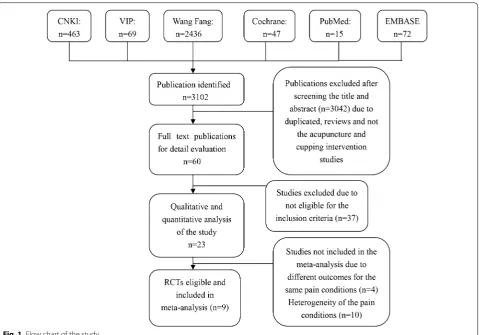
After primary searches from the 6 databases, 3102 stud-ies were identified. After screening title and abstract, the majority of studies were not included due to obvious ineligibility, and full texts of 3079 studies were retrieved.
Finally, 23 RCTs [18–40] were included in this review, 21
of which were published in Chinese and the remaining 2
[21, 40] were published in English. All of the 23 studies
were conducted in China (see Fig. 1).
Description of interventions
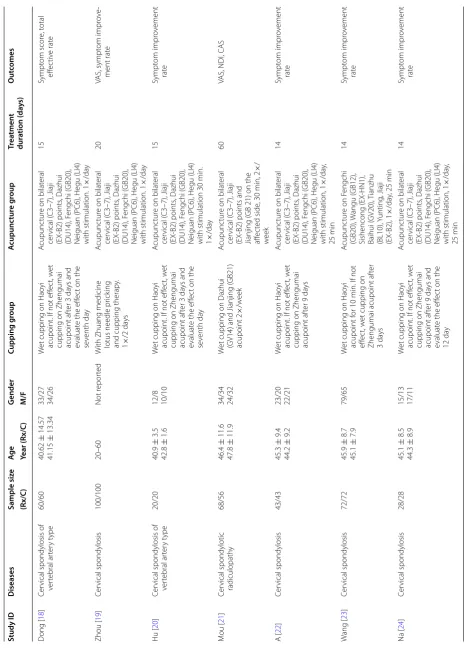
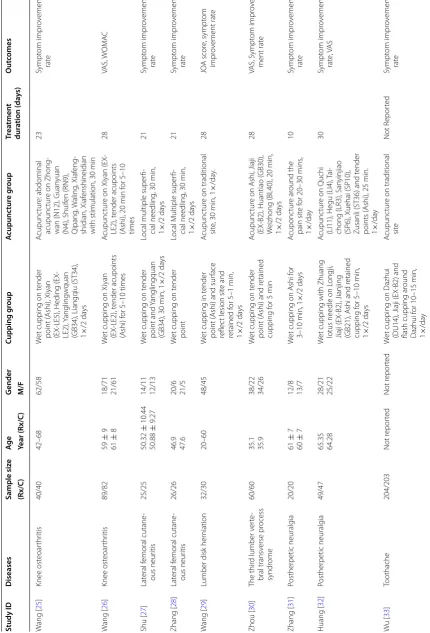
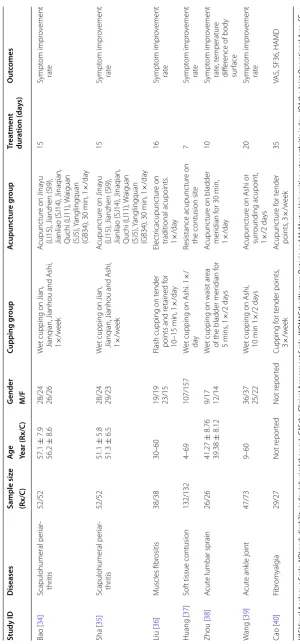
All the included studies compared cupping therapy with acupuncture. In the cupping group, 20 (86.96%)
stud-ies used wet cupping, and 3 [33, 36, 40] (13.04%) studies
used at least two types of cupping methods. Treatment
frequency in 3 [33, 36, 37] (13.04%) studies was once
daily, in 8 [19, 25, 27, 29, 31, 32, 38, 39] (34.78%)
stud-ies was once every 2 days, in 1 [21] (4%) study was twice
weekly, in 6 [18, 20, 22–24, 40] (26.08%) studies was 3
times weekly and in other 2 [34, 35] studies (8.6%) was
once weekly. The remaining 3 [26, 28, 30] (13.04%)
stud-ies not reported the frequency of the treatment. The treatment duration per session in 22 (95.7%) studies was
3–10 min, and in the remaining 1 [27] study was 30 min.
In the acupuncture group, 22 (95.6%) studies used man-ual acupuncture, and 1 (4.3%) study used
electroacu-puncture. Treatment frequency in 13 [18–20, 22–24, 29,
31, 32, 34–36, 38] (56.52%) studies was once a day, in 4
[27, 28, 30, 39] (17.39%) studies was once 2 days, in 1 [21]
(4.3%) study was once weekly, in another 1 [40] (4.3%)
study was 3 times weekly. The remaining 4 (17.39%) stud-ies not reported the treatment frequency. The treatment
duration per session was 20–30 min (Table 1).
Description of acupoints
In the cupping group, 22 (95.7%) studies used wet
cup-ping on tender points (Ashi), and 1 [38] (4.3%)
stud-ies chose the acupoints on the meridians passing the
pain area. In the acupuncture group, 4 [31, 37, 39,
40] (17.3%) studies only used tender points (Ashi) the
In general, the number of acupoints in acupuncture group is more than that in cupping therapy. According to the included studies of this review, it’s interesting to find that acupuncturists often selected acupoints according to syndrome differentiation, as well as the tender points (Ashi), while cupping therapy practitioners were more likely to choose the tender points (Ashi) for retaining cupping.
Distribution of diseases/conditions
Twelve diseases or conditions were treated in the
included RCTs (Table 1). The top 6 diseases/conditions
are cervical spondylosis [18–24], knee osteoarthritis [20,
21], lateral femoral cutaneous neuritis [27, 28], lumber
disk herniation [29, 30], postherpetic neuralgia [31, 32]
and scapulohumeral periarthritis [34, 35].
The pain-related conditions included locomotor pain (cervical spondylosis, lumber disk herniation, scapu-lohumeral periarthritis and knee osteoarthritis); tissue injury (soft tissue contusion, acute ankle joint); muscle pain (muscles fibrositis and fibromyalgia), neuralgia pain (lateral femoral cutaneous neuritis and postherpetic neu-ralgia) and acute pain (toothache). Relieving pain was the
main goal of the treatments for the included trials, and the study purposes of them were to compare the effec-tiveness on pain reduction between acupuncture and cupping therapy.
Outcome assessment
Twenty studies (86.95%) used the rate of symptom improvement as the primary outcome, which was defined as the rate of the sum of the cured, markedly effective and effective improvement. Symptom improvement was categorized into four grades (i.e. cured, markedly effec-tive, effeceffec-tive, and ineffective) according to the changes or improvement of the symptoms. ‘The cured’ was the disappearance of the pain symptoms, ‘markedly effective’ was the almost disappearance of the symptoms, ‘effec-tive’ was symptoms alleviation, and ‘ineffec‘effec-tive’ was no
changes in symptoms. Besides, 8 [18, 19, 21, 26, 29, 30,
32, 40] studies (34.78%) used numerical scales to
Table
1
C
har
ac
teristics of 23 included trials c
omparing cupping ther
ap y and acupunc tur e f or pain-r ela ted c onditions Study ID D iseases Sample siz e Ag e G ender Cupping g roup A cupunc tur e g roup Tr ea tmen t dur ation (da ys) O ut comes (Rx/C ) Year (Rx/C ) M/F D ong [ 18 ] Cer
vical spondylosis of
ver tebral ar ter y t ype 60/60 40.62 ± 14.57 41.15 ± 13.34 33/27 34/26 W
et cupping on Hao
yi
acupoint. I
f not eff
ec
t, w
et
cupping on Zhengumai acupoint af
ter 3
da
ys and
evaluat
e the eff
ec
t on the
se venth da y A cupunc tur
e on bilat
eral cer vical ( C3–7), Jiaji (EX ‑B2) points , Dazhui (DU14), F engchi ( GB20),
Neiguan (PC6), Hegu (LI4) with stimulation. 1
× /da y 15 Sympt om scor e, t otal eff ec tiv e rat e Zhou [ 19 ] Cer vical spondylosis 100/100 20–60 Not r epor ted W
ith Zhuang medicine lotus needle pr
ick
ing
and cupping therap
y. 1 × /2 da ys A cupunc tur
e on bilat
eral cer vical ( C3–7), Jiaji (EX ‑B2) points , Dazhui (DU14), F engchi ( GB20),
Neiguan (PC6), Hegu (LI4) with stimulation. 1
× /da y 20 VAS, sympt om impr ov e‑ ment rat e Hu [ 20 ] Cer
vical spondylosis of
ver tebral ar ter y t ype 20/20 40.9 ± 3.5 42.8 ± 1.6 12/8 10/10 W
et cupping on Hao
yi
acupoint. I
f not eff
ec
t, w
et
cupping on Zhengumai acupoint af
ter 3
da
ys and
evaluat
e the eff
ec
t on the
se venth da y A cupunc tur
e on bilat
eral cer vical ( C3–7), Jiaji (EX ‑B2) points , Dazhui (DU14), F engchi ( GB20),
Neiguan (PC6), Hegu (LI4) with stimulation 30
min. 1 × /da y 15 Sympt om impr ov ement rat e M ou [ 21 ] Cer vical spondylotic radiculopath y 68/56 46.4 ± 11.6 47.8 ± 11.9 34/34 24/32 W
et cupping on Dazhui (GV14) and Jianjing (
GB21) acupoint 2 × /w eek A cupunc tur
e on bilat
eral
cer
vical (
C3–7), Jiaji
(EX
‑B2) points and
Jianjing (
GB 21) on the
aff ec ted side , 30 min, 2 × / w eek 60
VAS, NDI, CAS
A [ 22 ] Cer vical spondylosis 43/43 45.3 ± 9.4 44.2 ± 9.2 23/20 22/21 W
et cupping on Hao
yi
acupoint. I
f not eff
ec
t, w
et
cupping on Zhengumai acupoint af
ter 9 da ys A cupunc tur
e on bilat
eral cer vical ( C3–7), Jiaji (EX ‑B2) points , Dazhui (DU14), F engchi ( GB20),
Neiguan (PC6), Hegu (LI4) with stimulation, 1
× /da y, 25 min 14 Sympt om impr ov ement rat e W ang [ 23 ] Cer vical spondylosis 72/72 45.9 ± 8.7 45.1 ± 7.9 79/65 W
et cupping on Hao
yi
acupoint f
or 10 min. I
f not
eff
ec
t, w
et cupping on
Zhengumai acupoint af
ter 3 da ys A cupunc tur
e on F
engchi (GB20), W angu (GB12), Sishencong (EX ‑HN1), Baihui (GV20), T ianzhu (BL10), Y unting , Jiaji (EX ‑B2), 1 × /da y, 25 min 14 Sympt om impr ov ement rat e Na [ 24 ] Cer vical spondylosis 28/28 45.1 ± 8.5 44.3 ± 8.9 15/13 17/11 W
et cupping on Hao
yi
acupoint. I
f not eff
ec
t, w
et
cupping on Zhengumai acupoint af
ter 9
da
ys and
evaluat
e the eff
ec
t on the
12 da y A cupunc tur
e on bilat
eral cer vical ( C3–7), Jiaji (EX ‑B2) points , Dazhui (DU14), F engchi ( GB20),
Neiguan (PC6), Hegu (LI4) with stimulation, 1
Table 1 c on tinued Study ID D iseases Sample siz e Ag e G ender Cupping g roup A cupunc tur e g roup Tr ea tmen t dur ation (da ys) O ut comes (Rx/C ) Year (Rx/C ) M/F W ang [ 25 ] Knee ost eoar thr itis 40/40 42–68 62/58 W
et cupping on t
ender
point (
A
shi), Xiyan
(EX
‑LE5), Heding (EX
‑
LE2), Y
anglingw
quan
(GB34), Liangqiu (ST34), 1×
/2 da ys A cupunc tur e: abdominal acupunc tur
e on Zhong
‑
wan (N12), Guan
yuan (N4), Shuif en (RN9), Qipang , W aling , Xiaf eng ‑ shidian, Xiaf enshineidian
with stimulation, 30
min 23 Sympt om impr ov ement rat e W ang [ 26 ] Knee ost eoar thr itis 89/82 59 ± 9 61 ± 8 18/71 21/61 W
et cupping on Xiyan (EX
‑LE2), t
ender acupoints
(A
shi) f
or 5–10 times
A
cupunc
tur
e on Xiyan (EX
‑ LE2), t ender acupoints (A shi), 20 min f or 5–10 times 28 VAS, W OM A C Shu [ 27 ] Lat eral f emoral cutane ‑ ous neur itis 25/25 50.32 ± 10.44 50.88 ± 9.27 14/11 12/13 W
et cupping on t
ender point and Y anglingquan (GB34), 30 min, 1 × /2 da ys
Local multiple super
fi‑ cial needling , 30 min, 1 × /2 da ys 21 Sympt om impr ov ement rat e Zhang [ 28 ] Lat eral f emoral cutane ‑ ous neur itis 26/26 46.9 47.6 20/6 21/5 W
et cupping on t
ender point Local M ultiple super fi‑ cial needling , 30 min, 1 × /2 da ys 21 Sympt om impr ov ement rat e W ang [ 29 ]
Lumber disk her
niation
32/30
20–60
48/45
W
et cupping in t
ender
point (
A
shi) and sur
face
reflec
t lesion sit
e and retained f or 5–1 min, 1 × /2 da ys A cupunc tur
e on traditional
sit e, 30 min, 1 × /da y. 28 JO A scor e, sympt om impr ov ement rat e Zhou [ 30 ] The thir
d lumber v
er te ‑ bral transv erse pr ocess syndr ome 60/60 35.1 35.9 38/22 34/26 W
et cupping on t
ender
point (
A
shi) and r
etained cupping f or 5 min A cupunc tur
e on A
shi, Jiaji
(EX
‑B2), Huantiao (
GB30),
W
eizhong (BL40), 20
min, 1 × /2 da ys 28 VAS, Sympt om impr ov e‑ ment rat e Zhang [ 31 ] Posther petic neuralg ia 20/20 61 ± 7 60 ± 7 12/8 13/7 W
et cupping on A
shi f
or
3–10 min, 1
× /2 da ys A cuponc tur e ar ound the pain sit e f
or 20–30 mins
, 1 × /da y 10 Sympt om impr ov ement rat e Huang [ 32 ] Posther petic neuralg ia 49/47 65.35 64.28 28/21 25/22 W
et cupping with Zhuang lotus needle on L
ongji,
Jiaji (EX
‑B2), Jianjing
(GB21), A
shi and r
etained cupping f or 5–10 min, 1 × /2 da ys A cupunc tur
e on Quchi
(LI11), Hegu (LI4),
Tai
‑
chong (LR3), San
yinjiao
(SP6), X
uehai (SP10),
Zusanli (ST36) and t
ender points ( A shi), 25 min. 1 × /da y 30 Sympt om impr ov ement rat e, V AS Wu [ 33 ] Toothache 204/203 Not r epor ted Not r epor ted W
et cupping on Dazhui (DU14), Jiaji (EX
‑B2) and
flash cupping ar
ound Dazhui f or 10–15 min, 1 × /da y A cupunc tur
e on traditional
Table 1 c on tinued Study ID D iseases Sample siz e Ag e G ender Cupping g roup A cupunc tur e g roup Tr ea tmen t dur ation (da ys) O ut comes (Rx/C ) Year (Rx/C ) M/F Bao [ 34 ] Scapulohumeral per iar ‑ thr itis 52/52 57.1 ± 7.9 56.2 ± 8.6 28/24 26/26 W
et cupping on Jian, Jianqian, Jianhou and A
shi, 1 × /w eek A cupunc tur
e on Jina
yu
(LI15), Jianzhen (SI9), Jianliao (SJ14), Jinaqian, Quchi
(LI11), W aiguan (SJ5), Y anglingquan (GB34), 30 min, 1 × /da y 15 Sympt om impr ov ement rat e Sha [ 35 ] Scapulohumeral per iar ‑ thr itis 52/52 51.1 ± 5.8 51.3 ± 6.5 28/24 29/23 W
et cupping on Jian, Jianqian, Jianhou and A
shi, 1 × /w eek A cupunc tur
e on Jina
yu
(LI15), Jianzhen (SI9), Jianliao (SJ14), Jinaqian, Quchi
(LI11), W aiguan (SJ5), Y anglingquan (GB34), 30 min, 1 × /da y 15 Sympt om impr ov ement rat e Liu [ 36 ] M uscles fibr ositis 38/38 30–60 19/19 23/15
Flash cupping on t
ender
points and r
etained f or 10–15 min, 1 × /da y Elec tr icacupunc tur e on traditional acupoints . 1 × /da y 16 Sympt om impr ov ement rat e Huang [ 37 ] Sof
t tissue contusion
132/132
4–69
107/157
W
et cupping on A
shi. 1 × / day Resistance acupunc tur e on
the contusion sit
e 7 Sympt om impr ov ement rat e Zhou [ 38 ] A cut
e lumbar sprain
26/26 41.27 ± 8.76 39.38 ± 8.12 9/17 12/14 W
et cupping on waist ar
ea
of the bladder mer
idian f or 5 mins , 1 × /2 da ys A cupunc tur
e on bladder
mer idian f or 30 min, 1 × /da y 10 Sympt om impr ov ement rat e, t emperatur e diff er
ence of body
sur face W ang [ 39 ] A cut e ank le joint 47/73 9–60 36/37 25/22 W
et cupping on A
shi, 10 min 1 × /2 da ys A cupunc tur
e on A
shi or sur rounding acupoint, 1 × /2 da ys 20 Sympt om impr ov ement rat e Cao [ 40 ] Fibr om yalg ia 29/27 Not r epor ted Not r epor ted Cupping f or t ender points , 3 × /w eek A cupunc tur e f or t ender points , 3 × /w eek 35
VAS, SF36, HA
MD VA S V isual A nalogue S cale , NDI neck disabilit y inde x (ph ysical ther ap y), CAS
the Clinical A
ssessmen t S cale , WOMA C the W est er n On tar
io and M
cM ast er Univ ersities ost eoar thr itis inde x, JOA the Join t Oper ational A rea, SF-36
the MOS it
em shor
t fr
om health sur
joint mobility, the MOS item short from health survey (SF-36), and the Hamilton Depression Scale (HAMD) for social activity.
Risk of bias assessment
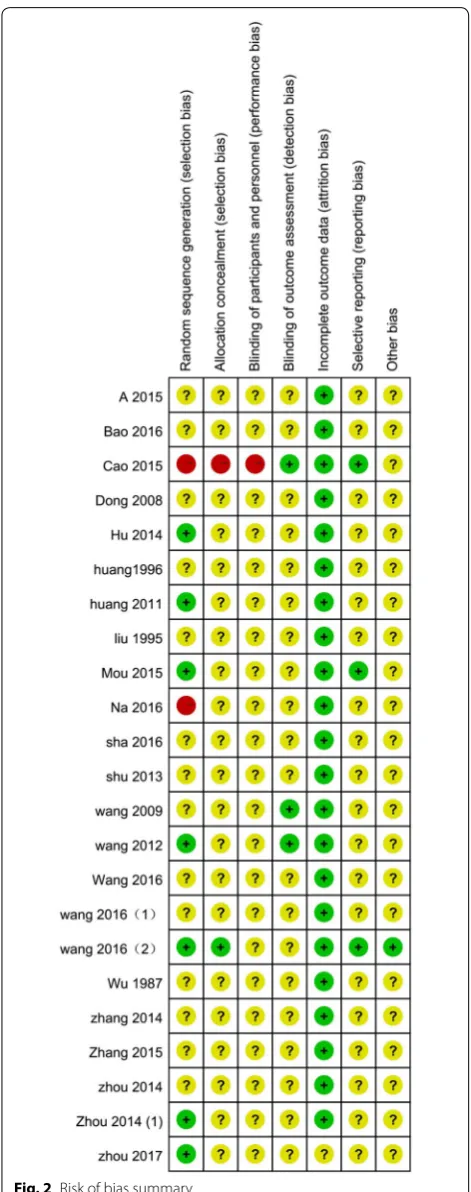
According to our pre-defined methodological qual-ity criteria, no study was evaluated as low risk of bias,
8 [19–21, 26, 29, 31, 32, 40] studies unclear risk of bias,
and the remaining 15 studies high risk of bias. The sam-ple size in each study varied from 40 to 407 participants with an average of 56 patients per group. None of the studies specified the sample size calculation. Eleven stud-ies described the details of randomization procedure.
Among them, 6 studies [19–21, 26, 29, 32] used a random
number table to generate the random allocation. One
study [27] was declared as ‘randomized controlled trial’,
however, it used a quasi-randomization method by divid-ing participants into two groups based on the sequence
of the registration order. Only 1 [26] of the above 11
stud-ies reported using sealed envelope to implement
alloca-tion concealment. Three studies [31, 39, 40] mentioned
they used blinding method, in which 2 studies [31, 40]
reported that they blinded outcome assessors, while the other one did not specify who were blinded. Two
stud-ies [21, 26] reported the number of dropouts, but none of
them used intention-to-treat analysis or other
appropri-ate methods to deal with the missing data (Fig. 2).
There were 19 (82.6%) studies reported the
comparabil-ity of baseline, but only 1 [40] study reported the baseline
data of both the outcomes and the demographic
charac-teristics of participants. Nine [19, 21, 26, 29, 31, 32, 34,
39, 40] (39.13%) studies reported the inclusion criteria,
and 9 [18, 19, 21, 26, 29, 31, 32, 38, 40] (39.13%)
stud-ies reported the exclusion criteria. Seventeen (73.91%) studies reported the diagnostic criteria (as we
men-tioned before). Only one protocol of a study [40] was
available which was registered in Clinicaltrials.gov, thus we acquired the protocol to supporting the judgment of reporting bias of this study and it was of low risk.
Effect estimates
Results from individual trials
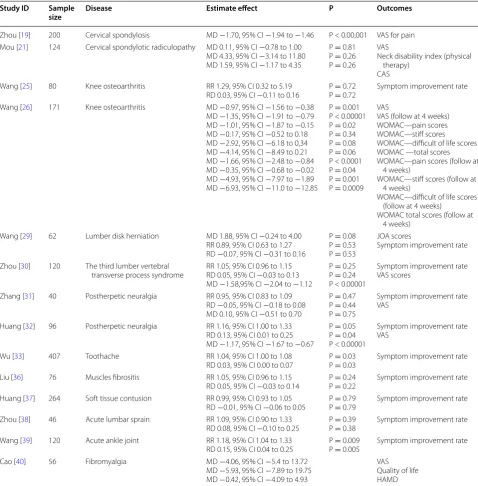
Due to the variations in study quality, participants’ charac-teristics and outcome measures of the included RCTs, data from 14 studies could not be synthesized by meta-analysis.
Among them, 11 [21, 25, 29–33, 36–38, 40] studies (78.5%)
reported that there was no statistical significant difference between cupping and acupuncture on the rate of symptom improvement for specific conditions, including cervical
osteoarthritis, toothache, muscles fibrositis, soft tissue contusion, acute lumber sprain, postherpetic neuralgia and
fibromyalgia. Three [19, 26, 39] studies reported cupping
might have better effects than acupuncture on increasing the total effective rate in acute ankle joint knee osteoar-thritis, acute lumbar sprain and the third lumber vertebral transverse process syndrome according to the VAS scores.
Table 2 shows the detailed results of the 14 studies.
Results from pooling analyses
Seven studies [18–24] compared acupuncture and
cup-ping therapy for cervical spondylosis, 2 [19, 21] of them
reported VAS scores and found cupping therapy was superior to acupuncture on pain relief, however, data could not be pooled due to the statistical heterogeneity
(I2 = 93%). One [18] of these two studies reported that
cupping had better effect on reducing VAS scores (MD
Table 2 Estimate effect of cupping therapy and acupuncture for pain-related conditions
VAS Visual Analogue Scale, MD mean difference, CAS the Clinical Assessment Scale, WOMAC the Western Ontario and McMaster Universities osteoarthritis index, JOA the Joint Operational Area, SF-36 the MOS item short from health survey, HAMD the Hamilton Depression Scale
Study ID Sample
size Disease Estimate effect P Outcomes
Zhou [19] 200 Cervical spondylosis MD −1.70, 95% CI −1.94 to −1.46 P < 0.00,001 VAS for pain Mou [21] 124 Cervical spondylotic radiculopathy MD 0.11, 95% CI −0.78 to 1.00
MD 4.33, 95% CI −3.14 to 11.80 MD 1.59, 95% CI −1.17 to 4.35
P = 0.81 P = 0.26 P = 0.26
VAS
Neck disability index (physical therapy)
CAS Wang [25] 80 Knee osteoarthritis RR 1.29, 95% CI 0.32 to 5.19
RD 0.03, 95% CI −0.11 to 0.16 P P == 0.72 0.72 Symptom improvement rate Wang [26] 171 Knee osteoarthritis MD −0.97, 95% CI −1.56 to −0.38
MD −1.35, 95% CI −1.91 to −0.79 MD −1.01, 95% CI −1.87 to −0.15 MD −0.17, 95% CI −0.52 to 0.18 MD −2.92, 95% CI −6.18 to 0,34 MD −4.14, 95% CI −8.49 to 0.21 MD −1.66, 95% CI −2.48 to −0.84 MD −0.35, 95% CI −0.68 to −0.02 MD −4.93, 95% CI −7.97 to −1.89 MD −6.93, 95% CI −11.0 to −12.85
P = 0.001 P < 0.00001 P = 0.02 P = 0.34 P = 0.08 P = 0.06 P < 0.0001 P = 0.04 P = 0.001 P = 0.0009
VAS
VAS (follow at 4 weeks) WOMAC—pain scores WOMAC—stiff scores WOMAC—difficult of life scores WOMAC —total scores WOMAC—pain scores (follow at
4 weeks)
WOMAC—stiff scores (follow at 4 weeks)
WOMAC—difficult of life scores (follow at 4 weeks)
WOMAC total scores (follow at 4 weeks)
Wang [29] 62 Lumber disk herniation MD 1.88, 95% CI −0.24 to 4.00 RR 0.89, 95% CI 0.63 to 1.27 RD −0.07, 95% CI −0.31 to 0.16
P = 0.08 P = 0.53 P = 0.53
JOA scores
Symptom improvement rate
Zhou [30] 120 The third lumber vertebral
transverse process syndrome RR 1.05, 95% CI 0.96 to 1.15RD 0.05, 95% CI −0.03 to 0.13 MD −1.58,95% CI −2.04 to −1.12
P = 0.25 P = 0.24 P < 0.00001
Symptom improvement rate VAS scores
Zhang [31] 40 Postherpetic neuralgia RR 0.95, 95% CI 0.83 to 1.09 RD −0.05, 95% CI −0.18 to 0.08 MD 0.10, 95% CI −0.51 to 0.70
P = 0.47 P = 0.44 P = 0.75
Symptom improvement rate VAS
Huang [32] 96 Postherpetic neuralgia RR 1.16, 95% CI 1.00 to 1.33 RD 0.13, 95% CI 0.01 to 0.25 MD −1.17, 95% CI −1.67 to −0.67
P = 0.05 P = 0.04 P < 0.00001
Symptom improvement rate VAS
Wu [33] 407 Toothache RR 1.04, 95% CI 1.00 to 1.08
RD 0.03, 95% CI 0.00 to 0.07 P P == 0.03 0.03 Symptom improvement rate Liu [36] 76 Muscles fibrositis RR 1.05, 95% CI 0.96 to 1.15
RD 0.05, 95% CI −0.03 to 0.14 P P == 0.24 0.22 Symptom improvement rate Huang [37] 264 Soft tissue contusion RR 0.99, 95% CI 0.93 to 1.05
RD −0.01, 95% CI −0.06 to 0.05 P P == 0.79 0.79 Symptom improvement rate Zhou [38] 46 Acute lumbar sprain RR 1.09, 95% CI 0.90 to 1.33
RD 0.08, 95% CI −0.10 to 0.25 P P == 0.39 0.38 Symptom improvement rate Wang [39] 120 Acute ankle joint RR 1.18, 95% CI 1.04 to 1.33
RD 0.15, 95% CI 0.04 to 0.25 P P == 0.009 0.005 Symptom improvement rate Cao [40] 56 Fibromyalgia MD −4.06, 95% CI −5.4 to 13.72
MD −5.93, 95% CI −7.89 to 19.75 MD −0.42, 95% CI −4.09 to 4.93
1.70 cm, 95% CI 1.46 to 1.94, n = 200) and the other
one [20] reported that cupping and acupuncture had
similar effects on decreasing VAS scores (MD −0.11 cm,
95% CI −1.0 to 0.78, n = 64). A meta-analysis was
con-ducted with the data from 6 [18–20, 22–24] studies
which reported the symptom improvement rate. The result showed that cupping had better effects on increas-ing symptom improvement rate (RR 1.13, 95% CI 1.01
to 1.26, P = 0.04, I2 = 67%; n = 646, 6 trials) than that
of acupuncture (Fig. 3). Symptom improvement rate of
cupping therapy was 10% higher than acupuncture (RD
0.1, 95% CI 0.01 to 0.19, P = 0.03, I2 = 67%; n = 646,
6 trials) (Fig. 3). The remaining 1 study [21] found no
significant difference between the two therapies on
changing of the VAS (MD −0.11 cm, 95% CI −0.92 to
2.62; n = 124), NDI (MD 4.33, 95% CI −3.14 to 11.80;
n = 124), and CAS scores (MD 1.59, 95% CI −1.17 to
4.35; n = 124).
Two studies [27, 28] assessed cupping therapy
com-pared with acupuncture for lateral femoral cutane-ous neuritis. The meta-analysis showed similar effects between cupping and acupuncture on increasing symp-tom improvement rate (RR 1.10, 95% CI 1.00 to 1.22,
P = 0.71, n = 100, 2 trials; RD 0.10, 95% CI 0.10 to 0.19,
P = 0.71, n = 100, 2 trials).
Two studies [34, 35] assessed cupping therapy
com-pared with acupuncture for scapulohumeral periarthritis. The meta-analysis showed similar effects between cup-ping and acupuncture on symptom improvement rate
(RR 1.31, 95% CI 1.51 to 1.51, P = 0.84; n = 208, 2 trials).
Cupping therapy was 22% higher than that of
acupunc-ture (RD 0.22, 95% CI 0.12 to 0.32, P < 0.0001; n = 208, 2
trials) in symptom improvement.
Funnel plot analysis could not be conducted due to the insufficient number of included trials in each meta-analysis.
Trial sequential analysis
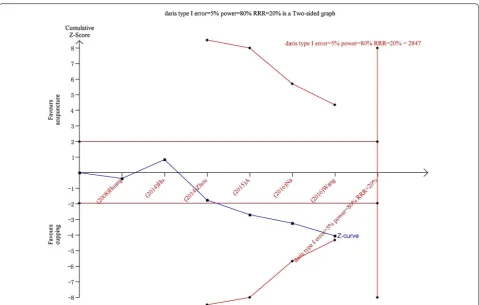
TSA was conducted with the data from 6 [18–20, 22–24]
studies which reported the symptom improvement rate for cervical spondylosis. TSA illustrated that the cumu-lative Z-curve (blue curve) only across the traditional boundary of 5% significance (horizontal red line) but did not cross the monitoring boundaries (red inward sloping curves), which is needed to obtain firm evidence con-trolling for the risk of random error. This resulted in a required information size of 2847 participants. TSA of all included trials suggests that about 18 high quality RCTs (2201 participants) were required to confirm possible
intervention effect (Fig. 4).
Adverse events
Seventeen (73.92%) out of the 23 studies did not report
the outcome on adverse event, and other 6 [24–27, 31,
32] (26.08%) studies reported that there was no adverse
event in both groups during the treatment.
Discussion
Summary of main findings
Twenty-three RCTs with 12 pain-related conditions were included in this review. The majority of the included studies had poor methodological quality according to cochrane risk of bias assessment. Manual or electro-acu-puncture were compared with cupping therapy (includ-ing wet cupp(includ-ing, mov(includ-ing cupp(includ-ing, flash cupp(includ-ing and retaining cupping) in these studies. Due to the obvious clinical or statistical heterogeneity, only data from ten studies could be pooled in three meta-analyses for cer-vical spondylosis, lateral femoral cutaneous neuritis and scapulohumeral periarthritis. It should be point out that though some of the included trials reported statistical significant differences between the two therapies accord-ing to the symptom improvement rate or pain relieve assessed by scales (such as VAS), according to clinical experience these differences have not achieved clinically
meaningful difference between cupping therapy and acu-puncture since the differences were too small (RR less
than 2 or MD of the VAS less than 3 cm) [41] and the
result of TSA for cervical spondylosis also indicated the character available data has not reached a powerful con-clusion. All of included studies showed similar effects of these two therapies on increasing symptom improvement rate and other pain reduction for the covered diseases/ conditions. No serious adverse events were reported from both groups.
Strengths and weakness
To the best of our knowledge, this review is the first sys-tematic review comparing cupping therapy with acu-puncture for pain-related conditions. The findings of our review might provide evidence-based information of the therapeutic effects of the two therapies to support clini-cal treatment decisions on pain-related conditions.
only three meta-analyses could be conducted with 2–6 studies in each. Though funnel plot analysis could not be conducted, most of the included studies were conducted and published in China, and outcomes of the original studies all got ‘positive’ conclusions, though some of which did not show any clinically meaningful difference between the two therapies. Therefore, the ‘uncertainty principle’ might be destroyed due to the ‘preference’ of the researchers and lead to publication bias.
Implication for clinical practice
Regardless the potential bias and limitations of this review, all of the included studies showed that cupping therapy had similar therapeutic effects with acupuncture in treating pain-related conditions (such as cervical pain, back pain, osteoarthritis, and acute soft tissue injury).
For pain-related conditions, cupping therapy and acu-puncture have different choice of acupoints. Based on our review, acupuncture often use two basic acupoints which are tenderness point (Ashi) and the meridians passing through the pain area; while for cupping therapy, wet cupping uses special acupoints (such as Haoyi for cervical spondylopathy) for local pain, and flash cupping combined with moving cupping often use the meridians passing through the pain area for widespread pain.
Considering the similar therapeutic effects of these two therapies, clinical practitioners may consider to choose any of them, based on their own clinical experience and the preference of patients.
Implications for future research
The methodological quality of included studies was gen-eral poor, therefore more well designed, conducted and reported RCTs are warranted in the future. Accord-ing to the Consolidated Standards of ReportAccord-ing Trials
(CONSORT) [42], randomization methods need to be
clearly described and fully reported. Although blinding of patients and practitioners might be very difficult for cupping therapy and acupuncture, we strongly suggest the blinding of outcome assessors should be attempted to minimize assessment bias. We also suggest future researchers to select outcome measures based on interna-tional consensus for relevant pain conditions. The study protocol is strongly suggested to be registered in
authori-tative registration plat form [43], such as WHO
interna-tional Clinical Trial Registration Platform (WHO ICTRP) or Clinicaltrial.com. The reporting of sample size calcula-tion, and using intention-to-treat analysis to deal missing data might be considered.
In addition, due to different treatment durations and variations of the cupping therapy and acupuncture, it is worthy developing cost-effectiveness analyses to fur-ther comparing these two TCM non-pharmaceutical
therapies, in order to find more economic clinical pro-cedure. Clinical equivalence trials with large sample size will be needed to confirm the non-significant differ-ence of effectiveness between acupuncture and cupping therapy. In addition, compliance, satisfaction and prefer-ence of participants to treatment would be considered to employ as outcome measurements in future study.
Conclusion
Currently, there are limited evidence shows that cupping therapy and acupuncture has similar effect on relieving pain and improving other symptoms of pain-related con-ditions. Larger and rigorously designed RCTs are needed to confirm this conclusion. Economic studied might be considered in the future to further compare the cost-effectiveness of cupping therapy and acupuncture.
Abbreviations
CI: confidence intervals; CAS: the Clinical Assessment Scale; HAMD: the Ham‑ ilton Depression Scale; JOA: the Joint Operational Area; MD: mean difference; NDI: neck disability index (physical therapy); RCT: randomized controlled trial; RD: risk difference; RR: risk ratio; REM: random‑effect model; SF‑36: the MOS item short from health survey; TCM: Traditional Chinese Medicine; TSA: trial sequential analysis; VAS: Visual Analogue Scale; WOMAC: the Western Ontario and McMaster Universities osteoarthritis index.
Authors’ contributions
HJC participated in the design of the study and drafted the manuscript. YJZ participated in extracted data, assessed study quality, analyzed data, performed the statistical analysis and drafted the manuscript. XYY, BYL participated in searched literature, identified clinical studies for inclusion and extracted data. XLL participated in extracted data and assessed study quality. GYY participated in the modification of the manuscript. JPL conceived of the study, and co‑developed the full text of the review and is the corresponding author. All authors read and approved the final manuscript.
Author details
1 Centre for Evidence‑Based Chinese Medicine, Beijing University of Chinese Medicine, 11 Bei San Huan Dong Lu, Beijing 100029, China. 2 The National Research Center in Complementary and Alternative Medicine (NAFKAM) Department of Community Medicine, Faculty of Health Science, UiT, The Arctic University of Norway, 9037 Tromsø, Norway. 3 National Institute of Comple‑ mentary Medicine, Western Sydney University, Sydney, NSW 2751, Australia.
Acknowledgements
We greatly thank Sun Jin for professional assistance in writing the manuscript and Yun Xia for expert assistance during the process of Trial sequential analysis.
Competing interests
The authors declare that they have no competing interests.
Availability of data and materials
All data used in this systematic review are fully available in the public domain.
Consent for publication Not applicable.
Ethics approval and consent to participate Not applicable.
Funding
Publisher’s Note
Springer Nature remains neutral with regard to jurisdictional claims in pub‑ lished maps and institutional affiliations.
Received: 26 April 2017 Accepted: 20 July 2017
References
1. Xu XQ, Xu QL, Xie SP, et al. Practice and consideration of non‑drug therapy in AIDS prevention and treatment. Chin J Tradit Chin Med Pharm. 2016;31:4912–5.
2. Shi XM. Acupuncture and moxibustion therapy. Beijing: People’s Medical Publishing House; 2001. p. 3.
3. Qaseem A, Wilt TJ, Mclean RM, et al. Noninvasive treatments for acute, subacute, and chronic low back pain: a clinical practice guideline from the American College of Physicians. Ann Intern Med. 2017. doi:10.7326/ M16‑2367.
4. MacPherson H, Vickers A, Bland M, et al. Acupuncture for chronic pain and depression in primary care: a programme of research. Southampton (UK): NIHR Journals Library; 2017. doi: 10.3310/pgfar05030.
5. Rubinstein SM, van Middelkoop M, Kuijpers T, et al. A systematic review on the effectiveness of complementary and alternative medicine for chronic non‑specific low‑back pain. Eur Spine J. 2010;19:1213–28. 6. Munoz‑ortego J, Solans‑Domenech M, Carrion C. Medical indications for
acupuncture: systematic review. Med Clin. 2016;147:250–6.
7. Qin ZS, Wu JN, Tian JH, et al. Network meta‑analysis of the efficacy of acu‑ puncture, alpha‑blockers and antibiotics on chronic prostatitis/chronic pelvic pain syndrome. Sci Rep. 2016;6:35737.
8. Deare JC, Zheng Z, Xue CCL, et al. Acupuncture for treating fibromyalgia. Cochrane Database Syst Rev. 2013;5:CD007070. doi:10.1002/14651858. 9. Linde K, Allais G, Brinkhaus B, et al. Acupuncture for migraine prophylaxis.
Cochrane Database Syst Rev. 2009;21:CD001218. doi:10.1002/14651858. 10. Gao LW. Practical cupping therapy (2004). Beijing: Academy Press; 2004. p.
5.
11. Chirali IZ. The cupping procedure. Traditional Chinese Medicine Cupping Therapy. London: Churchill Livingstone. 1999. p. 73–86.
12. Cao HJ, Han M, Li X, et al. Clinical research evidence of cupping therapy in China: a systematic literature review. BMC Complement Altern Med. 2010;10:70–80.
13. Cao H, Han M, Zhu X, Liu J. An overview of systematic reviews of clinical evidence for cupping therapy. J Tradit Chin Med Sci. 2015;2:3–10. 14. Cao H, Li X, Liu J. An updated review of the efficacy of cupping therapy.
PLoS ONE. 2012;7:e31793.
15. Cao HJ, Zhu CJ, Liu JP. Wet cupping therapy for treatment of herpes zoster: a systematic review of randomized controlled trials. Altern Ther Health Med. 2010;16:48–54.
16. World Health Organization. International statistical classification of dis‑ eases and health related problems. Geneva: World Health Organization; 2008.
17. Higgins JPT, Green S, et al. Cochrane handbook for systematic reviews of interventions, version 5.0.1 [updated September 2008]. The Cochrane Collaboration. 2008. http://www.cochrane‑handbook.org. Accessed 27 Mar 2010.
18. Dong YL, Ari GT. Clinical study of bloodletting therapy in the treat‑ ment of cervical spondylosis of vertebral artery type. Inn Mong Med J. 2008;04:409–11.
19. Zhou H, Huang GH, Li XM, et al. Lotus needling cupping of Zhuang medicine by clinical observation of 100 cases of blood stasis in treatment of cervical spondylosis. Sichuan J Tradit Chin Med. 2014;12:142–3. 20. Huge JLT, Hexi GBT. Mongolian medicine therapy treatment of vertebral
artery type cervical spondylosis, theory study and clinical analysis. Latest Med Inf Abstr. 2014;04:208–9.
21. Mou MY, Pu SA, Meng XW, et al. Thorn complex therapy curative effect observation of treatment of cervical spondylosis of nerve root type. J Acupunct Tuina Sci. 2015;04:236–41.
22. Amu GL. Clinical observation of 43 cases of bleeding and cupping therapy in the treatment of cervical spondylosis. Chin J Natl Med. 2015;11:8–9.
23. Wangsu RKLT. Mongolian medicine cupping bloodletting therapy to treat 72 cases of cervical spondylosis clinical observation. Chin J Med. 2016;9:27–8.
24. Nayin HY. Clinical observation of 28 cases of bleeding and cupping therapy in the treatment of cervical spondylosis. Chin Folk Med. 2016;2:6. 25. Wang PL. Observation of abdominal acupuncture combined with plum
blossom needle therapy and cupping therapy in the treatment of knee osteoarthritis curative effect. Clin J Chin Med. 2016;8:100–2.
26. Wang B, Liu XR, Hu ZH, et al. The “Yang” pricking and cupping therapy for knee osteoarthritis: a multicenter randomized controlled study. Zhong Guo Zhen Jiu. 2016;36:113–8.
27. Shu Q, Jiao Y. Plum blossom needle combined with cupping bloodletting in treating 25 cases of lateral femoral cutaneous neuritis. Hunan J Tradit Chin Med. 2013;6:71–2.
28. Zhang W, Wang XQ. Plum blossom needle and 26 cases of lateral femoral cutaneous neuritis treated with flash cupping. Hunan J Tradit Chin Med. 2014;04:96–7.
29. Wang H, Wang L, Zhang XL, et al. Clinical observation of acupuncture and cupping in the treatment of lumbar disc herniation. Shandong J Tradit Chin Med. 2012;12:875–6.
30. Zhou SD, Li J, Liang Z. 60 cases of bloodletting therapy in the treatment of the third lumbar transverse process syndrome. Guiding J Tradit Chin Med. 2014;16:93–4.
31. Zhang YX. Comparison of different methods of acupuncture treatment of residual neuralgia of herpes zoster. Shanghai J Acu‑mox. 2015;34:620–2. 32. Huang JM, Han HT, Li J, et al. To observe the curative effect of the treat‑
ment of postherpetic neuralgia of lotus needle cupping. Guangxi Tradit Chin Med. 2011;01:31–2.
33. Wu JS. To explore the treatment and mechanism of acupuncture and cupping toothache. China, Beijing: the establishment of the world federation of acupuncture and moxibustion and the first international symposium on acupuncture and moxibustion. 1987.
34. Bao S, Wuyun QQG. Clinical research on Mongolian medicine bloodlet‑ ting therapy in treating 52 cases of scapulohumeral periarthritis. Chin J Natl Med. 2016;11:8–9.
35. Sharen YT. The bleeding and cupping therapy in the treatment of periarthritis of shoulder: clinical observation of 52 cases. Chin J Natl Med. 2016;02:7–8.
36. Liu LJ. 40 cases of cellulitis electroacupuncture plus cupping treatment of muscle fiber. Zhong Guo Zhen Jiu. 1995;02:20.
37. Huang W. To observe the resistance of acupuncture and pricking blood purification blood in the treatment of soft tissue contusion curative effect. Chin J Sports Med. 1996;01:74–5.
38. Zhou X, Ao H, Mao X, et al. Seven Star needle buckle thorn cupping clini‑ cal observation on the treatment of acute lumbar sprain. J Emerg Tradit Chin Med. 2017;26:103–5.
39. Wang WZ. Cupping treatment of acute ankle sprain in 73 cases. Shanghai J Acupunct Moxibustion. 2009;05:282.
40. Cao HJ, Liu J, Li T, Hu H. Cupping therapy for fibromyalgia: interim results from a partially randomized patient preference study. Integr Med Res. 2009;4(1):14.
41. Guyatt GH, Oxman AD, Sultan S, Glasziou P, AKl EA, Alonso‑Coello P, Atkins D, Kunz R, Brozek J, Montori V, Jaeschke R. GRADE guidelined: 9. Rating up the quality of evidence. J Clin Epidemiol. 2011;64(12):1311–6.
42. CONSORT Statement 2001‑Checklist: Items to include when reporting a randomized trial. (http://www.consort‑statement.org).