Introducing Positive Leadership in the teaching & learning
process of Higher Education
Benito, A
1; Canteri, K
2; Grimley, M
3; Khanka, S
4; Lajud Desentis, C
5; Moreno
Melgarejo, A
6; Morley, S
7; Paul, N
8; Vasu, T
9.
1
(Laureate, US)
2
(Torrens University Australia, Australia)
3
(Torrens University Australia, Australia)
4
(UPES, India)
5
(Universidad Europea de Madrid, Spain)
6
(Universidad Europea de Madrid, Spain)
7
(Torrens University Australia, Australia)
8
(Pearl Academy, India)
9
(Pearl Academy, India)
ABSTRACT : Enhancing the effectiveness of the learning process in Higher Education requires enough doses of creativity, which can be inspired by successful initiatives that have worked in other fields. This is the case with Positive Leadership (PL), whose principles and implementation strategies have been well researched, and whose efficacy has been demonstrated across a diverse range of contexts and organizations. Thus, Positive leadership is positioned very favorably to be also tested in an educational environment. This article describes how a team of faculty members from several universities are working together to be able to transfer the Positive leadership principles (positive meaning, positive communication, positive relationships and positive climate) to the teaching-learning process, under the hypothesis that it will improve academic performance, student satisfaction with faculty and the engagement of faculty members.
KEYWORDS: Higher Education; Positive leadership; Learning effectiveness; Human interactions;
Engagement.
I. Positive Leadership
Towards the end of 1990, Martin Seligman and his team introduced the concept of „Positive Psychology‟ and subsequently developed an approach, which focuses on developing people‟s strengths, instead of focusing on their weaknesses. The focus of this work was on defining, measuring and improving „psychological capital.‟ Psychological capital is defined as “an individual‟s positive psychological state of development characterized by: (1) having confidence (efficacy) to take on and put in the necessary effort to succeed at challenging tasks; (2) making a positive attribution (optimism) about succeeding now and in the future; (3) persevering toward goals and, when necessary, redirecting paths to goals (hope) in order to succeed; and (4) when beset by problems and adversity, sustaining and bouncing back, and even beyond (resilience) to attain success” (Luthans et al, 2013) [4].
Beyond the thousands of studies and publications regarding leadership, a more recent theory called Positive Leadership (Cameron, 2012) [5], has produced extraordinary success in numerous practical contexts, across a variety of organizations, demonstrating extremely positive results. Positive Leadership focuses on strengths and the enhancement of virtuous behaviors. Its principles can easily become practical applications based on the implementation guides that its author proposes.
Positive Leadership is an example of evidence-based management principles, that demonstrate positive deviant performance (Cameron, 2012) [5]. The application of Positive Leadership establishes conditions that enable everyone to perform at his or her best all of the time, thus resulting in extraordinary outcomes. Cameron‟s model has four leadership strategies that include: fostering a positive climate, developing positive relationships, engaging in positive communication, and reinforcing positive meanings. To enable positive change a leader applies these four strategies to his/her professional or personal environment.
II. Positive Education
Positive Leadership principles were developed from a business/organizational perspective to improve organizational outcomes. Positive Education on the other hand was developed from a Positive Psychology perspective with the aim of improving educational outcomes, the two perspectives align very well and taken together represent a strong evidence base for improvements to the teaching and learning process in Higher Education. Positive Education (PE) has a fairly recent history that appears to stem from applying the principles of positive psychology in an educational environment (Green, Oades& Robinson, 2011 [6]; Cintra & War, 2017 [7]). One of the founders of positive psychology, Professor Martin Seligman, a Professor of Psychology at the University of Pennsylvania, has been a driving force in the embedding and application of such principles into a school environment and the beginning of the positive education professional community (Norrish, Williams, O‟Connor & Robinson, 2013 [8]).
Positive psychology is defined as „the study of the conditions and processes that contribute to the flourishing or optimal functioning of people, groups, and institutions‟ (Gable & Haidt, 2005) [9]. It focuses on people‟s strengths, positive communication and achieving happiness and optimal wellbeing (Seligman, Ernst, Gillham, Reivich, &Linkins, 2009) [10]. It is a rapidly expanding area of research (Rusk & Waters, 2013) [11] but quantitative studies on the impact and application in actual work environments are less available, providing future research opportunity.
Positive Education can be defined as “a blend of evidence-based learning from the science of positive psychology and best practices in learning and teaching” (White, 2016) [12]. Oades, Robinson, Green & Spence (2011) [13] define it as “the development of educational environments that enable the learner to engage in established curricula in addition to knowledge and skills to develop their own and others wellbeing”.
What is clear and agreed upon is that Positive Education encompasses the flourishing of students and staff, the promotion of wellbeing alongside academic performance and the longer term positive impact on societies and communities (Cintra & War, 2017) [7].
Positive Education (Bott, Escamilia, Kaufman, Kern, Krekel, Schlicht-Schmälzle, Seldon, Seligman, & White, 2016)14, which included three case studies involving: Caulfield Grammar School, St Peter‟s College (both in Australia and at secondary school level) and Tecmilenio University in Mexico.
With the assistance of Dr Seligman and his team, Caulfield Grammar School (CGS) was the first to launch a positive education curriculum and apply the principles with a whole school, „learn it, live it, teach it, embed it’ approach (Seligman et al, 2009) [10]. Norrish, Williams, O‟Connor and Robinson (2013) [8] discuss the model and its implementation alongside the perceived benefits to student mental health and academic skill development. Character strengths are fundamental to the CGS model which is implemented through six wellbeing characteristics: 1) positive health, 2) positive purpose, 3) positive relationships, 4) positive emotion, 5) positive engagement, and 6) positive accomplishment. These wellbeing characteristics are based on Seligman‟s PERMA model of psychological wellbeing - positive emotions, engagement, relationships, meaning and accomplishment (Kern, Waters, Adler & White, 2015) [14], and are well aligned to the Positive Leadership principles, supporting the alliance between positive psychology, positive leadership and positive education (Norrish et al, 2013 [8]; Cameron, 2012 [5]; Bott et al, 2016 [15]). The school has since started the Institute in Positive Education which has trained more than 10,000 educators from more than 600 schools to implement a Positive Education model.
St Peter‟s College in Adelaide has also embraced Positive Education, with all students attending weekly classes since 2011 (White, 2016) [12]. Staff are trained in an evidence-based approach to teaching incorporating Positive Education and best practice whilst students focus on wellbeing characteristics and strength based approaches. An empirical study to assess the impact of the PERMA framework using a wellbeing questionnaire was completed with 516 male students at St Peter‟s College and concluded that it was a valid instrument to utilize in positive education (Kern et al, 2015) [14].
Whilst secondary schools are dominating when it comes to Positive Education, Tecmilenio University in Mexico is leading the way in the higher education sector. Launching its new model in 2013, it aims to combine student academic success and employability with that of the student‟s wellbeing, happiness and value to the community (Bott et al, 2016) [14]. Also, based on Seligman‟s PERMA model, its vision is: “to form people with life purpose and the competences to achieve it”.
Oades, Robinson, Green and Spence (2011) [13] explore the idea of a „positive university‟ and apply the PERMA wellbeing characteristics across five contexts at a university level including the classroom, faculty, social and local community, confirming the relevance and benefits of such principles at a tertiary level and recommending expanding the research to Universities.
Positive Education and the application of positive psychology in an educational ecosystem, appears to have much to offer with the key outcomes of wellbeing, happiness and academic engagement but with the need for good empirical research in an applied setting. Aligning it with the more established and evidence based Positive Leadership approach which not only teaches but integrates and enhances character strengths and positive behaviors should provide an excellent opportunity for research leading to innovative and enhanced teaching and learning practice.
III. Description of this proposal
After having made the strategic decision of incorporating the principles of Positive Leadership into the managerial style of our network of universities, a group of academics became enthusiastic about the idea of also introducing Positive Leadership in the teaching and learning process, with the intention of promoting as extraordinary results in our universities as those of so many other organizations that adopted it before.
generate better learning outcomes. This is exactly what a few faculty members believed, and what will shortly be piloted in their four respective universities.
By introducing Positive Leadership in the teaching and learning process, we expect to…
• Humanize the teaching & learning process
• Increase faculty and student engagement
• Increase student satisfaction
• Reduce attrition
• Improve learning effectiveness and overall academic outcomes
As a first step, the faculty members involved in this project have created a „translation‟ of the PL principles to the teaching and learning process, developing a document with Faculty Guidelines which has been endorsed by Kim Cameron (the father of Positive leadership).
The working team started asking themselves numerous questions to frame the recommendations to faculty regarding each of the pillars of Positive Leadership. Outlined below includes an overview of them:
Enhancing positive meaning:
People define work in terms of job, career or calling, in the same manner that students define their university experience as a degree, a professional career or a passion. Can we encourage more students to have dreams and passions that guide their learning? Can we expose students to their future professional lives and make them see the positive impact of their future work on society and the world?
Enhancing a positive climate:
Can we make positive emotions predominate over negative emotions in our classes? Productivity, innovation and quality improve in organizations where compassion, forgiveness and gratitude are fostered. Would a similar effect occur regarding students´ outcomes if we fostered those same behaviors in Higher Education? Can we create an improved learning community? A more humanized interaction among faculty and students that enhances learning? Also, since positive practices demonstrate a high correlation to positive health, is there an opportunity to reduce stress often associated with student years and improve performance?
Enhancing positive communication:
Research shows that people who experience a greater number of positive emotions than negative ones work harder, perform better in their jobs, show more mental acuity, make higher quality decisions and are more creative. With this in mind, can we replace negative and critical language with affirmative and positive language in our classes? Can we make the strengths of our students play an even more relevant role in succeeding in our subject? Can the nature of the feedback we provide to them become more positive and encouraging?
Enhancing positive relationships:
Can we make the classroom become an environment of positive relationships, where interactions will be a be a generative source of enrichment, vitality and learning? Let us not only think of remediation, but also of strengthening existing knowledge and strong performance, could we do that? What about engaging our students even more actively in their learning experience? Can we intensify the role of the positive energizers, fostering peer interactions, mutual support and learning effectiveness beyond our own possibilities?
Figure 1: Faculty development program
[Source: own elaboration]
Figure 2: Design of the pilot study
[Source: own elaboration]
IV. Faculty Guidelines
1. Positive meaning 2. Positive climate
1. Bring the ethical, professional and academic context to your subject
2. Tie the subject learning outcomes with the program learning outcomes, and the latter with the
Institution's philosophy, values and attributes 3. Integrate academic skills with subject content which
provides context and purpose
4. Connect student goals with career paths - provide context: 'why did I choose this course and how is it going to help me become the professional I want to be'
5. Introduce discussions about the contributions of exemplary figures related to your subject 6. Take the students on a field trip to a relevant
institution or company reinforcing the relationship between academic contents and the professional world.
7. Link your subject to the work of some social organization that acts in a related field
8. Provide opportunity for 'Here for Good' activities within the course e.g. volunteer in discipline/field to connect the course outcomes with community benefit e.g. our Wellbeing Clinic for student practitioners provides a positive impact on the local community
9. Give awards for outstanding contributions to community impact activities and acknowledge students and staff who positively contribute to campus life i.e. positive energizers
1. Create a student centered environment
2. Start your subject with personal introductions and do your best to learn the students´ names. 3. Be sensitive to difficult personal situations and,
when possible, do your best to help or to make it possible for other students to help
4. Remind students of the principles of team work, and demonstrate that shows how collaboration can take you further than competition
5. Create a culture of abundance: more and better, should lead to more and better.
6. Set the rules for the use of technology in the classroom. The use of cellphones and computers during class are exclusively meant to enrichen everybody´s learning experience
7. Ensure human interaction (faculty-student, student-faculty and student-student) in every class 8. Provide praise and encouragement when progress
is made
9. Allow for an Advanced Team of students to be formed: more work, more learning, more challenging outcomes like a publication. Also, extra support from you!
3. Positive communication 4. Positive relationships
1. Create a participative environment, call students by their names, ask questions, and make engaging comments
2. Make every student feel valuable and provide them with some degree of personalized attention 3. In every class, keep the 5:1 ratio for positive
comments. Provide negative feedback in a positive, supportive, developmental manner
4. Try asking more questions to replace instructions and direct conclusions
5. Double check your written language for constructive expressions and positive remarks
6. Focus on behaviors and performance, not the person, his/her skills or limitations
7. Practice and teach students to use, supportive communication: descriptive vs evaluative; problem-centered vs person-problem-centered; validating; response types
8. Involve students in peer to peer assessment and help them provide constructive feedback to each other 9. Generate opportunities for mutual recognition
among students
1. Create a 'Teacher presence' through building trust, rapport and engaging in discussions
2. Create a 'social presence' through pastoral care, posting announcements & videos, reaching out to students at risk and engage in discussion forums 3. Set positive learning targets for each class 4. Diagnose the positive energy network in the class
and help students create their own positively energizing networks
5. Identify positively energizing students by observing them and/or by asking students to identify the top energizers
6. Create the conditions for the positively energizers to energize and develop other students around them, e.g. making them team leaders, etc. 7. Be supportive and make students understand that
asking for help does not make us weaker, but stronger
8. Also, when it comes to learning… everyone has needs, and everyone can help. Identify a strength in everyone and offer it to others who might benefit from it
9. Make the Advanced Team of students tutor others as part of their own development
Table 1.
Faculty guidelines to implement positive leadership strategies
V. Faculty Profile
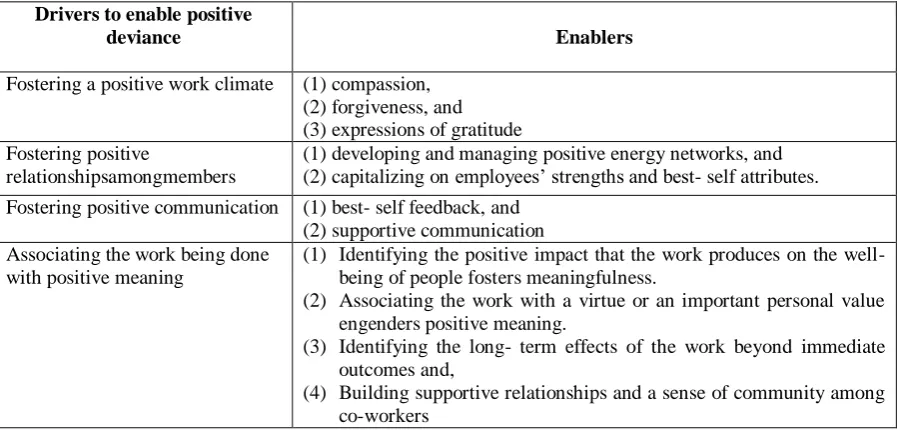
Faculty members are leaders in the classroom, and potential enablers of positive deviant behavior within the teaching and learning process. Therefore, in order to successfully achieve that goal, it is crucial to adopt some of the characteristics of positive leaders to. According to Cameron (2012) [5], the following propositions summarize the empirical findings associated with each strategy and become guidelines for leaders who aspire to enable positive deviance in their organizations.
Drivers to enable positive
deviance Enablers
Fostering a positive work climate (1) compassion, (2) forgiveness, and (3) expressions of gratitude Fostering positive
relationshipsamongmembers
(1) developing and managing positive energy networks, and (2) capitalizing on employees‟ strengths and best- self attributes. Fostering positive communication (1) best- self feedback, and
(2) supportive communication Associating the work being done
with positive meaning
(1) Identifying the positive impact that the work produces on the well- being of people fosters meaningfulness.
(2) Associating the work with a virtue or an important personal value engenders positive meaning.
(3) Identifying the long- term effects of the work beyond immediate outcomes and,
(4) Building supportive relationships and a sense of community among co-workers
Table 2. Drivers to enable positive deviance
Source: adapted from Cameron (2012: 124-130)5
Additionally, we know that numerous examples can be found in the literature about the profile of effective instructors. Ralph (2003) [16]identified five attributes of effective instructors: commitment to learners; knowledge of material; organization and management of the environment; desire to improve; and collaboration with others. Delaney et al. (2010) [17]also analyzed student‟s perceptions of effective teaching in higher education, identifying and listing the main characteristics for effective instructors according to the students as follows:
Position Characteristic Other adjectives that students used to describe this set of behaviors
1 Respectful fair, understanding, flexible, caring, patient, helpful, compassionate, open-minded, sincere, diplomatic, concerned, reasonable, consistent, kind, empathetic, humble, trustworthy, and realistic
2 Knowledgeable flexible, competent, eclectic, credible, current, practical, reflective, and qualified.
3 Approachable friendly, personable, helpful, accessible, happy and positive
4 Engaging enthusiastic, interesting, passionate, motivating, creative, positive, charismatic, stimulating, interactive, energetic, and assertive.
5 Communicative clear, understandable, thorough, constructive, and attentive. 6 Organized efficient, focused, and prepared.
7 Responsive helpful, efficient, perceptive and accommodating
8 Professional dedicated, punctual, dependable, efficacious, hygienic, and confident. 9 Humorous happy and positive
Table 3. Student´s perceptions of effective teaching in higher education
After compiling and analyzing the various profiles and positive behaviors, the authors of the present paper believe that, when it comes to incorporating positive leadership in the teaching and learning process, some characteristics of the instructor are better aligned with positive outcomes. Those key attributes are listed below:
• Dedicated and focused on others: Respectful; Good listener; Expresses interest in student ideas; Available; Offers support inside and outside the classroom.
• Enthusiastic and energizing: Shows passion and enthusiasm for teaching; Provides energy; Encourages active student participation in class; Guides and supports student engagement; Motivates, drives and an inspires students
• Positive and exemplary: Likes people, believes in them and is happy to help them grow; Has a positive attitude to life; Sees opportunities where other might only see problems, challenges or risks; Communicates and behaves in an assertive manner, avoiding aggressiveness and submission; Leads by example
VI. Recommendations for implementing positive leadership in the teaching and learning
process
Higher education institutions should strive to employ and develop teaching staff that demonstrate the characteristics of transformational instructor-leaders. According to Balwant (2016) [18], the benefits of doing so are twofold. First, such leadership is associated with increased students‟ motivation and learning, Second, transformational instructor-leadership is associated with perceptions of instructor credibility and student satisfaction. To maximize positive leadership implementation in the teaching and learning process we outline some recommendations to be taken into consideration.
Recruitment criteria. In order to be able to reinforce positive leadership in the teaching and learning process, department heads and HR teams should take into consideration the faculty profile previously defined when recruiting new faculty members.
Professional development opportunities. To help the existing faculty evolve toward transformational instructor-leaders profile, there is a need to focus on training. The training of instructor-leadership can be described in four phases, including assessment, design, implementation, and evaluation (DeSimone & Werner, 2006) [19]
Planning class delivery. Prior to starting the subject, instructors should thoroughly plan the incorporation of the various tools, techniques and resources. The creation of a specific timetable for concrete actions to be implemented, as part of a comprehensive pedagogical framework can be very useful.
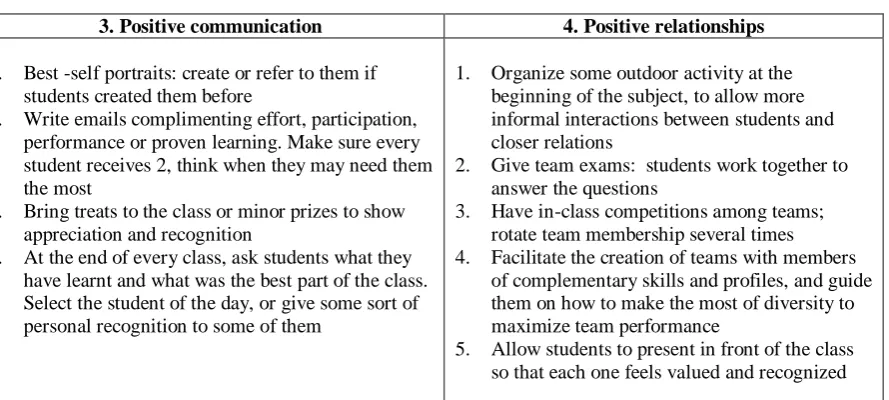
Implementing and using the tools. The table at the bottom of this section contains specific practices for the implementation of Positive Leadership in the teaching and learning process.
Continuous improvement. After finishing the subject, the instructor should analyze the outcomes and find further means of improving the learning of the students. When planning improvement, the direct voice of the students will be essential, as well as sharing with other faculty members and academic leaders.
1. Positive meaning 2. Positive climate
1. Help students identify and clarify their own core values
2. Link your class to the students´ Everest goals 3. Have students interview or research about their
own examples of inspirational leaders
4. Provide opportunities for students to contribute in meaningful ways as part of class assignments 5. Debate on human values and its role in the
students´ future professions
1. With international students, learn their nationality, try to say something in their language or about their country at some point during the term and be concerned for their welfare.
2. Share testimonies of how you overcame struggles as a learner
3. Introduce reciprocity rings as an additional tool to connect students with each other and build faculty/student relationships
3. Positive communication 4. Positive relationships
1. Best -self portraits: create or refer to them if students created them before
2. Write emails complimenting effort, participation, performance or proven learning. Make sure every student receives 2, think when they may need them the most
3. Bring treats to the class or minor prizes to show appreciation and recognition
4. At the end of every class, ask students what they have learnt and what was the best part of the class. Select the student of the day, or give some sort of personal recognition to some of them
1. Organize some outdoor activity at the beginning of the subject, to allow more informal interactions between students and closer relations
2. Give team exams: students work together to answer the questions
3. Have in-class competitions among teams; rotate team membership several times 4. Facilitate the creation of teams with members
of complementary skills and profiles, and guide them on how to make the most of diversity to maximize team performance
5. Allow students to present in front of the class so that each one feels valued and recognized
Figure 4. Suggested tools to be used in order to implement positive leadership in the teaching and learning process.
Source: own elaboration
References
[1] Hemphill, J. K., and Coons, A. E. (1957). Development of the Leader Behavior Description Questionnaire. In R. M. Stogdill and A. E. Coons (Eds.), Leader behavior: Its description and measurement. Columbus, OH: Bureau of Business Research, Ohio State University
[2] Stogdill, R. M. (1974). Handbook of leadership: A survey of theory and research. New York: Free Press
[3] Goldberg, L. R. (1990). Standard markers of the Big-Five factor structure. Unpublished report, Oregon Research Institute
[4] Luthans, Fred, Carolyn M. Youssef, David S. Sweetman, and Peter D. Harms. 2013. “Meeting the Leadership Challenge of Employee Well-Being through Relationship Psycap and Health PsyCap.” Journal of Leadership and Organizational Studies 20(1):118–33.
[5] Cameron, K. (2012). Positive Leadership: Strategies for Extraordinary Performance. San Francisco: Berrett-Koehler Publishers.
[6] Green, S., Oades, L. & Robinson, P. (2011). Positive education: Creating flourishing students, staff and schools. InPsych, 33 33. 16-18.
[7] Cintra, C. L., & Martins, G.V. (2017). Positive Education: The Application of Positive Psychology to Educational Institutions. School and Educational Psychology, 21(3), 505-514. https://dx.doi.org/10.1590/2175-35392017021311191
[8] Norrish, J. M., Williams, P., O‟Connor, M., & Robinson, J. (2013). An applied framework for positive education. International Journal of Wellbeing, 3(2), 147-161. doi:10.5502/ijw.v3i2.2
https://www.researchgate.net/publication/228341568_What_and_Why_Is_Positive_Psychology [accessed May 07 2018].
[10] Seligman, M., Ernst, R., Gillham, J., Reivich, K., &Linkins, M. (2009). Positive education: Positive psychology and classroom interventions. Oxford Review of Education, 35(3), 293-311. doi:10.1080/03054980902934563
[11] Rusk, R., & Waters, L. (2013). Tracing the size, reach, impact, and breadth of positive psychology. The Journal of Positive Psychology, 8(3), 207-221. doi:10.1080/17439760.2013.777766
[12] White, M. (2016). Why won‟t it Stick? Positive Psychology and Positive Education. Psychology of Well-Being (2016) 6:2 DOI 10.1186/s13612-016-0039-1
[13] Oades, L. G., Robinson, P., Green, S., & Spence, G. B. (2011). Towards a positive university. Journal Of Positive Psychology, 6(6), 432-439. doi:10.1080/17439760.2011.634828
[14] Kern, M.L., Waters, L.E., Adler, A. & White, M.A. (2015) A multidimensional approach to measuring well-being in students: Application of the PERMA framework, The Journal of Positive Psychology, 10:3, 262-271, DOI:10.1080/17439760.2014.936962
[15] Bott, D., Escamilia, H., Kaufman, S.B., Kern, M.L., Krekel, C., Schlicht-Schmälzle, R., Seldon, A., Seligman, M. & White, M. (2016). The State of Positive Education. The World Education Summit & the International Positive Education Network (IPEN). Retrieved from https://www.worldgovernmentsummit.org/api/publications/document/8f647dc4-e97c-6578-b2f8-ff0000a7ddb6
[16] Ralph, E.G. (ed.) (2003). Effective college teaching: Fresh insights and exemplary practices. New York: Nova Science.
[17] Delaney, J., Johnson, A. N., Johnson, T. D., &Treslan, D. L. (2010). Students' perceptions of effective teaching in higher education. St. John's, N.L: Memorial University of Newfoundland, Distance Education and Learning Technologies.
[18] Balwant, P. T. (2016). Transformational Instructor-Leadership in Higher Education Teaching: A Meta-Analytic Review and Research Agenda. Journal of Leadership Studies, 9, 4, 20-42.
![Figure 1: Faculty development program [Source: own elaboration]](https://thumb-us.123doks.com/thumbv2/123dok_us/9944567.1982071/5.595.73.506.346.595/figure-faculty-development-program-source-elaboration.webp)