© 2019, IRJET | Impact Factor value: 7.211 | ISO 9001:2008 Certified Journal
| Page 2122
Analysis of Engine fin body by Varying Geometry & Materials
Miss. Kumud V. Deshmukh
1, Prof. Prashant R. Walke
21
Mtech Student (Heat Power Engineering) BIT Ballarpur, Maharashtra, India
2
Assistant professor (Guide) Mechanical Engineering Department, BIT, Ballarpur Maharashtra, India
---***---
Abstract -
The Engine cylinder is one of the majorautomobile components, which is subjected to high temperature variations and thermal stresses. In order to cool the cylinder, fins are provided on the surface of the cylinder to increase the rate of heat transfer. By doing thermal analysis on the engine cylinder fins, it is helpful to know the heat dissipation inside the cylinder. We know that by increasing the surface area we can increase the heat dissipation rate, so designing such a large complex engine is very difficult. The main aim of the present paper is to analyze the thermal properties by varying geometry of cylinder fins using Ansys workbench. The 3D model of the geometries is created using SOLID EDGE and its thermal properties are analyzed using Ansys 18.1. The variation of temperature distribution over time is of interest in many applications such as in cooling. The accurate thermal simulation could permit critical design parameters to be identified for an improved life. The main aim of the project is to analyze the thermal heat dissipation of fins by varying its geometry.
Key Words: Engine cylinder, thermal analysis, extended surfaces, solid edge modelling, Ansys 18.1
INTRODUCTION
A fin is a type of heat exchanger that transfers the heat generated by an electronic or a mechanical device to a fluid medium, often air or a liquid coolant, where it is dissipated away from the device, thereby allowing regulation of the device's temperature at optimal levels. The problem arises when the heat transferred by these fins is not sufficient enough to cool the heat-generating devices and causes damage to the components of the device. The basic solution available is that the shape of fins can be optimized such that the heat transfer density is maximum when space and the materials used for the finned surfaces are constraints. Fin is a surface that extends from an object to increase the rate of heat transfer to or from the environment by increasing convection. Extensions on the finned surfaces are used to increase the surface area of the fin in contact with the fluid flowing around it which further increase the rate of heat transfer from the base surface as compared to fin without extensions provided to it. Types of extension provided on fin such as rectangular extensions trapezium extensions and triangular extension.
The amount of conduction or convection or radiation of an object determines the amount of heat it transfers. Heat transfer rates can be increased by increasing the, 1.Temperature gradient between the object and the environment 2.Convection coefficient 3.Surface Area of the object.
The internal combustion engine is an engine in which the combustion of a fuel (normally a fossil fuel) occurs with an oxidizer (usually air) in a combustion chamber. In an internal combustion engine, the expansion of the high-temperature and pressure gases produced by combustion applies direct force to some component of the engine, such as pistons, turbine blades, or a nozzle. This force moves the component over a distance, generating useful mechanical energy.
1.1 Extended Surfaces
I
t is the most common approach to enhance the Heat transfer by using the extended surfaces. A plain fin may increase the surface area but a special shape extended surface may increase the heat transfer coefficient in addition to the heat exchanger. The extended surfaces for liquids typically use much smaller fin heights than that used for gases because of the higher heat transfer coefficient for liquids. Use of high fins with liquids would result in low fin efficiency and result in poor material utilization. Externally finned tube and internally finned tube are the examples of extended surfaces for liquids. The temperature distribution, rate of heat transfer and fin effectiveness for six common profiles of longitudinal fins are given below. The analytical expressions given for these profiles are based on the following assumptions:1. The heat conduction in the fin is steady and one dimensional.
2. The fin material is homogeneous and isotropic. 3. There is no energy generation in the fin.
4. The convective environment is characterized by a uniform and constant heat transfer coefficient and temperatures.
5. The fin has a constant thermal conductivity.
© 2019, IRJET | Impact Factor value: 7.211 | ISO 9001:2008 Certified Journal
| Page 2123
7. The fin has a constant base temperature.1.2 Literature review
B N Niroop Kumar Gowd1 and Ramatulasi Vol. 3, No. 4, October 2014[1] Calculating heat transfer rate of cylinder fin body by varying geometry & material: The Engine cylinder is one of the major automobile components, which is subjected to high-temperature variations and thermal stresses. In order to cool the cylinder, fins are provided on the cylinder to increase the rate of heat transfer. By doing thermal analysis on the engine cylinder fins, it is helpful to know the heat dissipation inside the cylinder. The principle implemented in this project is to increase the heat dissipation rate by using the invisible working fluid, nothing but air. We know that, by increasing the surface area we can increase the heat dissipation rate, so designing such a large complex engine is very difficult. The main purpose of using these cooling fins is to cool the engine cylinder by air. The main aim of the project is to analyze the thermal properties by varying geometry, material and thickness of cylinder fins. Parametric models of cylinder with fins have been developed to predict the transient thermal behavior. The models are created by varying the geometry, rectangular, circular and curved fins. Present thickness of the fin is 3mm; it is reduced to 2.5mm. The 3D modeling software used is pro/ Engineer. Presently Material used for manufacturing cylinder fin body is Aluminum Alloy 204 which has a thermal conductivity of 110-150W/mk. In our project, it is replaced with Aluminum alloy 7075, Magnesium alloy and Beryllium and the total analysis is done in Ansys.
Sachin Kumar Gupta, Harishchandra Thakur and Divyank Dubey Volume 14, April 2015,[2]Analyzing Thermal Properties of an Engine Cylinder Fins by Varying Slot Sizes and Material: Engine performance depends on various parameters such as types of material used for making engine, numbers of fins used, thickness of fins, and fins Shape which escort thermal effect on it. In this project, our main aim is to analyses the thermal properties by using different types of materials for the fins with variable sizes slots to improve its performance and reduce its cost. The 3D modeling of engine with different slot sizes keeping fin size and number of fin same designed on Solid works and the analysis on the ANSYS steady state. Presently Material used for manufacturing cylinder fin body is Aluminium Alloy A204 and we are comparing its performance using different material such as Aluminium alloy 6061, Aluminium alloy C443 and Aluminium alloy 2014 which having higher thermal conductivities. The result shows that 75mm slotted fins of Aluminium alloy 2014 having a maximum heat transfer rate and also observed that as the slots size increase above 75mmthere will decrease in heat transfer rate.
G. Ashok kumar, K. Yathish , B. Prasanna kumar reddy, P. Dheeraj kumar, A. HarinathVolume: 05 Issue: 04 |
Apr-2018 [3]Modelling and Thermal Analysis On Cylinder Fins: The engine cylinder is one of the major automobile components, which is subjected to high-temperature variations and thermal stresses. In order to cool the cylinder, fins are provided on the surface of the cylinder to increase the rate of heat transfer. By doing thermal analysis on the engine cylinder fins, it is helpful to know the heat dissipation inside the cylinder. We know that, by increasing the surface area we can increase the heat dissipation rate, so designing such a large complex engine is very difficult. The main aim is to analyze the thermal properties by varying geometry and material of fins presently material used for manufacturing cylinder fin body is Aluminium Alloy 204 which has thermal conductivity of 110-150W/mk. In our project, the geometry of the fin i.e. straight fins are replaced with aero-dynamic fins and also replaced with Aluminium Alloy 7075 and Magnesium alloy. The cylinder block with fins is designed by using UNI-GRAPHICS (NX) software. Thermal analysis is carried by using ANSYS V15.0 software. The main objective of this project is to present the Thermal analysis which is subjected to high-temperature variations on Fins by varying the geometry and materials. Comparison of the temperature distribution and heat flux in both aerodynamic fins and straight fins. Finally obtained optimum temperature distribution, heat flux. We canincrease the durability of the engine by increasing the rate of heat transfer.
Ajay Paul et.al. [4] Carried out Numerical Simulations to determine heat transfer characteristics of different fin parameters namely, number of fins, fin thickness at varying air velocities. A cylinder with a single fin mounted and explained it was tested experimentally. The numerical simulation of the same setup was done using CFD. Cylinders with fins of 4 mm and 6 mm thickness were simulated for 1, 3, 4 & 6 fin configurations. The Engine cylinder is one of the major automobile component, which is subjected to high-temperature variations and thermal stresses. In order to cool the cylinder, fins are provided on the surface of the cylinder to increase the rate of Heat transfer.
2. Common application of fins.
1. Fins are commonly used as heat management in electrical appliances.
2. Condensers in Refrigeration and Air Conditioning. 3. Engine Cooling.
4. A thin plate of fins of Car Radiator 5. The heat exchanger in power plant
© 2019, IRJET | Impact Factor value: 7.211 | ISO 9001:2008 Certified Journal
| Page 2124
7. Nature has also taken advantage of thephenomena of fins. The ears of jackrabbits and fennec foxes act as fins to release heat from the blood that flows through them.
8. In old times say Dinosaur time, Fins are on the backside of the Dinosaur.
3. Fins used in cylinder
1. Rectangular fins
2. Circular fins
3. Triangular fins
4. Material selection
Material properties
Sr no .
Materials Specific heat (J/goC)
Thermal conductivi ty (w/mk)
Density (g/cc)
1. Al 6082 0.963 180 2.7
2. Copper 0.385 63 7.5
3. Al A204 0.963 125 7.85
4. Al 6061 0.896 167 2.7
5. Brass 0.380 110 8.4
6. Mild
steel 0.52416 54 7.85
7. Magnesiu
m 1.020 160 1.738
8. Al 7075 0.23 130 2.810
5. Modelling of cylinder fin
STEP1. Cylinder along with fin was modeled in SMO. The dimensions of the cylinder along with fin were taken from the commercially available bike datasheet. Fins with different geometries (circular and rectangular and triangular) were modeled using Solid edge modeling software.
STEP2. Analysis in Ansys Workbench: Analysis of the cylinder fin for different geometries was carried out in Ansys workbench. The basic model was generated using SMO and that model is imported to Ansys workbench. Meshing is done in Ansys workbench.
STEP3. By controlling the temperature of the heated tip and/or the sample a form of spatially resolved thermal analysis can be carried out.
5.1 Design details of engine cylinder
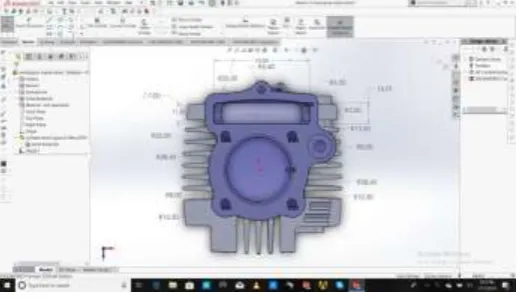
[image:3.595.309.569.140.289.2]5.1.1 Rectangular fins
[image:3.595.27.292.295.553.2]Fig -5.1
: two dimensional view of rectangular fin
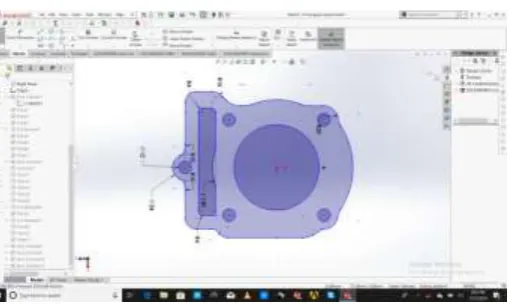
Fig -5.2
: two-dimensional view of rectangular fin
[image:3.595.321.580.490.644.2]© 2019, IRJET | Impact Factor value: 7.211 | ISO 9001:2008 Certified Journal
| Page 2125
5.1.2 Circular fins
[image:4.595.48.575.67.657.2]Fig -5.3
: two-dimensional view of circular fin
[image:4.595.65.566.112.264.2] [image:4.595.322.583.290.442.2]Fig -5.4
: two dimensional view of circular fin
Fig -5.5
: three-dimensional view of circular fin
[image:4.595.41.297.292.445.2]5.1.3 Triangular fins
Fig -5.5
:
two-dimensional view of triangular finFig.-5.6
: three-dimensional view of triangular fin
6. Analysis of fin in engine cylinder
6.1 Rectangular fins
© 2019, IRJET | Impact Factor value: 7.211 | ISO 9001:2008 Certified Journal
| Page 2126
Fig -6.1.2: heat flux analysis of rectangular fins6.2 circular fins
Fig -6.2.1:
temperature analysis of circular fins
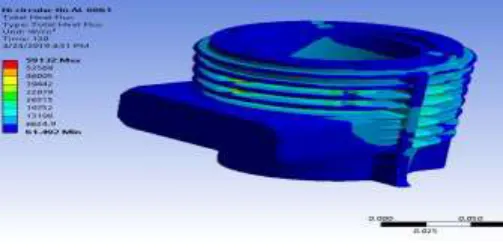
Fig -6.2.2: heat flux analysis of circular fins
6.3. Triangular fins
[image:5.595.35.297.278.402.2]Fig -6.3.1: temperature analysis of triangular fins
Fig -6.3.2
: heat flux analysis of triangular fins
7. RESULTS AND DISCUSSION
1) RESULTANT GRAPH:
Chart -1
: Temperature analysis in fins with
different materials & gemotries
Chart -2
: Heat flux analysis in fins with different
materials & geometries (w/m
2)
700 710 720 730 740 750 760 770 780 790 800
RECTANGULAR FINS
CIRCULAR FIN
TRIANGULAR FIN
0 50000 100000 150000 200000 250000 300000 350000 400000
AL
60
82
CO
PPE
R
AL4
204
AL
60
61
BR
ASS
MIL
D
S
TE
EL
MAG
N
ESIU
M
AL
70
75
TRIANGULAR FINS
CIRCULAR FINS
[image:5.595.323.574.294.490.2] [image:5.595.42.294.430.554.2]© 2019, IRJET | Impact Factor value: 7.211 | ISO 9001:2008 Certified Journal
| Page 2127
8. CONCLUSIONS
[1] The thermal analysis of fins by modifying its certain parameters such as geometry has been completed. [2] By observing the analysis results, we can easily say; using triangular fin with material Aluminum alloy 6082 is better since the temperature drops and the heat transfer rate in a triangular fin is much more compared to others. [3] From the results it is very clear that the use of fin with extensions provides both effective and efficient heat transfer. Fin with extensions provides near about 5% to 13% more in enhancement of heat transfer as compared to fin without extension.
[4] Heat transfer through fin with rectangular extensions higher than that of fin with other types of extensions. The temperature at end of the fin with rectangular extensions is minimum as compared to fin with other types of extensions. The effectiveness of fin with rectangular extensions greater than other extensions.
9. FUTURE SCOPE
1. The purpose of this project is to take a step towards a complete analysis of the heat dissipation through fins. Ideally, it should prevent overheating for all its applications.
2. A gap is seen in the present scenario of fins heat dissipation. The gap is seen for more cases, such as fins with extension during the run of the project.
3. Currently, the complete analysis of fins is based on a micro-level. The fin being analyzed here are of an Amplifier of a sound system.
4. The results obtained after the completion of this project, can be generalized and can be applied for various large scale applications such as fins for IC Engines, which can help in a considerable increase in the efficiency and life.
10. REFERENCES
[1] S. H. Barhatte, “Experimental and Computational Analysis and Optimization for Heat Transfer through Fins with Different Types of Notch”, Journal of Engineering Researches and Studies, Vol. II, 133-138, 2011.
[2] G. Raju, “Optimal Design of an I.C. Engine Cylinder Fin Arrays Using a Binary Coded Genetic Algorithms”, International Journal of Modern Engineering Research, Vol.2, Issue.6, pp-4516-4520, 2012.
[3] Wilson Boulevard, (2001). International Alloy Designations and Chemical Composition Limits for Wrought Aluminum and Wrought Aluminum Alloys (Revised 2001), (pp. 16).
[4] Metals Handbook, Vol.2, Properties and Selection: Nonferrous Alloys and Special-Purpose Materials, ASM International 10th Ed. 1990, (pp. 163).
[5] John M. (Tim) Holt, (1996). Structural Alloys Handbook: Technical Ed; C. Y. Ho, Ed., CINDAS/Purdue University, West Lafayette, IN, 1996.
[6] Domkundwar & Domkundwar, (2011). Heat and Mass Transfer Data Book:DhanpatRai and Co., (pp. 3.2, 3.5, 3.13) [7] A Dewan, P Patro, I Khan and P Mahanta(2009), “The Effect of Fin Spacing and Material on the Performance of a Heat Sink With Circular Pin Fins.
[8] Nabemoto A (1985), “Heat Transfer on aFin of Fin Tube”, Bulletin of the Faculty of Engineering, Hiroshima University, (inJapanese), Vol. 33, No. 2, pp. 127-136 [9] Pulkit Agarwal, Mayur Shrikhande and P Srinivasan (2011), “Heat Transfer Simulation by CFD from Fins of an Air Cooled Motorcycle Engine under Varying Climatic Conditions”, Proceedings of the World Congress on Engineering, Vol. III, London, U.K.
[10] Thornhill D and May A (1999), “An Experimental Investigation into the Cooling of Finned Metal Cylinders”. [11]Thornhill D, Graham A, Cunnigham G, Troxier P and Meyer R (1999), “Free Air Stream”, SAE Paper.
[12] U V Awasarmol and A T Pise (2011), “Pise Experimental Study of Effect of Angle of Inclination of Fins on Natural Convection Heat Transfer Through Permeable Fins”, Proceedings on International Conference on Thermal Energy and Environment.
BIOGRAPHIES
Miss.Kumud Vasantrao