3512
DEVELOPMENT AND EVALUATION OF COLON TARGETED COMPRESSED
COATING TABLETS OF ETODOLAC
C. Sivakumari*, M. Pradeep Kumar, P. Anitha, M. Purushothaman, S. Neelima
Department of Pharmaceutics, Vasavi Institute of Pharmaceutical Sciences,
Kadapa, Andhra Pradesh, India.
*
Corresponding author E-mail:
[email protected]
ARTICLE INFO
ABSTRACT
Key words:
Etodolac, Eudragit, HPMC K 15M, Xanthan Gum
Compression coating is one of the strategies for delivering drug to the colon. The main aim of these formulations to develop Etodolac core tablets compression coated with a mixture of time dependent hydrophilic swellable polymer HPMC K 15M, Eu-dragit L100 and Xanthan gum in different ratios. The effect of proportion of HPMC, Eudragit and Xanthan gum in the coat on premature drug release in upper part (Stomach and small intes-tine) of GIT & the amount of drug release in colon target area was studied. The formulations are carried out by using Direct Com-pression method. Sodium starch Glycolate used for rapid disinte-gration. FTIR used for Drug-Polymer Interaction studies. The prepare tablets were evaluated for hardness, thickness, friability, In-Vitro Dissolution. The F6 Batch Eudragit gives better result than other formulations.
INTRODUCTION:
Colon specific diseases are often in efficient-ly managed by oral therapy, because most oral-ly administered drugs are absorbed before ar-riving in the colon. Therefore, colon-specific drug delivery systems, which can release the drugs to the lower gastrointestinal tract without deliver in the upper GI-tract. It can be expected to increase the quality of life for patients suffering from colon specific diseases. Treatment might be more effective if the drug substances were targeted directly on the site of action in the colon. Lower doses might be ade-quate and, if so, reduced systemic side effects can be produced by giving lower doses in ade-quate amounts1. Number of serious diseases of
the colon might be capable of being treated more effectively if drugs were targeted on the colon. Therefore, it appears that targeted drug delivery with an appropriate release pattern could be crucial in providing effective therapy for these chronic Diseases.
In addition to providing more effective therapy of colon related diseases, colon specific deliv-ery has the potential to address important un-met therapeutic needs including oral delivery of macromolecular drugs2. The representatives of
colon specific diseases are Inflammatory Bowel Disease (IBD), including Ulcerative Colitis and Crohn’s disease, Irritable Bowel Syndromes (IBS), Constipation and Colorectal Carcinoma-I. In particular, patients suffering from colorec-tal cancer have been apprehensively increasing recently3. Etodolac is a Non-steroidal
anti-inflammatory drug with anti-anti-inflammatory. Etodolac inhibits the enzyme cycloxygenase (COX) and decreases the peripheral prosta-glandins synthesis involved in mediating in-flammation. It combinds to the COX enzyme active site upper portion and prevents its sub-strate, arachidonic acid, from entering the ac-tive site4. Previously Etodolac is a
non-selective COX inhibitor, but now it is known to be 5 – 50 times more selective to the COX-2
Journal of Global Trends in Pharmaceutical Sciences
3513
than COX-1. The antipyresis may produce by central action on the hypothalamus and result-ing in peripheral dilation, subsequent heat loss and increased cutaneous blood flow.
MATERIALS AND METHODS:
Etodolac, Starch, sodium starch glycolate, Poly vinyl propylene K30, Magnesium stearate, Hydroxypropylmethyl cellulose K15M, Eu-dragit L100, Xanthan gum, Microcrystalline cellulose pH 101 and talc are required for pre-paring of Etodolac compressed coating tab-lets5,6.
Estimation of Etodolac7
A spectrophotometric method based on the measurement of absorbance at 279nm in 0.1N HCl and pH 6.8 phosphate buffers are used in the present study for the estimation of Etodolac. Standard solution
100mg of Etodolac pure drug was dissolved in 100ml of 0.1N HCl (stock solution-1000𝜇g/ml), from this 10ml of solution was taken and the volume was adjusted to 100ml with 0.1N HCl (100 𝜇g/ml).
Calibration curve of Etodolac in 0.1N HCl
The above solution was subsequently diluted with 0.1N HCl to obtain the series of dilutions containing 2, 4, 6,8,10 and 12 𝜇g/ml of Etodolac solution. The absorbance of the above dilutions was measured at 279nm by us-ing the UV-Spectrophotometer usus-ing 0.1N HCl as blank. Then a graph was plotted by taking concentration on X-axis and absorbance on Y-axis which gives a straight line which is given in Table 1 and figure 1.
Calibration curve of Etodolac in Phosphate buffer pH 6.87
Accurately weighed quantity of Etodolac (100mg) was dissolved in methanol and the volume made up to 100ml with the same. 10ml of Stock solution I was further diluted with
100ml of buffer to get a working standard.
Ali-quots of 5-25µg of stock solution was pipetted into 10ml volumetric flask and diluted up to the volume with buffer. The absorbance was meas-ured at 279nm which is given in Table 2 and figure 2.
Drug–Exicipient interaction study
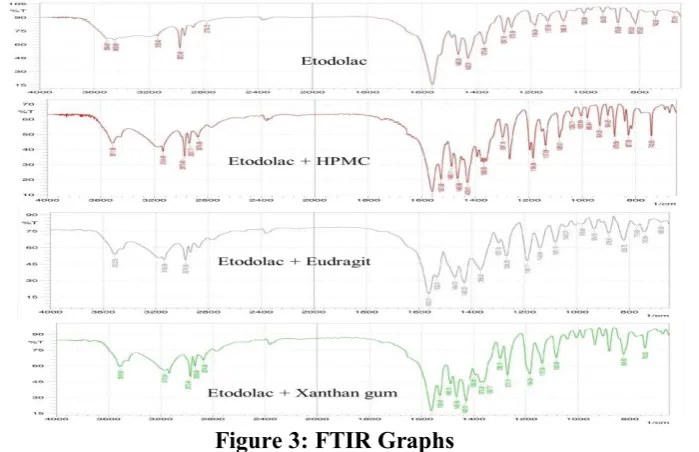
The pure drug and a mixture of it with the pol-ymers Xanthane gum, HPMC and Eudragit were mixed separately with IR grade KBr in the ratio of 100:1 and corresponding pellets were prepared by applying pressure in a hydraulic
press8. The pellets were scanned over a wave
number range of 4000-400cm-1 in Thermo Ni-colet USA, FTIR instrument and graphs given in figure 3.
Pre-compressional parameters 9-12 Bulk Density:
Bulk density is the ratio of total mass of pow-der to the bulk volume of powpow-der and it is measured by pouring the weighed sample or powder into a measuring cylinder and the vol-ume was noted.
Tapped Density:
Tapped density is the ratio of total mass of powder to the tapped volume of powder and the tapped volume was measured by tapping the powder to constant volume.
Hausner’s ratio:
Hausner’s ratio is the fast, simple, and popular methods of predicting powder flow characteris-tics. It is the ratio of tapped density to bulk density.
Angle of Repose
The angle of repose has been used to char-acterize the flow properties of solids. Angle of repose is a characteristic related to interparticu-late friction or resistance to movement between particles. This is the maximum angle possible between surface of a pile of powder or granules and the horizontal plane.
Carr’s Index:
It indicates the ease with which a material can be induced to flow.
Procedure for core tablets:13-15
Step 1: Weighing all ingredients and pass through the sieve number 60.
Step 2: Blend the mixture for 15min in double cone blender.
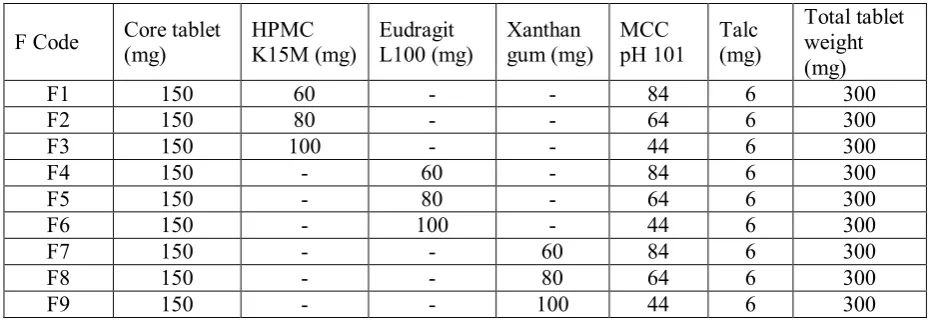
Step 3: Compression in flat faced 6mm circular punches and formulation of each tablet is given in tablet 4.
Procedure for press coated tablets:
Step 4: weigh the other excipients and pass through sieve number 60. Then blend the mix-ture in a poly bag for 10min.
Step 5: pour the half mixture in die (8.7mm) then place the core tablet and then fill remain-ing mixture on surface of the core tablet.
Step 6: Then compress the tablets and formula-tion of each tablet is given in table 5.
Post compressional Parameters: 16-18 Weight Variation:
Indi-3514
vidual tablet weight was compared with the average weight.
Hardness
The hardness of the 6 tablets of each formula-tion was determined by using the Monsanto hardness tester. This tester operates in a hori-zontal position. An anvil driven by manually presses the tablet at a constant load rate against a stationary anvil until the tablet breaks.
Friability
The friability of the tablet was determined using Roche Friabilator. The friabilator was operated at 25 rpm for four min.
Thickness
Thickness of tablets was important for uniformity of tablet size. Thickness of the tablet was measured by the using vernier calipers on 3 randomly selected samples.
Content uniformity test
Ten tablets were weighed and powdered, a quantity of powder equivalent to 10 mg of drug was transferred into 25 ml volumetric flask and
15 ml water is added. After appropriate dilution, the drug content was determined by
measuring the absorbance at 279 nm.
In-vitro dissolution study19-20
Acid release: 900 ml of 0.1N HCl was used as dissolution medium and it is placed in vessel. Then the USP apparatus-1 (basket having the tablet) was assembled and the medium was al-lowed to equilibrate to temperature of 370
± 0.50C. After that apparatus was operated and
the samples are removed at different time inter-vals in the acid stage (2 hours). The removed aliquots were passed through a suitable 0.45-µm filter. The amount of drug dissolved in acid stage was determined at λmax279 nm by UV
Spectrophotometric method.
Buffer stage: After the completion of 2 hours of dissolution in acid stage, immediately the PH
6.8 phosphate buffer was replaced in the disso-lution vessels and further subjected to drug re-lease study. The dissolution samples were col-lected at 3, 4, 5, 6, 7, 8, 9 and 10 hours time intervals and were passed through a suitable 0.45𝜇𝑚 filter. The amount of drug dissolved in the buffer stage at various time points was de-termined at λmax279 nm by UV
Spectrophoto-metric method.
In-vitro release kinetics21
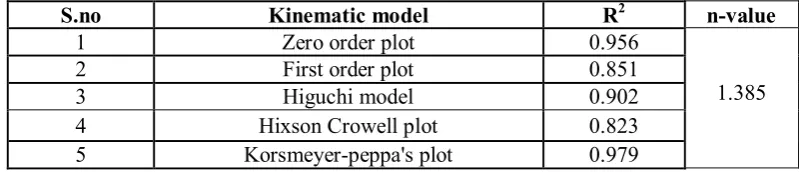
The dissolution profile of most satis-factory formulation was fitted into zero order, first order, Higuchi model and korsmeyer pep-pas model to ascertain the kinetic modeling of the drug release. The methods were adopted for deciding the most appropriate model.
RESULTS AND DISCUSSION:
The present study was undertaken to formulate Etodolac compressed tablets. The study in-volves preformulation studies of drug and exi-cipients, formulation and processing develop-ment along with evaluation of tablets made with the optimized formulation. Finally con-trolled release tablets were evaluated by in-vitro methods. Results of FTIR spectroscopy (figure 3) showed that, functional group fre-quencies of Etodolac were in the reported range which indicates that the obtained sample was of Etodolac and was pure. Pre compressional pa-rameter studies (table 3) of powder blends of different batches prepared by compression, it was concluded that powder blends of all batch-es had the good flow propertibatch-es. From the re-sults tabulated in the table 6 it was observed all physical parameters (Hardness & Thickness) of compressed coated tablets were found to be within the limits.
Table.1:
Calibration curve of Etodolac in 0.1N HClConcentration (mcg) Absorbance at 279nm
0 0
2 0.114
4 0.215
6 0.327
8 0.432
10 0.524
3515
Figure.1: Calibration curve of Etodolac in 0.1N HCl
Table.2 Calibration curve of Etodolac in pH 6.8 phosphate buffer.
Figure 2: Calibration curve of Etodolac in pH 6.8 phosphate buffer
y = 0.052x R² = 0.998
0 0.1 0.2 0.3 0.4 0.5 0.6 0.7
0 2 4 6 8 10 12 14
A
bs
or
ban
ce
(n
m
)
Concentration in mcg
y = 0.0383x R² = 0.9996
0 0.2 0.4 0.6 0.8 1 1.2
0 10 20 30
A
bs
or
ban
ce
(n
m
)
Concentration in mcg
Concentration (mcg) Absorbance at 279nm
0 0
5 0.185
10 0.375
15 0.585
20 0.766
3516
Figure 3: FTIR Graphs
Table 3: Pre Compressional properties of different blends:
F Code
Bulk Density
±SD* (gm/ml)
Tapped Density
±SD* (g/ml)
Carr’s Index
± SD* (%)
Hausner ratio
±SD*
Angle of repose
± SD*
F1 0.52±0.06 0.65±0.05 14.04±0.12 1.21±0.04 26.1±0.2
F2 0.55±0.04 0.64±0.06 12.72±0.15 1.16±0.03 28.6±0.2
F3 0.49±0.02 0.57±0.04 13.20±0.15 1.15±0.02 27.2±0.2
F4 0.48±0.04 0.55±0.06 12.72±0.14 1.14±0.04 24.1±0.4
F5 0.50±0.05 0.58±0.05 13.79±0.16 1.16±0.03 27.5±0.3
F6 0.53±0.05 0.61±0.06 13.11±0.14 1.15±0.01 26.8±0.2
F7 0.52±0.04 0.60±0.01 13.33±0.16 1.15±0.05 28.5±0.2
F8 0.55±0.06 0.64±0.01 14.06±0.12 1.16±0.02 24.6±0.4
F9 0.48±0.05 0.56±0.05 14.28±0.14 1.06±0.05 26.7±0.2
Table 4: Formulation for Core tablet:
Ingredients Quantity per Tablet (mg)
Etodolac 100
Starch 27
Sodium starch glycolate 15
PVP K30 5
Magnesium Stearate 3
3517
Table 5: Composition of press coated tablet
F Code Core tablet (mg) HPMC K15M (mg) Eudragit L100 (mg) Xanthan gum (mg) MCC pH 101 Talc (mg)
Total tablet weight (mg)
F1 150 60 - - 84 6 300
F2 150 80 - - 64 6 300
F3 150 100 - - 44 6 300
F4 150 - 60 - 84 6 300
F5 150 - 80 - 64 6 300
F6 150 - 100 - 44 6 300
F7 150 - - 60 84 6 300
F8 150 - - 80 64 6 300
F9 150 - - 100 44 6 300
Table 6: Post formulation studies:
Figure 4: In-vitro drug release in Acidic stage
02 4 6 8 10 12
0 0.5 1 1.5 2 2.5
%
dr
ug
re
le
as
e
time in hrs
F1 F2 F3 F4 F5 F6 F7 F8 F9
F Code Hardness*
(kg/cm2) SD
Friability (%) SD
Thickness (mm) SD
Weight variation SD
F1 5.4 0.05 0.62±0.05 3.81.46 2980.06
F2 6.10.05 0.64±0.05 3.61.45 2990.04
F3 5.50.05 0.76±0.05 3.90.63 3010.54
F4 5.20.10 0.89±0.10 3.80.92 3040.07
F5 5.10.05 0.64±0.05 3.80.75 2940.82
F6 5.20.05 0.46±0.15 3.80.66 2960.14
F7 5.40.15 0.65±0.05 3.50.75 2990.16
F8 5.20.05 0.55±0.10 3.61.45 3010.54
3518
Figure 5: In-vitro drug release in buffer stage
Table 7: In-vitro release kinetics for F6
In vitro dissolution studies of all formulations of colon tablets were carried out in 0.1N HCl for first 2 hours (figure 4) and remaining 8hours in 6.8 Phosphate buffer. The study was performed for 10hrs and the cumulative drug release was calculated at every hour interval. It was observed that the type of polymer influences the drug re-lease pattern. All the formulations contained dif-ferent amounts of rate retarding agents hydroxy-propylmethylcellulose (HPMC) and methacrylic acids (Eudragit L100) and natural polymer
Xan-than gum. The In-vitro drug release for
formula-tions (figure 5) with polymer HPMC K4M (F1 to F3) was ranged from 88.18% to 86.26 % for 10hrs. The In-vitro drug release for formulations with polymer Eudragit L100 (F4 to F6) was ranged from 92.06% to 94.32% for 10hrs. The In-vitro drug release for formulations with poly-mer Xanthan gum (F7 to F9) was ranged from 87.36% to 91.65% for 10hrs. The maximum drug release was observed from the formulations based on Eudragit and xanthan gum polymer. Varying the amount of 94.32% and 91.65% af-fect the drug release. All 9 formulation were showing better drug release profile in both medi-as, but Formulation F6 shows better drug release
retards up to 6hr, when the tablet enters in to co-lonic region is after 7 hrs it shows maximum re-lease profile. Hence, the F6 is best formulation. According to above R2 value (table 7), best
for-mulation, i.e., F-6 formulation follows zero order kinetics. From the Korsmeyer peppas model which may shows that drug release is case-2 re-laxation or super case transport-2 and refers to erosion of the polymeric chain (If n = 0.89 and above indicates case-2 relaxation or super case transport-2)
CONCLUSION
Etodolac compressed coating tablets were prepared by direct compression coating method by using HPMC K 15 M, Eudragit L100 and Xanthan gum polymers. Among all the formulations F6 showed 94.32% con-trolled drug release at the end of 10 hours. The stability studies were conducted as per the ICH guidelines no significant changes occur in the best formulation.
S.no Kinematic model R2 n-value
1 Zero order plot 0.956
1.385
2 First order plot 0.851
3 Higuchi model 0.902
4 Hixson Crowell plot 0.823
5 Korsmeyer-peppa's plot 0.979
0 20 40 60 80 100
0 5 10 15
%
D
ru
g
re
le
as
e
Time(hrs)
3519
REFERENCES
1. Gauri Bhawna, Singh Shailendra K
and Mishra Dinanath, Formulation and evaluation of colon targeted oral drug delivery systems for metronida-zole in treatment of amoebiasis. Int J of Drug Deliv. 2011; 3: 503-512.
2. Sharma Anuj, Jain K Amit. Colon
Targeted Drug Delivery Using Dif-ferent Approaches. Ijpsr, 2010; 1(1): 60-66.
3. Chetan Singh Chauhan, Pushpendra
Singh Naruka, Rajendrapal Singh Rathore, Viralkumar Badadwal. For-mulation and evaluation of Predniso-lone tablet for colon targeted drug de-livery system. J. Chem. Pharm. Res, 2010; 2(4): 993-998.
4. Gang Cheng, Time and pH-dependent
colon-specific drug delivery for orally administered diclofenac sodium and 5-aminosalicylic acid. World J Gas-troenterology. 2004; 10(12): 1769-1774.
5. P.S. Salve. Development and in vitro
evaluation colon targeted drug deliv-ery system using natural gums. Asian J. Pharm. Res. 2011; 1(4): 91-101.
6. Kothawade PD, Conventional And
Novel Approaches For Colon Specif-ic Drug Delivery: A Review. e-JST; 33-56.
7. Pinar Demirci Insuyu,. Quantitative
determination of etodolac by UV Spectrophtometric method in bulk drug and commercial formulations. IJPSR, 2013; 4(8): 2927-2932.
8. Jagmohan. Organic Spectroscopy.
Narosa Publications, Inc., New Delhi,
2003; 2:212-232.
9. Allen, Ansels Pharmaceutical Dosage
Forms and Drug Delivery Systems. Lippincott Williams and Wilkins, Wolters kluwer, New York. 2005; 9: 431-492
10. Vilegave K, Vidyasagar G and
Chan-dankar P: Preformulation studies of pharmaceutical new drug molecule and products: An Overview. Ameri-can journal of pharmacy and health research 2013; 1(3): 1-20.
11. Gaud RS, Yeole PG, Yadav AV and
Gokhale S.B: Text book of
pharma-ceutics. Nirali Prakashan, Pune, 2011; 12: 71-74.
12. Chickpetty SM, Raga Baswaraj, BK
Nanjwade. Studies On Development Of Novel Combined Time And Phde-pendent Solventless Compression Coated Delivery Systems For Colonic Delivery Of Diclofenac Sodium. Asian J Pharma and Clinical Res, 2010; 3(2): 110-114.
13. Swati C. Jagdale, Monali S. Sali1
,Ajay L. Barhate, Janardan N. Lo-harkar, Aniruddha R. Chabukswar, Design And Evaluation Of Enteric Press - Coated Tablet For Pulsatile Delivery Of Atenolol, Int J Pharma World Res. 2010;1(2): 1-15.
14. Raju, Formulation and Development
of Enteric Coated Tablets of Predni-solone as a Colon Targeted Drug De-livery. 2011; 2(3): 685-690.
15. The official compendium of
stand-ards, The United States Pharmaco-poeial Convention, 2007; USP30- NF25.
16. Ei-Arini SK, Leuenberger H,
Model-ling of drug release from polymer matrices: Effect of drug loading. Inter J Pharm, 1995; 121: 141-148.
17. Ronald H, Schmidt HK, Molecularly
Imprinted Polymer Films with Bind-ing Properties Enhanced by the Reac-tion-Induced Phase Separation of a Sacrificial Polymeric Porogen, Chem-ical Materials. 2005; 17(5): 1007– 1016.
18. European Pharmacopoeia, fourth ed.,
Suppl. 4.1, Published by the direc-torate for the quality of medicines of the council of Europe 9EDQM, Strasbourg, France, 2002.
19. Krishnaiah YSV, In vitro drug release studies on guar gum-based colon tar-geted oral drug delivery systems of 5-fluorouracil, Eur J Pharm Sci. 2002; 16: 185–192.
20. Negar Bashardous, Preparation and In
vitro Investigation of Chitosan Com-pressed Tablets for Colon Targeting.
Adv Pharm Bulletin, 2011; 1(2):
87-92.
21. Mohammad Barzegar - Kinetic