A D i a l o g C o n t r o l A l g o r i t h m a n d Its P e r f o r m a n c e
R o n n i e W . S m i t h * D e p t . of C o m p u t e r S c i e n c e
D u k e U n i v e r s t i y D u r h a m , N C 27706
r w s @ c s . d u k e . e d u
D . R i c h a r d H i p p D e p t . of C o m p u t e r S c i e n c e
D u k e U n i v e r s t i y D u r h a m , N C 27706
d r h @ c s . d u k e . e d u
A l a n W . B i e r m a n n D e p t . of C o m p u t e r S c i e n c e
D u k e U n i v e r s t i y D u r h a m , N C 27706
a w b @ c s . d u k e . e d u
A b s t r a c t
A pragmatic architecture for voice dialog ma- chines aimed at the equipment repair problem has been implemented which exhibits a num- ber of behaviors required for efficient human- machine dialog. These behaviors include:
(1) problem solving to achieve a target goal,
(2) the ability to carry out subdialogs to achieve appropriate subgoals and to pass control arbitrarily from one sub- dialog to another,
(3) the use of a user model to enable use- ful verbal exchanges and to inhibit un- necessary ones,
(4) the ability to change initiative from strongly computer controlled to strongly user controlled or somewhere in between, and
(5) the ability to use context dependent expectations to correct speech recog- nition and track user movement to new subdialogs.
A description of the implemented dialog control algorithm is given; an example shows the fun- damental mechanisms for achieving the listed behaviors. The system implementation is de- scribed, and results from its performance in 141 problem solving sessions are given.
1 A V o i c e - I n t e r a c t i v e D i a l o g M a c h i n e A limited vocabulary voice dialog system designed to aid a user in the repair of electronic circuits has been con- structed in our laboratory. The system contains a model of the device to be repaired, debugging and repair proce- dures, voice recognition and sentence processing mech- anisms, a user model, language generation capabilities, and a dialog control system which orchestrates the be- haviors of the various parts. This paper describes the *This research was supported by National Science Foun- dation Grant Number NSF-IRI-88-03802 and by Duke University.
dialog control algorithm and the performance of the to- tal system in aiding a series of subjects in the repair of an electronic circuit.
2 T a r g e t B e h a v i o r s
The purpose of the dialog control algorithm is to direct the activities of the many parts of the system to obtain efficient human-machine dialog. Specifically, it is aimed at achieving the following behaviors.
Convergence to a goal. Efficient dialog requires that each participant understand the purpose of the interac- tion and have the necessary prerequisites to cooperate in its achievement. This is the intentional structure of [Grosz and Sidner, 1986], the goal-oriented mechanism that gives direction to the interaction. The primary re- quired facilities are a problem solver that can deduce the necessary action sequences and a set of subsystems capable of carrying out those sequences.
Subdialogs and effective movement between them. Ef- ficient human dialog is usually segmented into utter- ance sequences, subdialogs, that are individually aimed at achieving relevant subgoals ([Grosz, 1978], [Linde and Goguen, 1978], [Polanyi and Scha, 1983], and [Reichman, 1985]). These are called "segments" by [Grosz and Sid- ner, 1986J and constitute the linguistic structure defined in their paper. The global goal is approached by a series of attempts at subgoals each of which involves a set of interactions, the subdialogs.
An aggressive strategy for global success is to choose the most likely subgoals needed for success and carry out their associated subdialogs. As the system proceeds on a given subdialog, it should always be ready to abruptly drop it if some other subdialog suddenly seems more ap- propriate. This leads to the fragmented style that so commonly appears in efficient human communication. A subdialog is opened which leads to another, then an- other, then a jump to a previously opened subdialog, and so forth, in an unpredictable order until the neces- sary subgoals have been solved for an overall success.
model specifies information needed for efficient interac- tion with the conversational partner. Its purpose is to indicate what needs to be said to the user to enable the user to function effectively. It also indicates what should be omitted because of existing user knowledge.
Because considerable information is exchanged during the dialog, the user model changes continuously. Men- tioned facts are stored in the model as known to the user and are not repeated. Previously unmentioned in- formation may be assumed to be unknown and m a y be explained as needed. Questions from the user m a y indi- cate lack of knowledge and result in the removal of items from the user model.
Change o f initiative. A real possibility in a coopera- tive interaction is that the user's problem solving ability, either on a given subgoal or on the global task, m a y ex- ceed that of the machine. When this occurs, an efficient interaction requires that the machine yield control so that the more competent partner can lead the way to the fastest possible solution. Thus, the machine must be able to carry out its own problem solving process and di- rect the actions to task completion or yield to the user's control and respond cooperatively to his or her requests. This is a mixed-initiative dialog as studied by [Kitano and Van Ess-Dykema, 1991], [Novick, 1988], [Whittaker and Stenton, 1988], and [Walker and Whittaker, 1990]. As a pragmatic issue, we have found that at least four initiative modes are useful:
(1) directive - T h e computer has complete dialog control. It recommends a subgoal for comple- tion and will use whatever dialog is necessary to obtain the needed item of knowledge related to the subgoal.
(2) suggestive - T h e computer still has dialog con- trol, but not as strongly. The computer will make suggestions about the subgoal to perform next, but it is also willing to change the di- rection of the dialog according to stated user preferences.
(3) declarative - T h e user has dialog control, but the computer is free to mention relevant, though not required, facts as a response to the user's statements.
(4) passive - T h e user has complete dialog control. T h e computer responds directly to user ques- tions and passively acknowledges user state- ments without recommending a subgoal as the next course of action.
Expectation o f u s e r input. Since all interactions occur in the context of a current subdialog, the user's input is far more predictable than would be indicated by a general g r a m m a r for English. In fact, the current subdi- alog specifies the focus of the interaction, the set of all objects and actions that are locally appropriate. This is the attentional structure described by [Grosz and Sidner, 1986] and its most i m p o r t a n t function in our system is to predict the meaning structures the user is likely to communicate in a response. For illustration, the open- ing of a chassis cover plate will often evoke comments about the objects behind the cover; the measurement of
a voltage is likely to include references to a voltmeter, leads, voltage range, and the locations of measurement points.
T h e subdialog structure thus provides a set of ex- pected utterances at each point in the conversation and these have two i m p o r t a n t roles:
(1) T h e expected utterances provide strong guid- ance for the speech recognition system so t h a t error correction can be maximized. Where ambiguity arises, recognition can be biased in the direction of meaningful statements in the current context. Earlier researchers who have investigated this insight are [Erman et al., 1980], [Walker, 1978], [Fink and Biermann, 1986], [Mudler and Paulus, 1988], [Carbonell and Pierrel, 1988], [Young et al., 1989], and [Young and Proctor, 1989].
(2) T h e expected utterances from subdialogs other than the current one can be used to indicate t h a t one of those others is being invoked. Thus, expectations are one of the p r i m a r y mecha- nisms needed for tracking the conversation as it j u m p s from subdialog to subdialog. This is known elsewhere as the plan recognition prob- lem and it has received much attention in re- cent years. See, for example, [Allen, 1983], [Lit- m a n and Allen, 1987], [Pollack, 1986], and [Car- berry, 1990].
Systems capable of all of the above behaviors are rare as has been observed by [Allen et al., 1989]: "no one knows how to fit all of the pieces together." One of the contributions of the current work is to present an archi- tecture that can provide t h e m all in the limited domair of electric circuit repair. [Allen et al., 1989] describe their own architecture which concentrates on represen- tations for subdialog mechanisms and their interactiom, with sentence level processing. Our work differs fro~ theirs on m a n y dimensions including our emphasis oR achieving mixed-initiative, real time, voice interactiv~ dialog which utilizes a user model.
3 T h e Z e r o L e v e l M o d e l
T h e system implemented in our laboratory (described in great detail in [Smith, 1991]) achieves the above b¢~ haviors sufficiently to enable efficient human-machine di. alogs in the electric circuit repair environment. T h e com. plexity of the system prevents its complete descriptior here. However, a zero level model has been devised fol pedagogical purposes which illustrates its principles o: operation. This model mimicks the mechanism of th~ dialog machine while o m i t t i n g the huge array of detail., necessary to make a real system work. A later sectiot in this paper describes the actual implementation an¢ some of its m a j o r modules.
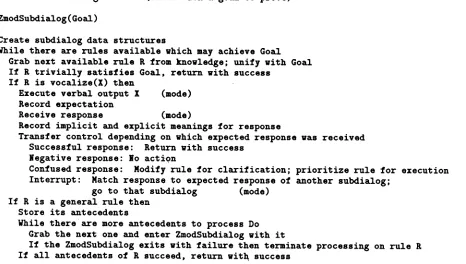
Recursive suh~ialog routine (enter with a goal to prove)
ZmodSubdialog(Goal)
Create sul~ialog data structures
While there are rules available which may achieve Goal Grab next available rule R from knowledge; unify with Goal
If R trivially satisfies Goal, return with success If R is vocalize(X) then
Execute verbal output X (mode) Record expectation
Receive response (mode)
Record implicit and explicit meanings for response
Transfer control depending on which expected response was r e c e i v e d
Successful response: Return with success
Negative response: No action
Confused response: Modify rule for clarification; prioritize rule for execution Interrupt: Match response to expected response of another subdialog;
go to that subdialog (mode) If R is a general rule then
Store its antecedents
While there are more antecedents to process Do Grab the next one and enter ZmodSuh~ialog with it
If the ZmodSubdialog exits with failure then terminate processing on rule R If all antecedents of R succeed, return wit h success
NOTE: SUCCESSFUL COMPLETION OF THIS ROUTINE DOES NOT NECESSARILY MEAN T R A N S F E R OF CONTROL TO THE CALLING ROUTINE. CONTROL PASSES TO THE SUBDIALOGUE SELECTED BY THE DIALOG CONTROLLER.
Figure 1: Zero Level Model
fact, the only voice interactions the system undertakes are those called for by the theorem proving machinery.
T h e ZmodSubdialog routine has a unique capabil- ity needed for proper modeling of subdialog behaviors. Specifically, its actions m a y be suspended at any time so that control m a y be passed to another subdialog, another instantiation of ZmodSubdialog that is aimed at achieving another goal. However, control m a y at a later time return to the current instantiation to continue its execution. In fact, a typical computation involves a set of ZmodSubdialog instantiations all advanced to some point in the proofs of their respective goals; con- trol passes back and forth between them looking for the most likely chances of success until, finally, enough goals are proven to complete the global proof.
T h e algorithm becomes understandable if an example is followed through in full detail. Assume that the fol- lowing database of Prolog-like rules are contained in the system knowledge base.
General Debugging Rules
set(knob,Y) <-- find(knob), adjust(knob,Y)
General Dialog Rules
Y <-- usercan(Y), vocalize(Y) vocalize(X)
User Model Rules
find(knob)
usercan(adjust (knob,X))
Further assume t h a t ZmodSubdialog is entered with
argument Goal = set(knob,10). T h e n in Prolog fashion, the routine grabs the rule R:
set(knob,Y) ~-- find(knob),adjust(knob,Y), and a t t e m p t s to prove set(knob,10). T h e algorithm of- fers three choices depending on whether R is trivial (a single predicate which is not vocalize(X)), tt is vocal- ize(X), or R is a rule with antecedents as is the case here. Thus, in this case the third alternative is followed, and the two antecedents are queued for sequential execution (find(knob) and adjust(knob,10)). T h e n the first an- tecedent is selected and ZmodSubdialog is entered with argument Goal = find(knob).
T h e new subdialog to achieve find(knob) is short, how- ever, since the user model indicates the user already knows how to find the knob because find(knob) ex- ists as an available rule. In fact, ZmodSubdialog finds find(knob) in the rule base, enters the first choice (triv- ial) and returns with success. If find(knob) had not been found in the user model, the system might have engaged in dialog to achieve this goal. T h e subdialog control mechanism is not obligated to pass control back to the calling routine, but in this example we will assume that it does.
[image:3.612.62.528.71.335.2]the user model which means control passes to the an- tecedent vocalize(adjust(knob,10)). This yields another entry to ZmodSubdialog and a selection of the second
branch. Here the system executes a voice output to
satisfy vocalize(adjust(knob,10)): "Set the knob to one zero."
T h e handling of the goal find(knob) illustrates how the user model can act to satisfy the theorem proving process and prevent the enunciation of unneeded infor- mation. As the theorem proving process proceeds, the fact that a user knows something is represented in the knowledge base as an achieved goal. T h e o r e m proving will encounter this and proceed without voice interac- tion. In the example, the model already indicates that the user knows how to find the knob so no voice interac- tion is needed for this goal.
T h e handling of the goal adjust(knob,10) illustrates how the user model supports the theorem proving pro- cess by enabling voice dialog when it is needed. This goal could not be proven by application of rules available in the database and the proof was blocked from further progress. In our terminology, there was a "missing ax- iom" for the proof. So the system must either give up on this proof or try to fill in the missing axiom by resorting to voice dialog. In the current case, voice dialog was en- abled by the user model fact usercan(adjust(knob,X)). This fact opens the way for a query to the user. If the query is positively answered, then the missing axiom is made available.
T h e role of the user model is thus to supply or fail to supply axioms at the b o t t o m of the proof tree. It both inhibits extraneous verbalism and enables interactions necessary to prove the theorem.
Returning to the example c o m p u t a t i o n of ZmodSub- dialog, a voice o u t p u t has just been given, and the sys- tem then records, for this output, the set of expected
r e s p o a s e s :
user (adjust (knob, I0) ) assertion(knob,position, I0) trivialrssponse (affirmation)
trivialresponse
(negat ire)
query(location(knob) )
query (color (knob))
Expected responses are compiled from the domain knowledge base and from the dialog controller knowl- edge base.
T h e user's response is then matched (unified) against the expected meanings and subsequent actions depend on which meaning fits best. Four different types of ac- tions m a y occur at this point.
(1) T h e user might respond with some paraphrase of "I set the knob to one zero," or "Okay", which would be interpreted as successful re- sponses. T h e routine ZmodSubdialog would re- turn with success.
(2) T h e user might also answer "No" yielding a failure and another cycle around the theorem proving loop looking for an applicable rule. (3) T h e user might respond with " W h a t color is
the knob?" indicating, there m a y be a chance
for a success here if there is further dialog. In fact, our system handles such a need for clarification by dynamically modifying the rule and reexecuting with a newly required clarifi- cation subdialog. Here the rule set(knob,10)
find(knob), adjust(knob,10) becomes mod- ified to set(knob,10) ~-- find(knob), vocal- ize(knob,white), adjust(knob,10). Reexecution will then yield an explanation of the knob color followed by the previous request reenunciated:
"Set the knob to one zero."
(4) T h e user might respond with an utterance that
matches no local expectation. Here the sys-
tem examines expectations of other subdialogs and searches for an acceptable match. If one is found, control will pass to that subdialog. For example, if the response is, "The L E D is flashing seven," and if this is an appropriate response in some other subdialog, control will pass to it.
T h e control of initiative in ZmodSubdialog is handled by special processing at the steps marked "mode." Thus, in strongly directive mode, verbal outputs will be very positively stated, responses will be expected to be obedi- ent, and interrupts to other subdialogs will be restricted. In less demanding modes, outputs will be weaker or merely suggestive, a wider range of responses will be al- lowed, and transitions to other subdialogs will be more freely permitted. In the most passive mode, there are few outputs except answers to questions, and an inter- rupt to any subdialog is acceptable.
A very important part of the dialog system is the do- m a i n processor, the application dependent portion of the system. It receives all information related to the current problem and suggests debugging steps to carry the process further. W e model calls to this processor with the rule: d e b u g ( X ) ~-- ( d e b u g g i n g s t e p ( X ) ) * . This rule is called upon to debug device X with the predi- cate debug(X) and its effect is to specify a sequence ot debugging steps which will be specified dynamically as the problem unfolds and which will lead to repair of the device.
4 T h e I m p l e m e n t a t i o n
4.1 A n I n t e g r a t e d A r c h i t e c t u r e
T h e implemented system is based on a computational model for dialog processing presented in [Smith, 1991]. T h e model is applicable to the general class of task- oriented dialogs, dialogs where the computer is assistin~ the user in completing a task as the dialog ensues. The derived implementation consists of the following mod- ules:
assist with input interpretation. It also main- tains all dialog information shared by the other modules and controls their activation.
domain processor- As previously mentioned, it provides suggestions about debugging steps to pursue. In our system the domain proces- sor assists users in circuit repair. It receives user-supplied domain information from the di- alog controller and returns suggested debug- ging subgoals to the controller for considera- tion. The subgoal selection process weighs the level of expected usefulness of a subgoal with the number of times the subgoal has been previ- ously selected. Consequently, the module may recommend challenging previously reported in- formation if no noticeable progress in the task is being made. In this manner, the module and system can recover from erroneous inputs. If the dialog system is to be used to repair other devices, this is the module that needs to be re- placed.
knowledge This is the repository of in- formation about task-oriented dialogs includ- ing: (1) rules for proving completion of goals; (2) user model information including a set of rules for inferring user model information from user input; (3) rules for determining when a clarification subdialog should be initiated; and (4) rules for defining the expectations for the user's response as a function of the type of goal being attempted. Note that the predefined in- formation of this module is easily modified with- out requiring changes to the dialog controller. theorem prover - This provides the general rea- soning capability of the system. In order to allow the dialog controller to control the poten- tially arbitrary movement among subdialogs, the theorem prover has been made interruptible and put under the supervision of the dialog con- troller. Consequently, the theorem prover can maintain a set of partially completed proofs, and can activate different proofs as instructed by the dialog controller. It can also dynami- cally modify the proof structure, a key feature for handling clarification subdialogs. Foremost, the theorem prover is able to suspend itself when it encounters a missing axiom, permit- ting natural language interaction to assist in axiom acquisition. This contrasts with tradi- tional theorem proving approaches (e.g. Pro- log) which simply engage in backtracking when a missing axiom is encountered.
linguistic interface - This consists of the gen- eration and recognition modules. They use in- formation on context and expectation as pro- vided by the dialog controller. The linguistic generator was developed by Robin Gambill. It uses a rule-driven approach that takes as input an utterance specification which encapsulates the desired meaning and produces as output an
English string that is sent to a text-to-speech converter for enunciation. Various approaches to generation have been described in [Danlos, 1987], [Hovy, 1988], [Jacobs, 1987], [McKeown, 1985], and [Patten, 1988]. The recognition module was designed to be able to recover from ungrammatical inputs. It will be described in greater detail below.
4.2 M i n i m u m d i s t a n c e p a r s i n g
A challenging design problem in any natural language system is the development of a parser which will trans- late the lattice of words output by the speech recognizer into a phrase of some synthetic language (Prolog in our instance) which encapsulates the meaning of what was originally spoken. The design difficulty is exacerbated by the fact that due to speech recognition errors, the word lattice output by the speech recognizer is proba- bly different from what the user spoke, and the fact that users will sometimes speak with a word order or sen- tence construction which the designers of the parser's grammar did not forsee. (These, and other problems associated with robust parsing of speech are further de- scribed in [Eastman and McLean, 1981], [Hayes et aL, 1986], and [Young et al., 1989].) In our system, pars- ing is accomplished using a minimum-distance parsing algorithm, similar to algorithms described in [Aho and Peterson, 1972], [Lyon, 1974], and [Levinson, 1985], but extended to accept a lattice as input, instead of a simple word list, and also extended to simultaneously perform syntax-directed translation [Aho and Ullman, 1969] into the target language. Minimum-distance parsing finds strings in a given context-free language which can be converted to a string of the input lattice with a mini- mum number of weighted insertions and deletions. When two or more strings are equidistant from the input, dia- log expectation is used to break the tie. The minimum- distance parsing algorithm is very robust - it always finds at least one parse - but it is also computationally expen- sive. Our algorithm is faster than previously reported parsing algorithms of the same generality, but it still re- quired careful hand-crafting and optimization on a fast machine in order to provide real-time response. It should also be noted that our recognition system is capable of selective verification of meaning. This is highlighted in the following sample dialogs.
5 S a m p l e D i a l o g s
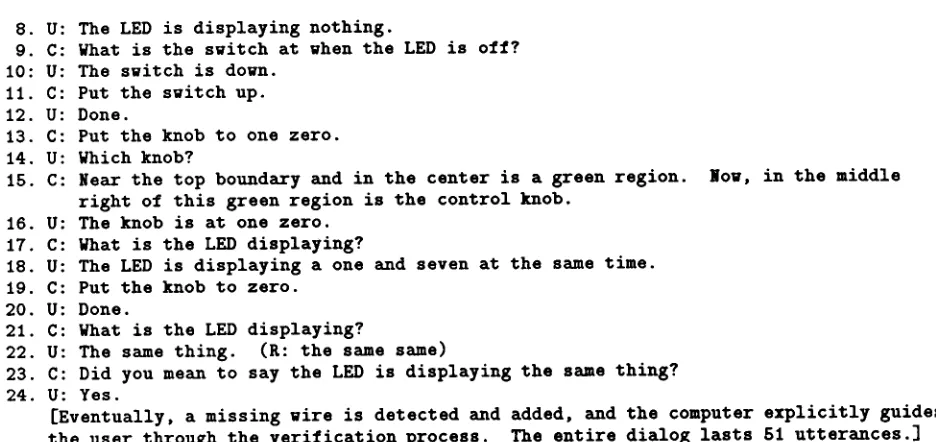
Figure 2 shows two dialogs obtained from actual usage of the system. These dialogs can be seen in [Hipp and Smith, 1991] that is part of the video presentation of the conference. The words in parentheses found beside certain user statements are the words actually provided by the speech recognizer. Where the discrepancy be- tween the output of the speech recognizer and the words produced by the user is insignificant, they have been omitted.
D i a l o g 1 - D e c l a r a t i v e Mode (C d e n o t e s the computer, U the user, a n d R the r e c o g n i z e r )
1. C: 2. U: 3. C:
4 U:
S C:
6
7
8
9 10. U:
11. C:
This is the circuit fix it shop. Hoe m a y I h e l p you?
I want to fix this rs111.
I am f a m i l i a r w i t h that circuit. The LED is s u p p o s e d to be d i s p l a y i n g a l t e r n a t e l y
f l a s h i n g one and seven.
The LED is d i s p l a y i n g an a l t e r n a t e l y f l a s h i n g one a n d the t o p c o r n e r of a seven.
T h e r e is s u p p o s e d to be a w i r e b e t w e e n c o n n e c t o r n i n e n i n e a n d c o n n e c t o r one z e r o zero.
U: It is there.
C: T h e r e is s u p p o s e d to be a w i r e b e t w e e n c o n n e c t o r n i n e n i n e and c o n n e c t o r one z e r o two. U: There is no w i r e on c o n n e c t o r one zero four. (R: stays k n o w w i r e i c o n n e c t o r one z e r o for) C: There is s u p p o s e d to be a w i r e b e t w e e n c o n n e c t o r one z e r o f o u r a n d c o n n e c t o r one z e r o two.
[User adds wire and v e r i f i e s the circuit is repaired, a t h r e e step p r o c e s s . ]
The circuit is working.
G l a d to h a v e b e e n of assistance. Good-bye.
D i a l o g 2 - D i r e c t i v e M o d e excerpt (begins just a f t e r c o m p u t e r d e s c r i b e s what c i r c u i t does)
8. U: 9 . C: I0: U:
1 1 . C:
12. U: 13. C:
14. U:
1 5 . C:
16. U:
17 C:
18 U:
19 C:
20 U:
21 C:
22 U:
23 C:
The LED is d i s p l a y i n g nothing.
What is the s w i t c h at w h e n the LED is off?
The s w i t c h is down. Put the s w i t c h up.
Done.
Put the k n o b to one zero.
W h i c h k n o b 7
N e a r the t o p b o u n d a r y a n d in the c e n t e r is a g r e e n region.
right of this g r e e n r e g i o n is the c o n t r o l knob.
The k n o b is at one zero. What is the LED d i s p l a y i n g ?
The LED is d i s p l a y i n g a one and seven at the same time.
Put the k n o b to zero.
Done.
What is the L E D d i s p l a y i n g ?
The same thing. (R: the same same)
D i d y o u m e a n to say the LED is d i s p l a y i n g the same t h i n g ?
Now, i n t h e m i d d l e
2 4 . U : Yes.
[Eventually, a m i s s i n g w i r e is d e t e c t e d and added, and the c o m p u t e r e x p l i c i t l y g u i d e s
the u s e r t h r o u g h the v e r i f i c a t i o n process. The entire d i a l o g lasts 51 u t t e r a n c e s . ]
Figure 2: Sample Dialogs
(1) Successful processing of anaphoric reference at utterance 6.
(2) Successful shifts to user-initiated subdialogs at utterances 8 and 10.
(3) Successful recovery from speech recognition er- rors at utterance 8.
T h e second dialog is an excerpt from a dialog con- ducted in directive mode (strongly computer-controlled dialog). The total dialog lasted 51 utterances in contrast to the 11 utterance declarative mode dialog. Particular points to notice from this excerpt include:
(1) C o m p u t e r responses which are more directed and forceful in content than in dialog 1. (2) Successful handling of a clarification subdialog
(utterances 13-16).
(3) Successful verification of the implicit meaning of a user utterance in the presence of speech
recognition errors in utterance 22. In contrast with utterance 8 of diMog 1, the system decided an explicit verification subdialog was required to ascertain the meaning of the user's utter- ante.
6
Experimental Results
T h e system has been implemented on a Sun 4 worksta- tion with the m a j o r i t y of the code written in Quintus Prolog 1, and the parser in C. Speech recognition is per- formed by a Verbex 6000 running on an IBM PC and speech production is performed by a D E C t a l k 2 DTCO1 text-to-speech converter. T h e users are restricted to a 125 word vocabulary in the connected speech system. 1Quintus Prolog is a trademark of Quintus Computer Sys- tems, Incorporated
[image:6.612.83.551.251.472.2]The implemented domain processor has been loaded with a model for a particular experimental circuit assembled on a Radio Shack 160-in-One Electronic Project Kit.
After testing system prototypes with a few volunteers, eight subjects used the system during the formal exper- imental phase. After a warmup session where the sub- ject trained on the speech recognizer and practiced us- ing the system, each subject participated in two sessions where up to ten problems were attempted. The system ran in declarative mode (user-controlled dialogs) during one session and in directive mode (strongly computer- controlled dialog) in the other session. Subjects at- tempted a total of 141 dialogs of which 118 or 84% were completed successfully. 3 Subjects spoke a total of 2840 user utterances, with 81.5% correctly interpreted by the system although only 50.0% were correctly recognized word for word by the speech recognizer. The average speech rate was 2.8 sentences per minute, and the aver- age task completion times for successful dialogs were 4.5 and 8.5 minutes, respectively, for declarative and direc- tive modes. The average number of user utterances per successful dialog was 10.7 in declarative mode and 27.6 in directive mode. A detailed description of the experiment and results is given in [Smith, 1991]. The substantially shorter completion times for users in declarative mode can be attributed to the fact that the subjects learned many of the debugging procedures during the experiment and did not need the detailed descriptions given in the directive mode.
7
Summary
A voice interactive dialog architecture has been devel- oped which achieves simultaneously a variety of behav- iors believed to be necessary for efficient human-machine dialog. Goal oriented behavior is supplied by the theo- rem proving paradigm. Subdialogs and movement be- tween them is implemented with an interruptible theo- rem prover that maintains a set of partially completed proofs and can work on the most appropriate one at any given time. A user model is provided by a contin- uously changing set of rules that are referenced in the theorem proving process either to enable or inhibit voice dialog. Mixed initiative is made possible by variable types of processing by the output and input routines and by restricting or releasing the ability to interrupt to a new subdialog. Expectation is associated with indi- vidual subdialogs, is compiled from domain and dialog information related to each specific output, and is used to improve voice recognition and enable movement be- tween subdialogs.
~Of the 23 dialogs which were not completed, 22 were ter- minated prematurely due to excessive time being spent on the dialog. Misunderstandings due to misrecognition were the cause in 13 of these failures. Misunderstandings due to inadequate grammar coverage occurred in 3 of the failures. In 4 of the failures the subject misconnected a wire. In one failure there was confusion by the subject about when the circuit was working, and in another failure there were prob- lems with the system software. A hardware failure caused termination of the final dialog.
R e f e r e n c e s
[Aho and Peterson, 1972] Alfred V. Aho and Thomas G. Peterson. A minimum distance error-correcting parser for context-free languages. SIAM Journal on Compu- tation, 1(4):305-312, 1972.
[Aho and Ullman, 1969] A. V. Aho and J. D. Ullman. Properties of syntax directed translations. Journal of Computer and System Sciences, 3(3):319-334, 1969. [Allen et al., 1989] J. Allen, S. Guez, L. Hoebel,
E. Hinkelman, K. Jackson, A. Kyburg, and D. Traum. The discourse system project. Technical Report 317, University of Rochester, November 1989.
[Allen, 1983] J.F. Allen. Recognizing intentions from natural language utterances. In M. Brady and R.C. Berwick, editors, Computational Models of Discourse,
pages 107-166. MIT Press, Cambridge, Mass., 1983. [Carberry, 1990] S. Carberry. Plan Recognition in Natu-
ral Language Dialogue. MIT Press, Cambridge, Mass., 1990.
[Carbonell and Pierrel, 1988] N. Carbonell and J.M. Pierrel. Task-oriented dialogue processing in human- computer voice communication. In H. Niemann, M. Lang, and G. Sagerer, editors, Recent Advances in Speech Understanding and Dialog Systems, pages 491-496. Springer-Verlag, New York, 1988.
[Chin, 1989] D.N. Chin. KNOME: Modeling what the user knows in UC. In A. Kobsa and W. Wahlster, editors, User Models in Dialog Systems, pages 74-107. Springer-Verlag, New York, 1989.
[Cohen and Jones, 1989] R. Cohen and M. Jones. In- corporating user models into expert systems for ed- ucational diagnosis. In A. Kobsa and W. Wahlster, editors, User Models in Dialog Systems, pages 313- 333. Springer-Verlag, New York, 1989.
[Danlos, 1987] L. Danlos. The Linguistic Basis of Text Generation. Cambridge University Press, New York, 1987.
[Eastman and McLean, 1981] C. M. Eastman and D. S. McLean. On the need for parsing ill-formed in- put. American Journal of Computational Linguistics,
7(4):257, 1981.
[Erman et al., 1980] L.D. Erman, F. Hayes-Roth, V.R. Lesser, and D.R. Reddy. The Hearsay-II speech- understanding system: Integrating knowledge to re- solve uncertainty. ACM Computing Surveys, pages 213-253, June 1980.
[Finin, 1989] T.W. Finin. GUMS: A general user model- ing shell. In A. Kobsa and W. Wahlster, editors, User Models in Dialog Systems, pages 411-430. Springer- Verlag, New York, 1989.
[Grosz and Sidner, 1986] B.J. Grosz and C.L. Sidner. Attentions, intentions, and the structure of discourse.
Computational Linguistics, 12(3):175-204, 1986. [Grosz, 1978] B.J. Grosz. Discourse analysis. In
D.E. Walker, editor, Understanding Spoken Language,
pages 235-268. North-Holland, New York, 1978. [Hayes et ai., 1986] Philip J. Hayes, Alexander G
Hauptmann, Jaime G. Carbonell, and Masaru Tomita. Parsing spoken language: A semantic caseframe ap- proach. In COLING-86: Proceedings of the llth In- ternational Conference on Computational Linguistics,
pages 587-592, Bonn, August 1986.
[Hipp and Smith, 1991] D. R. Hipp and R. W. Smith. A demonstration of the "circuit fix-it shoppe'. A 12 minute videotape available from the authors at Duke University, Durham, NC 27706, August 1991.
[Hovy, 1988] E.H. Hovy. Generating Natural Language under Pragmatic Constraints. Lawrence Erlbaum As- sociates, Hillsdale, N J, 1988.
[Jacobs, 1987] P.S. Jacobs. KING: a knowledge- intensive natural language generator. In Gerard Kem- pen, editor, Natural Language Generation, pages 219- 230. Martinus Nijhoff Publishers, Boston, 1987. [Kitano and Van Ess-Dykema, 1991] H. Kitano and
C. Van Ess-Dykema. Toward a plan-based under- standing model for mixed-initiative dialogues. In Pro- ceedings of the 29th Annual Meeting of the Association for Computational Linguistics, pages 25-32, 1991. [Kobsa and Wahlster, 1988] A. Kobsa and W. Wahlster,
editors. Special Issue on User Modeling. MIT Press, Cambridge, Mass., September 1988. A special issue of
Computational Lingusitics.
[Kobsa and Wahlster, 1989] A. Kobsa and W. Wahlster, editors. User Models in Dialog Systems. Springer- Verlag, New York, 1989.
[Lehman and Carbonell, 1989] J.F. Lehman and J.G. Carbonell. Learning the user's language: A step to- wards automated creation of user models. In A. Kobsa and W. Wahlster, editors, User Models in Dialog Systems, pages 163-194. Springer-Verlag, New York, 1989.
[Levinson, 1985] Stephen E. Levinson. Structural meth- ods in automatic speech recognition. Proceeding of the IEEE, 73(11):1625-1650, 1985.
[Linde and Goguen, 1978] C. Linde and J. Goguen. Structure of planning discourse. J. Social Biol. Struct.,
1:219-251, 1978.
[Litman and Allen, 1987] D.J. Litman and J.F. Allen. A plan recognition model for subdialogues in conversa- tions. Cognitive Science, 11(2):163-200, 1987. [Lyon, 1974] Gordon Lyon. Syntax-directed least errors
analysis for context-free languages. Communcations of the ACM, 17(1):3-14, 1974.
[McKeown, 1985] K.R. MeKeown. Text Generation.
Cambridge University Press, New York, 1985.
[Morik, 1989] K. Morik. User models and conversationa ~ settings: Modeling the user's wants. In A. Kobsa and W. Wahlster, editors, User Models in Dialog Systems
pages 364-385. Springer-Verlag, New York, 1989. [Mudler and Paulus, 1988] J. Mudler and E. Paulus
Expectation-based speech recognition. In H. Niemann M. Lang, and G. Sagerer, editors, Recent Advances i~ Speech Understanding and Dialog Systems, pages 473- 477. Springer-Verlag, New York, 1988.
[Novick, 1988] D.G. Novick. Control of Mixed-Initiatiw Discourse Through Meta-Locutionary Acts: A Corn putational Model. PhD thesis, University of Oregon 1988.
[Paris, 1988] C.L. Paris. Tailoring object descriptions t¢ a user's level of expertise. Computational Linguistic~
14(3):64-78, 1988.
[Patten, 1988] T. Patten. Systemic Text Generation a Problem Solving. Cambridge University Press, Nev York, 1988.
[Polanyi and Scha, 1983] L. Polanyi and It. Scha. O] the recursive structure of discourse. In K. Ehlich am H. van Riemsdijk, editors, Connectedness in Sentence Discourse and Text, pages 141-178. Tilburg Univer sity, 1983.
[Pollack, 1986] M.E. Pollack. A model of plan inferenc, that distinguishes between the beliefs of actors an, observers. In Proceedings of the 24th Annual Mee1 ing of the Association for Computational Linguistic,.
pages 207-214, 1986.
[Reichman, 1985] R. Reichman. Getting Computers t Talk Like You and Me. MIT Press, Cambridge, Mass 1985.
[Smith, 1991] R.W. Smith. A Computational Model c Expectation-Driven Mixed-Initiative Dialog Proces, ing. PhD thesis, Duke University, 1991.
[Walker and Whittaker, 1990] M. Walker and S. Whit taker. Mixed initiative in dialogue: An investigatio into discourse segmentation. In Proceedings of the 28t Annual Meeting of the Association for Computation4 Linguistics, pages 70-78, 1990.
[Walker, 1978] D.E. Walker, editor. Understanding Sp~ ken Language. North-Holland, New York, 1978. [Whittaker and Stenton, 1988] S. Whittaker and
P. Stenton. Cues and control in expert-client dis logues. In Proceedings of the 26th Annual Meeting t the Association for Computational Linguistics, pag~ 123-130, 1988.
[Young and Proctor, 1989] S.J. Young and C.E. Pro~ tor. The design and implementation of dialogue coi trol in voice operated database inquiry systems. Con purer Speech and Language, 3:329-353, 1989. [Young et al., 1989] S.R. Young, A.G. Hauptman]