Task-based Language Teaching: Definition,
Characteristics, Purpose and Scope
Olmedo Bula-Villalobos, Carlos Murillo-Miranda
Centro de Idiomas, Universidad Estatal a Distancia, COSTA RICA
Abstract— Task-based Language Teaching alludes to a communicative approach which is grounded on the usage of real-life and pedagogical tasks as a central element for language instruction. The paper explores salient features of Task-based Language Teaching within an English as a Foreign Language context. Additionally, the paper goes over reasons on why language teachers should use and incorporate TBLT in their lessons. Next, a lesson plan that is based on TBLT tenets is provided. Finally, a section on criticism to TBLT is included to provide a much-needed balance. Task-based Language Teaching constitutes a major approach to language instruction. Thus, TBLT has several implications within language classrooms. Likewise, real-life tasks bring authenticity to language classrooms as students use the language in a pragmatic way. Tasks constitute the core element of TBLT as the focus is on meaning and effective communication. The negotiation of meaning is another underlying feature of TBLT.
Keywords— Task-based Language Teaching, English as a Foreign Language, Tasks, English Teaching
I. INTRODUCTION
Task-based Language Teaching alludes to a
communicative approach which is grounded on the usage of tasks (real-life and pedagogical) as a central element for language instruction. Being able to communicate effectively on a variety of real-life situations so as to share specific types of information in different linguistic and cultural backgrounds constitutes a pivotal goal when becoming a competent user of the language (Juan-Garau & Jacob, 2015). Now, research indicates that Task-based Language Teaching, hereafter referred to as TBLT, is a relevant approach within Communicative Language Teaching (Bygate, 2016; Cordoba, 2016; Willis, 1996). Thus, TBLT has several implications within language classrooms. Likewise, real-life tasks bring authenticity to language classrooms as students use the language in a pragmatic way.
The aim of this paper is to explore salient features of TBLT within an EFL (English as Foreign Language) context. The current paper has five sections where implications and perspectives are considered – that is, a discussion is provided to analyze significant concepts and intricacies. The sections of this paper can be summarized as follows: Definition of TBLT, Salient Features of TBLT, Why Language Teachers Should Use TBLT, and the Dark Side of TBLT. Finally, some insightful and thought-provoking conclusions are also offered.
II. WHAT IS TASK-BASED LANGUAGE
TEACHING?
A Task-based approach is one where tasks are used as the main key element of planning and instruction in language teaching. Nunan (as cited in Richards and Rodgers, 2001) provides the following definition.
the communicative task [is] a piece of classroom work which involves learners in comprehending, manipulating, producing or interacting in the target language while their attention is primarily focused on meaning rather than form. The task should also have a sense of completeness, being able to stand alone as a communicative act in its own right. (p.224)
TBLT promotes the use of a task as the most important unit. According to Ellis (2009), a task must match the following criteria to be considered one.
The main focus is meaning.
A ‘gap’ has to be present whether it is to express
opinions, infer meaning or convey information.
Learners’ own knowledge is the essential key to
develop the activity.
The use of language is not an end rather than a mean.
More negotiation of meaning happens in two-way tasks.
Planned tasks (a speech) promotes more
negotiation of meaning than unplanned tasks. A task involving a clear resolution provides more
negotiation than an open-ended task.
Reaching one solution rather than having a
different opinion on how to solve a situation will definitely provide more negotiation of meaning. Moreover, as indicated previously, the negotiation of meaning during a task is an important characteristic of a successful task. Ellis (2009) emphasizes the relevance of clearly stating what a task is and attempts to do so.
The definition I provided [...] makes it clear that tasks aim to involve learners in processing both
semantic and pragmatic meaning. By
emphasizing the importance of a ‘gap’ to motivate the ‘goal’ of a task and the need for learners to use their own linguistic resources (rather than simply manipulating texts they are provided with), this definition, I would argue, is sufficiently tight to distinguish activities like ‘completing a family tree’ and ‘agreeing to give advice to the writer of a letter to an agony aunt’ (examples from Skehan 1998a) from traditional language learning activities (what I have called ‘exercises’) such as ‘filling the blanks in sentences’, or even situational grammar activities. According to Foster (1999), task-based learning is an organic process where errors do not necessarily mean that learning did not happen appropriately rather part of a natural process. Some similarities as the aforementioned might seem familiar to Communicative Language Teaching (CLT); as a matter of fact, Willis (1996) states that TBLT can be interpreted as a development of CLT. As stated before, TBLT is born as a logical development of
CLT – that is, some of the principles between them are
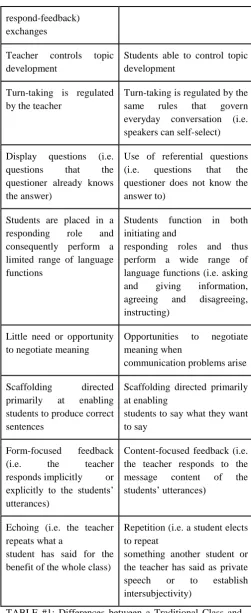
shared: real communication, meaningful tasks, and meaningful language. Because of the link to CLT, TBLT has received a lot of attention from SLA theory developers. Based on these definitions, it can be stated that tasks constitute an underlying construct for TBLT. The following table presents the differences between a traditional class and TBLT class (Ellis, 2009, p. 13)
Traditional form-focused pedagogy
Task-based pedagogy
Rigid discourse structure consisting of IRF
(initiate-Loose discourse structure
consisting of adjacency pairs
respond-feedback) exchanges
Teacher controls topic
development
Students able to control topic development
Turn-taking is regulated by the teacher
Turn-taking is regulated by the
same rules that govern
everyday conversation (i.e. speakers can self-select)
Display questions (i.e.
questions that the
questioner already knows the answer)
Use of referential questions
(i.e. questions that the
questioner does not know the answer to)
Students are placed in a
responding role and
consequently perform a limited range of language functions
Students function in both initiating and
responding roles and thus perform a wide range of language functions (i.e. asking
and giving information,
agreeing and disagreeing,
instructing)
Little need or opportunity to negotiate meaning
Opportunities to negotiate
meaning when
communication problems arise
Scaffolding directed
primarily at enabling
students to produce correct sentences
Scaffolding directed primarily at enabling
students to say what they want to say
Form-focused feedback
(i.e. the teacher
responds implicitly or
explicitly to the students’ utterances)
Content-focused feedback (i.e. the teacher responds to the
message content of the
students’ utterances)
Echoing (i.e. the teacher repeats what a
student has said for the benefit of the whole class)
Repetition (i.e. a student elects to repeat
something another student or the teacher has said as private
speech or to establish
intersubjectivity)
TABLE #1: Differences between a Traditional Class and TBLT class
Source: Ellis (2009)
understand TBLT in a more complete way. TBLT focuses more on tasks developed by the being student-centered- and providing a lot of opportunities for discussion of meaning.
III. SALIENT FEATURES OF TASK-BASED
LANGUAGE TEACHING
The following section explores the salient features of TBLT. First, relevant information related to the methodology of TBLT is considered. Advocates of TBLT have proposed a set of similar procedures built around tasks as a core component of language instruction and planning. Willis (1996), one of the most influential authors in the field, has proposed the following sequence.
The introduction to the task / Pretask: Teacher helps students comprehend the subtleties of a task (pictures, flashcards, and ideas). Students might play vocabulary-related games. Teacher and students go over new words and phrases. Students receive preparation time to plan about how to approach the task.
The task cycle / Task: In pairs or groups, students do the task and use language they already have. In
a supportive way, teacher monitors and
encourages students to communicate. Teacher does not correct errors. Teacher focuses on confidence-building as students communicate in a spontaneous way. Motivation is promoted upon completion of the task successfully. Planning: Students prepare and practice their presentations, speeches, and collaborations. Teacher helps students with their phrases and vocabulary items by suggesting keywords and polishing concepts. Teacher focuses on clarity, organization, and accuracy. Students ask questions related to specific language items. Report: Students present their situations and conversations – that is, students report to the whole class. The rest of students take notes with a purpose in mind (active listening). Posttask: Students listen to a recording of fluent speakers performing a similar task so as to compare the differences and similarities of their presentations.
The language focus / Analysis: Based on the texts students read or the transcripts they read, teacher sets language-focused tasks (finding words, filling in the blanks and underlying specific items). Teacher starts students off. Students continue in pairs or groups. Teacher monitors students’ analysis to assist accordingly. In a round-table discussion, teacher goes over the
analysis and significant language items. Practice: Teacher conducts practice activities (repetition, games, sentence completion, and matching) by using phrases and structures from the text (Willis, 1996).
Based on this sequence, one can conclude that TBLT revolves around the concept that tasks are essential – the sine qua non – for language instruction and planning, indeed. Now, let us examine the following table that exemplifies this sequence in a graphical way.
Fig.1: The Task-based Language Teaching Cycle Source: Adapted from Willis (1996)
When examining the figure, one can conclude that there is a degree of preparation and analysis for the task performance. To us, this fact provides students with enough time to prepare the task so as to accomplish the class objectives accordingly. Moreover, the posttask stage lets students and teachers adjust technical and linguistic elements to communicate effectively. Interestingly, the language focus stage equips students with pragmatic tools to better comprehend and use the language in everyday situations with real-life and pedagogical tasks. Building on this concept, Ellis (2003) has established the following sequence: Pretask: establishing the outcome of the task, doing a similar task. During task: time pressure, number of participants. Posttask: learner report, consciousness-raising, task repetition (Ellis, 2003). When comparing the steps, one can establish important similarities with the three main concepts: the pretask step, the task stage, and the posttask phase. These constructs represent the core of
the TBLT methodology. Additionally, a visual
Fig.2: The Task-based Language Teaching Cycle Source: Adapted from Ellis (2003)
When analyzing the figure, it can be concluded that this sequence embraces a much simpler sequence, but with three strong stages that also provide students with enough preparation time to perform the tasks. During the pre-task stage, framing the activity constitutes a powerful exercise that organizes students’ mental structures. Likewise, the posttask phase encourages reflection and critical analysis for meaning-making. Finally, in relation to the methodology of TBLT, four elements are relevant to mention here: TBLT as a needs-based approach to identify specific requirements, wants and lacks; the three-phase procedure which entails a pre-task, an on-task and a post-task phase; TBLT as a discovery-based element that fosters ways into discovering linguistic patterns for communication; and TBLT as a project-based approach in which a type of collaboration is required for an outcome (Bygate, 2016).
Second, relevant assumptions about the nature of learning and language are discussed here. Richards and Rodgers (2001) proposed the following constructs in relation to language. Language is basically a means of meaning-making. Making meaning is pivotal as it is central to task-based instruction. “In common with other realizations of communicative language teaching, TBLT emphasizes the central role of meaning in language use” (Richards & Rodgers, 2001, p. 226). Several models of language serve as the basis for TBI. For example, Skehan (as cited by Richards & Rodgers, 2001) proposed structural criteria in determining the complexity of tasks. Other scholars have offered interactional dimensions (Pica, 1994). Lexical units are essential when learning and using a language. The perspective that speech processing is based on vocabulary and phrase units becomes pivotal as fluency is concerned with the students’ ability to produce and analyze the intended message in real-time. “Vocabulary is here used to include the consideration of lexical phrases, sentence stems, prefabricated routines, and collocations, and not only words as significant units of linguistic lexical analysis and language pedagogy” (Richards & Rodgers, 2001, p. 227). Conversation is the main focus of language acquisition. Conversation is the cornerstone of TBLT, indeed. We would go even further to say that other types of synchronous and asynchronous communications might
be considered essential of language. For instance, exchanges on blogs and social media messages might be construed as significant conversations when designing specific types of tasks. “Speaking and trying to communicate with others through the spoken language drawing on the learners’ available linguistic and communicative resources is considered the basis for second language acquisition in TBI” (Richards & Rodgers, 2001, p. 228). From this information, it can be concluded that communication constitutes a major construct for TBLT.
Richards and Rodgers (2001) also proposed the following constructs in relation to learning. At this point, it is important to mention that TBLT is mainly motivated by a theory of learning. Tasks provide the input and output for language acquisition. Input is absolutely necessary for language acquisition (Krashen’s i+1 theory). It provides a model for intonation patterns, pronunciation, grammar structures, vocabulary, word stress and sentence stress conducive to acquisition. “Tasks, it is said, provide full opportunities for both input and output requirements, which are believed to be key processes in language learning” (Richards & Rodgers, 2001, p. 228). Likewise, learner involvement, reflection and the target language usage are regarded as crucial to language learning (Little, 2007). When analyzing these elements, it becomes pivotal for language teachers to keep them in mind when designing tasks and exercises. Richards and Rodgers (2001) also talk about the possibility that tasks offer for negotiation of meaning. To us, conversations do offer the
possibility to negotiate meaning. Thus, students
Third, closely related to these assumptions, Ellis (2003) proposed the following principles. Exposure to authentic language is significant; Language should be used for real purposes; Tasks need to motivate students to use language; A focus on language should be established. It is clear that these principles have a solid basis for communication. Additionally, Larsen-Freeman (2000) also propounded the following principles. Class activities have a clear purpose and outcome. A pre-task offers possibilities for students to understand the logic involved in the activity. A pre-task provides the language to complete the task. The cognitive process needs to be above students’ level so that they can successfully complete the task. Teachers adjust the language level to convey meaning. Teachers recast students’ utterances. Meaning is relevant for the learning process (Larsen-Freeman, 2000). Next, instruction needs to foster learner-centeredness (Hismanoglu & Hismanoglu, 2011). Interestingly, some commonalities emerge. First, pre-tasks do offer possibilities for students to plan the task accordingly and to prepare potential grammatical structures. Next, conversation is a key element in both lists of principles as it is the ultimate goal for communication. Finally, meaning-making constitutes a major element to promote communication.
Likewise, Ellis (2003) discussed the following features of a task. A task constitutes a workplan. It is true that a task implies a plan of action. A workplan provides a roadmap for organizational purposes. “This workplan takes the form of teaching materials or ad hoc plans for activities that arise in the course of teaching” (Ellis, 2003, p. 9). Tasks focus on meaning. Meaning is a hallmark of TBLT. To this end, tasks provide genuine opportunities for negotiation and meaning-making by using the necessary linguistic tools. “The workplan does not specify what language the task participants should use but rather allows them to choose the language needed to achieve the outcome of the task” (Ellis, 2003, p. 9). A task implies the usage of real-life language. Communication is the ultimate goal, indeed. Real-life tasks prepare students to function accordingly in societies. Completing a form, asking for and giving information, clarifying concepts, engaging in small-talk, taking notes and getting the gist of a text are examples of real-life tasks. “…the processes of language use that result from performing a task… will reflect those that occur in real-world communication” (Ellis, 2003, p. 9). A task might involve any of the four basic skills. It is also true that some tasks also foster the combination of different skills and subskills. Real-life conversations and situations are not solely based on a specific skill, grammar structure, intonation pattern, or learning strategy but rather a variety of elements to successfully complete particular linguistic
demands where productive and receptive skills become a must along with other elements. To illustrate this feature, Ellis (2003) has stated that “A task may require dialogic or monologic language use. In this respect, of course, tasks are no different from exercises” (p. 10). Tasks involve cognitive processes. Engaging in conversation requires students to come with and organize cognitive processes so as to build brain synapses and connections to perform accordingly. Tasks have a specific communicative result. Communicative outcomes are significant as they provide roadmaps and goals for any communicative endeavor. Moreover, they might have an evaluative purpose. “The stated outcome of a task serves as the means for determining when participants have completed a task” (Ellis, 2003, p. 10). Based on these features, we can conclude that specific grammatical structures or intended vocabulary do not represent underlying elements of the task process. Conversely, finding ways to convey meaning through authentic or artificial conversations constitutes the basis of TBLT. Likewise, high-thinking skills might become necessary to perform specific types of tasks, for instance, problem-solving activities. This means that students need to apply other types of thinking processes to be able to cope with more complex tasks. Finally, Nunan (2004) established the following set of principles when designing a syllabus around the concept of task-based materials. Scaffolding, task dependency, recycling, active listening, integration, reproduction to creation and reflection. These principles do provide students with elements to establish meaning-making processes when attempting to communicate. Now, it is evident that language teachers might come up with their own principles and instructional sequence when using and designing task-based materials.
that “A central role of the teacher is in selecting, adapting, and/or creating the tasks themselves and then forming these into an instructional sequence in keeping with learner needs, and language skill level” (p. 236). Likewise, Willis and Willis (2007) also provided a set of roles for the teacher in TBLT. These roles can be summarized as follows. Discussion leader: The teacher takes the initiative to start discussions/conversations and to keep them going as long as necessary. The teacher functions as a task administrator beginning with teacher-led conversations. A caveat, Willis and Willis (2007) noticed that a teacher-led class represents a challenge by mentioning that “You need to think things through with great care, anticipating the difficulties learners are likely to have and working out strategies for handling those difficulties” (p. 149). Group manager: Closely related to the previous role, being a group manager entails other types of responsibilities like convincing and persuading learners of potential benefits. Additionally, teachers need to be skillful enough to get the most out of students, tasks, combinations, and exchanges. Building on this concept, Willis and Willis (2007) manifested that “It is sometimes useful to change the composition of the groups and repeat a task… This provides useful opportunities for learners to rephrase ideas they have already worked through” (p. 150). We do believe this is significant as students engage in different mental processes that let them mull structures and vocabulary over to assess their appropriacy. Facilitator: The teacher eases students into activities by facilitating processes. Language teachers constantly find themselves adjusting activities and their level in order to fit students’ needs, wants, and lacks. When talking about this role, Willis and Willis (2007) manifested that “You need to find a balance between setting a task which provides the right kind of challenge, and making sure that learners can manage the task” (p. 150). To us, this is paramount basically because a very easy task is to bore students by not challenging them, whereas a very difficult task will probably lose students’ interests as it is difficult to digest and understand its logical structure and benefits. Motivator: It can be said that motivated students are more likely to engage effectively in tasks and internalize the linguistic concepts involved in the learning process. Based on this premise, it is only logical that language teachers become motivators to facilitate the meaning-making process of tasks. Motivation is a psychological factor that keeps the affective filter low (Krashen’s theory of affective filter. Enhancing motivation constitutes a must for all the stakeholders involved in the learning process. Language expert: The teacher is the language expert and ‘knower’, indeed. The teacher is usually an important source of input
and works as an adviser in terms of linguistic expertise. For this reason, teachers need to be truly knowledgeable not only on the pragmatic features of a language but also on the cultural nuances. Reading between the lines and grasping the hidden meaning of texts becomes a must for teachers – that is, understanding the ‘feelings’ and nature of words to convey a specific meaning that is not directly stated. In advising teachers how to operate in this role, Willis and Willis (2007) pointed out that “…you should resist the temptation to correct learners when they don’t really need it but you should be ready to help answering questions in a language study phase when learners are struggling…” (p. 151). One has to recognize that this poses real challenges for traditional and non-native teachers as they might imply that constant correction of mistakes is required in all stages of the communicative process. Providing safe spaces to construct a mental organization of oral structures and recasting might become effective tools to correct mistakes. Teachers do need to concentrate on error patterns and devote time to conduct a language focus. Language teacher: It is almost inevitable to adopt this traditional role as it represents a main function in the language classroom. This role implies preparation, planning, and execution. In TBLT, this traditional role is assumed at the end of the task cycle (Willis & Willis, 2007). When analyzing these roles, it can be concluded that the teacher is pivotal for the task cycle. Particularly, the planning stage demands careful analysis to select, adapt, create and choose the activities and material to be used in the task cycle.
Now, the roles of the learner are pondered. Richards and Rodgers (2001) proposed the following roles. Monitor: Teachers monitor students so as to guide them during the task cycle. Additionally, teachers are to raise much-needed awareness for students to grasp the particularities of a task. “Class activities have to be designed so that students have the opportunity to notice how language is used in communication” (Richards & Rodgers, 2001, p. 235). This is absolutely relevant so students can establish and internalize the sequence and the logic of the task. Innovator: Innovation and risk-taking become necessary constructs in order to make last-minute decisions and adaptations to the task cycle and to include specific strategies and skills when necessary. “Practice in restating,
paraphrasing, using paralinguistic signals (where
modifications are necessary. We consider it is interesting because this role implies a good sense of understanding and grasping the students’ context and reality when performing the task. This is not an uncomplicated mission, whatsoever.
Finally, we go over the role of instructional materials. Richards and Rodgers (2001) suggested these roles. Pedagogic materials: Books and other types of pedagogic materials represent a significant source of tasks. “Materials that can be exploited for instruction in TBLT are limited only by the imagination of the task designer” (Richards & Rodgers, 2001, p. 236). We fully endorse this concept since the possibilities are literally endless when it comes to imagining modifications and eventual incorporations. We do believe that designing tasks is like creating art in a way. Realia: Newspapers, magazines, internet, TV, streaming services, radio, and social networks constitute a much-needed source of input of the language in and outside the classroom, particularly in EFL contexts. It is also true that realia can be adapted to be used with pedagogical purposes. “TBI proponents favor the use of authentic tasks supported by authentic materials wherever possible. Popular media obviously provide rich resources for such materials” (Richards & Rodgers, 2001, p. 237). Additionally, authentic materials provide a general idea of the status quo of the identity of a society. Although this concept is important, authentic materials are not always suitable to be used with certain segments, for instance with beginners. These are the most relevant roles for teachers, students, and materials.
Fifth, it is relevant to consider factors that hamper the implementation of TBLT. Liu, Mishan and Chambers (2018) identified specific constraints in this regard. These factors are summarized as follows. Resource constraints: This is a relevant factor as it is closely related to the limited availability of textbooks with task-based activities (Liu et al., 2018). Based on our professional experience, it is a foregone conclusion that this factor constitutes an important limitation, indeed. Interestingly, such a limitation aligns with Hobbs’ (2011) findings that establish that the limited availability of genuinely task-based materials is a major criticism to TBLT. Moreover, challenges in the TBLT syllabus design and the task cycle implementation in an online environment were also identified (Lai, Zhao, & Wang, 2011). These were related to the usage of e-books within the stages. Administrative system constraints: this type of constraint is in relation to particular aspects of the pedagogical process, for example imposed methodologies and assessment. Rigid evaluation systems tend to force teachers and students to focus on specific results and expectation that conflict with the
enforcement of TBLT. “The limited teaching hours and the pressure to fulfill the form-focused teaching curriculum
are also highlighted as issues that challenge
implementation of TBLT” (Liu et al., 2018, p. 10). Our understanding revolves around the idea that these types of constraints are quite common in educational systems and might be part of a hidden curriculum or respond to specific agendas in order to favor political considerations and national policies. Constraints of students: We cannot deny the importance of students’ willingness to participate in class. They do need to be convinced of the relevance of the activities and their overall match within a general educational context. “Making sure that students understand the advantages of the techniques used in TBLT and that they were interested in them is very important for the implementation of the new methodology” (Liu et al., 2018, p. 11). To us, grasping the deductive nature of TBLT and the construction of well-balanced, real-life tasks is of absolute importance to students and, ultimately, the implementation of TBLT. Constraints of teachers: It is true that teachers are busy with an important number of responsibilities. Designing and assembling real-life tasks would also be within their purview given the limited availability of task-based materials. From our experience, changes tend to present a normal degree of resistance, especially when there are working responsibilities and cognitive loads attached. Liu et al. (2018) confirmed this idea when they stated that “Since there is not enough appropriate teaching material for TBLT, teachers feel they may have to design tasks by themselves” (p. 11). Likewise, we do believe there is a strong connection between training and the implementation of TBLT – that is, TBLT is a relatively new approach within modern educational systems and the P-P-P model seems to be a popular one in terms of its communicative possibilities and deductive system. These are significant factors that conflict with TBLT’s implementation.
Finally, some types of tasks are provided in this section. Based on our professional practice and experience, we have come up with these types of tasks without being exhaustive. Discussion tasks: Engaging in discussion is not easy as it implies a set of sociolinguistic skills, but it is
indispensable because it provides students with
offers learners opportunities to establish connections with previous knowledge and experiences. Likewise, it triggers the curiosity of the upcoming task. Split-information tasks: These types of tasks promote collaboration among students. This is essential to build trust and create communicative channels. It also lets students become experts with specific types of information or processes. Corrupted texts: Negotiation of meaning constitutes a relevant strategy for this type of tasks. When performing this type of task, students acquire the skills of ‘successful’ negotiation. The analysis of text (register and grammar) is also necessary here. Listing: An example of this kind of task is brainstorming. Brainstorming activates schemata and mental organization. Sequencing and ordering: The cognitive load is higher as it involves some sort of classification and analysis of the options. Storytelling: Connecting with tasks at a personal level is also plausible via stories. Time lines and picture dictogloss constitute examples of this task. Finally, a whole range of communicative tasks may be generated from games, problem-solving activities, puzzles, and projects. These are significant features and considerations of TBLT.
IV. WHY SHOULD LANGUAGE TEACHERS USE
TASK-BASED LANGUAGE TEACHING? Language teachers should refer to task-based since as mentioned before it is a logical step coming from CLT. According to Willis and Willis (2007), the main reason for using task-based can be accounted to implementing real-world tasks in the class. Therefore, TBLT engages in a way that a class activity resembles the language used in the real world. Willis and Willis (2007) indicated that many of the activities designed in TBLT are to be developed with everyday language; as an example: “making a conversation, reading newspapers, finding our way around the world by asking other people or looking at written sources on paper or electronically” (p.139). Hence, the relevance for language teachers to implement CLT as a means of preparing their students for interaction in the real world. Moreover, communicative tasks promoted under TBLT will allow the students not only improve their spontaneous spoken discourse but also prepare them for real-life interaction such as lectures and broadcasts. It is necessary for the student to come up against the characteristics of spontaneous speech.
In addition, authors have mentioned significant advantages of TBLT. Juan-Garau and Jacob (2015) claimed that TBLT developed English learners’ transcultural skills and competence through task-based instruction. Moreover, evidence suggested that content and task-based approaches can be integrated to promote competence and content
learning. Córdoba (2016) indicated that the
implementation of TBLT promoted the integration of the four major skills in an EFL environment and that it fostered motivation and self-awareness during the development of the task. When explaining the benefits of implementing TBLT in a Chinese context, Liu, Mishan and Chambers (2018) signaled that “Following globalisation trends, the importance of raising language learners’ multicultural awareness and preparing students for effective, interactive communication are essential factors that are emphasised in language teaching and learning” (p. 3). Moreover, the main reason for implementing TBLT comes from the tenets it promotes. TBLT is created through a result of a history of methods that have been implemented. TBLT has also shown flexibility to current developments in education as the use of online contexts such as conferencing tools and Virtual Learning Environments (VLE). Lai, Zhao and Wang (2011) stated that “… the online context was also found to have great potential for the implementation of TBLT, such as facilitating emergent individualized instruction, lowering the cognitive load for ab initio learners, and encouraging student participation” (p. 93). Arguably, implementing TBLT in online learning environments and contexts could easily go hand by hand to adjust to the necessity of the students in today’s world. When designing tasks, language teachers need to take into consideration that “Tasks are supposed to elicit the kinds of communicative behaviour (such as the negotiation of meaning) that naturally arises from performing real-life language tasks, because these are believed to foster language acquisition” (Van Den Branden, 2006, p. 9). A caveat, language teachers need to ponder positive and negative aspects of TBLT so as to implement its cycle and communicative stages.
V. THE DARK SIDE OF TASK-BASED
LANGUAGE TEACHING
establish whether students are progressing or not when it comes to specific linguistic patterns as students might turn to structures and vocabulary that was already internalized. Use of L1: This might be perceived as a weakness when designing the task. To us, this does not represent an issue as long as students use their L1 to specifically plan and design the task. Not suitable for beginners: It is implied that true beginners may need to learn vocabulary, communicative strategies, pronunciation patterns, and specific-purpose vocabulary to perform accordingly. Our position is that beginners and true beginners constitute a real challenge for any methodological approach or learning situation. Previous learning experience: Grammar-oriented classes or deductive methodologies where linguistic rules and patterns are provided might constitute an issue for TBLT as more traditional students may expect to encounter similar learning milieus. Next, it is agreed that TBLT has a Western philosophical orientation rooted on individual performance within a group. Undoubtedly, this represents a tremendous challenge for cultural groups with holistic, in-depth visions of the world where Indigenous principles of collaboration and integration are favored. The autonomy of the learner and the hierarchical relations fostered in TBLT, considered normal and beneficial elsewhere, might be perceived as disruptive in particular learning environments.
Another type of common criticism is the one related to the availability of textbooks and ready-made task-based materials. Even though research validates the relevance of TBLT, there is limited availability of genuinely task-based textbooks to be considered in language teaching (Hobbs, 2011). From our position, teachers and course administrators are accountable for the quality of the material to be used in class. Consequently, this implies creating and designing different sets of TBLT material which places an extra responsibility in several stakeholders of the teaching-learning process. This represents a paramount consideration when working with specific types of societies. In addition, it was found that teachers had an unclear understanding of the methodological application of TBLT in an EFL context (Nahavandi & Mukundan, 2012). Interestingly, it was also found that teachers do have negative views about implementing TBLT in language
classrooms (Mahdavirad, 2017). This a major
inconvenience when using task-based exercises in terms of the application of the teaching-learning process. A caveat, it is true that this was a specific context under particular circumstances and this fact might negatively influence the validity of the information. To us, these results constitute thought-provoking data to consider. Finally, an important piece of criticism comes from Richards and Rodgers
(2001) when they established that “…the basic assumption of Task-Based Language Teaching – that it provides for a more effective basis for teaching than other language teaching approaches – remains in the domain of ideology rather than fact” (p. 241). This is revealing in the sense that this concept constitutes only an assumption with no specific tenets or research to validate it. These are relevant pieces of criticism against TBLT.
VI. CONCLUSION
In summarizing, this article provided significant definitions of TBLT. When analyzing the definitions, a concept that is central to all of them revolves around the importance of meaning when using tasks. Next, the article explores salient features of TBLT. Engaging in conversations promote language as a tool for meaning-making. Likewise, the degree of reality in the construction
of tasks provides possibilities for authentic
communication. Additionally, some roles within TBLT are included. The most relevant roles of the teacher are as follow: task selector, discussion leader, motivator and facilitator. Then the article goes over reasons for teachers to use TBLT. The implementation of real world-tasks can be considered an essential reason. Previous research has shown that transcultural skills and multicultural awareness can be construed as reasons for language teachers to use TBLT. Lastly, some criticism to TBLT is offered to provide a complete perspective of TBLT. Lack of time, fear of losing control and the availability of textbooks and materials are among the most common sources of criticism to TBLT. Finally, the most important source of criticism comes from Richards and Rodgers (2001) as they claim
that the effectiveness of TBLT is not fully
established.
In today’s multicultural societies, globalized economies
call for intercommunicated societies with sound
pedagogical systems that foster interaction. TBLT has become paramount for language instruction, indeed. It provides genuine possibilities to develop oral skills that enhance effective communication (Willis, 1996). In addition, tasks constitute the core element of TBLT as the focus is on meaning and effective communication. The negotiation of meaning is another underlying feature of TBLT. Conveying meaning is essential in the process of establishing social interactions for TBLT advocates. It is a foregone conclusion that TBLT represents a significant approach for language instruction.
REFERENCES
https://doi.org/10.1080/09571736.2015.1039566
[2] Cordoba, E. (2016). Implementing task-based language teaching to integrate language skills in an EFL program at a Colombian University. Revista PROFILE: Issues in Teachers’ Professional Development, 18(2), 13.
[3] Ellis, R. (2003). Task-based language learning and teaching. Oxford: Oxford University Press.
[4] Ellis, R. (2009). The methodology of task-based teaching. The Asian EFL Journal: 11(5).
[5] Fotos, S., & Ellis, R. (1991). Communicating about grammar: A task-based approach. TESOL Quarterly, 25(4), 605-628. doi:10.2307/3587079
[6] Foster, P. (1999). Task-based learning pedagogy. ELT Journal, 53(1), 69-70. doi.org/10.1093/elt/53.1.69 [7] Hismanoglu, M., & Hismanoglu, S. (2011). Task-based
language teaching: What every
[8] EFL teacher should do. Procedia - Social and Behavioral Sciences, 15, 46–52. https://doi.org/10.1016/j.sbspro.2011.03.049
[9] Hobbs, J. (2011). Practical steps towards task-based teaching. In A. Stewart (Ed.), JALT2010 Conference Proceedings. Tokyo: JALT.
[10] Juan-Garau, M., & Jacob, K. (2015). Developing English learners’ transcultural skills through content- and task-based lessons. System, 54, 55–68. https://doi.org/10.1016/j.system.2015.04.017
[11] Lai, C., Zhao, Y., & Wang, J. (2011). Task-based language teaching in online ab initio foreign language classrooms. The Modern Language Journal, 95(s1), 81–103. https://doi.org/10.1111/j.1540-4781.2011.01271.x
[12] Larsen-Freeman, D. (2000). Techniques and principles in language teaching. (2nd Ed.) Oxford: Oxford University Press.
[13] Little, D. (2007). Language learner autonomy: some fundamental considerations Revisited. International Journal of Innovation in Language Learning and Teaching, 1(1), 14-29, doi:10.2167/illt040.0
[14] Liu, Y., Mishan, F., & Chambers, A. (2018). Investigating EFL teachers’ perceptions of task-based language teaching in higher education in China. The Language Learning Journal, 0(0), 1–16.
https://doi.org/10.1080/09571736.2018.1465110
[15] Mahdavirad, F. (2017). Task-based language teaching in Iran: A study of EFL teachers’perspectives. International Journal of English Language and Translation Studies, 05(04), 14–21.
[16] Nahavandi, N., & Mukundan, J. (2012). Task-based language teaching from teachers’ perspective. International Journal of Applied Linguistics and English Literature, 1(6), 115–121.
[17] Nunan, D. (2004). Task-Based Language Teaching. Cambridge: Cambridge University Press.
[18] Pica, T. (1994). Research on negotiation: What does it reveal about second-language learning conditions, processes, and outcomes? Language Learning, 44(3), 493-527. doi:10.1111/j.1467-1770.1994.tb01115.x
[19] Richards, J., & Rodgers, T. (2001). Approaches and methods in language teaching (2nd Ed.). New York:
Cambridge University Press.
[20] Van den Branden, K. (2006). Task-based language education: from theory to practice. Cambridge: Cambridge University Press.
[21] Willis, J. (1996). A flexible framework for task-based learning. In J. Willis and D. Willis
[22] (Eds.), Challenge and Change in Language Teaching. Oxford: Heinemann. 52-62.
[23] Willis, D., & Willis, J. (2007). Doing task-based teaching. Oxford: Oxford University Press.