The Power of Questioning: Teacher’s Questioning Strategies in
the EFL Classrooms
ANNISA ASTRID1, RIZQY DWI AMRINA2, DETA DESVITASARI 3, UCI
FITRIANI 4
, AND AISYAH SHAHAB 5
Abstract
The aims of the study were to investigate English teachers’ questioning strategies at one Madrasah in Palembang, South Sumatera. The qualitative research method with a case study approach was employed to look at the ways of the English teachers’ questioning strategies in the processes of teaching and learning and the reasons that made them use certain questioning strategies. The participants in this study were English teachers. We used observation and interviews as our data collection techniques. The observation was used to look at the teacher’s questioning types used in the daily practices of teaching in the EFL classroom while the interview was used to understand the reasons that made them use those types of questioning strategies. Our findings showed three types of teacher’s questioning strategies used by teachers in their teaching and learning processes including convergent, divergent, and procedural questions. Teachers mostly used convergent questions (yes/no and short answers). We also found five reasons why teachers preferred to those types of questioning strategies including recalling students’ understanding, attracting students’ attention, increasing students’ thinking in higher order level, and engaging students in learning activities. Implications and recommendations are also discussed.
Keywords
Application of questioning strategy, convergent questions, divergent question, procedural questions
1. *Corresponding author: English Education Study Program, Faculty of Tarbiyah and Teaching Sciences, State Islamic University of Raden Fatah, South Sumatra, Indonesia; [email protected]
2. English Education Study Program, Faculty of Tarbiyah and Teaching Sciences, State Islamic University of Raden Fatah, South Sumatra, Indonesia.
3. English Education Study Program, Faculty of Tarbiyah and Teaching Sciences, State Islamic University of Raden Fatah, South Sumatra, Indonesia.
4. English Education Study Program, Faculty of Tarbiyah and Teaching Sciences, State Islamic University of Raden Fatah, South Sumatra, Indonesia.
Introduction
In the globalization era, English is the most crucial language in the world which is used by many countries. There are some reasons why English is crucial as an international language. According to Cook (2003), English is used for communication as an international language in every country. It is known as a daily international communication tool with other people from different countries. Moreover, Crystal (2004) argues that people use English for their international contacts in some countries. In Indonesia, English as a foreign language is taught to students at schools. According to Ramelan (1994), English has been taught at school in Indonesia as the first foreign language. It is taught in kindergarten, elementary school, junior high school, senior high school even in the university level. Saputra and Marzulina (2015) confirm that English has become a compulsory subject and it must be learned as a foreign language from junior high school to senior high school in Indonesia. It is important because students learn English as a compulsory subject in school, especially for students of senior high school. As a compulsory subject, improving English skill of students needs the role of teacher; teacher has vital roles in teaching and learning processes. According to Brown (2001) and Harmer (2007), teacher can be as a controller, director, and facilitator (as cited in Haliani, 2013, p. 1). As a controller, teacher will determine what students do, when they should speak, and what language form they should use. As a director of classroom, teacher is responsible for increasing students’ motivation in order to make learning processes run smoothly. Also, as a facilitator, teacher will assist students in making the learning processes easier and more comfortable. Therefore, the teacher has an important role in classroom activities.
Moreover, as a director, teacher should apply questioning strategies for increasing students’ ability in classroom. Questioning strategy is important because asking or giving question is one of the crucial strategies that teacher can use in teaching processes. There are some reasons why questioning strategy is important. Shaunessy (2005) states that questioning strategies are essential to the growth of critical thinking skills, creative thinking ability, and higher level thinking skills. Questioning strategies are the ways which are used by teacher to know the ability of the students and how far the students understand the material which has been taught. In brief, questioning strategy is one of the important strategies that can improve students’ ability. Additionally, teacher can also use questioning strategy to measure students’ thinking ability. According to Blosser (2000), if students want to become better problem solvers, they need to develop higher-order thinking skills. Teacher should ask questions to increase students’ thinking and opinions. Based on the research conducted by Blosser (2000), the result shows that about 60 percent require only recall or facts, 20 percent require students to think, and 20 percent are procedural. It means that teachers often gives short answers, such as yes/no or short statements.
According to Blosser (2000), there are several types of questions: managerial, rhetorical, closed and opened questions. However, teacher does not focus only on those kinds of questions; because there are some other types of questions that can be used to gain students’ thinking. It is supported by Richards and Lockharts (1994) who propose that there are three types of questioning strategies such as procedural, convergent, and divergent questioning strategies. In short, teacher should know the appropriate types of question that can improve the level of students’ ability.
The results of several previous studies have indicated that the importance of the questioning strategies. For example, Sujiarti, Rahman, and Mahmud (2016) found that teachers applied more than one type of questions. Open/closed and display questions were applied frequently in all sessions of teaching. Also, the result of Ndun’s study (2015) showed that in the question type, display question (92%) was highly uttered by the teachers rather than referential questions (8, 1). Additionally, the result of Matra’s (2014) research showed that teachers used recall questions for 52%, comprehension for 42% and application occupied the remaining that was 6%. In brief, the researchers found several types that were usually used by each participant.
Thus, teacher’s questioning strategies are very important. Teachers should give some questions to their students either the questions are addressed to an individual student or they are for the whole class in their classroom. Teachers use various questions and questioning types as their strategies in questioning not only to promote classroom interaction, but also to encourage students to communicate in a real-life setting, and to build students’ critical thinking. Therefore, we were interested in conducting a study on investigating English teachers’ question strategies at one Madrasah in Palembang, South Sumatera for addressing the following research questions: (1) What are questioning strategies used by English teachers at one Madrasah in Palembang, South Sumatera? (2) What are the reasons driving the teachers to use the types of questioning strategies?
Literature Review
Question and questioning strategy
students. Questioning strategies can help students learn and improve their achievement. Daniels (1997), Gallagher (1985), Letzter (1982), Parker (1989), Pollack (1988), and Schwartz (1996) indicate that questioning strategies are essential to the growth of critical thinking skills, creative thinking skills, and higher level thinking skills.
Questioning strategies are vital to acquire knowledge. People usually ask questions to one another to know something about the unknown things. They are instruments to examine new ideas, facts, information, knowledge, and experiences. According to Brown and Wragg (1993), we normally ask questions when we really want to know something and, if we already know the answer, then we don’t need to ask (as cited in Ndun, 2015, p. 10). Questions in the language classroom enable the teacher to evaluate his or her students and motivate students to attend lessons attentively. Ma (2008) explains that a question plays a great part in communication (as cited in Ndun, 2015, p. 10). It is used as a learning tool to promote interaction in classroom.
Teachers in the EFL classrooms employ different types of questions to make teaching effective and enhance learners’ proficiency in the target language. As it has been explained by Richards and Lockharts (1994), there are three types of questions. First, procedural questions which the following questions usually occur in classrooms while teachers are checking the assignments have been completed, that instructions for a task is clear, and that student are ready for a new task. Second, convergent questions need the responses “yes” or “no” or short statements. Third, divergent questions encourage students’ responses which are not short answers and which require students to engage in higher level thinking.
The application of questioning strategy
Questioning at the beginning. Addressing questioning before teaching and studying material is effective for students who have/are high ability, and/or known to be interested in the subject matter. Eble (1988) argues that some teachers apply questioning in the classroom early to help students who have questions about previous lectures, readings and exam preparations (as cited Sujiarti et al., 2016, p. 111). In the beginning of a class, giving question as opening questions in a conversation can make easy for the students to answer, and does not force them to reveal too much about themselves. The questions before teaching can be in written forms as a quiz or oral question.
Questioning at the end of the class. Questioning students at the end of the class teaching is mostly used by teachers because it is essential to know students’ understanding, to assess students’ learning, to test students input and evaluate both teachers’ teaching quality and the teaching learning process whether they have been running well or not. In this section, it is essential for teachers to apply recall question, a referential question to check students’ understanding. Eble (1988) argues that open/closed questions, or other types of questions can also be used by teachers in completing the target learning (as cited in Sujariati et al., 2016, p. 112).
Methodology
Research design, research site, sampling, and participants
We conducted this study by using a qualitative method with case study approach. According to Creswell (2012), the historic origin for qualitative research design comes from anthropology, sociology, the humanities, and evaluation case study is one of the qualitative research approaches that is used in which the researcher develops an in-depth analysis of a case, often a program, event, activity, process, or one or more individuals (Creswell, 2012). The most important reason of using qualitative design is that this design is an appropriate way to explore every day behavior; the behavior of teacher and students in classroom, particularly teacher’s questioning strategies in EFL classroom. In this study, we investigated teacher’s questioning strategies in EFL classroom of one madrasah in Palembang, South Sumatera, Indonesia in academic years 2018/2019. There were two teachers at the madrasah who were willing to participate in this study. In this study, the participants were two English teachers. At the beginning, we planned to have 6 teachers; however, only 2 teachers were willing to participate in our study. One of the reasons of their reticence was that they were worried if we observed their classroom.
Data collection
Data analysis and trustworthiness
In analyzing data, we applied thematic analysis. We followed the steps proposed by Creswell (2012). First, we collected the detailed data from observation (e.g., field notes) and interview (e.g., interview transcriptions). We put the data into computer files and filed folder after transcribing the raw data into text. The second, we started to code all of data. In this process, we read all transcriptions and start to code the data that related to research questions. After collecting the data from interview and observation, we coded the types of questioning strategies and the reasons of implementing each type based on what was proposed by Richard and Lockarts (1994). The last, we made interpretation in qualitative research of the findings and results.
In this study, we used triangulation to enhance the accuracy of the study. Creswell (2012) explains that triangulate different data source of information by examining evidence from the source and using it to build a coherent justification for theme. Moreover, triangulation is defined as comparing different kind of data (e.g. qualitative and quantitative) and different method (e.g. observation and interview) to see whether they corroborate one another (Burn, 1999). Therefore, in this study we used triangulation methods to compare the data from one source with another.
Findings
The findings presented the two following things: (1) the types of questioning strategies used by two teachers during the learning process in EFL classes and (2) the reasons why those teachers applied each questioning strategy. Firstly, from thematic analysis that we conducted based on Creswell (2012), we found three themes which reflected three types of questioning strategies applied by the teachers. Secondly, we found four themes which reflected three reasons why the teachers employed each type of questioning strategies.
The teacher’s questioning strategy types used in the daily practices of teaching in the EFL classroom
After collecting the data in order to find out the types teacher’s questioning strategies used by the teachers to their students, we found that there were three types of question. The themes and the codes gained from thematic analysis were listed in Table 1.
Table 1. Themes and codes for the teacher’s questioning strategies
Themes Codes
Convergent questioning strategy The teachers asked questions which required yes/no answers
in the beginning of the lessons and after presenting the material.
The teachers asked questions which required short answer in the beginning of the lessons and after explaining the
Divergent questioning strategy The teachers asked questions that require responses in the form of open answers.
Procedural questioning strategy The teachers asked questions that related to students’
classroom activity in the beginning of the lesson and during explaining the material
Based on the themes and the codes listed in table 1, it could be inferred that there were three types of questioning strategies given by the teachers in the process of teaching and learning activities. It is in line to the types of questioning strategies proposed by Richard and Lockarts (1994) including convergent, divergent, and procedural questioning strategies.
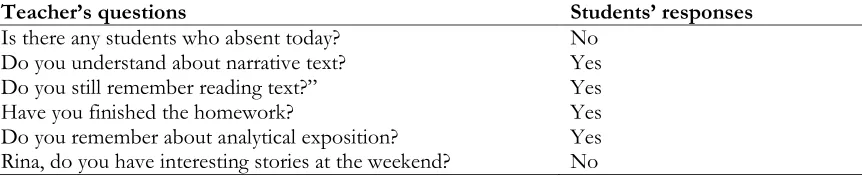
Convergent questioning strategies. After analyzing the data gained from the observation, we found that the convergent questioning strategies used by the teachers to their students were in the form of asking the questions that required short answers and yes/no answers. Most of students gave their responses when the teachers asked those questions during the learning activities. During the observation, we found that the two teachers asked the questions that required yes/no answers in the beginning of the lessons and after presenting the materials. At the beginning of the lesson, the two teachers started the interaction by asking questions that required yes/no answers.
Tabel 2. Convergent questioning strategy-yes/no answer: The beginning of the lesson
Teacher’s questions Students’ responses
Is there any students who absent today? No
Do you understand about narrative text? Yes
Do you still remember reading text?” Yes
Have you finished the homework? Yes
Do you remember about analytical exposition? Yes
Rina, do you have interesting stories at the weekend? No
Besides, after the teachers explained the materials before the students did the task, the teachers also asked the questions which also required yes/no answers. The students answered the teachers’ questions directly.
Tabel 3. Convergent questioning strategy-yes/no answer: After presenting the lessons
Teacher’s questions Students’ responses
Azka, do you understand about the material that I have explained? yes miss
Is the narrative text part of the reading text? Yes
Do you understand about analytical exposition? Yes
Is there any question about the text before you analyze the text? No
Have you understood about the expression of intention? Yes
The teachers asked questions which required short answers in the beginning of the lessons and after explaining the materials. During the observation, we found that the teachers asked the questions that required short answer in the beginning of the lesson and after explaining the materials. At the beginning of the lessons, the teachers started the interaction by asking questions that required short answers.
Tabel 4. Convergent questioning strategy-short answers: In the beginning of the lesson
Teacher’s questions Students’ responses
Who is absent today? Ina, miss
Students, last week we study about? invitation
Kenas, Please give me an example about
invitation? for example, would you come to my birthday party tonight?
After the teachers explained the materials, they asked questions which required short answers.
Tabel 5. Convergent questioning strategy-short answers: After presenting the lessons
Teacher’s questions Students’ responses
What does the text tell about? The story of Roro Jonggrang
What kind of the text found in the story of Roro Jonggrang Narrative text
What kind of expression found in the conversation?” Invitation
Azka, please mention the types of analytical exposition Thesis, argument, and reiteration
The teachers mostly asked the questions needing short answers for certain students. For example,
Teacher : “Reza, when you congratulate someone?” Student’s response : “when my friend's birthday”
However, there was a moment the teacher asked the questions to all students in the beginning of lesson and after the teacher explaining the materials. For example,
Teacher : “Students, last week we study about?” Students’ response : “invitation”
The results gained from the observations showed that teachers asked the questions that required short answers in the beginning of the lessons and after the teachers explained the materials.
During the observation, we found that the teachers asked the questions that required open answer after the teachers explained the materials. The functions of open questions were used to increase students’ critical thinking. After the teachers explained the materials, they asked the questions that required open answers.
Tabel 6. Divergent questioning strategies
Teacher’s questions Students’ responses
Please explain about analytical exposition, give your opinion? (silent) In your opinion, how do you analyze the text by using
analytical exposition? (silent)
“Students, what is the meaning of narrative text? What is your
opinion? (silent)
There was the moment when the teachers asked the questions needing higher order thinking answers for certain students and for all students after the teachers explained the materials. We found that the teachers did not asked questions in every meeting. They asked open questions after explaining the materials. Most of students did not give responses, they were usually silent.
Procedural questioning strategies. After analyzing the data gained from the observation, we found that the procedural questions given by the teachers to their students were in the form of students’ classroom activities. Most of the students gave their responses when the teachers asked those questions during the learning activities. During the observation, we found that the teachers asked the questions that related to students’ classroom activity in the beginning of learning activity and in the middle of explaining the material. For example,
Teacher : “Students, do you bring a dictionary?” Students’ response : “yes miss”
Teacher : “Is there homework?” Students’ response : “yes miss”
Additionally, in the middle of explaining the material, the teachers asked the questions to the students to do something in the classroom.
Teacher : “Rena and Gino, can you read the conversation?” Students’ response : “yes miss”
Teacher : “Andi, can you read the story?” Student’s response : “yes miss”
Teacher : “Students, do you bring a dictionary?” Students’ response : “yes miss”
The teacher asked the procedural questions related to students’ activity for certain students.
Teacher : “Rena and Gino, can you read the conversation?” Students’ response : “yes miss”
It can be inferred that the teachers asked procedural questions to their students in order to give instructions to the students to do something in the class.
The reasons that make teachers ask the three types of questions to the students
After collecting the data, in order to find out the reasons that made teachers use the three types of questioning strategies to the students, we found four themes and four codes. The themes and the codes gained from thematic analysis were listed in Table 7.
Table 7. Themes and codes for the reasons that make teachers use certain questioning strategy to the students
Themes Codes
Recalling students’ understanding The teachers used convergent questioning strategy by asking
the questions required yes/ no and short answers to recall students’ understanding
Attracting Students’ attention The teachers used convergent questioning strategy by asking
the questions required yes/ no and short answers to attract students’ attention.
Developing students’ thinking
ability in higher order level The teachers used divergent questioning strategy by asking the questions required open answers to develop the students thinking ability in higher order level.
Engaging students in the content of the lesson and to promote
classroom interaction
The teachers used the procedural questioning strategy to engage students in the content of the lesson
Recalling students’ understanding. Based on the observation, we found that the teachers used convergent questioning strategies by asking the questions required yes/ no and short answers in order to recall students’ understanding. We found that sometimes the teachers did not clarify to the students after their students gave responded to kind of the questions requiring yes/ no and short answers. However, sometimes the teachers gave follow up questions to clarify whether the students really understood on what they had answered to the questions which only needed yes/no answers. There were some questions that the answer was not clear, for example the teacher asked the question to their students “Do you still remember about narrative text?” Students’ response “yes”. The answer from the students actually could not guarantee that they really understood about the narrative text if the teacher did not ask further questions to make sure whether the answer from the students matched with the teachers’ expectation. When we clarified this matter to their teacher, one of the teachers assumed, “I’m sure they have understood, because most of the students answered my question. Therefore, I did not ask further questions. The interview data with the other teacher confirm why they did not ask the follow-up question. “I think the question was enough to know the students’ understanding, I just want to make sure the material was clear. I think the students’ answer represented to my expectation”. We also found why the teacher did not give open questions to recall the students’ understanding. When we clarified this, the teacher reported, “Because, when I asked open question, the students did not answer my question”.
Attracting students’ attention. We found that the teachers used convergent questioning strategies by asking the questions required yes/ no and short answer sto attract students’ attention. Based on the interview, it was found that both of the teachers preferred to using the questions which needed short answers and yes/no answers in order to attract their students’ attention. They had similar reasons. They felt that the questions were needed to find out whether their students really focused on the lessons or not and made them stop to do their own activities in the class. The questions with short answers and yes/no answers also made the students easy to understand. One of the teachers expressed, “Because the questions with yes/no and short answers are needed to find out whether students focus on the lesson or not and make them stop to do their own activities, the question also simple and made them understand”. We also found why the teachers did not ask question in the form of open answers. One of the teachers reported, “As I said before, when I asked the question in the form of open answer, most of them could not answer the question.”
Engaging students in the content of the lesson. Based on the observation, we found that the teachers used the procedural questioning strategies to engage students in the content of the lesson. The questions could be in the form of questions which required yes/ no and short answers. Based on the interview to the two the teachers they clarified similar opinion. One of the teachers said, “I frequently needed to sure whether the assignments I gave to them had been completed or not, or whether the instruction for that assignment was clear, and whether my students are ready for a new task by asking them questions.”
Discussions
Based on the results of data analysis, we found that the teachers of English at one Madrasah in Palembang, South Sumatera Indonesia contributed three types of questioning strategies as proposed by Richard and Lockarts (1994), they were convergent questioning strategies (by asking questions requiring yes/no and short answer), divergent questioning strategies (by asking questions needing open answers), and procedural questioning strategies (by asking questions related to the classroom activity). In the processes of teaching and learning activities, the teachers mostly asked the questions in the form questions that required short and yes/no answers. This result of study is congruent with the results of other studies (e. g., Matra, 2014; Ndun 2015; Sujiarti, Rahman, & Mahmud 2016) indicating that the questions in the forms of short and yes/no answers are used the most. Sometimes, when teachers asked the questions in the form of yes/no answers, teachers did not ask the follow up questions to clarify whether the students have understood the lessons or not. This is in line with Blosser (2000) who stated that closed questions not only need the response with one or two word answers, but also ask further question in order to clarify students’ understanding.
which indicated that the teachers often asked the questions that needed short answer and yes/no answers to the students.
Moreover, there were some reasons why teachers used those three types of questioning strategies. The first reason was to recall students’ understanding. We found that the teachers often used the convergent questioning strategy by asking the questions which required yes/no and short answers was to recall students’ understanding. This is because the teachers thought that the questions which required yes/no answers and short answers were enough to make sure their students’ understanding about the materials. According to Richard and Lockards (1994), the questions that need yes/no or short answers do not usually require students to engage in higher-level thinking but often focus on the recalling of students’ understanding.
The second reason why the teachers used convergent questioning strategy by asking questions that required short answers and yes/no answers were to attract their students’ attention. From the observations and interviews, we found that the teachers frequently asked the questions that need short answers or yes/no answers were to attract the students’ attention. This is because the question which required short answers was needed to find out whether the students paid attention to the lessons or not, and to stop their own activities that could disturb the learning processes. Richard and Lockards (1994) also indicated that the questions required yes/no and short answers were used to make students pay attention to the lesson. The findings of the study were also consistent with the findings of other studies (e.g., Matra, 2014; Ndun 2015) which indicate that the questions which required short answers and yes/no answer were used to encourage students’ participation and attention.
Furthermore, the reason why the teachers employed divergent questioning strategies by asking questions which required open answers was to develop the students’ thinking in higher order level. It is in line with Richard and Lockards (1994) who assert that open questions are used to encourage students’ responses and requires students to engage in higher-level thinking. Besides, in order to make the students become active participants in the class, they need to develop higher-order thinking skills (Blosser, 2000). However, the fact
show that when the teachers ask the question in the forms of open answers, the students
Conclusion and Recommendations
Based on the findings of this study, some important information on the English teachers’ types of questioning strategies used in the teaching process and the reasons why the teachers employed those questioning strategies was found. The teachers employed three kinds of questioning strategies; convergent questioning strategies, divergent questioning strategies, and procedural questioning strategies. Additionally, there were four reasons why the teachers employed each kind of questioning strategy; recalling students’ understanding, attracting students’ attention, developing students’ thinking ability in higher order level, and engaging students in the content of the lesson.
This study is expected for the teachers to apply various questioning strategies especially divergent questioning strategies through asking questions requiring open answers in all sessions of teaching and learning processes to create an active and effective teaching and learning process. It is also expected that the teachers do not focus on students’ answer, but on how the questions could motivate the students in learning English. Thus, the questions should be prepared by the teachers before they ask those questions in the teaching and learning processes. It is also recommended for teachers to study more about how to ask questions properly in order to develop their students’ critical thinking skills.
References
Abrar, M., Mukminin, A., Habibi, A., Asyrafi, F., Makmur, M., & Marzulina, L. (2018). “If our English isn’t a language, what is it?” Indonesian EFL student teachers’ challenges speaking English. The Qualitative Report, 23(1), 129-145. Retrieved from
http://nsuworks.nova.edu/tqr/vol23/iss1/9
Ary, D. (2010). Introduction to research in education (8th ed). Canada: Nelson Education.
Brown, H. D. (2001). Teaching by principles: An interactive approach to language pedagogy. New Jersey, NJ: Prentice Hall.
Brown, G., & Wragg, E. C. (1993). Questioning. London: Routledge.
Blosser, P. E. (2000). How to ask the right question. USA, Arlington: National Science Teachers Assosiation NSTA.
Cook, G. (2003). Applied linguistics (2nd ed). Oxford, NY: Oxford University Press.
Cotton, K. (2010). Questioning strategies: The schooling practices that matter most. In the Northwest Regional Educational Laboratory (NWREL).
Creswell, J. W. (2012). Educational research: Planning, conducting, and evaluating quantitative and qualitative research (4th ed.). Boylston Street, Boston: Pearson Education Boston.
Eble. (1988). The multidisciplinary world of questioning. In W.W. Wilen (Ed.), Questions, questioning techniques, and effective teaching. Washington, DC: National Education Association, 4966.
Gallagher, J. J. (1985). Teaching the gifted child. Boston: Allyn and Bacon.
Guest. (1985). The case study method: Critical thinking enhanced by effective teacher questioning skills. The 18th Annual International Conference of the World Assosiaation for Case Method Research & Application. Retrived from
https://files.eric.ed.gov/fulltext/ED455221.pdf.
Haliani, H. (2013). Teacher’s questioning strategies and students’ responses in young learners’ classroom interaction. retrived from http://repository.upi.edu/3066.
Harmer, J. (2001). The practice of English language teaching (3th ed) . New York, NY: Pearson
Education. Retrived from
https://epdf.tips/download/the-practice-of-english-language-teaching-3rd-edition.ht ml.
Letzter, F. (1982). Meeting the special needs of the gifted and creative student in the world history classroom. Social Education, 46, 195-199.
Ma, X. (2008). The skills of teacher’s questioning in English classes. International Educational Studies, 1(4), 92-100.
Matra, S.D. (2014). Teacher questioning in classroom interaction. A Journal of Culture, English Language Teaching and Literature, 14(1), 1-128. Retrived from
http://journal.unika.ac.id/index.php/celt/article/view/58
Ndun, L. N. (2015). Teacher question in the junior high school classroom (Master’s Thesis). Sanata Dharma Unifersity of Yogyakarta, Indonesia. Retrived from
https://repository.usd.ac.id/388/2/126332042_full.pdf
Parker, J. (1989). Instructional strategies for teaching the gifted. Boston: Allyn and Bacon.
Pollack, H. (1988). Questioning strategies to encourage critical thinking. (ERIC Document Reproduction Service No. ED297210)
Ramelan. (1994). English phonetics. Semarang: UNNES Press.
Saputra, H., & Marzulina, L. (2015). Teaching writing by using process genre approach to the eight grade students of SMP Negeri 22 Palembang. Jurnal Pendidikan dan
Pengajaran, 2(1),1-12. Retrived from
http://jurnal.radenfatah.ac.id/index.php/edukasi/article/view/592
Schwartz, B., & Millar, G. (1996). You are what you ask: The power of teaching students questioning skills for enabling thinking. Paper presented at the annual Sage conference , Calgary Alberta, Canada. (ERIC Document Reproduction Service No. ED408 744)
Shaunessy, E. (2005). Questioning strategies for teaching the gifted. AS: Prufrock Press Inc.
Sujiarti, Rahman, K., & Mahmud, M. (2016). English teacher’s questioning strategies in efl classroom at SMAN 1 Bontomarannu. ELT Worldwide, 3(1), 107-121. Retrived from
http://ojs.unm.ac.id/ELT/article/view/1884.
Biographical notes
Dr. ANNISA ASTRID works as a lecturer at English education study program in the Faculty of Tarbiyah and Education, State Islamic University of Raden Fatah, Palembang, Indonesia. Her research interests are on the area of education, language teaching, material development, and TEFL. Email: [email protected]
RIZQY DWI AMRINA works as a lecturer at English education study program in the Faculty of Tarbiyah and Education, State Islamic University of Raden Fatah, Palembang, Indonesia. Email: [email protected]
DETA DESVITASARI works as a lecturer at English education study program in the Faculty of Tarbiyah and Education, State Islamic University of Raden Fatah, Palembang, Indonesia. Email: [email protected]
UCI FITRIANI is a student at English education study program in the Faculty of Tarbiyah and Education, State Islamic University of Raden Fatah, Palembang, Indonesia.