5457
METHOD DEVELOPMENTAND VALIDATION FOR SIMULTANEOUS ESTIMATION OF RILUZOLE MINOCYCLINE
Shaikmohammed Zahiruddin*1 and Dharmamoorthy G1
*1Department of Pharmaceutical Analysis and Quality Assurance, Krishna Teja Pharmacy
College, Tirupati-517506, Andhra Pradesh, India.
1Department of Pharmaceutical Analysis, Krishna Teja Pharmacy College, Tirupati
-517506, Andhra Pradesh, India.
*Corresponding author E-mail: [email protected]
ARTICLE INFO ABSTRACT
Key Words
Riluzole and Minocycline,
RP-HPLC, Method development and
validation
Riluzole andminocycline are used in the treatment for amyotrophic lateral sclerosis (ALS) and as antibiotic respectively. The present workdescribes simple, precise and accurate- HPLC method for the determination of riluzole and minocycline in bulkand pharmaceutical dosage form. Quantification of RiluzoleandMinocyclinewas carried out with Inertsil-C18, ODS columnas a stationary phase using a mixture of mobile phase consists ofDegassed Acetonitrile 100%.in the ratio 1:1 v/v and in the absorbance/ reflectance mode at 280 nm. The limit ofdetection and the limit of quantification were found to be 0.33 ng/spot and 1.01ng/spot respectively. For riluzole and0.32 and 0.98 for minocycline The Coefficient of determination (r2) was 0.9994. The regression equation was found to be Y =16169C-95766.The accuracy and reliability of the proposed method was ascertained byevaluation various validation parameters like linearity, precision, accuracy and specificity according to ICH guidelines. The proposed method was analysed with more formulation units and provided a faster and cost effective quality control tool for routine analysis ofriluzole and minocycline in bulk and its dosage form. The excipients in the commercial tablet preparation did notinterfere in the method.
INTRODUCTION:
Riluzole chemically known 6-(trifluoromethoxy)-1, 3- benzothiazol-2-amineIt is a glutamate antagonist (receptors, glutamate) used as an anticonvulsant (anticonvulsants) and to prolong thesurvival of patients with amyotrophic lateral sclerosis. Minocycline chemically known as
:(4S,4aS,5aR,12aS)-4,7-bis (dimethylamino)
- 3, 10,12,12a-tetrahydroxy-1,11-dioxo- 1,4,4a,5,5a,6,11,12a-octahydrotetracene-2-carboxamide. A tetracycline analogue, having a 7-dimethylamino and lacking the 5 methyl and hydroxyl groups, which is effective against tetracycline-resistant staphylococcus infections
An Elsevier Indexed Journal ISSN-2230-7346
5458
EXPERIMENTAL
Chemicals and regents: Riluzole and Minocycline tablets, Combination Riluzole and Minocyclinetablets received from Spectrum labs, Hyderabad. Distilled water, Acetonitrile, Phosphate buffer, Methanol, Potassium dihydrogen ortho phosphate buffer, Ortho- phosphoric acid. Alltheabovechemicals and solvents were procured from Rankem.
Instrumentation: Chromatography was performed by using Inertsil C18 ODS column connected to UV detector and automatic injector. The data acquisition was performed by Spin chrome (LC SOLUTIONS) software.
Chromatographic Conditions: Chromatographic separation was achieved on Inertsil C18 ODS (250 x 4.6 mm, 5 µ) column with constant flow rate of 1 ml/min. The mobile phase consists of acetonitrile and methanol (90:10 v/v). The mobile phase filtered through 0.45 µm nylon syringe filters. The injection volume was 20µl for standards and samples. All analysis were done at ambient temperature. The samples were analyzed at different wavelengths but finally 280 nm was selected for the analysis becauseat this wavelength sharp and clearly resolved peaks for both the drugs were observed.
METHODS
Preparation of standard and stock solutions
Preparation of Standard stock solution: Reference solution: The solution was prepared by dissolving 20.0 mg of accurately weighed Riluzole and 25.0 mg Minocycline in Mobile phase, in two 100.0 mL volumetric flasks separately and sonicate for 20min. From the above solutions take 10.0 mL from each solution into a 50.0 mL volumetric flask and then makeup with mobile phase and sonicate for 10min.
Preparation of Standard working solution (100% solution): The stock solutions equivalent to 20ppm to 80ppm with respect to both drugs were prepared in combination of Riluzole and Minocycline above, sonicated and filtered through 0.45µ membrane.
Preparation of Sample solutions: Twenty tablets were weighed accurately and a quantity of tablet powder equivalent to 40 mg Riluzoleand 80 mg Minocycline was weighed and dissolved in the 70mL mobile phase with the aid of ultrasonication for 20 min. The content was diluted to 100 mL with mobile phase to furnish a stock test solution. The stock solution was filtered through a 0.45 µm Nylon syringe filter and 10.0 mL of the filtrate was diluted into a 100.0 mL volumetric flask to give a test solution containing 40 µg/mLRiluzoleand 80 µg/ minocycline [30-33].
Preparation of Ammonium acetate0.05m buffer: 3.85gm of Ammonium acetate dissolved in Hplc Grade water and adjust the pH with dilute ‘orthophosphoric acid to 6.5.
RESULTS AND DISCUSSION
5459
Table No. 1: Linearity table for Riluzole and Minocycline
Riluzole Minocycline
Concentration
(μg/ml) Peak area
Concentration
(μg/ml) Peak area
0 0 0 0
20 572087 20 219695
30 887800 30 398090
40 1239364 40 547437
50 1570861 50 715694
60 1869524 60 885479
70 2234112 70 1022457
80 2546863 80 1199855
Fig. No. 3: Calibration curve of Riluzole
5460
Table No. 2: Accuracy table of Riluzole % Level Amount Spiked
(µg/ml)
Amount Recovered
(µg/ml)
% Recovery Mean % Recovery
20 19.95 99.75
50 20 19.86 99.3 99.81%
20 20.86 100.4
40 40.14 100.35
100 40 39.96 99.9 99.91%
40 39.80 99.5
60 59.89 99.81
150 60 60.04 100.06 100.06
60 60.09 100.15
Table No. 3: Accuracy table of Minocycline % Level Amount Spiked
(µg/ml)
Amount Recovered
(µg/ml)
% Recovery Mean % Recovery
20 19.98 99.9
50 20 19.94 99.7 99.9%
20 20.02 100.1
40 39.86 99.65
100 40 40.05 100.125 99.9%
40 39.98 99.95
60 59.90 99.95
150 60 59.97 99.83 99.93%
60 60.02 99.95
Table No. 4: Data of Repeatability (System precision) forRiluzole and Minocycline
S. No Area of Riluzole Area of Minocycline
1. 1239678 549407
2. 1243389 547265
3. 1264984 553482
4. 1248352 551981
5. 1256493 551495
Mean 1250579 550726
S.D 10222.12 6031.135
5461
Table No. 5: Data of Repeatability (Method precision) for Riluzole and Minocycline S. No Area of Riluzole Area of Minocycline
1. 1243389 547265
2. 1264984 553782
3. 1248352 551981
4. 1256493 551495
5. 1239664 547437
6. 1243411 549117
Mean 1250579 550726
S.D 10222.12 2422.819
%RSD 0.817391 0.4399392
Table No. 6: LOD and LOQ table ofRiluzole and Minocycline Molecule LOD (µg/ml) LOQ (µg/ml)
Riluzole 0.33 1.01
Minocycline 0.32 0.98
Table No. 7: Robustness data for Riluzole and Minocycline.
S. No Condition %RSD of
Riluzole
%RSD of Minocycline
1 Flow rate (-) 0.8ml/min
0.2
0.2
2 Flow rate (+) 1.0ml/min
0.8
0.4
3 Flow rate (+) 1.2ml/min
0.7
0.4
The linearity charts of Riluzole and Minocycline was shown in figures 3 and 4. The correlation coefficient was found to be 0.999 for both drugs and hence the method was said to be linear. The results were tabulated in table 1.
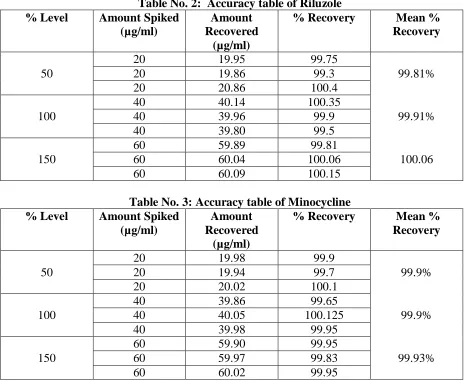
Accuracy: Accuracy was evaluated by standard addition method of three known concentrations of the drug and the spiked solutions were analyzed. The recovery of the added drug was determined by calculating the preanalysed drug concentration with concentration of spiked drug. The % recovery was calculated and the results were reported in table 2 and 3.
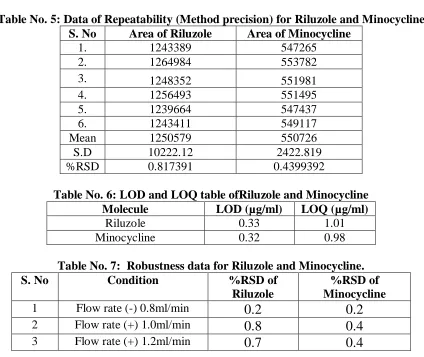
Precision: The precision of the analytical method was studied by injectingfive replicates of standard and sample concentrations on the system precision and method precision. The Riluzole and Minocycline concentrations ranging from 20
µg/ml to 80 µg/ml at two levels intra and inter day precision. The % RSD was calculated and the results were reported in table 4 and 5.
5462
Robustness: Small deliberatechanges in method like Flow rate are made but there were no recognized change in the result and are within range as per ICH Guide lines. Robustness conditions like Flow minus (0.8ml/min), Flow plus (1.0ml/min) Flow plus (1.02ml/min), was maintained and samples were injected in duplicate manner. System suitability parameters were not much affected and all the parameters were passed. %RSD was found to be within the limits and results were tabulated in table 7.
CONCLUSION
The study was undertaken in order to develop and validate theanalytical RP-HPLC method for estimation of Riluzole and Minocycline pharmaceutical formulations.This method gives good resolution between two compounds with a short analysis time. Hence this method can be used in quality control departments with respect to routine analysis for the assay of the tablets containing Riluzole and Minocycline.
Acknowledgements: Author expresses sincere thanks to the Principal and Head of Pharmaceutical Analysis and Quality Assurance department, Krishna Teja Pharmacy College for providing facilities and great support to carry out the research work.
REFERENCES:
1. Beckett A.H. and Stenlake J.B.; Practical Pharmaceutical Chemistry; 4th edition; CBS publishers and distributors, 1997.p.162-164,275-305.
2. Willard H.H.Meritt L.L, Dean J.A., Settle., Instrumental methods of Analysis ,7th edition, CBS publishers and distributors,1986,p.60-75,600-608.
3. Jeffery G.H.DenneyR.C.,Bassett j. Mendham J. Vogel’s Text Book of quantitative chemical analysis ,6th edition ,person education 2003,p.2-7,216-227. 4. Gurdeep R. Chatwal, Sham K.
Anand, “Instrumental methods of chemical analysis “, 5th edition. 2002, p.2 117-2.178, .567.
5. Gennaro A.R., Remington. The sciences and practical of pharmacy, 28th edition, Lippincott, Williams and Wilkins, Baltimore, Maryland, USA, 2000, p.534-549.
6. Connors K.A., A text book of pharmaceutical analysis, 3rd edition, Wiley-interscience publication 1982, p 638-639.
7. HPLC Introduction
{online}.Available from; http://e n. Wikipedia. org/ High
performance liquid
chromatography.
8. HPLC instrumentation (online).Available from: http//www.uft.uni-bremen. De/ chemi / pdf/ HPLC INTRO_BMB, pdf.
9. Validation of Analytical procedures/Methodology, ICH harmonized triplicate guidelines, 1996, p1-8.
10.Munson J.W., Pharmaceutical Analysis, part-b, Marcel Deckker, Vol-ii, Newyork, 1994, p.1-8.
5463
12.Joks R, Durkin HG (December 2011). "Non-antibiotic properties of tetracyclines as anti-allergy and asthma drugs". Pharmacol. Res. 64 (6): 602–9.
13.Greenwald RA (December 2011). "The road forward: the scientific basis for tetracycline treatment of arthritic disorders".Pharmacol. Res. 64 (6): 610–3.
14.Copeland KF, Brooks JI. (15 April 2010). "A Novel Use for an Old Drug: The Potential for Minocycline as Anti-HIV Adjuvant Therapy". J Infect Dis. 201 (8): 1115–7.
15.U.S. National Library of Medicine (2009, Dec 11) 'Perioral dermatitis'. Retrieved 7 August 2010.
16.Gough A, Chapman S, Wagstaff K, Emery P, Elias E (January 1996). "Minocycline induced autoimmune hepatitis and systemic lupus erythematosus-like syndrome". BMJ 312(7024): 169– 72
17.Krawitt EL (January 2006). "Autoimmune hepatitis". N. Engl. J. Med. 354 (1): 54–66.
18.Lefebvre N; Forestier E; Farhi D et al. (2007). "Minocycline-induced hypersensitivity syndrome presenting with meningitis and brain edema: a case report". Journal of Medical Case Reports 1: 22.
19.“Principles and methods for the assessment of nephrotoxicity associated with exposure to chemicals”. Environmental health criteria: 119. World Health Organization (WHO.
20.Piscitelli, Stephen C.; Keith Rodvold (2005). Drug Interactions in Infectious Diseases. Humana Press.
21.Science Vol 318, 1227, 2007
22.Nonaka K, Nakazawa Y, Kotorii T (December 1983). "Effects of antibiotics, minocycline and ampicillin, on human sleep".Brain Res. 288 (1-2): 253– 9. "MedlinePlus Drug Information: Minocycline Oral".
23.Geria AN, Tajirian AL, Kihiczak G, Schwartz RA (2009). "Minocycline-induced skin
pigmentation: an
update". ActaDermatovenerol Croat 17 (2): 123–6
24.MedicineNet: Minocycline Oral (Dynacin, Minocin) - side effects, medical uses, and drug interactions 25.Cohen, P. R. (2004).
"Medication-associated depersonalization symptoms: report of transientdepersonalization sympto
ms induced by
minocycline".Southern Medical Journal 97 (1): 70–73.
26.Mongey AB, Hess EV (March 2008). "Drug insight: autoimmune effects of medications-what's new?" (PDF).Nat
ClinPractRheumatol 4 (3): 136–44. 27.Ochsendorf F (2010). "Minocycline
in acne vulgaris: benefits and risks". Am J ClinDermatol 11 (5): 327–41.
28.Sweet, Richard L.; Gibbs, Ronald S. (2001). Infectious Diseases of the Female Genital Tract (4th ed.). Lippincott Williams & Wilkins. p. 635.
29.Friedman DI (2005). "Medication-induced intracranial hypertension in dermatology". Am J ClinDermatol 6 (1): 29–37.
30.FDA Adverse Events Reporting System Retrieved on January 16, 2011
5464
for schizophrenia". CNS NeurolDisord Drug Targets 7 (4): 376–81.
32.Levkovitz, Y.; Mendlovich, S.; Riwkes, S.; Braw, Y.; Levkovitch-Verbin, H.; Gal, G.; Fennig, S.; Treves, I.; Kron, S. (2010). "A Double-Blind, Randomized Study of Minocycline for the Treatment of Negative and Cognitive Symptoms in Early-Phase Schizophrenia". The Journal of Clinical Psychiatry 71 (2): 138– 149.
33.Willard, H.H.; Merrit, L.L.; Dean. J.A., “Instrumental methods of analysis”, 7thEdn., CBS Publishers, New Delhi.
34.Khopkar, S.M, “Basic concepts of analytical chemistry”, 2nd edition, 2005.
35.Tips on Liquid Chromatography, Waters www.waters.com.
36.Validation of Analytical Procedures, Methodology, ICH Tripartite Guidelines, 1996.
37.Validation of Analytical Procedures, ICH Harmonized Tripartite Guidelines 1994.
38.ICH, Q2A Text on validation of analytical procedures, Oct, 1994
www.ich.org.
39.ICH, Q3B Validation of analytical procedures: methodology, Nov, 1996.
40.Metformin -
http://www.drugbank.ca/drugs/db0 0331 [cited on 15-1-15
41.Nateglinide -
http://www.drugbank.ca/drugs/DB 00731 [cited on 16-1-15]