Available Online at www.ijpret.com 1462
INTERNATIONAL JOURNAL OF PURE AND
APPLIED RESEARCH IN ENGINEERING AND
TECHNOLOGY
A PATH FOR HORIZING YOUR INNOVATIVE WORK
FILTERING OF UNWANTED MESSAGES FROM OSN USER WALL USING
CONTENT-BASED FILTERING METHOD
SHISHIR THAKARE1, ARPIT PATOKAR1, PRANIT SHIRSATH1, CHETAN CHOUDHRY1, PROF. S.A.
DHAWALE2
1.Student, Department of Information, Technology, S.G.B.A.U. Amravati. 2.IBSS COE, Amravati.
Accepted Date: 05/03/2015; Published Date: 01/05/2015
Abstract:One major problem in today’s Online Social Networks (OSNs) is to give users skill to
regulate the messages posted on their own personal space to avoid that unauthorized data is displayed. OSNs give small support to these needs. In this thesis, I propose a system permit OSN users to have a straight control on the messages posted on their walls. It is achieved through a flexible rule-based system, that permit users to customize the filtering criteria to be put to their walls, and a Machine Learning-based soft classifier automatically labelling messages in endure of content based filtering. First conduct a set of large-scale measurements with a collection of accounts observe the difference among human. Up to now OSNs provide little support to this requirement.
Keywords:Online Social Networks, Filtering Method
Corresponding Author: MR. SHISHIR THAKARE
Access Online On:
www.ijpret.com
How to Cite This Article:
Shishir Thakare, IJPRET, 2015; Volume 3 (9): 1462-1469
Available Online at www.ijpret.com 1463 INTRODUCTION
In the last years, On-line Social Networks (OSNs) have become a popular interactive medium to communicate, share and disseminate a considerable amount of human life information. Daily and continuous communication implies the exchange of several types of content, including free text, image, audio and video data. According to Facebook statistics 1 average user creates 90 pieces of content each month, whereas more than 30 billion pieces of content (web links, news stories, blog posts, notes, photo albums, etc.) are shared each month. A main part of social network content is constituted by short text, a notable example are the messages permanently written by OSN users on particular public/private areas, called in general walls. Facebook allows users to state who is allowed to insert messages in their walls. However, no content-based preferences are supported and therefore it is not possible to prevent undesired messages, such as voilent or vulgar ones, no matter of the user who posts them.
The aim of the present paper is to propose and experimentally evaluate an automated system, called Filtered Wall (FW), able to filter out unwanted messages from social network user walls.
LITRATURE AND SURVEY
In the OSN domain, interest in access control and privacy protection is quite recent. As far as privacy is concerned, current work is mainly focusing on privacy-preserving data mining techniques, that is, protecting information related to the network, i.e., relationships/ nodes, while performing social network analysis? Works more related to their proposals are those in the field of access control. In this field, many different access control models and related mechanisms have been proposed so far, which mainly differ on the expressivity of the access control policy language and on the way access control is enforced
1.1 Content Based filtering
Available Online at www.ijpret.com 1464
classification, partitioning incoming documents into relevant and non relevant categories. More complex filtering systems include multi-label text categorization automatically labelling messages into partial thematic categories. Content-based filtering is mainly based on the use of the ML paradigm according to which a classifier is automatically induced by learning from a set of pre-classified examples.
RELATED WORK
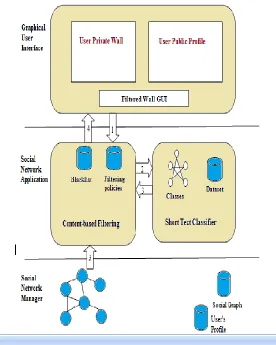
The aim of the present work is therefore to propose and experimentally evaluate an automated system, called Filtered Wall (FW), able to filter unwanted messages from OSN user walls. We exploit Machine Learning (ML) text categorization techniques [1] to automatically assign with each short text message a set of categories based on its content. The major efforts in building a robust short text classifier are concentrated in the extraction and selection of a set of characterizing and discriminate features. The solutions investigated in this work are an extension of those adopted in a previous work [11] from which we inherit the learning model
and the elicitation procedure for generating pre-classified data.A remarkable variety of related
Available Online at www.ijpret.com 1465 .
Figure 4.1: Filtered Wall architecture
1.2 Filtering rules
Available Online at www.ijpret.com 1466 1.3 FRs threshold
We address the problem of setting thresholds to filter rules, by conceiving and implementing within FW, an Online Setup Assistant (OSA) procedure. OSA presents the user with a set of messages selected from the dataset. For each message, the user tells the system the decision to accept or reject the message. The collection and processing of user decisions on an adequate set of messages distributed over all the classes allows to compute customized thresholds representing the user attitude in accepting or rejecting certain contents. Such messages are selected according to the following process. A certain amount of non neutral messages taken from a fraction of the dataset and not belonging to the training/test sets, are classified by the ML in order to have, for each message, the second level class membership values.
Notification
YES
NO
Figure: Flowchart Database
Checks message for bad language
Message is Posted on Wall
End Start
Registration & Login
User Home
Available Online at www.ijpret.com 1467
When any user tries to post a messages on other user wall it is intercepted by the filtered wall first.
Filtered wall check the messages for any restricted word and extracts the metadata and follows some procedure. If there is no restricted word found in that messages then that message is successfully sent to the destination user.
If there is restricted word occur in that message then the filtered wall apply the different filtering rules and at the same time the threshold value is increases in the database.
If the threshold value (TH) is equals to 4 and less than 8 then user gets notification that you crossed the first threshold value so be careful to send any type of message having bad word. If the threshold value is equals to 8 means. if user crossed the second threshold value after getting notification then he goes into the blacklist.
1.4 Blacklists
A further component of our system is a BL mechanism to avoid messages from undesired creators, independent from their contents. BLs are directly managed by the system, which should be able to determine who are the users to be inserted in the BL and decide when users retention in the BL is finished. To enhance flexibility, such information are given to the system through a set of rules, hereafter called BL rules. Rather, we decide to let the users themselves, i.e., the wall’s owners to specify BL rules regulating who has to be banned from their walls and for how long. Therefore, a user might be banned from a wall.
SOCIAL AWARENESS
Social Networking plays a very important role in social awareness in today’s world. As now the number of users who uses social networking is increasing rapidly. So any type of bad comments which belongs to particular topic or any small topic can be spread on social networking in very bad manner. The proposed system provides solution for such problems in social networking. We proposed a new system called Filtered Wall which is able to filter out the unwanted messages from OSN User wall.
RESULT AND DISCUSSION
Available Online at www.ijpret.com 1468
According to the survey 80% of the organizations use social networking for their business. As the number of users increases for their product, the percentage of security risk will increases. The proposed system will provide a way to minimize the security risk for such scenarios.
Figure: Security Risk
This system will have a way to block specified words from getting communicated over social networking. Above Figure shows the graph that represents that how the security risk decreases with the proposed system in which different filtering rules are there, that's why the security risk will be minimize as compare to the existing system.
CONCLUSION
We proposed a new system called Filtered Wall which is able to filter out the unwanted messages from OSN User wall. We compared this system with the number online social networking sites and other existing system. The experimental results show that the proposed system outperforms many of the existing system.
Available Online at www.ijpret.com 1469 REFERENCES
1. F.Sebastiani, “Machine learning in automated text categorization,” ACM Computing Surveys,
pp. 1–47, 2002, vol. 34, no. 1.
2. N. J. Belkin and W. B. Croft, “Information filtering and information retrieval: Two sides of the
same coin?” Communications of the ACM, vol. 35, no. 12, pp. 29–38, 1992.
3. P. J. Hayes, P. M. Andersen, I. B. Nirenburg, and L. M. Schmandt, “Tcs: a shell for
content-based text categorization,” in Proceedings of 6th IEEE Conference on Artificial Intelligence Applications (CAIA- 90). IEEE Computer Society Press, Los Alamitos, US, pp. 320–326, 1990.
4. G. Amati and F. Crestani, “Probabilistic learning for selective dissemination of
information,” Information Processing and Management, vol. 35, no. 5, pp. 633–654, 1999.
5. A. Adomavicius, G.and Tuzhilin, “Toward the next generation of recommender systems: A
survey of the state-of-the-art and possible extensions,” IEEE Transaction on Knowledge and Data Engineering, vol. 17, no. 6, pp. 734–749, 2005.
6. M. J. Pazzani and D. Billsus, “Learning and revising user profiles: The identification of
interesting web sites,” Machine Learning, vol. 27, no. 3, pp. 313–331, 1997.
7. R. J. Mooney and L. Roy, “Content-based book recommending using learning for text
categorization,” in Proceedings of the Fifth ACM Conference on Digital Libraries. New York: ACM Press, pp. 195–204, 2000.
8. M. J. Pazzani and D. Billsus, “Learning and revising user profiles: The identification of