Available Online at www.ijpret.com
141
INTERNATIONAL JOURNAL OF PURE AND
APPLIED RESEARCH IN ENGINEERING AND
TECHNOLOGY
A PATH FOR HORIZING YOUR INNOVATIVE WORK
EFFECT OF BACK FACE SHAPE OF RETAINING WALL ON EARTH PRESSURE
USING GEO 5
DHATRAK A. I1, VIRULKAR R. D2
1. Associate Professor, Department of Civil Engineering, Government College of Engineering, Amravati, Maharashtra, India.
2. PG Student, Department of Civil Engineering, Government College of Engineering, Amravati, Maharashtra, India.
Accepted Date: 27/02/2014 ; Published Date: 01/05/2014
\
Abstract: The main parameter that can affect the lateral pressure behind a retaining wall is
the back face shape of the wall. In order to study the behavior of earth pressure, the back face wall is taken as curved shape instead of inclined or straight which has not been investigated yet. The different parameters such as concave arc, convex arc, radius and angle of arc, angle of inclination are taken to evaluate the earth pressure using geotechnical software. It was observed that the active earth pressure is less for convex shape retaining wall and it decreases with respect to increase in distribution surface.
Keywords: Back face shape of wall, Retaining wall with concave and convex pressure face.
Corresponding Author: MR. VIRULKAR R. D.
Access Online On:
www.ijpret.com
How to Cite This Article:
Available Online at www.ijpret.com
142 INTRODUCTION
Retaining Structure’ is an indispensable feature of any civil construction projects. A soil mass is stable when the slope of the soil mass is flatter than the safe slope. At some location where the space is limited, it is not possible to provide flat slope and the soil is to be retained at a slope steeper than the safe one. In such cases, a retaining structure is required to provide lateral support to the soil mass. The walls have to withstand lateral pressures either from earth or any other material on their faces.
The lateral pressure which acts on a retaining wall is a function of the materials and surcharges that the wall must support, the groundwater and foundation conditions, and the mode and magnitude of movement that the wall undergoes as a result of soil structure foundation
interaction. The lateral earth pressure is linearly proportional to depth and it is taken as: σ = γs.
K.Z. There are two types of earth pressure and they are; Active earth pressure(Pa) and Passive earth pressure (Pp). Active earth pressure tends to deflect the wall away from the backfill. The Coulomb and Rankine theories are used to calculate active and passive earth pressure coefficient. In this work, gravity type retaining wall is used which resist the movement because of their heavy sections. They are built of mass concrete or stone or brick masonry. No reinforcement is required in these walls. The curved shape backface wall should be taken instead of inclined wall to analysis the earth pressure effect on wall. Various theoretical and graphical methods are available for determine the earth pressure such as Coulomb theory, Rankine theory, Rebhann’s graphical method and culmann’s graphical method. Nowadays computer based software are also available for determine the lateral pressure such as GEO 5, MIDAS, PLAXIS 2D & 3D and this software are widely used because of simple graphical user interface, accuracy & speed. Also the earth pressure problems can be analyzed using various input parameters & methods by using this software’s. The software’s gives results of analysis in the graphical form at which gives a better idea of the solution and failure mechanism if any.
2. LITERATURE REVIEW
The different parameter of retaining wall had been studied by a number of researchers. Several experimental and numerical analyses were performed by various authors. Some of related works are discussed below,
Available Online at www.ijpret.com
143 that the earth pressure increases at upper portions of the wall and decreases by the leaning slope at lower elevations.
Shekarian (2008) studied the effect of earth pressure on retaining wall with reinforced backfill. For numerical modelling, finite element software Plaxis (version 7.2) was used. Results of analysis show the pressure equal to 670 kN/m for un-reinforced mass, while by using three and five level of reinforcements, for increasing the length of reinforcements, resultant pressure on wall was reduced.
Ghanbari and Ahmadabadi (2010) studied the active earth pressure on inclined retaining walls in static and pseudo static condition. The characteristics of active earth pressure in static and pseudo-static conditions for inclined walls were investigated in this research. The investigation of results shows that active earth pressure (Ka) and seismic active pressure coefficient (Kae) both increase linearly with increase in slope of retaining wall.
Slaman et.al (2011) studied the earth pressure distribution behind retaining walls subjected to line load. The earth pressure distribution generated behind a 20 m high retaining wall was estimated by the finite element method and compare with that obtained from classical earth pressure theories. From the analyses, author had found that the maximum pressure is in the wall base. The value of the lateral earth pressure at the wall base is about (10 to 20%) less than that obtained by Coulomb equation.
Dewalkar, and Dixit (2012) studied the complete analysis of active thrust on an inclined wall with inclined cohesionless backfill under surcharge effect. Author used Kötter’s (1903) equation to compute the active earth pressure for an inclined wall retaining horizontal cohesionless backfill with a uniform surcharge. Authors concluded that the point of application of the active thrust depend upon a number of factor such as angle of soil fraction, angle of wall friction, angle of wall back, and inclination of backfill.
Available Online at www.ijpret.com
144 3. PERFORMANCE ANALYSIS USING GEO 5
The earth pressure distribution on back face shape of retaining wall will be analysis by taking different parameters. The geotechnical software “GEO 5” is used to evaluate the earth pressure. The data for analyzing the earth pressure for different cases are taken same. The
height of wall is 5m; unit weight of soil is 20 KN/m3, angle of friction is 300, angle of wall friction
is 200 and cohesion of soil is taken as zero. Fig 1 shows the analysis performance of earth
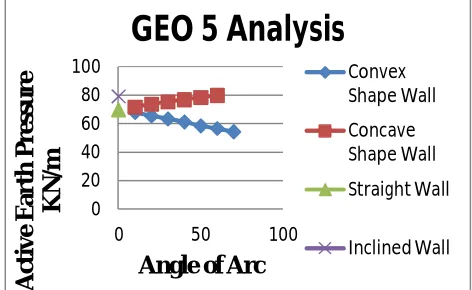
pressure distribution on straight back face wall. From this analysis, the active earth pressure of straight back face wall is 69.85KN/m.
Fig.1 Earth pressure analysis of retaining wall.
Fig 2 shows the analysis performance of earth pressure distribution on inclined back face wall. From this analysis, the active earth pressure of inclined back face wall is 79.32KN/m
Available Online at www.ijpret.com
145 The active earth pressure is calculated for different angle of an arc of convex shape retaining wall and concave shape retaining wall. The results of concave shape retaining wall and convex shape retaining wall are discussed in next chapter.
4. RESULTS AND DISCUSSION
Fig. 3 shows the analysis chart of an active earth pressure. The chart shows that the effect of active earth pressure on convex shape retaining wall is less than that of straight retaining wall, inclined retaining wall and concave shape retaining wall.
Fig.3 Active earth pressure analysis using GEO5
Fig. 4 shows the analysis chart of an active earth pressure using culmann’s graphical method. The back face shape of gravity retaining wall can affect the lateral pressure.
Fig.4 Active earth pressure analysis using culmann’s method
0 20 40 60 80 100
0 50 100
A ct iv e E a rt h P re ss u re K N /m
Angle of Arc
GEO 5 Analysis
Convex Shape Wall Concave Shape Wall Straight Wall Inclined Wall 0 50 100 150
0 50 100
A ct iv e E a rt h P re ss u re K N /m
Angle of Arc
Available Online at www.ijpret.com
146 5. CONCLUSION
From the above analysis of an earth pressure it is concluded that the convex shape is effective for an earth pressure and also for stability.
REFERENCES
1. Balwan, R. J. and Kumbhar, A. (2011) “Graviloft Retaining Wall: A Case Study”. Proceedings
of Indian Geotechnical Conference, Kochi (Paper No. Q-087), pp. 1068-1070.
2. Dewaikar, D.M., Pandey, S. R. and Dixit (2012) “Active Thrust on an Inclined Retaining Wall
with Inclined Cohesionless Backfill due to Surcharge Effect”. International Scholarly Research
Network ISRN Soil Science.
3. Frydman1, S and Keissar, I. (1987) “Earth Pressure on Retaining Walls Near Rock Faces”.
Journal of Geotechnical Engineering, Vol. 113, No.6, pp. 586-599 ©ASCE.
4. Frydman1, S and Keissar, I. (1987) “Earth Pressure on Retaining Walls Near Rock Faces”.
Journal of Geotechnical Engineering, Vol. 113, No.6, pp. 586-599 ©ASCE.
5. Sadrekarimi, A. and Ghalandarzadeh, A. (2007) “Static and Dynamic Behavior of
Hunchbacked Gravity Quay Walls”. Journal of Soil Dynamics and Earthquake Engineering, pp. 99–117.
6. Shekarian, S., Ghanbari, A. and Makarchian, M. (2008) “Earth Pressure on Retaining Walls