-
Available Online at www.ijpret.com
494
INTERNATIONAL JOURNAL OF PURE AND
APPLIED RESEARCH IN ENGINEERING AND
TECHNOLOGY
A PATH FOR HORIZING YOUR INNOVATIVE WORK
REMOTE RAINFALL MEASUREMENT USING GSM
SHRUTHI NAIR, BABITA PRASAD, MAHESH POKKALIDept. of Electronics and Telecommunication Rajarshi Shahu COE, Pune, India.
Accepted Date: 27/02/2014 ; Published Date: 01/05/2014
p
\
Abstract: Rainfall measurement becomes very important to design flood warning systems
which can wirelessly control dams. In today’s times latest inventions are made to ease human efforts. The main focus is to develop a system that can produce results with minimum human efforts. To get the data like temperature, rainfall, humidity of a particular region, one has to physically be present and report the data. In this paper we describe the method of automated rainfall measurement where we employ a tipping bucket rain gauge(TBRG) to collect rainfall. The collected rainfall is maintained in a data logger and then transmitted using GSM on the operator’s mobile. The system installed at the remote stations will measure the rainfall and provide the hourly update at the user end. This information can further be used to generate alerts, update the database of the metrological department and so on.
Keywords: Tipping Bucket Rain Gauge, GSM, Data Logger
Corresponding Author: MR. SANEH SURYA PHADTE
Access Online On:
www.ijpret.com
How to Cite This Article:
-
Available Online at www.ijpret.com
495
INTRODUCTION
Traditionally rainwater measuring device consist non-recording rain gauges that measure cumulative amount of rain.
The main in charge would have to personally visit the site and calculate the amount of rainfall.
Errors are introduced while measuring the rainfall as there is a tendency for water to fall out of the rain gauge if not handled properly. This manual measurement is not very accurate. The later development was a recording rain gauge which automatically records the amount of rainfall reaching the surface as a function of time.
We used a tipping bucket rain gauge which is an example of recording rain gauge. This rain gauge tips every 0.01inch of rainfall. This value can be calibrated as per our needs. At every tip a pulse is generated. We interface this tipping bucket rain gauge to a data logger which is a PIC microcontroller where the pulses are accumulated over an hour’s time and then multiplied with the calibrated value of the TBRG sensor to give the rainfall measured in an hour. This measured rainfall is transmitted using GSM using Quectel M10 and the measured rainfall is displayed on the in-charge’s mobile phone.
Rainfall gathering system using GPRS/CDMA has been already designed. This system uses a T-200B pluviometer produced by Norway GEONOR company as rainfall gathering equipment, Control Wave Express RTU produced by American Babcock Bristol (BB) company as controller and H7710 GPRS as wireless communication module. Dell company’s dedicated server is adopted as center of the system. The variation we have introduced in this paper is GSM instead of GPRS[2].
materials and methods
-
Available Online at www.ijpret.com
496
mobile every hour along with station name. With GPRS we can even upload the information on the internet.
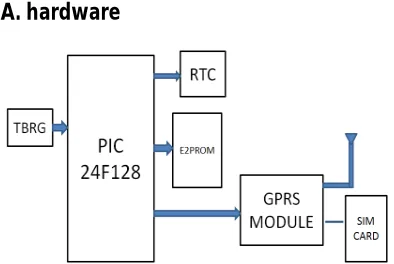
A. hardware
Fig 1.System Block diagram
The location of the rain gauge is very important to the successful operation of the instrument. The most accurate measurements are made in relatively sheltered areas protected from winds and storms. Openings in orchards or a grove of trees offer the best exposure for the rain gauge. Fences and other structures can be used as a protection and should not be very tall. In areas that are open with no nearby structures, a wind screen such is recommended to safeguard against wind effects.
-
Available Online at www.ijpret.com
497
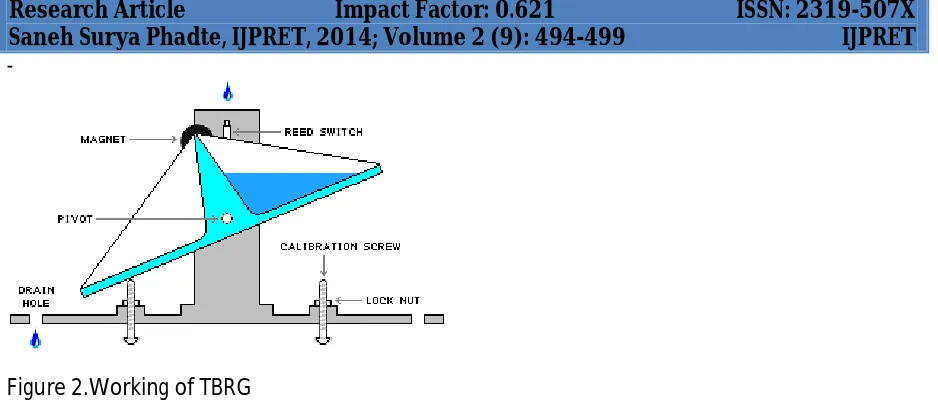
Figure 2.Working of TBRG
Consider the bucket tips for 200 times. The reference value set would be equal to 0.25mm. thus the rain collected in 200 tips of bucket would be equal to (200*0.25mm) 50mm.
This calculations would be done by the PIC24F128.PIC24F128 is 64 pin 16 bit microcontroller. It consist of 8MHz internal oscillator and 32MHz external oscillator. Also it consist of 16 channel A/D convertor, on chip flash memory having 20 years retention minimum. It consist of 64kbps of memory and thus to store the results an EEPROM 24C512 is attached to the circuit. This data is then displayed on LCD . The LCD will consist the information in the following format.
Date: 27/2/2014
Time: 3.19 pm
Pulse :50mm
-
Available Online at www.ijpret.com
498
the data received could be then stored in the form of the excel sheets. Thus on the basis of results obtain we could estimate approximately the rainfall in particular area.
b. Software
1] Begin.
2] Initialise ports, LCD and UART.
3] LCD write routine. The LCD displays title of the project “Automated rainfall measurement system.”
4] Setting and configuration handling. Specifying the mobile no.
5] Configuration of EEPROM.
6] GSM initialisation. Send AT commands and prepare the module to transmit SMS.
7] While loop(infinite loop) contains continuous reading of RTC and TBRG value.
8] Display the rainfall measurement on LCD.
9] As the update time arrives the system generates an SMS which is received at the user end.
10] End
RESULTS AND DISCUSSION
The system generates an SMS in the following pattern.
TIME: 9:00 am
RAINFALL: 120mm
This information is displayed on the operator’s mobile phone or the person in charge.
a. Advantages
-
Available Online at www.ijpret.com
499
b. Disadvantages
Installation cost would be more and the system may not be highly reliable because the measure rainfall is transmitted using GSM which may get lost due to network problems.
CONCLUSION
This system is a remote rainfall measurement device where the rainfall measure is transmitted via GSM to the receiver’s mobile phone. A TBRG is used to measure the rainfall which is a recording rain gauge. An eeprom is interfaced with the microcontroller to store the data which can be lost if the system loses power. A Quectel M10 GSM module is used which is robust as compared to other modules and can be used for longer durations. Manual intervention is not required to measure the rainfall. These systems can be installed at many locations and the information about the rainfall received by these areas can be conveyed to the operator sitting at the central station. The system can be further modified using GPRS to transmit the information about the rainfall received which has already been implemented and is much reliable than GSM. Such systems can be also used in flood warnig systems to wirelessly control the dams based on remote rainfall measurement.
REFERENCES
1. Tito Yuwono , Ruzardi, Mahamod Ismail, “Rain gauge development employing Bluetooth and
RF Modem”. Proceeding of the 2011 IEEE International Conference on Space Science and Communication (IconSpace) 12-13 July 2011,320-323
2. Cheng Ling.” Application of GPRS/CDMA Wireless Communication Technology in
Rainfall”.2012 International Symposium on Instrumentation & Measurement, Sensor Network and Automation(IMSNA),268-271.
3. Udom Lewtomphaisarl and Prawit Saengsatcha,” High Accuracy Tipping Bucket Rain Gauge”,