INTRODUCTION
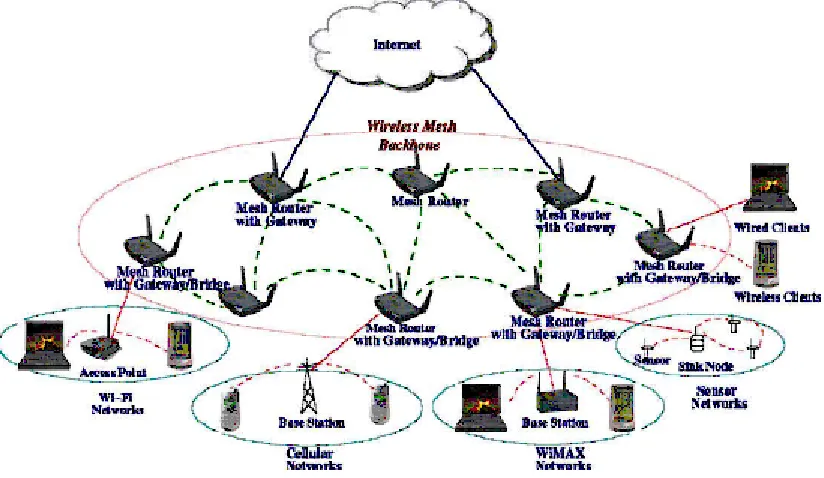
Most of the traditional wireless systems, such as cellular telephone networks and wireless local area networks (WLAN), use either point-to-point or point-to-point-to-multipoint-to-point network topologies. Recently, however, a new wireless network topology, mesh topology, has emerged with the increasing use of wireless sensor networks (WSN) in industrial applications.
Sensor networks are capable of providing local intelligence by sharing information about their local environment with nearby peers and further relaying this information to a central node where it can be processed and used to improve the performance of the network. The biggest problem in deploying a sensor network in an industrial environment is related to its size and complexity. Under typical circumstances, a wired sensor networ k can be ver y costly since factor y communication wiring can easily cost $5 to $10 per foot to install. A simple solution to this problem is to
Oriental Journal of Computer Science & Technology Vol. 2(1),23-29 (2009)
Wireless Mesh Networks - Reliability and Flexibility
K.RAMA KRISHNAIAH¹*, B. RAMESH BABU²,
T. PAVAN KUMAR³ and K.RAJASEKHARA RAO
41,3 & 4Department of Computer Science and Engineering, K.L. Univerity, Vaddeswaram (India)
²Department of Computer Science and Engineering, IIT-Guwahati (India)
(Received: April 20, 2009; Accepted: May 30, 2009)
ABSTRACT
With the increasing use of wireless sensor networks in industrial settings, a new type of network topology, mesh networks, has emerged in today's market. The success of wireless networks in every field has made wireless networks, an emerging key technology for the next generation wireless networking. The various features of wireless mesh networks have attracted the research community, which led to the rapid growth of this technology, inspiring many applications. Many challenging technical issues still exist in this field. This paper compares the reliability and flexibility of the mesh network with other two traditional wireless network topologies, namely point-to-point and point-to-multipoint networks, and illustrates why and how the mesh network has advantages in these areas with the help of a case study.
Key words: Wireless mesh networks, point-to-point networks, point-to-multipoint networks.
eliminate the wires by employing wireless data communications, where radio links replace the point-to-point wiring in a conventional system.
A natural question arising from the use of wireless connections in a sensor network is: "are they reliable?" Every one of us has the experience of a "dropped call" when we are using a cellular telephone system. So how can we make sure that a WSN can provide a robust communication link?
Related questions include: can the WSN be intelligent enough to find a "good" RF link by itself? And what will happen to the WSN if I remove or add a wireless sensor node at a certain place or just move a wireless sensor node from one place to another? Will the WSN be able to automatically adapt to these changes?
24 Krishnaiah et al., Orient. J. Comp. Sci. & Technol., Vol. 2(1), 23-29 (2009)
Wireless Network Topologies
There are several types of wireless networks available on the market today. They include: point-to-point networks, point-to-multipoint networks and the newly emerging mesh networks.
Point-to-Point Networks
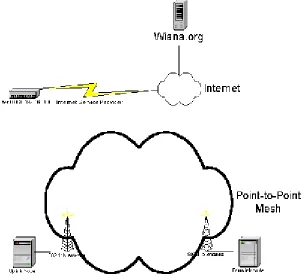
A point-to-point network is the simplest form of wireless network, composed of two radio and two high gain antennas in direct communication with each other. Point to point links are often used to provide high-performance, dedicated connections or high-speed interconnect links. These links are quick to deploy individually, but do not easily scale to create a large network. Client used these nodes in a site-to-site configuration.
In a point-to-point network, each network node directly communicates to only one other node. Figure 2 shows a typical topology of a point-to-point network. Wireless point-to-point systems are often used in wireless "backbone" systems such as microwave relay communications, or as a replacement for a single communication cable.
The biggest disadvantage of a point-to-point wireless system is it is strictly a one-to- one connection. This means that there is no redundancy in such a network at all. If the RF link between two point-to-point radios is not robust, the communicated data can be lost.
Point-to-Multipoint Networks
25 Krishnaiah et al., Orient. J. Comp. Sci. & Technol., Vol. 2(1), 23-29 (2009)
performed as a bridge to the uplink network and are generally in wired configuration for the clients. The problem with point to Multipoint node topology is that they are not design to mesh with other nodes due to the directional antenna.
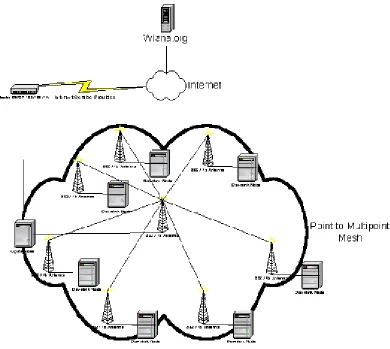
Point-to-multipoint networks have a star topology that can provide either one-way or two-way communications. Figure 3 shows a typical topology of a point-to-multipoint network. Examples of such a topology include cellular systems, WLAN, and satellite systems in which one satellite station communicates to multiple ground stations.
Signals in point-to-multipoint networks converge at the central node, for example, a base station of a cellular system, an access point of a WLAN or a satellite space station in a satellite system. The reliability of the networks with such a topology depends on the quality of the RF link between the central node and each end node.
In many industrial environments, it can be impossible to find a location for the central node from which it is able to provide robust communication links with all of the end nodes in the network. Usually, moving the central node to improve communication with one end node will often degrade communication with other end nodes.
While it may be possible to wire together multiple central nodes in order to improve reliability, the issue of cost will rise again.
Mesh Networks
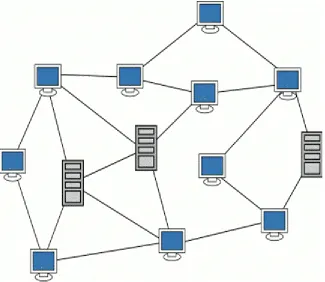
As in a point-to-multipoint network, most of the WSN with a mesh topology also has a single central node to collect information from all the end nodes (wireless sensor nodes in a WSN). However, the mesh topology is different from the point -to-multipoint topology in that every end node also can communicate with one or more nearby end nodes within the network. Figure 4 shows a typical topology of a mesh network.
26 Krishnaiah et al., Orient. J. Comp. Sci. & Technol., Vol. 2(1), 23-29 (2009)
In a mesh WSN, not only can each end node transmit its own information (i.e. information collected from its own sensor), but also it can relay information generated from other nodes. Thus, it is possible for the messages generated from an end node to reach the central node via multiple hops (going through multiple other end nodes to finally reach the central node). The path that a message takes to reach the central node is called a "route". And there may be multiple routes in a mesh network which can relay a message to the central node. This is a basic difference from how both point-to-point and point-to-multipoint topologies work; in both of those topologies all of the transmissions are strictly limited to one hop. In addition, a mesh network is often designed in such a way that it allows a
message to automatically use another route when the quality of the current route is degraded.
27 Krishnaiah et al., Orient. J. Comp. Sci. & Technol., Vol. 2(1), 23-29 (2009)
routing. Therefore the Internet allows sites to communicate even during a war.
There are two types of mesh topologies: full mesh and partial mesh:
· Full mesh topology occurs when every
node has a circuit connecting it to every other node in a network. Full mesh is very expensive to implement but yields the greatest amount of redundancy, so in the event that one of those nodes fails, network traffic can be directed to any of the other nodes. Full mesh is usually reserved for backbone networks.
· With par tial mesh, some nodes are
organized in a full mesh scheme but others are only connected to one or two in the network. Partial mesh topology is commonly found in peripheral networks connected to a full meshed backbone. It is less expensive to implement and yields less redundancy than full mesh topology.
Mesh Network Reliability
For most industrial applications, reliability
Fig. 4: Mesh network topology
is crucial. Depending on the application, corrupted data can result in anything from a disruptive glitch to a devastating failure. In the wireless world, two primary factors determine the signal reliability of an RF link between a radio transmitter and receiver.
· RF path loss
· RF interference
28 Krishnaiah et al., Orient. J. Comp. Sci. & Technol., Vol. 2(1), 23-29 (2009)
receiver, the path loss and the interference primarily determine the quality of the RF link.
The most difficult problem with an RF link is its instability and unpredictability. A typical problem is that link quality at time A can be totally different from link quality at time B. You could have a change in temperature, a change in moisture level, or a person walking across the transmission path at the particular time that you happen to be sending a message. All of these changes can change the RF link quality, sometimes severely.
Thus, for a point or point-to-multipoint network, a communication failure occurs (i.e. a "call drop" in a cellular system) when a single RF link failure happens. Since they are strictly one hop networks, they don't have any redundancy. However, the mesh topology can successfully avoid this problem. Since mesh networks support multi-hop routing, there is almost always more than one path from any end node to another. Thus, in a mesh network, reliability is enhanced by the degree of its route redundancy which is essentially a function of the node density. This means a mesh network can be easily "over-designed" just by adding extra nodes to provide more redundancy.
Mesh Network Flexibility
The flexibility of the mesh network arises from its self-configuration, self-healing and scaling capabilities. These capabilities are implemented in most mesh networks as part of their required network functions.
Self-Configuration
One of the popular functions that can be programmed into a mesh network is the ability to build and configure itself. When each end node is powered on, it listens for its neighbor nodes. If it finds one or more, it issues a request to join the network and gets admitted, provided that it meets admission cr iteria such as set by secur ity requirements. After the end node joins the network, it will not need a human intervention to get a message to its destination. Paths (or routes) will be automatically formed by the end node as the information that it transmits gets relayed by neighboring nodes until it reaches the central node.
Self-Healing
Self-healing is another popular mesh network function. It refers to the ability of a mesh network to reorganize itself and keep functioning even if one or more end nodes are moved from one location to another, or are simply removed from the network. This function of the mesh network is made possible largely because of the redundancy existing in the mesh topology. If a node in a mesh network fails, messages are sent around it via other nodes. Loss of one or more nodes does not necessarily affect its operation. Thus, a mesh networ k is healing because of its self-configuration capability by which human intervention is not necessary for re-routing of messages.
Scalability
The self-configuration and self-healing capabilities of the mesh network render it eminently scalable. In many cases, expanding a mesh network is simply requires the addition of more end nodes to cover additional areas.
Case Study
Cooper Bussmann, a division of Cooper Industr ies (NYSE: CBE), wanted to help its customers beyond supplying over current protective devices by addressing the issue of excessive and costly downtime. In an analysis of various industries, it was determined that reducing the time from the moment a circuit opened until power restoration was a big issue few had addressed in a systematic fashion. This was most crucial in older, established industries with an already large installed base of fuses and circuit breakers - primary metals, automotive, petrochemical, and pulp and paper.
29 Krishnaiah et al., Orient. J. Comp. Sci. & Technol., Vol. 2(1), 23-29 (2009)
To shorten this 60 percent of the downtime problem, Cooper Bussmann developed the Cooper Invision™ Downtime Reduction System. This system is real-time, utilizing batter y-powered sensors to detect a power loss and send an alert signal through the wireless mesh to a special computer appliance. This "gateway" interprets and forwards the alert signal, via the Internet, to a central server for processing and notifying specific customer personnel that are programmed into the system. Alerts can be sent by IVR phone call, e-mail or fax. In all instances, the alert recipient is notified of exactly which circuit has opened, where it is located and, for fused circuits, the correct replacement fuse to bring. There is also an escalation feature that notifies other people if an alert has not been acknowledged in a predetermined amount of time.
Wireless mesh technology was selected, as it best met the difficult environments of the identified industries. Those studied were dynamic and prone to failure with point or point-to-multipoint communications, as forklifts, cranes, trucks and other moving obstructions are a fact of life. Wired systems were never considered as their use posed too many problems of reliability and safety such as having a wire come out of an electrical enclosure containing high voltages and currents.
Unique to the Cooper InVision System is
using the 900MHz portion of the spectrum. This results from the necessity of mounting the battery-powered sensors inside metal electrical enclosures. The lower frequency provided less attenuation and allowed Cooper Bussmann to establish a minimum 30-foot distance from the sensor to the first router in the wireless mesh.
The system takes advantage of the latest wireless mesh technology and rationally applies it to the needs of customers that can best take advantage of the savings it offers. Once the basic system is installed, the mesh coverage area is expandable by installing more routers that automatically register and configure upon initial power up. And monitoring more circuits is easily accomplished, too. Again, upon initial power up, the sensors are automatically registered into the system, only requiring circuit and repor ting assignment in the server, which can be performed over the Internet by customer personnel with minimal computer skills.
CONCLUSION
This paper has described the reliability and flexibility of wireless mesh networks. A mesh network is reliable because of its redundancy. A mesh network is flexible because it is capable of self-configuration and self-healing, and is easily scaled to include more end nodes.
1. Ian F.Akyildiz (Georgia Institute of Technology), Xuedong Wang, Kiyon A survey on wireless mesh networks, (2005).
2. Nagesh Nandaraju, Deepti Nandaraju,
Lakshmi santhanam, BingHe, Junfang Wang, and Dhr ma P.Agrawal. Wireless mesh networks: Current Challenges and Future
REFERENCES
Directions of Web-in-the-sky 2006, University of Cincinnati, USA.
3. Ian F.Akyildiz, Xuedong Wang and weilin Wang. Wireless mesh networks, a survey, (2004).