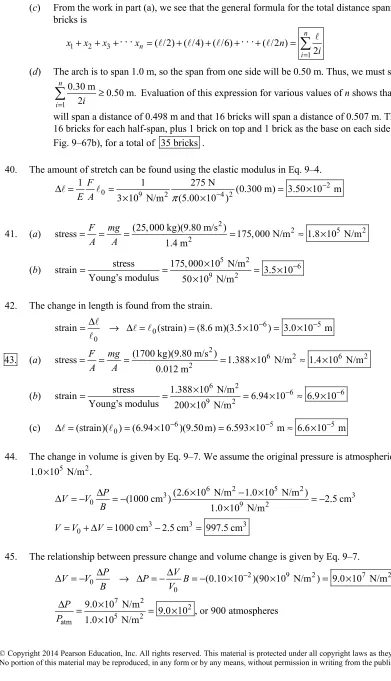
© Copyright 2014 Pearson Education, Inc. All rights reserved. This material is protected under all copyright laws as they currently exist.
Responses to Questions
1. If the object has a net force on it of zero, then its center of mass does not accelerate. But since it is not in equilibrium, it must have a net torque and therefore an angular acceleration. Some examples are:
• A compact disk in a player as it comes up to speed, after it has just been inserted. • A hard drive on a computer when the computer is first turned on.
• A window fan immediately after the power to it has been shut off. • The drum of a washing machine while it is speeding up or slowing down.
2. The bungee jumper is not in equilibrium, because the net force on the jumper is not zero. If the jumper were at rest and the net force were zero, then the jumper would stay at rest by Newton’s first law. The jumper has a net upward force when at the bottom of the dive, and that is why the jumper is then pulled back upward.
3. The meter stick is originally supported by both fingers. As you start to slide your fingers together, more of the weight of the meter stick is supported by the finger that is closest to the center of gravity, so the torques produced by the fingers are equal and the stick is in equilibrium. The other finger feels a smaller normal force, and therefore a smaller frictional force, so the stick slides more easily and moves closer to the center of gravity. The roles switch back and forth between the fingers as they alternately move closer to the center of gravity. Your fingers will eventually meet at the center of gravity. 4. Like almost any beam balance, the movable weights are connected to the fulcrum point by relatively
long lever arms, while the platform on which you stand is connected to the fulcrum point by a very short lever arm. The scale “balances” when the torque provided by your weight (large mass, small lever arm) is equal to that provided by the sliding weights (small mass, large lever arm).
5. (a) If we assume that the pivot point of rotation is the lower left corner of the wall in the picture, then the gravity force acting through the CM provides the torque to keep the wall upright. Note that the gravity force would have a relatively small lever arm (about half the width of the wall). Thus, the sideways force would not have to be particularly large to start to move the wall. (b) With the horizontal extension, there are factors that make the wall less likely to overturn:
• The mass of the second wall is larger, so the torque caused by gravity (helping to keep the wall upright) will be larger for the second wall.
• The center of gravity of the second wall is farther to the right of the pivot point, so gravity exerts a larger torque to counteract the torque due to FG.
• The weight of the ground above the new part of the wall provides a large clockwise torque that helps counteract the torque due to FG.
6. If the sum of the forces on an object is not zero, then the CM of the object will accelerate in the direction of the net force. If the sum of the torques on the object is zero, then the object has no angular acceleration. Some examples are:
• A satellite in a circular orbit around the Earth. • A block sliding down an inclined plane.
• An object that is in projectile motion but not rotating.
• The startup motion of an elevator, changing from rest to having a nonzero velocity. 7. When the person stands near the top, the ladder is more likely to
slip. In the accompanying diagram, the force of the person pushing down on the ladder (MgG) causes a clockwise torque about the contact point with the ground, with lever arm dx. The only force causing a counterclockwise torque about that same point is the reaction force of the wall on the ladder, FW.
G
While the ladder is in equilibrium, FW
G
will be the same magnitude as the frictional force at the ground, FGx.
G
Since FGx G
has a maximum value, FW G
will have the same maximum value, and FW
G
will have a maximum counterclockwise torque that it can exert. As the person climbs the ladder, his lever arm gets longer, so the torque due to his weight
gets larger. Eventually, if the torque caused by the person is larger than the maximum torque caused by W,
FG the ladder will start to slip—it will not stay in equilibrium.
8. The mass of the meter stick is equal to the mass of the rock. Since the meter stick is uniform, its center of mass is at the 50-cm mark. In terms of rotational motion about a pivot at the 25-cm mark, we can treat the stick as though its entire mass is concentrated at the center of mass. The meter stick’s mass at the 50-cm mark (25 cm from the pivot) balances the rock at the 0 mark (also 25 cm from the pivot), so the masses must be equal.
9. You lean backward in order to keep your center of mass over your feet. If, due to the heavy load, your center of mass is in front of your feet, you will fall forward.
10. (a) The cone will be in stable equilibrium if it is placed flat on its base. If it is tilted slightly from this position and then released, it will return to the original position.
(b) The cone will be in unstable equilibrium if it is balanced on its tip. A slight displacement in this case will cause the cone to topple over.
(c) If the cone is placed on its side, it will be in neutral equilibrium. If the cone is displaced slightly while on its side, it will remain in its new position.
stable unstable neutral equilib. equilib. equilib.
dy
x y Ly
dx
mgG
MgG
W
FG
G x
FG
G y
11. When you rise on your tiptoes, your CM shifts forward. Since you are already standing with your nose and abdomen against the door, your CM cannot shift forward. Thus gravity exerts a torque on you and you are unable to stay on your tiptoes—you will return to being flat-footed on the floor.
12. When you start to stand up from a normal sitting position, your CM is not over your point of support (your feet), so gravity will exert a torque about your feet that rotates you back down into the chair. You must lean forward in order that your CM is over your feet so that you can stand up.
13. While you are doing a sit-up, your abdomen muscles provide a torque to rotate you up away from the floor. The force of gravity on your upper half-body tends to pull you back down to the floor, which makes doing sit-ups difficult. The force of gravity on your lower half-body provides a torque that opposes the torque caused by the force of gravity on your upper half-body, making the sit-up a little easier. When your legs are bent, the lever arm for the lower half-body is shorter, so less counter-torque is available. 14. For rotating the upper half-body, the pivot point is near the waist and hips. In that
position, the arms have a relatively small torque, even when extended, due to their smaller mass. The more massive trunk–head combination has a very short lever arm, so it also has a relatively small torque. Thus, the force of gravity on the upper body causes relatively little torque about the hips, tending to rotate you forward, and the back muscles need to produce little torque to keep you from rotating forward. The
force on the upper half-body due to the back muscles is small, so the (partially rightward) force at the base of the spinal column (not shown in the diagram), to keep the spine in equilibrium, will be small. When you stand and bend over, the lever arm for the upper body is much larger
than while you are sitting, which causes a much larger torque. The CM of the arms is also farther from the support point and causes more torque. The back muscles, assumed to act at the center of the back, do not have a very long lever arm. Thus the back muscles will have to exert a large force to cause a counter-torque that keeps you from falling over. Accordingly, there will have to be a large force (mostly to
the right, and not drawn in the diagram) at the base of the spine to keep the spine in equilibrium. 15. Configuration (b) is more likely to be stable. In configuration (a), the CG of the bottom brick is at the
edge of the table, and the CG of the top brick is to the right of the edge of the table. Thus the CG of the two-brick system is not above the base of support, and gravity will exert a torque to roll the bricks clockwise off the table. Another way to see this is that more than 50% of the brick mass is not above the base of support—50% of the bottom brick and 75% of the top brick are to the right of the edge of the table. It is not in equilibrium.
In configuration (b), exactly half of the mass (75% of the top brick and 25% of the bottom brick) is over the edge of the table. Thus the CG of the pair is at the edge of the table—it is in unstable equilibrium. 16. A is a point of unstable equilibrium, B is a point of stable equilibrium, and C is a point of neutral
equilibrium.
17. The Young’s modulus for a bungee cord is much smaller than that for ordinary rope. We know that a bungee cord stretches more easily than ordinary rope. From Eq. 9–4, we have
0 /
. / F A E=
18. An object under shear stress has equal and opposite forces applied across its opposite faces. This is exactly what happens with a pair of scissors. One blade of the scissors pushes down on the cardboard, while the other blade pushes up with an equal and opposite force, at a slight displacement. This produces a shear stress in the cardboard, which causes it to fail.
19. Concrete or stone should definitely not be used for the support on the left. The left-hand support pulls downward on the beam, so the beam must pull upward on the support. Therefore, the support will be under tension and should not be made of ordinary concrete or stone, since these materials are weak under tension. The right-hand support pushes up on the beam, so the beam pushes down on it; it will therefore be under a compression force. Making this support of concrete or stone would be acceptable.
Responses to MisConceptual Questions
1. (d) In attempting to solve this problem, students frequently try to divide the beam into multiple parts to calculate the torque due to the weight of the beam. The beam should be considered as a single object with its weight acting at its center of mass 1
4
( A from the pivot). Since the woman is on the opposite side of the pivot and at the same distance as the beam’s center of mass, their forces of gravity and masses must be equal.
2. (d) A common misconception is that a nonrotating object has an axis of rotation. If an object is not rotating, it is not rotating about any arbitrary point. When solving an equilibrium problem with no rotation, the student can select any axis for the torques that facilitates solving the problem. 3. (a) Students might think that for the net force on the beam to be zero, the tension would equal the
weight of the beam. However, this does not take into account the force that the wall exerts on the hinged end. Students might assume that the tension is equal to half of the beam’s weight. However, this does not take into account the vector nature of the tension. The vertical
component of the tension is equal to half of the weight, but there is also a horizontal component. Adding these two components yields a tension at least half of the weight of the beam.
4. (c) Drawing a free-body diagram for this problem will resolve student misconceptions. When the ball is pulled to the side, there are three forces acting on the ball: the vertical weight, the horizontal applied force, and the tension along the direction of the cable. Resolving the tension into horizontal and vertical parts and applying Newton’s second law in equilibrium, we can see that the applied force is equal to the horizontal component of the tension.
5. (a) As the child leans forward, her center of mass moves closer to the pivot point, which decreases her lever arm. The seesaw is no longer in equilibrium. Since the torque on her side has
decreased, she will rise.
6. (c) A common misconception is that each cord will support one-half of the weight regardless of the angle. An analysis of the forces using Newton’s second law in equilibrium shows that the horizontal components of the tension are equal. Since cord A makes a larger angle with the horizontal, it has a greater total tension and therefore supports more than half the suspended weight.
8. (e) Students may consider the tension equal to the woman’s weight, or half of the woman’s weight, if they do not consider the vector nature of the forces. A free-body diagram for the point at the bottom of the woman’s foot shows three forces acting: the weight of the woman and the diagonal tensions in the wire on each side of her foot. Applying Newton’s second law in equilibrium in the vertical direction shows that the vertical component of the tension must equal half of her weight. Since vertical displacement is small compared to the horizontal length of the wire, the total tension is much greater than the vertical component of the tension.
9. (d) When the length, width, and number of floors are doubled, the weight of the garage increases by a factor of eight. To keep the stress on the columns unchanged, the area of the columns should also increase by a factor of eight.
10. (d) The stress (applied force) is proportional to the strain (change in length). Doubling the stress will cause the strain to double also.
Solutions to Problems
1. If the tree is not accelerating, then the net force in all directions is 0.
A B C
C A B
B C
C B
cos 105 0
cos 105 385 N (475 N) cos 105 262 1 N sin 105 0
sin 105 (475 N) sin 105 458 8 N
x x
x
y y
y
F F F F
F F F
F F F
F F
= + ° + = →
= − − ° = − − ° = − .
= ° + = →
= − ° = − ° = − .
∑
∑
2 2 2 2
C C C
C
1 1
C
( 262 1 N) ( 458 8 N) 528 4 N 528 N 458 8 N
tan tan 60 3 , 180 60 3 120
262 1 N x y
y
x
F F F
F F
θ − − φ
= + = − . + − . = . ≈
− .
= = = . ° = ° − . ° = °
− .
So FC G
is 528 N, at an angle of 120° clockwise from FA. G
The angle has 3 significant figures. 2. Because the mass m is stationary, the tension in the rope
pulling up on the sling must be mg, and the force of the sling on the leg must be mg, upward. Calculate torques about the hip joint, with counterclockwise torque taken as positive. See the free-body diagram for the leg. Note that the forces on the leg exerted by the hip joint are not drawn, because they do not exert a torque about the hip joint.
1
2 1
2
(35 0 cm)
0 (15 0 kg) 6 73 kg
(78 0 cm) x
mgx Mgx m M
x
.
τ = − = → = = . = .
.
∑
3. (a) See the free-body diagram. Calculate torques about the pivot point P labeled in the diagram. The upward force at the pivot will not have any torque. The total torque is zero, since the crane is in equilibrium.
0 Mgx mgd
τ = − = →
∑
(2800 kg)(7 7 m)
2 3 m (9500 kg)
md x
M
.
= = = .
B
FG
C
FG
A
FG
θ
φ
105°
x1
x2 mg
G
MgG
P FG
mgG
x
MgG
d
(b) Again, we sum torques about the pivot point. Mass m is the unknown in this case, and the counterweight is at its maximum distance from the pivot.
max
max max 0 max Mx (9500 kg)(3 4 m)(7 7 kg) 4200 kg
Mgx m gd m
d
.
τ = − = → = = =
.
∑
4. Her torque is her weight times the distance x between the diver and the left support post. 2
1800 m N 46 kg (9 80 m/s )(4 0 m)
mgx m
gx τ
τ= → = = ⋅ =
. .
5. (a) Let m = 0. Calculate the net torque about the left end of the diving board, with counterclockwise torques positive. Since the board is in equilibrium, the net torque is zero.
B
2 B
3
(1 0 m) (4 0 m) 0
4 4(52 kg)(9 80 m/s ) 2038 N 2 0 10 N, up
F Mg
F Mg
τ= . − . = →
= = . =
≈ . ×
∑
Use Newton’s second law in the vertical direction to find FA.
B A
2
A B
0
4 3 3(52 kg)(9 80 m/s ) 1529 N 1500 N, down y
F F Mg F
F F Mg Mg Mg Mg
= − − = →
= − = − = = . = ≈
∑
(b) Repeat the basic process, but with m = 28 kg. The weight of the board will add more clockwise torque.
B
2 B
B A
A B
2
(1 0 m) (2.0 m) (4 0 m) 0
4 2 [4(52 kg) 2(28 kg)](9 80 m/s ) 2587 N 2600 N, up
4 2 3
[3(52 kg) 28 kg](9.80 m/s ) 1803 N 1800 N, down y
F mg Mg
F Mg mg
F F Mg mg F
F F Mg mg Mg mg Mg mg Mg mg
τ= . − − . = →
= + = + . = ≈
= − − − →
= − − = + − − = +
= + = ≈
∑
∑
6. Since each half of the forceps is in equilibrium, the net torque on each half of the forceps is zero. Calculate torques with respect to an axis perpendicular to the plane of the forceps, through point
P, counterclockwise being positive. Consider a force diagram for one-half of the forceps. FG1 is the force on the half-forceps due to the plastic rod, and force FP
G
is the force on the half-forceps from the pin joint. FGP exerts no torque about point P.
T
T T 1 1 1 T
1
8 50 cm
cos cos 0 (11 0 N) 34 6 N
2 70 cm d
F d F d F F
d
τ = θ− θ= → = = . . = .
.
∑
The force that the forceps exerts on the rod is the opposite of FG1, so it is also 34 6 N .. 7. Write Newton’s second law for the junction, in both the x and y directions.
B Acos 45 0 x
F =F −F ° =
∑
From this, we see that FA >FB. Thus set FA =1660 N. A
A
sin 45 0
sin 45 (1660 N)sin 45 1174 N 1200 N y
F F mg
mg F
= ° − =
= ° = ° = ≈
∑
45ο
mgG
A
FG FGB
A FG
B FG
mgG MgG 1.0 m
2.0 m 4.0 m
T
FG
θ
1
FG
T
d
1
d
P
8. Since the backpack is midway between the two trees, the angles in the diagram are equal. Write Newton’s second law for the vertical direction for the point at which the backpack is attached to the cord, with the weight of the backpack being the downward vertical force. The angle is determined by the distance between the trees and the amount of sag at the midpoint, as illustrated in the second diagram.
(a) tan 1 tan 11 5 m 24 4 /2 3 3 m y
θ= − = − . = . °
. A
T 1
2 T
1
2 sin 0
(19 kg)(9 80 m/s ) 225 4 N 230 N 2 sin 2 sin 24 4
y
F F mg
mg F
θ
θ
= − = →
.
= = = . ≈
. °
∑
(b) tan 1 tan 10 15 m 2 60 /2 3 3 m y
θ= − = − . = . °
. A
2 T
1
(19 kg)(9 80 m/s )
2052 N 2100 N 2 sin 2 sin 2 60
mg F
θ
.
= = = ≈
. °
9. Let m be the mass of the beam, and M be the mass of the piano. Calculate torques about the left end of the beam, with
counterclockwise torques positive. The conditions of equilibrium for the beam are used to find the forces that the support exerts on the beam.
( )
( )
(
)
1 1
R 2 4
2
1 1 1 1
R 2 4 2 4
0
(110 kg) (320 kg) (9 80 m/s ) 1320 N
F mg Mg
F m M g
τ= − − =
⎡ ⎤
= + =⎣ + ⎦ . =
∑
A A AL R
2 3
L R
0
( ) (430 kg)(9 80 m/s ) 1 32 10 N 2890 N y
F F F mg Mg
F m M g F
= + − − =
= + − = . − . × =
∑
The forces on the supports are equal in magnitude and opposite in direction to the above two results. R 1300 N down
F = FL =2900 N down
10. Calculate torques about the left end of the beam, with counterclockwise torques positive. The conditions of equilibrium for the beam are used to find the forces that the support exerts on the beam.
B
2 4
B
(20 0 m) (25 0 m) 0
25 0 (1 25)(1200 kg)(9 80 m/s ) 1 5 10 N 20 0
F mg
F mg
τ = . − . = →
.
= = . . = . ×
.
∑
A B
2
A B
0
1 25 0 25 (0 25)(1200 kg)(9 80 m/s ) 2900 N y
F F F mg
F mg F mg mg mg
= + − =
= − = − . = − . = − . . = −
∑
Notice that FGA points down.
mgG T FG T
FG
θ
θ
θ
θ
A
yl/4 l
mgG MgG L
FG FR
G
A
FG FGB
mgG 20.0 m
11. The pivot should be placed so that the net torque on the board is zero. We calculate torques about the pivot point, with counterclockwise torques positive. The upward force FP G
at the pivot point is shown, but it exerts no torque about the pivot point. The mass of the child is m, the mass of the adult is M, the mass of the board is mB, and the center of gravity is at the middle of the board.
(a) Ignore the force m gB . ( ) 0
(25 kg) (9 0 m) 2 25 m 2 3 m from adult (25 kg 75 kg)
Mgx mg x
m x
m M
τ= − − = →
= = . = . ≈ .
+ +
∑
AA (b) Include the force m gB .
B B
B
( ) ( /2 ) 0
( /2) (25 kg 7 5 kg) (9 0 m) 2 54 m 2 5 m from adult ( ) (75 kg 25 kg 15 kg)
Mgx mg x m g x
m m x
M m m
τ= − − − − =
+ + .
= = . = . ≈ .
+ + + +
∑
A AA
12. Using the free-body diagram, write Newton’s second law for both the horizontal and vertical directions, with net forces of zero.
T2 T1 T2 T1
T1 T1
cos 0 cos sin 0
sin x
y
F F F F F
mg
F F mg F
θ θ
θ θ
= − = → =
= − = → =
∑
∑
2
T2 T1
2 T1
(190 kg)(9 80 m/s )
cos cos 2867 N 2900 N
sin tan tan 33
(190 kg)(9 80 m/s )
3418 N 3400 N sin sin 33
mg mg
F F
mg F
θ θ θ θ
θ
.
= = = = = ≈
° .
= = = ≈
°
13. Draw a free-body diagram of the junction of the three wires. The tensions can be found from the conditions for force equilibrium.
T1 T2 T2 T1
T1 T2
cos 37 cos 37 cos 53 0
cos 53 sin 37 sin 53 0
x
y
F F F F F
F F F mg
°
= ° − ° = → =
°
= ° + ° − =
∑
∑
T1sin 37 cos 37 T1sin 53 0 cos 53
F ° + °F ° −mg= →
°
2
T1 (33 kg)(9 80 m/s )cos 37 194 6 N 190 N sin 37 sin 53
cos 53
F = . ° = . ≈
° + °
°
T2 cos 37 T1 cos 37 (1 946 10 N) 258 3 N2 260 N cos 53 cos 53
F = °F = ° . × = . ≈
° °
l/2 – x
mgG
B m gG
MgG
P
FG
x A−x
A
mgG T2 FG θ
T1 FG
T1 FG T2
FG
mgG
14. The table is symmetric, so the person can sit near either edge and the same distance will result. We assume that the person (mass M) is on the right side of the table and that the table (mass m) is on the verge of tipping, so that the left leg is on the verge of lifting off the floor. There will then be no normal force between the left leg of the table and the floor. Calculate torques about the right leg of the table such that the normal force between the table and the floor causes no torque.
Counterclockwise torques are taken to be positive. The conditions of equilibrium for the table are used to find the person’s location.
24 0 kg
(0 60 m) 0 (0 60 m) (0 60 m) 0 218 m 66 0 kg
m
mg Mgx x
M
τ = . − = → = . = . . = .
.
∑
Thus the distance from the edge of the table is 0 50 m 0 218 m. − . = .0 28 m.
15. The bottle opener will pull upward on the cork with a force of magnitude Fcork, so there is a downward force on the opener of magnitude Fcork. We assume that there is no net torque on the opener, so it has no angular acceleration. Calculate torques about the rim of the bottle where the opener is resting on the rim.
cork cork
(79 mm) (9 mm) 0
9 9 (200 N) to 9 (400 N) 22 8 N to 45 6 N 20 N to 50 N
70 79 79
F F
F F
τ = − = →
= = = . . ≈
∑
16. The beam is in equilibrium, so both the net torque and net force on it must be zero. From the free-body diagram, calculate the net torque about the center of the left support, with counterclockwise torques as positive. Calculate the net force, with upward as positive. Use those two equations to findFA and FB.
B 1 2 3 4 1 1 2 1 2 3 1 2 3 5
1 1 2 1 2 3 1 2 3 5
B
1 2 3 4
( ) ( ) ( )
( ) ( )
( )
F x x x x F x F x x F x x x mgx
F x F x x F x x x mgx
F
x x x x
τ = + + + − − + − + + −
+ + + + + +
=
+ + +
∑
2 (4300 N)(2 0 m) (3100 N)(6 0 m) (2200 N)(9 0 m) (280 kg)(9 80 m/s )(5 0 m)
10 0 m 6072 N 6100 N
. + . + . + . .
=
.
= ≈
A B 1 2 3
2
A 1 2 3 B
0
9600 N (280 kg)(9 80 m/s ) 6072 N 6272 N 6300 N
F F F F F F mg
F F F F mg F
= + − − − − =
= + + + − = + . − = ≈
∑
17. From the free-body diagram, the conditions of equilibrium are used to find the location of the girl (mass mC). The 45-kg boy is represented by mA and the 35-kg boy by
B
m . Calculate torques about the center of the seesaw, and take counterclockwise torques to be positive. The upward
force of the fulcrum on the seesaw ( )FG causes no torque about the center.
( )
( )
( )
1 1
A 2 C B 2
A B 1 1
2 2
C
0
( ) (45 kg 35 kg) (3.2 m) 0.64 m 25 kg
m g m gx m g
m m
x m
τ = − − =
− −
= = =
∑
A AA
mgG MgG
x
0.60 m
N
FG
x1 x2 x3 x4
mgG
A
FG FGB
1
FG FG2 F3
G
5
x
C m gG A
m gG
B m gG FG
18. The beam is in equilibrium. Use the conditions of equilibrium to calculate the tension in the wire and the forces at the hinge. Calculate torques about the hinge, and take counterclockwise torques to be positive.
T 2 1 1 2 1
1 1
1 1 2 1
2 2
T
2
( sin ) /2 0
(155 N)(1 70 m) (215 N)(1 70 m) sin (1 35 m)(sin 35 0 )
642 2 N 642 N
F m g m g
m g m g
F τ θ θ = − − = → + . + . = = . . ° = . ≈
∑
A A AA A
A
H Tcos 0 H Tcos (642 2 N) cos 35 0 526 1 N 526 N
x x x
F =F −F θ = → F =F θ = . . ° = . ≈
∑
H T 1 2
H 1 2 T
sin 0
sin 155 N 215 N (642 2 N)sin 35 0 1 649 N 2 N y y
y
F F F m g m g
F m g m g F
θ θ
= + − − = →
= + − = + − . . ° = . ≈
∑
19. (a) The pole is in equilibrium, so the net torque on it must be zero. From the free-body diagram, calculate the net torque about the lower end of the pole, with counterclockwise torques as positive. Use that calculation to find the tension in the cable. The length of the pole is A.
T T
( /2) cos cos 0 ( /2 ) cos
F h mg Mg
m M g
F
h
τ θ θ
θ
= − − =
+ =
∑
A AA 2
(6 0 kg 21 5 kg)(9 80 m/s )(7 20 m) cos 37 407 8 N 410 N 3 80 m
. + . . . °
= = . ≈
.
(b) The net force on the pole is also zero since it is in equilibrium. Write Newton’s second law in both the x and y directions to solve for the forces at the pivot.
P T 0 P T 410 N
x x x
F =F −F = → F =F =
∑
2
P 0 P ( ) (33 5 kg)(9 80 m/s ) 328 N
y y y
F =F −mg Mg− = → F = m M g+ = . . =
∑
20. The center of gravity of each beam is at its geometric center. Calculate torques about the left end of the beam, and take counterclockwise torques to be positive. The
conditions of equilibrium for the beam are used to find the forces that the support exerts on the beam.
1
B 2
2
5 5
B 8 8
( /2) ( /4) 0
(940 kg)(9 80 m/s ) 5758 N 5800 N
F Mg Mg
F Mg
τ = − − = →
= = . = ≈
∑
A A A1
A B 2
2
3 7 7
A 2 B 8 8
0
(940 kg)(9 80 m/s ) 8061 N 8100 N y
F F F Mg Mg
F Mg F Mg
= + − − = →
= − = = . = ≈
∑
21. To find the normal force exerted on the road by the trailer tires, take the torques about point B, with counterclockwise torques as positive.
A
(5 5 m) (8 0 m) 0
mg F
τ = . − . = →
∑
2 A
4
5 5 m 5 5 m
(2500 kg)(9 80 m/s ) 16,844 N
8 0 m 8 0 m
1 7 10 N
F =mg⎛⎜ .. ⎞⎟= . ⎜⎛ .. ⎞⎟=
⎝ ⎠ ⎝ ⎠
≈ . ×
1 mgG
T FG θ H FG 1 2 A 2 A 1 A 2 mgG
A
FG 12Mg FGB
G
MgG 4
A
A 2
A
mgG
A
FG
B
FG
2.5 m 5.5 m θ
θ
x y
mgG
MgG
The net force in the vertical direction must be zero.
B A
2 3
B A
0
(2500 kg)(9 80 m/s ) 16,844 N 7656 N 7 7 10 N y
F F F mg
F mg F
= + − = →
= − = . − = ≈ . ×
∑
22. (a) For the extreme case of the beam being ready to tip, there would be no normal force at point A from the support. Use the free-body diagram to write the equation of rotational equilibrium under that condition to find the weight of the person, with FA = .0 Take torques about the location of
support B, and call counterclockwise torques positive. WG is the weight of the person, and mB is the mass of the beam.
B
B
(5.0 m) (5.0 m) 0 650 N
m g W
W m g
τ = − = →
= =
∑
(b) With the person standing at point D, we have already assumed that FA =0 . The net force in the vertical direction must also be zero.
3
A B B 0 B B 650 N 650 N 1.30 10 N
y
F =F +F −m g W− = → F =m g W+ = + = ×
∑
(c) The person moves to a different spot, so the free-body diagram changes again as shown. Again use the net torque about support B and then use the net vertical force.
B A
B A
A B B B B A
(5.0 m) (10.0 m) (12.0 m) 0
(5.0 m) (10.0 m) (650 N)(5.0 m) (650 N)(10.0 m) 810 N
12.0 m 12.0 m
0 1300 N 810 N 490 N
y
m g W F
m g W
F
F F F m g W F m g W F
τ = + − =
+ +
= = =
= + − − = → = + − = − =
∑
∑
23. Draw the free-body diagram for the sheet, and write Newton’s second law for the vertical direction. Note that the tension is the same in both parts of the clothesline.
T T
2 T
sin 3.5 sin 3.5 0 (0.75 kg)(9.80 m/s ) 2(sin 3.5 ) 2 (sin 3.5 )
60 N (2 significant figures) y
F F F mg
mg F
= ° + ° − = →
= =
° °
=
∑
The 60-N tension is much higher than the ~7.5-N weight of the sheet because of the small angle. Only the vertical components of the tension are supporting the sheet. Since the angle is small, the tension has to be large to have a large enough vertical component to hold up the sheet.
24. The person is in equilibrium, so both the net torque and net force must be zero. From the free-body diagram, calculate the net torque about the center of gravity, with counterclockwise torques as positive. Use that calculation to find the location of the center of gravity, a distancex from the feet.
T
FG
T
FG
mgG
3.5°
3.5°
3.0 m 7.0 m 5.0 m 5.0 m A
FG FB
G
WG
B m gG
C A B D
3.0 m 5.0 m 5.0 m 2.0 m
A FG
B FG WG mBg
G
C A B D
A–x x mgG A
mgG WG hinge
horiz FG
rope FG
hinge vert FG
φ
θ d
A x y
(
θ φ−)
B A
1
A A A
A B A B A B
( ) 0
35.1 kg
(1.72 m) 9.05 10 m 31.6 kg 35.1 kg
F x F x
F m g m
x
F F m g m g m m
τ
−
= − − =
= = = = = ×
+ + + +
∑
AA A A
The center of gravity is about 90.5 cm from the feet.
25. (a) The man is in equilibrium, so the net force and the net torque on him must be zero. We use half of his weight and then consider the force just on one hand and one foot, assuming that he is symmetrical. Take torques about the point where the foot touches the ground, with counterclockwise as positive.
1
2 h 1 2
2
2 2
h
1 2
( ) 0
(68 kg)(9.80 m/s )(0.95 m) 231 N 230 N
2( ) 2(1.37 m)
mgd F d d
mgd F
d d
τ = − + =
= = = ≈
+
∑
(b) Use Newton’s second law for vertical forces to find the force on the feet.
h f
2
1 1
f 2 h 2
2 2 0
(68 kg)(9.80 m/s ) 231 N 103 N 100 N y
F F F mg
F mg F
= + − =
= − = − = ≈
∑
The value of 100 N has 2 significant figures.
26. First consider the triangle made by the pole and one of the wires (first
diagram). It has a vertical leg of 2.6 m and a horizontal leg of 2.0 m. The angle that the tension (along the wire) makes with the vertical is
12.0
tan 37.6 . 2.6
θ= − = ° The part of the tension that is parallel to the ground is therefore FT h =FTsin .θ
Now consider a top view of the pole, showing only force parallel to the ground (second diagram). The horizontal parts of the tension lie as the sides of
an equilateral triangle, so each makes a 30° angle with the tension force of the net. Write the equilibrium equation for the forces along the direction of the tension in the net.
net T h
net T
2 cos30 0
2 sin cos 30 2(115 N) sin 37.6 cos 30 121.5 N 120 N
F F F
F F θ
= − ° = →
= ° = ° ° = ≈
∑
27. (a) Choose the coordinates as shown in the free-body diagram.
(b) Write the equilibrium conditions for the horizontal and vertical forces.
rope hinge
horiz hinge rope
horiz
sin 0
sin (85 N) sin 37 51 N x
F F F
F F
φ
φ
= − = →
= = ° =
∑
rope hinge
vert
2
hinge rope
vert
cos 0
cos (3.8 kg)(9.80 m/s ) 22 N (85 N) cos 37 8.6 N 9 N y
F F F mg W
F mg W F
φ
φ
= + − − = →
= + − =
+ − ° = − ≈ −
∑
So the vertical hinge force actually points downward.
2.6 m
2.0 m θ
o 30 30o
net
FG
T h
FG
T h
FG
d1 d2
1 2mg
G
h
FG Ff
(c) We take torques about the hinge point, with clockwise torques as positive.
( )
( )
1rope 2
1
rope 2
sin sin sin ( ) 0
sin ( ) sin
sin
Wd mg F
F mg
d
W
τ θ θ θ φ
θ φ θ
θ
= + − − = →
− − =
∑
A AA A
2
(85 N)(5.0 m) sin 16 (3.8 kg)(9.80 m/s )(2.5 m) sin 53
2.436 m 2.4 m (22 N) sin 53
° − °
= = ≈
°
28. See the free-body diagram. Take torques about the pivot point, with clockwise torques as positive. The plank is in equilibrium. Let m represent the mass of the plank and M represent the mass of the person. The minimum nail force would occur if there was no normal force pushing up on the left end of the board.
nails nails
2 (0.75 m) cos (2.25 m) cos
(0.75 m) cos 0 (0.75 m) (2.25 m)
3 (0.75 m)
(45 kg 3 (65 kg))(9.80 m/s ) 2352 N 2400 N
mg Mg
F
mg Mg
F mg Mg
τ θ θ
θ
= + −
= →
+
= = +
= + = ≈
∑
29. The forces on the door are due to gravity and the hinges. Since the door is in equilibrium, the net torque and net force must be zero. Write the three equations of equilibrium. Calculate torques about the bottom hinge, with counterclockwise torques as positive. From the statement of the problem,
1
Ay By 2 .
F =F = mg
A
2 A
A B B A
2
1 1
A B A B 2 2
( 2 ) 0 2
(13.0 kg)(9.80 m/s )(1.30 m)
55.2 N 2( 2 ) 2(2.30 m 0.80 m)
0 55.2 N
0 (13.0 kg)(9.80 m/s ) 63.7 N
x
x
x x x x x
y y y y y
w
mg F h d
mgw F
h d
F F F F F
F F F mg F F mg
τ= − − =
= = =
− −
= − = → = =
= + − = → = = = =
∑
∑
∑
30. Write the conditions of equilibrium for the ladder, with torques taken about the bottom of the ladder and counterclockwise torques as positive.
(
1)
1W 2 W 2
1
G W G W 2
G G
sin cos 0
tan 0
tan 0
x x x
y y y
mg
F mg F
mg
F F F F F
F F mg F mg
τ θ θ
θ
θ
= − = → =
= − = → = =
= − = → =
∑
∑
∑
A A
x y
mgG
W
FG
θ
Gy FGGx FG
cosθ
A
sinθ
A
pivot
FG
θ mg
G MgG
nails
FG
0.75 m 0.75 m 1.50 m
d h
w d x y
mgG
Bx
FG
By
FG Ax
FG Ay
d
mgG MgG
M
FG
A
D
For the ladder not to slip, the force at the ground FGx must be less than or equal to the maximum force of static friction.
G s N s G 12 s 1
s s
1 1
tan tan
tan 2 2
x y mg
F μF μ F μmg θ θ
θ μ − μ
⎛ ⎞
≤ = → ≤ → ≤ → ≥ ⎜ ⎟
⎝ ⎠
Thus the minimum angle is θmin =tan (1/2 ) .−1 μs
31. The arm is in equilibrium. Take torques about the elbow joint (the dot in the free-body diagram), so that the force at the elbow joint does not enter the calculation. Counterclockwise torques are positive. The mass of the lower arm is m=2.0 kg, and the mass of the load is M.
It is given that FM=450 N.
M 1 2 3
2
M 1 2
2 3
0
(450 N)(0.060 m) (2.0 kg)(9.80 m/s )(0.15 m) 7.0 kg (9.80 m/s )(0.35 m)
F d mgd Mgd
F d mgd
M
gd
τ = − − = →
− −
= = =
∑
32. Calculate the torques about the elbow joint (the dot in the free-body diagram). The arm is in equilibrium. Counterclockwise torques are positive.
∑
τ =F d mgD MgM − − A=0M
2
(2.3 kg)(0.12 m) (7.3 kg)(0.300 m) (9.80 m/s ) 970 N 0.025 m
mD M
F g
d + =
+
⎡ ⎤
=⎢ ⎥ =
⎣ ⎦
A
33. We redraw Figs. 9–14b and 9–14c with the person 45° from the horizontal, instead of the original 30°. All distances are as in the original problem. We still assume that the back muscles pull at a 12° angle to the spine. The 18° angle from the original problem becomes 33°. Torques are taken about the same point at the base of the spine, with counterclockwise torques as positive.
M H
A T
(0.48 m) sin 12 (0.72 m)( ) sin 45 (0.48 m)( ) sin 45 (0.36 m)( ) sin 45 0
F w
w w
τ = ° − °
− ° − ° =
∑
As in the original problem, wH =0.07 ,w wA =0.12 ,w wT=0.46 .w The torque equation then gives the following result:
M
[
(0.72 m)(0.07) (0.48 m)(0.12) (0.36 m)(0.46)]
sin 45 1.94 (0 48 m) sin 12F = + + w ° = w
. °
Take the sum of the forces in the vertical direction, set equal to zero.
∑
Fy =FVy−FMsin 33° −0.07w−0.12w−0.46w=0 → FVy=1.71wmgG MgG J
FG
M FG
1 d
2 d
3 d
45o M
FG
V
FG
T
wG
A
wG
H
Take the sum of the forces in the horizontal direction, set equal to zero.
∑
Fx=FVx−FM cos 33° =0 → FVy =1.63wThe final result is
FV = FV 2x+FV y2 = 2.4w
This compares with 2.5w for the more bent position.
34. (a) Calculate the torques about the elbow joint (the dot in the free-body diagram). The arm is in equilibrium. Take counterclockwise torques as positive.
M
2 M
( sin ) 0
(3 3 kg)(9 80 m/s )(0 24 m) 249 9 N sin (0 12 m)sin 15
250 N
F d mgD
mgD F
d
τ θ
θ
= − = →
. . .
= = = .
. °
≈
∑
(b) To find the components of FJ, write Newton’s second law for both the x and y directions. Then combine them to find the magnitude.
J M J M
M J
2
J M
2 2 2 2
J J J
cos 0 cos (249 9 N) cos 15 241 4 N
sin 0
sin (249 9 N)sin15 (3 3 kg)(9 80 m/s ) 32 3 N F (241 4 N) (32 3 N) 243 6 N 240 N
x x x
y y
y
x y
F F F F F
F F mg F
F F mg
F F
θ θ
θ θ
= − = → = = . ° = .
= − − = →
= − = . ° − . . = .
= + = . + . = . ≈
∑
∑
35. Calculate the torques about the shoulder joint, which is at the left end of the free-body diagram of the arm. Since the arm is in equilibrium, the sum of the torques will be zero. Take counterclockwise torques to be positive. The force due to the shoulder joint is drawn, but it exerts no torque about the shoulder joint.
M sin 0
F d mgD Mg
τ = θ− − =
∑
A2
M (3 3 kg)(0 24 cm) (8 5 kg)(0 52 m)(9 80 m/s ) 1600 N sin (0 12 m)sin 15
mD ML
F g
d θ
+ . . + . .
= = . =
. °
36. There will be a normal force upward at the ball of the foot, equal to the person’s weight (FN=mg). Calculate torques about a point on the floor directly below the leg bone (and in line with the leg bone force, FB).
G
Since the foot is in equilibrium, the sum of the torques will be zero. Take counterclockwise torques as positive.
N A
2
A N
(2 ) 0
2 2 2(72 kg)(9 80 m/s ) 1400 N
F d F d
F F mg
τ = − = →
= = = . =
∑
The net force in the y direction must be zero. Use that to find FB.
N A B 0 B N A 2 3 2100 N
y
F =F +F −F = → F =F +F = mg mg+ = mg=
∑
mgG MgG
M
FG
J
FG
θ
d D
l
N
FG
d D=2d A
FG FGB
mgG
M
FG
J
FG θ
37. Take torques about the elbow joint. Let clockwise torques be positive. Since the arm is in equilibrium, the total torque will be 0.
max max
(2 0 kg) (0 15 m) 25 kg (0 35 m) (0 050 m) sin 105 0 (2 0 kg) (0 15 m) (25 kg) (0 35 m) 1836 N 1800 N
(0 050 m) sin 105
g g F
g g
F
τ = . . + ( ) . − . ° = →
. . + .
= = ≈
. °
∑
38. From Section 9–4: “An object whose CG is above its base of support will be stable if a vertical line projected downward from the CG falls within the base of
support.” For the tower, the base of support is a circle of radius 7.7 m. If the top is 4.5 m off center, then the CG will be 2.25 m off center, and a vertical line
downward from the CG will be 2.25 m from the center of the base. As long as that vertical line is less than 7.7 m from the center of the base, the tower will be in
stable equilibrium . To be unstable, the CG has to be more than 7.7 m off center, so the top must be more than 2 × (7.7 m) = 15.4 m off center. Thus the top will have to lean 15.4 m – 4.5 m = 10 9 m. farther to reach the verge of instability. 39. (a) The maximum distance for brick #1 to remain on brick #2 will be reached
when the CM of brick #1 is directly over the edge of brick #2. Thus brick #1 will overhang brick #2 by x1=A/2.
The maximum distance for the top two bricks to remain on brick #3 will be reached when the center of mass of the top two bricks is directly over the edge of brick #3. The CM of the top two bricks is (obviously) at the point labeled X on brick #2, a distance of /4A from the right edge of brick #2. Thus
2 /4. x =A
The maximum distance for the top three bricks to remain on brick #4 will be reached when the center of mass of the top three bricks is directly over the
edge of brick #4. The CM of the top three bricks is at the point labeled X on brick #3 and is found relative to the center of brick # 3 by CM (0) 2 ( /2) /3,
3
m m
m +
= A =A or /6A from the right edge of brick #3. Thus x3=A/6.
The maximum distance for the four bricks to remain on a tabletop will be reached when the center of mass of the four bricks is directly over the edge of the table. The CM of all four bricks is at the point labeled X on brick #4 and is found relative to the center of brick #4 by
CM (0) 3 ( /2) 3 /8, 4
m m
m +
= A = A or /8A from the right edge of brick #4. Thus x4=A/8.
(b) From the last diagram, the distance from the edge of the tabletop to the right edge of brick #1 is 4 3 2 1 /8 ( /6) ( /4) ( /2) 25 /24
x + +x x + = (x A ) + A + A + A = A >A
Since this distance is greater than ,A the answer is yes, the first brick is completely beyond the edge of the table.
A
1
x
#1 # 2
A
#1
1
x
x
# 2
#3
x
2A
1
x
#1 # 2
#3
x
x
2# 4
x
3A
1
x
#1 # 2
#3
x
2# 4
x
34
x
x
(c) From the work in part (a), we see that the general formula for the total distance spanned by n bricks is
1 2 3
1 ( /2) ( /4) ( /6) ( /2 )
2 n n
i
x x x x n
i =
+ + +g = A + A + A +g+ A =
∑
A(d) The arch is to span 1.0 m, so the span from one side will be 0.50 m. Thus, we must solve
1
0 30 m 0 50 m. 2
n
i= i
. ≥ .
∑
Evaluation of this expression for various values of n shows that 15 bricks will span a distance of 0.498 m and that 16 bricks will span a distance of 0.507 m. Thus, it takes 16 bricks for each half-span, plus 1 brick on top and 1 brick as the base on each side (as in Fig. 9–67b), for a total of 35 bricks .40. The amount of stretch can be found using the elastic modulus in Eq. 9–4. 2
0 9 2 4 2
1 1 275 N (0 300 m) 3 50 10 m
3 10 N/m (5 00 10 ) F
E A π
− −
Δ = = . = . ×
× . ×
A A
41. (a)
2
2 5 2
2
(25,000 kg)(9 80 m/s )
stress 175,000 N/m 1 8 10 N/m
1 4 m F mg
A A
.
= = = = ≈ . ×
.
(b)
5 2
6
9 2
stress 175,000 10 N/m
strain 3 5 10
Young’s modulus 50 10 N/m
− ×
= = = . ×
×
42. The change in length is found from the strain.
6 5
0 0
strain=ΔA → Δ = A A (strain) (8 6 m)(3 5 10 )= . . × − = . ×3 0 10− m A
43. (a)
2
6 2 6 2
2 (1700 kg)(9 80 m/s )
stress 1 388 10 N/m 1 4 10 N/m
0 012 m F mg
A A
.
= = = = . × ≈ . ×
.
(b)
6 2
6 6
9 2
stress 1 388 10 N/m
strain 6 94 10 6 9 10
Young’s modulus 200 10 N/m
− −
. ×
= = = . × ≈ . ×
×
(c) Δ =A (strain)( ) (6 94 10 )(9 50 m) 6 593 10A0 = . × −6 . = . × −5m≈ . ×6 6 10−5m
44. The change in volume is given by Eq. 9–7. We assume the original pressure is atmospheric pressure,
5 2
1 0 10 N/m .. ×
6 2 5 2
3 3
0 9 2
3 3 3
0
(2 6 10 N/m 1 0 10 N/m )
(1000 cm ) 2 5 cm
1 0 10 N/m 1000 cm 2 5 cm 997 5 cm P
V V
B
V V V
Δ . × − . ×
Δ = − = − = − .
. ×
= + Δ = − . = .
45. The relationship between pressure change and volume change is given by Eq. 9–7.
2 9 2 7 2
0
0
7 2
2
5 2
atm
(0 10 10 )(90 10 N/m ) 9 0 10 N/m 9 0 10 N/m
9 0 10 , or 900 atmospheres 1 0 10 N/m
P V
V V P B
B V
P P
−
Δ Δ
Δ = − → Δ = − = − . × × = . ×
Δ = . × = . ×
46. The Young’s modulus is the stress divided by the strain.
(
3)
21 2
6 2
3 2
0
(13 4 N)/ 8 5 10 m stress /
Young’s modulus 9 6 10 N/m
strain / (3 7 10 m)/(15 10 m) F A
− −
⎡ ⎤
. ⎢π × . × ⎥
⎣ ⎦
= = = = . ×
ΔA A . × ×
2
47. The mass can be calculated from the equation for the relationship between stress and strain. The force causing the strain is the weight of the mass suspended from the wire. Use Eq. 9–4.
3 2
9 2
2
0 0
1 (1 15 10 m) 0 030
(200 10 N/m ) 25 kg
100 (9 80 m/s )
F mg EA
m
E A EA g
π −
Δ = = → = Δ = × . × . =
.
A A
A A
48. The percentage change in volume is found by multiplying the relative change in volume by 100. The change in pressure is 199 times atmospheric pressure, since it increases from atmospheric pressure to 200 times atmospheric pressure. Use Eq. 9–7.
5 2
2
9 2
0
199(1 0 10 N/m )
100 100 100 2 10
90 10 N/m
V P
V B
−
Δ = − Δ = − . × = − ×
× ,
The negative sign indicates that the interior space got smaller. 49. Elastic potential energy is given by 1 2 1
elastic 2 2
PE = k x( )Δ = F xΔ . The force is found from Eq. 9–4, using ΔA as Δx.
6 2 4 2
3 2
1 1 1
elastic 2 2 2 3
0 2
(2 0 10 N/m )(0 50 10 m )
PE (1 0 10 m)
(3 0 10 m) 1 7 10 J
EA
F x − − −
−
⎛ ⎞ . × . ×
= Δ = ⎜ Δ Δ =⎟ . ×
. ×
⎝ ⎠
= . ×
A A
A
50. Set the compressive strength of the bone equal to the stress of the bone.
6 2 4 2 4
max
max
compressive strength F F (170 10 N/m )(3 0 10 m ) 5 1 10 N A
−
= → = × . × = . ×
51. (a) The maximum tension can be found from the ultimate tensile strength of the material. max
6 2 4 2
max
tensile strength
(tensile strength) (500 10 N/m ) (5 00 10 m) 393 N F
A
F A π −
= →
= = × . × =
(b) To prevent breakage, thicker strings should be used, which will increase the cross-sectional area of the strings and thus increase the maximum force. Breakage occurs because when the strings are hit by the ball, they stretch, increasing the tension. The strings are reasonably tight in the normal racket configuration, so when the tension is increased by a particularly hard hit, the tension may exceed the maximum force.
52. (a) Compare the stress on the bone with the compressive strength to see whether the bone breaks. 4
4 2
7 2 8 2
3.3 10 N Stress
3.6 10 m
9.167 10 N/m 1 7 10 N/m (compressive strength of bone) F
A −
×
= =
×
= × < . ×
(b) The change in length is calculated from Eq. 9–4.
7 2 3
0
9 2
0 22 m
(9 167 10 N/m ) 1 3 10 m 15 10 N/m
F E A
−
⎛ . ⎞
Δ = =⎜⎜ ⎟⎟ . × = . ×
×
⎝ ⎠
A A
53. (a) The area can be found from the ultimate tensile strength of the material.
2 5 2 5 2
6 2
tensile strength safety factor safety factor tensile strength
7 0
(270 kg)(9 80 m/s ) 3 704 10 m 3 7 10 m 500 10 N/m
F A F
A
A − −
⎛ ⎞
= → = ⎜ ⎟ →
⎝ ⎠
.
= . = . × ≈ . ×
×
(b) The change in length can be found from the stress-strain relationship, Eq. 9–4. 2
3 0
5 2 9 2
0
(7 5 m)(320 kg)(9 80 m/s )
2 7 10 m
(3 704 10 m )(200 10 N/m ) F
F E
A AE
− −
Δ . .
= → Δ = = = . ×
. × ×
A A
A A
54. For each support, to find the minimum cross-sectional area with a safety factor means that strength ,
safety factor F
A= where either the tensile or compressive strength is used, as appropriate for each force. To find the force on each support, use the conditions of equilibrium for the beam. Take torques about the left end of the beam, calling counterclockwise
torques positive, and also sum the vertical forces, taking upward forces as positive.
B B
A B A B
25.0
(20.0 m) (25.0 m) 0 1.25
20.0
0 1.25 0.25
y
F mg F mg mg
F F F mg F mg F mg mg mg
τ = − = → = =
= + − = → = − = − = −
∑
∑
Notice that the forces on the supports are the opposite of FA G
and FB. G
So the force on support A is directed upward, which means that support A is in tension. The force on support B is directed downward, so support B is in compression.
A A
3 2
3 2
A 6 2
tensile strength 9.0
(0.25 ) (0.25)(2.9 10 kg)(9.80 m/s )
9.0 9.0 1.6 10 m
tensile strength 40 10 N/m F
A
mg
A −
= →
×
= = = ×
×
B B
3 2
3 2
B 6 2
compressive strength 9.0
(1.25 ) (1.25)(2.9 10 kg)(9.80 m/s )
9.0 9.0 9.1 10 m
compressive strength 35 10 N/m F
A
mg
A −
= →
×
= = = ×
×
55. The maximum shear stress is to be 1/7th of the shear strength for iron. The maximum stress will occur for the minimum area and thus the minimum diameter.
( )
1 2max 1 2
min
2
6 2
shear strength 7.0
stress
7 0 shear strength
4(7.0) 28(3300 N) 1.3 10 m 1 3 cm (shear strength) (170 10 N/m )
F F
A d
A F d
π
π π
−
= = → = = →
.
= = = × = .
×
A
FG FB
G
mgG 20.0 m
56. From the free-body diagram, write Newton’s second law for the vertical direction. Solve for the maximum tension required in the cable, which will occur for an upward
acceleration.
∑
Fy =FT−mg=ma → FT=m g a( + )The maximum stress is to be 1/8th of the tensile strength for steel. The maximum stress will occur for the minimum area and thus the minimum diameter.
T
( )
1 2 Tmax 1 2
min
8.0 tensile strength
stress
8.0 tensile strength
F F
A d
A π
= = → = = →
2
2
6 2
4(8.0) ( ) 32(3100 kg)(11.6 m/s ) 2.71 10 m 2.7 cm (tensile strength) (500 10 N/m )
m g a d
π π
−
+
= = = × ≈
×
57. Draw free-body diagrams similar to Figs. 9–31a and 9–31b for the forces on the right half of a round arch and a pointed arch. The load force is placed at the same horizontal position on each arch. For each half-arch, take torques about the lower right-hand corner, with counterclockwise as positive.
For the round arch:
Load H H Load
round round
( ) 0 R x
F R x F R F F
R
τ = − − = → = −
∑
For the pointed arch:
Load H H Load
pointed pointed
( ) 0 R x
F R x F y F F
y
τ = − − = → = −
∑
Solve for ,y given that 1
H 3 H
pointed round .
F = F
(
)
1 1
H 3 H Load 3 Load
pointed round 1 2
3 3 8.0 m 12 m
R x R x
F F F F
y R
y R
− −
= → = →
= = =
58. Write Newton’s second law for the horizontal direction.
∑
Fx=F2cosθ−F1cosθ=0 → F2=F1Thus the two forces are the same size. Now write Newton’s second law for the vertical direction.
5
6 Buttress
1sin 1sin Buttress 0 1 4.2 10 N 2.4 10 N
2 sin 2 (sin 5 )
y F
F F θ F θ F F
θ
×
= + − = → = = = ×
°
∑
m
g
G
T FG
2
FG
1
FG
Buttress
FG θ θ
H round
FG
H round
FG
V
FG
Load
FG
R R
x
H pointed
FG
H
FG
V
FG
Load
FG
R y
x
59. (a) The pole will exert a downward force and a clockwise torque about the woman’s right hand. Thus there must be an upward force exerted by the left hand to cause a counterclockwise torque for the pole to have a net torque of zero about the right hand. The force exerted by the right
hand is then of such a magnitude and direction for the net vertical force on the pole to be zero. Left
Left
Left Right
Right Left
2
2 0
1.0 m (10.0 kg)(9.80 m/s )
306.25 N 310 N, upward 0.32 m 0.32
0
306.25 N 208.25 N 210 N, downward (0.32 m) (1.0 m)
(10.0 kg)(9.80 m/s )
y
F mg
F mg
F F F mg
F F mg
τ = − = →
= = = ≈
= − − = →
= − = − = ≈
⎛ ⎞
⎜ ⎟
⎝ ⎠
∑
∑
(b) We see that the force due to the left hand is larger than the force due to the right hand, since both the right hand and gravity are downward. Set the left hand force equal to 150 N and calculate the location of the left hand by setting the net torque equal to zero.
Left
Left
98.0 N
(1.0 m) 0 (1.0 m) (1.0 m) 0.65 m 150 N
mg
F x mg x
F
τ= − = → = = =
∑
As a check, calculate the force due to the right hand.
Right Left 150 N 98.0 N 52 N OK
F =F −mg= − =
(c) Follow the same procedure, setting the left-hand force equal to 85 N: Left
Left
98.0 N
(1.0 m) 0 (1.0 m) (1.0 m) 1.153 m 1.2 m 85 N
mg
F x mg x
F
τ= − = → = = = ≈
∑
Right Left 85 N 98.0 N 13 N OK
F =F −mg= − = −
Note that now the force due to the right hand must be pulling upward, because the left hand is on the opposite side of the center of the pole.
60. If the block is on the verge of tipping, the normal force will be acting at the lower right-hand corner of the block, as shown in the free-body diagram. The block will begin to rotate when the torque caused by the pulling force is larger than the torque caused by gravity. For the block to be able to slide, the pulling force must be as large as the maximum static frictional force. Write the equations of equilibrium for forces in the x and y directions and for torque with the conditions as stated above.
N N
fr fr s N s
s 0
0 0
2 2
y
x
F F mg F mg
F F F F F F mg
mg
mg Fh Fh mgh
μ μ
τ μ
= − = → =
= − = → = = =
= − = → = =
∑
∑
∑
A ASolve for the coefficient of friction in this limiting case, to find μ =s 2h. A
h
l/2
mgG Ffr
G
N
FG FG mgG
x
Left
FG
Right
FG
1.0 m
mgG 0.32 m
Left
FG
Right
FG
(a) If μs <A/2 ,h then sliding will happen before tipping.
(b) If μ >s A/2 ,h then tipping will happen before sliding.
61. Assume that the building has just begun to tip, so that it is essentially vertical, but that all of the force on the building due to contact with the Earth is at the lower left-hand corner, as shown in the figure. Take torques about that corner, with counterclockwise torques as positive.
A
2
7 2 9
(90.0 m) (23.0 m)
[(950 N/m )(180.0 m)(76.0 m)] (90.0 m)
(1.8 10 kg)(9.80 m/s )(23.0 m) 2.9 10 m N
F mg
τ = −
=
− × = − × ⋅
∑
Since this is a negative torque, the building will tend to rotate
clockwise, which means it will rotate back down to the ground. Thus the building will not topple. 62. The truck will not tip as long as a vertical line down from the CG is
between the wheels. When that vertical line is at the wheel, it is in unstable equilibrium and will tip if the road is inclined any more. See the diagram for the truck at the tipping angle, showing the truck’s weight vector.
tan tan 1 tan 11.2 m 29 2.2 m
x x
h h
θ = → θ = − = − = °
63. (a) The meter stick is in equilibrium, so both the net torque and the net force are zero. From the force diagram, write an expression for the net torque about the 90-cm mark, with counterclockwise torques as positive.
T0
2 T0
(0.40 m) (0.90 m) 0
0.40 (0.180 kg)(9.80 m/s )0.40 0.78 N
0.90 0.90
mg F
F mg
τ= − = →
= = =