DEMOGRAPHIC RESEARCH
VOLUME 11, ARTICLE 7, PAGES 173-194
PUBLISHED 17 September 2004
www.demographic-research.org/Volumes/Vol11/7/
DOI: 10.4054/DemRes.2004.11.7
Research Article
Trends in East-West German Migration
from 1989 to 2002
Frank Heiland
1 Introduction: Data on East-West German Migration since 1989 174
2 The Two Waves of East-West German Migration 174
3 Distribution Across Origin and Destination Region 178
4 Concluding Remarks 188
5 Acknowledgements 189
Notes 190
Trends in East-West German Migration From 1989 to 2002
Frank Heiland1
Abstract
1. Introduction: Data on East-West German Migration
since 1989
Since Germany unified on 1 October 1990, total migration flows between the German Bundesländer (the fifteen administrative provinces or ’Länder’) are available for all eleven Länder in the West (including Berlin) and the five Länder in the East (cf. Map in Fig-ure 1). The data are obtained from aggregating residential registration records (a person who moves to another Land within Germany must register in her new community, which leads to deregistration at the location of origin). The Statistisches Bundesamt (SB) makes these data available in its annual Statistisches Jahrbuch der Bundesrepublik Deutschland (1993-2003) and through its web-based data service (cf. www.destatis.de). The SB data have been investigated by several authors, most recently Wendt (1993/94), Burda (2000), Hunt (2000), Parikh and van Leuvensteijn (2002), and Heiland (2003). [Note 1] The only existing population-level data set that covers the important period before the Reunification is from the Residence Department of the German Democratic Republic (GDR), Zentrales Einwohnerregister Berlin-Biesdorf (ZER). [Note 2] The ZER ceased collecting data in the summer of 1992.
The ZER data have first been discussed in Grundmann (1998). He analyzes various aspects of the distributions of East-West migrants between 1989 and 1992. He presents the distributions for Mecklenburg-Vorpommern and Thüringen (Grundmann 1998, pp. 183-184) but does not discuss the development since 1992. In this note we present the complete history of annual migration from the five regions in the East to the eleven re-gions in the West since 1989, using the outmigration distributions and migration flows in the ZER data for the years 1989 and 1990 and the SB data thereafter. [Note 3] From the distributions and the aggregate migration flows, we also calculate the total number of migrants from a region in the East to a region in the West for these years. For the years be-tween 1991 and 2002, we use the annual East-West migration data from the SB. [Note 4] We note that the data for the region of the city of Berlin are incomplete. Data on migra-tion into East Berlin before 1991 from East Germany are unavailable and a distincmigra-tion between West and East Berlin after 1992 is not possible. Hence, in the tables and charts presented in this note, Berlin before 1991 represents (former) West Berlin and West and East Berlin combined thereafter.
2. The Two Waves of East-West German Migration
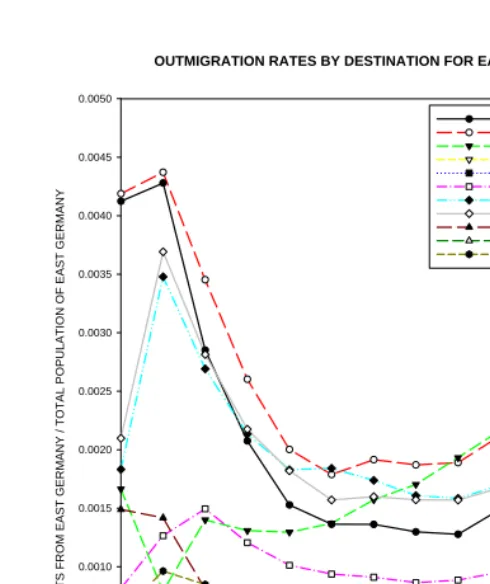
During the summer of 1989, a reduction in patrol at the Hungarian border enabled East German tourists enter West Germany via Austria. Mounting pressures from the East Ger-man public for political and economic reform led to the fall of the Berlin Wall in Novem-ber, which made migration from East to West Germany (and beyond) possible. Table 1 displays the distribution of migrants from East Germany (excluding East Berlin) across the West German Länder and the total number of East-West migrants between 1989 and 2002. To account for the differences in population size, [Note 5] Figure 2 shows the cor-responding outmigration rates. [Note 6] Between 1989 and 1990, almost 600,000 East Germans, roughly3.7% of the population in the region of the former GDR (excl. East Berlin), emigrated to West Germany (incl. West Berlin). [Note 7]
The fear of missing this unexpected window of opportunity to leave the GDR — likely the dominant motive of East-West migration in 1989 — faded in March 1990 by the outcome of the first free national election held in the GDR. The election strengthened the influence of the reformist parties and negotiations towards closer cooperations with West German officials began. This outcome coincided with a decline in the outmigration rate (cf. Wendt 1993/94, p. 526; Grundmann 1998, p. 176). Soon afterwards, on 1 July 1990, East and West Germany entered a comprehensive monetary, economic, and social union that marked an important step towards unification, thereby further reducing the uncertainty about the possibility of future travel and relocation.
From 1991 until the mid-1990s, the pace of East to West migration cooled off sub-stantially — the annual outmigration rate in 1994 was 1.04%, which is about half its 1990 level. The initial optimism, the speedy wage convergence in the early 1990s that translated into rising living standards for many in the East and fewer job opportunities in the West after 1992, may explain the relatively low outmigration rates during the early to mid-1990s. The average real wage gap between East and West Germany narrowed quickly to about 28% by 1994 (cf. Sinn 2000, Fig. 9), potentially giving East Germans less incentive to leave. Data on wages of manufacturing workers by region presented in Figure 10 illustrate the considerable pace of the wage increases in the East during the early 1990s. [Note 8] In addition, after the reunification-induced boom, the West German economy followed western Europe into a recession that lasted from late 1992 to 1994. As shown in Figure 9, the unemployment rate in the West German provinces dropped in the early 1990s but started to rise at the onset of the recession, which in turn reduced the opportunities for East Germans to move for a job in the West. It appears that these incentives outweighed the reasons to migrate to the West, such as rising unemployment in the East, soon after monetary unification (cf. Akerlof et al. 1991 and Figure 9).
OUTMIGRATION RATES BY DESTINATION FOR EAST GERMANY
YEAR
1989 1990 1991 1992 1993 1994 1995 1996 1997 1998 1999 2000 2001 2002
MIGRANTS FROM EAST GERMANY / TOTAL POPULATION OF EAST GERMANY
0.0000 0.0005 0.0010 0.0015 0.0020 0.0025 0.0030 0.0035 0.0040 0.0045 0.0050 BADEN-WUERTTEMBERG BAYERN BERLIN BREMEN HAMBURG HESSEN NIEDERSACHSEN NORDRHEIN-WESTFALEN RHEINLAND-PFALZ SAARLAND SCHLESWIG-HOLSTEIN
July 1 st, 1990: Monetary Union
October 3 rd, 1990: Reunification
March 18 th, 1990: First Free Elections
1992-1994: Recession in West Germany
Since 1996: The pace of the economic recovery in East Germany has slowed November 9 th,
1989: Fall of the Berlin Wall
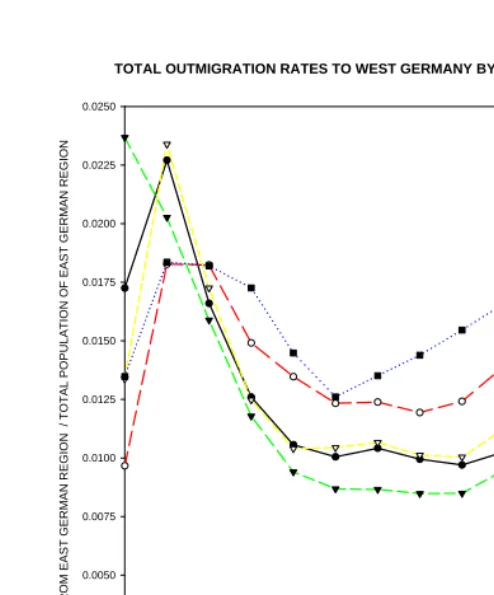
rise. First, wage convergence between East and West Germany has essentially halted since 1995 (cf. Sinn 2000, Fig. 9 and Figure 10). Second, the employment situation in the East stabilized only temporarily during 1994-1995 as shown in Figure 9. Between 1995 and 2002, the average unemployment rate in the East (incl. East Berlin) increased from 14.9% to 18.0% — a level more than twice as high as in the West. [Note 9] Figure 9 shows that 1997 and 1998 were the worst years for labor markets in the East German Län-der, and since then unemployment has remained above the highest levels reached in the 1992-1994 period. Third, and perhaps most importantly, the West German labor markets improved substantially after 1997 (cf. Figure 9).
The deteriorating economic conditions in the East have been attributed to challenges commonly encountered by regions in transition from centralized to market economies (e.g., the initial lack of competitive products) as well as the rapid wage increases in the East that were not justified by rising labor productivity. The East German firms that existed before unification experienced a dramatic labor cost squeeze after the monetary unification of the two Germanys in July 1990 when wages and salaries had to be paid in Deutschmarks (West German currency). [Note 10] In addition, powerful West German unions helped to ’bargain’ for new labor contracts in the East that mandated further large raises. [Note 11] In sum, the second outmigration wave probably resulted from disin-centives to stay in the East, primarily the worsening job prospects there after 1995 and improving employment conditions in the West after 1997.
3. Distribution Across Origin and Destination Region
The first observation is that the u-shaped (’two waves’) relationship of outmigration over time that we found at the aggregate level (Table 1) also holds for most of the source-destination pairs as shown in Figure 2. The exception is the region of the city of Berlin, which has become increasingly important thanks to its expanding role as the political and administrative center of unified Germany. Accordingly, migration into Berlin has steadily increased. [Note 12]
TOTAL OUTMIGRATION RATES TO WEST GERMANY BY REGION OF ORIGIN
YEAR
1989 1990 1991 1992 1993 1994 1995 1996 1997 1998 1999 2000 2001 2002
WEST-MIGRANTS FROM EAST GERMAN REGION / TOTAL POPULATION OF EAST GERMAN REGION
0.0000 0.0025 0.0050 0.0075 0.0100 0.0125 0.0150 0.0175 0.0200 0.0225 0.0250
THUERINGEN
MECKLENBURG-VORPOMMERN SACHSEN
SACHSEN-ANHALT BRANDENBURG
July 1 st, 1990: Monetary Union
October 3 rd, 1990: Reunification
March 18 th, 1990: First Free Elections
1992-1994: Recession in West Germany
Since 1996: The pace of the economic recovery in East Germany has slowed November 9 th,
1989: Fall of the Berlin Wall
OUTMIGRATION RATES BY DESTINATION FOR THUERINGEN
YEAR
1989 1990 1991 1992 1993 1994 1995 1996 1997 1998 1999 2000 2001 2002
NUMBER OF MIGRANTS FROM THUERINGEN / POPULATION OF THUERINGEN
0.000 0.001 0.002 0.003 0.004 0.005 0.006 0.007 0.008 0.009 0.010
BADEN-WUERTTEMBERG BAYERN
BERLIN BREMEN HAMBURG HESSEN NIEDERSACHSEN NORDRHEIN-WESTFALEN RHEINLAND-PFALZ SAARLAND SCHLESWIG-HOLSTEIN
OUTMIGRATION RATES BY DESTINATION FOR MECKLENBURG-VORPOMMERN
YEAR
1989 1990 1991 1992 1993 1994 1995 1996 1997 1998 1999 2000 2001 2002
NUMBER OF MIGRANTS FROM MECKLENBURG / POPULATION OF MECKLENBURG 0.000 0.001 0.002 0.003 0.004 0.005 0.006 0.007 0.008 0.009 0.010
BADEN-WUERTTEMBERG BAYERN
BERLIN BREMEN HAMBURG HESSEN NIEDERSACHSEN NORDRHEIN-WESTFALEN RHEINLAND-PFALZ SAARLAND SCHLESWIG-HOLSTEIN
OUTMIGRATION RATES BY DESTINATION FOR SACHSEN
YEAR
1989 1990 1991 1992 1993 1994 1995 1996 1997 1998 1999 2000 2001 2002
NUMBER OF MIGRANTS FROM SACHSEN / POPULATION OF SACHSEN
0.000 0.001 0.002 0.003 0.004 0.005 0.006 0.007 0.008 0.009 0.010
BADEN-WUERTTEMBERG BAYERN
BERLIN BREMEN HAMBURG HESSEN NIEDERSACHSEN NORDRHEIN-WESTFALEN RHEINLAND-PFALZ SAARLAND SCHLESWIG-HOLSTEIN
OUTMIGRATION RATES BY DESTINATION FOR SACHSEN-ANHALT
YEAR
1989 1990 1991 1992 1993 1994 1995 1996 1997 1998 1999 2000 2001 2002
NUMBER OF MIGRANTS FROM SACHSEN ANHALT / POPULATION OF SACHSEN ANHALT
0.000 0.001 0.002 0.003 0.004 0.005 0.006 0.007 0.008 0.009 0.010
BADEN-WUERTTEMBERG BAYERN
BERLIN BREMEN HAMBURG HESSEN NIEDERSACHSEN NORDRHEIN-WESTFALEN RHEINLAND-PFALZ SAARLAND SCHLESWIG-HOLSTEIN
OUTMIGRATION RATES BY DESTINATION FOR BRANDENBURG
YEAR
1989 1990 1991 1992 1993 1994 1995 1996 1997 1998 1999 2000 2001 2002
NUMBER OF MIGRANTS FROM BRANDENBURG / POPULATION OF BRANDENBURG 0.000 0.001 0.002 0.003 0.004 0.005 0.006 0.007 0.008 0.009 0.010
BADEN-WUERTTEMBERG BAYERN
BERLIN BREMEN HAMBURG HESSEN NIEDERSACHSEN NORDRHEIN-WESTFALEN RHEINLAND-PFALZ SAARLAND SCHLESWIG-HOLSTEIN
Other interesting differences between the regions in the East with regard to the overall likelihood of departing to the West exist. Like Brandenburg, Mecklenburg-Vorpommern also initially displayed a lower outmigration rate than the other three regions in the East, but outmigration has been higher there than in those regions since 1991. The slow start of Mecklenburg-Vorpommern may have resulted from its remote location (cf. Figure 1; Grundmann 1998). The strong outmigration in recent years may be caused by a persis-tently weak job market. As Figure 9 shows, Mecklenburg-Vorpommern is the region with the second highest unemployment rate (after Sachsen-Anhalt). We also note that Thürin-gen experiences a relatively slow pace of outmigration — especially given its proximity to the West — while it also enjoys the lowest unemployment rates of all regions in the East (cf. Figure 9).
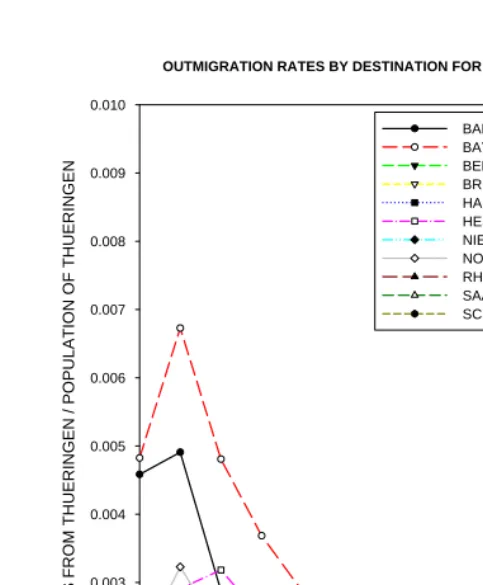
The level of the outmigration rates experienced by the western regions remains fairly stable over time for all departure regions (cf. Figures 2,4-8). This suggests that the rel-ative attractiveness of the West German Länder is changing little over the period under study. The only strong ’outliers’ in addition to Berlin (most visible for Brandenburg as shown in Figure 8) are the outmigration rates from Thüringen to Hessen during 1989 and 1990 where the rates are below those of Baden-Württemberg and Nordrhein-Westfalen (cf. Figure 4), and from Mecklenburg-Vorpommern to Hamburg which receives more migrants over time (cf. Figure 5). Looking at potential determinants of the migration dis-tribution by region, we note that unemployment rates and wages by region — as shown in Figures 9 and Figure 10 — display a similarly stable ordering over time that is consistent with the outmigration distribution pattern.
The outmigration distributions suggest that proximity to the destination region is pos-itively associated with migration to that destination. For example, Bayern and Baden-Württemberg are similar in terms of their respective population sizes and economic condi-tions. However, Bayern is further east than Baden-Württemberg and hence lies somewhat closer to Thüringen. Indeed, the outmigration rates from Thüringen to Bayern are greater than to Baden-Württemberg (on average at least0.1% as shown in Figure 3).
Nieder-UNEMPLOYMENT RATE IN GERMANY BY REGION
YEAR
1989 1990 1991 1992 1993 1994 1995 1996 1997 1998 1999 2000 2001 2002
UNEMPLOYMENT RATE (%)
2.5 5.0 7.5 10.0 12.5 15.0 17.5 20.0 22.5 25.0 27.5
BADEN-WUERTTEMBERG BAYERN
BERLIN BREMEN HAMBURG HESSEN NIEDERSACHSEN NORDRHEIN-WESTFALEN RHEINLAND-PFALZ SAARLAND SCHLESWIG-HOLSTEIN THUERINGEN
MECKLENBURG-VORPOMMERN SACHSEN
SACHSEN-ANHALT BRANDENBURG
Figure 9: Trends in Unemployment Rates by Region (Source: Statistisches Bundesamt,
WEEKLY GROSS NOMINAL MANUFACTURING WAGES IN GERMANY BY REGION
YEAR
1989 1990 1991 1992 1993 1994 1995 1996 1997 1998 1999 2000 2001 2002
WEEKLY WAGE (DEUTSCHMARKS)
400 450 500 550 600 650 700 750 800 850 900 950 1000 1050 1100 1150 1200 1250 BADEN-WUERTTEMBERG BAYERN BERLIN BREMEN HAMBURG HESSEN NIEDERSACHSEN NORDRHEIN-WESTFALEN RHEINLAND-PFALZ SAARLAND SCHLESWIG-HOLSTEIN THUERINGEN MECKLENBURG-VORPOMMERN SACHSEN SACHSEN-ANHALT BRANDENBURG
Figure 10: Trends in Wages by Region (Source: Statistisches Bundesamt, Statistisches
significant share of the migrants. A larger population size will typically be associated with a larger labor force and hence more job opportunities. In the case of the city regions, other factors such as location, the amenities of urban living, and high pay (cf. Figure 10) likely play an important role as well.
Finally, the relative employment conditions may also explain how migrants are dis-tributed across regions. The Bundesländer with the lowest unemployment rates, Bayern and Baden-Württemberg (cf. Figure 9), receive considerable flows of migrants even from more distant regions. For example, the outmigration rate from Mecklenburg-Vorpommern to those regions is greater than to Hessen which lies somewhat closer but has experienced higher unemployment. Also, Baden-Württemberg and Bayern were initially much more attractive destinations to potential migrants from Thüringen and Sachsen than, for exam-ple, Nordrhein-Westfalen, even though the latter has a much larger population and is only slightly further from these regions. However, the relatively large manufacturing sector in Bayern and in particular in Baden-Württemberg also leads to more dramatic changes in employment opportunity over the business cycle. This may explain that migration into these regions exhibits the largest swings. When the Reunification-induced boom for the Western manufacturing industry ended in late 1992, job prospects in the two southern provinces quickly worsened and Nordrhein-Westfalen became a more popular destination than Baden-Württemberg. However, migration into the latter took off much faster as soon as labor market conditions improved (cf. Figure 9).
4. Concluding Remarks
The primary focus of this article was to assemble a data set that provides researchers and policy makers with a more complete picture of the development of East to West migration by region before and after German unification.
5. Acknowledgements
Notes
1. Regional data on mobility in Germany is also provided by the the Federal Office for Building and Regional Planning as used in Maretzke and Möller 1993 and Maretzke 1998.
2. A related literature exists that relies on survey data (Hunt 2000; Alecke and Untiedt 1999; Burda 1993; Burda et al. 1998; Pischke et al. 1994; Schwarze 1996; Wagner 1998; Brückner and Trübswetter 2004).
3. See Dorbritz and Speigner 1991, Wendt 1993/94, and Grundmann 1998 for helpful dis-cussions of immigration and emigration in East Germany before 1989.
4. Comparing the outmigration distributions found in the ZER data to those from the SB data for 1991 — the period that is available in both data sets — we found that the distributions across the west German Länder are broadly consistent. The ZER data report somewhat lower levels of total East-West migration than the SB as noted previously by Grundmann 1998, p. 170 (footnote 32).
5. Mecklenburg-Vorpommern has the smallest population with 1.8 Million whereas Sach-sen is the largest province with a population of 4.4 Million in 2002 (cf. Statistisches Bundesamt: Statistisches Jahrbuch 2003, p. 59).
6. The (gross) outmigration rate is defined for some source regionsand some destination regiondas the ratio of the total number of migrants fromswho enterdduring that period over the population size ofs. In our computation of the outmigration rate we use the size of the residence population at the beginning of the calender year in the region of interest based on ZER and SB data. The outmigration rate can be interpreted as the probability that a person migrates fromstodwithin a given period.
7. East-West migration affected Germany and other Western European countries more broadly after the dissolution of socialism in Eastern Europe. For example, in 1992 Germany re-ceived 1.5 million new immigrants (a net inflow of 800,000) including more than 400,000 new asylum seekers and ethnic German refugees (cf. Zimmermann 1995, p. 47).
German currency for wages and prices which implied an estimated 350% appreciation of the East Mark (see e.g., Akerlof et al. 1991 and Franz and Steiner 1999).
11. In Germany wages are set periodically in a bargaining procedure that takes place on a regional level. The resulting agreements usually cover the majority of employees and workers in that region. In the wage bargaining process in East Germany during the Re-unification the representatives of the employer side had no incentive to keep wages low which explains the extreme wage increases (see e.g., Franz 1992).
References
Akerlof, G. A., Rose, A. K., Yellen, J. L., and H. Hessenius (1991), ”East Germany in from the Cold: The Economic Aftermath of Currency Union,” Brookings Papers on
Economic Activity, 1, 1-87.
Alecke, B. , and G. Untiedt (1999), ”Determinanten der Binnenwanderung in Deutsch-land seit der Wiedervereinigung - Eine makroökonometrische Analyse mit Panel-daten für die Bundesländer und den Zeitraum 1991 bis 1997,” University of Münster, Volkswirtschaftliche Diskussionsbeiträge Nr. 309.
Brückner, H., and P. Trübswetter (2004), ”Do the Best Go West? An Analysis of the Self-Selection of Employed East-West Migrants in Germany,” IZA Discussion Paper Series, Discussion Paper No. 986.
Bundesanstalt für Arbeit, Arbeitsmarkt 2002, Amtliche Nachrichten der Bundesanstalt für Arbeit, 51, Sondernummer Nürnberg 18. Juni 2003
(www.pub.arbeitsamt.de/hst/services/statistik/000100/html/jahr/index.shtml).
Burda, M. C. (2000), ”East-West German Wage Convergence after Unification: Migra-tion or InstituMigra-tions?” Paper presented at the Murphy Institute Conference on The Political Economy of Migration, Tulane University, March 2000.
Burda, M. C. (1993), ”The determinants of East-West German Migration – Some First Results,” European Economic Review, 37, 452-461.
Burda, M. C., Härdle, W., Müller, M., and A. Werwatz (1998), ”Semiparametric Analysis of German East-West Migration Intentions: Facts and Theory,” Journal of Applied
Econometrics, 13, 525-541.
Dorbritz, J., and W. Speigner (1991), ”Die Deutsche Demokratische Republik - ein Ein-und Auswanderungsland?” Zeitschrift für Bevölkerungswissenschaft, 16(1), 67-85.
Franz, W. (1992), ”Im Jahr danach - Bestandsaufnahmen und Analyse der Arbeitsmark-tentwicklung in Ostdeutschland,” in Von der Plan- zur Marktwirtschaft, edited by B. Gahlen, H. Hesse, and H. J. Ramser, Tübingen: Mohr-Siebeck, 245-274.
Franz, W., and V. Steiner (1999), ”Wages in the East German Transition Process - Facts and Explanations,” Centre for European Economic Research Paper.
nomic Research Working Paper No. 7564.
Maretzke, S., and F.-O. Möller (1993), ”Wanderungsverflechtungen zwischen den neuen und alten Bundesländern im Jahre 1991,” Geographische Rundschau, 45(3), 191-195.
Maretzke, S. (1998), ”Regionale Wanderungsprozesse in Deutschland sechs Jahre nach der Vereinigung,” in: Informationen zur Raumentwicklung 11/12, 743-762.
Parikh, A., and M. van Leuvensteijn (2002), ”Internal Migration in Regions of Germany: A Panel Data Analysis”, European Network of Economic Policy Research Institute, Economics Working Paper 2002-12.
Schwarze, J. (1996), ”Beeinflußt das Lohngefälle zwischen Ost- und Westdeutschland das Migrationsverhalten der Ostdeutschen?” Allgemeines Statistisches Archiv, 80, 50-68.
Sinn, H.-W. (2000), ”Germany’s Economic Unification: An Assessment After Ten Years,” National Bureau Of Economic Research Working Paper No. 7586.
Statistisches Bundesamt, Statistisches Jahrbuch der Bundesrepublik Deutschland, 1993-2003. Stuttgart: Kohlhammer.
Wagner, G. (1998), ”Migration Before and After Unification: Empirical Evidence and Policy Implications for Germany,” in: Policy Priorities for the Unified Korean Economy, edited by Il SaKong and Kwang Suk Kim, Seoul: Institute for Global Economics.
Wendt, H. (1993/94), ”Wanderungen nach und innerhalb von Deutschland unter beson-derer Berücksichtigung der Ost-West Wanderungen,” Zeitschrift für
Bevölkerungs-wissenschaft, 19(4), 517-540.