Iranian journal of educational Sociology
(Interdisciplinary Journal of Education) Available online at: http://www.iase-idje.ir/
Volume 1, Number 4, August 2017
The Effectiveness of Philosophy Education Program for children on Critical
Thinking and its Components in female Students
Mohammad Abbasi1, Zabih Pirani2*, Mohammad Reza Sarmadi3,Davoud Taghvaee4
1. Ph.D. student, Department of Educational Sciences, Arak Branch, Islamic Azad University, Arak, Iran 2. Associate Professor, Department of Psychology, Arak Branch, Islamic Azad University, Arak, Iran 3. Professor, Department of Educational Sciences, Payam Noor University, PO BOX 19395-3697 Tehran, IRAN 4. Associate Professor, Department of Psychology, Arak Branch, Islamic Azad University, Arak, Iran
Article history:
Received date: 19 April , 2017 Review date: 26 may 2017 Accepted date:20 June 2017 Printed on line: 2 August 2017
Abstract
Purpose: The purpose of the present research is to review the effectiveness of philosophy education program for children on critical thinking and its components in elementary fourth-grader girl students. Material and method: This was a semi-experimental study with designing pretest and posttest and the control group with following-up phase. Findings: This statistical population consists of elementary fourth-grader girl students in Arak, district 2. The sample of this research consists of 50 students that were selected by convenience sampling method and divided to two control and test groups. Shabani (1999) critical thinking questionnaire was used for data collection. Discussion: The results of covariance analysis showed that execution of the philosophy education program for children improves critical thinking, recognition ability, analogizing, and judgments in children (P<0.05). Furthermore, the effectiveness of philosophy education program for children was durable in fallowing-up test.
Keywords:
philosophy education to children,
critical thinking, female students
Please cite this article as: Abbasi,M1, Pirani,Z ,Sarmadi ,M.R , Taghvaee, D (2017). The Effectiveness of Philosophy Education Program for children on Critical Thinking and its Components in Girl Students. Iranian journal of educational sociology, 1(4), 96-103
* Corresponding Author Address: Email: [email protected] Department of Psychology, Arak Branch, Islamic Azad University, Arak, Iran
1. Introduction
Philosophy education for children has been mentioned by many education systems today. The aim of this education is making bed for progress and reinforcement of children intellectual skills and behavioral performance. These intellectual skills include cognition, analogizing, and judgment (Naji, 2007). Philosophy education for children has been experienced based on theoretical bases of “community of inquiry” in many education systems. Olson and Kegan (2007) wrote in determination of this theory: education based on community of inquiry has a collaborative learning approach in which student groups undertake the responsibility of learning themselves, and teacher has a guiding role (Richards and Rodgers, 2001). “Other authorities interpreted community of inquiry as rationality. This perception shows intention in which people respect to others and are ready to mention their ideas and emotions until not let their ideas be changed by others.” (Pask, 2015, p: 34) Philosophy education has been proposed to children as a necessity and need as a meta-cognitive approach in education.
2. Literature review
“Lipman, the critical thinking theorist, believes that critical thinking education to children makes the condition of experiencing creative and exploratory thinking and achieving cognition skill.” (Lipman, 1995, translated by Naji, 2004, p: 52) “It is to be noticed that curriculum content of philosophy for children transfers knowledge in social sciences, biological sciences, environmental, and ethical fields.” (Ghaedi, 2009, p: 42)
“Principally, children like to express their thought to others, find attachment to others, or be accepted in doing each responsibilities.” (Lipman, 1995, translated by Naji, p: 33) “These skills must be exercised in philosophy education classes for children and use discourse, negotiation, brainstorming, criticism, and argument for learners to find perceptual skills and logical Judgments.” (Eskandari, 2007, p: 27)
Children and teenagers face with behavioral problems both for problems of adolescence period and confrontation with social harms. (Pirani, 2013) “Lack of efficient skill in proper decisions selection leads to failures and problem occurrence for this social class.” (Yari, 2015, P: 63) “This matter has led to authorities of philosophy education program systems to children as an effective approach in this operational field.” (Yakhchalian, 2015, p: 67) Some believe that if youth could have abilities of reasoning, cognition, analogizing, and judgment about their surrounding events, they will be successful in decision making improvement, purpose setting in life, and success in various fields. Various studies have been conducted about the positive effects of philosophy education for children. Dilekli (2016) stated in this research that teacher educational style classes, which were programmed based on critical thinking skills, improve self-efficiency in cognition, analogizing, reasoning, and judgment. Emonoal (2016) reported in their experimental results that students in test group that participated on inquiry group were prior to their partners in discourage, participation in team work, and logical judgment.
Golerstein (2016) reported in their surveying that philosophy program reinforces critical thinking skills of participants. Students in test groups have learnt reasoning, analogizing, and judgment in generalized form of these skills. Pudinehmoghadam (2015) concluded in his research that philosophy program for children made students of test group in posttest have higher deductive reasoning, recognition of reality, judgment than students of control group. Toghian Chaharsoghi (2014) and Moradimokhles (2014) emphasized on critical thinking and its applications being acquired in life in all their research.
These findings show that philosophy program is essential for children and teenagers, and the institutionalized and reinforced skills from this skill in learners make them successful in other fields. Therefore, it is mentioned as a meta-cognition concept in education system. It is to be noticed that there is rare chance of philosophy education program for children. In spite of this important point and regarding to many changes that have been made in curriculum, there is still this lost chain, while critical thinking skills has been known as one of the necessities of the current world and globalization. This requirement makes execution of this study in the agenda. Researcher in this research seeks to test this hypothesis whether philosophy program influences on critical thinking and its elements on children?
3. Methodology
This research is semi-experimental with pretest and posttest design with the control group and 30-day following-up phase. Covariance analysis was used to analyze data. The studied population includes the elementary fourth-grader girl student’s girl students of Arak city, district 2, in 2016-2017 education year. The sample of this research includes of 50 students that were selected by convenience method and randomly replaced in two test and control groups. Sample volume was conducted by impact factor table by convenience method and 25 ones were considered for test group and the same for control group with totally 50 members by considering α=0.05 and 97% test power.
Pre-test of critical thinking was conducted to homogenize in test and control group, and the analogizing between test means and lack of significant different among them shows their consistency. The tools used in this research include: Educational package of philosophy program for children: this educational package was translated and used by Pirani, Banijamali, and Rahmani (2013) that was written by Gatt and Gatt in 2012. The content of this plan was executed in 12 weeks, and a basic conception of philosophy for children was mentioned in each session. A story was told and proper activities to it were executed in loop of community of inquiry. Critical thinking, reading skill, social skills, learning, and group activities are some of teachable skills in students’ community of inquiry.
Some issues such as justice, environment, seeking reality, ethics, aesthetics, and emotion control were proposed during the execution time of philosophy for children as a story. Critical thinking assessment scale: This scale was designed by Shabani (1999) to assess critical thinking skills of children. The content of this scale was made by 21 questions. Since the responders to this scale are children, its content has been adapted by knowledge of elementary school children. Assessment scales include: cognition, judgement, and analogizing. 6, 1, and 4 questions were considered for each scale, respectively. These questions had quantitative and score value. The score of each structure in this scale is 11 scores. Therefore, total scores are 32; as though, it is reported in the instruction of the scale. Its validity was confirmed by asking experts ideas and taking their modifying ideas, and its reliability was confirmed by re-test and calculation Cronbach’s alpha coefficient and obtaining 0.88 coefficient.
4. Findings
After organization children in two test and control groups, philosophy program was proposed in fictional content and the technic of students’ community of inquiry as one story is told in each session and group discourse, brainstorming, sharing ideas, reasoning, analogizing classmate’s ideas, and judgment approaches about the discussed clues were functionalized, and participants actively took part in discussions and judgment that are emphasized in critical thinking. Results of two groups were compared, and posttest was executed to follow up the durability of the effect of philosophy education program on children after 30 days.
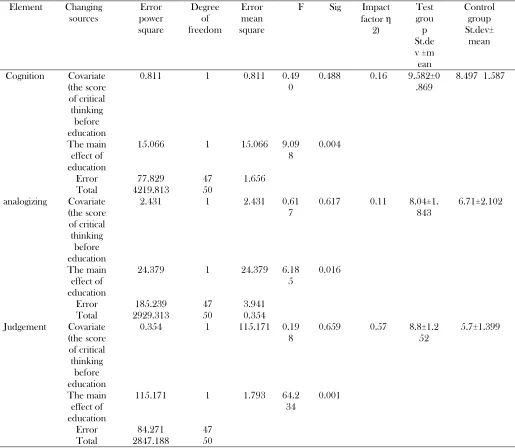
Table (1). covariance analysis to study the effect of philosophy education program for children in critical thinking elements
Element Changing sources Error power square Degree of freedom Error mean square
F Sig Impact factor η
2) Test grou p St.de v ±m ean Control group St.dev± mean
Cognition Covariate (the score of critical thinking
before education
0.811 1 0.811 0.49
0
0.488 0.16 9.582±0 .869
8.497 1.587
The main effect of education
15.066 1 15.066 9.09 8
0.004
Error 77.829 47 1.656
Total 4219.813 50 analogizing Covariate
(the score of critical thinking
before education
2.431 1 2.431 0.61
7
0.617 0.11 8.04±1. 843
6.71±2.102
The main effect of education
24.379 1 24.379 6.18 5
0.016
Error 185.239 47 3.941
Total 2929.313 50 0.354 Judgement Covariate
(the score of critical thinking
before education
0.354 1 115.171 0.19 8
0.659 0.57 8.8±1.2 52
5.7±1.399
The main effect of education
115.171 1 1.793 64.2 34
0.001
Error 84.271 47
Total 2847.188 50
Critical thinking
Covariate (the score of critical thinking
before education
6.891 1 6.891 0.49
9
0.483 0.36 26.46±3 .241
21.1±4.09
The main effect of education
370.197 1 370.197 26.8 19
0.001
Error 648.754 47 13.803
Total 29194.438 50
F-Levin test showed that sig=0.331>0.05 and F= (1, 48) =0.965. Therefore, the consistency assumption of regression slope is confirmed for the dependent variable of critical thinking. It is observed in table (1) that the mean scores of posttest for cognition is 9.582 in test group and 8.497 in control group. Results of covariance analysis show that the calculated F (F=9.098) is significant with degree of freedom (FD=1.47) in P<0.05 sig. level. The impact factor for cognition is 0.16 showing a strong impact. Thus, it can be claimed that execution of philosophy program for children increases cognition element score in children. Dilekli (2016) reported that philosophy education program for children didn’t influence on cognition skill of participants. This finding is also reported in research of Emonoal (2016), Pudineh moghadam (2015), and Moradimokhles (2014). Therefore, this finding is along with the related background.
-The mean score of posttest was 8.04 for test group and 6.71 in control group for analogizing skill. Results of covariance analysis show that the calculated F is 6.185 with DF=1.47 in P<0.05 sig. level. The impact factor of analogizing is 0.11 showing a strong effect. Therefore, it can be claimed that execution of philosophy education program for children increases analogizing score in children. Results of Golerstein research (2016) was along with it in which deepening analogizing power in students was obtained by critical thinking education. In research of Emonoal (2016), the advantages of critical thinking performance were reported as deepening analogizing skill. Moradimokhles (2014) and Bashir Banaem (2013) reported one of critical thinking educations in deepening analogizing skill in students. Therefore, it is observed that a philosophy education program for children that reinforces their critical thinking is one of the acquiring skills of students in analogizing. Thus, this finding is along with findings of the related literatures finings.
- The mean score of posttest was 8.8 for test group and 5.7 in control group for judgement. Results of covariance analysis show that the calculated F is 64.2345 with DF=1.47 in P<0.05 sig. level. The impact factor of analogizing is 0.57 showing a strong effect. Therefore, it can be claimed that execution of philosophy education program for children increases judgement score in children. Emonoal (2016) reported in his empirical research that educations to reinforce critical thinking skill express the judgment skill in learners. Emonoal (2016) wrote that elementary school students who participate in community of inquiry found judgement skill. This finding was also reported in Golerstein (2016) research. Moradimokhles (2014) and Fathi Vajargah (2010) found in their findings that judgment skill was obtained by education based on community of inquiry. Therefore, this finding is along with the finding of the related literature.
- Total mean score for posttest of critical thinking in test group was 26.46 and in control group was 21.1. Results of covariance analysis showed that the calculated F is 26.819 with DF=1.47 that is significant in P<0.05 sig. level. The impact factor of critical thinking is 0.36 showing a strong effect. Therefore, it can be claimed that execution of the philosophy education program for children increases score of critical thinking. Dilekli (2016) and Toghian chaharsoghi (2014) reported in this field that philosophy education program increases critical thinking of participants. This finding is
along with the findings of Emonoal (2016), Pudinehmoghadam (2015), and Moradimokhles (2014). Thus, this finding is in agreement with findings of the related literature.
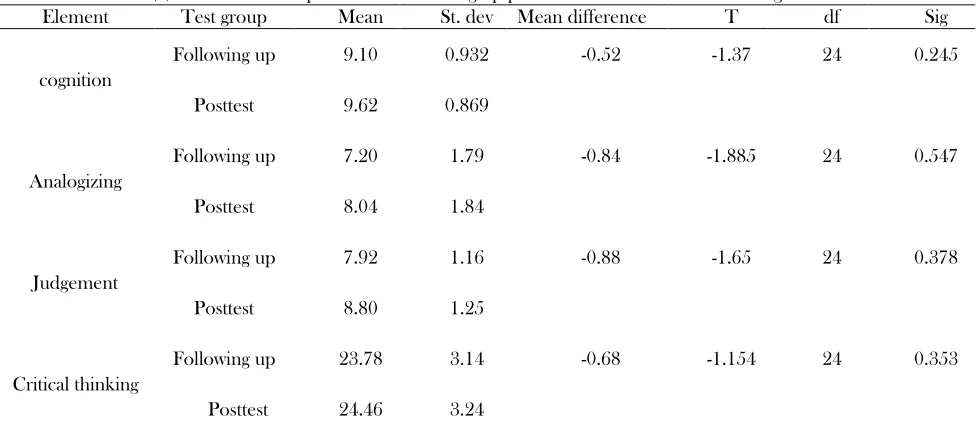
Table (2) - Paired t-test of posttest and following up phase scores about critical thinking element N=25
Element Test group Mean St. dev Mean difference T df Sig
cognition
Following up 9.10 0.932 -0.52 -1.37 24 0.245
Posttest 9.62 0.869
Analogizing
Following up 7.20 1.79 -0.84 -1.885 24 0.547
Posttest 8.04 1.84
Judgement
Following up 7.92 1.16 -0.88 -1.65 24 0.378
Posttest 8.80 1.25
Critical thinking
Following up 23.78 3.14 -0.68 -1.154 24 0.353
Posttest 24.46 3.24
Paired t-test was used in order to study the effect durability of the philosophy education program for students. The mean cognition element was 9.10 and 9.62 in following up phase and posttest, respectively. Therefore, there isn’t significant difference between posttest and following up scores. Therefore, the effect of philosophy education program for children in cognition elements was durable the same as posttest phase. The mean of cognition element was 7.20 and 8.04 in following up and posttest phase, respectively. Based on testing, sig=0.547>0.05 and t= -1.885. Thus, there is not significant difference between posttest and following up scores in analogizing element. Thus, the effect of philosophy education program for children in analogizing elements was durable the same as posttest phase. The mean judgment element was 7.92 and 8.80 in following up phase and posttest, respectively. Based on test, sig= 0.378> 0.05 and t=-1.165. Therefore, there isn’t significant difference between posttest and following up scores about judgment element. Thus, the effect of philosophy education program for children in judgment element was durable the same as posttest phase.
The mean score of critical thinking element was 23.782 and 24.46 in following up phase and posttest, respectively. Based on test, sig= 0.353> 0.05 and t=-1.154. Therefore, there isn’t significant difference between posttest and following up scores about critical thinking element. Thus, the effect of philosophy education program for children in critical thinking was durable the same as posttest phase.
Golerstein (2016) and Emonoal (2016) reported similar results about the durability of critical thinking skills in execution philosophy education program on children. Moradimokhles (2014), Fathi Vajargah (2010), and Pudinehmoghadam (2015) showed that learning level of students was similar in posttest phase and without any significant difference. Consequently, the learnt skills are protected. Therefore, findings of this research are in agreement with the learnt critical thinking skills of students in both posttest and following up phase.
5. Discussion
It was observed in this research that philosophy education program has a positive effect on promotion of the cognition skill of elementary fourth-grader girl students. The theories about this case are based on this fact that student motivated for sharing ideas in community of inquiry, are encouraged to criticize other ideas, and reach to the cognition degree when they compare others ideas in this process. In other words, they get closer to cognition of reality. This finding is in agreement with the finding of Dilekli (2016) with similar experience. Emonoal (2016) also reported such an effect. Pudinehmoghadam (2015) confirmed the mentioned effectiveness on the elementary school students.
Other findings of the present research were that students’ participation in a philosophy education program reinforced their analogizing skill. When students face with varieties of their classmate’s ideas, they spontaneously compared them and thought about their accuracy and honesty. This exercise reinforced the analogizing skill during the program. The studies in this field confirmed this effectiveness. Moradimokhles (2014) also reported in his research that learners with permanent participation in logical reasoning would later find the analogizing power, because analogizing the others ideas are repeatedly exercised. Bashir Banaem (2013) wrote: role of critical thinking in learners is their logical assessment, and they have to compare them to interpret other ideas. This analogizing institutionalizes this skill in various fields. Emonoal (2016) and Glorestine (2016) also talked about confirmation off this finding.
It was observed in this research that the execution of the philosophy education program for children helped them achieve judgment skill, based on the community of inquiry approach in class conducted by the teacher, when group member face with a subject they brainstorm and share idea and discuss about the cognition of the reality and use the teacher guidance. The durability of such a logical discussion helps them find the answer and accurate reality, and finally they achieve reasons and evidences for reality. The accurate from inaccurate events cognition needs a kind of judgment, that if it is based on events with enough evidences, its judgment will be accepted. When students repeat such as community of inquiry, they reach accurate judgment. Studies in this field show that the execution of the philosophy education program for children can approach them to this skill as they show judgment skill. This effectiveness was reported in studies of Dilekli (2016), Golerstein (2016), Hejazi (2011), Pudinehmoghadam (2015), and Moradimokhles (2015).
It was observed in this research that the execution of philosophy education program for children was effective on their cognition skill. It is suggested to the heads of elementary schools to include this program in the school curriculum with fictional nature to promote their cognition skill in critical thinking field besides responding to some of their behavioral needs. It is to be noticed that critical thinking is one of the essential skills collection for each citizen in the global system. One evidence of this research was that the execution of philosophy education program promotes analogizing skill in students. Therefore, it is suggested to teachers to provide opportunities in their classes for students’ brainstorming and criticizing others ideas on a common issue to make analogizing other ideas possible for students. This exercise reinforces the analogizing skill in students in long-term. It was observed in this research that the execution of philosophy education program made students obtain the judgment skill. Therefore, it is suggested to teachers in this field to provide opportunities in their classes for students to judge the pre-determined and specific issue. This exercise makes students judge and bring evidences for judgment and not to judge without efficient documents. This exercise institutionalizes an accurate judgment in learners.
References
Dilekli.y.(2016). the relationship a many teacher’s classroom practices for teaching thinking skills teacher self-efficacy towards teaching thinking skills and teacher’s styles by edogan tezcicenter.
Emonoal ,c.s.(2016).Howmight language affect critical thinking performance in Elementary schools.Axford university. Eskandari H. (2007). The Effect of Story on Increasing the Skills of Students Philosophy and Questioning. Quarterly
curriculum studies. (7). 36-1.
Fathi Vajargah K., Alaei Gh. (2010). World Citizenship Education. Effective School Research Journal. (8) .32-27. Gatt, Brace, Gatt, Morag. (2012). Philosophy for young children (practical guidance). Translated by Z. Pirani. Sh.
Banijamali, and A., Rahmani, 2013, Arak, publication of Islamic Azad University.
GATT, Brace, GATT, Mvrag. (2012). Philosophy for young children (Practical Guide). Translation sacrificed zabih Pirani, shoko al Sadat of Bani Jamali, Ali Rahmani (1392). Arak Islamic Azad University Press.
Ghaedi Y., 2009, Philosophy curriculum for children in secondary and high schools. Quarterly of culture, special philosophy for Cook and Teens. (1) .108-83.
-Golerstein, Damian. (2016). The importance of critical thinking in education is underpinned by decades of theoretical and practical work. Differences have been demonstrated between students who receive education in this area from. Hejazi E., Mousavi S.A., Borjali S. (2011). validation, accreditation, and factor analysis of the inventories. California
critical thinking at Iranian teenagers. Journal of Psychology (57). 23-39
Naji S. (2007). Talking to Professor Margaret Sharp, Professor at the University of Montclair, New Jersey, USA, translated by M, Safaei, S. Mirzaei, moon of cook and teen book, 12-19 (89).
Olson, christa.(2007).At Home in the world :Bridging the Gap Between Internationalization and Multicultural Education. Washington DC:American council on Education.
Pasek J. (2015). Schools as incubators of democratic participation. Building long-geopolitical Efficacy with civic education.perrs.WDC.
Pieani Z., 2013, the effectiveness of the philosophy education program for children on emotional self-esteem, ethical judgment, and life satisfaction of primary school boy students. Ph.D. Thesis. Tehran: Islamic Azad University, Science and Research Branch.
Pudinehmoghadam M. (2015). The Effect of Evidence Based Education on students' critical thinking, Journal of Nursing Education. (12). 9-17.
Richards, J.C.&Rodfers.T.(2001). Approaches and methods in Language Teaching U.K.: Cambridge university press. Toghian Chaharsoghi N., Irajpout A., 2014, obstacles against Critical Thinking Skills in Nurses. Journal of Medical
Education Development. (15). 86-93.
Yakhchalian F. (2015). the philosophical thinking of children from the perspective of Matthew Lipman. Ahwaz: Ahwaz Medical Science and Technology Publishing House.
Yari Dehnavi, M. (2015). an introduction to philosophy program for children. Tehran: Institute of Humanities and Cultural Studies.