Correspondence:
Andrea De Giacomo, U.O. Neuropsichiatria Infantile, piazza Giulio Cesare 11, 70100 Bari, Italy • Tel. 080 5592829 • E-mail: [email protected]
Diagnostic stability and early developmental trajectory
of pervasive developmental disorder using
the Autism Diagnostic Interview-Revised
Evoluzione comportamentale nel corso del primo sviluppo del disturbo pervasivo
dello sviluppo utilizzando l’Intervista Diagnostica dell’Autismo-Revisionata
Summary
Objective
A sample of 36 children with pervasive developmental disorder (PPD) was evaluated using the Autism Diagnos-tic Interview-Revised (ADI-R) to as-sess the natural course of autistic-type symptoms over time.
Methods
The average age at the time of diagno-sis (t1) of this sample was 4 years and 4 months (range 2-8). A follow-up oc-curred after 23.1 months (range from 6 to 84 months) (t2).
Results
All children improved significantly at follow-up, especially in interest,
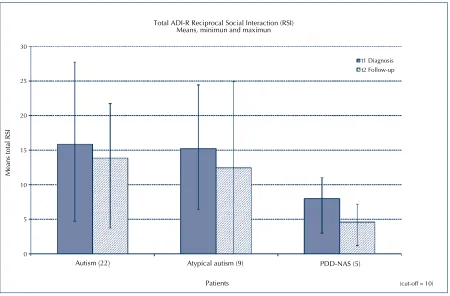
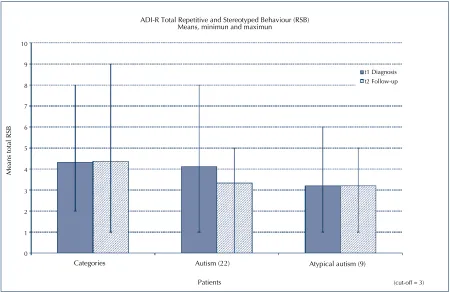
seeking to share own enjoyment with others, use of other’s body to communicate, quality of social over-tures, reciprocal conversation, and social chat. Total Communication, verbal rituals, and repetitive use of objects also improved significantly (Figs. 1, 2).
Discussion
In the three diagnostic categories, we found a clinical improvement at t2, especially in the communication area; however, pathological language per-sisted, but social interaction impair-ments were less prominent. Repeti-tive behaviours showed more stability with time; moreover diagnosis did not change during this approximately 2-year interval.
A. De Giacomo, A.L. Lamanna, E. Lafortezza, P. Lecce, D. Martinelli*, L. Margari
U.O. Neuropsichiatria Infantile, Dipartimento di Scienze
Neurologiche e Psichiatriche; * Sezione di Igiene del DIMO; Università di Bari
Key words
ADI-R • Pervasive development dis-orders • Follow-up
The aim of the present study is to monitor the developmental trajectory of autism spectrum symptomatology with a specific scale for autism (Au-tism Diagnostic Interview-Revised [ADI-R]) in relation to the rarity of the observations in the literature.
Monitoring changes of symptoms overtime is particularly useful for their prognostic and therapeutic implication of individual forms of pervasive developmental disorders (PDD). Nevertheless, there are few follow-ups for the period from 3 to 6 years about the natural history of these disor-ders with structured instruments 1-9.
and mental retardation with stereotyped move-ment and hyperactivity. In the last few years, the number of patients with PDD has increased 10 11. There are many standardized and semi-structured instruments for the diagnosis and the study of de-velopmental trajectories for these disorders in the first years of life. The most frequently used are: 1) ADI-R (Autistic Diagnostic Interview); 2) ADOS (Autism Diagnostic Observation Schedule), and 3) CARS (Childhood Autism Rating Scale).
The ADI-R12 13 is standardized instrument that pro-vides an algorithm for the ICD-10 14. This instru-ment is useful for its diagnostic and therapeutic implications. The ADI-R has been used in five stud-ies to assess diagnostic stability across a two-year follow-up in children diagnosed as Autistic and PDD 2 4 7-9. In the study of Cox et al. 2, diagnostic stability between 20 and 42 months has been con-firmed. The studies by Starr et al. 4 and Charman et al. 7, highlighted a clinical improvement between the ages of 2 and 5 years, above all in the com-munication domain, while progress in social in-teraction occurs later. Werner’s study 8 shows that 27% of the sample, which had the highest degree of social impairment at baseline, reported a sig-nificant loss of social ability between the third and the fourth years of age. The ADI-R was used also in Moss’s study 9 which has been carried-out on 35 children with a clinical diagnosis of ASD at T1. On initial assessment (mean age 3.5 years) all met ADI-R algorithm criteria for autism. ADI-R assess-ments were repeated at follow-up (mean age 10.5 years). Changes in ADI-R total, domain and ADI-R algorithm item scores were assessed. Twenty-eight children continued to score above the ADI-R cut-off for autism at follow-up, although significant decreases in ADI-R domain and item scores were also found. Hence, Moss’s study shows that while classification of children according to ADI-R crite-ria generally remained stable between pre-school and elementary school age, many children dem-onstrated significant improvements in symptom severity. In this study we evaluated a sample of 36 PDD children using the ADI-R to assess the natural course of autistic-type symptoms over time.
Methods and procedures
Participants
To conduct this study, families of 60 children with PDD diagnosis through the ICD-10, who had been
discharged by the Division of Children Neuropsy-chiatry of the University Hospital of Bari between 1997 and 2006 were reached on the phone and asked to participate in a follow-up visit to meet the objectives of this study. Of the 60 families taken into consideration, 36 accepted the proposed fol-low-up visit, thus constituting the population of the study. The missing families failed to cooperate for a variety of reasons: 1) it was not possible to contact them; 2) they were unable to reach the Di-vision of Children Neuropsychiatry because it was too far away from their residence; 3) due to family or work problems; 4) they did not want their child to undergo an additional clinical control because they had assumed a passive attitude of resignation after the initial diagnosis, preferring to postpone the proposed follow-up visit due to some improve-ments they felt had occurred in their children, im-provement which had increased their expectations for a brighter future.
Therefore, this study was conducted on a sample of 36 children with an average age of 4 years and 4 months (age range 2-8) at diagnosis. We called t1 the first diagnostic and t2 the follow-up visit. The t2 was performed after an average of 2 years (23.1 months: minimum 6 months maximum 84 months).
Evaluation
During the hospitalization at the t1 visit, all patients underwent a comprehensive examination that in-cluded clinical observation, laboratory exams, au-diometric tests, electroencephalogram (EEG) and magnetic resonance imaging (MRI) scans meant to exclude the presence of any organic disorders; then, on the basis of factors including age, level of development in speech and language skills, and, in particular, and level of cooperation and com-pliance from the children, the following standard scales for cognitive assessment were adminis-tered: Uzgiritz-Hunt, LEITER-R, WPPSI (Wechsler Preschool and Primary Scale of Intelligence), and WISC-R (Wechsler Intelligence Scale for Children Revised). Free observation, playing sessions, and standardized assessment tools specific for autism (ADI-R) were also used to detect any abnormal behaviours.
for caregivers of individuals with autism, which provides a diagnostic algorithm for the ICD-10 and DSM-IV (Diagnostic and Statistical Manual of Mental Disorders) definition of autism. The diffi-culty to use the ADI-R before the age of four is that this instrument has many questions peculiar to the 4-5 year age range, hence, attention must be to the paid to the code between 1-3 years.
An ADI-R diagnosis of childhood autism requires reaching or exceeding cut-off scores in all three ICD-10 symptom domains; there is, impairment in reciprocal social interaction (B = cut-off: 10), com-munication (C = cut-off: 7-8), repetitive behaviour and stereotyped patterns (D = cut-off: 3), given that abnormality of development is evident before 36 months (A = cut-off: 1). Different cut-off were ap-plied in the communication domain according to whether participants were verbal (8 points) or non-verbal (7 points). The two groups of items called C2V and C3V were administered only to “verbal” subjects, i.e. those subjects able to use at least 3-word sentences in a functional way including both spontaneous language and/or echolalic language or stereotyped language and is comprehensive to other people.
On the basis of the number of the areas examined (A, B, C, D) where the cut-off value exceeded the severity of the scores obtained in the ADI-R diag-nostic algorithm, the following three different di-agnostic subcategories were found: “infantile au-tism”, “atypical auau-tism”, “PDD-NOS”.
The data obtained at the time of diagnosis were compared with those obtained by the ADI-R diag-nostic algorithm related to the follow-up visit.
Statistical analysis
The data reported in the ADI-R diagnostic algo-rithm, both at the time of diagnosis and the follow-up visit in question, as well as the data collected from the non-standardized interview were statisti-cally analysed as follows:
• non-parametric tests (Kruskal-Wallis and Mann-Withney) were used to assess differences in the various diagnostic groups;
• the rank-order test with Wilcoxon sign was used to assess levels of improvement of the in-dividual groups of patients;
• contingence tables and coefficient of corre-lations were used to assess any associations among category variables.
Due to the non-parametric nature of our analysis,
the p < 0.05 was considered a statistically signifi-cant value.
Results
The sample of 36 children was made of 32 boys (88%) and 4 girls (12%) with a boy to girl ratio of 7:1. Clinical data are summarized in Table I.
TAble I.
Participants’ characteristics at t1. Caratteristiche dei partecipanti al t1.
N. %
Total sample 36
Infantile autism 22 61
Atypical autism 9 25
PDD nos 5 13
Boy/girl 32/4 88/12
Cognitive functioning:
• mental retardation 19 52
• no mental retardation 17 48
Language:
• verbal 14 39
• nonverbal 22 61
The following diagnoses were made according to the score reported in the ADI-R diagnostic algo-rithm with ICD 10:
• “infantile autism” in 22 children (61%); • “atypical autism” in 9 children (25%); the
atyp-ical nature of autism was linked to the age of onset (after 36 months) in 7 children and to the symptoms themselves in 2 children;
• “PDD-NOS” in 5 children (13 %).
The occurrence of mental retardation detected in most cases by non-structured observation of the behaviour of the child and by the problem-solv-ing strategies he/she adopted, was observed in 19 children of the sample (52%). An appropriate cog-nitive functioning was observed in the remaining 17 children of the sample.
ADI-R results
In comparing the data of the time of diagnosis with those of the follow up the mean value, we have observed improvement of total reciprocal social in-teraction, whereas total repetitive behaviours and stereotyped patterns are more rigid (Figs. 1, 2). Total C (Communication) highlights statistical significant improvement: from nonverbal subject become verbal, but often is pathological: with relative failure to initiate or sustain conversational interchange, stereotyped utterances, inappropriate questions, pronominal reversal and neologism/idi-osyncratic language.
On 40 items of the ADI-R mean has statistical sig-nificant improvement between t1 and t2 only in some items of the entire sample, others are un-changed. We report only the statistically improved mean items between t1 e t2; p < 0.05 mean T1-T2 of entire sample were found in:
B2b: Interest in children
B3c: Seeking to share own enjoyment with others B4b: Use of other’s body to communicate B4c: Quality of social overtures
C2va: Reciprocal conversation
C2vb: Social chat
About repetitive behaviours and stereotyped pat-terns
D2a: Verbal rituals
D4a: Repetitive use of objects
Statistically significant improvements with p < 0.05 were also found in some items of the three differ-ent diagnostic subcategories:
Autism
B4b: Use of other’s body to communicate B4c: Quality of social overtures
D4a: Repetitive use of objects
Atypical autism
D4a Repetitive use of objects
PDD nos
B2B Interest in children
C1B Conventional instrumental gestures
Regarding rehabilitative therapies, 50% of patients underwent various therapies between T1 and T2,
FIguRe 1.
RSI cut-off is 10. Il cut-off di RSI è 10.
Autism (22) Atypical autism (9) PDD-NAS (5)
30
25
20
15
10
5
0
Patients (cut-off = 10)
Means total RSI
t1 Diagnosis t2 Follow-up
like psychomotor therapy, psychomotor therapy associated with speech therapy, family therapy, horse therapy, hydrotherapy, music therapy, ho-meopathy, facilitated communication, holding, Portage and Delacato method, but the available data about their efficacy for the course and out-come of symptoms are not statistically significant in relation to the group that did not perform any kind of therapy in this small sample.
Discussion
The data of literature, relevant to the evolution of the autistic symptomatology highlight a decrement of the autistic symptoms in the most of individuals, even if the disorder is chronic.
In some studies conducted between the ages of 2 and 5 years, using different scales (CARS, Vineland Adaptive Behavioural Scale, Early Developmental Interview, ADOS) some improvements with time have been reported, especially in the area of social interaction compared with the repetitive behav-iours which were unchanged independently from
the age, while children who had serious social deficits underwent clinical worsening 3 5 6. Eaves & Ho 6 have considered the stability of diagnosis . In their study, conducted in 43 patients with PDD diagnosis, 10 children (23%) had a change in their clinical picture; 5 children (12%) moved from the PDD group to the autism group; 2 children (5%) moved from the autism group to the PDD-NAS group; 1 child with autism (2%) and 2 children with PDD-NAS developed in time other types of psychopathology.
A few studies used the ADI-R 2 4 7 8 and some of them highlighted a clinical improvement between the ages of 2 and 5 years, mostly occurring in the communication domain, while progress in social interaction occurred later 4 7. The Werner et al. study 8 showed that 27% of the sample, which had at the baseline the most social deficit, reported a significant loss of ability between 3-4 years of age. Among the studies which used the ADI-R, some also considered the stability of diagnosis. Accord-ing to Cox et al. 2, there was a stability of diagno-sis between 20 and 42 months. Charman et al. 7 FIguRe 2.
RSB cut-off is 3. Il cut-off di RSB è 3.
ADI-R Total Repetitive and Stereotyped Behaviour (RSB) Means, minimun and maximun
t1 Diagnosis t2 Follow-up
Means total RSB
Categories Autism (22) Atypical autism (9)
Patients (cut-off = 3)
10
9
8
7
6
5
4
3
2
1
on the other hand, in their study about a sample of 26 children between 2 and 7 years of age who have been suffering from autism since they were 2, found that 22 children (85%) met criteria for au-tism at 7 years of age; 3 children (12%) at 3 years were already in the atypical autism outline, and just 1 child (3%) did not meet diagnostic criteria for PDD at 7 years of age. A propos of this child, his parents had already a son with autism and wor-ried the second would also be autistic. So when this son was 2 they altered ADI-R answers. It is important to underline that all four children who changed their diagnosis had a high IQ.
The study of Moss et al. 9 examined the stability of scores on the ADI-R from pre-school to elementary school age in children with autism spectrum disor-ders. Participants were 35 children who, at T1, all had a clinical diagnosis of ASD. On initial assess-ment (mean age 3.5 years) all met ADI-R algorithm criteria for autism. ADI-R assessments were repeat-ed at follow-up (mean age 10.5 years). Changes in ADI-R total, domain and ADI-R algorithm item scores were assessed. Twenty-eight children con-tinued to score above the ADI-R cut-off for autism at follow up, although significant decreases in ADI-R domain and items scores were also found. Hence, Moss’s study shows that despite the sta-bility of classification of children according to the ADI-R criteria between pre-school and elementary school age, many children showed significant im-provements in symptom severity.
According to the data of literature, in our sample, in the three diagnostic classes, we find a clinical improvement at t2, especially in the communica-tion area and also in some social interaccommunica-tion areas, although less prominently; the area of repetitive behaviours is more stable with time; moreover, the diagnosis does not change in the interval of time taken into consideration. Limitations of the study were that the time interval between the diagnostic interview and the telephonic follow-up was not a fixed period (range from 6 to 84 months); this may lead to erroneous conclusions about developmen-tal trajectories.
As regards the secondary aims of our study, accord-ing to the literature, children with mental retarda-tion had a most important social deficit at t1 and a stability of diagnosis at t2 with less opportunity to achieve a personal and social autonomy 2. In our sample, it seems that the damage of verbal and ex-traverbal communication are one only block.
The outcomes examined in the “verbal” and “non-verbal” groups reflect the data of literature on the relationship between best shared attention, best imitation abilities and language abilities 15 16. So, intellectual functioning, language abilities, shared attention and imitation abilities seem to have an important role for the prognosis.
As for rehabilitative therapies, the available data of their efficacy for the course of symptoms are not statistically significant both due to small sample size and to the variability of different treatments. However, the results of our study suggests that stimulating shared attention (with proper com-ments), residual imitative abilities (with play activi-ties), pointing something to comment can improve communication abilities especially in not-verbal children at outset of the disease. For the diagno-sis impact on the parents professional counselling could be helpful above all in the early phase. The ADI-R seems to be a careful and useful means for diagnosis, actually in the period examined there are no changes in our sample about the diagnostic outline. Improvement or stability of diagnosis with ADI-R is confirmed also by clinical data obtained by direct observation of children.
Furthermore, the ADI-R can be used to follow-up the natural history of children with PDD. Actually, this interview provides from the outset some infor-mation about the probable course and outcome of clinical picture of each case and enhances our un-derstanding of the areas that have to be stimulated in particular periods of life. Moreover, on account of different predictive factors, the ADI-R allows us to understand which children and which families need the most important psycho-logical and reha-bilitative support for improving the developmental trajectory of PDD.
References
1 Piven J, Harper J. Course of behavioural change in
autism: a retrospective study of hight IQ in adoles-cent and adult. J Am Acad Child Adolesc Psychiatry 1996;35:523-9.
2 Cox A, Charman T, Baron Cohen S, Drew A,
Klein K, Baird G, et al. Autism spectrum disorders at 20 and 42 months of age: stability of clinical and ADI-R diagnosis. J Child Psychol Psychiatry 1999;40:719-32.
3 Fecteau S, Mottron L, Berthiaume C, Burack JA.
4 Starr E, Szatmari P, Bryson S, Swaigenbaum L.
Stabil-ity and Change among hight functioning children with pervasive developmental disorders: at 2 years out-come study”. J Autism Dev Disord 2003;33:15-21.
5 Werner E, Dawson G. Validation of the
phenom-enon of autistic regression using home videotapes. Arch Gen Psychiatry 2005;62:889-95.
6 Eaves Lc, Ho Hh. The very early identification of
au-tism: outcome to age 41/2-5. J Autism Dev Disord 2004;34:367-78.
7 Charman T, Taylor E, Drew A, Cockerril H, Brown
JA, Baird J. Outcome at 7 years diagnosed with au-tism at age 2: predictive validity of assessment con-ducted at 2 years and 3 years of age and pattern of symptom change over time. J Child Psychol Psychia-try 2005;46:500-13.
8 Werner E, Dawson G, Munson J, Osterling J.
Vari-ation in early developmental course in autism and its relation with behavioural outcome at 3-4 years of age. J Autism Dev Disord 2005;35:337-50.
9 Moss J, Magiati I, Charman T, Howlin P. Stability of
the autism Diagnostic Interview-Revised from pre-school to elementary pre-school age in children with autism spectrum disorders. J Autism Dev Disord 2008;38:1081-91.
10 Fombonne E. Epidemiological surveys of autism and
other pervasive developmental disorders: an update. J Autism Dev Disord 2003;33:365-82.
11 Tidmarsh L, Volmark F. Diagnosis and
epidemiol-ogy of autism spectrum disorders. Can J Psychiatry 2003;48:517-25.
12 Le Couteur A, Rutter M, Lord C, Rios P, Robertson S,
Holdgrafer M, et al. Autism Diagnostic Interview: a standardized-investigator based instrument. J Autism Dev Disord 1989;19:363-87.
13 Lord C, Rutter M, Le Coteur A. Autism Diagnostic
Interview-Revised; a revised version of a diagnostic interview for caregivers of individuals with possible pervasive developmental disorder. J Autism Dev Dis-ord 1994;24:657-9.
14 World Health Organization. The ICD-10
Classifi-cation of Mental and Behavioural Disorders. Clini-cal description and diagnostic guidelines. Geneva: WHO 1992.
15 Siller M, Sigman M. The behaviours of parents of
children with autism predict the subsequent de-velopment of their children’s. J Autism Dev Disord 2002;32:77-89.
16 Charman T, Baron-Cohen S, Swettenham J, Baird J,