Waste to energy technologies for solid waste management a case
study of Uganda
Gilbert John Miito
*, Noble Banadda
(Department Agricultural and Biosystems Engineering, Makerere University, Uganda)
Abstract: Municipal solid waste management is one of the major environmental problems of developing countries. Investments in solid waste management would not only translate into jobs and income but also a cleaner environment. Over years a number of solid waste management technologies have been carried out in many developing parts of the world. Some were successful in generating lasting impacts on the improvement of solid waste management, however, many technologies failed due to unsustainability. This is partly attributed to differences in waste characteristics between developed countries and the less developed countries and the resource constraints in less developed countries. On the other hand, less developed countries are also known for being energy deprived and thus energy recovery as sustainable waste management technology is advocated for in these countries. This paper seeks to review and assess the energy recovery potential from the various sustainable waste technologies in Uganda. The advantages attached to such technologies will be assessed and evaluated. In a further step, a comparative analysis with traditional energy sources like hydro-electricity power and petroleum products powered generators is also presented and discussed. This study concludes that renewable energy sources present Uganda with a rare opportunity to elevate millions out of energy poverty.
Keywords: solid waste, energy, sustainable, Sub-Saharan Africa, biomass, Uganda
Citation: Miito, G. J., and N. Banadda. 2016. Waste to energy technologies for solid waste management in developing countries: a case study of Uganda. Agricultural Engineering International: CIGR Journal, 18(3):136-146.
1 Introduction
1Currently, world cities generate about 1.3 billion tonnes of solid waste per year. This volume is expected to increase to 2.2 billion tonnes by 2025 (Hoornweg and Bhada-Tata, 2012). Developing countries have devised technologies to handle their waste effectively but less developed countries like Uganda are still facing major challenges with waste management. For the case of less developed countries, solid waste management is a challenge for the cities’ authorities mainly due to the
increasing generation of waste, the load posed on the municipal budget as a result of the high costs associated to its management (Manaf et al., 2009), the lack of understanding over a diversity of factors that affect the different stages of waste management and linkages
Received date: 2016-03-31 Accepted date: 2016-06-14 *Corresponding author: Gilbert John Miito, Department Agricultural and Biosystems Engineering, Makerere University, Uganda. Email: [email protected].
necessary to enable the entire handling system functioning and other management barriers including limited financial powers, lack of resources and poor governance (Okot-Okumu and Nyenje, 2011). Most of the waste generated in these less developed countries is organic (Troschinetz and Mihelcic, 2009) and the main sources of wastes are households, markets, institutions, streets, public areas, commercial areas and manufacturing industries (Kaseva and Mbuligwe, 2005)
flooding, air pollution environmental problems in African cities and urban areas (Achankeng, 2003; Henry et al., 2006; Kaseva and Mbuligwe, 2005). There is thus the need for a more appropriate solid waste management plan for less developed countries and this should address the health, environmental, aesthetic, land-use, resource, and economic concerns associated with the improper disposal of waste (Marshall and Farahbakhsh, 2013).
According to Mahadevan and Asafu-Adjaye (2007), energy use is low in countries with low GDP. This analysis encompasses most countries in the Sub-Saharan region as most of the countries are faced with energy deprivation. Uganda has a total energy demand of 173,287 GWh (Lee, 2013) of which 90% is cartered for by biomass in form of firewood,charcoal and to a small extent crop residues. The other 10% is cartered for by electricity (1.4%) and oil products at (8.7%). The challenge in the available energy sources is the sustainability. Due to the high reliance on forest products, there is a high rate of defforestation which is detrimental to the environmnent. In addition to the reliance on firewood, energy utilisation is done at low efficiencies of 10%-12% (Okot-Okumu and Nyenje, 2011). Electricity as an energy alternative would be viable but only 15% of the population in uganda has access to electricity majorly because of the high power tariffs and low coverage of the electricity grid. Oil products are expensive to purchase and their contribution to the environmnet is so highly negative. Due to the increasing energy demands with the increase in waste generation, sustainable solid waste technologies would aim at energy recovery from the waste. This paper seeks to review, analyze, assess and put forward resources and sustainable technologies that are likely to succeed in the context of developing countries.
2 Current energy sources
In addition to the conventional primary woody biomass resources, a large potential exists in the form of secondary sources like agro-industrial and agricultural
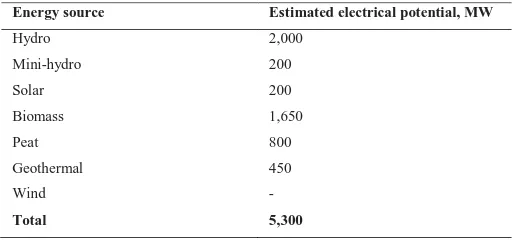
residues. Although it is technically possible to produce electricity from these residues by combustion through combined heat and power, it remains a matter of economic performance that determines the viability. The operational costs of using agricultural residues, the benefits of replacing grid electricity and income from the sale of excess electricity back to the national grid should provide an adequate rate of return on the capital investments in the bioenergy plant. The suitable technology depends on the size of the plant. Advanced biomass technologies such as pyrolysis are in their infancy in Uganda, possibly presenting viable bioenergy business opportunities. The Renewable Energy Policy for Uganda estimated a potential of more than 5 GW potential from renewable energy, as indicated in Table 1. Biomass could contribute 2.45 GW, almost 50%, of this potential capacity.
Table 1 Renewable energy power potential
Energy source Estimated electrical potential, MW
Hydro 2,000
Mini-hydro 200
Solar 200
Biomass 1,650
Peat 800
Geothermal 450
Wind -
Total 5,300
2.1 Demonstration of technology co-existence
Agriculturally endowed countries like Uganda have
a wide variety of agricultural residues in sufficient
quantities as summarized in Table 2. However, in order
to replace and/or supplement fossil based energy carriers,
cost is the critical challenge for success. It is of great
importance to be conscious of how to utilize the different
sources of bio-waste and for which purpose.
Agriculture in Uganda is linked to energy markets
through both indirect (cost of fossil-based inputs like
fertilizer and insecticides) and direct costs (production,
processing, and transport), and also through the
competition for resources, such as land and water, for
linkage between energy and agriculture is
disproportionate, with energy prices having a far greater
impact on agricultural prices than the influence that
agriculture could have on the world energy. At the same
time, the rising energy prices are raising the costs of
agricultural production, hurting the welfare of the poorest
most especially in Uganda.
Table 2 Selected Agricultural residues in Uganda
Crop type Residues Availability for
energy, %
Availability for energy, t
Cassava 667,200 0 0
Bananas 3,604,799 30 1,081,440
Beans 273,001 30 81,900
Cow peas 26,783 30 8,035
Soya beans 55,299 30 16,590
Sorghum 478,802 30 143,641
Maize 913,002 30 273,901
Rice 108,002 30 32,534
Wheat 10,800 0 0
Sun flower 22,251 0 0
Ground nuts 144,000 30 43,200
Coffee 145,172 30 43,552
Total 6,449,111 - 1,724,793
Source:(MEMD, 2014).
Currently, accessible sustainable wood biomass
supply in Uganda stands at 27.7 million tons. When
crop residues, whose theoretical potential in Uganda
could be 4.4 million tons, are included, there is a national
net surplus. Agro-industrial residues from the sugar,
coffee and rice industries amount to about 3.7 million
tons a year. Sawmilling residues (440,000 m3) consist
of sawdust, bark, chips and other waste wood that is not
suitable for further processing; most of this is used as fuel
wood. Access to electricity through grid extension is
unlikely to increase in many poor parts of the world, and
high oil prices are already preventing diesel generators
from running in villages. Therefore, there is a high
potential for small-scale decentralized power generation
for rural areas based on biomass conversion. The major
sources of power in the East African Community (Kenya,
Uganda, Tanzania, Rwanda and Burundi) include
Geothermal, Wind, Hydro, Solar and Biomass.
Statistics show that the East African Community (EAC)
population is more that 100 million but more that 81% of
this population live without access to modern energy
services. The statistics in Uganda further shows that:
Less than 30% of households use liquefied
petroleum gas;
Less than 40% of urban households have access to
electricity
Less than 5% rural households have access to
electricity; and.
Less than 10% of schools, clinics and hospitals in
rural areas have access to grid electricity.
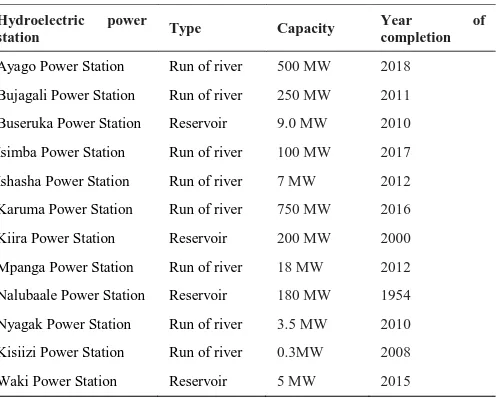
Uganda's hydro-power development is based on the
increasing use of the country's hydropower potential
available. Hydropower potential is estimated to be more
than 200 MW, with firm annual generation 12 500
GWh/year (excluding the abundant mini and micro hydro
potential). The current operating and planned hydro
project are indicated in Table 3.
Table 3 Hydropower dams in Uganda
Hydroelectric power
station Type Capacity
Year of
completion
Ayago Power Station Run of river 500 MW 2018
Bujagali Power Station Run of river 250 MW 2011
Buseruka Power Station Reservoir 9.0 MW 2010
Isimba Power Station Run of river 100 MW 2017
Ishasha Power Station Run of river 7 MW 2012
Karuma Power Station Run of river 750 MW 2016
Kiira Power Station Reservoir 200 MW 2000
Mpanga Power Station Run of river 18 MW 2012
Nalubaale Power Station Reservoir 180 MW 1954
Nyagak Power Station Run of river 3.5 MW 2010
Kisiizi Power Station Run of river 0.3MW 2008
Waki Power Station Reservoir 5 MW 2015
Lower energy prices and/or alternative renewable
energy sources decrease the cost of productive inputs like
(bio)-fertilizer, which is an additional benefit to food
producers that can be translated into lower food prices.
The introduction of clean-burning, reliable, and
assessable forms of biofuels into rural villages presents
opportunities for welfare gains and provides insurance
against external shocks in energy and food prices.
Particularly, there are potential time savings, especially
benefits, through the provision of cleaner, more reliable
and easily assessable forms of energy. Use of
agricultural wastes for pyrolysis would allow an
expansion of land for agriculture and open new markets
for farmers. Significant bio-waste materials from
agriculture are plant residuals such as straw, roots, leaves,
stems, Stover, peels and other residues from fruit,
vegetables, crop production and farming. Most straws
have significant contents of a wide range of inorganic
elements; those are extracted from the soil during plant
growth in particular potassium, which is an important
plant nutrient. Rice straw contains up to 20% of
inorganic elements and is an excellent fertilizer for rice
production due to high contents of potassium, nitrogen
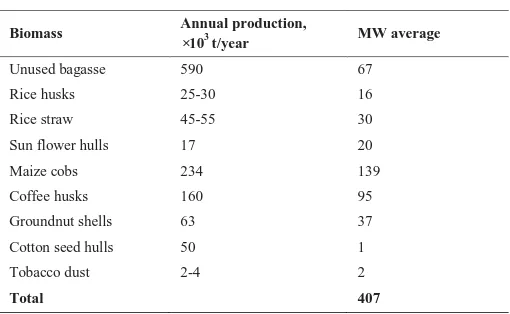
and silicon. Table 4 shows potential energy production
potential for agro-residues.
Table 4 Energy production potential from
agro-residues
Biomass Annual production,
×103 t/year MW average
Unused bagasse 590 67
Rice husks 25-30 16
Rice straw 45-55 30
Sun flower hulls 17 20
Maize cobs 234 139
Coffee husks 160 95
Groundnut shells 63 37
Cotton seed hulls 50 1
Tobacco dust 2-4 2
Total 407
2.2 Water resources
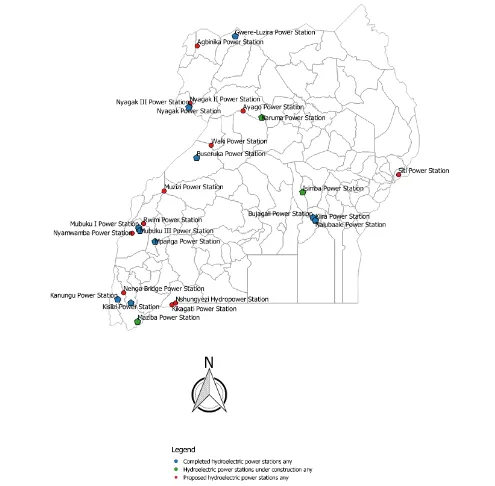
Uganda is richly endowed with water bodies and with potential hydro-energy resources like water falls and dams. Despite this, there is an existing installed capacity of 827.5 MW of the total estimated 2,000 MW potential of hydro-power. Figure 1 below is a GIS map showing the location of the various hydro power plants
and their status whether planned or functional. Despite the presence of the various Hydro Electricity Power sources, 18.2% of the general population has access to electricity and the current purchase of electricity stands at 2930 GWh. If fully tapped Uganda has a full hydroelectricity potential of 2 GW amounting to 17,520 GWh in Equation (1). The red outline shows areas that are not covered by any of the HEP projects and yet this is the cattle corridor of Uganda with the largest amounts of bio-material. With the total energy demand of 173,287 GWh in 2015, Hydro-electric power can only carter for 10% of the total energy demand of the country. Assuming 100% electricity access and full hydro potential harnessing, the energy demands out rightly surpasses the energy supply as thus hydroelectricity cannot stand as an independent energy source. With a 3.3% increase both in population and energy demand, the energy demand will increase to 23578 GWh and the HEP will be able to only carter for 0.75% of the total energy demand in Equation (2). Moreover, this analysis does not include the electricity that the country exports to neighboring countries.
(2)
e
D
D
(1)
(GWh)
8760
1
(GW)
rt 0
E
P
Where, P is Power,
E is Energy demand, D is .Population after t years D0 is Initial Population at time t=0
2.3 Petroleum products
Petroleum products for energy recovery majorly find applications in automobiles and to a small scale in small power generators and light farm equipment. Uganda alone imports 1.28 million cubic meters of petroleum products (UBOS, 2014) with an energy equivalent of 13 GWh which is less than 1% of the total energy demand. To cater for all the energy demands of the country, there is a need to import more over 128 million cubic meters. Despite the fact that Petroleum alone cannot satisfy the total energy demand of the
country, it is not a sustainable energy source since it’s a
non-renewable resource.
2.4 Bio Bio-resources
Biomass is the predominant type of energy use in Uganda with 94% of the total consumption. Charcoal is majorly used in urban and semi-urban areas, firewood in the rural areas and in some cases the burning of farm residues for energy recovery. Bio-resources can be subdivided into animal and crop resources.
2.4.1 Animal resources
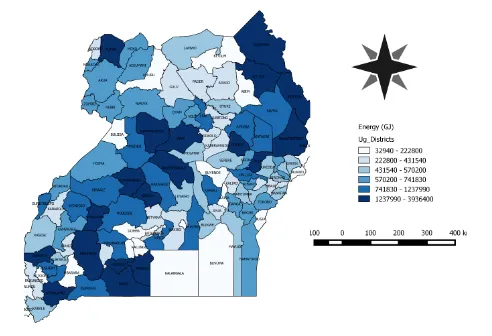
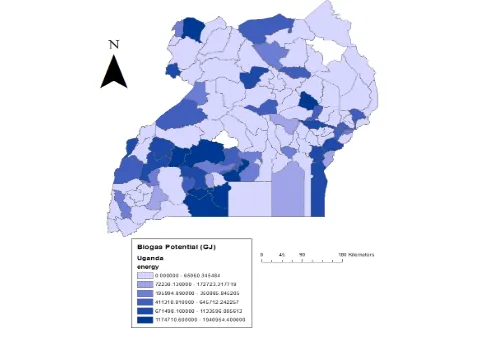
Uganda is an agricultural country and as thus engages in livestock production. According to UBOS (2014), there are 11.4 million cows, 12.5 million goats, 3.4 million sheep, 3.2 million pigs and 37.4 million chicken. Figure 2 shows a GIS map with the intensity of energy that can be obtained per district if the animal waste in Uganda is collected and energy harnessed from it. With 100% of the animal waste collection and a
3.2% increase in the animal populations will provide 1.535 m3 of biogas which translates to 8.5 GWh per annum. With a 281,869 GWh energy demand of Uganda by 2040, the energy from animal resources using Anaerobic Digestion cannot cater for the energy needs sufficiently. The possibility of animal resources as a standalone technology is thus not possible as it can only contribute to 3% of the total energy demand by 2040.
2.4.2 Crop resources
Crop resources are the most common energy sources in less developed countries. The energy is mainly used in households and in food preparation by commercial vendors in urban areas. The challenge with the existing energy use is that the efficiency is low. According to Okello et al. (2013) the efficiency is 10%-12% on weight-out to weight-in basis. This suggests that about 9 kg of wood are necessary to produce 1 kg of charcoal, which translates into 22% efficiency on an energy output to energy input basis. There is a need for introduction of
perennial grasses under good weather conditions ranges between 6.3-8.8 t DM/ha, while under poor conditions between 2.8-6.5 t/ha. The net calorific value of the grass dry biomass ranges from 17.1 to 18.5 MJ/kg and depends on grass composition, growing conditions and cutting time, he further noted that the energy potential of tall-growing grass cultivated on light soils low in humus is 115–153 GJ/ha. This energy source can put the arable land to use while addressing energy issues in Sub-Saharan Africa.
3 Proposed waste to energy alternatives
3.1 Second generation resources
Much emphasis has been given to the 90% degradable material generated in less developed countries and less attention is allocated to the other waste compositions like plastics. Energy recovery from the first generation sources has been deemed necessary to address the energy demand but the challenge there is competition in raw materials as the first generation sources like corn are food to humans (Naik et al., 2010). Continual destruction of crops in the pretext of being energy sources if not handled with caution will lead to decrease in food supply. The second generation sources like plastics which constitute 2% of the waste generated in Uganda if treated with pyrolysis can produce diesel (Smolders and Baeyens, 2004) which can be used to address a portion of the energy demand. The fuel from pyrolysis of plastic waste has a calorific value of 22-30 MJ/m3 depending on the waste material being processed. It is important to note that 2.8% of the waste in Uganda is hard plastics (Komakech et al., 2014) which are a potential for diesel extraction. According to Van Zwieten et al. (2010), from 1 kg of plastic waste, 1 L of diesel can be obtained. This can lower the reliance on the traditional energy sources. This technology is new for low developing countries as thus no cases have been cited in Uganda as of yet.
3.2 Landfill gas generation
When waste is deposited in landfills, the organic matter in the waste decomposes to Landfill Gas which is a mixture of about half methane and half carbon dioxide (Sel et al., 2013). The Land Fill Gas production rate steadily increases while MSW accumulates in the landfill. The gases produced within a landfill can be collected and used in various ways. The landfill gas can be utilized directly on site by a boiler or any type of combustion system, providing heat. Electricity can also be generated on site (Unnikrishnan and Singh, 2010). In Uganda, the major landfill of Kampala the capital city is 11.745 hectares which with a gas yield of 25 m3/hectare (Fennell, 2013) this will yield 293.625 m3 of landfill gas per day. This bio gas yield can contributes to 6 GJ of power (1667 kWh). Despite the potential, this methane has not been harnessed as of yet.
3.3 Bio-Methanation
situation within Sub-Saharan Africa will be improved at least. The government of less developed countries should look forward to bio-methanation technology as a secondary source of energy by utilizing municipal solid
wastes. Cases of bio-methanation have been cited within institutions like schools and projects by SNV, Pamoja and CREEC have embarked on biogas projects but the spread is low and non-commercialized.
3.4 Fermentation, pyrolysis and gasification
Thermal treatment of waste is a technology that developed countries have adopted in the form of incineration but this technology is not very much practiced in less developed countries. This may be due to the high organic material high moisture content high inert and low calorific value content in solid waste (Sharholy et al., 2008). Less energy demanding options like fermentation, pyrolysis and gasification are probable alternatives to address the problems. Bioenergy conversion through fermentation involves production of ethanol from sugar or starch-rich biomass, and is the most widely used biofuel production method in the world (Faaij, 2006). In Uganda, molasses from sugarcane
of ethanol. This yield despite being low also has a role in curbing down the energy crisis in less developed countries.
Pyrolysis is the thermo-chemical conversion of biomass under limited supply of oxygen at temperatures ranging from 350°C to 700°C (Goyal et al., 2008). Products of pyrolysis include charcoal, bio-oil or fuel gas, the proportion of which varies depending on the temperature and residence time of the biomass material in the reactor (Panwar et al., 2012). Fast pyrolysis for production of bio-oil and slow pyrolysis for production of charcoal (Becidan, 2007). Gasification is the partial oxidation of carbonaceous feedstock such as coal and biomass materials, at elevated temperature, into a gaseous energy carrier (Bridgwater, 1995). Gasification takes place when biomass is heated in a gasification medium such as air, oxygen or steam. The product of biomass gasification is a mixture of several gases, collectively called producer gas, or synthesis gas. As both gasification and pyrolysis process work on carbon-based wastes, they are considered appropriate for food wastes. According to Digman and Kim (2008), both pyrolysis and gasification produce a syngas composed mainly of CO and H2 (85%), with a small proportion of CO2 and CH4.
Pyrolysis produces 75% bio-oil, of which the heating value is around 17 MJ/kg. Pyrolysis for energy recovery is still under research at the Department of Agricultural and Bio systems engineering Makerere University but preliminary studies show that the technology is sustainable. We can thus appreciate that solid waste offers a good potential for solid waste thermal treatment with the specific aim of power generation.
3.5 Densification
Biomass densification is the conversion of loose biomass into high density solid material through application of pressure (Katimbo et al., 2014). Normally, biomass materials such as agricultural and forest residues have high moisture content, irregular shapes and sizes, and low bulk density, making it very difficult to handle, transport, store and utilize.
Combustion of loose biomass is associated with low thermal efficiency, and high particulate matter emissions (Chen et al., 2009). Biomass densification provides the solution to these problems by increasing the initial bulk density of the loose biomass making it easier and cheaper to handle, transport, and store. Biomass densification could play an important role in improving the utility of the large quantity of loose biomass materials generated. Biomass briquettes from organic matter have energy contents ranging from 4.48-5.95 KJ/g and with the waste production of Uganda that stands at 3.38 MT, this will yield 20 TJ of energy (5,556 MWh) (Manga et al., 2008). Even though briquetting technology has been existing in Uganda for over twenty years the wide
availability of biomass for energy purposes has meant that the extra processing steps
involved in producing briquettes have never allowed it to compete on a commercial scale (Ferguson, 2012).
4 Conclusions
abundant biomass is notably at low efficiencies as such more efficient technologies should be adopted to maximize the energy recovery. Uganda should invest in bioconversion technologies at small scale to match with small holder farmers’ production and productivity. This
will unlock the potential of millions trapped in energy poverty and deficiencies.
Acknowledgement
This research paper is made possible through the help and support from ABE staff and my colleagues.
References
Achankeng, E. 2003. Globalization, urbanization and municipal solid waste management in Africa. In Proceedings of the African Studies Association of Australasia and the
Pacific 26th Annual Conference.
Arapoglou, D., T. Varzakas, A. Vlyssides, and C. Israilides. 2010. Ethanol production from potato peel waste (PPW). Waste Management, 30(10):1898-1902.
Ban-Koffi, L., and Y. Han. 1990. Alcohol production from pineapple waste. World Journal of Microbiology and Biotechnology, 6(3):281-284.
Becidan, M. 2007. Experimental studies on municipal solid waste and biomass pyrolysis.Bridgwater, A. 1995. The technical and economic feasibility of biomass gasification for power generation. Fuel, 74(5):631-653. Chen, L., L. Xing, and L. Han. 2009. Renewable energy from
agro-residues in China: solid biofuels and biomass briquetting technology. Renewable and Sustainable Energy Reviews, 13(9):2689-2695.
Digman, B., and D. S. Kim. 2008. Review: alternative energy from food processing wastes. Environmental Progress, 27(4):524-537.
Faaij, A. 2006. Modern biomass conversion technologies. Mitigation and Adaptation Strategies for Global Change,
11(2):335-367.
Fennell, K. 2013. Economic and energy efficiency assessment of biomass harvesting at a northern off-grid community: a case study of Barren Lands First Nation at Brochet, Manitoba, Canada.
Ferguson, H. 2012. Briquette Businesses in Uganda. The Potential for Briquette Enterprises to Address.
Goyal, H. B., D. Seal, and R. C. Saxena. 2008. Bio-fuels from thermochemical conversion of renewable resources: A review. Renewable and Sustainable Energy Reviews, 12(2):504-517.
Guerrero, L. A., G. Maas, and W. Hogland. 2013. Solid waste management challenges for cities in developing countries. Waste Management, 33(1):220-232.
Henry, R. K., Z. Yongsheng, and D. Jun. 2006. Municipal solid waste management challenges in developing countries–Kenyan case study. Waste Management, 26(1):92-100.
Hoornweg, D., and P. Bhada-Tata. 2012. What a waste: a global review of solid waste management.
Jasinskas, A., A. Zaltauskas, and A. Kryzeviciene. 2008. The investigation of growing and using of tall perennial grasses as energy crops. Biomass and Bioenergy, 32(11):981-987.
Jumbe, C. B., F. B. Msiska, and M. Madjera. 2009. Biofuels development in Sub-Saharan Africa: Are the policies conducive? Energy Policy, 37(11):4980-4986.
Kaseva, M. E., and S. E. Mbuligwe. 2005. Appraisal of solid waste collection following private sector involvement in Dar es Salaam city, Tanzania. Habitat International, 29(2):353-366.
Katimbo, A., N. Kiggundu, S. Kizito, H. B. Kivumbi, and P. Tumutegyereize. 2014. Potential of densification of mango waste and effect of binders on produced briquettes. Agricultural Engineering International: CIGR Journal,
16(4):146-155.
Kim, H. J., S. H. Kim, Y. G. Choi, G. D. Kim, and T. H. Chung. 2006. Effect of enzymatic pretreatment on acid fermentation of food waste. Journal of Chemical Technology and Biotechnology, 81(6):974-980.
Komakech, A. J., N. E. Banadda, J. R. Kinobe, L. Kasisira, C. Sundberg, G. Gebresenbet, and B. Vinnerås. 2014. Characterization of municipal waste in Kampala, Uganda. Journal of the Air & Waste Management Association,
64(3):340-348.
Konteh, F. H. 2009. Urban sanitation and health in the developing world: Reminiscing the nineteenth century industrial nations. Health & Place, 15(1):69-78. Lee, L. Y.-T. 2013. Household energy mix in Uganda. Energy
Economics, 39(3):252-261.
Mahadevan, R., and J. Asafu-Adjaye. 2007. Energy consumption, economic growth and prices: A reassessment using panel VECM for developed and developing countries. Energy Policy, 35(4): 2481-2490. Manaf, L. A., M. A. A. Samah, and N. I. M. Zukki. 2009.
Municipal solid waste management in Malaysia: Practices and challenges. Waste Management, 29(11):2902-2906.
Marshall, R. E., and K. Farahbakhsh. 2013. Systems approaches to integrated solid waste management in developing countries. Waste Management, 33(4):988-1003.
MEMD. 2014. Renewable Energy Policy for Uganda. Ministry of Energy and Mineral Development. http://www.rea.or.ug/index.php/policies-and-legislation? download=42: the-renewable-energy-policy-for-uganda. (Accessed on May16th, 2016)
Molino, A., F. Nanna, Y. Ding, B. Bikson, and G. Braccio. 2013. Biomethane production by anaerobic digestion of organic waste. Fuel, 103(1):1003-1009.
Naik, S., V. V. Goud, P. K. Rout, and A. K. Dalai. 2010. Production of first and second generation biofuels: a comprehensive review. Renewable and Sustainable Energy Reviews, 14(2):578-597.
Oberoi, H. S., P. V. Vadlani, L. Saida, S. Bansal, and J. D. Hughes. 2011. Ethanol production from banana peels using statistically optimized simultaneous saccharification and fermentation process. Waste Management, 31(7):1576-1584.
Okello, C., S. Pindozzi, S. Faugno, and L. Boccia. 2013. Development of bioenergy technologies in Uganda: A review of progress. Renewable and Sustainable Energy Reviews, 18(2):55-63.
Okot-Okumu, J., and R. Nyenje. 2011. Municipal solid waste management under decentralisation in Uganda. Habitat International, 35(4):537-543.
Panwar, N., R. Kothari, and V. Tyagi. 2012. Thermo chemical conversion of biomass–Eco friendly energy routes. Renewable and Sustainable Energy Reviews,
16(4):1801-1816.
Sel, I., O. Arikan, I. Demir, and B. Ozkaya. 2013. Landfill gas to electricity production at sanitary landfills in Kocaeli. Journal of Selcuk University Natural and Applied
Science, 681-693.
Sharholy, M., K. Ahmad, G. Mahmood, and R. Trivedi. 2008. Municipal solid waste management in Indian cities–A review. Waste Management, 28(2):459-467.
Smolders, K., and J. Baeyens. 2004. Thermal degradation of PMMA in fluidised beds. Waste Management, 24(8):849-857.
Troschinetz, A. M., and J. R. Mihelcic. 2009. Sustainable recycling of municipal solid waste in developing countries. Waste Management, 29(2):915-923.
Tsai, W. T. 2007. Bioenergy from landfill gas (LFG) in Taiwan. Renewable and Sustainable Energy Reviews,
11(2):331-344.
UBOS. 2014. Uganda Demographic and Health Survey, 2004. Uganda Bureau of Statistics.Unnikrishnan, S., and A. Singh. 2010. Energy recovery in solid waste management through CDM in India and other countries. Resources, Conservation and Recycling, 54(10):630-640.
Van Zwieten, L., S. Kimber, S. Morris, K. Chan, A. Downie, J. Rust, S. Joseph, and A. Cowie. 2010. Effects of biochar from slow pyrolysis of papermill waste on agronomic performance and soil fertility. Plant and Soil, 327(1-2):235-246.