
Latest Trends on the Application of Shape
Memory Alloy Cables (Wire Ropes) in
Structural Earthquake Engineering
Peyman Narjabadifam
1*& Ali Saman Watandust
21Assistant Professor of Structural Earthquake Engineering, Department of Civil Engineering, Faculty of Engineering, University of Bonab, 5551761176, Bonab, Iran
*Corresponding Author E-mail Id: [email protected]
2Student, Structural Engineering, Department of Civil Engineering, Faculty of Engineering, University of Bonab, 5551761176, Bonab, Iran
E-mail Id: [email protected]
Abstract: Structural earthquake engineering deals with earthquake protection of civil structures. Different techniques and various materials can be used in this major sub-discipline of structural engineering. Smart materials can improve the structural performances against earthquakes. One of the most attractive types of these materials are SMAs (Shape Memory Alloys). SMAs are well suited for structural earthquake engineering applications, due to their unique properties including superelasticity and shape memory effect. They are being used in the forms of wires, bars, films and some other structural elements. Large forces in real structures and some technical considerations, however, requires the applications of stronger and more robust elements. The Latest trends on the application of SMA Cables are promising. These trends are studied in this paper, paying attention to the technical details. It is concluded that the trends will be increased in the future, when the commercial production of SMA cables are being increased and the alternative alloys such as Iron -based alloys with improved properties are going to reduce the costs.
Keywords: Shape Memory Alloy, Wire Rope, Cable, Structural Earthquake Engineering, Vibration Isolator, Damper
I. INTRODUCTION
Civil engineering is a specialized discipline of engineering related to civil structures. A major sub-discipline in this field is structural engineering. Structural earthquake engineering is a branch of structural engineering that deals with earthquake protection of civil structures. Different materials are used to this purpose. Smart materials are a specific category of materials suited to be used in structural earthquake engineering applications. SMAs (Shape Memory Alloys) are one of the most attractive materials known for their unique properties. They exhibit two excellent features in loading and unloading process, referred to as SME (Shape Memory Effect) and SE (Superelasticity). SME is the ability of these materials to recover their original shapes by the means of heating. SE is also an interesting ability of SMAs to recover strains upon the removal of the loads applied.
resistances also in terms of fatigue, corrosion, abrasion. Several alloys are proposed. Nickel-Titanium (NiTi) is the most known alloy. Some copper-based alloys are also well-known SMA materials. Recent researches propose Iron-based alloys as the alternative cost-effective alloys with improved performances.
Over the past decade, many researchers made great advances in the field of SMAs. SMAs find different applications in civil structures. They can be used as braces, isolation devices, damping devices, structural connections, and reinforcing elements in concrete structures. SMA cables (wire ropes) make such applications more practical.
In this paper, the latest trends on the applications of SMA cables (wire ropes) in the field of structural earthquake engineering are studied with regard to the technical details and some remarkable applications are introduced.
II. SHAPE MEMORY ALLOYS AND THEIR PROPERTIES
The unique properties of SMA materials (SME and SE) owe to the specific solid to solid transformations between their austenitic and martensitic phases.
The austenitic phase is basically available at higher temperatures and can be transformed to the martensitic phase when the material cooled. The main characteristic of the austenite state is its cubic crystals in its structure. The martensite state on the other hand is the low-temperature state with single or multiple variants in its structure. Transformations of the austenitic material to the martensitic state occurs through a microscopic process [1], having no signs in the macroscopic scale and the shape of the SMA specimen. The reason for this behavior is that the several multipally oriented crystals in the martensitic material, wich are already called variants, change into a single structure of the austenite state. The variants of the martensite state are self-accommodated at the end of transformation induced by thermal changes and will not change the macroscopic shape of the specimen [2].
In the absence of stress, four transformation temperatures, as shown in Fig. 1 can be characterized for SMAs. These specific temperatures are known as Ms (indicating the beginning of the martensitic state) and Mf (indicating the finalization of the transformation to martensitic state) during cooling, As (indicating the beginning of the austenitic state) and Af (indicating the finalization of the transformation to austenitic state) during heating [2].
Figure 1. The specific behavior of shape memory alloys: stress-temperature and stress-strain curves of the materials [2]
With the stress loading of an austenitic SMA available above the temperature Af, the transformation from austenitic phase to martensitic phase occurs in a specific stress and strain in the beginning of the plateau. The stress remains almost constant in the plateau (until the martensitic phase is finished) if the loading is increased without any change in temperature. Continuing to the loading, the created martensitic state will be loaded elastically. Due to the fact that the martensitic state is unstable in the absence of stress at temperatures greater than Af, a reverse transformation will be occurred with unloading. The level of stress, however, will be lower than that of loading, resulting in the hysteretic effect. Residual displacements after the unloading will be negligible if the temperature of the material is above Af. This is the reason that this effect is referred to as superelasticity. The hysteretic behavior provides also an acceptable amount of energy dissipation, making SMAs suitable for structural earthquake engineering applications [2].
III. SHAPE MEMORY ALLOY CABLES
Cables (or wire ropes) are basically composed of wires, strands, and cores that interplay each other in the production process. Fig. 2 shows the structure of a cable (wire rope). Structural and mechanical engineers design cables with various metals, layouts, and finishes to obtain the best performances regarding strength, fatigue, corrosion resistance, and some other criteria for each use.
Figure 2. Cable (wire rope) components [5]
The cross sectional details of the common layouts of cables (or wire ropes) are shown in Fig. 3.
Figure 3. The cross sections of some commonly used cables (or wire ropes) [5]
Figure 4. Some known cross sections of strands [5]
Recently, many researchers are interested to exploit the advantageous properties of SMA cables in different structural applications. SMA- cable dampers for passive aseismic control of structures have been studied [6], for example. SMA CuAlBe cables were subjected to axial cyclic loading to understand their behavior in order to demonstrate their potential to be used in structural engineering [7]. Some other studies are also reported in the literature. It is, however, important to know about the behavior of cables. Reedlunn et al. [8] conducted an extensive set of cyclic uniaxial tension tests of two cable layouts of NiTi shape memory alloys (including a 7×7 right regular lay and a 1×27 alternating lay) to characterize the superelastic behavior of them in the room temperature. Fig. 5 shows the details of cables studied in this research.
The average axial stress of the cables versus their strain are reported in Fig. 6 over four tests performed on the two layouts mentioned before. As shown in the figure, two cases has been tested for each layout: (i) testing the cable in dry condition as received from factory (the solid line in the figure), and (ii) testing the cable lubricated in the laboratory (the dashed line).
Figure 6. Normalized force- strain relation for cables [8]
As can be seen, a close match is occurred between the responses of the cables and their core wires, especially in the 7×7 layout. This result shows that the friction between the wires is high enough to prevent the relative sliding between them. For the 1×27 layout, the behaviors are a little different in the cable and single wire. The similarity available, however, suggests the possibility of practical application, because of the robustness observed. Further studies are required to further validate the behaviors [8].
IV. APPLICATIONS
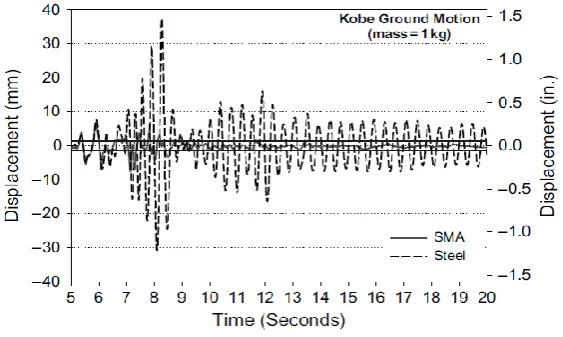
SMA cables are firstly the interesting candidates to be used as bracing elements. Comparison between SMA wire braced frame and steel wire braced frame has already been investigated [14]. The mechanical behavior of steel and SMA bracing systems were compared through the study of the behavior of structure subjected to the 1995 Kobe earthquake. In order to study the yielding of steel bracings two different levels of additional mass are applied to the roof levels of the frames. The reduced-scale test set up is shown in Fig. 7.
Figure 7. Experimental test setup [14]
Fig. 8 shows the displacement response histories of the roofs of the frames. Comparison between the first six seconds of the responses show similar behavior for the steel and SMA braced systems. After that the yielding occurred, the roof displacement becomes larger with steel braces, while with SMA braces the roof displacement reduces 80% [14].
Balaji et al. [15] recently proposed new building system composed of cables (wire ropes) formed as helix between the metal retainers. The system is referred to as WRI. There are two types of WRI with helical (Fig. 9(a)) and Polycal (Fig. 9(b)) cables. The major advantages of WRI is its ability to provide isolation in all three planes and in all directions. The helical WRI finds its application in heavy industries and the polycal WRI finds its application in the small-scale industries such as in the isolation of electronic and electrical equipment.
Figure 9. (a) Helical Isolator (b) Polycal Isolator [15]
Two types of experiments has been carried out: (i) monotonic loading test and (ii) shaking table test. The monotonic test has been performed to determine the static stiffness of WRIs and the shaking table test has been performed to study the isolation capabilities of WRIs. Table 1 shows the specification of WRIs used in the tests with monotonic loading [15].
Table 1. Specifications of the WRIs [15]
Isolator
No. Wire rope diameter (mm) Number of turns Width (mm) Height (mm)
Length (mm)
1 6.4 8 64 54 146
2 9.5 8 84 71 216
3 12 8 105 90 216
4 15.9 8 112 99 268
Fig. 10(a) shows the load-displacement of the WRIs subjected to compressive loading. The static stiffnesses are obtained from the slopes of the curves and Fig. 10(b) shows the slopes of the load-displacement curves which are the vertical stiffnesses of the WRIs [15].
Narjabadifam [16] proposed a base isolation system based on friction and superealasticity, using SMA cables (wire ropes). It is mentioned that the most attractive features of sliding isolators are further elongation of the natural period, insensitivity to the frequency content of excitation, and lower transmission of the ground motion accelerations into the superstructure. Flat Sliding Bearings (FSBs) are known as the simplest slider. FSBs, however, require a proper restoring mechanism. SMA based recentering is addressed as a relatively modern approach in to provide an alternative restoring mechanism for FSBs. (SMA)-based Superelasticity-assisted slider (SSS) is proposed in this regard. SSS is practically made up of FSBs allowing isolation displacement and austenitic SMA cables (wire ropes) providing proper self-centering capability. The SSS is schematically illustrate in Fig. 11 for its basic configuration [16].
Figure 11. A schematic view of the Shape Memory Alloy (SMA)-based Superelasticity-assisted Slider (SSS) proposed by Narjabadifam [16] for the application of SMA cables (wire ropes) in aseismic
isolation
Alternative configurations can mainly be considered based on vertical, diagonal or horizontal arrangements of SMA cables (wire ropes). Table 2 shows the average responses in terms of residual displacements (∆), maximum displacement (Dmax), and maximum base shears as a fraction of building weight (Vmax / W). Total length of required SMA wires (LSMAs) are also reported for each configuration. The maximum base shears are almost same for all the configurations. The total length of SMA wires required in the vertical configuration is considerably less than the other two configurations. The recentering capability seems to be stronger in the horizontal and diagonal configurations [16].
Table 2. Seismic performances of SSS under the same design assumptions [16]
Configuration LSMAs (m)
Seismic Performances
Δ (cm) Dmax (m) Vmax / W
Vertical 3570 4.5 0.300 0.138
Diagonal 7883 2 0.272 0.135
Horizontal 8196 1.5 0.274 0.134
Table 3. Seismic performance of SSS with vertical SMAs compared to those of FPS and HD-LRB [16]
IS Seismic Performances
V (kN) aimax (m/s2) dijmax (%)
SSS 1713 3 0.23
FPS 2074 2.9 0.26
HD-LRB 2245 3.4 0.69
It has also been illustrated that, SSS can be applied without and with Isolation Units (IUs). Alternative configurations have been detailed based on specific arrangements of SMA wire ropes. SSS seems to be effective for the purpose of aseismic control of structures. Further investigations including detailed study of materials, complete structural design, advanced computer simulation, and precise performance evaluation should be carried out to make the system practical.
Torra et al. [17] investigated an SMA damper through its design and optimization. Some analyses were also performed to evaluate the performances. The relevant physical effects were also qualified from the experimental measurements. The design and optimization of the damper included determining the appropriate length and required number of wires for the damper. 3.4 mm diameter CuAlBe wires and 2.46 mm diameter NiTi wires were loaded up to ultimate strain levels. Fig. 12 shows the SMA damper.
The structure that being investigated was composed of three one-story 3-bay frames. The optimization of the damper was performed in two steps. Firstly, the analyses were carried out for one of the two-dimensional frames equipped with the dampers subjected to the highest load. Secondly, the responses were studied for the three-dimensional frame including the dampers [17].
Figure 12. The SMA damper made up of 12 CuAlBe 3.4 mm diameter wires [17]
Figure 13. The three-dimensional frame equipped with the SMA dampers (left) and the central two-dimensional frame composed of H-shaped sections as the columns and I-shaped sections as the beams
[17]
Ozbulut et al. [12] proposed a Superelastic Viscous Damper (SVD) in order to add the re-centering capability for the viscoelastic damper composed of two high-damped butyl blended elastomer layers. Fig. 14 shows the 3D renderings of the SVD and the schematic diagrams of the device in the un-deformed and un-deformed position [12].
In Fig. 15 also the force-deformation curves of SVD and its sub-elements are shown [12].
Figure 15. The force-deformation curves of SVD and its sub-elements [12]
V. CONCOLUSION
Latest trends on the applications of Shape Memory Alloy (SMA) cables (or wire ropes) in the field of structural earthquake engineering were studied. It was shown that the unique properties of SMA materials that make them suitable for earthquake protection of structures can practically be exploited using recently introduced cable (wire rope) forms of these materials. Different innovative applications were reviewed. Further applications are expectable. It was also indicated that Iron-based alloys will improve the performances at a lower cost.
ACKNOWLEDGMENT
The authors acknowledge the financial support provided by University of Bonab as a member of ministry of science, research, and technology of Iran.
Conflict of interest: The corresponding author declares that there is no conflict of interest.
Ethical statement: It is also declared that ethical responsibilities are completely followed.
REFERENCES
[1] H. Funakubo (1987). Shape memory alloys, Gordon & Breach Science publishers, New York, 1987. [2] M. Dolce, and D. Cardone (2001). Mechanical behaviour of shape memory alloys for seismic
applications 1. Martensite and austenite NiTi bars subjected to torsion. International Journal of Mechanical Sciences, 1; 43 (11), pp. 2631-2656.
[3] CM. Wayman, TW Duerig (1990). An introduction to martensite and shape memory, TW Engineering aspects of shape memory alloys, London: Butter-Heinemann Ltd, pp. 3-20.
[4] K. Otsuka, and C.M. Wayman (1999). Mechanism of shape memory effect and super elasticity, Shape memory materials, Cambridge, UK: Cambridge university press, pp. 27-48.
[6] W. Ren, H. Li, and G. Song (2008). An innovative shape memory alloy damper for passive control of structures subjected to seismic excitations, World Conference on Earthquake Engineering.
[7] JF. Beltran, C. Cruz, R. Herrera, and O. Moroni (2011). Shape memory alloy CuAlBe strands subjected to cyclic axial loads, Engineering Structures, 1; 33 (10), pp. 2910-2918.
[8] B. Reedlunn, S. Daly, and J. Shaw (2013). Superelastic shape memory alloy cables: Part I–isothermal tension experiments. International Journal of Solids and Structures, 1; 50 (20-21), pp. 3009-3026. [9] B. Reedlunn, S. Daly, and J. Shaw (2013). Superelastic shape memory alloy cables: Part II–
Subcomponent isothermal responses, Inter. J. of Solids and Structures, 1; 50 (20-21), pp. 3027-3044. [10] B. Carboni, W. Lacarbonara, and F. Auricchio (2014). Hysteresis of multiconfiguration assemblies of
nitinol and steel strands: experiments and phenomenological identification, Journal of Engineering Mechanics, 3; 141 (3).
[11] OE. Ozbulut, S. Daghash, and MM. Sherif (2015). Shape memory alloy cables for structural applications, Journal of Materials in Civil Engineering, 26; 28 (4).
[12] OE. Ozbulut, RJ. Michael, and B. Silwal (2015). Seismic performance assessment of steel frames upgraded with self-centering viscous dampers, Dyna. of Civil Stru., Vol. 2, pp. 421-432.
[13] MM. Sherif, and OE. Ozbulut (2017). Tensile and superelastic fatigue characterization of NiTi shape memory cables, Smart Materials and Structures, 27; 27 (1).
[14] P. Lafortune, J. McCormick, R. DesRoches, and P. Terriault (2007). Testing of superelastic recentering pre-strained braces for seismic resistant design, J. of Earthquake Engineering, 21; 11(3), pp. 383-399. [15] PS. Balaji, ME. Rahman, L. Moussa, and HH. Lau (2015). Wire rope isolators for vibration isolation of
equipment and structures–A review, IOP Conference Series: Materials Science and Engineering 2015, Vol. 78, No. 1, p. 012001.
[16] P. Narjabadifam (2015) Shape Memory Alloy (SMA)-based Superelasticity-Assisted Slider (SSS), International Conference on Seismology & Earthquake Engineering, 18-21 May 2015.
[17] V. Torra, A. Isalgue , F. Martorell, P. Terriault, and FC. Lovey (2007). Built in dampers for family homes via SMA: An ANSYS computation scheme based on mesoscopic and microscopic experimental analyses, Engineering Structures, 1; 29 (8), pp. 1889-902.
![Figure 1. The specific behavior of shape memory alloys: stress-temperature and stress-strain curves of the materials [2]](https://thumb-us.123doks.com/thumbv2/123dok_us/1292624.1636030/3.595.54.533.77.340/figure-specific-behavior-memory-alloys-stress-temperature-materials.webp)
![Figure 2. Cable (wire rope) components [5]](https://thumb-us.123doks.com/thumbv2/123dok_us/1292624.1636030/4.595.55.543.362.635/figure-cable-wire-rope-components.webp)
![Figure 5. Two NiTi cables studied by Reedlunn et al., showing side view and cross section [8]](https://thumb-us.123doks.com/thumbv2/123dok_us/1292624.1636030/5.595.56.543.76.201/figure-niti-cables-studied-reedlunn-showing-cross-section.webp)
![Figure 6. Normalized force- strain relation for cables [8]](https://thumb-us.123doks.com/thumbv2/123dok_us/1292624.1636030/6.595.145.460.167.403/figure-normalized-force-strain-relation-cables.webp)
![Table 1. Specifications of the WRIs [15]](https://thumb-us.123doks.com/thumbv2/123dok_us/1292624.1636030/8.595.55.544.424.541/table-specifications-of-the-wris.webp)
![Figure 11. A schematic view of the Shape Memory Alloy (SMA)-based Superelasticity-assisted Slider (SSS) proposed by Narjabadifam [16] for the application of SMA cables (wire ropes) in aseismic isolation](https://thumb-us.123doks.com/thumbv2/123dok_us/1292624.1636030/9.595.102.494.235.510/schematic-superelasticity-assisted-proposed-narjabadifam-application-aseismic-isolation.webp)
![Table 2. Seismic performances of SSS under the same design assumptions [16]](https://thumb-us.123doks.com/thumbv2/123dok_us/1292624.1636030/10.595.54.547.102.220/table-seismic-performances-sss-design-assumptions.webp)
![Figure 12. The SMA damper made up of 12 CuAlBe 3.4 mm diameter wires [17]](https://thumb-us.123doks.com/thumbv2/123dok_us/1292624.1636030/11.595.121.479.508.705/figure-sma-damper-cualbe-mm-diameter-wires.webp)
![Figure 15. The force-deformation curves of SVD and its sub-elements [12]](https://thumb-us.123doks.com/thumbv2/123dok_us/1292624.1636030/12.595.71.534.185.338/figure-force-deformation-curves-svd-sub-elements.webp)
