Channel Assignment in Dense MC-MR Wireless
Networks: Scaling Laws and Algorithms
Rahul Urgaonkar, Ram Ramanathan, Jason Redi, William N. Tetteh
Network Research Department
Raytheon BBN Technologies, Cambridge, MA 02138
Email:
{
rahul, ramanath, redi, wtetteh
}
@bbn.com
Abstract—We investigate optimal channel assignmentalgo-rithms that maximize per node throughput in dense multi-channel multi-radio (MC-MR) wireless networks. Specifically, we consider an MC-MR network where all nodes are within the transmission range of each other. This situation is encountered in many real-life settings such as students in a lecture hall, delegates attending a conference, or soldiers in a battlefield. In this scenario, we show that intelligent assignment of the available channels results in a significantly higher per node throughput. We first propose a class of channel assignment algorithms, parameterized byT (the number of transceivers per node), that can achieve ΘN11/T
per node throughput using Θ(T N1−T1) channels. In view of practical constraints on T, we then propose another algorithm that can achieve Θ(log1
2N)2
per node throughput using only two transceivers per node. Finally, we identify a fundamental relationship between the achievable per node throughput, the total number of channels used, and the network size under any strategy. Using analysis and simulations, we show that our algorithms achieve close to optimal performance at different operating points on this curve. Our work has several interesting implications on the optimal network design for dense MC-MR wireless networks.
I. INTRODUCTION
Starting with the seminal work in [1], there has been a lot of research on studying optimal scaling laws for wireless ad hoc networks under different assumptions about node capabilities [2], [3], availability of infrastructure support [4], [5], mobility [6], [7], channel models [8], traffic models [9], etc. Given the vast literature in this area, we refer the interested reader to the excellent surveys [10], [11] for an overview of this work.
One practical way to improve the capacity of wireless ad hoc networks is to deploy MC-MR networks. The resulting capacity gains are mainly due to the use of additional channels as compared to the single channel model of [1]. This has attracted much attention recently and several works study the problem of channel assignment, routing, and scheduling in general MC-MR networks under different constraints [12], [13], [14]. The work in [15] extends the analytical framework of [1] and derives scaling laws for general MC-MR networks. It is shown in [15] that, depending on the number of interfaces per node and the number of available channels, there can be a degradation in the network capacity.
Much of this work on scaling laws has focused on general ad hoc networks where it is assumed that the nodes are randomly distributed in an area and that multi-hop routing is necessary for end-to-end communication. However, one scenario that has received little attention is where all nodes
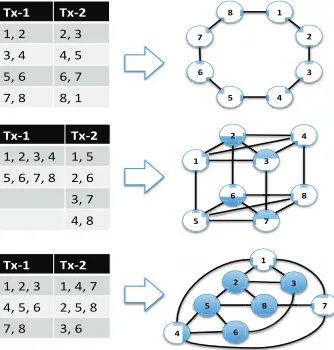
Fig. 1. Three possible channel assignments in a Parking Lot network of8 nodes with2transceivers per node. For each transceiver (Tx-1 and Tx-2), the entries in the tables show the list of nodes that share an orthogonal channel on that transceiver. The resulting effective topology is shown on the right.
are within the transmission range of each other. This scenario, which we refer to as theParking Lotmodel, is encountered in many real-life settings. Examples include students in a lecture hall, delegates attending a conference, or a platoon of soldiers in a battlefield. Because of its prevalence, it is important to study this model in more detail and understand fundamental limits on its performance.
node Parking Lot network with 2 transceivers per node. Also shown is the resulting topology for each assignment. Note that these are only three out of many possible channel assignments for this network.
This example illustrates that the presence of multiple transceivers adds a “degree of freedom” and expands the network design space considerably. Now the problem of
throughput maximization involves a joint optimization of the
channel assignment, routing, and scheduling strategies. This is subject to the following tradeoff: Given a fixed number of transceivers per node, when a channel assignment scheme uses more channels, it allows for more concurrent transmissions. However, the path between any two nodes tends to become longer, leading to more relay transmissions and reduced per node throughput. To keep the path lengths small, more nodes should share a channel. However, this reduces throughput as at most one node can transmit per channel at any time. This is because spatial reuse of frequency channels is not possible in the Parking Lot model.
Thus, the key design objective is to maximize the number of concurrent transmissions while keeping the path lengths small. However, this by itself is not sufficient. For example, one could assign the first transceiver of all nodes to the same channel and form many small groups using the remaining transceivers. With this assignment, all nodes are within one hop of each other while many concurrent transmissions are possible. However, the common channel of the first transceiver becomes a bottleneck. What is needed is to ensure that there
is sufficient capacity for allflows in the network.
In this paper, we study the problem of optimal channel assignment, routing, and scheduling in an MC-MR Parking Lot network where the goal is to maximize the uniform per node throughput. In addition, we are interested in characterizing the scaling behavior of per node throughput as a function of
network size. We focus on static channel assignment
algo-rithms where a particular assignment, once assigned, is used for a reasonably long period of time. This is motivated by the practical limitations and resulting overheads associated with dynamic channel switching. In this setting, there is rich design space involving the number of available channels, number of transceivers per node and the network size that we explore. Our main contributions are:
• We propose a class of algorithms parameterized byT,
the number of transceivers per node, that can achieve ΘN11/T
per node throughput using Θ(T N1−T1)
channels in the Parking Lot model. Thus, an algorithm
in this class can achieve Θ(1)per node throughput if
T = Θ(log2N).
• In view of practical constraints on T, we propose
another algorithm that can achieve Θ(log1
2N)2
per node throughput using only two transceivers per node.
• We identify a fundamental relationship between the
network size, the total number of channels used, and the achievable per node throughput under any strategy. Our algorithms are shown to achieve close to optimal performance at different operating points on this curve.
The rest of the paper is organized as follows. In Sec. II, we
present the network model and assumptions along with a dis-cussion of our analytical approach. Sec. III and IV analyze two channel assignment schemes that can achieve progressively higher per node throughput by using more channels. In Sec. V, we establish a fundamental relation between the number of channels used, network size and per node throughput under any scheme. We also define a common metric by which to evaluate the performance of a scheme. This allows us to bound the performance of the schemes studied in Sec. III and IV against the best possible scheme. In Sec. VI, we compare the performance of our channel assignment schemes along with some other schemes using packet-level simulations. Finally, we discuss the implications of our results on the optimal network architecture for dense MC-MR networks in Sec. VII-A.
II. NETWORKMODEL
Channel Model: We consider a wireless network of N
nodes, indexed 1,2, . . . , N, where all nodes are within the
transmission range of each other. The network has a total
of F orthogonal frequency channels, each of bandwidth B
Hz. Every node in the network is assumed to have T ≥ 2
transceivers. As noted earlier, the T = 1 case has a trivial
solution. Each transceiver can be assigned at most one channel at any time. We assume that the transceivers operate in the half-duplex mode where they can either transmit or receive (but not both) on their channel at any time. Further, we assume a collision model for interference so that at most one transceiver can transmit successfully on a channel at any time. The link level transmission rate per channel is assumed to be the same
for all channels and is given by R bps.
Traffic Model: We consider the N source-destination pair random unicast model where every node is the source of one unicast session destined to another node that is chosen uniformly at random. Each source generates packets of size
D bits at a rate given by λ packets/sec. We assume that the
source-destination pairings are not known a priori. Note that if the pairings were known, then one can optimize the channel assignments and routing with respect to them. This would yield higher per node throughput. However, our focus is on the case where the traffic patterns are not known a priori and/or change rapidly. Under these assumptions, this traffic model is equivalent to the model where each node generates packets
at rate λ packets/sec and each packet is equally likely to be
destined to any other node. We are interested in designing
algorithms that maximize the rateλthat can be supported. We
call this rate the uniform per node throughput.
Channel Assignment Model: We focus on static channel assignment schemes where a particular assignment, once as-signed, is used for a reasonably long period of time. Dy-namic channel assignment can be shown to outperform static schemes. Indeed, it can be shown to achieve the best possible throughput under our model. However, factors such as switch-ing delay, coordination overheads, and hardware constraints make dynamic channel assignment challenging to implement in practice.
consists of the channel assignment, routing as well as trans-mission scheduling algorithms. For any given tuple(N, T, F), this can be formulated as an optimization problem that searches over all possible channel assignment, routing, and scheduling options and yields the maximum throughput. However, given the enormous search space, this approach quickly becomes intractable and does not yield useful insights.
Instead, we take a scaling analysis approach where we focus on characterizing the scaling behavior of the achievable throughput as a function of the network sizeN. This approach is useful because, while being tractable, it provides insights into the optimal network design and helps derive scaling laws. In analyzing the scaling behavior of the throughput, we assume that the number of available channels F can scale with N according to a fixed function. For example, F(N) could be
√
N. This approach significantly simplifies the problem and allows us to develop algorithms whose achievable throughput can be computed exactly in closed form. We will present these algorithms in Sec. III and IV. For each algorithm that we study, we will also calculate the exact total number of channels used. Finally, in Sec. V, we will bound the “performance gap” between these algorithms and the best possible throughput that can be achieved by solving the optimization problem for (N, T, F(N)).
For simplicity, in the rest of the paper, we assume normal-ized and idealnormal-ized transmission rates so that 1 packet can be transmitted per channel use. This assumption is relaxed in the simulations in Sec. VI.
III. HINT: HIERARCHICALINTERLEAVEDCHANNEL ASSIGNMENT
In this section, we present a class of channel assignment strategies that we call HINT-T which can achieve ΘN11/T
per node throughput using F = Θ(NTT−1) channels and T transceivers per node. The main idea behind this strategy is to form NTT−1 groups, each of sizeN1/T, for every transceiver index. Then it assigns transceivers to these groups in such a way that every node can reach every other node in at most
T hops. For simplicity of presentation, we assume throughout that N1/T is an integer. This scheme can be modified to be applicable when this is not the case using similar ideas. For brevity, we do not discuss this extension in the paper. However, in the simulations in Sec. VI, we also implement this scheme for the case when N1/T is not an integer.
A. HINT-2
To provide intuition, we first describe the assignment for T = 2. The general case is treated in Sec. III-B.
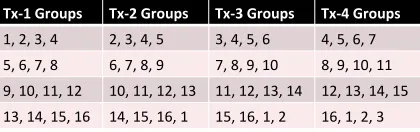
1) Channel Assignment under HINT-2: Let M = N1/2. Group the first transceiver of all nodes into M groups, each containingM nodes. We call these the Tx-1 groups and assign consecutively numbered nodes to them as follows. The first Tx-1 group contains nodes 1,2, . . . , M, the second Tx-1 group contains nodes M+ 1, M + 2, . . . ,2M, and so on.
Similarly, group the second transceiver of all nodes into M groups, each containing M nodes. We call these the Tx-2 groups and assign nodes to them as follows. The first Tx-Tx-2 group contains the first node from each Tx-1 group, i.e., nodes
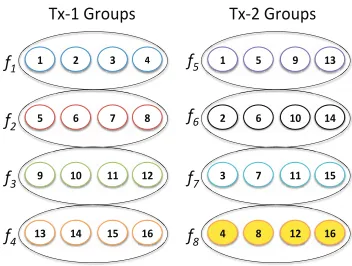
Fig. 2. Channel Assignments under HINT-2 forN= 16.
1, M+ 1,2M+ 1, . . . ,(M−1)M + 1. Likewise, the second Tx-2 group contains the second node from each Tx-1 group, and so on.
Each of the groups thus formed is assigned an orthogonal channel. Since there are a total of2M groups, the total number of channels used is2M. Note that the first transceiver of every node is assigned to a Tx-1 group while the second transceiver of every node is assigned to a Tx-2 group. Fig. 2 illustrates this assignment for a network ofN= 16nodes using channels f1 tof8. Note that nodes in Tx-2 groups are obtained by
in-terleavingnodes from the Tx-1 groups. As shown later in Sec. III-B, the same idea can be applied in ahierarchicalfashion to obtain assignments for the generalT case. Hence, we call this family of schemes HINT-T: Hierarchical Interleaved Channel Assignment with T transceivers.
2) Scheduling and Routing under HINT-2: We next de-scribe the scheduling and routing strategy that is used with this assignment.
Scheduling Strategy: Every transceiver in a group gets the same fraction of time to transmit on that group’s channel. Since each group hasM transceivers, every transceiver gets1/M of the total transmission capacity of the channel.
Routing Strategy: For any source node s, if a destination nodedis in the same Tx-1 group, it transmits directly todin one hop on its Tx-1 channel. Else, stransmits to that noder in its Tx-2 group which shares its Tx-1 group with d. Noder then forwards to dusing its Tx-1 channel.
For example, in Fig. 2, the route from node1to node3 fol-lows the path1−3on channelf1. This involves transmissions only by the first transceiver of node 1. On the other hand, the route from node1to node11follows the path1−9on channel f5 and9−11 on channelf3. This involves transmissions by the second transceiver of node 1 and the first transceiver of node 9. It can be seen that this routing strategy ensures that every node is within 2 hops of any other node.
3) Throughput Analysis of HINT-2: We now show that the HINT-2 assignment along with the scheduling and routing strategy as described above can achieve a throughput of1/M for every node.
Proof: Because of the symmetry of the assignment, it is sufficient to focus on the total load on each of the two transceivers of node 1 and show that it can be supported. Consider the second transceiver of node 1. On this, node 1 transmits those packets generated by itself that are destined for nodes in all Tx-1 groups other than its own group. There are M−1 such groups and each group has M nodes. Node 1 generates packets at rate Nλ−1 for each of these nodes. Thus, the total traffic load on the second transceiver of node 1 is given by λMN(M−1−1). This must be less than the total transmission rate 1/M. Solving this, we get:
λ≤ N−1 M2(M −1) =
M2−1 M2(M −1) =
1 M +
1
M2 (1)
From this, it can be seen thatλ= 1/M satifies (1). A similar result is shown for the first transceiver of node 1 in [18]. Since HINT-2 uses 2M channels and M = N1/2, Theorem 1 follows.
B. HINT-T
We next present the assignment strategy forT >2.
1) Channel Assignment under HINT-T: Let M = N1/T. Similar to the T = 2case, the HINT-T strategy forms MT−1 groups for every transceiver index. The groups corresponding to transceiver index k are called Tx-k groups where1≤k≤ T. Each Tx-k group contains M nodes and is assigned one orthogonal channel. Since there are a total of T MT−1 such groups, the total number of channels used under HINT-T is T MT−1. The node assignment to these groups is performed as follows.
Fix a transceiver index k where 1≤k ≤T. Leti and j be integers such that 1 ≤i ≤ MT−k and 1 ≤ j ≤ Mk−1. Then the Tx-k group number (i−1)Mk−1+j contains the following nodes:
{(i−1)Mk+j,(i−1)Mk+j+Mk−1,
(i−1)Mk+j+ 2Mk−1,(i−1)Mk+j+ 3Mk−1, . . . ,(i−1)Mk+j+ (M −1)Mk−1}. (2)
This definition ensures that every Tx-k group has M nodes. Further, the total number of Tx-k groups is
MT−k i=1
Mk−1
j=1 1 =MT−1.
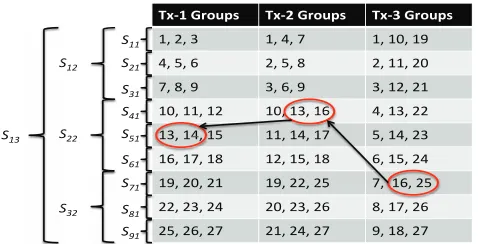
Fig. 3 shows the HINT-3 assignment for a network ofN = 27 nodes withT = 3transceivers per node. It also illustrates the routing strategy that will be described in Sec. III-B3. Note that this assignment ensures that every node is within3 hops of any other node. In general, the HINT-T assignment ensures that every node is within T hops of any other node.
2) Level Sets: In order to describe the routing strategy, we define the following collection of sets for each transceiver index k where 1 ≤ k ≤ T. For 1 ≤ i ≤ MT−k, define
Sik as the set containing the nodes (i−1)Mk+ 1 to iMk. For each k, there are MT−k such sets, each containing Mk consecutively numbered nodes. We call them the “levelksets”. Fig. 3 illustrates these sets for N = 27. Note that for k= 3, there is only one such set S13 and it consists of all nodes.
The following properties follow directly from the definition of the level sets and the HINT-T assignment in (2).
Fig. 3. Channel Assignment under HINT-3 forN= 27. Also shown are the level sets and the route from node25to node14.
1) Any two level setsSik andSjk wherei=j are disjoint. 2) Any level setSikwherek >1is a union ofM level sets
from levelk−1.
3) Under the HINT-T assignment (2), for1≤k≤T−1, no two nodes from any Sik are in the same Tx-k+1 group.
To illustrate the third property in Fig. 3, note that nodes 1,2,3 from the first Tx-1 group are in different Tx-2 groups. Similarly, nodes 3,6,9 from the third Tx-2 group are in different Tx-3 groups. This is precisely the interleaving of nodes from lower Tx groups to form upper Tx groups as seen in HINT-2. HINT-T generalizes this interleaving to T hierarchical levels.
3) Scheduling and Routing under HINT-T: We now de-scribe the scheduling and routing strategy that is used with HINT-T.
Scheduling Strategy: Similar to HINT-2 strategy, every transceiver in a group gets 1/M of the total transmission capacity of the channel.
Routing Strategy: For any two nodesaandb, definek(a, b) as the smallest k for which there exists a level set Sik such that botha and b are in Sik. Note that at least one such set always exists since the set S1T contains all nodes. Further, k(a, b) ≤T for all a, b. The routing strategy from a source node s to a destination node dcan be described using these k(a, b)values.
First, calculatek(s, d). Ifk(s, d) = 1, thendis in the same Tx-1 group assandstransmits directly todin one hop using its first transceiver. Ifk(s, d)= 1, thendis in a different Tx-1 group thansand the packet is routed as follows.
Ifdis in the same Tx-k(s, d) group ass, thenstransmits directly todin one hop using its k(s, d)thtransceiver.
Else, s determines the node with the smallest value of k(r, d) among all of its neighbors r in its Tx-k(s, d) group. Denote this node by r∗. Then srelays the packet to node r∗ using its k(s, d)th transceiver. Node r∗ now uses the same algorithm as described before to route the packet to d.
group neighbors7and16. Using Fig. 3, we havek(7,14) = 3 andk(16,14) = 2. Therefore, node25forwards the packet to
node16for relaying to the destination. This procedure is now
repeated by node 16. The following Lemma characterizes the
HINT-T routing strategy.
Lemma 1: The HINT-T routing strategy ensures that there
are at mostT hops between any pair of nodes.
Proof: The proof makes use of the following property of
the level sets. Given any set Sik, a node a ∈ Sik can reach
any other node b∈ Sik in at mostk hops using the HINT-T
routing strategy. Since the level set S1T contains all nodes,
Lemma 1 follows. The full proof is provided in [18].
4) Throughput Analysis of HINT-T: We now show that the HINT-T assignment along with the scheduling and routing
strategy as described above can acheive a throughput of1/M
for every node.
Theorem 2: For N1/T = M (where M is an integer),
HINT-T achieve a uniform per node throughput of 1/N1/T
using T NTT−1 channels.
Proof: The proof is based on similar ideas as Theorem 1 and is provided in [18].
C. Discussion of HINT-T
Theorem 2 implies that if T = log2N and if there are
Nlog2N/2 channels available, then HINT-T can achieve a
per node throughput given by 1/N1/log2N = 1/2. Thus, it
is possible to get Θ(1) per node throughput if each node
has log2N transceivers and there are Nlog2N/2 channels
available. This is in sharp contrast to the case of a single
radio network, i.e.,T = 1. Note that the best possible uniform
throughput forT = 1under static channel assignment is1/N.
This is because when T = 1, all transceivers must share the
same channel so that the network remains connected. However,
when T >1, much higher throughput can be achieved. This
shows that there is a fundamental difference between single radio and multi radio networks when static channel assignment is used.
However, requiringΘ(log2N)transceivers per node is
im-practical. Also impractical is the availability ofΘ(Nlog2N/2)
channels. This raises the following questions:
1) Do we really need the number of transceivers per node
and total channels required to grow to infinity to getΘ(1)
per node throughput?
2) Is there a fundamental way to characterize the perfor-mance of any channel assignment strategy? Specifically, what is the relationship between number of transceivers, number of channels used, network size and per node throughput?
We address these questions in the following sections.
IV. TOWARDSλ= Θ(1)WITHT = 2
A. LOG-2 Assignment
In this section, we describe a strategy called LOG-2 that
achieves Θ(log1
2N)2
throughput per node with only two
transceivers per node usingO N
log2N
channels. The main idea
Fig. 4. Assignment under LOG-2 for a network of sizeN= 8 log28 = 24.
behind this strategy is the following. We first form two sets of
groups, one per transceiver index. Each set containsOlogN2N
groups, each group having size O(log2N) nodes. Then the
strategy assigns nodes to these groups in such a way that a
node can reach any other node in at most O(log2N) hops.
For simplicity of presentation, we assume in the following that
N is of the formN =Mlog2M wherelog2M ∈Z+. This
scheme can be modified to be applicable when this is not the case using similar ideas.
1) Channel Assignment under LOG-2: The channel assign-ment is performed as follows. First, group the first transceiver
of all nodes intoM Tx-1 groups, each containinglog2M
con-secutively numbered nodes. Thus, thekthTx-1 group contains
nodes (k−1) log2M + 1,(k−1) log2M + 2, . . . , klog2M.
Next, group the second transceiver of all nodes into M
Tx-2 groups, each containinglog2M nodes. We assign nodes
to them as follows. For 1 ≤i ≤log2M, the ith node from
Tx-1 group number ((j−1 + 2i−1) modM) is assigned to
be the ithnode of Tx-2 group numberj (where1≤j≤M).
The “mod M” operation used here and in rest of the paper is
defined as follows. For any non-negative integersaandb, we
use the following definition:
(amodM)=
M ifa=bM
x ifa=bM+xwhere0< x < M
Each of the groups thus formed is assigned an orthogonal
channel. Since there are a total of2M groups, the total number
of channels used is 2M. Fig. 4 shows this assignment for a
network ofN = 24 = 8 log28nodes withT = 2. To illustrate
the working of the algorithm, consider Tx-2 group number
7. For 1 ≤ i ≤ 3, the ith node from Tx-1 group number
((7−1 + 2i−1) mod 8)is assigned to be theithnode of this
group. Fori= 1, this is given by the first node of Tx-1 group
(6 + 1 mod 8) = 7, i.e., node19. Fori= 2, this is given by
the second node of Tx-1 group (6 + 2 mod 8) = 8, i.e., node
23. And for i = 3, this is given by the third node of Tx-1
group (6 + 4 mod 8) = 2, i.e., node 6.
The following property follows from the definition of the LOG-2 assignment strategy:
Property 1: In any Tx-2 group numberj, there is one node
from each of the Tx-1 groups numbered ((j−1 + 2i−1) mod
M)where1≤i≤log2M.
This means that the difference between the Tx-1 group
numbers of consecutive nodes in a Tx-2 group follows the
Fig. 5. Idea behind the formation of Tx-2 groups under LOG-2.
This is precisely the intuition behind this strategy, as illustrated in Fig. 5. This figure shows the nodes in the first Tx-2 group (black circles) under LOG-2 assignment for N = 64 placed on a ring. It can be seen that the neighboring nodes of 1 are located progressively farther away as we traverse clockwise on the ring. Note that the assignment on Tx-1 ensures that node 1 can reach close by nodes 2,3,4 in one hop. As we show in the next section, using a combination of local neighbors on Tx-1 and progressively farther away neighbors on Tx-2, this strategy ensures that a node is within2 log2M+1hops of any other node. We note that the idea behind this strategy bears a resemblance to prior works on distributed hash tables for fast lookup such as Chord [16].
2) Cover Sets: In order to describe the routing strategy, we define the following collection of sets for each Tx-2 group j (where 1 ≤ j ≤ M). For every ith node in this group, we define a set Uij as follows. For 1 ≤ i ≤ log2M −1,
Uij contains 2i−1 Tx-1 group numbers, starting from ((j− 1 + 2i−1) modM) and incrementing by 1 and using the “mod M” operation as defined before. For i = log2M,
Uij contains (2i−1+ 1) Tx-1 group numbers, starting from ((j−1 + 2i−1) modM)and incrementing by1 while using the mod M operation. For example, for the network in Fig. 4, we have:
U11={1},U21={2,3},U31={4,5,6,7,8}
U17={7},U27={8,1},U37={2,3,4,5,6}
There are a total of Mlog2M such sets. The routing strategy we discuss next uses these sets as follows. A node at the ith level of Tx-2 group j is responsible for relaying to nodes in those Tx-1 groups whose index is in the set Uij. Thus, this set lists all those Tx-1 groups that are “covered” by this node. Hence, it is called a Cover Set. For example, in Fig. 4, node 5 which is at the2ndlevel in Tx-2 group1 forwards data for destinations in the set of Tx-1 groups in U21. Likewise, node
6 which is at the 3rd level in Tx-2 group7 forwards data for destinations in the Tx-1 groups ofU37. Note that for anyj, the sets Uij are disjoint and their union covers all Tx-1 groups.
3) Scheduling and Routing under LOG-2: We now describe the scheduling and routing strategy of LOG-2.
Scheduling Strategy: Every transceiver in a Tx-1 group gets the same fraction of time to transmit on that group’s channel. However, only the first node gets all the transmission time in a Tx-2 group. As we will see next, the routing strategy of LOG-2 requires only the first node of each Tx-LOG-2 group to transmit on that group’s channel.
Fig. 6. Illustration of the routing strategy under LOG-2. Black arrows show transmissions in Tx-1 groups. Red arrows show transmissions in Tx-2 groups.
Routing Strategy: Consider a node n that has a packet destined for node m. This packet could have been generated by node n itself, or it could have been forwarded to nto be relayed to m. In both cases, node n does the following. Let the Tx-1 group number of nodes nandm beg(n)andg(m) respectively. In order to route a packet from n tom, n first checks if m is in its Tx-1 group, i.e., if g(n) = g(m). If yes, thenn transmits directly to min one hop using its first transceiver. Else, n transmits the packet to the first node in Tx-1 group numberg(n)for relaying ton. Note that this step is not required ifn itself is the first node in its Tx-1 group.
Letqbe the first node in Tx-1 groupg(n). Note that under LOG-2,qwill also be the first node in Tx-2 groupg(n). Node qchecks ifmis in its Tx-2 group. If yes, it transmits directly to m in one hop using its second transceiver. Else, node q transmits the packet to that node in its Tx-2 group that “covers” nodem. More precisely, qtransmits to theithnode in its Tx-2 group for forwarding to m where 2 ≤ i ≤ log2M and g(m)∈ Uig(n). This process is repeated until the packet gets delivered.
In Fig. 6, this procedure is illustrated for the 24 node network of Fig. 4. Suppose node 3 wants to send to node 18. Using Fig. 4, we have thatg(3) = 1andg(18) = 6. Thus, node 3 transmits the packet to node 1 in its Tx-1 group for relaying to18. Node1checks if18is in its Tx-2 group. Since it is not, node 1 determines the node in its Tx-2 group that covers node18. This node is given by the third node, i.e., node 12, sinceU31={4,5,6,7,8}. Therefore, node1transmits the packet to node12in its Tx-2 group. Node12now repeats this procedure. Fig. 6 shows the final outcome of this process. The entire route is given by3-1-12-10-14-13-17-18. Note that the hops alternate between Tx-1 and Tx-2 group transmissions. Further, only the first node of a Tx-2 group transmits in any Tx-2 group transmission.
The following Lemma characterizes routing under LOG-2.
Lemma 2: The LOG-2 routing strategy ensures that there are at most2 log2N+ 1hops between any pair of nodes.
Proof:The proof is based on the observation that at each step in a Tx-2 transmission, the distance between the node holding the packet and the destination decreases by at least half. The full proof is provided in [18].
strategy as described above can achieve a throughput of
1/(log2M)2 for every node.
Theorem 3: For N = Mlog2M where log2M ∈ Z+,
LOG-2 can achieve a uniform per node throughput of
1/(log2M)2 using2M channels.
Proof: The proof is based on the following observations. Because of the symmetry of the assignment, it is sufficient to focus on the total load on the nodes in the first Tx-1 group and the first Tx-2 group. Then we calculate a bound on the total number of group-to-group traffic flows that involve these groups. This is used to show that a per node input rate of
1/(log2M)2is feasible. The full proof is provided in [18].
B. Discussion of LOG-2
Theorem 3 shows that LOG-2 can achieve a per node
throughput of at least 1/(log2(N))2 with only 2 transceivers
per node. Thus, we can get close toΘ(1)per node throughput
with O(1) transceivers per node. However, this answers the
first question raised in Sec. III-C only partially. As we show in the next section, under the Parking Lot model of Sec. II,
it is necessary to have Ω(N) channels to get Θ(1) per node
throughput irrespective of the number of transceivers per node.
However, given Ω(N) channels, it is not clear if one can
achieveΘ(1)per node throughput usingO(1)transceivers per
node under static channel assignment. It is our conjecture that this is not possible.
V. EFFICIENCY OF APOLICY
Let P denote the set of all possible feasible policies for
channel assignment, routing, and scheduling under the network model described in Sec. II. We show that there exists a simple relation between the total number of channels used, network size, and maximum per node throughput achievable under any
policy p∈ P. LetCp denote the number of channels used by
the channel assignment under p. LetL¯p denote the resulting
average path length traversed by a packet underp. This average
is taken over all source-destination pairs. Finally, letλp be the
maximum per node input rate that can be supported under p. Then, since the total traffic load cannot exceed the total transmission capacity of the network, we must have that
N λpL¯p≤Cp. (3)
The left hand side of (3) denotes the time average total number of transmissions required to deliver packets from all sources to
all destinations. This cannot exceedCp, the maximum number
of transmissions possible per unit time. Since L¯p ≥1 under
any p, it follows from (3) thatCp= Ω(N)when λ= Θ(1).
Note that (3) is anecessarycondition for the feasibility of
any input rate λ and can be used to establish a lower bound
on the performance of any policy as shown next.
Definition 1: Consider any channel assignment, routing,
and scheduling policyp∈ Pthat usesCpchannels in a Parking
Lot network of sizeN. Suppose it can support a maximum per
node input rate ofλp. Then the efficiency ofp,ηp, is defined
as:
ηp=N λp
Cp
(4)
Fig. 7. Channel Assignment under RING forN= 16.
Since L¯p ≥1 under any p, using (3) it follows that ηp ≤1
for allp∈ P. This includes the throughput maximizing policy
obtained by solving the optimization problem for the tuple
(N, T, Cp) as discussed in Sec. II. Therefore, the maximum
per node throughput achievable under a given policy p that
uses Cp channels in a network of size N is within a factor
ηp of the maximum per node throughput achievable under
anypolicy that usesCp channels on the same network. Thus,
the efficiency of a policy establishes a lower bound on its performance.
Using the results in Sec. III and IV, the efficiency of the T and LOG-2 strategies can be calculated. Since
HINT-T uses T NTT−1 channels to support per node rate of 1/NT1,
we have:
ηHINT-T=
N
N1/T×T NTT−1 =
1
T (5)
For a fixed T, we note that ηHINT-T is independent of the
network size N. Thus, HINT-T is within a constant factor of
the optimal solution.
Likewise, for N =Mlog2M, LOG-2 uses 2M channels
to support per node rate of1/(log2M)2. This yields:
ηLOG-2=
N
(log2M)22M = 1 2 log2M >
1
2 log2N (6)
Thus, the LOG-2 scheme is within a logarithmic (in network size) factor of the optimal solution. This may suggest that HINT-T has a better performance than LOG-2. However, note
that for any given T, the maximum per node throughput
under HINT-T is 1/N1/T while LOG-2 can achieve at least
1/(log2N)2 with T = 2 which exceeds 1/N1/T for
suffi-ciently largeN.
VI. SIMULATION-BASEDEVALUATION
We now present simulation-based evaluation of HINT-T and LOG-2. We also compare their performance against two representative schemes that we call RING and GRID. These are described in the next section. In our simulations, we
consider a Parking Lot network with4 transceivers per node.
Our simulations are performed using OPNET [17].
A. RING and GRID Channel Assignment
The RING assignment scheme first forms N/4 Tx-1
groups, each of size 4and containing consecutively numbered
nodes. The other transceiver groups are obtained by shifting
node ids in each Tx-1 group by 2,3 and4 respectively, with
wraparound. Fig. 7 shows this for N = 16. The resulting
topology resembles a ring (similar to Example 1 in Fig. 1),
degree 4 torus grid and assigns a channel to each link in the
resulting graph. Thus, each Tx group contains2 nodes.
Under the RING assignment, it is easy to show that the
average path length over all source-destination pairs isΘ(N).
Similarly, the total number of channels used is N = Θ(N).
Thus, using (3), it follows that the maximum per node
through-put under RING isO(1/N). Further, using (4), we have that its
efficiency isηRIN G=O(1/N). Under the GRID assignment,
the average path length over all source-destination pairs can be
shown to beΘ(√N)while the total number of channels used
is2N = Θ(N). Thus, using (3), it follows that the maximum
per node throughput under GRID isO(1/√N). Further, using
(4), we have that its efficiency is ηGRID=O(1/
√
N).
B. Simulation Setup
The input topology is a Parking Lot MC-MR network of
size N nodes where N is varied between 16and100. These
nodes are placed in a 250m×250m area and use a fixed
transmit power such that all nodes are within the transmission
range of each other. Every node has 4 identical transceivers,
each capable of operating on a channel of bandwidth10MHz.
We assume that such channels are available starting from900
MHz. Each transceiver independently uses 802.11 CSMA for medium access on its assigned frequency channel. The raw
MAC level throughput per channel is 1.2 Mbps.
Under each scheme, the assignments to the different transceivers are determined at the start of a simulation run and fixed for the duration of that run. In each run, traffic is generated using the uniform all-pair unicast model. Specif-ically, every node generates packets according to a Poisson process of fixed rate and each packet is equally likely to be destined to any of the other nodes. We assume that all packets
are fixed size UDP packets of length 436 bytes that includes
control headers. Each simulation run has a duration of 150
seconds at the end of which we count the total number of packets delivered successfully to their destinations. We use the default link state routing protocol available in OPNET for routing packets. We do not implement the load balanced routing strategies under HINT and LOG as discussed in the earlier sections. Thus, we expect the achievable performance of HINT and LOG with load balanced routing to outperform what we report here.
Our objective is to compare the maximum achievable per node throughput under each scheme. In addition, we are interested in comparing it against the theoretical bounds. Given
a network size N and an assignment schemeX, we estimate
it as follows. Simulations are run with increasing values of the input rate until when the total number of delivered packets does not increase anymore. We call this the “saturation throughput”
underXfor a givenNand use it as a measure of the maximum
per node achievable throughput under X for N. Note that
the theoretical bounds for maximum throughput are derived under idealized assumptions such as collision free transmission scheduling, load balanced routing, no buffer overflows, and ignoring any control overheads (such as due to CSMA and link state routing updates). This no longer holds in the simulations which are closer to the realistic setting. However, these factors affect all of the schemes being compared and the saturation throughput can be thought of as a measure of the remaining effective capacity.
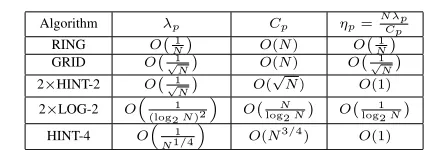
TABLE I. SUMMARY OFTHEORETICAL PERFORMANCE BOUNDS
Algorithm λp Cp ηp=NλpCp
RING ON1 O(N) ON1
GRID O√1
N
O(N) O√1
N
2×HINT-2 O√1
N
O(√N) O(1)
2×LOG-2 O 1
(log2N)2
Olog2NN Olog21N
HINT-4 O 1 N1/4
O(N3/4) O(1)
In this setup, we implement the following: RING, GRID,
2×HINT-2, 2×LOG-2, and HINT-4. 2×HINT-2 implements
HINT-2 on transceivers1,2and repeats it on transceivers3,4.
Similarly, 2×LOG-2 implements LOG-2 on transceivers 1,2
and repeats it on transceivers 3,4. Table I summarizes the
theoretical performance bounds for these schemes.
C. Simulation Results and Discussion
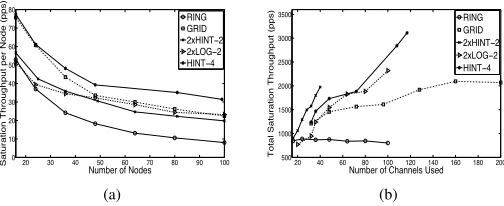
We first compare these schemes in terms of their saturation throughput. Fig. 8(a) plots the per node saturation through-put (in packets/sec, pps) vs. N. As can be seen, HINT-4
outperforms the RING scheme by 200-300% for high tens
of nodes, and outperforms its nearest rival GRID by nearly 150%at N = 100. The behavior of the curves is consistent with the theoretical bounds with RING showing the largest
drop asN increases. Note that the per node throughput under
2×LOG-2 scales asΘ(1/(log2N)2)which is the best scaling
performance among all of these schemes. However, in the finite
range of N considered here, HINT-4 outperforms 2×LOG-2.
Both GRID and 2×HINT-2 also outperform 2×LOG-2 up to
a crossover point, after which 2×LOG-2 is better. We expect
2×LOG-2 to eventually outperform HINT-4 as well after a
sufficiently largeN.
We note that GRID generally has a better performance
than both 2×HINT-2 and 2×LOG-2. However, this plot only
considers the per node saturation throughput and does not capture the total number of channels used. To incorporate this, we next compare these schemes in terms of their efficiency. Fig. 8(b) plots the total network saturation throughput vs. the number of channels used under each scheme. Recall that efficiency of a scheme is the ratio between maximum total network throughput and the total number of channels used. Thus, the slope of the performance curve for a scheme in Fig. 8(b) can be interpreted as its efficiency at that point. It can
be seen that both 2×HINT-2 and 2×LOG-2 have much higher
efficiency than GRID. Further, this gap increases withN.
Fig. 8(b) also agrees quite well with the theoretical bounds.
2×HINT-2 and HINT-4 both have a theoretical efficiency of
O(1), i.e., independent of N (see Table I). Their curves in
Fig. 8(b) have a slope that does not decrease withN. On the
other hand, RING has an efficiency of O(1/N) which goes
to 0 as N increases. Its curve in Fig. 8(b) flattens to slope0
quickly. GRID has efficiencyO(1/√N). Its curve also flattens,
but more slowly than RING. Finally, 2×LOG-2 has efficiency
O(1/log2N)and its slope is even more slower to flatten.
In terms of both per node throughput and efficiency, RING has the worst performance. Intuitively, this is because
under RING, packets have to traverseO(N)hops on average,
' $""%
&'$&"!$"'#'&#$"##%
(
(
(a)
(!%#"" &&
#' '(%'#"%#($('$$&
)
)
(b)
Fig. 8. (a) Saturation Throughput per node vs. Network Size under different schemes. (b) Total Saturation Throughput vs. Number of Channels used under different schemes. The slope of each curve is the efficiency of that scheme at that point.
nodes is now O(√N). It has similar scaling as HINT-2 in
terms of throughput but uses a lot more channels. Thus, it has poor efficiency. The HINT-T schemes have the best performance in terms of their efficiency which does not depend
on N. However, in terms of throughput, T must be large to
remain close to O(1)as N increases. LOG-2 can achieve this
with just2transceivers. However, its efficiency is not as good
as HINT-T. Thus, both HINT and LOG are order optimal or close to order optimal along one of the dimensions (throughput or efficiency).
VII. CONCLUSIONS ANDFUTUREWORK
A. Implications for Network Architecture
Our results have several interesting implications on the architecture of dense MC-MR networks. The scaling laws in [1] imply that in a random ad hoc network, if individual transceivers can only operate over channels of fixed bandwidth
(that does not increase withN), then the best possible scaling
is O(1/√N) even if the network has a large number of
channels available and each node has multiple (but finite) transceivers. The idea behind the optimal strategy in [1] is to keep transmit power sufficiently low, just enough to ensure connectivity, and use multi-hop routing. The motivation behind reducing the transmit power is to maximize spatial reuse of the finite network bandwidth.
In contrast, our results show that in the Parking Lot model, it is possible to get significantly higher throughput if nodes have multiple transceivers and the number of available channels scales with the network size. Our results also suggest that in this model, reducing power to maximize spatial reuse of frequency does not help. It is better to preserve the Parking Lot structure and use all available channels while keeping inter-node distance small in the resulting effective topology by careful channel assignment.
B. Open Questions
There are several open questions that offer directions for future work. For example, it is not clear if one can achieve
Θ(1) per node throughput using O(1) transceivers per node
under static channel assignment. Similarly, it is not clear which
algorithm is the best given a particular (N, T, F). Recall
that HINT-T has Θ(1) efficiency for any fixed T but its
throughput scales as Θ(1/N1/T). On the other hand, LOG-2
hasΘ(1/(log2N)2)throughput butΘ(1/(log2N))efficiency.
Thus, it would be interesting to design a “universal” channel assignment policy that has both high throughput and high
efficiency for finite T atallpoints of the curve (3).
ACKNOWLEDGEMENTS
Distribution Statement “A” (Approved for Public Release, Distribution Unlimited). This work is sponsored by DARPA through the Air Force Research Laboratory (AFRL) Contract FA8750-07-C-0169. The views and conclusions contained in this document are those of the author and should not be inter-preted as representing the official policies, either expressed or implied, of the Defense Advanced Research Projects Agency or the U.S. Government.
REFERENCES
[1] P. Gupta and P. R. Kumar. The capacity of wireless networks IEEE Trans. Inf. Theory, vol. 46, no. 2, pp. 388-404, Mar. 2000.
[2] S. Aeron and V. Saligrama. Wireless ad hoc networks: Strategies and scaling laws for the fixed snr regime.IEEE Trans. Inf. Theory, vol. 53, no. 6, pp. 2044-2059, Jun. 2007.
[3] A. Ozgur, O. Leveque, and D. Tse. Hierarchical cooperation achieves optimal capacity scaling in ad hoc networks.IEEE Trans. Inf. Theory, vol. 53, no. 10, pp. 3549-3572, Oct. 2007.
[4] B. Liu, P. Thiran, and D. Towsley. Capacity of a wireless ad hoc network with infrastructure. InProc. ACM MobiHoc, Sep. 2007.
[5] U. Kozat and L. Tassiulas. Throughput capacity of random ad hoc networks with infrastructure support. In Proc. ACM MobiCom, Jun. 2003.
[6] M. Grossglauser and D. Tse. Mobility increases the capacity of ad hoc wireless networks.IEEE/ACM Trans. Netw., vol. 10, no. 4, pp.477-486, Aug. 2002.
[7] M. J. Neely and E. Modiano. Capacity and delay tradeoffs for ad-hoc mobile networks. IEEE Trans. Inf. Theory, vol. 51, no. 6, pp. 1917-1937, Jun. 2005.
[8] S. Li, Y. Liu, and X. Li. Capacity of large scale wireless networks under gaussian channel model. InProc. ACM MobiCom, 2008.
[9] Z. Wang, H. R. Sadjadpour, and J. J. Garcia-Luna-Aceves. A unifying perspective on the capacity of wireless ad hoc networks.Proc. IEEE INFOCOM, Apr. 2008.
[10] F. Xue and P. R. Kumar. Scaling laws for ad-hoc wireless networks: An information theoretic approach.Foundations & Trends in Netw., vol. 1, no. 2, 2006.
[11] A. Ozgur, O. Leveque, and D. Tse. Operating regimes of large wireless networks.Foundations & Trends in Netw., vol. 5, no. 1, 2009. [12] M. Kodialam and T. Nandagopal. Characterizing the capacity region
in multi-radio multi-channel wireless mesh networks. In Proc. ACM MobiCom, Aug. 2005.
[13] M. Alicherry, R. Bhatia, and L. E. Li. Joint channel sssignment and routing for throughput optimization in multiradio wireless mesh networks.IEEE Journal on Selected Areas in Comm., vol. 24, no. 11, Nov. 2006.
[14] X. Lin and S. Rasool. A distributed joint channel-assignment, schedul-ing and routschedul-ing algorithm for multi-channel ad hoc wireless networks. Proc. IEEE INFOCOM, April 2007.
[15] P. Kyasanur and N. H. Vaidya. Capacity of multi-channel wireless networks: Impact of number of channels and interfaces. InProc. ACM MobiCom, Aug. 2005.
[16] I. Stoica, R. Morris, D. Liben-Nowell, D. R. Karger, M. F. Kaashoek, F. Dabek, and H. Balakrishnan. Chord: A scalable peer-to-peer lookup protocol for internet applications.IEEE/ACM Trans. Netw., vol. 11, no. 1, pp. 17-32, Feb. 2003.
[17] OPNET Modeler, http://www.opnet.com/