O R I G I N A L A R T I C L E
Open Access
Bridging the divide between causal
illusions in the laboratory and the real
world: the effects of outcome density with
a variable continuous outcome
Julie Y. L. Chow
*, Ben Colagiuri and Evan J. Livesey
Abstract
Illusory causation refers to a consistent error in human learning in which the learner develops a false belief that two unrelated events are causally associated. Laboratory studies usually demonstrate illusory causation by presenting two events—a cue (e.g., drug treatment) and a discrete outcome (e.g., patient has recovered from illness)—probabilistically across many trials such that the presence of the cue does not alter the probability of the outcome. Illusory causation in these studies is further augmented when the base rate of the outcome is high, a characteristic known as the outcome density effect. Illusory causation and the outcome density effect provide laboratory models of false beliefs that emerge in everyday life. However, unlike laboratory research, the real-world beliefs to which illusory causation is most applicable (e.g., ineffective health therapies) often involve consequences that are not readily classified in a discrete or binary manner. This study used a causal learning task framed as a medical trial to investigate whether similar outcome density effects emerged when using continuous outcomes. Across two experiments, participants observed outcomes that were either likely to be relatively low (low outcome density) or likely to be relatively high (high outcome density) along a numerical scale from 0 (no health improvement) to 100 (full recovery). In Experiment 1, a bimodal distribution of outcome magnitudes, incorporating variance around a high and low modal value, produced illusory causation and outcome density effects equivalent to a condition with two fixed outcome values. In Experiment 2, the outcome density effect was evident when using unimodal skewed distributions of outcomes that contained more ambiguous values around the midpoint of the scale. Together, these findings provide empirical support for the relevance of the outcome density bias to real-world situations in which outcomes are not binary but occur to differing degrees. This has implications for the way in which we apply our understanding of causal illusions in the laboratory to the development of false beliefs in everyday life.
Keywords:illusory causation, contingency learning, causal learning, outcome density
Significance
Many of the decisions we make in everyday life are mo-tivated by beliefs about cause and effect. For example, in deciding to use or recommend a medical treatment, pa-tients and health practitioners usually hold a belief that the target treatment will increase the probability that the patient’s health will improve. Critically, laboratory re-search on contingency learning suggests we are biased to overestimate the causal relationship between a
putative cause and an outcome when they are in fact un-related, particularly when the outcome occurs fre-quently, a phenomenon known as the outcome density (OD) bias. This effect can account for the prevalent use of ineffective therapies in the treatment of illnesses that have high rates of spontaneous remission, since frequent experiences of symptomatic relief may mislead patients to perceive that the treatment is effective. To date, la-boratory experiments investigating these cognitive biases conventionally present the outcome in a discrete fashion (e.g., the patient is sick vs. the patient has recovered). Real-world experiences, on the other hand, are often not * Correspondence:[email protected]
School of Psychology, University of Sydney, Sydney, NSW 2006, Australia
binary in nature but have variability and ambiguity, which make inferring causality particularly challenging. The current study is an attempt to bridge the gap be-tween experimental research and real-world experience by investigating the OD bias with continuous and vari-able outcomes, emulating the need to extract causal rela-tionships from noisy information. This is one step to demonstrating the validity and relevance of contingency learning research in the laboratory to causal learning problems in the real world.
Background
The ability to extract causal knowledge from direct ex-perience is crucial in helping us make sense of the world. The knowledge that an environmental cue or an action performed by the individual causes a particular outcome can be used to guide our behaviours to maxi-mise desirable outcomes and avoid undesirable ones. For example, if a patient develops a skin rash every time they eat a particular food, the patient may choose to avoid that food in the future to prevent an adverse allergic re-action. Thus, the importance of extracting accurate
causal beliefs from the available information, including correctly identifying the lack of a causal relationship be-tween unrelated events, is important for our well-being. However, people sometimes identify causality where none exists, and this can affect the way we make judg-ments and decisions. For these reasons, researchers often take a keen interest in fallacious biases in causal learning. Examples of important real-world phenomena that researchers have argued could be strongly and nega-tively influenced by learning biases include stereotype formation (Hamilton & Gifford, 1976; Le Pelley et al.,
2010), judgment of guilt and voluntariness of confessions in the courtroom (Lassiter, 2002), and the use of poten-tially ineffective health therapies (Matute, Yarritu, & Vadillo,2011).
Although the impact of biased causal judgments is relevant to many examples of causal learning in the real world, recent literature has focused on the effects of biased causal learning in medically relevant con-texts, particularly beliefs about of the effectiveness of health treatments (e.g., Rottman, Marcum, Thorpe, & Gellad, 2017). This focus is partly motivated by in-creasing public concern over—and apparent increased use of—pseudo-medicine (Blanco, 2017). In this vein, the rest of this paper will focus on the effects of biased causal learning on judgments about potentially ineffective health treatments. Health treatment choices, like many of the decisions we make in every-day life, are motivated by beliefs about cause and ef-fect. People form a belief about the causal relationship between a putative cause and the out-come (e.g., a drug treatment is thought to improve
health) by accumulating evidence from direct experi-ences with the cause (taking the drug) and outcome events (health improvement). The ability of a putative cause to increase or decrease the probability of an outcome, relative to a base rate in which the cause is not present, is often referred to as contingency. Hence, one way in which people form beliefs about cause and effect is through contingency learning, ac-quiring evidence about the likelihood of the outcome after drug treatment and after no treatment (Jenkins & Ward, 1965).
Although people are often accurate when assessing causal relationships via contingency learning (Wasserman,
1990), research has shown that under certain conditions, we are misled to see a causal link between a potential (but ineffective) cause and an outcome (Alloy & Abramson,
1979). In the context of making appropriate decisions about health care, this error in learning is a concern be-cause it may result in the development and maintenance of erroneous beliefs that drive maladaptive choices. For example, despite the lack of support within the scientific community for the efficacy of certain forms of comple-mentary and alternative medicine (CAM), many people still believe in their effectiveness and may even prefer such treatments over those that are scientifically validated (Lilienfeld, Ritschel, Lynn, Cautin, & Latzman, 2014). In-deed, there is now a strong evidence base suggesting that some CAM treatments are completely ineffective (e.g., Barrett et al.,2010). In such cases, the putative cause has no impact on the targeted health outcome and statistical contingency between treatment and outcome is presum-ably zero or close to it. Nevertheless, frequent personal use of such treatments does not appear to strongly dis-suade consumers from purchasing these products.
Causal learning under zero contingency
Simple contingency learning experiments typically in-volve two binary events—one potential cause and one outcome—yielding four possible combinations of cause and outcome, as shown in Table1.
Manipulations of the covariation between cause and outcome are possible by varying the relative frequency of each trial type, with the resulting contingency con-veniently quantified using theΔp metric (Allan,1980):
Table 1Contingency matrix showing the four different trial types as a function of whether the cause and outcome are present or absent
Outcome present Outcome absent
Cause present a b
Δp¼p Oð jCÞ p Oð jCÞ
¼½a=ðaþbÞ ½c=ðcþdÞ: ð1Þ
According to this widely used formula, Δp is positive if the outcome is more likely to occur when the cause is present than when the cause is absent, suggesting that the cause generates the outcome. Alternatively, a nega-tiveΔp suggests that the presence of the causeprevents
the outcome from occurring. For both positive and negativeΔp values, there is some causal relationship be-tween cause and outcome, whereas if the potential cause has no real effect on the outcome, such that p(O|C) = p(O|~C), thenΔp is zero.
Although studies of action–outcome and cue– out-come judgments have generally found that people are sensitive to the strength of positive and negative contin-gencies (Allan & Jenkins, 1983; Shanks & Dickinson,
1988; Wasserman, 1990), judgments of causation con-sistently deviate from theΔp rule when there is no con-tingency between the potential cause and the outcome (i.e., Δp= 0). The overestimation of causal relationships between two non-contingent events, such that Δp ap-pears to be either positive or negative when in fact it is zero, is commonly referred to as the illusion of causality (see Matute et al.,2015for a review). Illusion of causality is an important phenomenon because it represents a consistent error in human learning that is thought to contribute to the development and maintenance of superstitious beliefs and pseudoscientific thinking (Matute et al.,2011).
Causal illusion and event densities
Many of the studies on illusory causation have explored the probability of the cue and outcome and their ef-fect on generating a false association. Manipulations that increase cause–outcome coincidences (i.e., trial typeain Table 1) appear to be particularly effective in producing stronger causal judgments regarding the cue–outcome relationship, regardless of whether the two events are ac-tually causally associated with one another (Blanco, Matute, & Vadillo, 2013; Wasserman, 1990). In other words, a higher coincidence of the cue and outcome re-sults in stronger beliefs that the cuecausesthe outcome. This can be particularly misleading if one of the events has a high rate of occurrence and produces a large num-ber of coincidences for this reason alone.
The OD bias is one example of this effect: it is the ten-dency to overestimate the relationship between cue and outcome when the outcome occurs frequently. In a clas-sic example, Alloy and Abramson (1979) asked partici-pants to determine the degree of control they possessed over the onset of a green light by pressing a button. In conditions where the button press had absolutely no ef-fect on the light (i.e., zero contingency), participants
were more likely to overestimate the action–outcome rela-tionship when the light frequently turned on (high OD) than when it rarely turned on (low OD). This effect has now been replicated across a wide variety of learning tasks with zero-contingency events using binary outcomes (e.g., Matute et al., 2011). Essentially, a high OD increases the frequency ofaandctrials relative tobandd, even though contingency remains zero, and this is found to be suffi-cient in generating strong illusions of causality.
Similarly, when there is a high probability of thecause
occurring (inflating the frequency ofaandbtrials relative to c and d), participants typically report greater causal judgments than when the cause rarely occurs (Allan & Jenkins, 1983; Vadillo, Musca, Blanco, & Matute, 2011). This is known as the cue density effect (e.g., Allan & Jenkins, 1983; Matute et al., 2011; Wasserman, Kao, Van Hamme, Katagiri, & Young,1996).
Causal learning about real-world outcomes
Illusory causation is clearly relevant to many of the deci-sions we must make in day-to-day life. Beliefs about in-effective treatments are grounded in causal illusions, whereby two unrelated events such as consuming Echin-acea(i.e., an action or cue) and common cold relief (i.e., outcome) are believed to be related in some meaningful way. For example, there is evidence from numerous sources against the efficacy of Echinacea when used to treat the common cold (see Karsch-Völk et al., 2014for a review), and yet the illusory belief may be persistent among regular consumers who experiencefirst handthe zero contingency betweenEchinaceaand cold relief. The decisions made based on these false beliefs are incredibly costly: out-of-pocket expenditures on CAM in the United States in 2012 were approximately $30.2 billion (Nahin, Barnes, & Stussman, 2016). Thus, there is a strong imperative to apply cognitive theories of causal learning to real-world problems to formulate ways in which we might mitigate illusory causal beliefs.
unproven in their efficacy and potentially dangerous (U.S. Food and Drug Administration,2017). One poten-tial reason for the persistent use of these unvalidated treatments is the ability for cognitive illusions, including illusory causation, to interfere with the acquisition of evidence-based knowledge. A study by Yarritu, Matute, and Luque (2015) found that participants who developed strong false beliefs about a bogus treatment’s ability to cure a disease in Phase 1 had difficulty learning that a different treatment was actually effective in Phase 2. This suggests that even when patients are given scientif-ically validated treatment, their ability to accurately rec-ognise improvement in their condition is impaired as a result of previous false beliefs regarding the efficacy of alternative treatments. As a result, they may continue to prefer and seek out treatments that are ineffective in treating their condition.
Although we will not be manipulating the cue density effect in this paper, it is important to note that the cue density effect also has implications for the continued use of ineffective treatments: frequent use may produce stronger causal illusions about the treatment’s effective-ness. This is problematic since most alternative therapies do not produce any side effects. Accordingly, CAM sub-scribers may be more liberal in using these treatments since the short-term cost of treatment use is low. The ef-fect of the cost of administration was investigated in Blanco, Barberia, and Matute’s (2014) study, in which participants were presented with two fictitious drugs, one with a side effect and one without. The researchers found that participants were more likely to administer the drug without any side effects, and the frequency of drug administration was highly predictive of illusory causation; participants exposed to the drug frequently (i.e., high cue density) were more likely to judge the treatment as being more efficacious than those who rarely administered the drug and thus, had fewer cue-present events (Blanco, Barberia, & Matute,2014).
The laboratory research on contingency learning and causal illusion thus paints a concerning picture of people’s potential motives for making maladaptive choices. If the principles uncovered in this research are applicable to real-world health beliefs then they suggest that choosing to use ineffective treatments is a self-perpetuating prob-lem: treatments that are used more frequently are per-ceived to be more effective, and treatments perper-ceived to be effective are used more frequently. This cycle is par-ticularly prevalent for the treatment of ailments with a high rate of spontaneous remission (Blanco et al.,2013).
At face value, experimental evidence for outcome and cue density effects suggest that they provide good la-boratory models for how beliefs in ineffective treatments develop. However, one potentially critical difference be-tween the experimental work and their applications is
that the former almost exclusively involves situations in which the outcome is binary and invariant (e.g., a green light either does or does not turn on), whereas many real-life outcomes are continuous and noisy. Medical treatments are given in the context of the fluctuating health experiences and biometric data of the patient, which vary in degrees. What might be interpreted as the absence of an outcome (e.g., the patient still presents with the same symptoms and shows no sign of improve-ment) is not experienced by the individual as the ab-sence of any events. Traditional laboratory-based learning experiments that use health scenarios typically present highly simplified outcomes in a binary and discrete fashion (the patient gets better vs. the patient does not get better). While this aids the task of studying illusory causation, it is not known whether key phenom-ena (e.g., the OD bias) rely heavily on this simplified way in which events are presented. Continuous and variable outcomes do not fit neatly into the outcome-present vs. outcome-absent dichotomy on which many theories of causal learning are based, and it is unclear whether people readily parse their experiences of continuous noisy events into the presence vs. absence of a target outcome, as in Table 1. This issue was highlighted by Marsh and Ahn (2009) who note that the task of parsing events into the four discrete categories shown in Table 1 is often not a trivial problem, yet is ignored by simple covariation-based models. Indeed, it is less clear whether people are able to (or indeedneedto) parse their experience of the cue with the outcome into four categorical trial types when the out-comes presented are continuous. Therefore, event infor-mation may not come readily classified as evidence for or against the putative cue–outcome relationship.
To our knowledge, no study has previously examined the effects of using more ecologically valid representa-tions of the outcome in examining the OD effect in en-hancing the illusion of causality. As such, it is important to test whether continuous, variable, and potentially am-biguous outcomes produce lawful variations in illusory causal judgments in the same way as a simple binary outcome. Thus, we were interested in measuring illusory causation and OD effects using continuous and variable outcomes that are always present to some extent but vary in degree and may be difficult to dichotomise.
Overview of the current study
using binary or discrete outcome events, an outcome was presented on every trial, but its magnitude varied along a continuous scale. To illustrate, instead of the conventional binary outcome where a fictitious patient is either sick or has recovered as a function of treatment or no treatment, patient recovery (i.e., the outcome) was represented on a linear numerical scale from no improvement to full recov-ery, where the assessment of patient recovery could poten-tially take on any value within the range.
Participants were presented instructions suggesting a potential causal relationship between the drug cue and health outcome, namely that the drug Cloveritol may increase the recovery rate of patients suffering from a serious illness. Participants then observed a series of trials in which patients were administered Cloveritol or no treatment, with the drug actually having no impact whatsoever on recovery. During training, participants witnessed outcomes presented along a scale from 0 (no improvement) to 100 (full
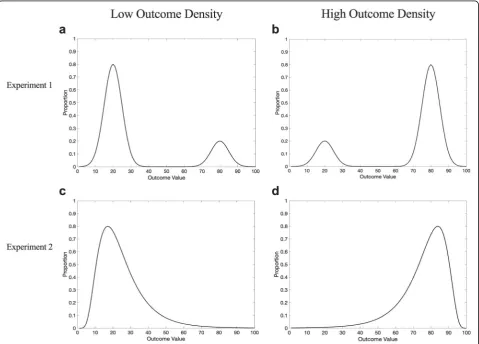
recovery), which they were told represented the pa-tient’s improvement in health. Observed outcomes were sourced from different types of distributions in Experiments 1 and 2. In Experiment 1, we introduced variability in the variable outcome condition by using a bimodal distribution centred at two mean values, a high (80) and low (20) value, and tested whether the presence of variability around these values affected il-lusory causation and OD effects. The inclusion of variability in the way we represented the outcome was directly contrasted with a fixed-value outcome condition, where low health recovery was represented with a constant value of 20 and high health recovery with a constant value of 80.
In Experiment 2, all participants were presented with continuous and variable outcomes sourced from a uni-modal skewed distribution, with either a high or low modal value (see Fig. 1). In both experiments, partici-pants were separated into low OD and high OD
conditions, whereby low OD participants observed out-comes that were predominantly low in magnitude with some high magnitude outcomes, whereas high OD par-ticipants observed predominantly high magnitude out-comes with some low magnitude outout-comes. Although we use the term“outcome density”for consistency with the broader literature, it should be noted that the term entails a slightly different meaning when the outcome is not binary. In our set of experiments, because the out-come occurs on every trial but to a varying degree, a high OD condition is one where a high magnitude come is more likely to occur than a low magnitude out-come, whereas a low OD condition is when a low magnitude outcome is more likely to occur.
As in most OD effect studies, the critical measure was participants’causal judgments about the cue, in this case measured using ratings of how effective the drug was in treating the disease.
Experiment 1
Experiment 1 was conducted to test whether an OD bias produced using a continuous and variable outcome was comparable to that of a fixed-value outcome, most closely resembling the binary outcomes presented in previous research. The OD bias in causal judgments (i.e., ratings of the efficacy of the cause in producing the out-come) is a well-replicated effect but previous studies have used simple and discrete binary outcomes (Alloy & Abramson,1979; Blanco & Matute,2015; Langer,1975). We used a generative causal scenario in which partici-pants were given information suggesting that the drug cue, Cloveritol, may produce faster recovery from illness (i.e., improved health). In Experiment 1, we manipulated OD (low vs. high) and outcome variability (fixed vs. vari-able) independently as between-subject variables. We used a cue-outcome (i.e., non-instrumental) contingency learning task to keep the probability of the cause (i.e., the cue density) constant across conditions. If differ-ences in outcome variability can sustain similar causal learning biases to those observed with binary outcomes, then the high OD condition should generate greater treatment efficacy ratings than the low OD condition, and this effect should be evident for both the fixed and variable outcome conditions.
Method
Participants
Altogether, 112 participants (78 female, Mage= 22.2 years, and standard deviation [SD] = 5.35 years) com-pleted the study for class participation or monetary re-imbursement. Participants were randomly allocated to one of four experimental conditions according to time of arrival (n= 28 in each).
Design
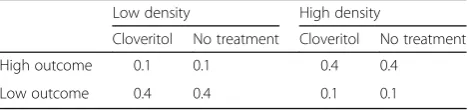
The study used a 2 (OD: high vs. low) × 2 (outcome variability: fixed vs. variable) between-subject design. Participants in the fixed outcome condition were pre-sented with an exact-value outcome of 80 or 20 on each trial, presented on a linear scale from 0 to 100. The proportion of each of these two outcomes depended on OD group (80 on 80% of trials in the high OD condition, vs. 80 on 20% of trials in the low OD condition). This condition is analogous to con-ventional contingency learning paradigms that repre-sent the outcome in a discrete fashion without any variability (i.e., the patient is either sick or has recov-ered). Participants in the variable outcome condition on the other hand, observed outcomes sampled from a bi-modal distribution with outcomes sampled from a low distribution (M= 20, SD = 5, and range = 13–27) and a high distribution (M= 80, SD = 5, and range = 73–87). The proportion of trials sourced from each distribu-tion depended on OD condidistribu-tion (80% from the high distribution in the high OD condition, vs. 20% from the high distribution for low OD condition). The crit-ical difference between the fixed and variable condi-tions is, therefore, the presence of variability in outcome values that could be classified as low and high, with the fixed condition experiencing no vari-ability in outcome values (always 20 or 80), and the variable condition experiencing some variability around a low (20) or high (80) outcome value.
All participants completed 100 training trials, 50 with and 50 without the treatment cue. Trials were pre-sented to participants in blocks of 10 such that each block was representative of the total frequency of high and low outcomes in the experiment (Table2). Drawing on previous research in OD effects, we retain the focus on test judgments of the efficacy of the treatment cue as the primary measure of relevance for the OD effect. However, we also included trial-by-trial predictions of the outcome during training, and an average outcome measure in the test phase. To anticipate the results of both experiments, we found consistent differences across test measures suggesting that causal judgments are particularly conducive to producing OD effects. Discussion of these differences will be saved for the general discussion in Section5.
Table 2Proportion of total trials (per block and overall) in low and high outcome density conditions. There were 10 blocks of 10 trials matching these proportions, yielding 100 trials in total
Low density High density
Cloveritol No treatment Cloveritol No treatment
High outcome 0.1 0.1 0.4 0.4
Stimuli and apparatus
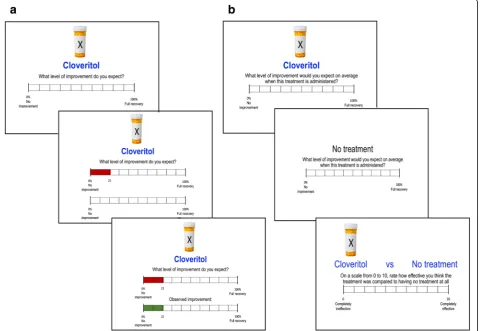
On cue-present trials, administration of the treatment was indicated by presentation of a pill bottle, with the drug name‘Cloveritol’written below it (as shown in Fig.2). On cue-absent trials,‘no treatment’appeared without an ac-companying image. Predictions in training were made along a visual analogue scale ranging from 0% (no im-provement) to 100% (full recovery). The experiment was programmed using MATLAB and the Psychophysics Toolbox extensions (Brainard,1997; Pelli,1997).
Procedure
Participants were first asked to imagine they were a medical researcher investigating a new illness. Partici-pants were told that a new experimental drug Cloveritol has been created to treat the disease. The objective of the study was for them to test the drug’s efficacy in treating the disease. All participants were told that pa-tients usually take a long time to recover, and a large im-provement in health is indicative of a rapid recovery from illness.
During training, participants were presented with trials where they were asked to predict the level of improvement in the patient’s health. Each trial represented a new patient and participants were shown whether the drug or no treat-ment was administered. Below this cue, a prediction scale was presented and participants were required to predict the patient’s health in that trial by clicking on a point on the scale from 0 (no improvement) to 100 (full recovery). A click on the prediction scale would result in the appearance of a horizontal bar extending from point 0 (extreme left of the scale) to the final click location. The prediction bar was always red, regardless of the magnitude of the prediction. Once a prediction was made and the participant had pressed the space bar to continue, a near-identical scale would appear below with the actual observed health im-provement for that trial, animated as a horizontal bar grow-ing from left to right across the scale until it reached the outcome magnitude for that trial. The outcome bar was al-ways green, regardless of the magnitude of the outcome. We used different colours for the two bars to allow partici-pants to differentiate easily between their predictions (red) and the actual observed outcome (green) on that trial.
During the test, participants were instructed to make judgments about the treatment based on their observa-tions during training. Participants were first presented with two average prediction ratings in a randomised order, one each for Cloveritol and no treatment, and were instructed to predict the level of improvement they would expecton averageif the patient was given Cloveritol or no treatment. Having made average prediction judgments for each cue separately, participants were then presented with the critical causal rating, where both Cloveritol and no treatment cues appeared on the same screen followed by instructions to rate how effective they thought the treat-ment was relative to no treattreat-ment. Ratings were made on a scale from 0 (completely ineffective) to 10 (completely effective). The task procedure is depicted in Fig.2.
Results
To recap, previous literature suggests that any effect of OD should be most evident in causal ratings, with greater efficacy ratings reported by participants in the high OD relative to the low OD condition. Importantly for this experiment, if the introduction of variability to the outcome does not produce systematic changes to the OD effect, we would expect the effect of OD to be com-parable between the fixed and variable outcome condi-tions. Given participants were told that the drug should generate greater health improvements, the presence of illusory causation is indexed by greater overall prediction ratings for Cloveritol than no treatment during training and in the test phase. However, previous contingency learning research has often failed to find OD effects in prediction ratings, despite showing the effect in causal judgments (Matute, Vegas, & De Marez, 2002; Shou & Smithson,2015; Vadillo, Miller, & Matute,2005).
Efficacy ratings at test
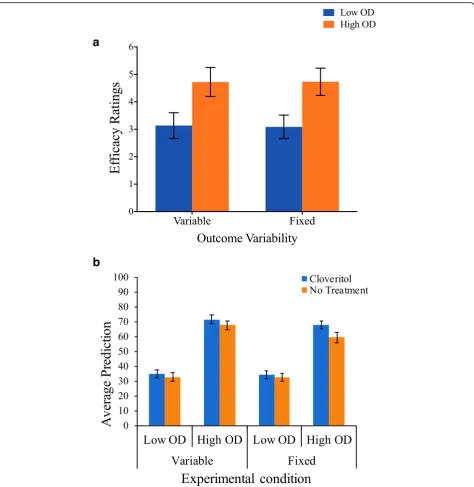
Treatment efficacy rating, the critical dependent vari-able, is shown in Fig. 3(a) as a function of OD and out-come variability. We ran a 2 (OD: high vs. low) × 2 (Outcome variability: fixed vs. variable) between-subject ANOVA and found a main effect of OD (F(1,108) = 11.3,
p= .001, and ηp2= .094), such that participants in the high OD condition (M= 4.73 and SD = 2.69) reported significantly greater efficacy ratings than participants in the low OD condition (M= 3.11 and SD = 2.34).
Critically, we found no significant interaction effect between OD and outcome variability (F(1,108) = .004,
p= .953, and ηp2< .001), suggesting that fixed and variable outcomes produce equivalent OD effects. Indeed, significant OD effects were found when participants were presented with variable outcomes (F(1,108) = 5.43, p= .022, and ηp2= .048), as well as when they were presented with fixed outcomes (F(1,108) = 5.83,
p= .017, andηp2= .051).
Average prediction at test
Figure3(b) illustrates the average prediction of Cloveri-tol and no treatment across the low and high OD condi-tions for participants in the fixed and variable outcome variability conditions. A mixed-model ANOVA with OD (high vs. low) and outcome variability (fixed vs. variable) as between-subject factors and cue type (Cloveritol vs. no treatment) as a within-subject factor revealed a main effect of cue type, where mean predictions for Cloveritol (M= 52.1 and SD = 22.7) were higher than for no treat-ment (M= 48.1 and SD = 22.1; F(1,108) = 6.374, p= .013, and ηp2= .056), suggesting illusory causation was present. However this effect of cue type did not interact with OD (F(1,108) = 2.00, p= .160, and ηp
2
= .018); that is the difference between Cloveritol and no treatment test trials was not larger for the high OD relative to the low OD condition (such an interaction would indicate an OD effect on this measure). There was also no inter-action between cue type and outcome variability (F <1), nor was there a three-way interaction between cue type, outcome variability and OD (F <1).
Predictions across training
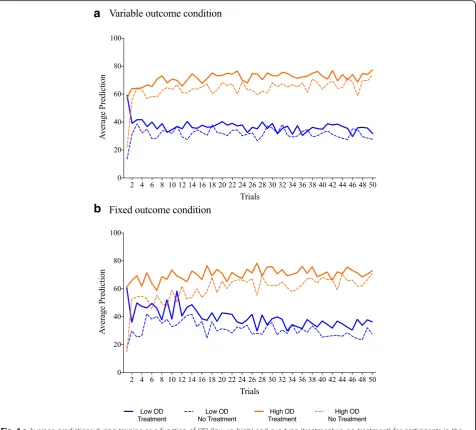
Figure 4 shows mean predictions for the 50 treatment cue trials and 50 no treatment trials during training. The analysis for training predictions was conducted with a mixed-model ANOVA with OD (low vs. high) and out-come variability (fixed vs. variable) as between-subject factors, and cue type (Cloveritol vs. no treatment) and trials (50) as within-subject factors. Like the average pre-dictions at test, there was a consistent difference in mean prediction for the two cue types, with significantly higher predictions for Cloveritol trials (M= 54.6 and SD = 27.1) compared to no treatment trials (M= 46.6 and SD = 27.2; F(1,108) = 58.5, p< .001, and ηp
2 = .351). Again, this effect of cue type did not interact with OD (F < 1) or outcome variability (F(1,108) = 1.96, p= .165, and ηp
2
= .018), nor was there a three-way interaction between these variables (F <1).
Discussion
for the treatment cue relative to no treatment (i.e., illusory causation). Outcome predictions were on average higher for treatment cue trials than for no treatment trials, but this bias was no larger for high OD than for low OD conditions. Ratings of the effectiveness of the cue in causing the out-come constitute the most widely used measure of OD in the literature, and we found strong evidence of OD effects on our version of this measure. We, therefore, consider this result to be highly consistent with those of previous studies that have used discrete binary outcomes.
Experiment 1 showed that the use of variable out-comes during training did not significantly alter the re-sults relative to a contingency learning task with fixed-magnitude outcomes, akin to binary outcomes typ-ically presented in these tasks. However, although our bimodal outcome distribution included some variability around a low and high central value, it still lacked am-biguous outcomes (e.g., a value around 50 on a scale of 0–100) and thus, may still be easy to categorise in a bin-ary fashion. For instance, all experienced outcomes
a
b
could be readily categorised into a low (e.g., a value around 20) and a high magnitude (e.g., a value around 80). The ease with which these outcomes could be dichot-omised arguably limits the ecological validity of the ex-periment. In many real-life situations, the representation of the outcome is considerably more complex and in-cludes both variability and ambiguity and is, thus, more difficult to classify neatly into discrete categories. Experi-ment 2, therefore, tested for the same OD effects in illu-sory causation but using a unimodal outcome distribution, in which participants experience a full range of outcome values on a linear scale of 1–99, including intermediate outcomes that are neither low nor high (e.g., they are around the midpoint of the scale).
Experiment 2
Experiment 2 was mostly identical in procedure to Ex-periment 1, with changes to the way in which the out-comes presented to participants were distributed. Instead of a bimodal distribution with values centred around 20 and 80, participants experienced outcome values sourced from a single skewed distribution, with values ranging from 1 to 99, but with a modal value that was either high or low. Like Experiment 1, participants in the low OD condition experienced a majority of low magnitude outcomes with some high magnitude out-comes, and this was reversed for participants in the high OD condition. All outcomes presented were independ-ent of the cue. A cindepend-entral difference between the
a
b
distribution used in Experiment 2 compared to the vari-able outcome condition of Experiment 1 is the addition of ambiguous outcome values around the mid-range of the scale that are less readily classifiable as low magni-tude or high magnimagni-tude outcomes. The procedure, thus, arguably has greater ecological validity. We were inter-ested in determining whether we could still obtain OD biases in a contingency learning task with continuous and variable outcomes sampled from a complete range of values, some of which are more decipherable to the participants than others (i.e., intermediate values are more ambiguous given the instructions).
Method
Participants
Altogether, 56 participants (35 female, Mage= 22.9 years, and SD = 4.44 year) completed the study for a partial course credit or monetary reimbursement. All partici-pants were allocated to one of two experimental condi-tions according to time of arrival (n= 28 in each).
Design
The study used a between-subject design with OD (low vs. high OD) as the only manipulation. For the low OD condition, the sample of observed outcomesOwas posi-tively skewed, created using a truncated ex-Gaussian dis-tribution with a higher proportion of low magnitude outcomes (distribution parameters: μ= 10, σ= 5, τ= 25, and range = 1–99, yielding sample mean = 32 and SD = 20). For the high OD condition, we took the comple-ment of this same distribution (i.e., 100–O) to produce a negatively skewed distribution with a higher
proportion of high magnitude outcomes (sample mean = 68 and SD = 20). A sample of values from this distribu-tion was randomly generated but with the further con-straint on the proportion of trials with an outcome value below 50: participants in the low OD condition experi-enced 80% of trials with outcomes below 50, whereas participants in the high OD condition only experienced 20% of trials with outcomes below a value of 50. Ratings of treatment efficacy presented in the test were modified to capture a greater variance in responses, with values ranging from −100 (effectively worsens recovery) to +100 (effectively improves recovery) with a midpoint of 0 (completely ineffective). This modification in Experi-ment 2 allowed meaningful comparisons to be made be-tween the group means and 0, the midpoint of the scale, whereas 0 represented an extreme end of the scale in Experiment 1. It is also possible that some participants judge that the drug actually makes health improvement less likely (a negative efficacy rating) since the base rate of recovery without the drug was quite high.
All participants received identical causal instructions and the procedure of the study was identical to that of Experiment 1.
Results and discussion
Efficacy ratings at test
Treatment efficacy rating was the critical dependent vari-able for observing OD effects; these are shown in Fig.5
(right). A one-way ANOVA comparing low vs. high OD revealed a main effect of OD (F(1,54) = 4.54,p= .038, and ηp2
= .078), such that participants in the high OD condi-tion (M= 33.6 and SD = 31.7) reported significantly
greater efficacy ratings than participants in the low OD condition (M= 16.5 and SD = 28.3).
Average prediction at test
Figure 5 (left) illustrates the average prediction of Cloveritol and no treatment for participants in low and high OD conditions. Mixed-model ANOVA with OD (low vs. high) as a between-subject factor and cue type (Cloveritol vs. no treatment) as a within-subject factor revealed a similar pattern of results to that in Experi-ment 1. Mean predictions for Cloveritol (M= 56.9 and SD = 17.8) were higher than for no treatment (M= 44.8 and SD = 18.0; F(1,54) = 24.4, p< .001, and ηp2= .311), indicative of an illusory causation effect. Although the interaction between cue type and OD did not reach sig-nificance (F(1,54) = 3.06, p= .086, and ηp2= .054), the marginal p value suggests that the difference in predic-tion ratings for Cloveritol and no treatment was slightly larger in magnitude in the high OD relative to the low OD group, consistent with OD predictions.
Predictions across training
Figure6shows mean predictions for the 50 treatment cue trials and 50 no treatment trials during training. A mixed-model ANOVA with OD (low vs. high) as a between-subject factor and cue type (Cloveritol vs. no treatment) and trials (50) as a within-subject factor found a consistent difference in mean prediction for the two cue types, with significantly higher predictions in Cloveritol trials (M= 53.8 and SD = 24.9) compared to no treatment trials (M= 48.9 and SD = 24.5;F(1,54) = 24.1,p< .001, and ηp
2
= .309). This effect of cue type, which is indicative of an illusory causation effect, was not different for the high OD relative to the low OD condition. Hence, we did not
find an OD effect on this measure (F(1,54) = .151,p= .699, andηp
2 = .003).
These results are, thus, highly consistent with those of Experiment 1. In this case, we used a skewed uni-modal distribution of outcomes in which many trials ended with intermediate consequences that are not as easy to classify as a discrete outcome (e.g., good vs. bad). Nevertheless, we still observed evidence of illu-sory causation across all measures and an OD effect in causal ratings.
General discussion
In both experiments we found support for the use of variable outcomes in generating OD effects, with greater efficacy ratings in the high OD relative to the low OD condition. In particular, we found that vari-ability (Experiment 1) and ambiguity (Experiment 2) in the outcomes presented to participants did not alter the systematic biases associated with the OD ef-fect. Importantly, these findings indicate that the OD effect is comparable when using variable outcomes to when using fixed-value outcomes (analogous to discrete events), indicating that OD effects are not confined to simplified binary outcomes. We consist-ently found an illusory causation effect, indexed by higher prediction ratings for Cloveritol relative to no treatment, and overall positive causal judgments about the efficacy of the treatment relative to no treatment. While researchers have explored causal learning using causes and effects that vary continuously (e.g., Soo & Rottman, 2018), to our knowledge this is the first demonstration of illusory causation and illusory cor-relation more broadly, using continuous and variable outcomes.
As anticipated, the evidence for OD effects in this study was largely confined to efficacy ratings. While there were consistent differences in the mean predic-tions for Cloveritol and no treatment during training and at test, suggestive of illusory causation, these differ-ences were no greater in the high OD group than in the low OD group. Most studies on OD effects have relied only on causal or efficacy ratings at test as a measure of causal illusion. Indeed, studies that have examined pre-dictions made during training have not always found strong evidence for OD effects, revealing potentially im-portant discrepancies between the decision processes made during training and judgments of causality assessed at the end of training (e.g., Blanco & Matute,
2015; Dèttore & O’Connor, 2013; Waldmann, 2001). Some authors have argued that the dissociation between prediction and causal judgments occurs because these measures are incomparable (Vadillo et al.,2011); predic-tions during training are typically binary and summed across the training procedure (proportion of “yes” re-sponses to the question Will the patient recover? Yes/ no), whereas causal judgments are made on a linear nu-merical scale. That we have observed the same dissoci-ation between causal judgments and predictions made using a linear numerical scale suggests that this argu-ment is insufficient to account for the dissociation. Im-portantly for our purposes, the discrepancy between prediction and causal judgments is not uncommon in contingency learning literature, suggesting that the current experimental design did not produce unlawful variations in illusory causation effects (Matute et al.,
2002; Shou & Smithson, 2015; Vadillo et al., 2005; Vadillo & Matute, 2011).
Our results suggest that illusory causation and the OD effect, in particular, do not depend on processing events in a small number of artificially defined trial types like those illustrated in Table 1. This is important for con-firming the validity of contingency learning procedures as laboratory models for the development of causal be-liefs in the real world, but it also has theoretical implica-tions. Viable theoretical approaches to causal learning ought to provide a tractable account of illusory correl-ation effects, explain why they are sensitive to OD, and be applicable to situations involving both discrete and continuous outcomes. Some existing theoretical ap-proaches may be better placed than others to satisfy these constraints. For instance, theorists have shown that associative learning can account for both illusory causation and the OD effect as biases that emerge early in learning and which are corrected over time with greater experience (Matute et al.,2015). This analysis re-volves around updating the associative values of the treatment cue and the context by comparing the out-come prediction (a continuous value) against a binary
teaching signal, usually set to 1 or 0 to represent the presence or absence of a discrete outcome. However, learning algorithms of this kind operate in essentially the same way when continuous values are used for the teaching signal, for instance values that are directly pro-portional to the magnitude of the outcome. In principle, the same biases early in learning should still be observed in this implementation. It is also possible that other models of causal learning that, in principle, offer expla-nations for illusory causation and OD effects, such as Griffiths and Tenenbaum’s (2005) causal support theory, can be easily modified for learning about continuous outcomes. However, this remains a goal for future re-search and theory development.
Notwithstanding the argument above, one might as-sume that learners have a natural tendency to parse con-tinuous outcome events into discrete outcome categories, and that it is this process that gives rise to the OD effect. Participants might spontaneously classify continuous events in discrete terms if doing so enabled them to decide whether outcome information was con-sistent with or contrary to their current causal hypoth-esis. This seems relatively plausible for Experiment 1, where the distribution of outcome magnitudes was bi-modal and high and low outcomes were distinctly sepa-rated, even when variability was introduced to the precise magnitudes observed in each trial. It is less clear that it would be an obvious or indeed useful strategy for partici-pants to adopt in Experiment 2, where the distribution of outcome magnitudes was unimodal. Nevertheless, even in this design, when confronted with ambiguous outcome magnitudes around the middle of the range, it is possible that the learner spontaneously classifies the outcome as being part of a high or low category, in which case they may do so in a way that is biased towards their current causal beliefs (e.g., an outcome around 50 counts as good recovery if Cloveritol was administered but is regarded as poor recovery if no treatment was delivered).
probability of recovery as a long-term outcome is high. However, the rate of recovery and the persistence of un-pleasant symptoms during recuperation are highly vari-able outcomes and are not necessarily easy for the patient or health practitioner to classify in a discrete fashion. Thus, our experimental approach provides a more realistic laboratory model for common day-to-day causal beliefs that impact on decisions we make about health and medical treatments.
An understanding of the role cognitive biases play in in-fluencing how we learn about causal relationships is im-portant as it allows us to recognise the many ways in which we are biased to form erroneous associations be-tween events. Findings from this set of experiments sug-gest that even when the outcomes are difficult to classify into neat categories, people still show a bias to detect pat-terns of causality where there is none, and this bias is fur-ther inflated by factors that increase the rate of cue– outcome coincidences. As alluded to in the introduction, the overestimation of a causal relationship between unre-lated events is particularly problematic when the errone-ous belief is used to guide subsequent behaviours. To illustrate, although the efficacy of some CAM treatments, and the “science” behind them, remain highly debated, CAM has evolved to be a commercially successful indus-try, where users are willing to pay hefty treatment costs without insurance coverage. In Australia, a wide variety of medications are made affordable for the consumer through subsidies provided by the Pharmaceutical Benefits Scheme (PBS). CAM treatments are not routinely funded under the PBS, partly because of their weak evidence base. Even so, consumer expenditure on alternative therapies approached $3.5 billion (Complementary Medicines Australia,2014), approximately $1.8 billion more than pa-tient expenditure on PBS-funded medications, which ap-proximated $1.5 billion in the same year (Department of Health, 2015). Out-of-pocket expenditure on CAM ser-vices is even greater in the United States, with the average user spending approximately $435 a year on complemen-tary health approaches (Nahin et al., 2016). Although some may argue that CAM is at best harmless, research into pseudo-medicine administered to Australian children found that most fatalities related to CAM were a result of the failure to use, or rejection of, conventional medicine in favour of CAM therapies (Lim, Cranswick, & South,
2010). This suggests that illusory causation in the context of health therapies can no longer be perceived as harmless when errors in causal learning may lead to dire conse-quences. It is, therefore, pertinent that we understand the mechanisms behind these cognitive biases and how we can prevent harmful illusions from developing. To do this, we first need to test these effects in an ecologically valid manner that reflects actual experiences of cue–outcome relationships in the real world.
Conclusions
In summary, researchers may benefit from adopting a contingency learning paradigm with continuous and variable outcome events that is more ecologically sound, particularly when investigating false causal beliefs in medicine and public health where the consequences of choosing the wrong treatment as a result of biased con-tingency judgments could have detrimental effects (Freckelton, 2012). This experimental approach may be an important stepping stone to bridging the gap between experimental research and real-world experience.
Additional file
Additional file 1:Summary file containing deindividualized data, including ratings for all Cloveritol and No treatment trials during training, and ratings at test for Experiments 1 and 2. (XLSX 86 kb)
Abbreviations
CAM:Complementary and alternative medicine; OD: Outcome density; PBS: Pharmaceutical Benefits Scheme; SD: Standard deviation
Funding
This research was supported by Discovery Grant DP160102871 from the Australian Research Council.
Availability of data and materials
The dataset supporting the conclusions of this article is included within the article (and its Additional file1).
Authors’contributions
JC contributed to study design, data collection, analyses, and manuscript preparation. EL and BC contributed to study design and manuscript preparation. All authors read and approved the final manuscript.
Ethics approval and consent to participate
The ethical aspects of this study were approved by the University of Sydney Human Research Ethics Committee under protocol 2017/839. Participants involved in the study provided written consent to the collection and publication of aggregated responses before participating in the study.
Consent for publication Not applicable.
Competing interests
The authors declare that they have no competing interests in the publication of this article.
Publisher’s Note
Springer Nature remains neutral with regard to jurisdictional claims in published maps and institutional affiliations.
Received: 10 October 2018 Accepted: 11 December 2018
References
Allan, L. G. (1980). A note on measurement of contingency between two binary variables in judgment tasks.Bulletin of the Psychonomic Society,
15(3), 147–149.
Allan, L. G., & Jenkins, H. M. (1983). The effect of representations of binary variables on judgment of influence.Learning and Motivation,14(4), 381–405. Allan, L. G., Siegel, S., & Tangen, J. M. (2005). A signal detection analysis of
Alloy, L. B., & Abramson, L. Y. (1979). Judgment of contingency in depressed and nondepressed students: Sadder but wiser?Journal of Experimental Psychology: General,108(4), 441.
Barrett, B., Brown, R., Rakel, D., Mundt, M., Bone, K., Barlow, S., & Ewers, T. (2010).
Echinaceafor treating the common cold: a randomized trial.Annals of Internal Medicine,153(12), 769–777.
Blanco, F. (2017). Positive and negative implications of the causal illusion.
Consciousness and Cognition,50, 56–68.
Blanco, F., Barberia, I., & Matute, H. (2014). The lack of side effects of an ineffective treatment facilitates the development of a belief in its effectiveness.PloS one,
9(1), e84084.
Blanco, F., & Matute, H. (2015). Exploring the factors that encourage the illusions of control: the case of preventive illusions.Experimental Psychology, 62(2), 131–142.
Blanco, F., Matute, H., & Vadillo, M. A. (2013). Interactive effects of the probability of the cue and the probability of the outcome on the overestimation of null contingency.Learning & Behavior,41(4), 333–340.
Brainard, D. H. (1997). The psychophysics toolbox.Spatial Vision,10, 433–436. Complementary Medicines Australia. (2014, 31 July).In Good Health: 2014
Complementary Medicines Industry Survey[Brochure]. Retrieved fromhttp:// www.cmaustralia.org.au/resources/Documents/Reports/
CMA%20Industry%20Audit%202014.pdf. Accessed 25 June 2018.
Department of Health (2015).Expenditure and prescriptions twelve months to 30 June 2014, (pp. 1–37). Canberra: PBS Information Management Section,
Pharmaceutical Policy Branch Retrieved fromhttp://www.pbs.gov.au/statistics/ 2013-2014-files/expenditure-and-prescriptions-12-months-to-30-june-2014.pdf. Dèttore, D., & O’Connor, K. (2013). OCD and cognitive illusions.Cognitive Therapy
and Research,37(1), 109–121.
Dossett, M. L., Davis, R. B., Kaptchuk, T. J., & Yeh, G. Y. (2016). Homeopathy use by US adults: results of a national survey.American Journal of Public Health,
106(4), 743–745.
Freckelton, I. (2012). Death by homeopathy: issues for civil, criminal and coronial law and for health service policy.Journal of Law and Medicine,19(3), 454–478. Griffiths, T. L., & Tenenbaum, J. B. (2005). Structure and strength in causal
induction.Cognitive Psychology,51(4), 334–384.
Hamilton, D. L., & Gifford, R. K. (1976). Illusory correlation in interpersonal perception: A cognitive basis of stereotypic judgments.Journal of Experimental Social Psychology,12(4), 392–407.
Jenkins, H. M., & Ward, W. C. (1965). Judgment of contingency between responses and outcomes.Psychological Monographs: General and Applied,79(1), 1. Karsch-Völk, M., Barrett, B., Kiefer, D., Bauer, R., Ardjomand-Woelkart, K., & Linde, K.
(2014).Echinaceafor preventing and treating the common cold.The Cochrane database of systematic reviews, 2, CD000530.
Langer, E. J. (1975). The illusion of control.Journal of Personality and Social Psychology,32(2), 311–328.
Lassiter, G. D. (2002). Illusory causation in the courtroom.Current Directions in Psychological Science,11(6), 204–208.
Le Pelley, M. E., Reimers, S. J., Calvini, G., Spears, R., Beesley, T., & Murphy, R. A. (2010). Stereotype formation: Biased by association.Journal of Experimental Psychology: General,139(1), 138.
Lilienfeld, S. O., Ritschel, L. A., Lynn, S. J., Cautin, R. L., & Latzman, R. D. (2014). Why ineffective psychotherapies appear to work: A taxonomy of causes of spurious therapeutic effectiveness.Perspectives on Psychological Science,9(4), 355–387. Lim, A., Cranswick, N., & South, M. (2010). Adverse events associated with the use
of complementary and alternative medicine in children.Archives of Disease in Childhood, 96(3), 297–300.
Marsh, J. K., & Ahn, W. K. (2009). Spontaneous assimilation of continuous values and temporal information in causal induction.Journal of Experimental Psychology: Learning, Memory, and Cognition,35(2), 334.
Matute, H., Blanco, F., Yarritu, I., Díaz-Lago, M., Vadillo, M. A., & Barberia, I. (2015). Illusions of causality: how they bias our everyday thinking and how they could be reduced.Frontiers in Psychology,6, 888.
Matute, H., Vegas, S., & De Marez, P.-J. (2002). Flexible use of recent information in causal and predictive judgments.Journal of Experimental Psychology: Learning, Memory, and Cognition,28(4), 714.
Matute, H., Yarritu, I., & Vadillo, M. A. (2011). Illusions of causality at the heart of pseudoscience.British Journal of Psychology,102(3), 392–405.
Nahin, R. L., Barnes, P. M., & Stussman, B. J. (2016). Expenditures on
complementary health approaches: United States, 2012. InNational Health Statistics Reports. Hyattsville: National Center for Health Statistics.
Pelli, D. G. (1997). The VideoToolbox software for visual psychophysics: Transforming numbers into movies.Spatial Vision,10(4), 437–442. Rottman, B. M., Marcum, Z. A., Thorpe, C. T., & Gellad, W. F. (2017). Medication
adherence as a learning process: insights from cognitive psychology.Health Psychology Review,11(1), 17–32.
Shanks, D. R., & Dickinson, A. (1988). Associative accounts of causality judgment.
Psychology of Learning and Motivation,21, 229–261.
Shou, Y., & Smithson, M. (2015). Effects of question formats on causal judgments and model evaluation.Frontiers in Psychology,6, 467.
Soo, K. W., & Rottman, B. M. (2018). Causal strength induction from time series data.Journal of Experimental Psychology: General,147(4), 485.
U.S. Food and Drug Administration (2017).FDA proposes new, risk-based enforcement priorities to protect consumers from potentially harmful, unproven homeopathic drugs [News Release]. Silver Spring: Author Retrieved from https://www.fda.gov/newsevents/newsroom/pressannouncements/ ucm589243.htm.
Vadillo, M. A., Miller, R. R., & Matute, H. (2005). Causal and predictive-value judgments, but not predictions, are based on cue-outcome contingency.
Learning & Behavior,33(2), 172–183.
Vadillo, M. A., Musca, S. C., Blanco, F., & Matute, H. (2011). Contrasting cue-density effects in causal and prediction judgments.Psychonomic Bulletin & Review,18(1), 110–115.
Waldmann, M. R. (2001). Predictive versus diagnostic causal learning: Evidence from an overshadowing paradigm.Psychonomic Bulletin & Review,8(3), 600–608. Wasserman, E. (1990). Detecting response-outcome relations: Toward an
understanding of the causal texture of the environment.Psychology of Learning and Motivation,26, 27–82.
Wasserman, E. A., Kao, S. F., Van Hamme, L. J., Katagiri, M., & Young, M. E. (1996). Causation and association. In D. R. Shanks, K. Holyoak, & D. L. Medin (Eds.),
Causal learning, (pp. 207–264). San Diego: Academic Press.