R E S E A R C H
Open Access
Iterative methods for triple hierarchical
variational inequalities and common fixed
point problems
DR Sahu
1, Shin Min Kang
2*, Vidya Sagar
1and Satyendra Kumar
1 *Correspondence:2Department of Mathematics and RINS, Gyeongsang National University, Jinju, 660-701, Korea Full list of author information is available at the end of the article
Abstract
The purpose of this paper is to introduce a new iterative scheme for approximating the solution of a triple hierarchical variational inequality problem. Under some requirements on parameters, we study the convergence analysis of the proposed iterative scheme for the considered triple hierarchical variational inequality problem which is defined over the set of solutions of a variational inequality problem defined over the intersection of the set of common fixed points of a sequence of nearly nonexpansive mappings and the set of solutions of the classical variational inequality. Our strong convergence theorems extend and improve some known corresponding results in the contemporary literature for a wider class of nonexpansive type
mappings in Hilbert spaces. MSC: 47J20; 47J25
Keywords: metric projection mapping; nonexpansive mapping; sequence of nearly nonexpansive mappings; triple hierarchical variational inequality
1 Introduction
The classical variational inequality problem initially studied by Stampacchia [] for a non-linear operatorA:C→His a problem which provides us suchx∗∈Dwhich satisfies
Ax∗,y–x∗≥, ∀y∈D, (.)
whereCis a nonempty closed convex subset of a real Hilbert spaceHandDis a nonempty closed convex subset ofC. The variational inequality (.) is denoted byVID(C,A). The set
of solutions of (.) is denoted byD(C,A), that is,
D(C,A) =
x∗∈D:Ax∗,y–x∗≥,∀y∈D.
ForC=D, we useVI(C,A) :=VID(C,A) and(C,A) :=D(C,A).
In the framework of variational inequality problems, various problems arising in several branches of pure and applied sciences can be studied (see [, ]).
The equivalence relation between the variational inequality and fixed point problems can be seen by projection technique which plays an important role in developing an impor-tant role in developing some efficient methods for solving variational inequality problems
and related optimization problems. The problem of finding the fixed points of a nonexpan-sive mapping is the subject of current interest related to variational inequality problems in functional analysis.
Over the set of fixed points of a nonexpansive mapping, several authors (see [–]etc.) have studied the variational inequality problem in a particular manner. This kind of vari-ational inequality is named a hierarchical varivari-ational inequality; it is defined as follows:
Findx∗∈F(S) such that(I–T)x∗,y–x∗≥, ∀y∈F(S),
whereTandSare two nonexpansive mappings from a nonempty closed convex subsetC
of a real Hilbert spaceHinto itself, andF(S) denotes the set of fixed points of the map-pingS. One can easily observe thatVIF(S)(C,I–T) is equivalent to the fixed point problem
x∗=PF(S)(Tx∗), that is,x∗is a fixed point of the nonexpansive mappingPF(S)(T), wherePF(S) is the metric projection fromHonto a nonempty closed convex subsetF(S) ofH.
After all, in the scenario of variational inequality problem, we eagerly discuss such kind of variational inequality problem which is defined over the set of solutions of a variational inequality and the set of fixed points of a nonexpansive mapping, having a triple structure in contrast with bilevel programming problems or hierarchical constrained optimization problems or hierarchical fixed point problems. This kind of variational inequality is called the triple hierarchical variational inequality (see [, ]), which is also called the triple hi-erarchical constrained optimization problem (see []), and it is defined as follows:
Findx∗∈F(S)(C,A) such that
Fx∗,y–x∗≥, ∀y∈F(S)(C,A), (.)
whereF(S)(C,A) is the set of solutions ofVIF(S)(C,A)=∅, and mappingsA,F, andSare in-verse strongly monotone, strongly monotone and Lipschitz continuous, and nonexpansive from a nonempty closed convex subsetCof a real Hilbert spaceHinto itself, respectively. IfF(S)(C,I–T) is nonempty, then the metric projectionPF(S)(C,I–T)is well defined. The minimum norm solutionx∗ofVIF(S)(C,I–T) exists uniquely and is exactly the nearest point projection of the origin toF(S)(C,I–T), that is,x∗=PF(S)(C,I–T)(). Alternatively, x∗is the unique solution of the quadratic minimization problem:
x∗=min x :x∈F(S)(C,I–T)
.
Finding of this minimum norm solutionx∗is an interesting problem. In this context, Yao
et al.[] proposed two iterative schemes in an implicit and an explicit both ways to find the minimum norm solutionx∗ofVIF(S)(C,I–T). They proved two strong convergence results by regularizing the nonexpansive mappingT using contractions.
In , the first author introduced the class of nearly nonexpansive mappings [, ] which is an important generalization of the class of nonexpansive mappings. LetC
be a nonempty subset of a Banach spaceX. Fix a sequence{an}in [,∞) withan→.
A mappingT:C→Cis said to be nearly nonexpansive with respect to the sequence{an}
if for eachn∈N,
Tnx–Tny≤ x–y +an for allx,y∈C.
We now discuss the notion of the sequence of nearly nonexpansive mappings.
LetC be a nonempty subset of a Banach spaceX. LetT :={Tn}∞n= be a sequence of mappings fromCinto itself. We denote byF(T) the set of common fixed points of the sequenceT, that is,F(T) =∞n=F(Tn). Fix a sequence{an}in [,∞) withan→, and let {Tn}be a sequence of mappings fromCintoX. Then the sequenceT :={Tn}is called a
sequence of nearly nonexpansive mappings (see []) with respect to a sequence{an}if
Tnx–Tny ≤ x–y +an for allx,y∈Candn∈N.
Clearly, the sequence of nearly nonexpansive mappings can easily be seen to be a wider class of sequence of nonexpansive mappings.
Motivated and inspired by the works mentioned above, we introduce an explicit itera-tive scheme that generates a sequence and prove that this sequence converges strongly to a unique solution of the considered triple hierarchical variational inequality problem de-fined over the set of solutions of a variational inequality problem which is dede-fined over the intersection of the set of common fixed points of a sequence of nearly nonexpansive map-pings and the set of solutions of the classical variational inequality problem. Our results generalize the result of Cenget al.[] in the context of the sequence of nearly nonexpan-sive mappings and in some other remarkable senses. Our results also extend the result of Yaoet al.[] and many other related works.
2 Preliminaries
Throughout this paper, we denote by→andthe strong convergence and weak conver-gence, respectively. The symbolNstands for the set of all natural numbers andωw({xn})
denotes the set of all weak limits of the sequence{xn}.
LetCbe a nonempty subset of a real Hilbert spaceHwith inner product·,·and norm
· , respectively. A mappingT:C→His called
() monotone if
Tx–Ty,x–y ≥ for allx,y∈C,
() η-strongly monotone if there exists a positive real numberηsuch that
Tx–Ty,x–y ≥η x–y for allx,y∈C,
() α-inverse strongly monotone if there exists a positive real numberαsuch that
() k-Lipschitzian if there exists a constantk> such that
Tx–Ty ≤k x–y for allx,y∈C,
() ρ-contraction if there exists a constantρ∈(, )such that
Tx–Ty ≤ρ x–y for allx,y∈C,
() nonexpansive if Tx–Ty ≤ x–y for allx,y∈C,
() λ-strictly pseudocontractive if there existsλ∈[, )such that
Tx–Ty ≤ x–y +λ(I–T)x– (I–T)y for allx,y∈C,
whereIis the identity mapping. Note that ifT:C→Hisλ-strictly
pseudocontractive, then the mappingA:=I–Tis –λ-inverse strongly monotone.
LetC be a nonempty closed convex subset ofH. Then, for anyx∈H, there exists a unique nearest point inC, denoted byPC(x), such that
x–PC(x)=inf x–y =:d(x,C) for ally∈C.
The mappingPCis called the metric projection fromHontoC(see Agarwalet al.[]
for some other information related toPC).
LetA:C→Hbe a monotone andk-Lipschitz continuous mapping and letNC(v) be the
normal cone toCatv∈C,i.e.,
NC(v) =
w∈H:v–y,w ≥ for ally∈C.
Define
Tv= ⎧ ⎨ ⎩
Av+NC(v), ifv∈C, ∅, ifv∈/C.
ThenT is a maximal monotone and ∈Tvif and only ifv∈(C,A).
LetCbe a nonempty subset of a real Hilbert spaceHand letT,T:C→Hbe two map-pings. We denoteB(C), the collection of all bounded subsets ofC. The deviation between
TandTonB∈B(C) [], denoted byDB(T,T), is defined by
DB(T,T) =sup
Tx–Tx :x∈B
.
The following lemmas will be needed to prove our main results.
Lemma .([]) The metric projection mapping PCis characterized by the following prop-erties:
(i) PC(x)∈Cfor allx∈H;
(ii) x–PC(x),PC(x) –y ≥for allx∈Handy∈C;
Lemma .([]) Let C be a nonempty subset of a real Hilbert space H.Suppose that λ∈(, )andμ> .Let F:C→H be a k-Lipschitzian andη-strongly monotone operator
on C.Define the mapping W:C→H by
Wx=x–λμF(x) for all x∈C.
Then W is a contraction providedμ<kη.More precisely,forμ∈(,
η
k), Wx–Wy ≤( –λτ) x–y for all x,y∈C,
whereτ = – –μ(η–μk)∈(, ].
Lemma .([]) Let T be a nonexpansive self-mapping of a nonempty closed convex sub-set C of a real Hilbert space H.Then I–T is demiclosed at zero,i.e.,if{xn}is a sequence in C weakly converging to some x∈C and the sequence{(I–T)xn}strongly converges to, then x∈F(T).
Lemma .([]) Assume{sn}is a sequence of nonnegative real numbers such that
sn+≤( –αn)sn+αnβn for all n∈N,
where{αn}and{βn}are sequences of nonnegative real numbers which satisfy the condi-tions:
(i) {αn}∞n=⊂(, )and ∞
n=αn=∞; (ii) lim supn→∞βn≤,or
(ii) ∞n=αnβnis convergent.
Thenlimn→∞sn= .
Lemma .([]) Let C be a nonempty closed convex subset of a real Hilbert space H and letλi> (i= , , , . . . ,N)such that
N
i=λi= .Let T,T,T, . . . ,TN :C→C be nonex-pansive mappings withNi=F(Ti)=∅and let T=
N
i=λiTi.Then T is nonexpansive from C into itself and F(T) =Ni=F(Ti).
Proposition .([]) Let C be a nonempty subset of a real Hilbert space H.Let A:C→H be anα-inverse strongly monotone mapping.Then,the mapping(I–tA)is nonexpansive from C into H,if≤t≤α.
3 Main results
Theorem . Let C be a nonempty closed convex subset of a real Hilbert space H.Let
F:C→H be a k-Lipschitzian andη-strongly monotone operator,and g:C→H be a
ρ-contraction mapping.Let S:C→C be a nonexpansive mapping and A:C→H be an α-inverse strongly monotone mapping.LetT ={Tn}be a sequence of nearly nonexpansive mappings from C into itself with respect to a sequence{an}such that
∞
n=DB(Tn,Tn+) <∞
τ = – –μ(η–μk).Assume that,the set of solutions of the hierarchical variational
inequality of finding z∗∈F(T)∩(C,A)such that
(μF–γS)z∗,z–z∗≥, ∀z∈F(T)∩(C,A), (.)
is nonempty.Consider the sequence{xn}in C for arbitrary x∈C,generated by the following
iterative process: ⎧
⎪ ⎪ ⎨ ⎪ ⎪ ⎩
x∈C,
yn=TnPC[xn–tnAxn],
xn+=PC[λnγ(αng(xn) + ( –αn)Sxn) + (I–λnμF)yn]
(.)
for all n∈N,where{αn},{λn}are sequences in(, ),and{tn}is a sequence in[a,b] (for some a,b with <a<b< α)satisfying the following conditions:
(i) limn→∞λn= ,limn→∞αn= and
∞
n=αnλn=∞; (ii) limn→∞|αnλn–ααn–λn–|
nλn = andlimn→∞
|λn–λn–|
αnλnλn– = ; (iii) limn→∞DB(Tn,Tn+)
αn+λn+
= for eachB∈B(C)and∞n=|tn+–tn|<∞; (iv) limn→∞λ
θ n
αn = ,limn→∞ an
αnλn= andlimn→∞
|tn–tn–|
αnλn = ; (v) there are constantsk¯> andθ> satisfying
x–Tnx ≥ ¯k
dx,F(T)∩(C,A)θ, ∀x∈Candn∈N.
If the generated sequence{xn}is bounded andlimn→∞ xn–PC[xnλn–tnAxn] = ,then it con-verges strongly to the point x∗∈F(T)∩(C,A),where x∗is the unique solution of the triple hierarchical variational inequality of finding x∗∈such that
(μF–γg)x∗,x–x∗≥, ∀x∈. (.)
Proof First of all, we assume that{xn}is bounded andlimn→∞ xn–PC[xnλn–tnAxn] = . We
divide the proof into several steps. Step .limn→∞ xn+–xn = .
Setun=λnγ(αng(xn) + ( –αn)Sxn) + (I–λnμF)ynandγn= ( –ρ)γ λnαn. Then, we have
un–un–=αnλnγ
g(xn) –g(xn–)
+λn( –αn)γ(Sxn–Sxn–) +(I–λnμF)yn– (I–λnμF)yn–
+ (αnλn–αn–λn–)γ
g(xn–) –Sxn–
+ (λn–λn–)(γSxn––μFyn–).
From (.), we have
xn+–xn =PC(un) –PC(un–)
≤ un–un–
+(I–λnμF)yn– (I–λnμF)yn– +|αnλn–αn–λn–|γg(xn–) –Sxn– +|λn–λn–| γSxn––μFyn–
≤αnλnγρ xn–xn– +λn( –αn)γ xn–xn–
+ ( –λnτ) yn–yn– +|αnλn–αn–λn–|M+|λn–λn–|M, (.)
whereMis a constant such that
M=sup
n∈N
γg(xn) –S(xn)+ γSxn–μFyn
.
Setzn:=PC(xn–tnAxn) andB={zn}. Since{xn}is bounded, it follows thatB∈B(C).
Now, we have
yn+–yn =Tn+PC(xn+–tn+Axn+) –TnPC(xn–tnAxn) ≤Tn+PC(xn+–tn+Axn+) –Tn+PC(xn–tnAxn)
+Tn+PC(xn–tnAxn) –TnPC(xn–tnAxn) ≤PC(xn+–tn+Axn+) –PC(xn–tnAxn)
+DB(Tn+,Tn) +an+
≤(xn+–tn+Axn+) – (xn–tnAxn)+DB(Tn+,Tn) +an+
≤ xn+–xn +|tn+–tn| Axn +DB(Tn+,Tn) +an+. (.)
From (.) and (.), we obtain
xn+–xn ≤αnλnγρ xn–xn– +λn( –αn)γ xn–xn– +|αnλn–αn–λn–|M+|λn–λn–|M+ ( –λnτ)
xn–xn– +DB(Tn,Tn–) +|tn–tn–| Axn– +an
= – ( –ρ)γ λnαn
xn–xn– +M
|αnλn–αn–λn–| +|λn–λn–|
+ ( –λnτ)
DB(Tn,Tn–) +|tn–tn–| Axn– +an
≤( –γn) xn–xn– +M
|αnλn–αn–λn–|+|λn–λn–|
+DB(Tn,Tn–) +N|tn–tn–|+an ≤( –γn) xn–xn– +γn
M
|
αnλn–αn–λn–|+|λn–λn–|
γn
+DB(Tn,Tn–)
γn
+N|tn–tn–|
γn
+an
γn
, (.)
where N =supn∈N{ Axn }. Note thatlimn→∞αannλn = and
∞
n=αnλn=∞. Therefore,
from conditions (ii), (iii), and Lemma ., we havelimn→∞ xn+–xn = .
Setdn= an zn–u +anandεn= λn γ(αng(xn) + ( –αn)Sxn) –μFu yn–u +dn.
One can observe that
zn–u =PC(xn–tnAxn) –PC(u–tnAu)
≤(xn–tnAxn) – (u–tnAu)
=(xn–u) –tn(Axn–Au)
≤ xn–u – tnxn–u,Axn–Au+tn Axn–Au ≤ xn–u –tn(α–tn) Axn–Au
≤ xn–u –a(α–b) Axn–Au .
We also have
yn–u = Tnzn–Tnu ≤ zn–u +an
≤ zn–u + an zn–u +an
= zn–u +dn.
From (.), we have
xn+–u =PC
λnγ
αng(xn) + ( –αn)Sxn
+ (I–λnμF)yn
–PC(u)
≤λnγ
αng(xn) + ( –αn)Sxn
+ (I–λnμF)yn–u
=λn
γαng(xn) + ( –αn)Sxn
–μFu+ (I–λnμF)(yn)
– (I–λnμF)(u) ≤λnγ
αng(xn) + ( –αn)Sxn
–μFu+ ( –λnτ) yn–u
≤λnγ
αng(xn) + ( –αn)Sxn
–μFu
+ ( –λnτ)
zn–u +dn
+ λn( –λnτ)γ
αng(xn) + ( –αn)Sxn
–μFu yn–u ≤λnγ
αng(xn) + ( –αn)Sxn
–μFu+ zn–u +εn ≤λnγ
αng(xn) + ( –αn)Sxn
–μFu+ xn–u
–a(α–b) Axn–Au +εn. (.)
Thus, we get
a(α–b) Axn–Au ≤λnγ
αng(xn) + ( –αn)Sxn
–μFu
+ xn–u – xn+–u
+εn ≤λnγ
αng(xn) + ( –αn)Sxn
–μFu
+ xn–xn+
xn–u + xn+–u
Sinceλn→,εn→ and xn+–xn → asn→ ∞, we obtain Axn–Au → as n→ ∞. From (.), we have
xn+–xn
λn ≤
( –γn)
xn–xn–
λn
+M(|αnλn–αn–λn–|+|λn–λn–|)
λn
+DB(Tn,Tn–)
λn
+N|tn–tn–|
λn
+an
λn
= ( –γn) xn
–xn–
λn–
+ ( –γn)
x
n–xn–
λn
– xn–xn–
λn–
+M(|αnλn–αn–λn–|+|λn–λn–|)
λn
+DB(Tn,Tn–)
λn
+N|tn–tn–|
λn
+an
λn
≤( –γn)
xn–xn–
λn–
+αnλn xn–xn–
αnλn
λn–
λn–
+Mαnλn(|αnλn–αn–λn–|+|λn–λn–|)
αnλn
+αnλn
D
B(Tn,Tn–)
αnλn
+N|tn–tn–|
αnλn
+ an
αnλn
.
Noticing thatlimn→∞αannλ
n = ,limn→∞
|tn–tn–|
αnλn = , and
∞
n=αnλn=∞. Thus, using
con-ditions (ii) and (iii), and applying Lemma ., we have
lim
n→∞
xn+–xn λn
= . (.)
Step . xn–zn → asn→ ∞.
Letu∈F(T)∩(C,A). Then using Lemma .(iv), we have
zn–u =PC(xn–tnAxn) –PC(u–tnAu) ≤(xn–tnAxn) – (u–tnAu),zn–u
=
(xn–tnAxn) – (u–tnAu)
+ zn–u
–(xn–tnAxn) – (u–tnAu) – (zn–u)
≤
xn–u + zn–u –(xn–zn) –tn(Axn–Au)
.
It follows that
zn–u ≤ xn–u – xn–zn
+ tnxn–zn,Axn–Au–tn Axn–Au . (.)
From (.) and (.), we have
xn+–u ≤λnγ
αng(xn) + ( –αn)Sxn
–μFu+ xn–u
which gives
xn–zn ≤λnγ
αng(xn) + ( –αn)Sxn
–μFu
+ xn–u – xn+–u
+ tnxn–zn,Axn–Au–tn Axn–Au +εn ≤λnγ
αng(xn) + ( –αn)Sxn
–μFu
+ xn–u + xn+–u
xn–xn+
+ tn xn–zn Axn–Au –tn Axn–Au +εn.
We have xn+–xn →,λn→,εn→, and Axn–Au → asn→ ∞. Therefore, we
have xn–zn → asn→ ∞.
Step . xn–Txn → asn→ ∞.
Sinceyn=Tnzn, we get
xn+–Tnzn =PC
λnγ
αng(xn) + ( –αn)Sxn
+ (I–λnμF)yn
–PC(Tnzn) ≤λnγ
αng(xn) + ( –αn)Sxn
+ (I–λnμF)yn–Tnzn
=λnγ
αng(xn) + ( –αn)Sxn
+yn–λnμFyn–Tnzn
=λnγ
αng(xn) + ( –αn)Sxn
–μFyn→ asn→ ∞.
It follows that
xn–yn = xn–Tnzn
≤ xn–xn+ + xn+–Tnzn → asn→ ∞. (.)
Also, we get
zn–Tnzn ≤ zn–xn + xn–Tnzn → asn→ ∞.
Note that
xn–Tnxn ≤ xn–Tnzn + Tnzn–Tnxn
≤ xn–Tnzn + zn–xn +an→ asn→ ∞.
Thus,
Txn–xn ≤ Txn–Tzn + Tzn–Tnzn + Tnzn–xn
≤ xn–zn +DB(Tn,T) + Tnzn–xn → asn→ ∞.
Step .ωw({xn})⊂F(T)∩(C,A).
Note thatAis anα-inverse strongly monotone mapping so that it isα-Lipschitz contin-uous. Therefore, we have
lim
Since{xn}is a bounded sequence inC, there exists a subsequence{xnk}of{xn}which
con-verges weakly to somexˆinC. Sincelimn→∞ xn–Txn = , it follows, from the
demiclosed-ness principle of nonexpansive mappings, thatxˆ∈F(T). Now, let us show thatxˆ∈(C,A). Let
Av= ⎧ ⎨ ⎩
Av+NC(v), ifv∈C, ∅, ifv∈/C.
Note thatAis maximal monotone and ∈Avif and only ifv∈(C,A). Let (v,w)∈G(A), the graph ofA. Then, we havew∈Av=Av+NC(v) and hencew–Av∈NC(v). Thus, we
have
w–Av,v–u ≥ for allu∈C.
On the other hand, fromzn=PC(xn–tnAxn) andv∈C, we have
xn–tnAxn–zn,zn–v ≥,
and hence
v–zn, zn–xn
tn
+Axn
≥.
Therefore, fromw–Av∈NC(v) andzni∈C, we have
v–zni,w ≥ v–zni,Av
≥ v–zni,Av–
v–zni, zni–xni
tni
+Axni
=v–zni,Av–Azni+v–zni,Azni–Axni
–
v–zni,
zni–xni tni
≥ v–zni,Azni–Axni–
v–zni, zni–xni
tni
.
Letting limitni→ ∞we obtainv–xˆ,w ≥. Thus,xˆ∈A– together with the maximal
monotonicity ofAimplyxˆ∈(C,A).
Step .lim supn→∞(μF–γg)x∗,xn–x∗ ≥.
From (.), we have
xn+=PC(un) –un+λnγ
αng(xn) + ( –αn)Sxn
+ (I–λnμF)yn.
Therefore, we have
xn–xn+=un–PC(un) +αnλn(μF–γg)xn+λn( –αn)(μF–γS)xn
+ ( –λn)(xn–yn) +λn
(I–μF)xn– (I–μF)yn
Setvn:=λxnn(––xnα+n),∀n∈N. Notexn=PC(un–). Then, we have
vn=
un–PC(un) λn( –αn)
+ αn –αn
(μF–γg)xn+ (μF–γS)xn
+ ( –λn)
λn( –αn)
(xn–yn) +
–αn
(I–μF)xn– (I–μF)yn
.
Letw∈F(T)∩(C,A). Observe that
vn,xn–w=
λn( –αn)
un–PC(un),PC(un–) –w
+ αn –αn
(μF–γg)xn,xn–w
+(μF–γS)xn,xn–w
+ –λn
λn( –αn)
xn–yn,xn–w
+
–αn
(I–μF)xn– (I–μF)yn,xn–w
=
λn( –αn)
un–PC(un),PC(un) –w
+
λn( –αn)
un–PC(un),PC(un–) –PC(un)
+(μF–γS)w,xn–w
+(μF–γS)xn– (μF–γS)w,xn–w
+ –λn
λn( –αn)
xn–yn,xn–w+ αn
–αn
(μF–γg)xn,xn–w
+
–αn
(I–μF)xn– (I–μF)yn,xn–w
. (.)
The first and fourth terms in (.) are nonnegative due to the property of the projection operator given in Lemma .(ii), and the monotonicity of (μF–γS), respectively. Note
xn+=PC(un). Thus, from (.), we have
vn,xn–w ≥
λn( –αn)
un–PC(un),PC(un–) –PC(un)
+(μF–γS)w,xn–w
+ αn
–αn
(μF–γg)xn,xn–w
+
–αn
(I–μF)xn– (I–μF)yn,xn–w
+ –λn
λn( –αn)
xn–yn,xn–w
=un–PC(un),vn
+(μF–γS)w,xn–w
+ αn –αn
(μF–γg)xn,xn–w
+
–αn
(I–μF)xn– (I–μF)yn,xn–w
+ –λn
λn( –αn)
Noticing, from (.), that xn–yn →, we have (I–μF)xn– (I–μF)yn →. It is clear
from (.) thatvn→. By assumptionαn→ and the sequence{xn}is bounded; we see
that{un}is bounded. Thus, from (.), we have
lim sup
n→∞
(μF–γS)w,xn–w
≤, ∀w∈F(T)∩(C,A). (.)
This is sufficient to guarantee that ωw({xn})⊆,i.e., every weak limit point of the
se-quence{xn}solves the hierarchical variational inequality (.). In fact, if{xnk}is a
subse-quence of{xn}such thatxnkx˜∈ωw({xn}), then, from (.), we have
(μF–γS)w,x˜–w=lim sup
n→∞
(μF–γS)w,xn–w
≤, ∀w∈F(T)∩(C,A),
that is,
(μF–γS)w,w–x˜≥, ∀w∈F(T)∩(C,A). (.)
Note that ωw({xn})⊆F(T)∩(C,A). Moreover, (μF–γS) is monotone and Lipschitz
continuous, andF(T)∩(C,A)=∅is closed and convex. Therefore, the inequality (.) is equivalent to the inequality (.) by the Minty lemma (see []). Thus, we havex˜∈.
Now, we choose a subsequence{xnk}of{xn}satisfying
lim sup
n→∞
(μF–γg)x∗,xn–x∗
= lim
k→∞
(μF–γg)x∗,xnk–x∗
.
Without loss of generality, we may further assume thatxnkx˜. Note thatx˜∈. Asx∗is
a solution of the triple hierarchical variational inequality (.), we obtain
lim sup
n→∞
(μF–γg)x∗,xn–x∗
=(μF–γg)x∗,x˜–x∗≥.
Step .xn→x∗asn→ ∞.
Noticing thatyn=Tnzn, γn= ( –ρ)γ λnαn, andxn+ =PC(un). Setχn=αnλnχn+χn,
whereχn:=(γg–μF)x∗,xn+–x∗andχn=λn( –αn)(γS–μF)x∗,xn+–x∗. From (.), we have
xn+–x∗
=un–x∗,xn+–x∗
+PC(un) –un,PC(un) –x∗
≤un–x∗,xn+–x∗
=λnγ
αng(xn) + ( –αn)Sxn
+ (I–λnμF)yn–x∗,xn+–x∗
=(I–λnμF)yn– (I–λnμF)x∗,xn+–x∗
+αnλnγ
g(xn) –g
x∗,xn+–x∗
+λn( –αn)γ
Sxn–Sx∗,xn+–x∗
+αnλn
(γg–μF)x∗,xn+–x∗
+λn( –αn)
(γS–μF)x∗,xn+–x∗
≤( –λnτ)zn–x∗+anxn+–x∗+αnλnγρxn–x∗xn+–x∗ +λn( –αn)γxn–x∗xn+–x∗+χn
+λn( –αn)γxn–x∗xn+–x∗+ ( –λnτ)anxn+–x∗+χn ≤ –λnτ+αnλnγρ+λn( –αn)γxn–x∗xn+–x∗
+anxn+–x∗+χn
≤ –αnλnγ( –ρ)xn–x∗xn+–x∗+anxn+–x∗+χn
≤ –αnλnγ( –ρ)
xn–x ∗
+xn+–x∗
+anxn+–x∗+χn.
It follows that xn+–x∗≤
–αnλnγ( –ρ)
+αnλnγ( –ρ)
xn–x∗+
+γn
χn+
an
+γn R
≤ –αnλnγ( –ρ)xn–x∗+
χn
+γn
+ anR +γn
(.)
for someR> . Sincex∗∈, by using condition (v) we have
(γS–μF)x∗,xn+–x∗
=(γS–μF)x∗,xn+–PF(T)∩(C,A)(xn+)
+(γS–μF)x∗,PF(T)∩(C,A)(xn+) –x∗
≤(γS–μF)x∗,xn+–PF(T)∩(C,A)(xn+)
≤(γS–μF)x∗dxn+,F(T)∩(C,A)
≤(γS–μF)x∗
¯
k xn+–Tnxn+
θ
. (.)
Note that
xn+–Tnxn =PC(un) –PC(Tnxn) ≤ un–Tnxn
=λnγ
αng(xn) + ( –αn)Sxn
+ (I–λnμF)yn–Tnxn ≤λnγ
αng(xn) + ( –αn)Sxn
–μFyn+ Tnzn–Tnxn ≤λnγ
αng(xn) + ( –αn)Sxn
–μFyn+ zn–xn +an.
We observe that
xn+–Tnxn+ ≤ xn+–Tnxn + Tnxn–Tnxn+
≤ xn–xn+ + xn+–Tnxn +an ≤ xn–xn+ +λnγ
αng(xn) + ( –αn)Sxn
–μFyn
+ zn–xn + an.
Hence from (.), we get
(γS–μF)x∗,xn+–x∗ ≤ ¯ k θ
(γS–μF)x∗ xn–xn+ +Mλn+ zn–xn + an
θ ≤λ θ nM
+ xn–xn+
λn
+ zn–xn
λn
+an
λn
θ
(.)
for some constantM. Therefore from (.) and (.), we have xn+–x∗≤
–γ( –ρ)αnλnxn–x∗
+αnλn +γn
χn+Mλ θ n αn
+ xn–xn+
λn
+ zn–xn
λn
+an
λn
θ
+ anR +γn
= ( –γn)xn–x∗
+σn+
anR
+γn
,
where
σn=
αnλn
+γn
χn+Mλ θ n αn
+ xn–xn+
λn
+ zn–xn
λn
+an
λn
θ
.
Note that limn→∞anλ
n = and
∞
n=αnλn=∞. Using Lemma ., we obtain xn→x∗.
This completes the proof.
If we putg= in (.), then this triple hierarchical variational inequality reduces to the variational inequality (.). Thus, the following is the direct consequence of Theorem ..
Theorem . Let C be a nonempty closed convex subset of a real Hilbert space H.Let
F:C→H be a k-Lipschitzian andη-strongly monotone operator, and S:C→C be a
nonexpansive mapping.Let A:C→H be anα-inverse strongly monotone mapping and
T ={Tn}be a sequence of nearly nonexpansive mappings from C into itself with respect to a sequence{an}such that
∞
n=DB(Tn,Tn+) <∞for all B∈B(C)and F(T)∩(C,A)=∅
and let T be a mapping from C into itself defined by Tx=limn→∞Tnx for all x∈C.Suppose that F(T) =F(T), <μ<kη,and <γ ≤τ,whereτ= –
–μ(η–μk).Assume that
,the set of solutions of the hierarchical variational inequality(.),is nonempty.Consider the sequence{xn}in C for arbitrary x∈C,generated by the following iterative process:
⎧ ⎪ ⎪ ⎨ ⎪ ⎪ ⎩
x∈C,
yn=TnPC[xn–tnAxn],
xn+=PC[λn( –αn)γSxn+ (I–λnμF)yn]
finding x∗∈such that
Fx∗,x–x∗≥, ∀x∈. (.)
TakeTn=T andA= in Theorem ., we have the following.
Corollary .(Cenget al.[, Theorem .]) Let C be a nonempty closed convex sub-set of a real Hilbert space H.Let F:C→H be a k-Lipschitzian andη-strongly monotone operator,and g:C→H be aρ-contraction mapping.Let S and T be nonexpansive map-pings from C into itself such that F(T)=∅.Suppose that <μ<kη and <γ ≤τ,where τ= – –μ(η–μk).Assume that,the set of solutions of the hierarchical variational
inequality of finding z∗∈F(T)such that
(μF–γS)z∗,z–z∗≥, ∀z∈F(T),
is nonempty.Consider the sequence{xn}in C for arbitrary x∈C,generated by the following
iterative process: ⎧
⎨ ⎩
x∈C,
xn+=PC[λnγ(αng(xn) + ( –αn)Sxn) + (I–λnμF)Txn]
for all n∈N,where{αn}and{λn}are sequences in(, )satisfying the conditions(i)-(ii)of Theorem..Suppose thatlimn→∞λ
θ n
αn = ,and x–Tx ≥ ¯k[d(x,F(T))]
θ,∀x∈C,where
¯
k> andθ> are constants.Then the following hold:
(a) If the generated sequence{xn}is bounded,then the sequence{xn}converges strongly
to the pointx∗∈F(T),wherex∗is the unique solution of the triple hierarchical variational inequality of findingx∗∈such that
(μF–γg)x∗,x–x∗≥, ∀x∈.
(b) If the sequence{xn}inCfor arbitraryx∈C,generated by the following iterative process:
⎧ ⎨ ⎩
x∈C,
xn+=PC[λn( –αn)γSxn+ (I–λnμF)Txn]
for alln∈N,is bounded,then the sequence{xn}converges strongly to the unique
solutionx∗of the variational inequality of findingx∗∈such that
Fx∗,x–x∗≥, ∀x∈.
We now derive the result of Yaoet al.[, Theorem .] as a corollary.
Corollary . Let C be a nonempty closed convex subset of a real Hilbert space H.Let f :C→H be aρ-contraction mapping.Let S and T be nonexpansive mappings from C into itself such that F(T)=∅.Assume that,the set of solutions of the hierarchical variational inequality of finding x∗∈F(T)such that
is nonempty.Consider the sequence{xn}in C for arbitrary x∈C,generated by the following
iterative process: ⎧
⎨ ⎩
x∈C,
xn+=PC[λn(αnf(xn) + ( –αn)Sxn) + ( –λn)Txn]
for all n∈N,where{αn}and{λn}are sequences in(, )satisfying the conditions(i)-(ii)of Theorem..Suppose thatlimn→∞λ
θ n
αn = and x–Tx ≥ ¯k[d(x,F(T))]
θ,∀x∈C,where
¯
k> andθ> are constants.Then:
(a) If the generated sequence{xn}is bounded,then the sequence{xn}converges strongly
to the pointx∗∈F(T),wherex∗is the unique solution of the variational inequality of findingx∗∈such that
(I–f)x∗,x–x∗≥, ∀x∈.
(b) If the sequence{xn}inCfor arbitraryx∈C,generated by the following iterative process:
⎧ ⎨ ⎩
x∈C,
xn+=PC[λn( –αn)Sxn+ ( –λn)Txn]
for alln∈N,is bounded,then the sequence{xn}converges strongly to a minimum
norm solution of the hierarchical variational inequality(.).
Again, we derive the following result as a corollary forSandTbeing two nonexpansive mappings.
Corollary . Let C be a nonempty closed convex subset of a real Hilbert space H.Let
F:C→H be a k-Lipschitzian andη-strongly monotone operator,and g:C→H be a
ρ-contraction mapping.Let S and T be nonexpansive mappings from C into itself and A:
C→H be anα-inverse strongly monotone mapping such that F(T)∩(C,A)=∅.Suppose that <μ<kη and <γ ≤τ,whereτ = –
–μ(η–μk).Assume that,the set of
solutions of the hierarchical variational inequality of finding z∗∈F(T)∩(C,A)such that
(μF–γS)z∗,z–z∗≥, ∀z∈F(T)∩(C,A),
is nonempty.Consider the sequence{xn}in C for arbitrary x∈C,generated by the following
iterative process: ⎧
⎪ ⎪ ⎨ ⎪ ⎪ ⎩
x∈C,
yn=TPC[xn–tnAxn],
xn+=PC[λnγ(αng(xn) + ( –αn)Sxn) + (I–λnμF)yn]
limn→∞λ θ n
αn = ,
∞
n=|tn+–tn|<∞,limn→∞|tnα–tn–|
nλn = and x–Tx ≥ ¯k[d(x,F(T)∩ (C,A))]θ,∀x∈C,wherek¯> andθ> are constants.Then the following hold:
(a) If the generated sequence{xn}is bounded andlimn→∞ xn–PC[xnλn–tnAxn] = ,then the
sequence{xn}converges strongly to the pointx∗∈F(T)∩(C,A),wherex∗is the
unique solution of the triple hierarchical variational inequality of findingx∗∈such that
(μF–γg)x∗,x–x∗≥, ∀x∈.
(b) If the sequence{xn}inCfor arbitraryx∈C,generated by the following iterative process:
⎧ ⎪ ⎪ ⎨ ⎪ ⎪ ⎩
x∈C,
yn=TPC[xn–tnAxn],
xn+=PC[λn( –αn)γSxn+ (I–λnμF)yn]
for alln∈N,is bounded andlimn→∞ xn–PC[xnλ–tnAxn]
n = ,then the sequence{xn}
converges strongly to the unique solutionx∗of the variational inequality of finding
x∗∈such that
Fx∗,x–x∗≥, ∀x∈.
4 Applications
In this section, we present two applications of Theorem .. The first application is con-cerned with the image recovery problem which is equivalent to finding a common fixed point of finitely many nonexpansive self mappings. The first application improves a num-ber of results related to this context. The second application deals with a strictly pseudo-contractive mapping.
Theorem . Let C be a nonempty closed convex subset of a real Hilbert space H.Let
F:C→H be a k-Lipschitzian andη-strongly monotone operator,and g:C→H be a
ρ-contraction mapping. Let S:C→C be a nonexpansive mapping and A:C→H be anα-inverse strongly monotone mapping.Let t,t,t, . . . ,tN > such that
N
i=ti= .Let T,T,T, . . . ,TN:C→C be nonexpansive mappings such that
N
i=F(Ti)∩(C,A)=∅ and assume that T =Ni=tiTi.Suppose that <μ< kη and <γ ≤τ, whereτ = –
–μ(η–μk).Assume that,the set of solutions of the hierarchical variational
in-equality of finding z∗∈Ni=F(Ti)∩(C,A)such that
(μF–γS)z∗,z–z∗≥, ∀z∈
N
i=
F(Ti)∩(C,A),
is nonempty.Consider the sequence{xn}in C for arbitrary x∈C,generated by the following
iterative process: ⎧
⎪ ⎪ ⎨ ⎪ ⎪ ⎩
x∈C,
yn=Ni=tiTiPC[xn–tnAxn],
for all n∈N,where{αn},{λn}are sequences in(, )and{tn}is a sequence in[a,b] (for some a,b with <a<b< α)satisfying all the conditions of Corollary..Then the following hold:
(a) If the generated sequence{xn}is bounded andlimn→∞ xn–PC[xnλn–tnAxn] = ,then the
sequence{xn}converges strongly to the pointx∗∈
N
i=F(Ti)∩(C,A),wherex∗is
the unique solution of the triple hierarchical variational inequality of findingx∗∈
such that
(μF–γg)x∗,x–x∗≥, ∀x∈.
(b) If the sequence{xn}inCfor arbitraryx∈C,generated by the following iterative process:
⎧ ⎪ ⎪ ⎨ ⎪ ⎪ ⎩
x∈C,
yn=
N
i=tiTiPC[xn–tnAxn],
xn+=PC[λn( –αn)γSxn+ (I–λnμF)yn]
for alln∈N,is bounded andlimn→∞ xn–PC[xnλn–tnAxn] = ,then the sequence{xn}
converges strongly to the unique solutionx∗of the variational inequality of finding
x∗∈such that
Fx∗,x–x∗≥, ∀x∈.
Proof Lemma . implies thatTis nonexpansive fromCinto itself andF(T) =Ni=F(Ti).
Hence, the result follows from Corollary ..
Theorem . Let C be a nonempty closed convex subset of a real Hilbert space H.Let
F:C→H be a k-Lipschitzian andη-strongly monotone operator,and g:C→H be a
ρ-contraction mapping.Let S:C→C be a nonexpansive mapping.Let U:C→C be a λ-strictly pseudocontractive mapping andT ={Tn}be a sequence of nearly nonexpansive mappings from C into itself with respect to a sequence{an}such that∞n=DB(Tn,Tn+) <∞
for all B∈B(C)and F(T)∩F(U)=∅and let T be a mapping from C into itself defined by Tx=limn→∞Tnx for all x∈C.Suppose that F(T) =F(T), <μ<kη,and <γ ≤τ,where τ = – –μ(η–μk).Assume that,the set of solutions of the hierarchical variational
inequality of finding z∗∈F(T)∩F(U)such that
(μF–γS)z∗,z–z∗≥, ∀z∈F(T)∩F(U),
is nonempty.Consider the sequence{xn}in C for arbitrary x∈C,generated by the following
iterative process: ⎧
⎪ ⎪ ⎨ ⎪ ⎪ ⎩
x∈C,
yn=Tn[( –tn)xn+tnUxn],
for all n∈N,where{αn},{λn}are sequences in(, )and{tn}is a sequence in[a,b] (for some a,b with <a<b< –λ)satisfying the conditions(i)-(iv)of Theorem..Suppose that x–Tnx ≥ ¯k[d(x,F(T)∩F(U))]θ, ∀x∈C and n∈N,wherek¯> andθ > are constants.Then the following hold:
(a) If the generated sequence{xn}is bounded andlimn→∞ xn–λUxnn = ,then the sequence {xn}converges strongly to the pointx∗∈F(T)∩F(U),wherex∗is the unique solution
of the triple hierarchical variational inequality of findingx∗∈such that
(μF–γg)x∗,x–x∗≥, ∀x∈.
(b) If the sequence{xn}inCfor arbitraryx∈C,generated by the following iterative process:
⎧ ⎪ ⎪ ⎨ ⎪ ⎪ ⎩
x∈C,
yn=Tn[( –tn)xn+tnUxn],
xn+=PC[λn( –αn)γSxn+ (I–λnμF)yn]
for alln∈N,is bounded andlimn→∞ xn–λUxnn = ,then the sequence{xn}converges
strongly to the unique solutionx∗of the variational inequality of findingx∗∈such that
Fx∗,x–x∗≥, ∀x∈.
Proof PutA=I–Uin Theorem ., thenAis (–λ)-inverse strongly monotone. We also haveF(U) =(C,A) andPC(xn–tnAxn) = ( –tn)xn+tnUxn. Therefore, the conclusion
follows from Theorem . and Theorem ..
5 Numerical example
In this section, we discuss the following example which shows the effectiveness and con-vergence of iteratively generated sequence{xn}by the considered scheme (.) of
Theo-rem ..
Example . LetH=RandC= [, ]. LetA,S, andT be mappings defined byA(x) = x– ,S(x) =x, andT(x) = –xfor allx∈C.
LetF,g:C→Hbe mappings defined byF(x) = xandg(x) =x
+ for allx∈C. Define
{tn},{αn}, and{λn}in (, ) bytn=,αn=(n+) p, andλn=(n+) q, where <p+ q< . It is
clear thatSandTare nonexpansive self mappings, andAis -inverse strongly monotone. NoteFis a -Lipschitzian and -strongly monotone, andgis a -contraction mapping. Here, k= ,η= , andρ=. We takeμ= ,γ =τ = – –μ(η–μk) =
,p= ,
q=
, andθ =
. Note that <μ< η
k. Observe thatTn=Twithan= for alln∈Nand F(T)∩(C,A) ={}. The iterative algorithm (.) can be written as
xn+=PC(un) for alln∈N,
where
un=λnγ
αng(xn) + ( –αn)Sxn
We observe that
zn=PC(xn–tnAxn) =PC
xn–
(xn– )
=PC
= ,
yn=Tnzn=T(/) = /
and
un=λnγ
αng(xn) + ( –αn)Sxn
+ (I–λnμF)yn
=λn αn xn +
+ ( –αn)xn
+ – λn F
=λn
αn+
–αn
xn + – λn .
Letx∈C. Forn= , we have
u =
λ
α+
–α x + – λ
≤ λ
α+
–α + – λ = () () + + – () = () + () +
= . < .
Thus,u∈C.
Next we show thatxn∈Cfor alln∈N. Noteu∈C. Suppose thatuk∈Cfor somek∈N.
Now, forn=k+ , we have
uk+ =
λk+
αk++
–αk+
xk+
+ –
λk+
= λk+
αk++
–αk+
PCuk
+
–
λk+
= λk+
αk++
–αk+ uk + –
λk+
≤ λk+
αk++
–αk+
+
–
λk+
= λk+
αk+ +
+
–
λk+ = λk+
+
+
λk+αk+ < + + = .
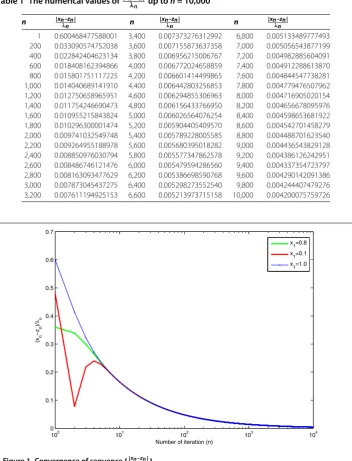
Thus, by mathematical induction, we getun∈Cfor alln∈N. Therefore,xn∈Cfor all n∈N. It can be seen from Table and Figure that{|xnλ–zn|
Table 1 The numerical values of|xnλ–zn|
n up ton= 10,000
n |xnλ–zn|
n n
|xn–zn|
λn n
|xn–zn| λn
1 0.600468477588001 3,400 0.007373276312992 6,800 0.005133489777493 200 0.033090574752038 3,600 0.007155873637358 7,000 0.005056543877199 400 0.022842404623134 3,800 0.006956215006767 7,200 0.004982885604091 600 0.018408162394866 4,000 0.006772024658859 7,400 0.004912288613870 800 0.015801751117225 4,200 0.006601414499865 7,600 0.004844547738281 1,000 0.014040689141910 4,400 0.006442803256853 7,800 0.004779476507962 1,200 0.012750658965951 4,600 0.006294855306963 8,000 0.004716905020154 1,400 0.011754246690473 4,800 0.006156433766950 8,200 0.004656678095976 1,600 0.010955215843824 5,000 0.006026564076254 8,400 0.004598653681922 1,800 0.010296300001474 5,200 0.005904405409570 8,600 0.004542701458279 2,000 0.009741032549748 5,400 0.005789228005585 8,800 0.004488701623540 2,200 0.009264955188978 5,600 0.005680395018282 9,000 0.004436543829128 2,400 0.008850976030794 5,800 0.005577347862578 9,200 0.004386126242951 2,600 0.008486746121476 6,000 0.005479594286560 9,400 0.004337354723797 2,800 0.008163093477629 6,200 0.005386698590768 9,600 0.004290142091386 3,000 0.007873045437275 6,400 0.005298273552540 9,800 0.004244407479276 3,200 0.007611194925153 6,600 0.005213973715158 10,000 0.004200075759726
Figure 1 Convergence of sequence{|xnλ–zn|
n }.
Thus, all the assumptions of Theorem . are satisfied. Therefore, the iteratively generated sequence{xn}defined by (.) converges strongly to{}, which is also the unique solution
of the triple hierarchical variational inequality (.).
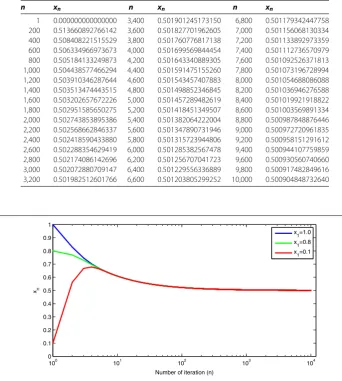
The numerical values ofxnup ton= , have been calculated in Table and
conver-gence of sequence{xn}is given in Figure . Finally, mathematically, we show thatxn→
and|xnλ–zn|
n → asn→ ∞. Note
xn+ =PC(un) =un= λn
αn+
–αn
xn
+
–
λn
≤λn
αn+
–αn
+ –
λn
=
αnλn
+
λn
+
Table 2 The numerical values ofxnup ton= 10,000
n xn n xn n xn
1 0.000000000000000 3,400 0.501901245173150 6,800 0.501179342447758 200 0.513660892766142 3,600 0.501827701962605 7,000 0.501156068130334 400 0.508408221515529 3,800 0.501760776817138 7,200 0.501133892973359 600 0.506334966973673 4,000 0.501699569844454 7,400 0.501112736570979 800 0.505184133249873 4,200 0.501643340889305 7,600 0.501092526371813 1,000 0.504438577466294 4,400 0.501591475155260 7,800 0.501073196728994 1,200 0.503910346287644 4,600 0.501543457407883 8,000 0.501054688086088 1,400 0.503513474443515 4,800 0.501498852346845 8,200 0.501036946276588 1,600 0.503202657672226 5,000 0.501457289482619 8,400 0.501019921918822 1,800 0.502951585650275 5,200 0.501418451349507 8,600 0.501003569891334 2,000 0.502743853895386 5,400 0.501382064222004 8,800 0.500987848876446 2,200 0.502568662846337 5,600 0.501347890731946 9,000 0.500972720961835 2,400 0.502418590433880 5,800 0.501315723944806 9,200 0.500958151291612 2,600 0.502288354629419 6,000 0.501285382567478 9,400 0.500944107759859 2,800 0.502174086142696 6,200 0.501256707041723 9,600 0.500930560740660 3,000 0.502072880709147 6,400 0.501229556336889 9,800 0.500917482849616 3,200 0.501982512601766 6,600 0.501203805299252 10,000 0.500904848732640
Figure 2 Convergence of the sequence{xn}.
which implies that
xn+– ≤αnλn
+
λn
→ asn→ ∞. (.)
Therefore, from (.) we getxn→asn→ ∞.
From (.), we have
xn+– =
λn
αn+xn–
–
αnxn
,
which implies that
|xn+–|
λn+
= λn λn+
αn+xn–
–
αnxn