R E S E A R C H A R T I C L E
Open Access
Low-level
226
Ra determination in
groundwater by SF-ICP-MS: optimization of
separation and pre-concentration methods
Lorenzo Copia
1,2, Stefano Nisi
3, Wolfango Plastino
1,2, Marta Ciarletti
1,2and Pavel P Povinec
4*Abstract
Background:Inductively coupled plasma mass spectrometry (ICP-MS) techniques have been widely used for analysis of long-lived environmental radionuclides. In this paper, we present an optimization of the sector field (SF)-ICP-MS technique for the analysis of226Ra in groundwater samples using a method of pre-concentration of radium in water samples.
Methods:The separation protocol and a sequential application of ion exchange and extraction chromatography have been optimized, and related polyatomic interferences and matrix effects affecting the226Ra signal were investigated. Results:Analyzing 12 replicates (water spiking at 22 fg g−1of226Ra), the226Ra recovery efficiency close to 100 % has been obtained. The instrumental226Ra detection limit of 0.09 fg g−1(3σcriterion) and the absolute detection limit of 0.05 fg in a 25-mL groundwater sample have been reached.
Conclusions:An optimization of the radium separation method and a pre-concentration of radium in groundwater samples led to high radium recoveries, almost up to 100 %. The same could be said with respect to the separation of the interfering elements, important for the quantitative226Ra analysis by SF-ICP-MS. The improvements in the separation and pre-concentration techniques also helped to improve the226Ra detection limit down to 0.05 fg/25 mL of groundwater sample.
Keywords:Groundwater; SF-ICP-MS;226Ra; Extraction chromatography; Polyatomic interferences
Background
The radium-226, 226Ra (T½= 1622 years), is a naturally
occurring radioisotope belonging to the 238U decay chain, which has widely been used as a tracer in ground-water and seaground-water transport and mixing (Smith et al. 2012), as well as for studying water-rock interactions in groundwater reservoirs (Reynolds et al. 2003). Several analytical radiometric and mass spectrometry techniques have been developed for the analysis of226Ra in environ-mental samples: radon emanation (Kim et al. 2001), li-quid scintillation spectrometry (Repinc and Benedik 2002), alpha-ray spectrometry (Morvan et al. 2001), gamma-ray spectrometry (Johnston and Martin 1997), thermal ionization mass spectrometry (TIMS) (Cohen
and O’Nions 1991), and inductively coupled plasma mass spectrometry (ICP-MS) (Chabaux et al. 1994; Park et al. 1999; Lariviere et al. 2003; Lariviere et al. 2005; Zheng and Yamada 2006; Varga 2008; Cozzella et al. 2011; Hou and Roos 2008; Butler et al. 2015). With the exception of ICP-MS, these methods are time consum-ing, often expensive, and therefore not convenient when large number of samples are to be analyzed. However, the ICP-MS method has also some drawbacks, first of all possible interferences, which could make precise ICP-MS analysis of long-lived radionuclides in the environ-ment difficult (Wyse et al. 2001; Lee et al. 2008; Lehto and Hou 2010; Lujanienėet al. 2013).
The aim of the present work has been to develop a ro-bust technique for the 226Ra analysis of groundwater samples collected from the Gran Sasso (GS) aquifer (central Italy) (Plastino et al. 2013). Within the frame-work of the Environmental Radioactivity Monitoring for * Correspondence:[email protected]
4
Department of Nuclear Physics and Biophysics, Faculty of Mathematics, Physics and Informatics, Comenius University, 84244 Bratislava, Slovakia Full list of author information is available at the end of the article
Earth Sciences (ERMES) project carried out at the Insti-tuto Nazionale di Fisica Nucleare (INFN) Gran Sasso National Laboratory, 1-L groundwater samples have been collected weekly since 2008 at ten different sites lo-cated in the underground laboratory (Plastino et al. 2010; Plastino et al. 2011). In order to analyze with high precision such large number of samples necessary for the development of 226Ra time series, it has been pro-posed to develop a new analytical technology, which would be based on ICP-MS.
To accomplish the above requirements, a method de-scribed by Lariviere et al. (2005) has been chosen as a suit-able base for further developments. This method consists of the sequential application of a cation exchange resin (50W-X8) and an extraction chromatographic resin (Sr resin). The first method has been widely used to separate
226
Ra in liquid matrices (Lariviere et al. 2005; Varga 2008; Cozzella et al. 2011; Hou and Roos 2008; Butler et al. 2015), while the latter retains Sr and partially also Ba, the main polyatomic interferences in the analysis of 226Ra in groundwater samples (Chabaux et al. 1994; Horwitz et al. 1992). Due to high-precision data requirements for the de-velopment of the 226Ra groundwater time series, the ori-ginal Lariviere et al. (2005) method has been modified by adding a pre-concentration part, effects of which were thoroughly investigated. This work focuses therefore on the optimization of the separation protocol, on the pre-concentration of samples, and on the evaluation of par-ticularly related polyatomic interferences and matrix ef-fects that could affect the226Ra peak window.
Methods
Reagents and standards
Deionized water (Milli-Q water system, Millipore, Bedford, USA) and hyperpure hydrochloric and nitric acids (Panreac, Barcelona, Spain) were used during this study. Mono-elemental standard of Ca, Ba, Mg, Sr, Ce, La, and Nd (NIST, Gaithersburg, USA) in stock solutions were diluted to obtain matrix-matched standards and spikes. Radium standard and spikes were obtained by dilution from a 100.5 Bq g−1 STD (PTB, Braunschweig, Germany). Pre-concentration and separation of 226Ra were performed using two commercially available resins: a strong cation exchange resin (AG-50W-X8) and a crown ether-based resin (Sr resin) (Triskem, Bruz, France).
Instrumentation
In order to determine 226Ra in groundwater samples, a sector field (SF)-ICP-MS (Finnigan Element 2, Thermo Scientific), equipped with an Apex Q high-sensitivity introduction system (Element Scientific Inc.), was used. The Apex Q system was tested with three different micro-nebulizers: 64, 100, and 200μL/min, using a 100-ppt Thermo Tuning solution and monitoring of 238U as
a descriptive of heavy elements. The 100 μL/min one showed the best performance. A spray chamber oper-ational temperature of 100 °C and a Peltier-cell conden-ser operational temperature of 2 °C, optimal for aqueous samples, were chosen. The N2 flow pressure was not
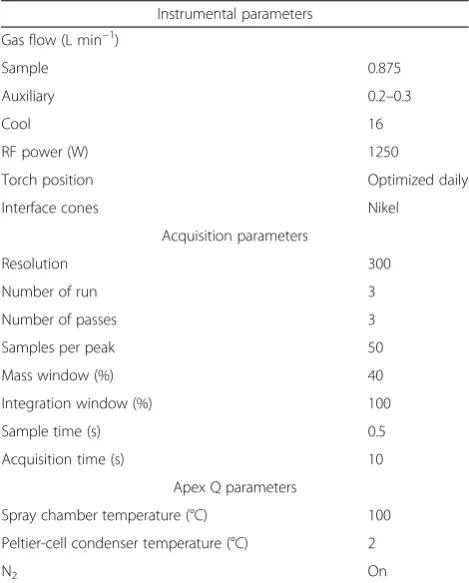
crucial for the gain of the system, in the sense that above a certain value, flux variations did not modify the count-ing rate in the uranium window. The instrument has been optimized daily with respect to the torch position and to the sample and the auxiliary gas flow, in order to reach a maximum counting rate and a stable signal. The acquisition parameters were chosen with an isotopic ratio measurement approach (Hamester et al. 1999), with a nar-row mass window in order to gain in sensitivity, and with a long acquisition time to improve counting statistics. The optimized parameters are reported in Table 1.
Sample preparation
The optimization of the procedures for the ICP-MS ana-lysis of226Ra in groundwater samples was carried out with the aim to accomplish separation of radium from matrix constituents and from spectral interfering elements. One gram of (AG-50W-X8) resin was packed into a plastic cartridge. The column was pre-washed and conditioned using 10 mL of 4-M HNO3, 5 mL of H2O Milli-Q, and
10 mL of 1.7-M HCl. Then, 25 mL of acidified (pH 1 HCl)
Table 1Optimized values of Finnigan Element 2 with Apex Q introduction system
Instrumental parameters
Gas flow (L min−1)
Sample 0.875
Auxiliary 0.2–0.3
Cool 16
RF power (W) 1250
Torch position Optimized daily
Interface cones Nikel
Acquisition parameters
Resolution 300
Number of run 3
Number of passes 3
Samples per peak 50
Mass window (%) 40
Integration window (%) 100
Sample time (s) 0.5
Acquisition time (s) 10
Apex Q parameters
Spray chamber temperature (°C) 100
Peltier-cell condenser temperature (°C) 2
sample was loaded. After that, 15 mL of 2.5-M HCl were eluted to wash away Ca, Mg, and the other matrix constituents.
At this point, the AG-50W-X8 and Sr resin cartridges were connected in series, and 10 mL of 4-M HNO3were
eluted through to desorb Ra from AG-50W-X8 and separ-ate it from Sr and Ba in the Sr resin. Then, 10 mL of 3-M HNO3were eluted in order to completely recover Ra. At
the end of this procedure, the solution containing Ra was collected, evaporated, and re-dissolved in 0.5 mL of 3-M HNO3.
Results and discussion
Starting from the a priori assumption that238U decay chain is in secular equilibrium in the investigated groundwater samples, and having a 238U concentration between 1 and 2 ng g−1, a226Ra concentration around 0.3–0.7 fg g−1was expected. At such a low concentration, radium was barely detectable by available instrumentation, so a pre-concentration was needed. A pre-pre-concentration factor of 50 was chosen because, on one side, it guarantees a meas-urable signal and a good counting statistics; on the other hand, a small sample amount of 25 mL of water is sufficient for the analysis. The226Ra ICP-MS measurements suffer of both spectral and nonspectral interferences; therefore, it is crucial to understand how these elements are separated in the procedure, how big are their levels in the final solu-tion, and which are their effects on the measurement.
Polyatomic interferences studies
As reported in the literature (Epov et al. 2003), 226Ra measurements by ICP-MS may suffer several polyatomic interferences:
88
Sr138Ba 40
Ar40Ar146Nd 87
Sr139La 86
Sr140Ce
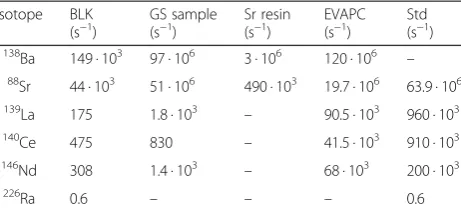
The aim of this part of the work has been to characterize in Gran Sasso groundwater samples the matrix concentra-tions of the elements Ba, Sr, Ce, La, and Nd, which are responsible for interferences, and to evaluate if, after a pre-concentration, these interferences could really be observed, and what would be their impacts on the Ra peak. First of all, each interfering element signal in the groundwater sam-ple and in the solution after the elution procedure was measured. Then, the signal values after evaporation were calculated (Table 2). Considering the values in the fifth col-umn of this table as representatives of the signals of inter-fering elements after evaporation and re-dissolution, we mimicked these concentrations using single-element stand-ard solutions and then evaluated these effects in the 226Ra peak window.
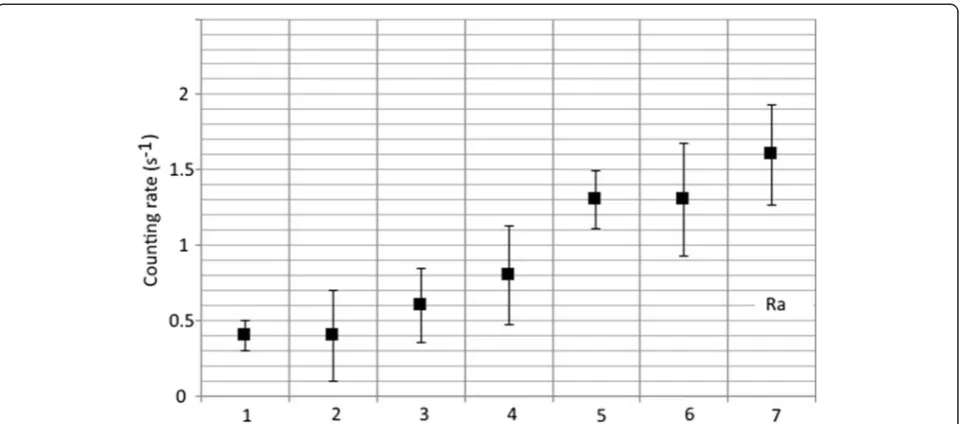
In order to evaluate 88Sr138Ba effects, an interference calibration curve using 500 ng g−1of Ba, and increasing the levels of Sr (0, 10, 20, 30, 40, and 50 ng g−1), was ob-tained and measured. Concentration values were se-lected by comparing the expected signals to Sr and Ba calibration curves. When the concentrations of Ba and Sr were under 500 and 20 ng g−1, respectively, the counts in the Ra window could be considered as a fluctuation of the background, while above these values, they were signs of an interference (Fig. 1).
Possible interferences from Ce, La, and Nd were evalu-ated measuring a solution containing 50 pg g−1 of Ce, La, and Nd and 10 ng g−1 of Sr. These concentrations were around ten times higher than actual values in the final step of the procedure. As shown in Table 2, no sign of interferences were observed.
Matrix interferences
A presence of Ca and Mg in groundwater can affect the sensitivity of the ICP-MS system, both in a positive and a negative way. Assuming a pre-concentration factor of 50, the matrix element concentration values are reported in Table 3. Starting from these values (column 3 (x)), and maintaining the ratio between element concentra-tions, we constructed a matrix calibration curve for four levels (8x/3,x,x/2,x/6), with a fixed level of Ra (33 fg g−1). There was a nonlinear decrease in the element signal, likely due to a loss of ionizing effi-ciency, together with a quick and progressive obstruc-tion of the skimmer cone.
These effects preclude a priori the application of chro-matographic extraction methods without the separation of matrix elements, as for example in the Lariviere et al. (2003) method, or in the mere application of a Sr resin in order to eliminate polyatomic interferences. After ap-plication of the elution procedure, the matrix elements were separated with efficiency higher than 99 %. Then, the sample was concentrated by a factor 40, obtained evaporating to dryness the 20 mL of elution products
Table 2The blank (BLK) and Gran Sasso (GS) groundwater signal values (columns 2 and 3)
Isotope BLK (s−1)
GS sample (s−1)
Sr resin (s−1)
EVAPC (s−1)
Std (s−1)
138
Ba 149 · 103 97 · 106 3 · 106 120 · 106 –
88
Sr 44 · 103 51 · 106 490 · 103 19.7 · 106 63.9 · 106
139
La 175 1.8 · 103 – 90.5 · 103 960 · 103
140
Ce 475 830 – 41.5 · 103 910 · 103
146
Nd 308 1.4 · 103 – 68 · 103 200 · 103
226
Ra 0.6 – – – 0.6
The fourth and fifth columns report signal values after Sr elution and total pre-concentration procedure, respectively. The sixth column reports signal
values of a Ce, La, Nd, and Sr standard (50 pg g−1
of Ce, La, and Nd and
10 ng g−1
and re-dissolving in 0.5 mL of 3-M HNO3. Signal values
and relevant efficiencies are reported in Table 3. The matrix effect was then evaluated for concentrations around those previously obtained, using five matrix-matched226Ra standards, with increasing concentrations of Ca (1, 2, 5, 10, and 20μg g−1) and Mg (0.25, 0.5, 1.25, 2.5, and 5 μg g−1), and comparing them with a standard without Ca and Mg, at the same 226Ra concentration (27.5 fg g−1). The obtained results are also reported in Table 3. Results showed that the presence of the matrix has a positive effect on the signal, remaining quite
constant over the concentration range. This can be taken into account in measurement sessions performing a cali-bration curve acquisition with standards matching the Ca and Mg proposed concentrations.
Optimization of separation procedures and recovery studies
The utilization of a strong cation exchange resin (AG-50W-X8) in separating Ra from water matrix constitu-ents has been well documented in the literature (Lari-viere et al. 2003, 2005; Varga 2008; Cozzella et al. 2011; Park et al. 1999). The procedure can be divided into four steps:
(i) pre-washing and conditioning (ii) sample loading
(iii) washing away Ca, Mg, and other matrix constituents using HCl
(iv) recovering of Ra using HNO3
These methods differ mainly in HCl molarity in step 3. In order to evaluate the separation efficiencies and the Fig. 1Counting rates in the Ra peak in solutions. The fixed concentration of Ba was 500 ng g−1. The Sr concentrations varied (X-axis): 1–blank; 2–0; 3–10; 4–20; 5–30; 6–40; 7–50 ng g−1
Table 3Typical Ca, Mg, K, and Na concentration values in a sample of Gran Sasso (GS) groundwater (column 2), theoretical values after pre-concentration without separation (column 3), Ca and Mg signals in GS groundwater (column 4), after elution procedure (column 5), after evaporation (column 7), and the relevant separation efficiencies (column 6)
Isotope GS (μg g−1)
GSAPCWS(x) (μg g−1)
GS (s−1)
After proc. (s−1)
Sep. eff. (%)
After evap. (s−1)
Ca 18 1000 46 · 106 0.26 · 106 99.4 10.4 · 106
Mg 9.4 500 860 · 106 1.63 · 106 99.8 65.2 · 106
Na 0.9 50
K 0.2 10
Isotope S1 S2 S3 S4 S5 S6
Ca (μg g−1)
1 2 5 10 20 0
Mg (μg g−1)
0.25 0.5 1.25 2.5 5 0
Ra (s−1) 93(2) 93(1) 96(3) 97(1) 95(1) 85(2)
In the latter part of the Ra signals with respect to increasing values of Ca and
Mg, each sample was spiked at226Ra concentration of 27.5 fg g−1
Table 4The Ra recovery efficiencies and the Ba, Sr, Ca, and Mg separation efficiencies
Step 3 Recovery eff. (%) Separation efficiency (%)
HCl M 226Ra 43Ca 25Mg 88Sr 138Ba
1.7 86.9 68 98.2 19.8 23.4
2.5 100 99.7 99.9 96.4 12.1
4 64.2 99.8 99.9 99.7 96.2
radium recovery for each method, four replicas with dif-ferent HCl molarity in phase 3 were done, using a GS sample spiked at 22 fg g−1of226Ra. The obtained results are reported in Table 4. Considering recovery and separ-ation efficiencies, a 2.5-M HCl wash seemed the best choice, as suggested by Lariviere et al. (2005).
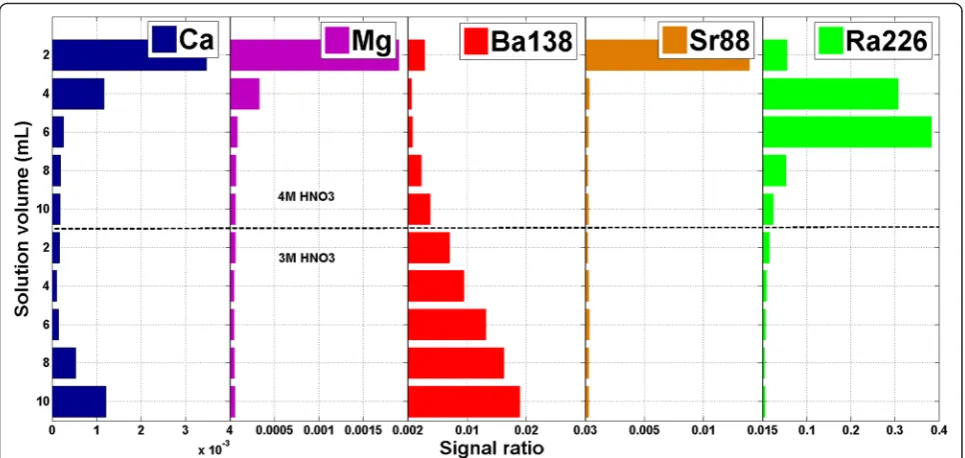
The elution profiles for most important elements are re-ported in Figs. 2 and 3. They graphically show in which step of the procedure each single element was eliminated or recovered. The first one shows a very good separation efficiency for Ca and Mg and also a very good recovery ef-ficiency for Ra. Ba and Sr were not retained properly by Fig. 2AG-50W-X8 elution profiles for Ca, Mg, Ba, Sr, and Ra. The corresponding solutions were collected every 2 mL. Bar amplitudes were expressed in arbitrary units obtained as signal ratio between the volume fraction collected and the original sample, weighted for the relevant volumes
this resin, so using Sr resin was required to avoid forma-tion of the88Sr138Ba interference.
After washing with HCl (step 3), the two cartridges were connected in series and the rest of the procedure was performed. The series connection allows to avoid an intermediate evaporation step in the Lariviere et al. (2005) procedure, with a significant reduction of its dur-ation. Loading a sample in the Sr resin at 4-M HNO3
did not affect the column capacity factor k’, as previously described (Plastino et al. 2010). After the elution in Sr resin, as shown in Fig. 3, the separation efficiencies of Ba and Sr were 98 and 99.3 %, respectively, and the result-ing values of Ba and Sr were below the level of interfer-ence formation (Fig. 1). The amount of 3-M nitric acid rinse was then reduced to 5 mL.
Analyzing 12 replicates (water spiking at 22 fg g−1 of
226
Ra), the 226Ra recovery efficiency close to 100 % has been obtained thanks to the optimization of the radium separation method and a pre-concentration of radium in groundwater samples. The same could be said with re-spect to the separation of the interfering elements, im-portant for the quantitative 226Ra analysis by SF-ICP-MS. The improvements in the separation and pre-concentration techniques also helped to improve the
226
Ra detection limit down to 0.05 fg/25 mL of ground-water sample. The absolute detection limit for a ground-water sample equivalent of 1.95 10−18g g−1has been obtained.
Conclusions
We presented an optimization of the SF-ICP-MS tech-nique for the analysis of 226Ra in groundwater samples using a method of pre-concentration of radium in water samples. The separation protocol and a sequential applica-tion of ion exchange and extracapplica-tion chromatography have been optimized, and related polyatomic interferences and matrix effects affecting the226Ra signal were investigated. The226Ra recovery efficiency close to 100 % has been ob-tained thanks to the optimization of the radium separation method and a pre-concentration of radium in ground-water samples. The same could be said with respect to the separation of the interfering elements, important for the quantitative226Ra analysis by SF-ICP-MS.
The improvements in the separation and pre-concentration techniques helped to improve the226Ra de-tection limit down to 0.05 fg/25 mL of groundwater sam-ple. The absolute detection limit for a water sample is equivalent to 1.95 10−18 g g−1. A hydrological paper de-scribing the measured226Ra concentrations and discussing its behavior in the groundwater system of the Gran Sasso massif is under preparation.
Competing interests
The authors declare that they have no competing interests.
Authors’contributions
LC was responsible for the method optimization, sample preparation, and data evaluation. SN was responsible for the SF-ICP-MS measurements and method optimization. WP was responsible for the coordination of the project, organization of groundwater sampling campaigns in the Gran Sasso National Laboratory, data evaluation, and drafting of the manuscript. MC was responsible for the data evaluation. PPP was responsible for the data evaluation and for the finalization of the manuscript. All authors read and approved the final manuscript.
Acknowledgements
The authors greatly acknowledge the support by the National Scientific Committee Technology of the National Institute of Nuclear Physics for the ERMES project and the Chemistry and Chemical Plants Service of the Gran Sasso National Laboratory.
Author details
1Department of Mathematics and Physics, Roma Tre University, Via della
Vasca Navale, 84, I-00146 Rome, Italy.2National Institute of Nuclear Physics, Section of Roma Tre, Via della Vasca Navale, 84, I-00146 Rome, Italy.3Gran
Sasso National Laboratory, National Institute of Nuclear Physics, S.S. 17/bis km. 18 + 910, I-67010 Assergi, Italy.4Department of Nuclear Physics and
Biophysics, Faculty of Mathematics, Physics and Informatics, Comenius University, 84244 Bratislava, Slovakia.
Received: 22 May 2015 Accepted: 2 June 2015
References
Butler OT, Cairns WRL, Cook JM, Davidson CM (2015) 2014 atomic spectrometry update—a review of advances in environmental analysis. J Anal At Spectrom 30:21–63
Chabaux F, Othman D, Birck J (1994) A new Ra-Ba chromatographic separation and its application to Ra mass-spectrometric measurement in volcanic rocks. Chem Geol 114:191–197
Cohen AS, O’Nions RK (1991) Precise determination of femtogram quantities of radium by thermal ionization mass spectrometry. Anal Chem 63:2705–2708 Cozzella ML, Leila A, Hernandez RS (2011) Determination of226Ra in urine samples
by Q-ICP-MS: a method for routine analyses. Radiat Meas 46:109–111 Epov V, Lariviere D, Evans R, Li C, Cornett R (2003) Direct determination of226Ra
in environmental matrices using collision cell inductively coupled plasma mass-spectrometry. J Radioanal Nucl Chem 256:53–60
Hamester M, Wiederin D, Wills J, Kerl W, Douthitt CB (1999) Strategies for isotope ratio measurements with a double focusing sector field ICP-MS. Fresen J Anal Chem 364:495–498
Horwitz EP, Chiarizia R, Dietz ML (1992) A novel strontium-selective extraction chromatographic resin. Solvent Extr Ion Exc 10:313–336
Hou X, Roos P (2008) Critical comparison of radiometric and mass spectrometric methods for the determination of radionuclides in environmental, biological and nuclear waste samples. Anal Chim Acta 608:105–112
Johnston A, Martin P (1997) Rapid analysis of226Ra in waters by gamma-ray
spectrometry. App Radiat Isot 48:631–638
Kim G, Burnett W, Dulaiova H, Swarzenski P, Moore W (2001) Measurement of
224
Ra and226Ra activities in natural waters using a radon-in-air monitor. Environ Sci Technol 35:4680–4683
Lariviere D, Epov VN, Evans RD, Cornett RJ (2003) Determination of radium-226 in environmental samples by inductively coupled plasma mass spectrometry after sequential selective extraction. J Anal At Spectrom 18:338–343 Lariviere D, Epov VN, Reiber K, Cornett R, Evans R (2005) Micro-extraction
procedures for the determination of Ra-226 in well waters by SF-ICP-MS. Anal Chim Acta 528:175–182
Lee SH, Povinec PP, Wyse E, Hotchkis MAC (2008) Ultra-low-level determination of236U in IAEA marine reference materials by ICPMS and AMS. Appl Radiat
Isot 66:823–828
Lehto J, Hou X (2010) Chemistry and analysis of radionuclides: laboratory techniques and methodology. Wiley, New York, p 426
LujanienėG, BenešP,Štamberg K, Jokšas K, KulakauskaitėI (2013) Pu and Am sorption to the Baltic Sea bottom sediments. J Radioanal Nucl Chem 295:1957–1967
Park CJ, Oh PJ, Kim HY, Lee DS (1999) Determination of226Ra in mineral waters
by high-resolution inductively coupled plasma mass spectrometry after sample preparation by cation exchange. J Anal At Spectrom 14:223–227 Plastino W, Povinec PP, De Luca G, Doglioni C, Nisi S, Ioannucci L, Balata M,
Laubenstein M, Bella F, Coccia E (2010) Uranium groundwater anomalies and L'Aquila earthquake, 6th April 2009 (Italy). J Environ Radioactiv 101:45–50 Plastino W, Panza GF, Doglioni C, Frezzotti ML, Peccerillo A, De Felice P, Bella F,
Povinec PP, Nisi S, Ioannucci L, Aprili P, Balata M, Cozzella ML, Laubenstein M (2011) Uranium groundwater anomalies and active normal faulting. J Radioanal Nucl Chem 288:101–107
Plastino W, Laubenstein M, Nisi S, Peresan A, Povinec PP, Balata M, Bella F, Cardarelli A, Ciarletti M, Copia L, De Deo M, Gallese B, Ioannucci L (2013) Uranium, radium and tritium groundwater monitoring at INFN-Gran Sasso National Laboratory, Italy. J Radioanal Nucl Chem 295:585–592
Repinc U, Benedik L (2002) Development of a method for the determination of
226
Ra by liquid scintillation counting. J Radioanal Nucl Chem 254:181–185 Reynolds BC, Wasserburg GJ, Baskaran M (2003) The transport of U- and Th-series nuclides in sandy confined aquifers. Geochim Cosmochim Acta 67:1955–1972 Smith C, Swarzenski P, Dimova N, Zhang J (2012) Natural radium and radon tracers
to quantify water exchange and movement in reservoirs. Handbook of Environmental Isotope Geochemistry. Springer, Berlin, Heidelberg, pp 345–365 Varga Z (2008) Ultratrace-level radium-226 determination in seawater samples by
isotope dilution inductively coupled plasma mass spectrometry. Anal Bioanal Chem 390:511–519
Wyse EJ, Lee SH, La Rosa J, Povinec P, de Mora SJ (2001) ICP-sector field mass spectrometry analysis of plutonium isotopes: recognizing and resolving potential interferences. J Anal Atom Spectrom 16:1107–1111
Zheng J, Yamada M (2006) Determination of U isotope ratios in sediments using ICP-QMS after sample cleanup with anion-exchange and extraction chromatography. Talanta 68:932–939
Submit your manuscript to a
journal and benefi t from:
7Convenient online submission
7Rigorous peer review
7Immediate publication on acceptance
7Open access: articles freely available online
7High visibility within the fi eld
7Retaining the copyright to your article