M E T H O D O L O G Y
Open Access
Evaluations of the uptake and impact of
the Preferred Reporting Items for
Systematic reviews and Meta-Analyses
(PRISMA) Statement and extensions: a
scoping review
Matthew J. Page
1*and David Moher
2,3Abstract
Background:
The PRISMA Statement is a reporting guideline designed to improve transparency of systematic reviews
(SRs) and meta-analyses. Seven extensions to the PRISMA Statement have been published to address the reporting of
different types or aspects of SRs, and another eight are in development. We performed a scoping review to map the
research that has been conducted to evaluate the uptake and impact of the PRISMA Statement and extensions. We
also synthesised studies evaluating how well SRs published after the PRISMA Statement was disseminated adhere to its
recommendations.
Methods:
We searched for meta-research studies indexed in MEDLINE® from inception to 31 July 2017, which investigated
some component of the PRISMA Statement or extensions (e.g. SR adherence to PRISMA, journal endorsement of PRISMA).
One author screened all records and classified the types of evidence available in the studies. We pooled data on SR
adherence to individual PRISMA items across all SRs in the included studies and across SRs published after 2009 (the
year PRISMA was disseminated).
Results:
We included 100 meta-research studies. The most common type of evidence available was data on SR adherence
to the PRISMA Statement, which has been evaluated in 57 studies that have assessed 6487 SRs. The pooled results of these
studies suggest that reporting of many items in the PRISMA Statement is suboptimal, even in the 2382 SRs published after
2009 (where nine items were adhered to by fewer than 67% of SRs). Few meta-research studies have evaluated the
adherence of SRs to the PRISMA extensions or strategies to increase adherence to the PRISMA Statement and
extensions.
Conclusions:
Many studies have evaluated how well SRs adhere to the PRISMA Statement, and the pooled result of
these suggest that reporting of many items is suboptimal. An update of the PRISMA Statement, along with a toolkit of
strategies to help journals endorse and implement the updated guideline, may improve the transparency of SRs.
Keywords:
Reporting, Systematic reviews, Methodology, Quality
* Correspondence:[email protected]
1School of Public Health and Preventive Medicine, Monash University, 553 St
Kilda Road, Melbourne, VIC 3004, Australia
Full list of author information is available at the end of the article
Background
Systematic reviews (SRs) and meta-analyses are an
es-sential resource for healthcare decision-makers [1].
When conducted well, SRs can provide credible and
timely data on a range of enquiries, such as which
treat-ments are effective, ineffective or harmful; which tests
accurately diagnose a condition and which exposures are
associated with health outcomes. However, the value of
SRs depends on how well authors have reported what
they did, and what they found. If such information is
ab-sent or ambiguous, readers cannot judge whether the
re-sults of the SR are robust to the methods used, cannot
attempt to reproduce the findings and cannot interpret
the findings accurately. This can contribute to the failure
to implement the findings of SRs into clinical practice
[2]. Therefore, transparent reporting of SRs should be
considered critically important by authors of SRs [3, 4].
The transparency of SRs and meta-analyses of health
re-search has been called into question on many occasions
[5]. The first formal appraisal of SRs with a focus on
medi-cine was performed by Cynthia Mulrow, who identified
several poor reporting practices in a sample of 50 medical
review articles published between June 1985 and June
1986 [6]. For example, clearly specified methods of
identi-fying, selecting and appraising studies were available in
one article only. Transparency was only slightly better in
reviews published in 1996, with less than 25% of articles
describing how evidence was identified, evaluated or
syn-thesised [7]. In the last decade, transparency of SRs has
certainly improved, yet a high amount of suboptimal
reporting persists [8].
Improvements in the transparency of SRs in recent
years may be attributed to the dissemination of reporting
guidelines. Reporting guidelines provide evidence-based
recommendations for authors on how to report their
research methods and findings clearly [9]. In 1999, an
international group of 30 epidemiologists, clinicians,
stat-isticians, editors and researchers developed a reporting
guideline for meta-analyses of randomised trials
—
the
QUOROM (QUality Of Reporting Of Meta-analyses)
Statement [10]. In 2005, a meeting was convened to
up-date QUOROM to address several conceptual and
prac-tical advances in the methodology of SRs and to help
overcome several shortcomings identified in an audit of
SRs [3]. The guideline was renamed the PRISMA
(Pre-ferred Reporting Items for Systematic reviews and
Meta-Analyses) Statement, and published in 2009 [11]. It was
accompanied by an explanation and elaboration
docu-ment, which provided detailed guidance for each of the 27
included items, and examples of exemplar reporting [12].
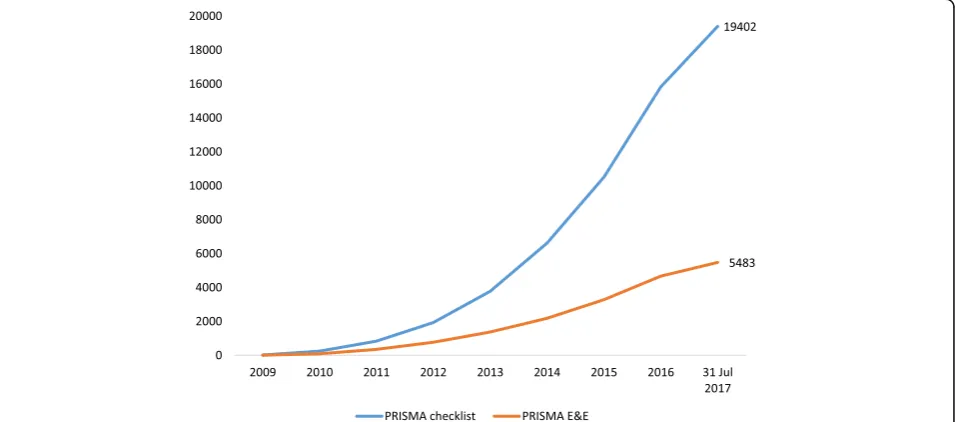
According to citation data in Scopus®, the PRISMA
State-ment has had a very high uptake from the biomedical
re-search community (Fig. 1). The checklist paper [11, 13
–
19]
has been cited 19,402 times as of 31 July 2017, and the
ac-companying explanation and elaboration document [12,
20
–
23] received 5483 citations by this date. However, not
all published SRs cite the guideline; for example, in a
ran-dom sample of 119 non-Cochrane SRs of therapeutic
inter-ventions indexed in MEDLINE® in February 2014, 42 (35%)
mentioned the use of the PRISMA Statement [8].
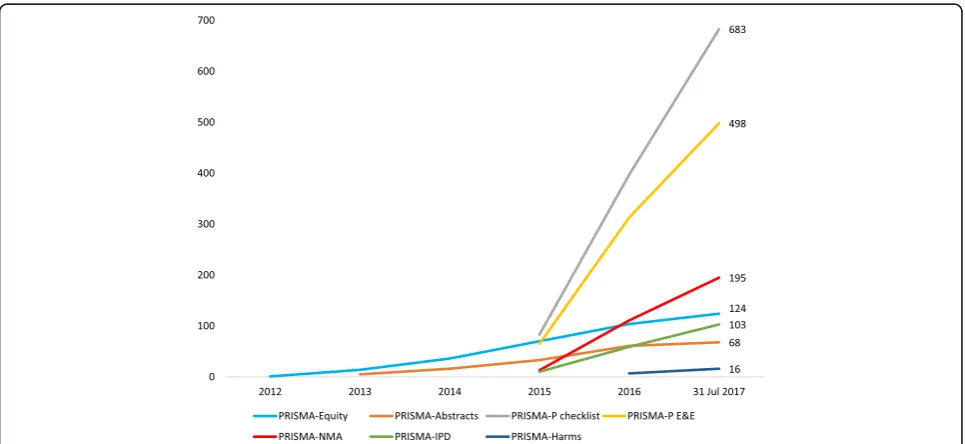
Since its publication, seven extensions to the PRISMA
Statement have been developed to facilitate reporting of
different types or aspects of SRs (Table 1). These include
the PRISMA-Equity extension [24
–
26], PRISMA for
Ab-stracts of SRs [27], PRISMA extension for reporting SRs
incorporating network meta-analysis [28], PRISMA for
SRs and meta-analyses of individual participant data
[29], PRISMA for SR protocols [30, 31], PRISMA harms
checklist [32] and PRISMA extension for SRs of
com-plex interventions [33, 34]. Citation counts for the
PRISMA extensions are much lower than those of the
PRISMA Statement, but they have not had the same
amount of time to accrue citations (Fig. 2). Also, one
should not expect the extensions to receive as many
ci-tations, as they are more restricted in scope, meaning
that fewer SRs to which the extensions are applicable are
published each year. The most cited extension is the
checklist paper for PRISMA-P (for SR protocols) [30],
which has received 683 citations since its publication in
January 2015.
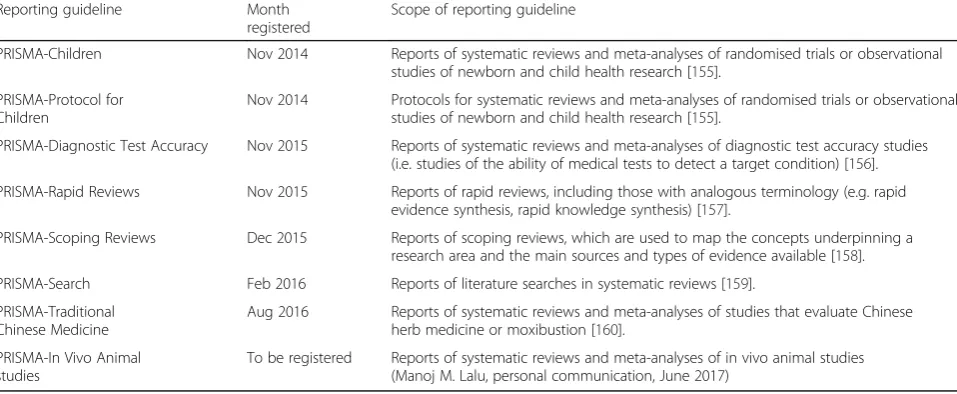
There are also eight PRISMA extensions that are in
development (Table 2). These include extensions for SRs
of newborn and child health research and for protocols
of such SRs, for SRs of diagnostic test accuracy studies,
Table 1
Scope of the PRISMA Statement and published extensions
Reporting guideline Year published
Scope of reporting guideline
PRISMA 2009 Reports of systematic reviews and meta-analyses, primarily of randomised trials that evaluate health care interventions [11–23].
PRISMA-Equity 2012 Reports of systematic reviews and meta-analyses with a focus on health equity, defined as the absence of avoidable and unfair inequalities in health [24–26].
PRISMA-Abstracts 2013 Abstracts for all types of systematic reviews, but the emphasis is on systematic reviews of evaluations of interventions where one or more meta-analyses are conducted [27].
PRISMA-Network Meta-Analysis
2015 Reports of systematic reviews that address networks of multiple treatment comparisons [28].
PRISMA-Individual Participant Data
2015 Reports of systematic reviews and meta-analyses of individual participant data. Developed primarily for reviews of randomised trials, but many items apply to other contexts, including reviews of diagnosis and prognosis [29].
PRISMA-Protocols 2015 Protocols for systematic reviews and meta-analyses that summarise aggregate data from studies, particularly those which evaluate the effects of interventions [30,31].
PRISMA-Harms 2016 Reports of systematic reviews and meta-analyses assessing adverse events (as either a primary or secondary outcome) that are reported in prospective interventional studies or observational studies (with or without a comparison group) [32].
PRISMA-Complex Interventions
2017 Reports of systematic reviews and meta-analyses of complex interventions. Complex interventions are defined as interventions that have‘multiple components (intervention complexity) and complicated/multiple causal pathways, feedback loops, synergies and/or mediators and moderators of effect (pathway complexity)’[33,34].
for rapid reviews, for scoping reviews, for SR search
methods, for SRs of traditional Chinese medicine
inter-ventions and for SRs of in vivo animal studies.
It is important to evaluate whether the PRISMA
State-ment and extensions have achieved what they are
de-signed to do
—
improve the transparency of SRs. We are
aware of two previous SRs that have investigated the
ad-herence
of SRs to the PRISMA Statement (i.e. the extent
to which SRs comply with each item in the statement)
[35, 36]. Another SR has examined whether transparency
is better in SRs published in journals that
endorse
the
PRISMA Statement (e.g. suggest its use in the journal
instructions to authors or require that authors submit a
PRISMA checklist accompanying their SR) [37].
How-ever, to our knowledge, there has been no attempt to
map what other research on the uptake, and impact of
the PRISMA Statement and extensions has been done.
Also, there has been no attempt to synthesise studies
evaluating adherence of SRs published
after
the PRISMA
Statement was disseminated. Therefore, we aimed to
ad-dress these gaps by conducting a scoping review of
meta-research studies evaluating the PRISMA Statement
and extensions.
Methods
We did not pre-register the methods of our scoping
review, as we are unaware of any register for
meth-odological research of this nature.
We considered articles to be eligible for inclusion if
they were an empirical study of any design (e.g.
rando-mised trial, cross-sectional analysis, before-after study),
which investigated some component of the PRISMA
Statement or extensions (e.g. how often PRISMA is
re-ferred to in journal instructions to authors) or which
used the PRISMA Statement or one of the extensions
for evaluative purposes (e.g. to assess how often SRs
ad-here to each PRISMA item). We included meta-research
studies regardless of language or year of publication. We
excluded commentaries, editorials or letters to the
editor.
One author (MJP) searched for potentially relevant
studies indexed in MEDLINE® from inception to 31
July 2017 (specifically, Ovid MEDLINE® Epub Ahead
of Print, In-Process and Other Non-Indexed Citations;
Ovid MEDLINE® Daily and Ovid MEDLINE and
Ver-sions®). The following search strategy was used to
re-trieve
articles
that
included
the
term
‘
PRISMA
’
(abbreviated or spelled out in full) in the title or
ab-stract of the article:
1.
‘
Preferred Reporting Items for Systematic Reviews
and Meta-analyses
’
.ti,ab.
2. PRISMA.ti,ab.
3. 1 or 2.
One author (MJP) screened all titles and abstracts, and
any full-text articles retrieved, to determine eligibility.
The same author recorded the types of evidence
avail-able in the included meta-research studies. Types of
evi-dence were classified as:
data on SR adherence to the PRISMA Statement or
extensions;
characteristics associated with SR adherence to
PRISMA (e.g. journal endorsement, year of
publication);
the frequency of journal instructions to authors
referring to the PRISMA Statement or extensions;
Table 2
Scope of the PRISMA extensions in development
Reporting guideline Month
registered
Scope of reporting guideline
PRISMA-Children Nov 2014 Reports of systematic reviews and meta-analyses of randomised trials or observational studies of newborn and child health research [155].
PRISMA-Protocol for Children
Nov 2014 Protocols for systematic reviews and meta-analyses of randomised trials or observational studies of newborn and child health research [155].
PRISMA-Diagnostic Test Accuracy Nov 2015 Reports of systematic reviews and meta-analyses of diagnostic test accuracy studies (i.e. studies of the ability of medical tests to detect a target condition) [156]. PRISMA-Rapid Reviews Nov 2015 Reports of rapid reviews, including those with analogous terminology (e.g. rapid
evidence synthesis, rapid knowledge synthesis) [157].
PRISMA-Scoping Reviews Dec 2015 Reports of scoping reviews, which are used to map the concepts underpinning a research area and the main sources and types of evidence available [158]. PRISMA-Search Feb 2016 Reports of literature searches in systematic reviews [159].
PRISMA-Traditional Chinese Medicine
Aug 2016 Reports of systematic reviews and meta-analyses of studies that evaluate Chinese herb medicine or moxibustion [160].
PRISMA-In Vivo Animal studies
To be registered Reports of systematic reviews and meta-analyses of in vivo animal studies (Manoj M. Lalu, personal communication, June 2017)
other (e.g. frequency of SR authors who reported
using the PRISMA Statement to guide their
reporting).
To determine the influence of the PRISMA Statement
on the transparency of SRs, we pooled the findings of
meta-research studies evaluating how often SRs adhere
to the PRISMA Statement. This updates a previous SR
which included adherence studies published up to
Oc-tober 2014 [35]. One author (MJP) collected from each
meta-research study the following data about the SRs
evaluated: focus (e.g. therapeutic, diagnostic), clinical
area, language, years of publication and frequencies of
SRs adhering to each of the 27 PRISMA Statement
items. In some cases, authors of meta-research studies
recorded if a particular PRISMA item was fully
re-ported or partially rere-ported in each of the SRs
evalu-ated. In such cases, we recorded only the number of
SRs that fully reported the PRISMA item. One author
(MJP) contacted study authors to request data on
ad-herence to individual items if these data were not
available in the published article (e.g. when study
au-thors reported only the mean number of items that SRs
adhered to).
We pooled data on SR adherence to individual
PRISMA items across all SRs in the included studies.
We noted items that fewer than two thirds (67%) of SRs
adhered to and those that are fewer than half of SRs
ad-hered to. We also pooled data on SR adherence to
indi-vidual PRISMA items in a subset of studies that
evaluated SRs published after the PRISMA Statement
was disseminated. For this analysis, we analysed studies
which included only SRs published in 2010 or later or
studies which reported data on a subgroup of SRs
pub-lished in 2010 or later. We did not contact study authors
for this subgroup data. We conducted all analyses in
Microsoft Excel.
Results
Scoping review of meta-research studies
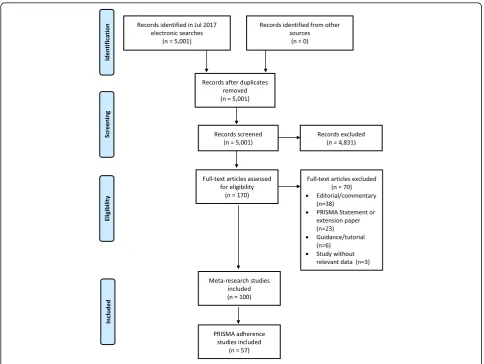
The search of MEDLINE® yielded 5001 citations (Fig. 3).
After screening each title and abstract, we retrieved the
full text of 170 articles. We excluded 70 of these articles,
most of which were editorials or commentaries (reasons
for exclusion are listed in Additional file 1: Table S1).
One hundred meta-research studies met our inclusion
criteria (listed in Additional file 2: Table S2). The studies
were published between 2011 and 2017, and more than
half were published in 2015 or later (
n
= 59). All of the
studies were observational in design; there were 86
cross-sectional analyses, six uncontrolled before-after
studies, four surveys of authors and four systematic
re-views of meta-research studies.
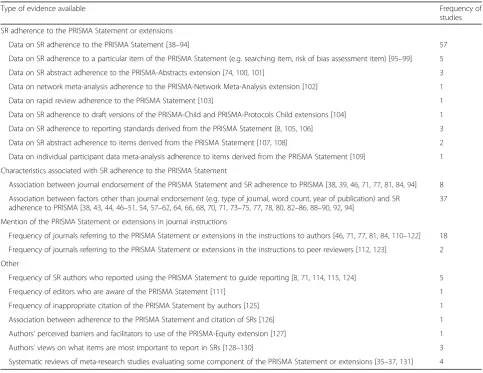
We recorded 20 different types of evidence available
across the included meta-research studies (Table 3). The
most common type of evidence available was data on SR
adherence to the PRISMA Statement, which was
re-ported in 57/100 (57%) studies. Many of these 57 studies
(
n
= 37 [65%]) also investigated characteristics associated
with SR adherence to the PRISMA Statement, such as
the type of journal, year of publication and article word
count. The third most common type of evidence
avail-able was data on the frequency of journals referring to
the PRISMA Statement or extensions in the instructions
to authors (
n
= 18/100 [18%]).
Few studies have evaluated how well SRs adhere to the
PRISMA extensions; adherence to PRISMA for
Ab-stracts and PRISMA for Network Meta-Analyses has
been examined in three studies and one study,
respect-ively (Table 3). Further, few studies have investigated
whether the endorsement of the PRISMA Statement by
journals was associated with adherence to PRISMA (
n
=
8/100 [8%]). We did not identify any studies that
investi-gated whether journal endorsement of one of the
PRISMA extensions was associated with SR adherence
to the extension.
Evaluations of SR adherence to the PRISMA Statement
Of the 57 studies evaluating SR adherence to the
PRISMA Statement [38
–
94], most were published
be-tween 2015 and 2017 (33/57 [58%]), focused on SRs of
therapeutic interventions only (45/57 [79%]), evaluated
non-Cochrane SRs only (34/57 [60%]) and evaluated SRs
written in English only (39/57 [68%]) (Table 4). A total
Table 3
Types of evidence available in meta-research studies (
n
= 100) evaluating the PRISMA Statement or extensions
Type of evidence available Frequency of
studies SR adherence to the PRISMA Statement or extensions
Data on SR adherence to the PRISMA Statement [38–94] 57
Data on SR adherence to a particular item of the PRISMA Statement (e.g. searching item, risk of bias assessment item) [95–99] 5
Data on SR abstract adherence to the PRISMA-Abstracts extension [74,100,101] 3
Data on network meta-analysis adherence to the PRISMA-Network Meta-Analysis extension [102] 1
Data on rapid review adherence to the PRISMA Statement [103] 1
Data on SR adherence to draft versions of the PRISMA-Child and PRISMA-Protocols Child extensions [104] 1 Data on SR adherence to reporting standards derived from the PRISMA Statement [8,105,106] 3
Data on SR abstract adherence to items derived from the PRISMA Statement [107,108] 2
Data on individual participant data meta-analysis adherence to items derived from the PRISMA Statement [109] 1 Characteristics associated with SR adherence to the PRISMA Statement
Association between journal endorsement of the PRISMA Statement and SR adherence to PRISMA [38,39,46,71,77,81,84,94] 8 Association between factors other than journal endorsement (e.g. type of journal, word count, year of publication) and SR
adherence to PRISMA [38,43,44,46–51,54,57–62,64,66,68,70,71,73–75,77,78,80,82–86,88–90,92,94]
37
Mention of the PRISMA Statement or extensions in journal instructions
Frequency of journals referring to the PRISMA Statement or extensions in the instructions to authors [46,71,77,81,84,110–122] 18 Frequency of journals referring to the PRISMA Statement or extensions in the instructions to peer reviewers [112,123] 2 Other
Frequency of SR authors who reported using the PRISMA Statement to guide reporting [8,71,114,115,124] 5
Frequency of editors who are aware of the PRISMA Statement [111] 1
Frequency of inappropriate citation of the PRISMA Statement by authors [125] 1
Association between adherence to the PRISMA Statement and citation of SRs [126] 1
Authors’perceived barriers and facilitators to use of the PRISMA-Equity extension [127] 1
Authors’views on what items are most important to report in SRs [128–130] 3
of 6487 SRs were evaluated across all studies; the
me-dian (interquartile range) number of SRs evaluated per
study was 74 (44-144). The evaluated SRs were
pub-lished between 1989 and 2016.
All 57 studies assessed adherence to individual
PRISMA items, with relevant data provided on request
by authors of ten studies [39, 42, 43, 45, 66, 67, 69, 77,
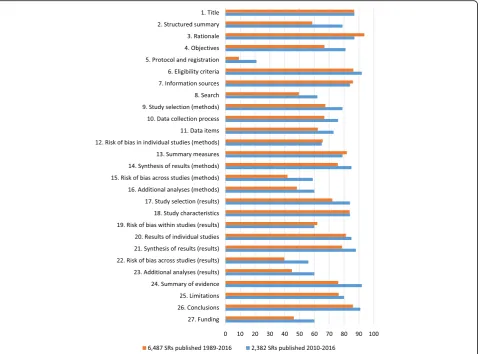
79, 85]. By pooling the PRISMA adherence data across
SRs in all 57 reports, we identified 11 items that fewer
than 67% of SRs adhered to (Fig. 4; numerical data
avail-able in Additional file 3: Tavail-able S3). These include item 2
(structured summary), item 5 (methods: protocol and
registration),
item
8
(methods:
search),
item
11
(methods: data items), item 12 (methods: risk of bias in
individual studies), item 15 (methods: risk of bias across
studies), item 16 (methods: additional analyses), item 19
(results: risk of bias within studies), item 22 (results: risk
of bias across studies), item 23 (results: additional
ana-lyses) and item 27 (funding). There were six items that
fewer than 50% of SRs adhered to (items 5, 15, 16, 22,
23 and 27).
PRISMA adherence data for SRs published in 2010 or
later (i.e. after the PRISMA Statement was published)
were available in 27 studies [38, 39, 41, 42, 44, 46, 56,
60, 62, 68
–
79, 81
–
84, 92, 94], which evaluated 2382 SRs.
The characteristics of these studies (i.e. focus, clinical
area, language of SRs) were similar to those of the total
set of studies. SR adherence to the PRISMA Statement
was higher for nearly all items in this subset of recent
SRs, compared with the adherence data across all SRs
(Fig. 4; numerical data available in Additional file 3:
Table S3). There were 12 items that more than 80% of
SRs adhered to (items 1, 3, 4, 6, 7, 14, 17, 18, 20, 21, 24
and 26). However, lack of transparency remains an issue
for many SRs. There were nine items that fewer than
67% of SRs adhered to (items 5, 8, 12, 15, 16, 19, 22, 23
and 27), and one item was adhered to by 21% of SRs
only (item 5, on whether a SR protocol or registration
number exists).
Discussion
Our scoping review suggests that the PRISMA
State-ment and extensions have provided fertile ground for
meta-research. Twenty different types of evidence were
available across 100 meta-research studies. The most
common type of evidence was data on SR adherence to
the PRISMA Statement, which has been evaluated in 57
studies. The pooled results of these studies indicate that
reporting of many items of the PRISMA Statement is
suboptimal, even in those SRs published after its
dissem-ination in 2009. Very few meta-research studies have
evaluated SR adherence to the PRISMA extensions, but
this is unsurprising given that most extensions were
dis-seminated in 2015 or later. Few studies have tested
strat-egies to increase adherence to the PRISMA Statement
and extensions.
Strengths and limitations
There are several strengths of our research. To our
knowledge, this is the first attempt to systematically map
research conducted on the PRISMA Statement and
ex-tensions. Most of the included studies assessing SR
ad-herence to the PRISMA Statement focused on one
clinical area, so by pooling data across these studies, our
findings are more generalisable. Also, we managed to
obtain unpublished data from ten studies that had not
reported data on adherence to each individual PRISMA
item [39, 42, 43, 45, 66, 67, 69, 77, 79, 85].
A few limitations must be acknowledged. We included
only meta-research articles indexed in one bibliographic
database (MEDLINE®) and written in English. However,
Table 4
Characteristics of 57 studies evaluating SR adherence
to the PRISMA Statement
Characteristic Summary data
Year of study publication
2011–2014 24 (42%)
2015–2017 33 (58%)
Focus of SRs evaluated
Therapeutic interventions (treatment/prevention) 45 (79%)
Diagnostic 4 (7%)
Mix (e.g. some therapeutic, some diagnostic) 6 (11%)
Not specified 2 (4%)
Clinical area of SRs evaluated
Surgery 14 (25%)
General medicine 5 (9%)
Nursing 5 (9%)
Complementary and alternative medicine 4 (7%) Other (specific clinical condition) 29 (51%)
Median number of SRs evaluated 74 (44-144)
Median earliest year of publication of SRs evaluated 2005 (2001–2009) Median latest year of publication of SRs evaluated 2013 (2011–2015) Journal of SRs evaluated
Non-Cochrane only 34 (60%)
Both Cochrane and non-Cochrane 22 (39%)
Unclear 2 (11%)
Language of SRs evaluated
English only 39 (68%)
Chinese only 9 (16%)
Portuguese only 1 (2%)
English and LOE (less than 10% LOE) 6 (11%) English and LOE (more than 40% LOE) 2 (4%)
we do not see any reason why our findings would differ
had other databases and meta-research articles in
lan-guages other than English been consulted. Screening of
records and collection of data from articles were
per-formed by one author only. It is therefore possible that
we may have missed some relevant meta-research
stud-ies or made errors when recording the frequency of SRs
adhering to the PRISMA Statement. We have uploaded
all data collected to the Open Science Framework
(https://osf.io/7x2mp/) so that interested readers can
verify our data and replicate our results. Most of the SRs
evaluated in the 57 studies investigating SR adherence to
the PRISMA Statement were written in English, and it is
possible that non-English language SRs may be less
likely to adhere to PRISMA, if their authors were not
confident in English. Our classification of types of
evi-dence available in meta-research studies reflects what
was
reported
; we did not contact study authors to
en-quire whether they conducted other analyses yet chose
not to report the findings. We did not record the
refer-ences of SRs evaluated in each study investigating SR
adherence to the PRISMA Statement and so are
unaware if some SRs appeared in more than one of the
included meta-research studies. However, based on the
information regarding the types of SRs (e.g. Cochrane
or non-Cochrane), years of publication of SRs and
clin-ical focus of SRs, we judged the number of overlapping
SRs to be low.
We were unable to compare the reporting of SRs
pub-lished after PRISMA was disseminated in 2009 with that
before 2009 because of how the included meta-research
studies were designed and reported. Most studies (43 of
57) included some SRs published before 2009 and some
published after 2009, but most studies did not report the
number of SRs in each category. There were 14 studies
that included only SRs published after 2009, 13 studies
which provided subgroup data on SRs published after
2009 (but not all of these studies provided
correspond-ing data for SRs published before 2009) and three
stud-ies included only SRs published before 2009. Given the
data on PRISMA adherence in SRs published before
2009 was limited to a small subset of the included
stud-ies, we decided to restrict our analysis of PRISMA
ad-herence to all SRs (regardless of year of publication) and
SRs published after 2009. A formal before-after
compari-son was therefore not possible.
We focused on the PRISMA Statement and
exten-sions, although we are aware of other reporting
guide-lines
for SRs. These include the Methodological
Expectations
of
Cochrane
Intervention
Reviews
(MECIR) reporting standards [132, 133], the American
Psychological Association Meta-Analysis Reporting
Stan-dards (MARS) [134], the ENTREQ Statement for
syn-theses of qualitative research [135], the RAMESES
publication standards for realist syntheses [136] and
meta-narrative reviews [137] and reporting guidance for
describing interventions in SRs [138]. More research is
needed to map the research conducted on these
report-ing guidelines.
Comparison with other studies
We are aware of two other syntheses of meta-research
studies that have investigated the adherence of SRs to
the PRISMA Statement [35, 36]. Samaan et al. [36]
in-cluded three studies, and Pussegoda et al. [35] inin-cluded
13 studies, respectively. Both reached the same
conclu-sion as us, that adherence to the PRISMA Statement is
suboptimal; however, unlike our review, neither analysed
reporting of SRs published after the PRISMA Statement
was published. Another SR by Stevens et al. [37]
synthe-sised the results of three studies exploring whether SR
adherence to the PRISMA Statement is higher in
jour-nals which endorse the reporting guideline. We
identi-fied in our scoping review an additional five studies that
could be added to an update of this review. To our
knowledge, ours is the only review which has mapped
research conducted on the PRISMA extensions.
Implications of the findings
There are several reasons why adherence is better for
some PRISMA items than others. It is possible that the
less complex the item, the easier it is to report it. For
ex-ample, most of the 12 PRISMA items that were adhered
to by more than 80% of SRs published in 2010 or later
are relatively straightforward to report. These items
in-clude identifying the report as a SR or meta-analysis in
the title, providing a rationale and objectives, presenting
study characteristics and reporting conclusions. Several
items in the PRISMA Statement comprise multiple
com-ponents, which some systematic reviewers may fail to
fully address (e.g. item 12 asks authors to
‘
describe
methods used for assessing risk of bias of individual
studies (including specification of whether this was done
at the study or outcome level), and how this information
is to be used in any data synthesis
’
). Also, reporting of
some items may depend on whether the journal
facili-tates reporting of that item (e.g. authors may be unable
to present a full electronic search strategy (item 8) in
journals that do not allow supplementary files). In
addition, some items with low adherence may not be
considered sufficiently important to report by a majority
of systematic reviewers and journal editors. It would be
useful to conduct surveys and interviews with systematic
reviewers to explore the contributions of these potential
barriers and facilitators to complete SR reporting.
To our knowledge, there have been no prospectively
designed, controlled studies evaluating whether the
PRISMA Statement or extensions are having their
intended effect. This is surprising, and a different
thresh-old than that required to introduce a drug into the
marketplace. Instead, only a few cross-sectional or
un-controlled before-after studies have evaluated the impact
of journal endorsement of the PRISMA Statement on
reporting of SRs. Of these eight studies [38, 39, 46, 71,
77, 81, 84, 94], six evaluated whether journals which
‘
recommend
’
or
‘
encourage
’
use of the PRISMA
State-ment in the journal instructions to authors publish SRs
that are reported more completely. Two studies
investi-gated whether reporting is clearer in journals that ask
authors to submit a PRISMA checklist when submitting
an SR. Both are rather low-intensity interventions that
may not have the desired effect. For example, a
recom-mendation in the instructions to authors can easily be
missed by authors (some of whom will not even check
the instructions), while a submitted PRISMA checklist
may be ignored by peer reviewers and journal editors
who face competing pressures on their time.
Researchers need to develop more efficient and
inten-sive interventions to implement reporting guidelines
such as the PRISMA Statement and extensions. We
be-lieve technology can play a valuable role in this regard.
For example, StatReviewer software performs an
auto-mated review of the statistical and reporting integrity of
scientific manuscripts (http://www.statreviewer.com/).
Manuscripts can currently be checked against the
fol-lowing reporting guidelines: CONSORT 2010 [139],
STROBE [140], STARD [141, 142], ARRIVE [143] and
The Uniform Requirements for Medical Journals (http://
www.icmje.org/recommendations/). StatReviewer is
con-sidering including PRISMA in their suite of reporting
guidelines (D. Moher, personal communication). We also
think rigorous evaluations, in the form of randomised
trials, of StatReviewer are needed. Such evaluations
could build upon the experiences of previous
rando-mised trials evaluating web-based reporting guideline
tools (e.g. WebCONSORT [144], COBWEB [145]).
checklist items to increase clarity. It will also allow for
potential new items to be considered, based on recent
methodological developments affecting SR conduct and
reporting. These developments include novel guidance
on how to:
summarise findings when meta-analysis is not
appropriate [
146
,
147
];
report and synthesise intervention characteristics of
included studies [
138
,
148
];
use and interpret prediction intervals for
random-effects meta-analyses [
149
,
150
];
enhance reproducibility of meta-analytic results and
share data collected [
151
,
152
] and
report the methods and results of updated SRs [
153
]
and living SRs [
154
].
In addition, developing a comprehensive research
translation strategy to help journals endorse and
imple-ment the updated guideline may facilitate its use. Journal
editors and researchers should work together to develop
prospective (ideally randomised), controlled studies to
provide robust evidence about the effect of the updated
guideline on the transparency of SRs.
Conclusions
Many studies have evaluated how well SRs adhere to the
PRISMA Statement, and the pooled result of these
sug-gests that reporting of many items is suboptimal. Little
research has been done to design and test strategies to
increase adherence to the PRISMA Statement or
exten-sions. An update of the PRISMA Statement, followed by
a toolkit of strategies to help journals endorse and
im-plement the updated guideline, may improve the
trans-parency of SRs.
Additional files
Additional file 1:Tables of excluded papers. (DOCX 21 kb)
Additional file 2:List of included meta-research studies. (DOCX 25 kb)
Additional file 3:Summary across reports of SRs adhering to the PRISMA Statement. (DOCX 17 kb)
Abbreviations
CI:Confidence interval; E&E: Explanation and elaboration;
EQUATOR: Enhancing the QUAlity and Transparency Of health Research; IPD: Individual participant data; NMA: Network meta-analysis;
PRISMA: Preferred Reporting Items for Systematic reviews and Meta-Analyses; QUOROM: QUality Of Reporting Of Meta-analyses; SR: Systematic review
Acknowledgments
We thank the following study authors who provided us with unpublished data on SR adherence to PRISMA: Shayden Bryce, Jared Campbell, Alexander Fowler, Richard McGee, Livia Puljak, Amanda Shen and Matt Vassar.
Funding
There was no direct funding for this study. MJP is supported by an Australian National Health and Medical Research Council (NHMRC) Early Career Fellowship (1088535). DM is supported in part by a University Research Chair, University of Ottawa. The funders had no role in the study design, data collection and analysis, decision to publish or preparation of the manuscript.
Availability of data and materials
The data underlying this study are available on the Open Science Framework: https://osf.io/7x2mp/
Authors’contributions
Both authors declare to meet the ICMJE conditions for authorship. MJP and DM conceived the study design. MJP collected the data and undertook the statistical analyses. MJP wrote the first draft of the article. DM contributed to the revisions of the article. Both authors approved the final version of the submitted article.
Ethics approval and consent to participate Not applicable.
Consent for publication Not applicable.
Competing interests
We have read the journal’s policy, and the authors of this manuscript have the following competing interests: DM is co-Editor in Chief, and MJP is an Associate Editor forSystematic Reviews, but neither had involvement in the peer review process or decision for publication. DM led the development of the PRISMA Statement. MJP and DM are leading the update of the PRISMA Statement. DM is an unpaid advisor to StatReviewer.
Publisher
’
s Note
Springer Nature remains neutral with regard to jurisdictional claims in published maps and institutional affiliations.
Author details
1School of Public Health and Preventive Medicine, Monash University, 553 St
Kilda Road, Melbourne, VIC 3004, Australia.2Centre for Journalology and Canadian EQUATOR Centre, Clinical Epidemiology Program, Ottawa Hospital Research Institute, Ottawa K1H 8L6, Canada.3School of Epidemiology and Public Health, Faculty of Medicine, University of Ottawa, Ottawa K1H 8M5, Canada.
Received: 2 October 2017 Accepted: 8 December 2017
References
1. Agoritsas T, Vandvik PO, Neumann I, Rochwerg B, Jaeschke R, Hayward R, et al. Chapter 5: finding current best evidence. In: Guyatt G, Rennie D, Meade MO, Cook DJ, editors. Users’guides to the medical literature: a manual for evidence-based clinical practice. 3rd ed. New York: McGraw-Hill; 2015. p. 29–50.
2. Glasziou P, Altman DG, Bossuyt P, Boutron I, Clarke M, Julious S, et al. Reducing waste from incomplete or unusable reports of biomedical research. Lancet. 2014;383(9913):267–76.
3. Moher D, Tetzlaff J, Tricco AC, Sampson M, Altman DG. Epidemiology and reporting characteristics of systematic reviews. PLoS Med. 2007;4:e78. 4. Page MJ, Moher D. Mass production of systematic reviews and meta-analyses: an exercise in mega-silliness? Milbank Q. 2016;94(3):515–9. 5. Ioannidis JP. The mass production of redundant, misleading, and conflicted
systematic reviews and meta-analyses. Milbank Q. 2016;94(3):485–514. 6. Mulrow CD. The medical review article: state of the science. Ann Intern
Med. 1987;106(3):485–8.
7. McAlister FA, Clark HD, van Walraven C, Straus SE, Lawson FM, Moher D, et al. The medical review article revisited: has the science improved? Ann Intern Med. 1999;131(12):947–51.
9. Moher D, Schulz KF, Simera I, Altman DG. Guidance for developers of health research reporting guidelines. PLoS Med. 2010;7(2):e1000217.
10. Moher D, Cook DJ, Eastwood S, Olkin I, Rennie D, Stroup DF. Improving the quality of reports of meta-analyses of randomised controlled trials: the QUOROM statement. Qual Reporting Meta-Analyses Lancet. 1999;354(9193): 1896–900.
11. Moher D, Liberati A, Tetzlaff J, Altman DG, Group P. Preferred reporting items for systematic reviews and meta-analyses: the PRISMA statement. PLoS Med. 2009;6(7):e1000097.
12. Liberati A, Altman DG, Tetzlaff J, Mulrow C, Gotzsche PC, Ioannidis JP, et al. The PRISMA statement for reporting systematic reviews and meta-analyses of studies that evaluate health care interventions: explanation and elaboration. J Clin Epidemiol. 2009;62(10):e1–34.
13. Moher D, Liberati A, Tetzlaff J, Altman DG, Group P. Preferred reporting items for systematic reviews and meta-analyses: the PRISMA statement. BMJ. 2009;339:b2535.
14. Moher D, Liberati A, Tetzlaff J, Altman DG, Group P. Preferred reporting items for systematic reviews and meta-analyses: the PRISMA statement. J Clin Epidemiol. 2009;62(10):1006–12.
15. Moher D, Liberati A, Tetzlaff J, Altman DG, Group P. Preferred reporting items for systematic reviews and meta-analyses: the PRISMA statement. Ann Intern Med. 2009;151(4):264–9. W64
16. Moher D, Liberati A, Tetzlaff J, Altman DG. Preferred reporting items for systematic reviews and meta-analyses: the PRISMA Statement. Open Medicine. 2009;3(3):e123–30.
17. Moher D, Liberati A, Tetzlaff J, Altman DG, Group P. Reprint—preferred reporting items for systematic reviews and meta-analyses: the PRISMA statement. Phys Ther. 2009;89(9):873–80.
18. Moher D, Liberati A, Tetzlaff J, Altman DG, Altman D, Antes G, et al. Preferred reporting items for systematic reviews and meta-analyses: the PRISMA statement (Chinese edition). J Chin Integrative Med. 2009;7(9): 889–96.
19. Moher D, Liberati A, Tetzlaff J, Altman DG, Group P. Preferred reporting items for systematic reviews and meta-analyses: the PRISMA statement. [erratum appears in Int J Surg. 2010;8(8):658]. Int J Surg. 2010;8(5):336–41. 20. Liberati A, Altman DG, Tetzlaff J, Mulrow C, Gotzsche PC, Ioannidis JP, et al.
The PRISMA statement for reporting systematic reviews and meta-analyses of studies that evaluate healthcare interventions: explanation and elaboration. BMJ. 2009;339:b2700.
21. Liberati A, Altman DG, Tetzlaff J, Mulrow C, Gotzsche PC, Ioannidis JP, et al. The PRISMA statement for reporting systematic reviews and meta-analyses of studies that evaluate health care interventions: explanation and elaboration. Ann Intern Med. 2009;151(4):W65–94.
22. Liberati A, Altman DG, Tetzlaff J, Mulrow C, Gotzsche PC, Ioannidis JP, et al. The PRISMA statement for reporting systematic reviews and meta-analyses of studies that evaluate health care interventions: explanation and elaboration. PLoS Med. 2009;6(7):e1000100.
23. Liberati A, Altman DG, Tetzlaff J, Mulrow C, Gøtzsche PC, Ioannidis JPA, et al. The PRISMA statement for reporting systematic reviews and meta-analyses of studies that evaluate health care interventions: explanation and elaboration. Ital J Public Health. 2009;6(4):354–91.
24. Welch V, Petticrew M, Tugwell P, Moher D, O'Neill J, Waters E, et al. PRISMA-Equity 2012 extension: reporting guidelines for systematic reviews with a focus on health equity. PLoS Med. 2012;9(10):e1001333.
25. Welch V, Petticrew M, Petkovic J, Moher D, Waters E, White H, et al. Extending the PRISMA statement to equity-focused systematic reviews (PRISMA-E 2012): explanation and elaboration. Int J Equity Health. 2015; 14:92.
26. Welch V, Petticrew M, Petkovic J, Moher D, Waters E, White H, et al. Extending the PRISMA statement to equity-focused systematic reviews (PRISMA-E 2012): explanation and elaboration. J Clin Epidemiol. 2016;70: 68–89.
27. Beller EM, Glasziou PP, Altman DG, Hopewell S, Bastian H, Chalmers I, et al. PRISMA for abstracts: reporting systematic reviews in journal and conference abstracts. PLoS Med. 2013;10:e1001419.
28. Hutton B, Salanti G, Caldwell DM, Chaimani A, Schmid CH, Cameron C, et al. The PRISMA extension statement for reporting of systematic reviews incorporating network meta-analyses of health care interventions: checklist and explanations. Ann Intern Med. 2015;162(11):777–84.
29. Stewart LA, Clarke M, Rovers M, Riley RD, Simmonds M, Stewart G, et al. Preferred reporting items for systematic review and meta-analyses of
individual participant data: the PRISMA-IPD statement. JAMA. 2015;313(16): 1657–65.
30. Moher D, Shamseer L, Clarke M, Ghersi D, Liberati A, Petticrew M, et al. Preferred reporting items for systematic review and meta-analysis protocols (PRISMA-P) 2015 statement. Syst Rev. 2015;4:1.
31. Shamseer L, Moher D, Clarke M, Ghersi D, Liberati A, Petticrew M, et al. Preferred reporting items for systematic review and meta-analysis protocols (PRISMA-P) 2015: elaboration and explanation. BMJ. 2015;349:g7647. 32. Zorzela L, Loke YK, Ioannidis JP, Golder S, Santaguida P, Altman DG, et al.
PRISMA harms checklist: improving harms reporting in systematic reviews. BMJ. 2016;352:i157.
33. Guise JM, Butler ME, Chang C, Viswanathan M, Pigott T, Tugwell P, et al. AHRQ series on complex intervention systematic reviews—paper 6: PRISMA-CI extension statement and checklist. J Clin Epi. 2017;90:43-50.
34. Guise JM, Butler M, Chang C, Viswanathan M, Pigott T, Tugwell P, et al. AHRQ series on complex intervention systematic reviews-paper 7: PRISMA-CI elaboration and explanation. J Clin Epi. 2017;90:51-58.
35. Pussegoda K, Turner L, Garritty C, Mayhew A, Skidmore B, Stevens A, et al. Systematic review adherence to methodological or reporting quality. Systematic Reviews. 2017;6(1):131.
36. Samaan Z, Mbuagbaw L, Kosa D, Borg Debono V, Dillenburg R, Zhang S, et al. A systematic scoping review of adherence to reporting guidelines in health care literature. J Multidiscip Healthc. 2013;6:169–88.
37. Stevens A, Shamseer L, Weinstein E, Yazdi F, Turner L, Thielman J, et al. Relation of completeness of reporting of health research to journals’endorsement of reporting guidelines: systematic review. BMJ. 2014;348:g3804.
38. Adie S, Ma D, Harris IA, Naylor JM, Craig JC. Quality of conduct and reporting of meta-analyses of surgical interventions. Ann Surg. 2015;261(4): 685–94.
39. Agha RA, Fowler AJ, Limb C, Whitehurst K, Coe R, Sagoo H, et al. Impact of the mandatory implementation of reporting guidelines on reporting quality in a surgical journal: a before and after study. Int J Surg. 2016;30:169–72. 40. Aguiar PM, Brito GD, Correr CJ, Lyra Junior DP, Storpirtis S. Exploring the quality of systematic reviews on pharmacist interventions in patients with diabetes: an overview. Ann Pharmacother. 2014;48(7):887–96.
41. Akhigbe T, Zolnourian A, Bulters D. Compliance of systematic reviews articles in brain arteriovenous malformation with PRISMA statement guidelines: review of literature. J Clin Neurosci. 2017;39:45–8. 42. Bryce S, Sloan E, Lee S, Ponsford J, Rossell S. Cognitive remediation in
schizophrenia: a methodological appraisal of systematic reviews and meta-analyses. J Psychiatr Res. 2016;75:91–106.
43. Campbell JM, Kavanagh S, Kurmis R, Munn Z. Systematic reviews in burns care: poor quality and getting worse. J Burn Care Res. 2017;38(2):e552–e67. 44. Chapman SJ, Drake TM, Bolton WS, Barnard J, Bhangu A. Longitudinal
analysis of reporting and quality of systematic reviews in high-impact surgical journals. Br J Surg. 2017;104(3):198–204.
45. Chong AB, Taylor M, Schubert G, Vassar M. Interventional radiology clinical practice guideline recommendations for neurovascular disorders are not based on high-quality systematic reviews. AJNR: Am J Neuroradiol. 2017; 38(4):759–65.
46. Cullis PS, Gudlaugsdottir K, Andrews J. A systematic review of the quality of conduct and reporting of systematic reviews and meta-analyses in paediatric surgery. PLoS One. 2017;12(4):e0175213.
47. DiSilvestro KJ, Tjoumakaris FP, Maltenfort MG, Spindler KP, Freedman KB. Systematic reviews in sports medicine. Am J Sports Med. 2016;44(2):533–8. 48. Evaniew N, van der Watt L, Bhandari M, Ghert M, Aleem I, Drew B, et al.
Strategies to improve the credibility of meta-analyses in spine surgery: a systematic survey. Spine J. 2015;15(9):2066–76.
49. Fleming PS, Seehra J, Polychronopoulou A, Fedorowicz Z, Pandis N. A PRISMA assessment of the reporting quality of systematic reviews in orthodontics. Angle Orthod. 2013;83(1):158–63.
50. Gagnier JJ, Kellam PJ. Reporting and methodological quality of systematic reviews in the orthopaedic literature. J Bone Joint Surg (Am Vol). 2013;95(11): e771–7.
51. Ge L, Wang JC, Li JL, Liang L, An N, Shi XT, et al. The assessment of the quality of reporting of systematic reviews/meta-analyses in diagnostic tests published by authors in China. PLoS One. 2014;9(1):e85908.
53. Jin YH, Ma ET, Gao WJ, Hua W, Dou HY. Reporting and methodological quality of systematic reviews or meta-analyses in nursing field in China. Int J Nurs Pract. 2014;20(1):70–8.
54. Klimo P Jr, Thompson CJ, Ragel BT, Boop FA. Methodology and reporting of meta-analyses in the neurosurgical literature. J Neurosurg. 2014;120(4):796–810. 55. Kurz A, Evaniew N, Yeung M, Samuelsson K, Peterson D, Ayeni OR.
Credibility and quality of meta-analyses addressing graft choice in anterior cruciate ligament reconstruction: a systematic review. Knee Surg Sports Traumatol Arthrosc. 2017;25(2):538–51.
56. Lee SY, Sagoo H, Whitehurst K, Wellstead G, Fowler AJ, Agha RA, et al. Compliance of systematic reviews in plastic surgery with the PRISMA Statement. JAMA Facial Plastic Surgery. 2016;18(2):101–5.
57. Li JL, Ge L, Ma JC, Zeng QL, Yao L, An N, et al. Quality of reporting of systematic reviews published in“evidence-based”Chinese journals. Syst Rev. 2014;3:58.
58. Li X, Wang R, Shi X, Su J, Pan Y, Tian J, et al. Reporting characteristics and quality of systematic reviews of acupuncture analgesia. Pain Pract. 2017;13:13. 59. Liu D, Jin J, Tian J, Yang K. Quality assessment and factor analysis of systematic
reviews and meta-analyses of endoscopic ultrasound diagnosis. PLoS One. 2015;10(4):e0120911.
60. Liu P, Qiu Y, Qian Y, Chen X, Wang Y, Cui J, et al. Quality of meta-analyses in major leading gastroenterology and hepatology journals: a systematic review. J Gastroenterol Hepatol. 2017;32(1):39–44.
61. Liu X, Kinzler M, Yuan J, He G, Zhang L. Low reporting quality of the meta-analyses in diagnostic pathology. Arch Pathol Lab Med. 2017;141(3):423–30. 62. Liu Y, Zhang R, Huang J, Zhao X, Liu D, Sun W, et al. Reporting quality of
systematic reviews/meta-analyses of acupuncture. PLoS One. 2014;9(11):e113172. 63. Luo J, Xu H, Yang G, Qiu Y, Liu J, Chen K. Oral Chinese proprietary medicine
for angina pectoris: an overview of systematic reviews/meta-analyses. Complement Ther Med. 2014;22(4):787–800.
64. Ma B, Guo J, Qi G, Li H, Peng J, Zhang Y, et al. Epidemiology, quality and reporting characteristics of systematic reviews of traditional Chinese medicine interventions published in Chinese journals. PLoS One. 2011;6(5):e20185. 65. Ma B, Qi GQ, Lin XT, Wang T, Chen ZM, Yang KH. Epidemiology, quality, and
reporting characteristics of systematic reviews of acupuncture interventions published in Chinese journals. J Altern Complement Med. 2012;18(9):813–7. 66. Martins DE, Astur N, Kanas M, Ferretti M, Lenza M, Wajchenberg M. Quality
assessment of systematic reviews for surgical treatment of low back pain: an overview. Spine J. 2016;16(5):667–75.
67. McGee RG, Craig JC, Rogerson TE, Webster AC. Systematic reviews of surgical procedures in children: quantity, coverage and quality. J Paediatr Child Health. 2013;49(4):319–24.
68. Nicolau I, Ling D, Tian L, Lienhardt C, Pai M. Methodological and reporting quality of systematic reviews on tuberculosis. Int J Tuberc Lung Dis. 2013;17(9):1160–9. 69. Nissen T, Wayant C, Wahlstrom A, Sinnett P, Fugate C, Herrington J, et
al. Methodological quality, completeness of reporting and use of systematic reviews as evidence in clinical practice guidelines for paediatric overweight and obesity. Clin Obesity. 2017;7(1):34–45. 70. Padula RS, Pires RS, Alouche SR, Chiavegato LD, Lopes AD, Costa LO.
Analysis of reporting of systematic reviews in physical therapy published in Portuguese. Rev Bras Fisioter. 2012;16(4):381–8. 71. Panic N, Leoncini E, de Belvis G, Ricciardi W, Boccia S. Evaluation of the
endorsement of the preferred reporting items for systematic reviews and meta-analysis (PRISMA) statement on the quality of published systematic review and meta-analyses. PLoS One. 2013;8(12):e83138.
72. Passon AM, Drabik A, Sawicki PT. Quality scores do not predict discrepant statistical significances among meta-analyses on different targets of glycemic control in type 2 diabetes. J Clin Epidemiol. 2013; 66(12):1356–66.
73. Pastorino R, Milovanovic S, Stojanovic J, Efremov L, Amore R, Boccia S. Quality assessment of studies published in open access and subscription journals: results of a systematic evaluation. PLoS One. 2016;11(5):e0154217. 74. Peters JP, Hooft L, Grolman W, Stegeman I. Reporting quality of systematic reviews and meta-analyses of otorhinolaryngologic articles based on the PRISMA Statement. PLoS One. 2015;10(8):e0136540.
75. Pidgeon TE, Wellstead G, Sagoo H, Jafree DJ, Fowler AJ, Agha RA. An assessment of the compliance of systematic review articles published in craniofacial surgery with the PRISMA statement guidelines: a systematic review. Journal of craniomaxillofacial. Surgery. 2016;44(10):1522–30. 76. Pinzon MC, Hayden DM, Ariel D, Bartosiak KA, Chiodo MV, Kosmidis K, et al.
Are our publications failing the inspection?: a review of the publications in
rectal cancer surgery between 2002 and 2012. Dis Colon Rectum. 2014; 57(8):983–92.
77. Riado Minguez D, Kowalski M, Vallve Odena M, Longin Pontzen D, Jelicic Kadic A, Jeric M, et al. Methodological and reporting quality of systematic reviews published in the highest ranking journals in the field of pain. Anesth Analg. 2017;
78. Rice DB, Kloda LA, Shrier I, Thombs BD. Reporting completeness and transparency of meta-analyses of depression screening tool accuracy: a comparison of meta-analyses published before and after the PRISMA statement. J Psychosom Res. 2016;87:57–69.
79. Scott J, Howard B, Sinnett P, Schiesel M, Baker J, Henderson P, et al. Variable methodological quality and use found in systematic reviews referenced in STEMI clinical practice guidelines. Am J Emerg Med. 2017;14:14. 80. Shi C, Zhu L, Wang X, Qin C, Xu Q, Tian J. Epidemiology, methodological
and reporting characteristics of systematic reviews of nursing interventions published in China. Int J Nurs Pract. 2014;20(6):689–700.
81. Tam WW, Lo KK, Khalechelvam P. Endorsement of PRISMA statement and quality of systematic reviews and meta-analyses published in nursing journals: a cross-sectional study. BMJ Open. 2017;7(2):e013905. 82. Tan WK, Wigley J, Shantikumar S. The reporting quality of systematic
reviews and meta-analyses in vascular surgery needs improvement: a systematic review. Int J Surg. 2014;12(12):1262–5.
83. Tian J, Zhang J, Ge L, Yang K, Song F. The methodological and reporting quality of systematic reviews from China and the USA are similar. J Clin Epi .2017;85:50-58.
84. Tunis AS, McInnes MD, Hanna R, Esmail K. Association of study quality with completeness of reporting: have completeness of reporting and quality of systematic reviews and meta-analyses in major radiology journals changed since publication of the PRISMA statement?.[erratum appears in radiology. 2014 Jul;272(1):304]. Radiology. 2013;269(2):413–26.
85. Wasiak J, Shen AY, Ware R, O'Donohoe TJ, Faggion CM, Jr. Methodological quality and reporting of systematic reviews in hand and wrist pathology. J Hand Surg Eur Vol 2017:1753193417712660.
86. Wasiak J, Tyack Z, Ware R, Goodwin N, Faggion CM Jr. Poor methodological quality and reporting standards of systematic reviews in burn care management. Int Wound J. 2016;18:18.
87. Weir CR, Staggers N, Laukert T. Reviewing the impact of computerized provider order entry on clinical outcomes: the quality of systematic reviews. Internation J Med Inform. 2012;81(4):219–31.
88. Willis BH, Quigley M. The assessment of the quality of reporting of meta-analyses in diagnostic research: a systematic review. BMC Med Res Methodol. 2011;11:163.
89. Xiao Z, Zhang Y, Wang Y, Xu F. Quality assessment for systematic review/ meta-analysis on antidepressant therapy published in Chinese journals. Int J Pharmacol. 2012;8(7):614–20.
90. Yang M, Jiang L, Wang A, Xu G. Epidemiology characteristics, reporting characteristics, and methodological quality of systematic reviews and meta-analyses on traditional Chinese medicine nursing interventions published in Chinese journals. Int J Nurs Pract. 2017;23(1)
91. Yang SL, Ying K, Wang F, Wang L, Ren XY, Yang QF. Methodological and reporting quality assessment for Chinese systematic reviews and meta analysis in oral medicine. Shanghai Kou Qiang Yi Xue/Shanghai J Stomatol. 2015;24(4):505–10.
92. Zhang H, Han J, Zhu YB, Lau WY, Schwartz ME, Xie GQ, et al. Reporting and methodological qualities of published surgical meta-analyses. J Clin Epidemiol. 2016;70:4–16.
93. Zhang J, Wang J, Han L, Zhang F, Cao J, Ma Y. Epidemiology, quality, and reporting characteristics of systematic reviews and meta-analyses of nursing interventions published in Chinese journals. Nurs Outlook. 2015; 63(4):446–55. e4
94. Zhu Y, Fan L, Zhang H, Wang M, Mei X, Hou J, et al. Is the best evidence good enough: quality assessment and factor analysis of meta-analyses on depression. PLoS One. 2016;11(6):e0157808.
95. Atakpo P, Vassar M. Publication bias in dermatology systematic reviews and meta-analyses. J Dermatol Sci. 2016;82(2):69–74.
96. Hedin RJ, Umberham BA, Detweiler BN, Kollmorgen L, Vassar M. Publication bias and nonreporting found in majority of systematic reviews and meta-analyses in anesthesiology journals. Anesth Analg. 2016;123(4):1018–25. 97. Fleming PS, Koletsi D, Seehra J, Pandis N. Systematic reviews published in
98. Saltaji H, Ospina MB, Armijo-Olivo S, Agarwal S, Cummings GG, Amin M, et al. Evaluation of risk of bias assessment of trials in systematic reviews of oral health interventions, 1991–2014: a methodology study. J Am Dent Assoc. 2016;147(9):720–8. e1
99. Toews LC. Compliance of systematic reviews in veterinary journals with Preferred Reporting Items for Systematic Reviews and Meta-Analysis (PRISMA) literature search reporting guidelines. J Med Lib Assoc. 2017; 105(3):233–9.
100. Tsou AY, Treadwell JR. Quality and clarity in systematic review abstracts: an empirical study. Research Synthesis Methods. 2016;7(4):447–58.
101. Bigna JJ, Um LN, Nansseu JR. A comparison of quality of abstracts of systematic reviews including meta-analysis of randomized controlled trials in high-impact general medicine journals before and after the publication of PRISMA extension for abstracts: a systematic review and meta-analysis. Syst Rev. 2016;5(1):174.
102. Ge L, Tian JH, Li XX, Song F, Li L, Zhang J, et al. Epidemiology characteristics, methodological assessment and reporting of statistical analysis of network meta-analyses in the field of cancer. Sci Rep. 2016;6:37208.
103. Kelly SE, Moher D, Clifford TJ. Quality of conduct and reporting in rapid reviews: an exploration of compliance with PRISMA and AMSTAR guidelines. Syst Rev. 2016;5:79.
104. Farid-Kapadia M, Joachim KC, Balasingham C, Clyburne-Sherin A, Offringa M. Are child-centric aspects in newborn and child health systematic review and meta-analysis protocols and reports adequately reported?—two systematic reviews. Syst Rev. 2017;6(1):31.
105. Turner L, Galipeau J, Garritty C, Manheimer E, Wieland LS, Yazdi F, et al. An evaluation of epidemiological and reporting characteristics of
complementary and alternative medicine (CAM) systematic reviews (SRs). PLoS One 2013;8(1):e53536.
106. Gianola S, Gasparini M, Agostini M, Castellini G, Corbetta D, Gozzer P, et al. Survey of the reporting characteristics of systematic reviews in
rehabilitation. Phys Ther. 2013;93(11):1456–66.
107. Kiriakou J, Pandis N, Fleming PS, Madianos P, Polychronopoulou A. Reporting quality of systematic review abstracts in leading oral implantology journals. J Dent. 2013;41(12):1181–7.
108. Seehra J, Fleming PS, Polychronopoulou A, Pandis N. Reporting
completeness of abstracts of systematic reviews published in leading dental specialty journals. Eur J Oral Sci. 2013;121(2):57–62.
109. Simmonds M, Stewart G, Stewart L. A decade of individual participant data meta-analyses: a review of current practice. Contemp Clin Trials. 2015;45(Pt A):76–83.
110. Glujovsky D, Boggino C, Riestra B, Coscia A, Sueldo CE, Ciapponi A. Quality of reporting in infertility journals. Fertil Steril. 2015;103(1):236–41. 111. Glujovsky D, Villanueva E, Reveiz L, Murasaki R. Adherence to research
reporting guidelines in biomedical journals in Latin America and the Caribbean. Pan Am J Public Health. 2014;36(4):232–7.
112. Hua F, Walsh T, Glenny AM, Worthington H. Surveys on reporting guideline usage in dental journals. J Dent Res. 2016;95(11):1207–13.
113. Knuppel H, Metz C, Meerpohl JJ, Strech D. How psychiatry journals support the unbiased translation of clinical research. A cross-sectional study of editorial policies. PLoS One. 2013;8(10):e75995.
114. Koch M, Riss P, Umek W, Hanzal E. The explicit mentioning of reporting guidelines in urogynecology journals in 2013: a bibliometric study. Neurourol Urodyn. 2016;35(3):412–6.
115. Mannocci A, Saulle R, Colamesta V, D'Aguanno S, Giraldi G, Maffongelli E, et al. What is the impact of reporting guidelines on public health journals in Europe? The case of STROBE, CONSORT and PRISMA. J Public Health. 2015; 37(4):737–40.
116. Meerpohl JJ, Wolff RF, Antes G, von Elm E. Are pediatric open access journals promoting good publication practice? An analysis of author instructions. BMC Pediatr. 2011;11:27.
117. Reveiz L, Villanueva E, Iko C, Simera I. Compliance with clinical trial registration and reporting guidelines by Latin American and Caribbean journals. Cad Saude Publica. 2013;29(6):1095–100.
118. Sims MT, Henning NM, Wayant CC, Vassar M. Do emergency medicine journals promote trial registration and adherence to reporting guidelines? A survey of“instructions for authors”. Scand J Trauma Resusc Emerg Med. 2016;24(1):137.
119. Smith TA, Kulatilake P, Brown LJ, Wigley J, Hameed W, Shantikumar S. Do surgery journals insist on reporting by CONSORT and PRISMA? A follow-up survey of‘instructions to authors’. Ann Med Surg. 2015;4(1):17–21.
120. Tao KM, Li XQ, Zhou QH, Moher D, Ling CQ, WF Y. From QUOROM to PRISMA: a survey of high-impact medical journals’instructions to authors and a review of systematic reviews in anesthesia literature. PLoS One. 2011; 6(11):e27611.
121. Toews I, Binder N, Wolff RF, Toprak G, von Elm E, Meerpohl JJ. Guidance in author instructions of hematology and oncology journals: a cross sectional and longitudinal study. PLoS One. 2017;12(4):e0176489.
122. Wayant C, Smith C, Sims M, Vassar M. Hematology journals do not sufficiently adhere to reporting guidelines: a systematic review. J Thromb Haemost. 2017;15(4):608–17.
123. Hirst A, Altman DG. Are peer reviewers encouraged to use reporting guidelines? A survey of 116 health research journals. PLoS One. 2012;7(4): e35621.
124. Tsujimoto Y, Tsujimoto H, Kataoka Y, Kimachi M, Shimizu S, Ikenoue T, et al. Majority of systematic reviews published in high-impact journals neglected to register the protocols: a meta-epidemiological study. J Clin Epidemiol. 2017;84:54–60.
125. Fleming PS, Koletsi D, Pandis N. Blinded by PRISMA: are systematic reviewers focusing on PRISMA and ignoring other guidelines? PLoS One. 2014;9(5):e96407.
126. van der Pol CB, McInnes MD, Petrcich W, Tunis AS, Hanna RI. Quality and completeness of reporting of systematic reviews and meta-analyses published in high impact radiology journals associated with citation rates? PLoS One. 2015;10(3):e0119892.
127. Burford BJ, Welch V, Waters E, Tugwell P, Moher D, O'Neill J, et al. Testing the PRISMA-Equity 2012 reporting guideline: the perspectives of systematic review authors. PLoS One. 2013;8(10):e75122.
128. Lee AW. Use of network meta-analysis in systematic reviews: a survey of authors. Syst Rev. 2016;5:8.
129. Rader T, Mann M, Stansfield C, Cooper C, Sampson M. Methods for documenting systematic review searches: a discussion of common issues. Research Synthesis Methods. 2014;5(2):98–115.
130. Shi X, Wang X, Liu Y, Li X, Wei D, Zhao X, et al. A survey of evidence users about the information need of acupuncture clinical evidence. BMC Complement Altern Med. 2016;16(1):455.
131. Pussegoda K, Turner L, Garritty C, Mayhew A, Skidmore B, Stevens A, et al. Identifying approaches for assessing methodological and reporting quality of systematic reviews: a descriptive study. Syst Rev. 2017;6(1):117. 132. Churchill R, Lasserson T, Chandler J, Tovey D, Higgins JPT. Standards for the
reporting of new Cochrane Intervention Reviews. In: Higgins JPT, Lasserson T, Chandler J, Tovey D, Churchill R, editors. Methodological Expectations of Cochrane Intervention Reviews. London: Cochrane; 2016.
133. Chandler J, Lasserson T, Higgins JPT, Tovey D, Churchill R. Standards for the planning, conduct and reporting of updates of Cochrane Intervention Reviews. In: Higgins JPT, Lasserson T, Chandler J, Tovey D, Churchill R, editors. Methodological Expectations of Cochrane Irntervention Reviews. London: Cochrane; 2016.
134. APA Publications and Communications Board Working Group on Journal Article Reporting Standards. Reporting standards for research in psychology: why do we need them? What might they be? Am Psychol. 2008;63(9):839–51.
135. Tong A, Flemming K, McInnes E, Oliver S, Craig J. Enhancing transparency in reporting the synthesis of qualitative research: ENTREQ. BMC Med Res Methodol. 2012;12:181.
136. Wong G, Greenhalgh T, Westhorp G, Buckingham J, Pawson R. RAMESES publication standards: realist syntheses. BMC Med. 2013;11:21. 137. Wong G, Greenhalgh T, Westhorp G, Buckingham J, Pawson R. RAMESES
publication standards: meta-narrative reviews. BMC Med. 2013;11:20. 138. Hoffmann TC, Oxman AD, Ioannidis JP, Moher D, Lasserson TJ, Tovey DI, et
al. Enhancing the usability of systematic reviews by improving the consideration and description of interventions. BMJ. 2017;358:j2998. 139. Schulz KF, Altman DG, Moher D. CONSORT 2010 statement: updated
guidelines for reporting parallel group randomised trials. BMJ. 2010; 340:c332.
140. von Elm E, Altman DG, Egger M, Pocock SJ, Gotzsche PC, Vandenbroucke JP. Strengthening the Reporting of Observational studies in Epidemiology (STROBE) statement: guidelines for reporting observational studies. BMJ. 2007;335(7624):806–8.
142. Bossuyt PM, Reitsma JB, Bruns DE, Gatsonis CA, Glasziou PP, Irwig L, et al. STARD 2015: an updated list of essential items for reporting diagnostic accuracy studies. BMJ. 2015;351:h5527.
143. Kilkenny C, Browne WJ, Cuthill IC, Emerson M, Altman DG. Improving bioscience research reporting: the ARRIVE guidelines for reporting animal research. PLoS Biol. 2010;8(6):e1000412.
144. Hopewell S, Boutron I, Altman DG, Barbour G, Moher D, Montori V, et al. Impact of a web-based tool (WebCONSORT) to improve the reporting of randomised trials: results of a randomised controlled trial. BMC Med 2016; 14(1):199.
145. Barnes C, Boutron I, Giraudeau B, Porcher R, Altman DG, Ravaud P. Impact of an online writing aid tool for writing a randomized trial report: the COBWEB (Consort-based WEB tool) randomized controlled trial. BMC Med. 2015;13:221.
146. Thomson HJ, Thomas S. The effect direction plot: visual display of non-standardised effects across multiple outcome domains. Research Synthesis Methods. 2013;4(1):95–101.
147. Harrison S, Jones HE, Martin RM, Lewis SJ, Higgins JPT. The albatross plot: a novel graphical tool for presenting results of diversely reported studies in a systematic review. Research Synthesis Methods. 2017;8(3):281-289. 148. Glasziou PP, Chalmers I, Green S, Michie S. Intervention synthesis: a missing
link between a systematic review and practical treatment(s). PLoS Med. 2014;11(8):e1001690.
149. Riley RD, Higgins JP, Deeks JJ. Interpretation of random effects meta-analyses. BMJ. 2011;342:d549.
150. IntHout J, Ioannidis JP, Rovers MM, Goeman JJ. Plea for routinely presenting prediction intervals in meta-analysis. BMJ Open. 2016;6(7):e010247. 151. Li T, Vedula SS, Hadar N, Parkin C, Lau J, Dickersin K. Innovations in data
collection, management, and archiving for systematic reviews. Ann Intern Med. 2015;162(4):287–94.
152. Lakens D, Hilgard J, Staaks J. On the reproducibility of meta-analyses: six practical recommendations. BMC Psycholol. 2016;4(1):24.
153. Garner P, Hopewell S, Chandler J, MacLehose H, Schunemann HJ, Akl EA, et al. When and how to update systematic reviews: consensus and checklist. BMJ. 2016;354:i3507.
154. Elliott JH, Turner T, Clavisi O, Thomas J, Higgins JP, Mavergames C, et al. Living systematic reviews: an emerging opportunity to narrow the evidence-practice gap. PLoS Med. 2014;11(2):e1001603.
155. Kapadia MZ, Askie L, Hartling L, Contopoulos-Ioannidis D, Bhutta ZA, Soll R, et al. PRISMA-Children (C) and PRISMA-Protocol for Children (P-C) extensions: a study protocol for the development of guidelines for the conduct and reporting of systematic reviews and meta-analyses of newborn and child health research. BMJ Open. 2016;6(4):e010270. 156. McInnes M, Moher D, Bossuyt P. PRISMA-DTA: checklist for reporting of
diagnostic test accuracy systematic reviews (registered 18 November 2015) http://www.equator-network.org/library/reporting-guidelines-under-development/#52 [Accessed 16 Aug 2017].
157. Stevens A. PRISMA-RR 2017: an extension to PRISMA for rapid reviews (registered 4 November 2015) http://www.equator-network.org/library/ reporting-guidelines-under-development/#51 [Accessed 16 Aug 2018]. 158. Tricco AC, Straus S, Moher D. Preferred Reporting Items for Systematic Reviews and Meta-Analysis extension for Scoping Reviews (PRISMA-ScR) (registered 18 December 2015) http://www.equator-network.org/library/ reporting-guidelines-under-development/#55 [Accessed 16 Aug 2017]. 159. Rethlefsen M, Koffel J, Kirtley S. PRISMA-Search: guidelines for reporting
systematic review literature searches (registered 17 February 2016) http:// www.equator-network.org/library/reporting-guidelines-under-development/ #57 [Accessed 16 Aug 2017].
160. Bian Z. Preferred Reporting Items for Systematic Review and Meta-Analyses of traditional Chinese medicine: the PRISMA-TCM Statement (registered 18 August 2016)
http://www.equator-network.org/library/reporting-guidelines-under-development/#65 [Accessed 16 Aug 2017]. • We accept pre-submission inquiries
• Our selector tool helps you to find the most relevant journal • We provide round the clock customer support
• Convenient online submission • Thorough peer review
• Inclusion in PubMed and all major indexing services • Maximum visibility for your research
Submit your manuscript at www.biomedcentral.com/submit