S H O R T R E P O R T
Open Access
Effects of non-invasive vagus nerve
stimulation on attack frequency over time
and expanded response rates in patients
with chronic cluster headache: a post hoc
analysis of the randomised, controlled
PREVA study
Charly Gaul
1*, Delphine Magis
2, Eric Liebler
3and Andreas Straube
4Abstract
Background:In the PREVention and Acute treatment of chronic cluster headache (PREVA) study, attack frequency
reductions from baseline were significantly more pronounced with non-invasive vagus nerve stimulation plus standard of care (nVNS + SoC) than with SoC alone. Given the intensely painful and frequent nature of chronic cluster headache attacks, additional patient-centric outcomes, including the time to and level of therapeutic response, were evaluated in a post hoc analysis of the PREVA study.
Findings:After a 2-week baseline phase, 97 patients with chronic cluster headache entered a 4-week randomised phase to receive nVNS + SoC (n= 48) or SoC alone (n= 49). All 92 patients who continued into a 4-week extension phase received nVNS + SoC. Compared with SoC alone, nVNS + SoC led to a significantly lower mean weekly attack frequency by week 2 of the randomised phase; the attack frequency remained significantly lower in the nVNS + SoC group through week 3 of the extension phase (P< 0.02). Attack frequencies in the nVNS + SoC group were
significantly lower at all study time points than they were at baseline (P< 0.05). Response rates were significantly greater with nVNS + SoC than with SoC alone whenresponsewas defined as attack frequency reductions of≥25%, ≥50%, and≥75% from baseline (≥25% and≥50%,P< 0.001;≥75%,P= 0.009). The 100% response rate was 8% with nVNS + SoC and 0% with SoC alone.
Conclusions:Prophylactic nVNS led to rapid, significant, and sustained reductions in chronic cluster headache attack frequency within 2 weeks after its addition to SoC and was associated with significantly higher≥25%,≥50%, and ≥75% response rates than SoC alone. The rapid decrease in weekly attack frequency justifies a 4-week trial period to identify responders to nVNS, with a high degree of confidence, among patients with chronic cluster headache.
Keywords:Non-invasive vagus nerve stimulation, Prophylaxis, Prophylactic treatment, Chronic cluster headache, PREVA, Attack frequency, Response rate, Patient-centric outcomes
* Correspondence:[email protected]
1Department of Headache and Facial Pain, Migraine and Headache Clinic, Ölmühlweg 31, Königstein im Taunus 61462, Germany
Full list of author information is available at the end of the article
Background
Cluster headache (CH) imposes a substantial health care burden and affects approximately 1 in 1000 individuals worldwide [1–3], with chronic cluster headache (cCH) comprising 10% to 15% of cases [4]. Patients with cCH experience many intense attacks, which have been described as the worst possible pain one can experience [4, 5]. Clinical studies and evidence-based guidelines on CH prophylaxis are limited, and few prophylactic treatment options are available for this condition [6–9]. Lithium is the only prophylactic medication currently approved for CH (only in Germany); however, there is a lack of rigorous, randomised, controlled studies of this drug and other treatments such as verapamil and topira-mate, which are used off-label for CH attack prevention [6, 10, 11].
The PREVention and Acute treatment of chronic clus-ter headache (PREVA) study of non-invasive vagus nerve stimulation (nVNS) (gammaCore®; electroCore, LLC; Basking Ridge, NJ, USA) used adjunctively with standard of care (SoC) is the largest cCH prophylaxis trial to show significant treatment effects [6, 12]. The primary end point of PREVA was achieved, demonstrating a sig-nificantly more pronounced reduction from baseline in weekly attack frequency with nVNS + SoC than with SoC alone and yielding a mean therapeutic benefit of 3.9 fewer attacks per week (P= 0.02) [12]. Secondary end points were also met for patients in the nVNS + SoC group; 40% had a ≥50% reduction in weekly attack fre-quency, and a 57% reduction from baseline in abortive medication/oxygen use was observed (P< 0.001) [12]. Economic analyses of PREVA from German and UK per-spectives demonstrated that nVNS + SoC was more cost-effective when compared with SoC alone [13].
An increasing interest in clinically informative and patient-centric outcomes, including the time to and level of therapeutic response, has been identified in the litera-ture [4, 14, 15]. These outcomes are improving the ability of health care professionals and payers to assess the clinical significance of observed treatment benefits [4, 14, 15]. Randomised controlled studies of several emerging therapies for primary headache have expanded the definition ofresponder rateto include various levels of response (i.e. ≥25%, ≥50%,≥75%, and 100%) [14–17]. A treatment’s capacity for faster onset and higher levels of response may be of particular importance for patients with CH because of the excruciating nature and thera-peutic urgency of the associated pain [18, 19]. Here, we report a post hoc analysis of PREVA to further investi-gate the time to therapeutic benefit onset and the re-sponse rate levels associated with adjunctive nVNS used in cCH prophylaxis. This analysis allows clinicians to justify continued treatment for responders identified within a defined period.
Methods
Study design
A complete description of the methods for the 3-phase, multicentre, prospective, randomised, controlled PREVA study has been reported elsewhere [12]. After a 2-week baseline phase, in which all participants received their indi-vidualised SoC therapy, patients were randomly assigned (1:1) to receive nVNS + SoC or SoC alone during a 4-week randomised phase. An optional 4-week extension phase followed, with all patients receiving nVNS + SoC.
Study population
Patients were 18 to 70 years of age and had been diagnosed with cCH according to International Classification of Headache Disorders (ICHD) criteria [4] more than 1 year before enrolment. Patients who had a change in prophylac-tic medication type or dosage less than 1 month before enrolment were excluded, as were those with a history of intracranial/carotid aneurysm, haemorrhage, surgery (e.g. carotid endarterectomy or vascular neck surgery), syncope, or seizures. Other key exclusion criteria were significant head trauma, known or suspected cardiac/cardiovascular disease, and current implantation with electrical or neuro-stimulation devices or metallic hardware.
Intervention
Throughout PREVA, no changes in a patient’s prophy-lactic regimen were allowed. The nVNS-treated patients self-administered three 2-minute prophylactic stimula-tions (each separated by a period of 5 min) to the right side of the neck (right vagus nerve); this preventive treatment regimen occurred twice daily for a total of 6 stimulations per day. Three additional nVNS stimula-tions were permitted as needed for the acute treatment of individual CH attacks. Patients were permitted to re-ceive abortive medications if their CH attacks persisted beyond 15 min after stimulation.
End points
Mean weekly attack frequency over time, global percent-age change from baseline in weekly CH attack frequency at the end of the randomised phase, and response rates in the randomised phase were evaluated in this post hoc ana-lysis. Cut-offs of≥25%,≥50%,≥75%, and 100% reductions from baseline in attack frequency were used to define re-sponse. The≥50% response rate was a secondary end point of the PREVA study [12]. The remaining response rates were defined specifically for this post hoc analysis.
Statistical analyses
percentage change in weekly attack frequency, P values were derived from thettest. For response rates,P values were derived from the Fisher exact test or the chi-square test as appropriate.
Findings
Patients
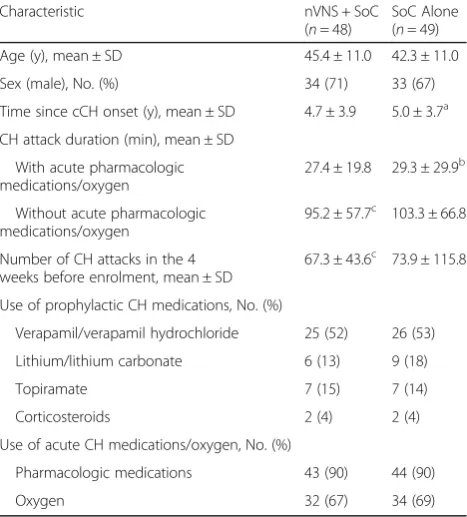
Complete descriptions of patient disposition, demographics, and baseline characteristics in PREVA have been reported previously [12]. A total of 97 patients with cCH were randomly assigned to receive nVNS + SoC (n= 48) or SoC alone (n= 49) (Fig. 1). Demographics, baseline charac-teristics, and use of prophylactic SoC medications (i.e. verapamil, lithium, topiramate, and corticosteroids) were comparable between groups (Table 1). The number of pa-tients in the mITT population varied among the end points because of its dependence on the availability of measurable observations. Of the 92 patients who continued into the ex-tension phase, 44 continued to receive nVNS + SoC and 48 switched from SoC alone to nVNS + SoC.
Weekly attack frequency
The mean weekly attack frequency was significantly lower with nVNS + SoC than with SoC alone from week 2 of the randomised phase through week 3 of the exten-sion phase (P< 0.02; Fig. 2). For the nVNS + SoC group, attack frequencies were significantly reduced from base-line beginning at week 1 of the randomised phase and continuing through week 4 of the extension phase (P< 0.05). Attack frequencies were relatively stable through-out the extension phase.
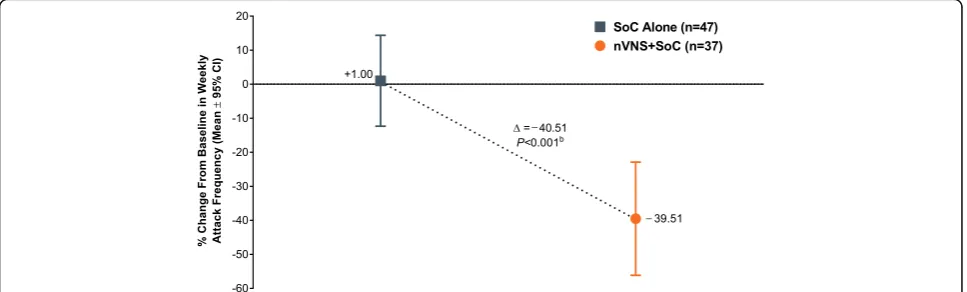
Global mean attack frequency at the end of the rando-mised phase had decreased by 40% from baseline in the nVNS + SoC group and had increased by 1% with SoC alone, representing a 41% therapeutic benefit of nVNS (P< 0.001; Fig. 3).
Response rates
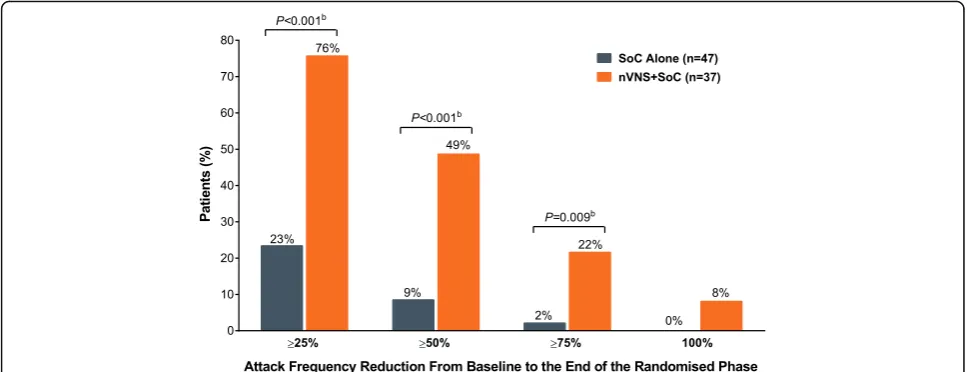
At the end of the randomised phase, a significantly higher percentage of patients in the nVNS + SoC group
than in the SoC group had≥25%,≥50%, and≥75% attack frequency reductions from baseline (≥25% and ≥50%, P < 0.001; ≥75%, P= 0.009; Fig. 4). There were 3 patients (8%) in the nVNS + SoC group who had a 100% attack frequency reduction; no patients who received SoC alone had a 100% response.
Safety and tolerability
As previously reported [12], nVNS was safe and well tol-erated in the PREVA study. There were similar propor-tions of patients in the nVNS + SoC and SoC groups who reported≥1 adverse event. Rates of discontinuation due to adverse events were also similar between groups. No serious device-related adverse events occurred.
Discussion
Our post hoc analysis of the PREVA study helps to further define the possible clinical value of the nVNS efficacy ob-served in the largest study of cCH prophylaxis to date that showed significant treatment effects [6, 12]. Significant beneficial effects were seen with nVNS + SoC (versus SoC alone) within 2 weeks after nVNS initiation. The SoC con-trol group began to experience significant treatment bene-fits within 1 week after switching to nVNS + SoC. The Fig. 1PREVA Study Design. Abbreviations: nVNS, non-invasive vagus
nerve stimulation; SoC, standard of care
Table 1PREVA Demographics and Baseline Characteristics
Characteristic nVNS + SoC
(n= 48)
SoC Alone (n= 49)
Age (y), mean ± SD 45.4 ± 11.0 42.3 ± 11.0
Sex (male), No. (%) 34 (71) 33 (67)
Time since cCH onset (y), mean ± SD 4.7 ± 3.9 5.0 ± 3.7a
CH attack duration (min), mean ± SD
With acute pharmacologic medications/oxygen
27.4 ± 19.8 29.3 ± 29.9b
Without acute pharmacologic medications/oxygen
95.2 ± 57.7c 103.3 ± 66.8
Number of CH attacks in the 4 weeks before enrolment, mean ± SD
67.3 ± 43.6c 73.9 ± 115.8
Use of prophylactic CH medications, No. (%)
Verapamil/verapamil hydrochloride 25 (52) 26 (53)
Lithium/lithium carbonate 6 (13) 9 (18)
Topiramate 7 (15) 7 (14)
Corticosteroids 2 (4) 2 (4)
Use of acute CH medications/oxygen, No. (%)
Pharmacologic medications 43 (90) 44 (90)
Oxygen 32 (67) 34 (69)
Abbreviations:CHcluster headache,nVNSnon-invasive vagus nerve stimulation,
SDstandard deviation,SoCstandard of care
a
Data were missing for 2 patients in the SoC alone group.b
potential for further benefits with continued nVNS treat-ment is consistent with findings from several studies [12, 20–23]. Significant reductions from baseline in weekly at-tack frequency were observed by the end of the first week of treatment and were sustained until the end of the study (i.e. week 8). In the 4-week randomised phase, nVNS + SoC treatment led to a 40% reduction in CH attack frequency, whereas SoC alone resulted in a 1% increase. The ≥25%,
≥50%, and ≥75% response rates were significantly higher with nVNS + SoC than with SoC alone. Limitations of this analysis are similar to those that have been well docu-mented for post hoc analyses in general [24].
As important as the statistically significant findings, nVNS had effects that were clinically meaningful, de-fined as the ability to provide practical advantages that address current therapeutic challenges [25]. The excruci-ating nature of CH attacks warrants a greater sense of urgency for prophylactic treatment [18, 19] that may be addressed by nVNS with its rapid onset of efficacy,
which was significant within 2 weeks of nVNS addition to SoC, and its beneficial effects on ≥25%, ≥50%, ≥75%, and 100% response rates. For the nVNS + SoC group, the time to response is as fast as that seen in a previous clinical study of patients with episodic CH treated with verapamil, which is also considered to have an early on-set of effect once therapeutic levels are reached [18, 26]. Nearly half of patients treated with nVNS during the randomised phase of PREVA experienced a ≥50% re-sponse, which exceeds the 30% improvement that is widely accepted by general pain specialists as clinically meaningful [27–29]. The≥25% response experienced by the majority of patients (76%) in the current analysis would likely also be considered clinically meaningful for those suffering from the intense pain of cCH.
Our analysis has identified subgroups of patients with dramatic responses similar to those seen in studies of other therapies for primary headache [14, 16, 17]. In the nVNS + SoC group, 8% of patients were attack free for the duration Fig. 2Mean Attack Frequencies (mITT Populationa). Abbreviations: CI, confidence interval; mITT, modified intent-to-treat; nVNS, non-invasive vagus nerve stimulation; SoC, standard of care.aSubjects with available data for each study week.bFrom thettest
Fig. 3Global Change in Weekly Attack Frequency at the End of the Randomised Phase (mITT Populationa). Abbreviations: CI, confidence interval;
mITT, modified intent-to-treat; nVNS, non-invasive vagus nerve stimulation; SoC, standard of care.aSubjects with available data for each study
of the randomised phase, and no patients receiving SoC alone had this result. A≥75% reduction in weekly attacks occurred in 22% of patients receiving nVNS + SoC com-pared with 2% of patients receiving SoC alone. Further ef-forts towards identifying potential predictors of such favourable responses may help to individualise future treat-ment decisions regarding adjunctive nVNS prophylaxis.
The safety, tolerability, and practicality of nVNS are well established [12, 22, 23, 30–33]. Based on the frequent pharmacologic dosing and potentially indefinite treatment period required for cCH, important challenges of prophy-laxis include the potential for drug interactions and drug-related adverse events including atrioventricular conduction abnormalities, tremor, and confusion [18]. In PREVA, nVNS was easily incorporated into the existing pharmacologic SoC regimens without any risk of drug interactions or drug-related adverse events [12]. The safety and tolerability profile of nVNS may also help to avoid potential delays in pain re-lief, as seen in certain patients treated with verapamil, which requires gradual titration in order to minimize the risk of third-degree atrioventricular block [18, 34]. The significant reduction in abortive pharmacologic medication/oxygen use in the nVNS + SoC group of PREVA helps to mitigate the drug-related safety and tolerability, dosing, and portability challenges of existing acute CH therapies [7, 12, 35, 36]. Although PREVA did not examine the effects of nVNS in patients with episodic CH, the rapid beneficial effects on at-tack frequency observed within 2 weeks of treatment initi-ation in this cCH analysis, combined with the established safety profile of nVNS, suggest that a trial in episodic CH would be clinically reasonable.
Conclusions
In this post hoc analysis of attack frequency over time and expanded response rates, the practical combination of nVNS
and currently available cCH treatments led to rapid, sus-tained, and clinically meaningful responses. Within 2 weeks after the addition of prophylactic nVNS to SoC, sustained reductions in attack frequency were significantly greater with this combination than with SoC alone. After 4 weeks, patients’ average weekly attack frequency was 41% lower with prophylactic nVNS + SoC treatment than with SoC alone. The rapid decrease in weekly attack frequency justi-fies a 4-week trial period to identify responders to nVNS, with a high degree of confidence, among patients with cCH. The≥25%,≥50%, and≥75% response rates were significantly higher with adjunctive nVNS than with SoC alone.
Preva study group
Investigators are listed by country. 1. Germany: Migraine and Headache Clinic, Königstein–Charly Gaul, MD, PhD (principal investigator), and Ronald Brand, MD (subinvesti-gator); University Hospital-Essen, Essen – Hans-Christoph Diener, MD, PhD (principal investigator), and Kasja Rabe, Holle Dagny, Steffen Nägel, MD, and Maja Bak, MD (subinvestigators); Ludwig-Maximilian University, Munich– Andreas Straube, MD (principal investigator), and Bernhard Blum, MD, Ruth Ruscheweyh, MD, and Ozan Eren, MD (subinvestigators); Department of Neurology, Charité Uni-versity Hospital, Berlin–Uwe Reuter, MD (principal investi-gator), and Heike Israel-Willner, MD, and Lars Neeb, MD (subinvestigators); Krankenhaus Lindenbrunn, Lindenbrunn
–Stefan Evers, MD, PhD (principal investigator); 2. United Kingdom: The Walton Centre for Neurology and Neurosur-gery, Liverpool–Nicholas Silver, MBBS, PhD (principal in-vestigator), and Helen Banks, MD, and Heike Arndt, MD (subinvestigators); The Southern General Hospital, Glasgow
– Alok Tyagi, MD (principal investigator); Hull Royal In-firmary, Hull–Fayyaz Ahmed, MD (principal investigator), and Anwar Osman, MD (subinvestigator); 3. Belgium: Liège Fig. 4Response Rates (mITT Populationa). Abbreviations: mITT, modified intent-to-treat; nVNS, non-invasive vagus nerve stimulation; SoC, standard
University, Liège–Delphine Magis, MD, PhD (principal in-vestigator), and Jean Schoenen, MD (subinvestigator); 4. Italy: Sant’Andrea Hospital, Sapienza University of Rome, Rome – Paolo Martelleti, MD (principal investigator), and Andrea Negro, MD (subinvestigator).
Abbreviations
cCH:Chronic cluster headache; CH: Cluster headache; CI: Confidence interval; mITT: Modified intent-to-treat; nVNS: Non-invasive vagus nerve stimulation; PREVA: The PREVention and Acute treatment of chronic cluster headache study; SD: Standard deviation; SoC: Standard of care
Acknowledgements
The authors would like to acknowledge Hans-Christoph Diener, MD, PhD; Nicholas Silver, MBBS, PhD; Uwe Reuter, MD; and Annelie Andersson for their contributions to the original publication of the PREVA study, as well as all of the investigators and study sites. The PREVA study investigators acknowledge the contributions of all the nurses and study coordinators. Post hoc statistical analyses were conducted by Candace McClure, PhD, of North American Science Associates Inc. (Minneapolis, MN, USA). Professional writing and editorial support was provided by Stefanie Dorlas, BMath, BEd, of MedLogix Communications, LLC, under the direction of the authors.
Funding
The PREVA study and this post hoc analysis were funded by electroCore, LLC. Statistical analyses by North American Science Associates (NAMSA) Inc. (Minneapolis, MN, USA) were supported by electroCore, LLC. Professional writing and editorial support from MedLogix Communications, LLC (Schaumburg, IL, USA), funded by electroCore, LLC, was provided under the direction of the authors throughout draft development and revisions in accordance with International Committee of Medical Journal Editors (ICMJE) criteria for authorship. The authors are guarantors of this document, which expresses the opinions and conclusions of the authors and not those of their corresponding affiliations. None of the authors received compensation from a pharmaceutical company, device company, or other agency for their contributions to the development of this manuscript.
Availability of data and materials
Data from the PREVA study are available in the following publication: Gaul C, Diener HC, Silver N, et al. (2016) Non-invasive vagus nerve stimulation for
PREVention and Acute treatment of chronic cluster headache (PREVA): a randomised controlled study. Cephalalgia 36:534–546. doi:10.1177/0333102415607070. The datasets supporting the conclusions of this article are included within the article and have been validated by NAMSA; additional files can be provided upon request.
Authors’contributions
CG: drafting/revising the manuscript, study concept or design, analysis or interpretation of data, acquisition of data, and approval of the final draft. DM: drafting/revising the manuscript, acquisition of data, and approval of the final draft. EL: drafting/revising the manuscript, study concept or design, analysis or interpretation of data, and approval of the final draft. AS: drafting/ revising the manuscript, acquisition of data, and approval of the final draft.
Competing interests
CG has received honoraria from Allergan plc; Bayer AG; Boehringer Ingelheim GmbH; Desitin Arzneimittel GmbH; electroCore, LLC; Grünenthal GmbH; Hormosan Pharma GmbH; Eli Lilly and Company; Novartis Pharma AG; Ratiopharm GmbH; and Reckitt Benckiser Group plc. He has no ownership interests and does not own any pharmaceutical company stocks. DM has received travel grants from Allergan, Inc.; Bayer; Biogen Idec, Inc; and electroCore, LLC. EL is an employee of electroCore, LLC, and receives stock ownership. AS has received honoraria from Allergan plc; Berlin-Chemie AG; Boehringer Ingelheim GmbH; Desitin Arzneimittel GmbH; electroCore, LLC; Hormosan Pharma GmbH; Medical Specialties Distributors, LLC; Novartis Pharma AG; and Teva GmBh. He has also received grants from the German Council of Science and Humanities; the German Secretary of Education; the Else Kröner-Fresenius Foundation; and the Ludwig-Maximilian University.
Consent for publication Not applicable.
Ethics approval and consent to participate
The PREVA study was conducted in accordance with principles and requirements of the Declaration of Helsinki, Good Clinical Practices, and clinical trial registration (ClinicalTrials.gov identifier: NCT01701245). Investigators obtained ethics approval for this study from Charité-Universitätsmedizin Berlin, Campus Charité Mitte Ethik-Kommission (reference number: EA1/272/12); Ethik-Kommission der Universität Duisburg-Essen (reference number: 12-5228-BO); Ethik-Kommission bei der Landesärztekammer Hessen (reference number: FF97/2012); Ärztekammer Niedersachsen (reference number: grae/257/ 2012); Ethik-Kommission der Medizinischen Fakultät (reference number: 461/12); Comitato Etico dell’Azienda Ospedaliera Sant’Andrea, Istituito ai sensi del OM (reference number: 13918/2013); Belgium Local Ethics Committee (reference number: B412201317020 1307); West of Scotland Research Ethics Committee 4 (reference number: 13/WS/0143). Upon recruitment, all study subjects provided informed consent to participate.
Author details
1Department of Headache and Facial Pain, Migraine and Headache Clinic, Ölmühlweg 31, Königstein im Taunus 61462, Germany.2Headache Research Unit, University Department of Neurology, Centre Hospitalier Régional de la Citadelle, Boulevard du 12ème de Ligne 1, 4000 Liège, Belgium.3electroCore, LLC, 150 Allen Road, Suite 201, Basking Ridge 07920, NJ, USA.4Department of Neurology, Ludwig-Maximilian University, Marchioninistr 15, Munich D81377, Germany.
Received: 3 January 2017 Accepted: 7 February 2017
References
1. Fischera M, Marziniak M, Gralow I, Evers S (2008) The incidence and prevalence of cluster headache: a meta-analysis of population-based studies. Cephalalgia 28:614–618. doi:10.1111/j.1468-2982.2008.01592.x 2. Gaul C, Finken J, Biermann J et al (2011) Treatment costs and indirect costs
of cluster headache: a health economics analysis. Cephalalgia 31:1664–1672. doi:10.1177/0333102411425866
3. Martelletti P (2015) Cluster headache management and beyond. Expert Opin Pharmacother 16:1411–1415. doi:10.1517/14656566.2015.1052741 4. Headache Classification Committee of the International Headache Society
(2013) The International Classification of Headache Disorders, 3rd edition (beta version). Cephalalgia 33:629–808. doi:10.1177/0333102413485658 5. Rozen TD (2005) Cluster headache: diagnosis and treatment. Curr Pain
Headache Rep 9:135–140
6. Francis GJ, Becker WJ, Pringsheim TM (2010) Acute and preventive pharmacologic treatment of cluster headache. Neurology 75:463–473. doi: 10.1212/WNL.0b013e3181eb58c8
7. Martelletti P, Giamberardino MA, Mitsikostas DD (2016) Greater occipital nerve as target for refractory chronic headaches: from corticosteroid block to invasive neurostimulation and back. Expert Rev Neurother 16:865–866. doi:10.1586/14737175.2016.1164599
8. Martelletti P, Curto M (2016) Cluster headache treatment–RCTs versus real-world evidence. Nat Rev Neurol 12:557–558. doi:10.1038/nrneurol.2016.134 9. Martelletti P, Mitsikostas DD (2015) Cluster headache: a quasi-rare disorder
needing a reappraisal. J Headache Pain 16:59. doi:10.1186/s10194-015-0545-1 10. Freitag FG, Schloemer F (2014) Medical management of adult headache.
Otolaryngol Clin North Am 47:221–237. doi:10.1016/j.otc.2013.11.002 11. Holle D, Burmeister J, Scherag A, PredCH Study Group et al (2013) Study
protocol of Prednisone in episodic Cluster Headache (PredCH): a randomized, double-blind, placebo-controlled parallel group trial to evaluate the efficacy and safety of oral prednisone as an add-on therapy in the prophylactic treatment of episodic cluster headache with verapamil. BMC Neurol 13:99. doi:10.1186/1471-2377-13-99
12. Gaul C, Diener H-C, Silver N, PREVA Study Group et al (2016) Non-invasive vagus nerve stimulation for PREVention and Acute treatment of chronic cluster headache (PREVA): a randomised controlled study. Cephalalgia 36: 534–546. doi:10.1177/0333102415607070
14. Dodick DW, Goadsby PJ, Silberstein SD, ALD403 study investigators et al (2014) Safety and efficacy of ALD403, an antibody to calcitonin gene-related peptide, for the prevention of frequent episodic migraine: a randomised, double-blind, placebo-controlled, exploratory phase 2 trial. Lancet Neurol 13:1100–1107. doi:10.1016/S1474-4422(14)70209-1
15. Mitsikostas DD, Rapoport AM (2015) New players in the preventive treatment of migraine. BMC Med 13:279. doi:10.1186/s12916-015-0522-1 16. Bigal ME, Dodick DW, Rapoport AM et al (2015) Safety, tolerability, and
efficacy of TEV-48125 for preventive treatment of high-frequency episodic migraine: a multicentre, randomised, double-blind, placebo-controlled, phase 2b study. Lancet Neurol 14:1081–1090. doi:10.1016/S1474-4422(15)00249-5
17. Dodick DW, Goadsby PJ, Spierings ELH, Scherer JC, Sweeney SP, Grayzel DS (2014) Safety and efficacy of LY2951742, a monoclonal antibody to calcitonin gene-related peptide, for the prevention of migraine: a phase 2, randomised, double-blind, placebo-controlled study. Lancet Neurol 13:885– 892. doi:10.1016/S1474-4422(14)70128-0
18. Becker WJ (2013) Cluster headache: conventional pharmacological management. Headache 53:1191–1196. doi:10.1111/head.12145 19. Mitsikostas DD, Edvinsson L, Jensen RH et al (2014) Refractory chronic
cluster headache: a consensus statement on clinical definition from the European Headache Federation. J Headache Pain 15:79. doi:10.1186/1129-2377-15-79
20. Aaronson ST, Carpenter LL, Conway CR et al (2013) Vagus nerve stimulation therapy randomized to different amounts of electrical charge for treatment-resistant depression: acute and chronic effects. Brain Stimul 6:631–640. doi: 10.1016/j.brs.2012.09.013
21. Murphy JV; Pediatric VNS Study Group (1999) Left vagal nerve stimulation in children with medically refractory epilepsy. J Pediatr 134:563–566 22. Silberstein SD, Calhoun AH, Lipton RB, EVENT Study Group et al (2016)
Chronic migraine headache prevention with noninvasive vagus nerve stimulation: the EVENT study. Neurology 87:529–538. doi:10.1212/WNL. 0000000000002918
23. Silberstein SD, Mechtler LL, Kudrow DB, ACT1 Study Group et al (2016) Non-invasive vagus nerve stimulation for the ACute Treatment of cluster headache: findings from the randomized, double-blind, sham-controlled ACT1 study. Headache 56:1317–1332. doi:10.1111/head.12896 24. Curran-Everett D, Milgrom H (2013) Post-hoc data analysis: benefits and
limitations. Curr Opin Allergy Clin Immunol 13:223–224. doi:10.1097/ACI. 0b013e3283609831
25. Kazdin AE (1999) The meanings and measurement of clinical significance. J Consult Clin Psychol 67:332–339
26. Leone M, D’Amico D, Frediani F et al (2000) Verapamil in the prophylaxis of episodic cluster headache: a double-blind study versus placebo. Neurology 54:1382–1385
27. Dworkin RH, Turk DC, McDermott MP et al (2009) Interpreting the clinical importance of group differences in chronic pain clinical trials: IMMPACT recommendations. Pain 146:238–244. doi:10.1016/j.pain.2009. 08.019
28. Jürgens TP, Barloese M, May A, et al. (2016) Long-term effectiveness of sphenopalatine ganglion stimulation for cluster headache. Cephalalgia. doi: 10.1177/0333102416649092.
29. Miller S, Sinclair AJ, Davies B, Matharu M (2016) Neurostimulation in the treatment of primary headaches. Pract Neurol 16:362–375. doi:10.1136/ practneurol-2015-001298
30. Barbanti P, Grazzi L, Egeo G, Padovan AM, Liebler E, Bussone G (2015) Non-invasive vagus nerve stimulation for acute treatment of high-frequency and chronic migraine: an open-label study. J Headache Pain 16:61. doi:10.1186/ s10194-015-0542-4
31. Grazzi L, Egeo G, Calhoun AH, McClure CK, Liebler E, Barbanti P (2016) Non-invasive vagus nerve stimulation (nVNS) as mini-prophylaxis for menstrual/ menstrually related migraine: an open-label study. J Headache Pain 17:91. doi:10.1186/s10194-016-0684-z
32. Kinfe TM, Pintea B, Muhammad S et al (2015) Cervical non-invasive vagus nerve stimulation (nVNS) for preventive and acute treatment of episodic and chronic migraine and migraine-associated sleep disturbance: a prospective observational cohort study. J Headache Pain 16:101. doi:10. 1186/s10194-015-0582-9
33. Nesbitt AD, Marin JC, Tompkins E, Ruttledge MH, Goadsby PJ (2015) Initial use of a novel noninvasive vagus nerve stimulator for cluster headache treatment. Neurology 84:1249–1253. doi:10.1212/WNL.0000000000001394
34. Cohen AS, Matharu MS, Goadsby PJ (2007) Electrocardiographic abnormalities in patients with cluster headache on verapamil therapy. Neurology 69:668–675. doi:10.1212/01.wnl.0000267319.18123.d3 35. Ashkenazi A, Schwedt T (2011) Cluster headache–acute and prophylactic
therapy. Headache 51:272–286. doi:10.1111/j.1526-4610.2010.01830.x 36. Ekbom K, Hardebo JE (2002) Cluster headache: aetiology, diagnosis and
management. Drugs 62:61–69
Submit your manuscript to a
journal and benefi t from:
7 Convenient online submission 7 Rigorous peer review
7 Immediate publication on acceptance 7 Open access: articles freely available online 7 High visibility within the fi eld
7 Retaining the copyright to your article