The Thirty-Third AAAI Conference on Artificial Intelligence (AAAI-19)
Learning to Align Question and Answer Utterances in Customer Service
Conversation with Recurrent Pointer Networks
Shizhu He,
1Kang Liu,
1,2Weiting An
31National Laboratory of Pattern Recognition, Institute of Automation,
Chinese Academy of Sciences, Beijing, China 2University of Chinese Academy of Sciences, Beijing, China
3Alibaba Group, Hangzhou, China
{shizhu.he, kliu}@nlpr.ia.ac.cn [email protected]
Abstract
Customers ask questions, and customer service staffs answer those questions. It is the basic service manner of customer service (CS). The progress of CS is a typical multi-round con-versation. However, there are no explicit corresponding rela-tions among conversational utterances. This paper focuses on obtaining explicit alignments of question and answer utter-ances in CS. It not only is an important task of dialogue analy-sis, but also able to obtain lots of valuable train data for learn-ing dialogue systems. In this work, we propose end-to-end models for aligning question (Q) and answer (A) utterances in CS conversation with recurrent pointer networks (RPN). On the one hand, RPN-based alignment models are able to model the conversational contexts and the mutual influence of different Q-A alignments. On the other hand, they are able to address the issue of empty and multiple alignments for some utterances in a unified manner. We construct a dataset from an in-house online CS. The experimental results demonstrate that the proposed models are effective to learn the alignments of question and answer utterances.
Introduction
Customer service (CS) provides an irreplaceable platform for sellers to answer the questions and solve the problems of customers. In general, in the practical CS (e.g., CS of e-commerce website), Customers pose questions that will be answered by customer service staffs (hereinafter called
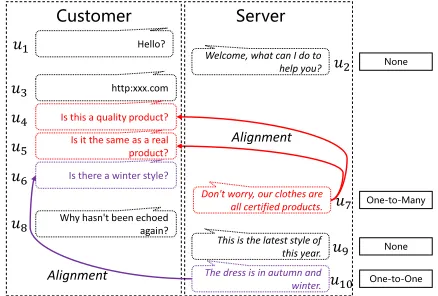
Server), and the communication between a customer and a server is a typical multi-round conversation. In fact, as shown in Figure 1, there are certain corresponding relations among conversation utterances raised by different partici-pants (e.g., customer and server). It is because each server utterance is replying to some of previously customer utter-ances with consulting intention. Actually, there are no ex-plicit relations among those conversational utterances.
In this paper, we focus on the utterance alignment (UA), which is to align the question (Q) and answer (A) utter-ances in the multi-round conversation between customer and server. Finding the alignments among utterances with dif-ferent participants is very important in conversation anal-ysis. Based on the alignments, the questions posed by a customer are connected with the corresponding responses
Copyright c⃝2019, Association for the Advancement of Artificial Intelligence (www.aaai.org). All rights reserved.
Server Customer
http:xxx.com
Don't worry, our clothes are all certified products.
Welcome, what can I do to help you?
Is this a quality product?
Is it the same as a real product?
Is there a winter style?
Why hasn't been echoed again?
This is the latest style of this year.
The dress is in autumn and winter.
𝑢2
𝑢3
𝑢4
𝑢5
𝑢6
𝑢8
𝑢7
𝑢9
𝑢10
Alignment
Alignment
One-to-Many None
One-to-One None
Hello?
𝑢1
Figure 1: Question and answer alignments of multi-round conversation utterances in customer service.
in all customer’s utterances (vice versa). However, this sim-ple strategy will ignore several important issues. First, the meaning of an utterance is context dependent. It makes the individual classification (Du, Poupart, and Xu 2017; Jiang et al. 2018) for each utterance pair is not enough to align the whole conversation utterances. Second, the align-ments of different utterances are correlating and interac-tional with each other. For example, if question Q1 (e.g., u4in Figure 1) is verysimilartoQ2(u5) in content, and the questionQ2 (u5) aligns with answerA1(u7), the question Q1(u4) should alsoalignwith answerA1(u7). And if ques-tionQ1(u5) is verydissimilartoQ2(u6), and the question Q2(u6) aligns with answerA1(u10), the questionQ1 (u5) should not alignwith answer A1 (u10). Finally, there are various alignments of Q-A utterances in a CS conversation. For one thing, chatting messages may be interspersed in the conversation utterances, which raises theemptyalignment (None) issue (no alignment for a given utterance, e.g.,u2 andu9). For another, customers may consult one thing with multiple similar questions, which raises themultiple align-ment (One-to-Many) issue (one answer may align with mul-tiple questions, e.g,u7should align with two utterances:u4 andu5). TheNoneandOne-to-Manyalignments obviously cannot be addressed by the content matching based models. Therefore, the most challenge of learning to align question and answer utterances in a CS conversation is:how to build a unified model, which not only is able to model the con-versational contexts and the mutual influence of different utterances, but also address the issue of empty and multiple alignments.
To this end, this paper proposes end-to-end models to ob-tain Q-A alignments in a CS conversation. We first utilize
recurrent networksto encode the conversational utterances,
and we also adopt two separate encoders for intensive mod-eling the customer’s and server’s information. Then,pointer
networksare adopted to decode all alignments for server’s
utterances. Specifically, the proposed models are able to deal withNonealignment by appending a shared placeholder rep-resentation in each conversation reprep-resentation memory. We adopt aclassification loss to learn the basic model. More-over, we adopt aregression loss for conveniently and ele-gantly addressing the case ofOne-to-Manyalignments.
Besides, we construct a dataset from an in-house online CS. The results demonstrate the efficiency of the proposed models.Compared with the state-of-the-arts, the proposed models are able to promote the F1 from 79.5% to 84.86% on the overall alignments. Moreover, for None alignments, we improve the F1 from 91.1% to 94.07%. And for One-to-Many alignments, the F1 is improved from 76.27% to 80.39%.
In brief, the main contributions are as follows:
• We focus on the task of obtaining the alignments of ques-tion and answer utterances in a CS conversaques-tion, it is very useful for CS conversation analysis and building intelli-gent dialogue systems.
• We propose end-to-end models to learning the alignments of question and answer utterances in conversations with recurrent pointer networks. Our models not only are able
to model the conversational contexts and consider the mu-tual influence of different Q-A alignments, but also ad-dress the issue ofNoneandOne-to-Manyalignments in a unified manner.
• We construct a dataset from an in-house online CS1. The experimental results demonstrate that the proposed mod-els are effective to obtain Q-A alignments, even for the utterances withNoneandOne-to-Manyalignments.
Task Description
The Task
There are two participants in a customer service (CS): a cus-tomer and a server. In most case, the cuscus-tomer raises the questions which will be answered by the server. In fact, the server also may ask questions to the customer for obtaining more detailed intention. In this work, we mainly focus on the former, and the proposed methods could be easily extended to deal with the latter when we simply reverse the alignment direction. Therefore, we devote to finding the alignments be-tween each server’s utterance (answer) and the correspond-ing customer’s utterances (question). We formulate the task as a sequence multi-classification multi-label classification task, and we can learn supervised models with annotation training data.
Let CS = [(u1, t1),(u2, t2), ...,(un, tn)] denotes a CS
conversation,ui = [w1, ..., w|ui|]indicates the natural
lan-guage sentence (word sequence) and ti indicates the role
of speaker. In this scenario, only two roles (Customer (c) and Server (s)) are considered. For each server’s utterance (ui, ti), ti = s, we should find the alignment utterances
from all customer’s raised ones beforei({j|j < i, tj =c})
which could be answered byui.
Data
We construct a dataset from an in-house online CS to facili-tate the research. We first sample 10,000 conversations from a human-to-human customer service system, which own about 6-20 utterances for each conversational episode. To construct the explicit alignments between customer’s utter-ances (question) and server’s utterutter-ances (answer), we built a labeling website and invite five annotators. They need to annotate the aligned customer’s utterances when given a server’s utterance. It is independent in labeling different an-swering utterances. If the server’s utterance is a meaning-less utterance and cannot answer any questions, it will be labeled as “None” alignment. The coincidence rate of the five annotators is about 85% (Fleiss’ Kappa was 0.523). An-other annotator is employed to review all labeled alignments and remove some inconsistency cases. In the end, we ob-tain 5,741 labeled conversations. There are 6.0 utterances of customers with 22.7 words and 4.5 utterances of servers with 6.2 words on average per conversation. The answer is aligned with 1.38 questions on average when neglecting the
Nonealignment (1.15 questions when considering theNone
alignment). And the alignments ofNoneandOne-to-Many
account for 57% and 12%, respectively.
1
𝑢1 𝑢2 𝑢3 𝑢4 𝑢5 𝑢6 𝑢7 𝑢8 𝑢9 Customer
Server
Utterance Encoder
Conversation Enc&Dec (oder)
5 4
6
0
0
Recurrent Pointer Networks
Alignment None
𝑢10 𝑢2alignments
𝑢7alignments
𝑢10alignments
𝑢9alignments
Utterance Encoder
Conversation Encoder Customer
Encoder
Server Enc&Dec (oder)
4 5
6
0 0
Recurrent Pointer Networks
None
Customer
Server 𝑢1 𝑢2 𝑢3 𝑢4 𝑢5 𝑢6 𝑢7 𝑢8 𝑢9
Alignment
𝑢10 𝑢2alignments 𝑢7alignments
𝑢9alignments
𝑢10alignments
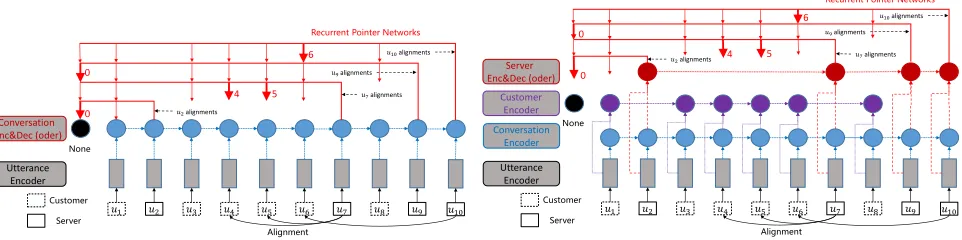
Figure 2: Main architectures of Recurrent Pointer Networks (RPN) for aligning question and answer utterances in a multi-turn conversation. The red arrows and the bold ones indicate candidate pointers (all previous customer’s utterances) and right pointers (alignment utterances), respectively.Model-I(Left) utilizes a sharing encoder for customer and server.Model-II (Right) utilizes independent encoders for customer and server, which are built upon a sharing conversation encoder.
Challenges
A conversation may contain more than one consultation (e.g., two consults in the Figure 1). Considering the se-quence of the dialogue process, we can align utterances by their posing orders (e.g.,u7 align u6,u9 align u8). How-ever, in a real scenario, this simple alignment rule may not work. At first, customer may raise a number of questions at a time (e.g.,u3,u4,u5,u6), and the server may answer the questions with different orders. In addition, each server may need to communicate with multiple customers at the same time, so each customer’s question may not be answered im-mediately. The situation will aggravate the above situation. On the other hand, people may express the same intention in a number of short and simple utterances in the spoken com-municating environment (e.g.,u4 andu5express the same meaning). Therefore, some answers should align with more than one questions (e.g.,u7 should align with bothu4and u5). At last, there may have some chat messages (e.g., u9) interspersed in the consulting process, and they should not be aligned with any utterance. The different alignment types mixed together in a CS conversation is another challenge in learning the alignment models. Besides the challenges in the language understanding and dialogue analysis, the data from the real applications are very noisy and contains typos, non-standard and other informal expressions.
Methodology
Inspired by the work on the encoder-decoder framework, es-pecially the Pointer Networks (Vinyals, Fortunato, and Jaitly 2015), we propose end-to-end neural network models for aligning question and answer utterances in multi-round con-versation (as illustrated in Figure 2). Compared with typi-cal dialogue modeling, there are two different roles in cus-tomer service, therefore, besides utilizing one model to en-code all utterance (Model-I, as shown in Figure 2(a)), we also utilize two extra models to independently encode cus-tomer’s and server’s utterances (Model-II, as shown in Figure 2(b)).
Our end-to-end neural network models consist of three components, includingUtterance Encoder,Conversation
EncoderandAlignment Decoder. Besides,theModel-II adopts two additional encoders for independent model cus-tomer and server conversations. Specifically,Utterance En-codertransforms the natural language sentenceuiinto a
nu-merical representation vui which is able to feed into
neu-ral models.Conversation Encoderconsiders the relevance of conversation utterances. In Model-II,Customer En-coderandServer Encoderare similar to the Conversation Encoder, but only deal with customer’s and server’s utter-ances, respectively.Alignment Decodertakes the represen-tation of server’s utterance into account and predicts the alignments with the previous customer’s utterances (or do not align with anyone). Considering the empty alignment with a joint manner, we set a shared representation for the “None” placeholder (as shown in Figure 2).
Utterance Encoder
Each utterance (ui= [w1, ..., w|ui|]) is a word sequence. By
adopting word embeddings and semantic composition mod-els such as convolutional neural network (CNN) and Recur-rent Neural Network (RNN), we can learn the utterance rep-resentation. We adopt the CNN model to learning the sen-tence representation. To distinguish utterances raised by cus-tomer and server, we utilize low-dimensional vectorsroui
to represent different roles. That is, two vectors are adopted to represent customer and server, respectively. The final ut-terance representationvuiis concatenated of the CNN result
v′uiand the role embeddingroui.
Conversation Encoder
conver-sation in CS. Moreover, consider the customer and server owning different knowledge (consulting questions/answers) in a conversation, we utilize two individual RNN models in Model-II. RNN models such as LSTM (Hochreiter and Schmidhuber 1997) and GRU (Chung et al. 2014) are able to transform the original utterance representations (sequen-tial vectors){vu1,vu2, ...,vun}into context dependent
rep-resentations{hu1,hu2, ...,hun}(another sequential vectors)
in a CS conversation.
Customer and Server Encoders In model-II, we employ two RNN models to encode customer and server’s utter-ances, respectively. Here, we take the customer encoder to illustrate its implement progress, the server encoder owns the similar progress. Each input of customer encoderxct is
the concatenation of the original utterance representationvct
and the output of conversation encoderhct(ctindicates the
t-th utterance of customer.). Customer encoder is used to transform the original customer’s utterance representations
{xc1,xc2, ...,xcn} into customer context dependent
repre-sentations{hc1,hc2, ...,hcn}. The server encoder can also
be used to obtain the utterance representations in the server context{hs1,hs2, ...,hsn},stindicates thet-th utterance of server.
Alignment Decoder
This component is the core step in the proposed models, which is to find the alignments between each server’s ut-terance and previous customer’s utut-terances. The empty and multiple alignments should be considered in a unified man-ner. In practice, the progress of aligning utterance is to find the “matching utterance ids” for each utterance. Therefore, we adopt a pointer network as the alignment decoder. We define the alignment scoreai,jas the probability or weight
ofi-th utterance (server’s) to answer thej-th utterance (cus-tomer’s). There are some explicit rules which can be simply implanted in the model with mask vectors:
ai,j= 0, if : j >=i. (1)
ai,j= 0, if : ti=c. (2)
ai,j= 0, if : tj=s. (3)
To learn a better align model, these rules are merely utilized in the testing stage.
The alignment score in model-I and model-II can be com-puted by the following functions:
Model-I: ai,j =f(hui,huj)
Model-II: asi,cj =f(hsi,hcj)
(4)
Functionf can be modeled by neural networks such as bi-linear functionf(hui,huj) =h
T
ui·W·huj(Wis the model
parameter andhTuj indicates the transpose of the column vec-torhuj) . We also utilizef(hui,hN one)andf(hsi,hN one)
to compute the score of empty alignment.hN oneis the
rep-resentation of the “None” placeholder which owns the same shape of utterance’s representation.
Based on the alignment scores, we can obtain the original alignment results. However, the numerical values are not a
probability value, which hampers the testing and training. To address this problem, we utilize two different methods to transform the score vector[ai,0, ai,1, ..., ai,n]into an easily
compared probability vector.
Classification Alike to the typical recurrent prediction tasks, such as text generation and sequence labeling, we uti-lize thesoftmaxfunction to obtain the prediction proba-bility distribution. In each time step (for each server’s utter-ance), the score vector is converted to the distribution vector [a′i,0, a′i,1, ..., a′i,n] withsoftmax([ai,0, ai,1, ..., ai,n])j =
[ exp(ai,j)
∑n
k=0exp(ai,k)]. And we can obtain the final alignments
through thearg maxoperation: ˆ
ai= arg max
j a
′
i,j. (5)
However, the arg max operation merely obtain one align-ment, and it cannot deal with the multiple alignments. To deal with such issue, we simply return the utterances when the difference between their alignment scores and the maxi-mum alignment score are less than a certain threshold:
{ˆai}={j|a′i,j+λ≥maxnk=0{a′i,k}}. (6)
We call this type of prediction method as classification.
Regression The benefit of the above classification method is that it can coordinate the alignments among different utter-ances by throughsoftmaxfunction. However, its obvious weakness is that it cannot elegantly handle the case of mul-tiple alignments. To avoid the setting of threshold λin the classification method, we convert each align scoreai,j into
a probability valuepi,jwhich indicate the possibility of the
answer utteranceialigns the question utterancej. Specifi-cally, we utilize thesigmoidfunction to compute the prob-ability value: pi,j = sigmoid(ai,j) = 1+e−1ai,j. And we
can return the utterance as the predicted alignments when the probability value larger than0.5(calledregression method):
{aˆi}={j|pi,j≥0.5}. (7)
Even the probability value pi,j does not consider the
rel-evance of i-th answer utterance with other utterances, the representations ofi-th andj-th utterances in computing the alignment score could consider the context of conversation environment. In this way, the computation of probabilitypi,j
is also able to model the relevance of different utterances and their alignments in a multi-round conversation.
Training
The proposed models jointly predict all alignments of server’s utterances. The inputs are utterance sequences, and the outputs are indexes sequences of aligned utterances. Therefore, we adopt a sequence to sequence (Seq2Seq) learning to train our models. The goal of Seq2Seq learning is to maximize the probability of observing an output tar-get sequence by given an input source sequence. Given the batches of the source utterances and target indexes of align-ment utterances, the objective function is to minimize the negative log-likelihood:
L=− 1
M
M
∑
k=1
N
∑
i=1
, where the superscript(k)indicates the index of one con-versation episode which contains utterances with variable number (N).¯ai andˆai indicate the golden and predicted
alignments fori-th utterance, which are represented by one-hot vectors for the convenience of calculation, especially the backpropagation of gradients.Lis the loss function in fit-ting the standard result¯ai and the predict resultˆai. There
are some minor differences in computing the loss between the methods ofclassificationandregression.
Classification Loss: We use cross-entropy to compute the loss of two probability distributions:
LC(¯ai,ˆai) =− n
∑
k=0 ˆ
ai,klog(¯ai,k). (9)
, ˆai,k is the k-th value of the alignment distribution
vec-tor computed by the softmaxfunction for thei-th utter-ance. And¯aiis a golden probabilistic alignment vector (e.g.,
the original alignment vector[0,0,1,1,0]should convert to [0,0,0.5,0.5,0]).
Regression Loss: We useL2norm to compute the compati-bility of two probacompati-bility values’ vectors.
LR(¯ai,ˆai) =
1
2||¯ai−ˆai||L2+α||ˆai||L1. (10)
,||ˆai||L1 is theL1norm of predicting vector, which can po-larize probability values (the alignment probability tent to 0 or 1).αis the coordinate coefficient ofL1norm which is a very small value, usually.
Experiments
In this section, we present our main experimental results, which devote to answering the following questions: 1)Are the proposed models able to effectively obtain all utterance
alignments in a unified manner?2)Are the proposed models
able to deal with the empty and multiple alignments?
Comparison Methods
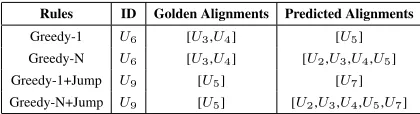
The multi-round conversation in CS has some specific char-acteristics: 1) it has only two participants (a customer and a server); 2) the customer mainly poses the questions; and 3) the server mainly poses the answers. Therefore, we can simply obtain the utterance alignments using some heuristic rules based on the posing order of utterances. For example, the ruleGreedy-1selects the nearest customer’s utterance as the aligned question for the given server’s answer. The ruleGreedy-Nselects the multiple adjacent customer’s ut-terances until meeting a server’s utterance. And the rules withJumpindicate that we can jump the adjacent servers’ utterances to select aligned customer’s utterances. Four rules are adopted and their sample results for the conversation in Figure 1 are given in Table 1.
The above rule-based methods is very limited, for ex-ample, they are not applied to multi-party communica-tion (Ouchi and Tsuboi 2016). Therefore, we are still com-mitted to finding the alignments of utterances through con-versational analysis and natural language processing. We learn different Q-A alignment models based on utterance content matching (marked as Match). They all utilize
Rules ID Golden Alignments Predicted Alignments
Greedy-1 U6 [U3,U4] [U5]
Greedy-N U6 [U3,U4] [U2,U3,U4,U5]
Greedy-1+Jump U9 [U5] [U7]
Greedy-N+Jump U9 [U5] [U2,U3,U4,U5,U7]
Table 1: Sample utterance alignments obtained by rules.
deep neural networks to score the matching degree be-tween customer’s and server’s utterances. And we adopt the CNN, the basic RNN and the LSTM models to encode the customer’s and server’s utterances. Take the CNN for example, the matching score sQ,A of a customer’s
ques-tion Q and a server’s answer A is calculated as: sQ,A =
sigmoid(CN N(Q)T·M·CN N(A)),CN N(S)indicates the vector representation of utterance S (word sequences) by CNN, and the matrixMis the parameter of the match-ing model. We utilize the followmatch-ing margin-based rank-ing loss to train aforementioned matchrank-ing models: L = max(0, sQ,A′ +λm −sQ,A) (or L = max(0, sQ′,A +
λ−sQ,A)), Q′ and A′ indicate the random selected non
aligned utterances. For each server’s utterance, we choose the customer’s utterance with the maximum matching score as the aligned question (marked as greedy (G)). In addi-tion, a threshold strategy is adopted to deal with some an-swers which may own multiple aligned questions (marked as threshold (T)).
Besides the rule-based and match-based methods, we also re-implement two state-of-the-arts approaches. The first one is discriminative models (we construct a Chinese question word set and run a LDA model on our conversation cor-pus), including the Discriminative(marked as Disc) and
Discriminative + LDA(marked asDisc+LDA), which have
been proposed in (Du, Poupart, and Xu 2017). The second one is a two-stage method which has been proposed in (Jiang et al. 2018). The first stage selects message pairs and trains a pairwise similarity model with a siamese hierarchical CNN (SHCNN). And the second stage first constructs a graph with similarity ranking (CISIR) and then finds the connected components as the final linked utterances.
Configurations
The dataset is split into training (80%), validation (10%) and testing set (10%). The utterances in Chinese are seg-mented into word sequences with Jieba2tool after some
ba-sic preprocessing such as convert all URLs to a special la-bel “URL”. And we use the words with the frequency more than 3, which covering 96.8% of the word in the corpus. All the out of vocabulary words are replaced by a special token “UNK”.
For a fair comparison, we set word embedding dimen-sion is 100 for all deep learning based models. For CNN based models, we utilize three filter sizes (2,3,4) and 50 fil-ter numbers with each size. The marginλmare choose from
[0.3,0.5,0.7,0.9]. The threshold value (theλin Formula 6) is set as 0.2 when using classification (We tried 0.1, 0.2 and
2
0.3. The results of 0.1 and 0.2 are better, but there is little difference between them.). We choose the best parameters with grid search in validation data. We use LSTM for all en-coders and decoder in all proposed models with hidden layer size = 300. We use the Adam optimizier to update gradients in all experimental configures.
Evaluation metrics: Based on the human-labeled align-ments for each server’s utterances, we calculate the precision (P), recall (R) andF1for utterance alignments. Considering that there are multiple alignments, we utilize the micro av-eraging to obtain the overall metrics for equally treating all utterance pairs.
Overall Performance
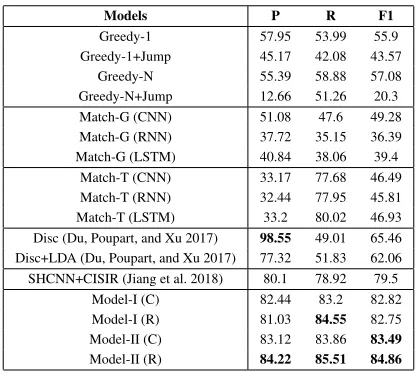
The overall experimental results are shown in Table 2. The first four rows are the results of rule-based methods. The fol-lowing six rows come from the Q-A alignment models based on utterance content matching. And the next three rows are two alignment results of methods proposed in (Du, Poupart, and Xu 2017) and one result of (Jiang et al. 2018). The last four rows are the results of our proposed models with recur-rent pointer networks (RPN).CandRindicate the classifi-cation and regression loss adopted in the training process, respectively.
Models P R F1
Greedy-1 57.95 53.99 55.9
Greedy-1+Jump 45.17 42.08 43.57
Greedy-N 55.39 58.88 57.08
Greedy-N+Jump 12.66 51.26 20.3
Match-G (CNN) 51.08 47.6 49.28
Match-G (RNN) 37.72 35.15 36.39
Match-G (LSTM) 40.84 38.06 39.4
Match-T (CNN) 33.17 77.68 46.49
Match-T (RNN) 32.44 77.95 45.81
Match-T (LSTM) 33.2 80.02 46.93
Disc (Du, Poupart, and Xu 2017) 98.55 49.01 65.46 Disc+LDA (Du, Poupart, and Xu 2017) 77.32 51.83 62.06 SHCNN+CISIR (Jiang et al. 2018) 80.1 78.92 79.5
Model-I (C) 82.44 83.2 82.82
Model-I (R) 81.03 84.55 82.75
Model-II (C) 83.12 83.86 83.49
Model-II (R) 84.22 85.51 84.86
Table 2: ThePrecision,Recall andF1(%) for all test data.
From the four upper parts of Table 2, we can observe that: 1) The effects of rule-based methods are not very bad. The overall F1 even exceed the results of matching meth-ods. The possible reason is that the annotators’ vision is dif-ficult to cover a longer context (more previous utterances), it is a challenge and should be addressed in future work. 2) The rules without “Jump” own a better precision and a bet-ter recall. The main reason is that there are lots of empty alignments, and the “Jump” rules tent to obtain more in-valid alignments. 3) The proposed methods in (Du, Poupart, and Xu 2017) obtain a very high precision, but do not have a good recall. The main reason is that the human-designed one-hot features and the simple discriminative models have not a good generalization ability, while comparing with deep
learning methods with symbol embeddings and deep seman-tic composition models. 4) The proposed method in (Jiang et al. 2018) obtain greatly improvements, it illustrates the im-portance of modeling the interaction effect among multiple utterance alignments. 5) It is very hard to obtain satisfactory results only based on matching utterance content, even the threshold-based matching methods are only able to improve some recalls to a certain extent.
And the last part of Table 2 shows that: 1) Two proposed models are able to promote the performances of utterance alignments on both precision and recall. The results demon-strate that the alignments of conversational utterances not only rely on the language expressions but also depend on relevant utterances. 2) Two separate encoders for customer and server are better on modeling the conversational knowl-edge which models on the top of the whole conversation. We have tried to remove the outputs of conversation encoder to the inputs of customer and server encoder, but the results are far from satisfied. Therefore, the alignment of one Q−A pairs not only rely on the relevance of otherQ′ withQand otherA′ withA, but also rely on the other Q′ −A′ pairs. 3) For precision, the classification and regression loss obtain roughly the same results, but for recall, the regression loss has certain advantages.
None
and
One-to-Many
Alignments
To validate the performance of our proposed methods on
NoneandOne-to-Manyalignments. We compute the P, R,
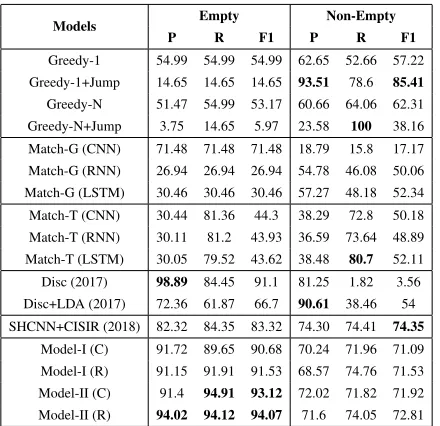
and F1 with different alignment types. And the experimen-tal results are shown in Table 3 and Table 4. The cases of empty alignment are classified as “One-to-One” in Table 4.
From Table 3 and Table 4, we can observe that: 1) The performances of different methods are very quite differ-ent from the effect of differdiffer-ent alignmdiffer-ent types. 2) The rule-based methods are hard to obtain a higher precision in the case of a relatively better recall. Some rules (e.g., “Greedy-1+Jump”) favor precision and some other rules (e.g., “Greedy-N+Jump”) are beneficial to recall. 3) The Q-A alignment models based on utterance content matching have no advantages both onEmptyandOne-to-Many align-ments. 4) The methods in (Du, Poupart, and Xu 2017) are failed inNon-EmptyandOne-to-Manyalignments, despite they obtain a very high precision on empty alignments. 5) The proposed method in (Jiang et al. 2018) is very good at dealing with the Non-Empty alignments and not good at the Empty alignments. 6) RPN-based alignment models are able to obtain appropriate results onEmptyand One-to-Many alignments, which illustrate that the unified models are effective for all alignment types. 7) Compared with clas-sification loss, the regression loss has more advantages for
One-to-Manyalignments.The main reason is that the
classi-fication loss heavily rely on the thresholdλ, which is hard to turn and may own different values in different conver-sational episodes, and the regression loss avoids using this hyper-parameter.
Related Work
Models Empty Non-Empty
P R F1 P R F1
Greedy-1 54.99 54.99 54.99 62.65 52.66 57.22
Greedy-1+Jump 14.65 14.65 14.65 93.51 78.6 85.41
Greedy-N 51.47 54.99 53.17 60.66 64.06 62.31
Greedy-N+Jump 3.75 14.65 5.97 23.58 100 38.16
Match-G (CNN) 71.48 71.48 71.48 18.79 15.8 17.17
Match-G (RNN) 26.94 26.94 26.94 54.78 46.08 50.06
Match-G (LSTM) 30.46 30.46 30.46 57.27 48.18 52.34
Match-T (CNN) 30.44 81.36 44.3 38.29 72.8 50.18
Match-T (RNN) 30.11 81.2 43.93 36.59 73.64 48.89
Match-T (LSTM) 30.05 79.52 43.62 38.48 80.7 52.11
Disc (2017) 98.89 84.45 91.1 81.25 1.82 3.56
Disc+LDA (2017) 72.36 61.87 66.7 90.61 38.46 54
SHCNN+CISIR (2018) 82.32 84.35 83.32 74.30 74.41 74.35
Model-I (C) 91.72 89.65 90.68 70.24 71.96 71.09
Model-I (R) 91.15 91.91 91.53 68.57 74.76 71.53
Model-II (C) 91.4 94.91 93.12 72.02 71.82 71.92
Model-II (R) 94.02 94.12 94.07 71.6 74.05 72.81
Table 3: ThePrecision,Recall andF1(%) for Empty and Non-Empty alignments.
which has been widely embedded in many tasks such as machine translation (Fraser and Marcu 2007). Coreference resolution needs to find all expressions that align with the same entity in a text (Lee et al. 2017). Entity and ontol-ogy alignment are important modules of knowledge integra-tion (Zhu et al. 2017; Noy, Musen, and others 2000). More-over, there are also many tasks devote to obtaining sentence-level alignments, such as sentence simplification (Hwang et al. 2015), paraphrase (Barzilay and Lee 2003), and cross-language sentences alignments (Chen 1993; Moore 2002). The tasks mentioned above focus on aligning different ex-pressions with the same meaning, but the utterance align-ment devotes to aligning the question sentences for each an-swer sentence (vice versa).
The most related task to this paper is discourse pars-ing, which aims at finding the entire discourse structure of discourse and dialogue. (Qin, Wang, and Kim 2017) was only classifying the discourse relations (pre-defined lim-ited set) by two utterances given. By contrast, our utter-ance alignment is to find which utterutter-ance pairs are needed to link. (Elsner and Charniak 2011; Wang et al. 2011; Afantenos et al. 2015; Jiang et al. 2018) devote to finding which discourse units are attached to which ones in multi-party chat dialogues or technical web forums. (Du, Poupart, and Xu 2017) is the most related work, which devotes to discovering dependencies between chatty messages in a dia-log. And this paper mainly focuses on the Q-A alignments of two-party dialogue in customer service. Compared with (Du, Poupart, and Xu 2017), we not only propose two end-to-end models which are able to deal with theEmptyand One-to-Manyalignments with a unified manner, but also construct a larger dataset and perform a more detailed experiment.
Pointer network is a kind of sequences to sequences neu-ral network models, which initial to be used in learning approximate solutions for addressing geometric problems
Models One-to-One One-to-Many
P R F1 P R F1
Greedy-1 57.41 57.41 57.41 66.85 29.31 40.75
Greedy-1+Jump 42.08 42.08 42.08 96.07 42.12 58.56
Greedy-N 53.07 58.47 55.64 78.93 61.82 69.34
Greedy-N+Jump 10.46 44.5 16.94 38.78 100 55.88
Match-G (CNN) 52.73 52.73 52.73 24.02 10.59 14.7
Match-G (RNN) 35.59 35.59 35.59 72.63 32.02 44.44
Match-G (LSTM) 38.7 38.7 38.7 75.98 33.5 46.5
Match-T (CNN) 31.74 79.78 45.42 56.57 62.56 59.42
Match-T (RNN) 31.03 79.95 44.71 55.25 63.55 59.11
Match-T (LSTM) 31.47 80.98 45.33 59.05 73.15 65.35
Disc (2017) 98.61 55.67 71.16 80 0.99 1.95
Disc+LDA (2017) 76.2 54.88 63.81 96.03 29.8 45.49
SHCNN+CISIR (2018) 82.24 82.24 82.24 93.24 64.53 76.27
Model-I (C) 81.72 85.52 83.58 88.55 57.14 69.46
Model-I (R) 80.35 86.44 83.28 87.54 70.94 78.37
Model-II (C) 82.66 87.57 85.04 89.7 66.5 76.38
Model-II (R) 83.47 87.43 85.4 91.51 71.67 80.39
Table 4: ThePrecision,Recall andF1(%) for One-to-One and One-to-Many alignments.
such as traveling salesman problem (Vinyals, Fortunato, and Jaitly 2015). It is also has been applied to many NLP tasks, such as question answering (He et al. 2017) and dialogue system (Gu et al. 2016). The core idea of pointer network is that the decoder could directly obtain the sub-sequences of the source in generating the target. Compared with the meth-ods above which mainly own a fixed-size source sequence, the pointer customer’s utterances will be changed for differ-ent server’s utterances in the alignmdiffer-ent of a CS conversa-tional episode.
Conclusion
In this paper, we focus on a practical task in CS which de-votes to obtaining the alignments of customer’s questions and server’s answers in CS conversation. We propose two end-to-end models with recurrent pointer networks (RPN). RPN-based alignment models are not only able to model the conversational contexts and consider the mutual influence of different utterances, but also address the issue of empty and multiple alignments for some answer utterances. And the fu-ture work includes: a) incorporating the goods’ knowledge information with memory networks (Sukhbaatar et al. 2015) in learning the utterance alignments; b) developing unsuper-vised or semi-superunsuper-vised methods which may alleviate the labor-intensive manual labeling in current methods.
Acknowledgments
Open Research Fund.
References
Afantenos, S.; Kow, E.; Asher, N.; and Perret, J. 2015. Dis-course parsing for multi-party chat dialogues. In Proceed-ings of the 2015 Conference on Empirical Methods in
Natu-ral Language Processing, 928–937.
Barzilay, R., and Lee, L. 2003. Learning to paraphrase: an unsupervised approach using multiple-sequence alignment.
InProceedings of the 2003 Conference of the North
Ameri-can Chapter of the Association for Computational
Linguis-tics on Human Language Technology-Volume 1, 16–23.
As-sociation for Computational Linguistics.
Chen, S. F. 1993. Aligning sentences in bilingual corpora using lexical information. InProceedings of the 31st annual
meeting on Association for Computational Linguistics, 9–
16. Association for Computational Linguistics.
Chung, J.; Gulcehre, C.; Cho, K.; and Bengio, Y. 2014. Em-pirical evaluation of gated recurrent neural networks on se-quence modeling. arXiv preprint arXiv:1412.3555.
Cui, L.; Huang, S.; Wei, F.; Tan, C.; Duan, C.; and Zhou, M. 2017. Superagent: A customer service chatbot for e-commerce websites. Proceedings of ACL 2017, System
Demonstrations97–102.
Du, W.; Poupart, P.; and Xu, W. 2017. Discovering con-versational dependencies between messages in dialogs. In
AAAI, 4917–4918.
Elsner, M., and Charniak, E. 2011. Disentangling chat with local coherence models. InProceedings of the 49th Annual Meeting of the Association for Computational Linguistics:
Human Language Technologies-Volume 1, 1179–1189.
As-sociation for Computational Linguistics.
Fraser, A., and Marcu, D. 2007. Measuring word alignment quality for statistical machine translation. Computational
Linguistics33(3):293–303.
Gu, J.; Lu, Z.; Li, H.; and Li, V. O. 2016. Incorporating copying mechanism in sequence-to-sequence learning. In
ACL. Association for Computational Linguistics.
He, S.; Liu, C.; Liu, K.; and Zhao, J. 2017. Generating nat-ural answers by incorporating copying and retrieving mech-anisms in sequence-to-sequence learning. InProceedings of the 55th Annual Meeting of the Association for
Computa-tional Linguistics (Volume 1: Long Papers), volume 1, 199–
208.
Hochreiter, S., and Schmidhuber, J. 1997. Long short-term memory.Neural computation9(8):1735–1780.
Hwang, W.; Hajishirzi, H.; Ostendorf, M.; and Wu, W. 2015. Aligning sentences from standard wikipedia to simple wikipedia. InHLT-NAACL, 211–217.
Ji, Z.; Lu, Z.; and Li, H. 2014. An information retrieval approach to short text conversation.Computer Science.
Jiang, J.-Y.; Chen, F.; Chen, Y.-Y.; and Wang, W. 2018. Learning to disentangle interleaved conversational threads with a siamese hierarchical network and similarity ranking.
InProceedings of the 2018 Conference of the North
Ameri-can Chapter of the Association for Computational Linguis-tics: Human Language Technologies, Volume 1 (Long
Pa-pers), volume 1, 1812–1822.
Lee, K.; He, L.; Lewis, M.; and Zettlemoyer, L. 2017. End-to-end neural coreference resolution. arXiv preprint
arXiv:1707.07045.
Mikolov, T.; Chen, K.; Corrado, G.; and Dean, J. 2013. Ef-ficient estimation of word representations in vector space.
arXiv preprint arXiv:1301.3781.
Moore, R. 2002. Fast and accurate sentence alignment of bilingual corpora. Machine Translation: From Research to
Real Users135–144.
Noy, N. F.; Musen, M. A.; et al. 2000. Algorithm and tool for automated ontology merging and alignment. In Proceed-ings of the 17th National Conference on Artificial Intelli-gence (AAAI-00). Available as SMI technical report
SMI-2000-0831.
Ouchi, H., and Tsuboi, Y. 2016. Addressee and response selection for multi-party conversation. InEMNLP, 2133– 2143.
Qin, K.; Wang, L.; and Kim, J. 2017. Joint modeling of content and discourse relations in dialogues. In Proceed-ings of the 55th Annual Meeting of the Association for
Com-putational Linguistics (Volume 1: Long Papers), volume 1,
974–984.
Sukhbaatar, S.; Weston, J.; Fergus, R.; et al. 2015. End-to-end memory networks. InAdvances in neural information
processing systems, 2440–2448.
Vinyals, O., and Le, Q. 2015. A neural conversational model. arXiv preprint arXiv:1506.05869.
Vinyals, O.; Fortunato, M.; and Jaitly, N. 2015. Pointer networks. In Advances in Neural Information Processing
Systems, 2692–2700.
Wang, L.; Lui, M.; Kim, S. N.; Nivre, J.; and Baldwin, T. 2011. Predicting thread discourse structure over technical web forums. InProceedings of the Conference on Empirical
Methods in Natural Language Processing, 13–25.
Associa-tion for ComputaAssocia-tional Linguistics.
Zhang, M.; Liu, Y.; Luan, H.; and Sun, M. 2017. Adver-sarial training for unsupervised bilingual lexicon induction.
InProceedings of the 55th Annual Meeting of the
Associa-tion for ComputaAssocia-tional Linguistics (Volume 1: Long Papers),
volume 1, 1959–1970.
Zhu, H.; Xie, R.; Liu, Z.; and Sun, M. 2017. Iterative entity alignment via knowledge embeddings. In Proceedings of the International Joint Conference on Artificial Intelligence