Anale. Seria Informatică. Vol. XVII fasc. 2 – 2019 Annals. Computer Science Series. 17th Tome 2nd Fasc. – 2019
A
AU
UT
TO
O
MA
M
A
TI
T
IC
C
S
SP
PE
EE
EC
CH
H
R
RE
EC
CO
OG
G
NI
N
IT
TI
IO
ON
N
U
US
SI
IN
NG
G
M
MF
FC
CC
C
I
IN
N
F
FE
EA
AT
TU
UR
RE
E
E
EX
XT
TR
RA
AC
CT
TI
IO
ON
N
B
BA
AS
SE
ED
D
H
HM
MM
M
F
FO
OR
R
H
HU
UM
MA
AN
N
C
CO
OM
MP
PU
UT
TE
ER
R
I
IN
NT
TE
ER
RA
AC
CT
TI
I
ON
O
N
I
I
N
N
H
H
AU
A
US
SA
A
Y
Y
a
a
k
k
u
u
b
b
u
u
A
A
.
.
I
I
b
b
r
r
a
a
h
h
i
i
m
m
11,
,
S
S
i
i
l
l
a
a
s
s
A
A
.
.
F
F
a
a
k
k
i
i
11,
,
T
T
a
a
o
o
f
f
e
e
e
e
k
k
-
-
I
I
b
b
r
r
a
a
h
h
i
i
m
m
F
F
a
a
t
t
i
i
m
m
o
o
h
h
A
A
b
b
i
i
d
d
e
e
m
m
i
i
221
Department of Computer Science, Bingham University, Karu, Nasarawa State, Nigeria 2
Department of Computer Science, Federal polytechnic, Offa, Kwara State, Nigeria
Corresponding Author: Yakubu A. Ibrahim, [email protected]
ABSTRACT: Efficient speech interface to computer has been drawing the attention of researchers globally because it is more convenient than the traditional methods. The challenge of Speech human computer interaction is a difficult task because human language is complex in nature. Although automatic speech recognition is not a new affair in existing developments of HCI but the showcased facts only provide expected solutions for the two accepted international languages such as English and French . However, very little effort has been made by the scholars in domain of speech processing for African languages like Hausa, thus, the need to extend Hausa speech recognition system in order to include diverse applications based on speech recognition. Hausa as a language is an important indigenous lingua franca in west and central Africa. The speech recognition is a needed model for many applications such as HCI which are very helpful for handicap and aged individuals to live the comfortable life. The study shows MFCC technique for good speech feature extraction in a Hidden Markov Model based recognition approach with 97% recognition accuracy.
KEYWORDS: ASR, HCI, HMM, MFCC, Hausa.
1. INTRODUCTION
The study is aimed at improving HCI communication barrier by allowing the system understands human speech in Hausa. Speech recognition system is employed to offer comfortable HCI for handicapped individuals who cannot use a computer keyboard or mouse. In fact, there are many individuals that cannot make effective use of the computer and other ICT tools reason been that they have come of age and as a result have visual challenges due to ageing. In this view, development of ASR for HCI system in Hausa or any other African language could essentially make their lives better and interesting. In the same vein, Illiterate Hausa individuals that can only communicate in their mother language Hausa can benefit from the system. Systems such as computer need a good way of identifying the user at any given time. The commonly available way of user identification and verification is by the adoption of passwords which
are not often good for some reasons. One, computer can identify the user through the use of passwords which are sequence of strings or characters typed by the user. It is therefore, easy for any individual knowing this sequence of string to have unauthorized access to the system. This access method of using passwords sometimes could be very dangerous because passwords are easily guessed. Human voice is peculiar and unique to every individual as a result of this a user’s voice could be a very efficient and accurate way to authenticate a user access to the system.
2. AUTOMATIC SPEECH RECOGNITION
Anale. Seria Informatică. Vol. XVII fasc. 2 – 2019 Annals. Computer Science Series. 17th Tome 2nd Fasc. – 2019
every model and the model with the maximal probability is chosen to be correct model. The most popular stochastic model used in the speaker recognition is HMM ([CL95]). For non-stochastic variables, Gaussian Mixture Model is normally deployed for speech recognition process ([DTR00]).
3. PRE-PROCESSING
At this phase the human voice recorded of an individual to be used in the ASR system is divided and segmented into small unit of chunks referred to as frames. The voiced and unvoiced speech samples can be detected in a given speech by short term energy and zero crossing rates techniques ([MK15]).
3.1 Short Term Energy
After the speech signal waveform is segmented into small measurable length of frames. The energy of a voiced speech signal is often greater than that of the unvoiced speech. Any given speech of voiced signal has it energy to be high, the peaks stands for vowels and the valleys at the two ends stands for the coda. Each frame has ω samples, where ω ˂ n while n is total number of samples. The STE is used to calculate the energy of speech on frame by frame basis. The square of each sample is performed as well as the finally summation of all squared samples. The equation one is used for calculating energy of a given speech signal waveform:
(1)
3.2 Zero Crossing Rate
The ZCR is the number of occurrence for the change of speech signal from positive side to negative side and vice versa ([IOI17]). The ZCR of a given speech is always calculated on frame by frame basis. If the zero crossing of a given speech sample is high then that speech sample is said to be unvoiced otherwise it is voiced. If ZCR is used for speech sample and fricative speech samples are more than threshold then the speech is considered as a voiced speech as well. Fricative speech signal has more ZCRs as compared to unvoiced speech signal. The equation for calculating the ZCR is shown in equation two ([IOI17]):
(2)
Where sgn() is the sign function, that is
3.3 Start and End Point Detection
The start and end point boundaries can accurately be detected using zero crossing and energy respectively. Zero crossing is use to calculate the voice activity detection in other words the start points of a speech while energy is use to calculate the end point of a speech. ([MK15]).
3.4 Removal of Unvoiced Parts between Start and End Point
The accuracy of the speech recognition can be improved when the unvoiced part between the start and end points are readily detected and removed. There are some particular samples of speech in between start and end points which have minimum energy they do not carry any information but noise, so by removing them makes recognition accuracy better.
Figure 1: Blocked diagram of Speech Recognition System
4. HAUSA LANGUAGE
Hausa is a major language that has more first language speakers than any other language in sub-Saharan Africa. Also, it belongs to the Chadic branch of Afro-asiatic languages with about 50 million people speaking the language in Nigeria, Niger, Cameroon, Togo and Ghana. The majority of its speakers live in northern states of Nigeria and in the southern areas of the neighbouring Republic of Niger ([Jag01]).
In Nigeria, Hausa is one of the major languages spoken alongside Yoruba and Igbo; it is a language spoken in the northern states of Nigeria. Mother-tongue speakers of Hausa include many ethnic Fulani. Hausa is also spoken by Diaspora communities. However, it is the most important widespread West African language, rivalled only by Swahili as an African lingua Franca, and has expanded rapidly as a first or second language, especially in Northern Nigeria. Hausa is among the best documented and most extensively researched of all sub-Saharan African languages, and has been the subject of serious study for over 150 years
Recognized Speech
Testing
Database
Speech Signal
Pre-processing
Feature
Extraction HMM
Recognized Speech
Testing
Anale. Seria Informatică. Vol. XVII fasc. 2 – 2019 Annals. Computer Science Series. 17th Tome 2nd Fasc. – 2019
([New00]). Hausa consists of 22 characters of the English alphabet (A/a, B/b, C/c, D/d, E/e, F/f, G/g, H/h, I/i, J/j, K/k, L/l, M/m, N/n, O/o, R/r, S/s, T/t,
U/u, W/w, Y/y, Z/z) plus Ɓ/ɓ, Ɗ/ɗ, Ƙ/ƙ, Ƴ/ŷ called
“hook letters” and “ ‘ ”called “a glottal stop ”
every word written with an initial vowel in Hausa actually begins with a glottal stop, so strictly speaking, the word ‘no’ should be written ’a’a. The basic digraphs in Hausa are: dy, fy, gw, gy, kw, ky,
ƙy, ƙw, sh and ts. Hausa has five vowel alphabets: a,
e, i, o, u. Hausa digits (0-9) are written respectively
as follows: Sifiri, Ɗaya, Biyu, Uku, Hudu, Shida, Bakwai, Takwas and Tara respectively. There are three basic tones in Hausa, namely: low, high and mid/falling tone. Each of the five vowels /a/, /e/, /i/, /o/, and /u/ may have low, high, or mid/falling tone ([Bur92]). Additionally, it is distinguished between short and long vowels which can also affect word meaning. Neither the vowel lengths nor the tones are marked in standard written Hausa.
5. FEATURE EXTRACTION/SPEECH ANALYZER
Speech analysis, also known as front-end analysis or feature extraction, it is one of the basic steps in every efficient ASR system. Feature extraction process aims to extract acoustic features vectors from the speech waveform. There are three major types of front-end processing techniques, namely: LPC, PLP, and MFCC ([SC13]).
a. Linear predictive coding
LPC assumes that a speech signal is generated by a buzzer at the end of a tube, with sometimes added hissing as a noise and popping sounds as well. The glottis which is the space between the vocal cords produces the buzz, which is characterized by its intensity and frequency which is also called the pitch. The vocal tract which begins from the mouth and throat forms the tube and it is characterized by its resonances, which are called formants ([KS12]).
b. Perceptual Linear Prediction
PLP is focused on the short-term spectrum of a given speech signal and change the short term spectrum of the speech by many psychophysically based transformations. The psychophysics of hearing has three basic concepts to derive an estimate of the auditory spectrum: the critical-band spectral resolution, the equal-loudness curve, as well as intensity loudness power law.
The auditory spectrum is then approximated by an autoregressive all-pole model. The conventional linear predictive (LP) analysis when compare to PLP
analysis then the PLP is more consistent with human hearing.
c. Mel-Frequency Cepstral Coefficients
MFCCs are commonly derived in the following patterns: firstly, it takes the Fourier transform of a signal, secondly, it maps the log amplitudes of the spectrum obtained above onto the Mel scale, using triangular overlapping windows, thirdly, it takes the DCT of the list of Mel log-amplitudes, as if it were a signal and finally, the MFCCs are the amplitudes of the resulting spectrum
MFCC is one of the most normally used for extracting features from a speech signal in ASR ([SC13]). It is based on the known variation of the human ear’s critical bandwidth frequencies and logarithmically at high frequencies used to capture important characteristics of speech. The formula in equation three is used to calculate the Mels for particular frequency:
(3)
6. METHODOLOGY: TRAINING/DATASET CREATION
a. Pre-emphasis
The signal is passed through a filter which emphasis a high frequencies. Due to the characteristics of the human speech production the higher frequencies get dampened while the lower frequencies are boosted. To avoid that lower frequencies dominate the signal it is normal to apply a high-pass FIR-filter to flatten the spectrum of the speech sample ([MG13]). Equation four is often used to denote the pre-emphasis at time domain.
= − ( −1) (4)
Where Sn denotes the output sample, Xn is present
input sample, X(n-1) is past sample and value of a is the pre-emphasis factor between 0.95 to 1.
Pre-emphasis ensures that in the frequency domain all the formats of the speech signal have similar amplitude so that they get equal importance in subsequent processing stages ([DHP00]). In the frequency domain, it looks like:
(5)
Figure 2: Block Diagram of Training Phase ([DB13])
b. Frame Blocking
At this stage the given speech signal is divided into several smaller frames such that each frame can be examined in the short time instead of the entire signal. Speech is not a stationary signal. Frame size is typically 10-25ms and the overlapping is applied to frames, frame overlap/shift is the length of time between successive frames which is typically, 5-10ms.
c. Windowing
Windowing is the process of multiplying a waveform of speech signal segment by a time window of given shape, to stress pre-defined characteristics of the signal. There are diverse types of windows. In the study hamming window was used. Windowing is performed in order to reduce signal discontinuity at beginning and end of the block ([IOI17]). A commonly used window in speech recognition is the Hamming window. The equation six shows the formula for calculating Hamming window of a given speech.
( ) =(n) ( ) (6)
(7)
d. Discrete Fourier Transform
The DFT has an input signal x[n]…x[m] which is Windowed. The output is calculated for each of N discrete frequency bands while X[k] complex number representing magnitude and phase of that frequency component in the original signal. The equation eight is used to calculate Discrete Fourier Transform of a speech.
(8)
Standard algorithm for computing DFT is Fast Fourier Transform. FFT primarily converts the
frames of speech signal from time domain to frequency domain. The conversion is done from time to frequency domain because the information is more in frequency domain. However, the FFT of speech signal is executed to obtain the magnitude frequency response of each frame A 25ms Hamming windowed speech signal and its spectrum are computed by DFT.
e. Mel-Scale Filter
A pitch has a unit called Mel. Two sounds that are perceptually equidistant in pitch are separated by an equal number of Mels. Human ear perception of frequency contents of sounds for speech signal does not follow a linear scale. Therefore, for each tone with an actual frequency f, measured in Hz, a subjective pitch is measured on a scale called the Mel scale ([KS12]). The Mel frequency scale is linear frequency spacing below 1000Hz and a logarithmic spacing above 1000Hz. Mel-scale is approximately linear below 1 kHz and logarithmic above 1 kHz. Mel scale is calculated by following formula in equation nine.
(9)
f. Pass all DFT spectrums through triangular filter
Mel spaced filter bank is one approach to simulating the subjective spectrum is to use a filter bank, spaced uniformly on the Mel scale where the filter bank has a triangular band pass frequency response, and the spacing as well as the bandwidth is determined by a constant Mel frequency interval. The modified spectrum of thus consists of the output power of these filters where S is the input. The number of Mel spectrum coefficients, K, is typically chosen as 20. By applying the bank of filters according Mel scale to the spectrum each filter output is the sum of its filtered spectral components ([MG13]).
g. Log Energy Computation
The logarithm of the square magnitude is computed for the output of Mel-filter bank Logarithm compresses dynamic range of values. Human response to signal level is logarithmic humans less sensitive to slight differences in amplitude at high amplitudes than low amplitudes makes frequency estimates less sensitive to slight variations in input ([DB13]). Phase information not helpful in speech.
Speech Signal
Frame
Pre-Emphasis Filtering
Frame Blocking
Windowing
Spectrum
FFT
MFCC
Derivatives
Mel-Scale Filters
IDFT Log
Anale. Seria Informatică. Vol. XVII fasc. 2 – 2019 Annals. Computer Science Series. 17th Tome 2nd Fasc. – 2019
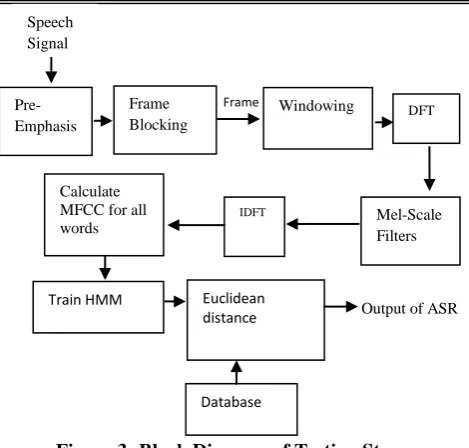
Figure 3: Block Diagram of Testing Stage
h. Convert the output back to time domain
To actually convert the log Mel spectrum back to time domain, the Mel Frequency cepstrum coefficient is calculated. The cepstrum of a spectrum gives the information about the frequency components of a signal changed. The cepstrum requires Fourier analysis which can be calculated by applying the inverse of DFT to a speech signal in frequency domain to time domain. So the equation to apply inverse of DFT is in equation ten ([DB13]).
(10)
In testing phase, this process is repeated till MFCC coefficient is calculated. The database prepared in training phase is then compared to testing phase by taking the Euclidean distance and HMM algorithm ([DB13]).
7. HIDDEN MARKOV MODEL
HMM is an algorithm in which you observe a sequence of emissions, but do not know the sequence of states the model went through to generate the emissions. Analyses of hidden Markov models seek to recover the sequence of states from the observed data.
The HMM concept is based on the following elements defined as follows ([MG13]):
i. N is the no of states in HMM module i.e. {1,2,3,…,N } and the state at time t is qt
ii. M is the different symbols per state. iii. Initial State Distribution:
(11)
in which πi is defined as πi=P(q1=i)
iv. State Transition Probability Distribution A=[aij]
where
(12)
v. Observation symbol probability distribution
(13)
Where in which probability function for each state j is , the calculation of can be discrete or continuous observation densities. The 3 sets of probability measures are π, A and B and these probability measures use the symbol λ. Expressed as λ = (A, B, π). This is referred to as HMM model in which the states are hidden. Three possible issues encountered with HMM are:
Challenge 1: when the observation series O = (o1,
o2, …, oT) , and the model λ = (A, B, π ) are
provided, how is the probability of the observation series calculated? In other words, how is P (O|λ) computed efficiently?
Challenge 2: Given the observation sequence O = (o1, o2, ... , oT) , and the model λ = (A, B, π), how is
corresponding state series, q = (q1, q2, ..., qT),chosen
to be optimal?
Challenge 3: How is the probability estimates, λ = (A, B, π), adjusted to maximize P (O|λ)? The third issue is normally observed at the training stage. That is given the training sequences create a model for each word.
i. Solution to Challenge 1 - Probability Evaluation
The major aim of this issue is to get the probability of the observation series O = (o1, o2, . .., oT,), given
the model λ, i.e., P (O|λ). Since the observations generated by states are assumed to be independent of each other and at time t, the probability of observation series, O = (o1, o2,. .., oT, ) being
generated by a certain state series q is calculated by a product:
P(O|q,B) = bq1(o1).bq2(o2),...,bqT(oT) (14)
Hence, the probability of the state sequence q is found as
P(O|q,π) = πq1.aq1q2.aq2q3,...,aqt-1qt
The probability of O and q, occur simultaneously of the state series, is simply the product of the above two terms i.e.:
P(O,q|λ)=P(O|q,B).P(q|A,π) =
πq1bq1(o1)aq1q2(o2),...,aqT-1qt bqT(oT) (15)
Speech Signal
Calculate MFCC for all words
Train HMM Euclidean distance
Database
Output of ASR Frame
Pre-Emphasis
Frame Blocking
Windowing
IDFT Mel-Scale
Filters
The aim is to find P (O|λ), and this probability of O is obtained by summing the probability over all possible state series q. First, at time t = 1 the process starts by jumping to state q1 with probability πq1, and
generate the observation symbol o1 with probability
bq1 (o1 ). The clock changes from t to t + 1 and a
transition from q1 to q2 will occur with probability
aq1 q2, and the symbol o2 will be generated with
probability bq2 (o2). The process continues in this
manner until the last transition is made, i.e., a transition from qT−1 to qT will occur with probability
aqT−1 qT, and the symbol oT will be generated with
probability bqT (oT). The forward algorithm is an
excellent tool which cuts the computational requirements to linear, relative to time.
1. The Forward Algorithm
Take a forward variable αt (i), given as:
αt (i) = P (o1, o2, ..., ot, qt = i|λ) (16)
Where t stands for time and i is the state, then αt (i) will be the probability of the partial observation series, o1, o2, ... ot, when being in state i at time t. The
calculate the forward variable, αt+1 (i) is found by summing the forward variable for all N states at time t and thereafter multiplied with their corresponding state transition probability, aij, and by the emission
probability bj (ot + 1). This is done with the
following procedure ([DB13]): 1. Initialization Set t = 1;
(17)
2. Induction
, 1 j N (18)
3. Reset the time t=t+1; return to step 2 if t<T; Otherwise, terminate the algorithm (go to step 4) 4. Termination
(19)
2. The Backward Algorithm
When the backward variable is defined by taking βt
(i) as: βt (i) = P (ot+1 ot+2 . . . oT |qt = i, λ) then, the
probability of the partial observation series from t + 1 to the end, given state i at time t and the model λ. Notice that the definition for the forward variable is a joint probability whereas the backward probability is a conditional probability ([DB13]). Also, just like the forward algorithm, backward can be estimated inductively. The steps in backward algorithm are: 1. Initialization:
Set t=T-1;
βT (i) =1, 1 i N (20)
2. Induction
βt+1 (i) aij bj (ot+1), 1 i N (21)
3. Update time Set t=t-1;
Return to step 2 if t>0; otherwise, terminate the algorithm.
3. Scaling the Forward and Backward Variables
The estimation of αt (i) and βt (i) involves
multiplication with probabilities. All these probabilities have a value less than 1 and as t starts to increase, each term of αt (i) or βt (i) starts to go
exponentially to zero. For sufficiently large t (e.g., 100 or more) the dynamic range of αt (i) and βt (i)
computation will exceed the precision range of any machine. The basic scaling procedure multiplies αt (i) by a scaling coefficients dependent only of the time t and independent of the state i. The scaling estimate factor for the forward variable is denoted by ct (scaling estimate is calculated for every time t
for all states i, 1 ≤ i ≤ N). This factor will also be used for scaling the backward variable, βt (i).
Scaling αt (i) and βt (i) with the same scale factor
will be useful in challenge 3 (parameter estimation). In the scaled variant of the forward algorithm some extra notations will be used. αt (i) denote the un-scaled forward variable, αt (i) denote the un-scaled and iterated variant of αt (i), αt (i) denote the local version of αt (i) before scaling and ct will represent the scaling coefficient at each time. Here follows the scaled forward algorithm:
1. Initialization: set t=2;
(22)
(23)
2. Induction
(24)
(25) (26)
3. Reset the time t=t+1;
Go to step 2 if t⩽T; otherwise terminate the algorithm (go to step 4) L=4;
4. Termination
Anale. Seria Informatică. Vol. XVII fasc. 2 – 2019 Annals. Computer Science Series. 17th Tome 2nd Fasc. – 2019
ii. Solution to Challenge 2 - Optimal State Sequence
If some states transitions have zero probability (aij=0)?, it implies that the
found optimal path may not be valid. Such a method exist, based on dynamic programming, namely the Viterbi algorithm is used.
iii. Solution to Challenge 3 - Parameter Estimation
This issue is concerned with the parameter estimation of the model, λ = (A, B, π).
It is issue is formulated as: λ = arg max [P (O|λ)]. When provided with an observation O, find the model λ from all possible λ that maximizes P (O|λ). This issue is the most difficult of the three chanllenges. The reason been that there is no known way to analytically find the model parameters that maximizes the probability of the observation series in a closed form. However, can the model parameters be chosen to locally maximize the likelihood P (O|λ)? Some common methods used for solving this problem is Baum-Welch. Both of these methods uses iterations to improve the likelihood P (O|λ), though, there are some advantages with the Baum-Welch method compared to the gradient techniques ([MM02]).
8. EXPERIMENTAL RESULTS
The result in table 1 shows that 97% successful detection probability was achieved. Five different speakers were used for test and result is 97.5% for speech recognition. The acoustical environment where recognizers are used to introduce another layer of corruption in speech signals. This is because of background noise, reverberation, microphones, and transmission channels.
9. EXPERIMENTAL SETUP
9.1 Data Collection
The data set consists of five repetitions of ten words by 5 persons (3 male and 2 female). The data collected from the close-talking microphone containing the effect of room acoustics and the background noise. The speech collected was sampled at 16 KHz, single channel (mono) in .wav file format.
9.2 Experimental Details
Three different experiments dealing with various aspects of speech recognition system were conducted. In order to match the Test data set to the
reference data set of the same speaker. The recorded speech of speakers were converted to sequence vectors of MFCC and stored into a binary file as reference data set template. However, during matching process stored reference template with the test data set were used with HMM algorithm.
Experiment 1: at this stage test and reference data
set of the same speaker were matched, though in this experiment, first repetition of ten spoken words were used as the reference and next three repetitions of the words are used as test template. The 30(3*10) template were matched using HMM algorithm implemented in MATLAB (R2015a).
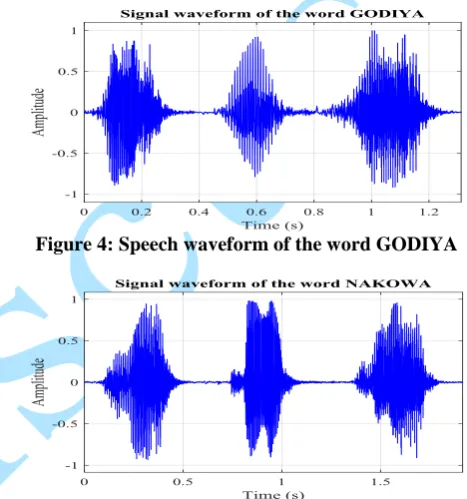
Figure 4: Speech waveform of the word GODIYA
Figure 5: Speech waveform of the word NAGODE
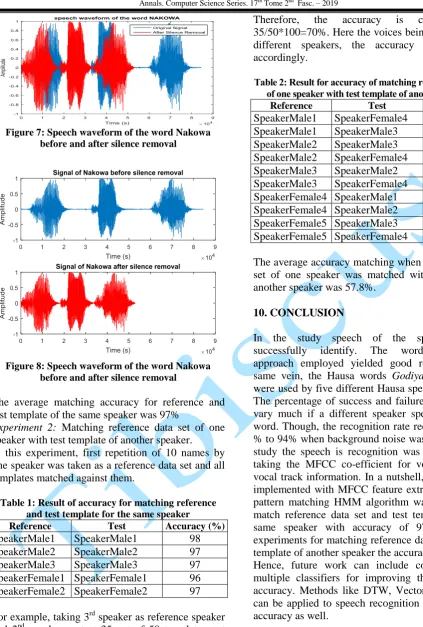
Figure 7: Speech waveform of the word Nakowa before and after silence removal
Figure 8: Speech waveform of the word Nakowa before and after silence removal
The average matching accuracy for reference and test template of the same speaker was 97%
Experiment 2: Matching reference data set of one
speaker with test template of another speaker. In this experiment, first repetition of 10 names by one speaker was taken as a reference data set and all templates matched against them.
Table 1: Result of accuracy for matching reference and test template for the same speaker
Reference Test Accuracy (%)
SpeakerMale1 SpeakerMale1 98
SpeakerMale2 SpeakerMale2 97
SpeakerMale3 SpeakerMale3 97
SpeakerFemale1 SpeakerFemale1 96 SpeakerFemale2 SpeakerFemale2 97
For example, taking 3rd speaker as reference speaker and 2nd speaker as test 35 out of 50 templates got matched.
The measuring of recognition accuracy (RA) is done based on equation 28:
(28)
Therefore, the accuracy is calculated as 35/50*100=70%. Here the voices being matched are different speakers, the accuracy decreased as accordingly.
Table 2: Result for accuracy of matching reference dataset of one speaker with test template of another speaker
Reference Test Accuracy (%)
SpeakerMale1 SpeakerFemale4 50
SpeakerMale1 SpeakerMale3 65
SpeakerMale2 SpeakerMale3 68
SpeakerMale2 SpeakerFemale4 50
SpeakerMale3 SpeakerMale2 67
SpeakerMale3 SpeakerFemale4 55 SpeakerFemale4 SpeakerMale1 50 SpeakerFemale4 SpeakerMale2 55 SpeakerFemale5 SpeakerMale3 50 SpeakerFemale5 SpeakerFemale4 68
The average accuracy matching when reference data set of one speaker was matched with template of another speaker was 57.8%.
10. CONCLUSION
In the study speech of the speakers were successfully identify. The word recognition approach employed yielded good results. In the same vein, the Hausa words Godiya and Nakowa
were used by five different Hausa speaking persons. The percentage of success and failure rate does not vary much if a different speaker speaks the same word. Though, the recognition rate reduces from 97 % to 94% when background noise was added. In the study the speech is recognition was performed by taking the MFCC co-efficient for vocal cord and vocal track information. In a nutshell, the ASR was implemented with MFCC feature extraction and for pattern matching HMM algorithm was used which match reference data set and test template for the same speaker with accuracy of 97%. In other experiments for matching reference data set and test template of another speaker the accuracy was 57.8%. Hence, future work can include combination of multiple classifiers for improving the recognition accuracy. Methods like DTW, Vector Quantization can be applied to speech recognition to improve its accuracy as well.
REFERENCES
[Bur92] D. A. Burquest – An Introduction to the Use of Aspect in Hausa Narrative,
Anale. Seria Informatică. Vol. XVII fasc. 2 – 2019 Annals. Computer Science Series. 17th Tome 2nd Fasc. – 2019
[CL95] C. Che, Q. Lin
–
Speaker recognition using hmm with experiments on theYOHO database, Euro speech 95,
Spain, Madrid, pp. 625-628, 1995.
[Dod85] G. R. Doddington – Speaker recognition-identifying people by their
voices, IEEE, vol. 73, no. 11, pp.
1651-1664, 1985.
[DB13] S. D Deshmukh, M. R. Bachute –
Automatic Speech and Speaker
Recognition by MFCC, HMM and
Vector Quantization, International
Journal of Engineering and Innovative Technology Vol. 3, Issue 1, July 2013.
[DHP00] J. R. Deller, J. L. Hanse, J. G. Proakis – Discrete-Time processing of
speech signals. IEEE Press, ISBN
0-7803-5386-2, 2000.
[DTR00] A. R Douglas, F. Q. Thomas, B. D. Robert – Speaker verification using
adapted Gaussian Mixture Models,
Digital Signal Processing 10, pp. 19-41, 2000.
[HBP93] A. Higgins, I. Bahler, J. Porter –
Voice identification using nearest
neighbor distance measure,
International Conference on Acoustics, Speech, and Signal Processing, USA, Minneapolis, pp. 375-378, 1993.
[IOI17] Y. A. Ibrahim, J. C. Odiketa, T. S. Ibiyemi – Pre-processing Technique in Automatic Speech Recognition for Human Computer Interaction: An
Overview. Annals Computer Science
Series. 15(1), pp 186-191, 2017.
[Jag01] P. J. Jaggar – Hausa Language. Journal of African Languages and Linguistics, London Oriental and African Languages Library Series, Vol. 7, ISBN: 9027238073, pp. 1-60, 2001.
[KS12] S. Karpagavali, P. V. Sabitha –
Isolated Tamil Words Speech
Recognition using Linear Predictive
Coding and Networks, International
Journal of Computer Science and Management Research, Vol.1, Issue 5, December 2012.
[MG13] B. S. Mayur, S. T. Gandhe – Speech processing for isolated Marathi word recognition using MFCC and DTW
features, International Journal of
Innovations in Engineering and Technology, Vol. 3 Issue 1 October 2013, ISSN: 2319-1058, pp 109-114, 2013.
[MK15] R. G. Mayur, D. Kinnal
–
Isolated Words Recognition Using MFCC, LPCand Neural Network, International
Journal of Research in Engineering and Technology ISSN: 2319-1163 | ISSN: 2321-7308. Volume: 04 Issue: 06 |
June-2015, Available @
http://www.ijret.org.
[MM02] N. Mikael, E. Marcus – Speech Recognition Using Hidden Markov
Model, Performance evaluation in noisy
environment, Bleking Institute of Technology March 2002.
[New00] P. Newman – The Hausa Language:
An Encyclopedic Reference Grammar.
New Haven: Yale University Press, 2000.
[RC95] D. Reynold, B. Carlson – Text-dependent speaker verification using decoupled and integrated speaker and
speech recognizers, Euro speech 95,
Spain, Madrid, pp. 647-650, 1995.
[RZ91] L. Rudasi, S. A. Zahorian – Text-independent talker identification with
neural networks, International
Conference on Acoustics, Speech, and Signal Processing, Toronto, Ontario, Canada, pp. 389-392, 1991.
[SC13] T. S. Shanthi, L. Chelpa – Review of Feature Extraction Techniques in
Automatic Speech Recognition,
International Journal of Scientific Engineering and Technology, Vol. 2, Issue 6, pp.479-484, June 2013.
[S+85] F. Soong, A. Rosenberg, L. Rabiner, B. H. Juang – A vector quantization
approach to speaker recognition,
![Figure 2: Block Diagram of Training Phase ([DB13])](https://thumb-us.123doks.com/thumbv2/123dok_us/8958666.1868034/4.595.55.293.64.201/figure-block-diagram-training-phase-db.webp)