Autonomously Replicating Linear Plasmids That Facilitate the
Analysis of Replication Origin Function in
Candida albicans
Swati Bijlani,aMathuravani A. Thevandavakkam,aHung-Ji Tsai,b Judith Bermana
aSchool of Molecular Cell Biology and Biotechnology, Tel Aviv University, Ramat Aviv, Israel bDepartment of Cell Biology, Johns Hopkins School of Medicine, Baltimore, Maryland, USA
ABSTRACT The ability to generate autonomously replicating plasmids has been elusive inCandida albicans, a prevalent human fungal commensal and pathogen. In-stead, plasmids generally integrate into the genome. Here, we assessed plasmid and transformant properties, including plasmid geometry, transformant colony size, four selectable markers, and potential origins of replication, for their ability to drive au-tonomous plasmid maintenance. Importantly, linear plasmids with terminal telomere repeats yielded many more autonomous transformants than circular plasmids with the identical sequences. Furthermore, we could distinguish (by colony size) transient, autonomously replicating, and chromosomally integrated transformants (tiny, me-dium, and large, respectively). Candida albicans URA3 and a heterologous marker,
ARG4, yielded many transient transformants indicative of weak origin activity; the
replication of the plasmid carrying the heterologousLEU2marker was highly depen-dent upon the addition of a bona fide origin sequence. Severalbona fide chromo-somal origins, with an origin fragment of ⬃100 bp as well as a heterologous origin,
panARS, fromKluyveromyces lactis, drove autonomous replication, yielding moderate
transformation efficiency and plasmid stability. Thus, C. albicansmaintains linear plasmids that yield high transformation efficiency and are maintained autonomously in an origin-dependent manner.
IMPORTANCE Circular plasmids are important tools for molecular manipulation in model fungi such as baker’s yeast, yet, in Candida albicans, an important yeast pathogen of humans, prior studies were not able to generate circular plasmids that were autonomous (duplicated without inserting themselves into the chromosome). Here, we found that linearizing circular plasmids with sequences from telomeres, the chromosome ends, allows the plasmids to duplicate and segregate inC. albicans. We used this system to identify chromosomal sequences that facilitate the initiation of plasmid replication (origins) and to show that an⬃100-bp fragment of aC. albicans
origin and an origin sequence from a distantly related yeast can both function as or-igins inC. albicans. Thus, the requirements for plasmid geometry, but not necessarily for origin sequences, differ betweenC. albicansand baker’s yeast.
KEYWORDS CaURA3, linear plasmids, replication, replication origins, telomere repeats
P
lasmids are autonomously replicating extrachromosomal elements that facilitate molecular studies in bacteria as well as in yeasts and other fungi (1). Some yeast species carry circular plasmids (e.g., 2 in Saccharomyces cerevisiae [2]) or linear plasmids (e.g., killer plasmids inKluyveromyces lactis[3] and mitochondrial plasmids inFusarium oxysporum[4, 5]). Plasmid replication requires, among other components, an
origin DNA sequence to which the origin recognition complex (ORC) binds. Origins of replication initiation (ORIs) on chromosomes and plasmids appear to have different sequence requirements in different yeast species (6). In S. cerevisiae, autonomously
CitationBijlani S, Thevandavakkam MA, Tsai H-J, Berman J. 2019. Autonomously replicating linear plasmids that facilitate the analysis of replication origin function inCandida albicans. mSphere 4:e00103-19.https://doi.org/10.1128/ mSphere.00103-19.
EditorAaron P. Mitchell, Carnegie Mellon University
Copyright© 2019 Bijlani et al. This is an open-access article distributed under the terms of theCreative Commons Attribution 4.0 International license.
Address correspondence to Judith Berman, [email protected].
S.B. and M.A.T. made equal contributions.
Autonomous plasmids that work in Candida albicans. @swatibijlani @HJTsai @judithberman11
Received13 February 2019 Accepted21 February 2019 Published6 March 2019
Molecular Biology and Physiology
crossm
on September 8, 2020 by guest
http://msphere.asm.org/
replicating sequences (ARSs; ORIs able to drive plasmid replication) are modular, requiring a minimum of 100 bp that includes an 11-bp ARS consensus sequence (ACS) (7–9) and a T-rich “B element” (10, 11). In most other organisms, the DNA requirements for centromere and ORI function are less well defined:K. lactisrequires a 50-bp ACS that is necessary and sufficient for ARS activity (12), andSchizosaccharomyces pombehas no specific ARS consensus but requires a region of⬎500 bp with multiple A-T hook motifs that binds the ORC (13–15).
In Candida albicans, a common human fungal commensal and an opportunistic
pathogen, ORIs have been only partially characterized.C. albicansorigins, like those of
S. pombe and higher eukaryotes, have longer and less well defined DNA motifs (16).
Prior work with S. cerevisiaeidentified ARSs based on their high transformation effi-ciency (17, 18). Early studies found thatScARS plasmids with circular or linear geometry could be maintained autonomously for some time (19, 20). Work inC. albicans identi-fied a few sequences that conferred high transformation efficiency on circular plasmids (21–27). However, either the resulting transformants were highly unstable (transient transformants) or the plasmid rapidly integrated into the genome (integrants). The
CaURA3marker used in many of these studies was later found to have an intrinsic weak
ARS activity (28), and there was no direct evidence that replication initiated from the inserted sequences.
We previously used a machine learning approach to identify proposed-origins (pro-ORIs) based on ORC binding activity and nucleosome occupancy patterns (28). Four pro-ORIs were shown to be bona fideorigins that produced replication bubble structures on nondenaturing 2-dimensional (2-D) DNA gels, thereby providing direct evidence of ORI function (28). Importantly, all fourbona fideORIs also drove plasmid replication on linear (but not circular) plasmids derived from circles carrying long inverted telomere (TEL) repeats separated by a spacer sequence that is cleaved to linearize the plasmid (29). These large plasmids with inverted telomere sequences could work well but were prone to rearrangement during propagation of the circular precursor plasmid inEscherichia coli.
Here, we compared circular and linear plasmids inC. albicansthat rely onbona fide
ORIs for their maintenance. Linear plasmids were constructed from circlesde novoby PCR with primers bearing telomeric repeats prior to transformation. Linear plasmids consistently had higher transformation efficiency, larger numbers of autonomous transformants, and higher mitotic stability than analogous circular plasmids. Transfor-mant colony size was a clear reflection of plasmid stability, with tiny colonies indicative of unstable, transient transformants; medium-size colonies indicative of autonomous transformants with moderate stability levels; and large, smooth colonies indicative of integrants, in which plasmid was inserted at chromosomal positions. We also tested four markers including CaURA3andCaHIS1as well as heterologous markersCdARG4
and CmLEU2(30), which all had different levels of origin-dependent transformation
efficiency and maintenance. Finally, we tested bona fide ORIs (28) as well as origin fragments and heterologous origin sequences and found that an⬃100-bp ORI frag-ment and aK. lactis panARS(31) have moderate origin activity inC. albicans.
RESULTS
CircularCaURA3plasmids with and without ORIs.In this study, we investigated the outcomes of transformations with plasmids that differed by selection markers, geometry (circular versus linear), and replication origins. We compared the transfor-mation parameters, including transfortransfor-mation efficiency (number of transformants/g of DNA), size of the transformant colonies (tiny [⬍0.4 mm], medium [0.4 to 1.6 mm], and large [⬎1.6 mm]; Table 1), mitotic stability (proportion of cells that retain the plasmid under selection), and plasmid loss rate (rate of plasmid loss per generation in the absence of selection). We used a set of isogenic strains that differed primarily in the relevant auxotrophy.
Overall, across the markers and plasmids tested, three types of transformant colo-nies were evident. Tiny colocolo-nies that could not be maintained on selection (see Fig. S1A
Bijlani et al.
on September 8, 2020 by guest
http://msphere.asm.org/
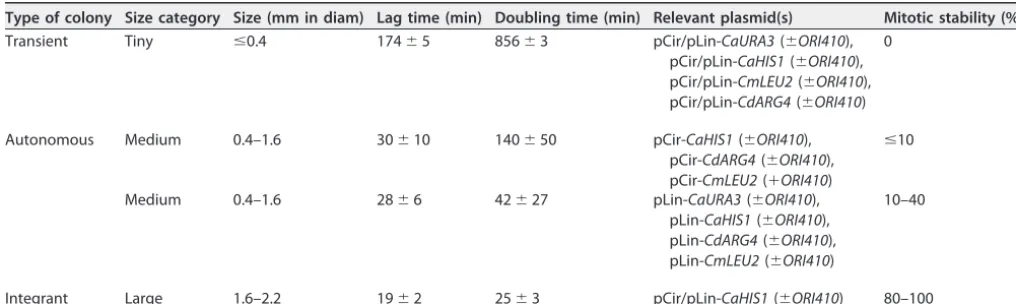
and B in the supplemental material) with undetectable plasmid retention (mitotic stability,⬃0) indicative of rapid plasmid loss were defined as transient transformants (referred to as transients here) (Table 1). Large, round colonies with short lag time and doubling time (Table 1; Fig. S1C) were defined as integrants based on their high stability under selection (mitotic stability, ⬃80 to 100%). Medium colonies (mitotic stability, 1 to 80%) that grew, albeit less well than integrants under selection, with comparatively longer lag and doubling times (Table 1; Fig. S1D), were defined as autonomously replicating transformants (ARS-transformants), assuming that replicating plasmids can be maintained under selection and lost in the absence of selection. Accordingly, colony size can reliably predict the mitotic stability of plasmids and used as a proxy for the number of different transformant types.
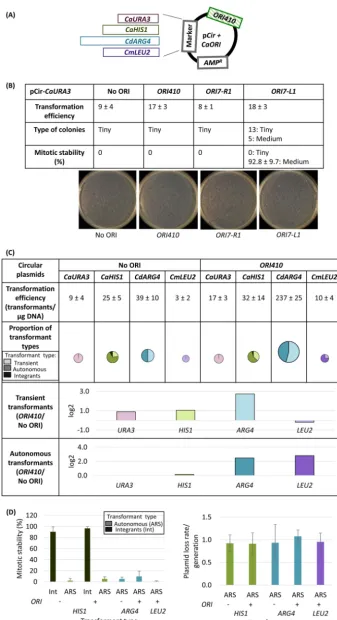
To test the hypothesis that bona fide ORIs drive the autonomous replication of plasmids inC. albicans, we first constructed circular plasmids with theCaURA3marker similar to those from prior studies (22, 23, 25–27) with and withoutbona fide ORI410
(28) (Fig. 1A). Transformation efficiency with and withoutORI410was relatively modest (17 and 9 transformants/g DNA, respectively [Fig. 1B]). Importantly, all selected colonies were tiny (⬍0.4 mm), with and without inclusion ofORI410(Fig. 1B). The tiny colonies did not grow upon restreaking or when seeded into liquid cultures (Fig. S1A), which is a characteristic of transients. Thus, as in several prior studies (22, 23, 25, 27), circularCaURA3plasmids were not maintained autonomously.
Because this result conflicts with the claim that two sequences,ORI7-R1andORI7-L1, drive the replication of a circularCaURA3plasmid (26), we constructed plasmids with these sequences in pCir-CaURA3.Both of them had modest transformation efficiency (8 and 18 transformants, respectively; Fig. 1B). We obtained only transients forORI7-R1
with similar transformation efficiency as the no-ORI plasmid; ORI7-L1 gave twice as many transients as no-ORI plasmid and produced a small number of stable transfor-mants (Fig. 1B), indicating that they integrated into the genome. Thus, neither of the twoCEN7flanking sequences yielded autonomous transformants in the context of a circular CaURA3 plasmid (Fig. 1B), consistent with the poor performance of
pCir-CaURA3-ORI410. Similar results for pCir-CaURA3withORI410,ORI7-L1, andORI7-R1were
also evident in a second strain background (Table S1).
Comparison of different selectable markers on circular plasmid.We next asked if theC. albicans HIS1(CaHIS1) marker would show better transformation efficiency and mitotic stability thanCaURA3, with the goal of obtaining ARS-transformants. However,
the CaHIS1 plasmid yielded small numbers of transformants (32 and 25, with and
without ORI410, respectively), with a modest increase (⬃25%) in transformation effi-ciency attributable to ORI410 (Fig. 1C). pCir-CaHIS1 ARS-transformants had mitotic stability of ⬍5% and plasmid loss rates of ⬃0.9 (Fig. 1D), indicating that they were autonomous but highly unstable. Thus, in addition to transients and integrants (ana-lyzed in more detail below), pCir-CaHIS1 produced a small number of ARS-transfor-mants—a group not detected with pCir-CaURA3(Fig. 1C).
TABLE 1Properties of different types of transformants obtained with circular and linear plasmids
Type of colony Size category Size (mm in diam) Lag time (min) Doubling time (min) Relevant plasmid(s) Mitotic stability (%) Transient Tiny ⱕ0.4 174⫾5 856⫾3 pCir/pLin-CaURA3(⫾ORI410),
pCir/pLin-CaHIS1(⫾ORI410), pCir/pLin-CmLEU2(⫾ORI410), pCir/pLin-CdARG4(⫾ORI410)
0
Autonomous Medium 0.4–1.6 30⫾10 140⫾50 pCir-CaHIS1(⫾ORI410), pCir-CdARG4(⫾ORI410), pCir-CmLEU2(⫹ORI410)
ⱕ10
Medium 0.4–1.6 28⫾6 42⫾27 pLin-CaURA3(⫾ORI410), pLin-CaHIS1(⫾ORI410), pLin-CdARG4(⫾ORI410), pLin-CmLEU2(⫾ORI410)
10–40
Integrant Large 1.6–2.2 19⫾2 25⫾3 pCir/pLin-CaHIS1(⫾ORI410) 80–100
on September 8, 2020 by guest
http://msphere.asm.org/
FIG 1 (A) Map of a circular plasmid showing relative position of selection markers (CaURA3, CaHIS1,
CdARG4, andCmLEU2) and ORI sequence. (B) pCir-CaURA3plasmid with different origin sequences trans-formed inC. albicansBWP17: transformation efficiency, types of colonies, and their mitotic stability. The transformation efficiency is an average from three independent experiments. (C) Comparison of circular
(Continued on next page) Bijlani et al.
on September 8, 2020 by guest
http://msphere.asm.org/
Because heterologous markers are less likely to integrate into the genome, we tested theCmLEU2marker fromCandida maltosaand theCdARG4marker fromCandida
dubliniensis(30). With the addition ofORI410, transformation efficiency ofCmLEU2was
increased by⬃3 times (Fig. 1C), and most of them were ARS-transformants with mitotic stability of⬍5% (Fig. 1D) compared to only transients withoutORI410; no large colonies were detected. Thus,CmLEU2produced a small number of ARS-transformants with low mitotic stability upon addition ofORI410.
In contrast,CdARG4had a 5-fold-higher transformation efficiency withORI410on the plasmid relative to that without the ORI,⬃50% being ARS-transformants (Fig. 1C) that had mitotic stability of⬃10% for those withORI410and⬃5% for those without the ORI (Fig. 1D). Thus,CdARG4withORI410yielded more than 100 ARS-transformants/g of DNA, with an improved mitotic stability (but with the loss rate remaining quite high [Fig. 1D]). However, whileORI410was required for high transformation efficiency and improved mitotic stability, it was not required for some autonomous plasmid replica-tion. We suggest that theCdARG4sequence might enable a weak ORI to form on the plasmid (discussed below). Thus, for circular plasmids with all four selectable markers tested, the inclusion of an origin was not sufficient to produce relatively stable autonomously replicating plasmids (low mitotic stability and high loss rate). This indicates that a heterologous marker can drive autonomous replication of a circular plasmid with rare integration events, but they are lost at high frequency.
We also asked if autonomous plasmids were detectable in DNA extracts from the medium colonies (low mitotic stability and high loss rate). Indeed, Southern blotting of DNA from medium colonies (Fig. S2A) detected bands with similar electrophoretic mobility as that of naked circular plasmids. In contrast, in the DNA from a pCir-CdARG4
-ORI410large colony with high mitotic stability (presumed integrant), a larger band was
detected along with autonomously replicating plasmid (Fig. S2A), indicating integration in some cells in a population. This is consistent with the idea that large colonies contain integrated plasmid and medium colonies contain autonomously replicating plasmids. Moreover, analysis of theCaHIS1integrants found gene replacement at the native locus by single crossover (Fig. S3A).
Linear plasmids with telomere ends are maintained autonomously.Since cir-cular plasmids did not yield high transformation efficiency and high mitotic stability for ARS-transformants, we constructed and transformed linear plasmids, which are known to replicate autonomously in some fungal model organisms (4, 32–35). Since classical methods of producing linear plasmids (29) used for monitoring origin function in C.
albicans(28) proved challenging, we designed a new approach in which linear plasmids
were constructed from circular plasmids by PCR (details in Materials and Methods) (Fig. 2A) and transformed directly intoC. albicans.
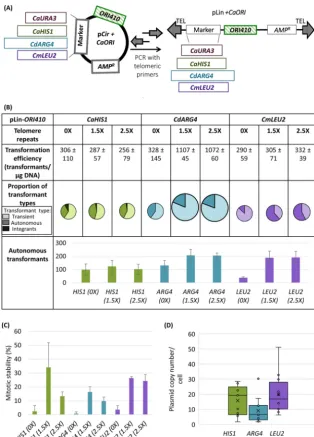
Because telomere sequences are not necessary to be added to linear DNA during transformation in some fungal models (4, 32–34), we asked if the presence and the length of the telomere repeats (34-nt versus 57-nt TEL, i.e., 1.5⫻versus 2.5⫻of a single 23-nt C. albicansTEL repeat [36]) affect transformation parameters. Linear plasmids without TEL repeats had a transformation efficiency of⬃300/g for all three markers tested (CaHIS1,CdARG4, andCmLEU2) with the majority being transients (Fig. 2B). The
FIG 1Legend (Continued)
plasmids carrying different selection markers with and withoutORI410: transformation efficiency, propor-tion of different types of transformants, and log2value of the ratio of average number of transient or autonomous transformants with ORI to that without ORI (ORI410/No ORI).CaURA3,CaHIS1,CdARG4, and
CmLEU2plasmids were transformed inC. albicansBWP17, SN76, SN76, and SN152, respectively. Different markers are represented by different colors, and different types of transformants are represented by various shades of a color (lightest shade representing transients, intermediate shade representing ARS-transformants, and darkest shade representing integrants). The transformation efficiency is an average from three independent experiments. The size of circles showing proportion of transformant types is an approximation of transformation efficiency. (D) Mitotic stability (%) of integrants and ARS-transformants and plasmid loss rate/generation for ARS-transformants obtained with different circular plasmids with and without ORI410. The data represent the average from three independent colonies of each type. Int, integrants; ARS, ARS-transformants.
on September 8, 2020 by guest
http://msphere.asm.org/
CaHIS1 linear plasmid without telomere repeats resulted in an increased number of total and ARS-transformants but also an increase in integration events over the corresponding circular plasmid (Fig. 2B versus Fig. 1C;Pⱕ0.025 andPⱕ0.044 for total and ARS-transformants, respectively, using Student’sttest). Notably, theCmLEU2linear plasmid without telomere repeats resulted in a much higher transformation efficiency FIG 2 (A) Schematic of construction of linear plasmid using primers with telomeric repeats at their ends. (B) Comparison of linear plasmids carrying different selection markers andORI410with 0⫻, 1.5⫻, and 2.5⫻ telomere repeats at its ends: transformation efficiency, proportion of different types of transformants, and the number of autonomous transformants.CaHIS1andCdARG4plasmids were transformed inC. albicansSN76, andCmLEU2plasmids were transformed inC. albicansSN152. Different markers are represented by different colors, and different types of transformants are represented by various shades of a color (lightest shade representing transients, intermediate shade representing ARS-transformants, and darkest shade representing integrants). The transformation efficiency and number of autonomous transformants are an average for three independent experiments. The size of circles showing proportion of transformant types is an approximation of transformation efficiency. (C) Mitotic stability (%) of ARS-transformants obtained with different linear plasmids with 0⫻, 1.5⫻, and 2.5⫻telomere repeats. The data represent the average for three independent ARS-transformants. (D) A box plot representing copy number variations of linear plasmids withCaHIS1,
CdARG4, orCmLEU2 andORI410. The data represent the average copy number of nine independent ARS-transformants (accounting for mitotic stability). In the box plot, dots represent different samples, crosses represent mean values, and the horizontal lines represent the medians.
Bijlani et al.
on September 8, 2020 by guest
http://msphere.asm.org/
and more ARS-transformants (⬃50/g DNA) than the corresponding circular plasmid (⬍10/g DNA [Fig. 2B versus Fig. 1C]; Pⱕ0.007 and Pⱕ0.003 for total and ARS-transformants, respectively, using Student’sttest). TheCdARG4plasmid was an excep-tion yielding similar transformaexcep-tion efficiencies in circular and linear plasmids without telomeres (Fig. 2B versus Fig. 1C). However, all of the ARS-transformants obtained had low mitotic stability (⬍5%) (Fig. 2C) with an irregular colony shape, indicating that they were not readily maintained in the autonomous state, and higher proportions of cells failed to divide in the colony under selection conditions.
Adding TEL repeats to linear plasmids increased the number of ARS-transformants for both CdARG4 and CmLEU2 plasmids, compared to those without TEL repeats (Fig. 2B;Pⱕ0.043 andPⱕ0.018 forCdARG4andCmLEU2ARS-transformants, respec-tively, using Student’sttest). In contrast, TEL sequence addition increased the trans-formation efficiency only forCdARG4plasmids among the three markers tested. Fur-thermore, adding TEL repeats increased the mitotic stability of ARS-transformants by 2- to 6-fold (mitotic stability,⬃10 to 35%) for all three markers. Thus, relative to circular plasmids, linearized plasmids with terminal TEL repeats produced more ARS-transformants with higher mitotic stability (Fig. 2B and C), and the ARS-ARS-transformants displayed shorter lag time and doubling time (Table 1; see also Fig. S1E and F). In contrast, when 1.5⫻ TEL sequence was included on circular plasmids, there was no significant change in any of the transformation parameters relative to the correspond-ing circular plasmids (Fig. S4A and B). Thus, it is likely the linear geometry of the plasmids, along with the inclusion of telomere sequence, that resulted in an increase in ARS-transformants and mitotic stability (see Discussion). Since we found no obvious advantage to including 2.5⫻versus 1.5⫻TEL repeats, we used plasmids linearized with the 1.5⫻TEL repeats in all subsequent studies.
We next asked if linear plasmids carrying 1.5⫻ TEL repeats were maintained autonomously. The ARS-transformants obtained exhibited moderate mitotic stability even after three passages, indicating that they were maintained autonomously over a few generations (Table S2). Southern blotting of DNA from a pLin-CdARG4-ORI410
ARS-transformant with moderate mitotic stability (Fig. S2B) showed a single band with electrophoretic mobility similar to that of the naked linear DNA molecule used for transformation. We also recovered pLin-CmLEU2-ORI410 molecules from ARS-transformants inE. coli(Fig. S5), demonstrating autonomous replicationin vivo. Copy number of the linear plasmids in ARS-transformants, measured by qPCR, ranged widely (⬃2 to 50 per cell, accounting for mitotic stability) (Fig. 2D).
In contrast, CaHIS1transformants with moderate mitotic stability (45% and 63%) produced larger plasmid-hybridizing bands on Southern blots indicative of genomic integration (Fig. S2B). Further analysis of these CaHIS1 integrants indicated gene replacement at the native locus by either double crossover or a gene conversion event (Fig. S3B). This is consistent with the idea that plasmids with a homologous marker can yield integrants apart from ARS-transformants.
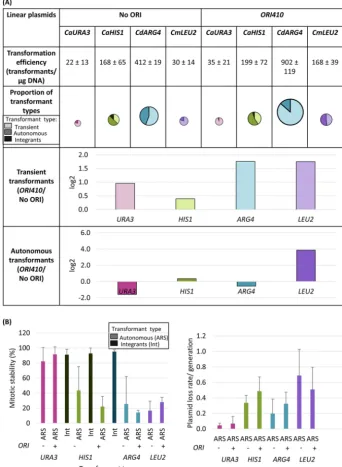
Effect of marker gene andbona fideORIs on transformation parameters. We next asked to what extent abona fideORI sequence (ORI410) affected the transforma-tion parameters of linear plasmids with different markers. With both homologous markers, CaURA3 and CaHIS1, there were some integration events, initially more frequent forCaHIS1, although when propagated under selection, many of theCaURA3
plasmids integrated (mitotic stability,⬃80 to 100%, and loss rate,⬍0.1 per generation; Fig. 3B). Furthermore, forCaURA3andCdARG4,addition ofORI410had no effect on the number of ARS-transformants (Fig. 3A) but improved plasmid stability compared to circular plasmids (Fig. 3B). This suggests that there may be a cryptic, intrinsic origin activity withinCaURA3andCdARG4marker fragments (1.3 and 3.1 kb, respectively) that obviates the use of these markers to monitor the contribution of ORIs to plasmid replication and maintenance (discussed below). Similar results forCaHIS1andCdARG4
were evident in different lab strains (Fig. S6). In contrast, addition of ORI410 on pLin-CmLEU2resulted in an⬃5-fold increase in transformation efficiency, an⬃14-fold
on September 8, 2020 by guest
http://msphere.asm.org/
increase in ARS-transformants (Fig. 3A), and improved plasmid stability (Fig. 3B) relative to pLin-CmLEU2(Pⱕ0.005 andPⱕ0.025 for total and ARS-transformants, respectively, using Student’sttest), suggesting thatCmLEU2does not carry the intrinsic ARS activity seen on other markers.
FIG 3 (A) Comparison of linear plasmids carrying different selection markers with and withoutORI410: transformation efficiency, proportion of different types of transformants, and log2value of the ratio of average number of transient or autonomous transformants with ORI to that without ORI (ORI410/No ORI).
CaURA3,CaHIS1,CdARG4, andCmLEU2plasmids were transformed inC. albicansBWP17, SN76, SN76, and SN152, respectively. Different markers are represented by different colors, and different types of transfor-mants are represented by various shades of a color (lightest shade representing transients, intermediate shade representing ARS-transformants, and darkest shade representing integrants). The transformation efficiency is an average from three independent experiments. The size of circles showing proportion of transformant types is an approximation of transformation efficiency. (B) Mitotic stability (%) of integrants and ARS-transformants and plasmid loss rate/generation for ARS-transformants obtained with different linear plasmids with and withoutORI410. The data represent the average from three independent colonies of each type except for ARS-transformants withCdARG4andCmLEU2plasmids, where they represent the average from six independent colonies. Int, integrants; ARS, ARS-transformants.
Bijlani et al.
on September 8, 2020 by guest
http://msphere.asm.org/
Given that all markers were inserted in the same position on a plasmid, which does not have any obvious origin-promoting sequence features, we tested the hypothesis that some feature required for origin firing is present at higher levels inCaURA3,CaHIS1,
andCdARG4 relative toCmLEU2, although many CaHIS1ARS-transformants integrate
into the genome after additional passages. Since the lengths ofCaHIS1andCmLEU2are similar, it seems unlikely that marker length is an important factor. Interestingly, the AT content of the two markersCmLEU2(62.3%) andCaHIS1(63.3%) with higher levels of ORI-dependent ARS-transformants (Fig. 3A) was below the average AT content of the
C. albicans genome (66.7%), while the AT content of CaURA3 (68.4%) and CdARG4
(69.1%) was higher than that of the C. albicans genome. Thus, it appears that the markers with cryptic ORI function (CaURA3andCdARG4) that interferes withbona fide
ORI activity have higher AT content. Of note, neither ORIs alone nor sequences on markers with possible cryptic ARSs share any obvious conserved primary sequence motifs. Based on its ORI dependence, CmLEU2 is the most effective of the markers tested for comparing origin activity.
Comparing differentbona fideorigins andORI410fragments.Four ORIs fromC.
albicans(ORI410as well asORI1055,ORI1046, andORI246), defined previously asbona
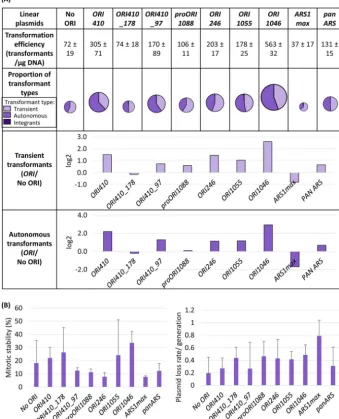
fideORIs (28), were inserted into pLin-CmLEU2to examine their function compared to no-origin plasmids. All four bona fideORIs yielded high transformation efficiencies (⬃150 to 600/g DNA) and ARS-transformants (⬃75 to 300/g DNA) (Fig. 4A) with moderate mitotic stability (10 to 45%) and plasmid loss rate (0.2 to 0.7 per generation) (Fig. 4B).ORI1046consistently yielded the highest transformation efficiency and ARS-transformants (⬃300/g DNA). Both negative-control plasmids, pLin-CmLEU2(No ORI) and that with proORI1088, a genomic ORC binding region that did not produce replication bubble arcs in 2-D gels (28), gave much lower transformation efficiency and ARS-transformants (31 and 44/g DNA). Thus, all four bona fideORIs can drive the origin-dependent autonomous replication of pLin-CmLEU2(Fig. 4A).
InS. cerevisiae, where the ACS is 11 bp, ARS function is detected only when the
transforming fragment is⬃100 bp, including ACS (7, 8, 37, 38). We asked if two small overlapping fragments (178 bp and 97 bp) derived fromORI410(1.2 kb) (28) were able to retain minimum ARS function in C. albicans.ORI410_97 had 2- to 3-times-higher transformation efficiency (⬃170 transformants/g DNA) and a⬃3-times-higher num-ber of ARS-transformants than the no-ORI control (Fig. 4A). While the numnum-ber of total and ARS-transformants forORI410_97was lower than for the entireORI410, the ARS-transformants had moderate mitotic stability (10 to 15%) and loss rate (⬃0.4 per generation) (Fig. 4B). Thus, an ORI fragment of only⬃100 bp can drive linear plasmid replication and can yield ARS-transformants, which are 2- to 3-fold more stable than an analogous circular plasmid carrying the entireORI410fragment.
Heterologous ARSs. C. albicans centromeres are regional and epigenetic, which contrasts with the point centromeres ofS. cerevisiae(16). Since plasmid replication and origin function were difficult to demonstrate inC. albicans, we asked whether heter-ologous ARS fragments would function inC. albicans. The “panARS,” a 452-bp fragment from theK. lactisgenome, functions as an active ORI in a range ofSaccharomycotina
yeast species with diverse ARS requirements, in some cases, even more efficiently than average homologous ARSs (e.g.,Pichia pastoris) (31). The “ARS1max,” an origin fromS.
cerevisiae, was selected to drive better growth rates and lower plasmid loss rates than
the originalARS1(39). Thus, we tested the ability of both the sequences to direct C.
albicans plasmid replication on pLin-CmLEU2 (pLin-CmLEU2⫹panARS and
pLin-CmLEU2⫹ARS1max) relative to pLin-CmLEU2⫹ORI410and pLin-CmLEU2.
The pLin-CmLEU2⫹panARS plasmid resulted in⬃2- to 3-times-higher numbers of total and ARS-transformants relative to pLin-CmLEU2 (Fig. 4A). The panARS ARS-transformants had moderate mitotic stability (⬃10 to 20%) and loss rate (⬃0.3 per generation) that were comparable to ORI410_97 (Fig. 4B). This suggests that the sequence requirements ofC. albicansorigin function are at least partially conserved with those of K. lactis among other Saccharomycotina species. In contrast,
on September 8, 2020 by guest
http://msphere.asm.org/
CmLEU2⫹ARS1maxhad transformation parameters inferior to those of control plasmid pLin-CmLEU2: lower transformation efficiency, fewer ARS-transformants with the lowest mitotic stability (⬍8%), and the highest loss rate (⬃0.8 per generation) (Fig. 4A and B) detected for any linear plasmid. This supports the idea that sequence requirements for origins in C. albicans(and other yeasts, for example,Pichia pastoris [40]) are distinct from those inS. cerevisiae.
DISCUSSION
Early studies seeking potential origin sequences based on their ability to confer high transformation efficiency usually used circular plasmids withCaURA3as the selectable (and counterselectable) marker (22, 23, 25, 27). However, most transformants were FIG 4 (A) Comparison of linear plasmids carryingCmLEU2marker withORI410fragments, differentbona fideORIs, and heterologous ORIs transformed inC. albicansSN152: transformation efficiency, proportion of different types of transformants, and log2value of the ratio of average number of transient or autonomous transformants with ORI to that without ORI (ORI/No ORI). Different types of transformants are represented by various shades of a color (lightest shade representing transients, intermediate shade representing ARS-transformants, and darkest shade representing integrants). The transformation efficiency is an average from three independent experiments. The size of circles showing proportion of transformant types is an approximation of transformation efficiency. (B) Mitotic stability (%) and plasmid loss rate/generation for ARS-transformants obtained with different linear plasmids mentioned in panel A. The data represent the average from six independent ARS-transformants of each plasmid.
Bijlani et al.
on September 8, 2020 by guest
http://msphere.asm.org/
highly unstable or rapidly integrated into the genome and thus were not useful for autonomous plasmid maintenance. Here we systematically compared four selectable markers in plasmids with circular or linear geometries to monitor the function of ORI sequences. Importantly, an ⬃100-bp fragment (28) or the heterologouspanARS(31) was sufficient to provide ARS function on a plasmid inC. albicans. This implies that sequence requirements for origin function in C. albicans are shared with distantly related yeasts. Nevertheless, the ability of cryptic ARSs on marker sequences to gen-erate transient transformants implies that the sequence requirements for ARS function (and most likely chromosomal ORI function as well) are dependent on sequence context, possibly AT-richness, and other features that are not yet well understood.
An important insight from this work is that transformant colony size provides a useful preliminary indicator of plasmid mitotic stability. Presumably, colony size reflects the degree to which the plasmid replication and/or segregation enables growth of individual cells in a population under selective conditions. Specifically, in tiny or “pinpoint” colonies (25), plasmids are lost rapidly; in large colonies, plasmids are integrated stably (Table 1). In medium colonies, plasmids are moderately stable (Table 1) because they replicate autonomously, with some cells retaining the plasmid and others losing it. Of note, ARS-transformants with plasmids carrying homologous markers sometimes integrate in subsequent passages (generating larger colony sub-clones), a property less prevalent with the heterologous markers. Nonetheless, all markers on linear plasmids yield ARS-transformants, which initially can be identified based on colony size.
Circular versus linear plasmids.InS. cerevisiae, linear plasmids and minichromo-somes were used to study chromosome components and to propagate large segments of DNA (41, 42). However, most work was done with circular plasmids that are readily propagated in E. coli; propagation of linearizable plasmids with inverted telomere repeats (29, 43–45) was labor-intensive and subject to recombination of the repeats
in E. coli. Here, a simple approach obviates many of these technical challenges by
synthesizing linear plasmids from circles immediately prior to transformation (Fig. 2A). Thus, the two plasmid geometries are directly comparable, differing only by the presence or absence of 1.5⫻TEL repeats.
Does the presence of TEL sequence alone improve the segregation of linear versus circular plasmids? In C. albicans as in S. cerevisiae, adding TEL sequences to linear plasmids improves their stability (46) (Fig. 2C). However, adding TEL sequences does not improve circular plasmid segregation inC. albicans(see Fig. S4 in the supplemental material); by contrast, TEL sequences on circles stabilized ScARS plasmids (47) and antagonized the segregation ofScCENplasmids (48). Thus, CaTEL sequence function is required for autonomous linear plasmid maintenance and is dependent upon its geometry: in a chromosome end context, but not within a circular context. This supports the idea that interactions between nonterminal TEL DNA and telomeric proteins likely differ between C. albicans andS. cerevisiae and that linear plasmids require telomere ends to remain stable.
InS. cerevisiae, noncentromeric plasmids are retained in the mother cells due to their
attachment to the nuclear membrane (49) as well the presence of a diffusion barrier at the bud neck (50). It is tempting to speculate if this is also true for circular plasmids (with or without TEL) inC. albicans. Whether and how the linear plasmids might be better able to segregate to daughter cells remain to be explored.
Effect of selectable markers.Comparison of the markers found thatCaURA3was not ideal, which explains difficulties in many earlier investigations (25, 26), and addition
ofLEU2orHIS1toCaURA3plasmids relied onURA3selection as well (22, 27). Studies
selecting for IMH3R or CaADE2 found that putative ARS-transformants integrated at high frequency (21, 25). Sometimes integration events involved and/or altered the putative origin structure (24), and the resulting plasmids were not maintained auton-omously. Notably,CaURA3linear plasmid produced very few ARS-transformants, with or without ORI addition, and these eventually integrated into the genome (Fig. 3). In
on September 8, 2020 by guest
http://msphere.asm.org/
contrast, ARS-transformants with eitherCaHIS1,CdARG4, orCmLEU2were maintained over three passages (Table S2).
We suggest the appearance of transient transformants cannot be used to define origin function on a plasmid, especially when the CaURA3marker with latent origin activity is used. Therefore, transients seen withORI7-L1and-R1cannot be used to draw conclusions about the function of these chromosomal regions as origins, especially since the published data lack a control plasmid containing theCaURA3marker without an origin (26). Transient transformants with these origins have been used to postulate that centromere function required a preexisting origin. However, our results showing that these chromosomal regions do not act as origins, together with published neocentromere locations at chromosomal regions that did not contain preexisting origins (51, 52), support a model where kinetochore assembly can convert a nonorigin region to an origin. Furthermore, if many genome sequences can recruit replication factors and provide weak origin function on a plasmid as inS. pombe(14, 53), it is not surprising that sequences within neocentromere regions may recruit origins to new loci. The dramatically increased origin efficiency of the neocentromeric loci is likely due to neocentromere-mediated recruitment of replication initiation activities like Cdc7-Dbf4, which is normally found at wild-type centromeres (54).
Heterologous CdARG4 did not integrate frequently, yet, it gave high numbers of ARS-transformants in the absence of an added ORI. We posit that bothCaURA3and
CdARG4have weak intrinsic ARS activity and that this may compete with abona fideORI
when both are on a plasmid. This suggests thatC. albicans, likeS. pombe, has “cryptic origins” (55), i.e., sites that are normally not used for replication initiation yet have the potential to form active replication origins. It also suggests that, once a cryptic origin has been established, it can continue to function, perhaps because, once well estab-lished in an ARS-transformant, a weak origin may be more likely to fire in the next cell cycle. The requirements for cryptic ARS function remain elusive. We cannot rule out the possibility that chromatin structure and topological constraints might affect ARS activity.
Why might inefficient ORIs interfere withbona fideORI activity? InS. cerevisiae, two ORIs in close proximity in the genome interfere with each other (56). Three mechanisms were proposed to explain this: (i) timing of ORI firing might differ such that the nonfiring ORI is replicated passively, (ii) DNA at the two ORIs might interfere topolog-ically (e.g., via altered supercoiling), or (iii) the two origins may compete for a limited number of licensing factors (e.g., ORC-associated proteins) (56). Interestingly, the orientation of ORC sites relative to one another could also be relevant (57), and all six predicted ORC sites (28) onCmLEU2are oriented in the same direction, while predicted ORC sites (28) on the other three markers were found in both orientations. While mechanisms ofCaORI andScORI firing are likely to differ to some degree, these options may explain the phenomenon inC. albicansas well.
Most organisms do not have highly defined ARS consensus sequences, and it appears that this is the case inC. albicansas well. InS. pombe, ORIs have average AT contents ranging from 72 to 75% (58), with an average of 64% in the genome.CaURA3
andCdARG4have 68.4% and 69.1%, respectively, with an average of 66.7% AT content
in the genome. Furthermore, for all four markers on linear plasmids, the number of poly(A) tracts (ⱖ3 nucleotides, normalized for marker length) correlated well (R2⫽0.85)
with the number of transients obtained. This is consistent with the idea that AT-rich sequences and/or poly(A) tracts may attract replication factors and acquire cryptic ORI function. This, in turn, might interfere with bona fide ORI firing on the plasmid by mechanisms like those proposed forS. cerevisiae(56).
Testing origin function. The linearCmLEU2plasmid backbone provided the first opportunity to compare the efficiencies of different bona fide ORIs, ORI410-derived fragments (28), and heterologous origins (31, 39). All fourbona fideORIs yielded high numbers of ARS-transformants as well as moderate mitotic stability and loss rates (Fig. 4). We do not know why the 178-bp fragment,ORI410_178, had little or no obvious
Bijlani et al.
on September 8, 2020 by guest
http://msphere.asm.org/
origin function while a smaller fragment derived from it (ORI410_97) was active. Clearly, DNA primary sequence is not sufficient to confer ORI function. We presume that sequence features together with their context relative to other plasmid components affect ORI activity, which has been seen onScARS plasmids as well (59). Importantly, the syntheticpanARS, which was derived fromK. lactis(31), had transformation parameters similar to those ofORI410_97. Thus, the requirements for replication origin function in
C. albicansare at least partially conserved with other Saccharomycotinaspecies, and
panARSprovides a heterologous ORI that should not integrate into the genome. We
suggest that it might be possible to whittle down the 452-bp panARSto generate a relatively good heterologous ORI of⬃100 bp.
Summary.ARS function can be studied inC. albicansusing a heterologous marker and a bona fide ORI of as small as ⬃100 bp or the heterologouspanARS on linear plasmids carrying 1.5⫻ TEL ends. Importantly, linear plasmid conformation greatly facilitates transformation efficiency and mitotic stability. Unexpectedly, the choice of selectable marker has a major effect on the degree to which plasmids are maintained autonomously. To date,CmLEU2is the single marker that has a low level of intrinsic cryptic origin activity and rare integration events, making it ideal for studying origin activity on a plasmid. The linear plasmids described here fill a major gap in the tools available for conventional molecular manipulations ofC. albicansand will facilitate our ability to study molecular aspects of ORI, telomeric, and centromeric structure and function.
MATERIALS AND METHODS
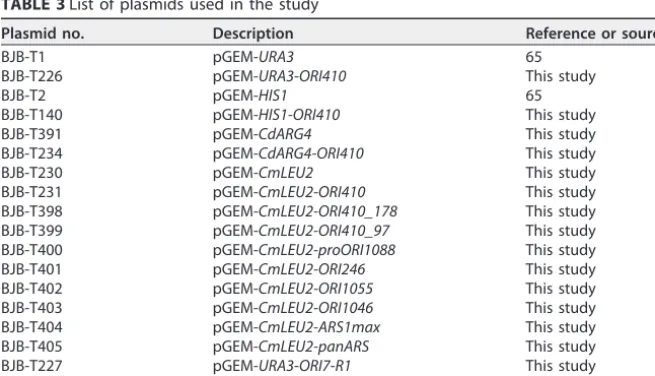
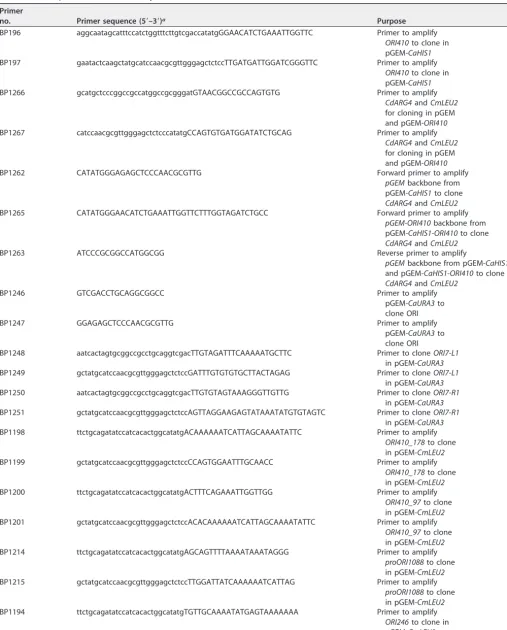
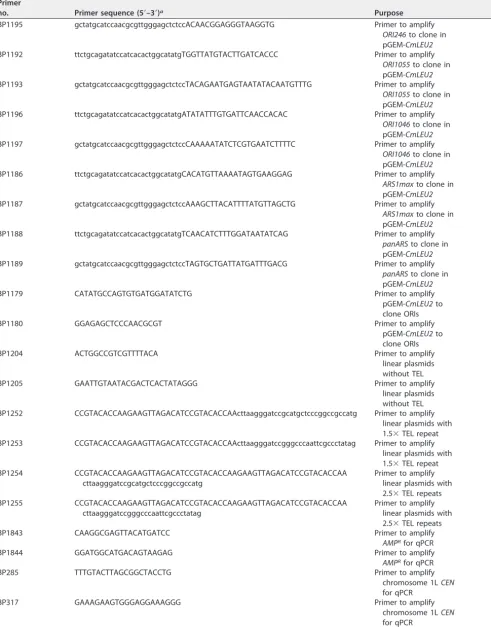
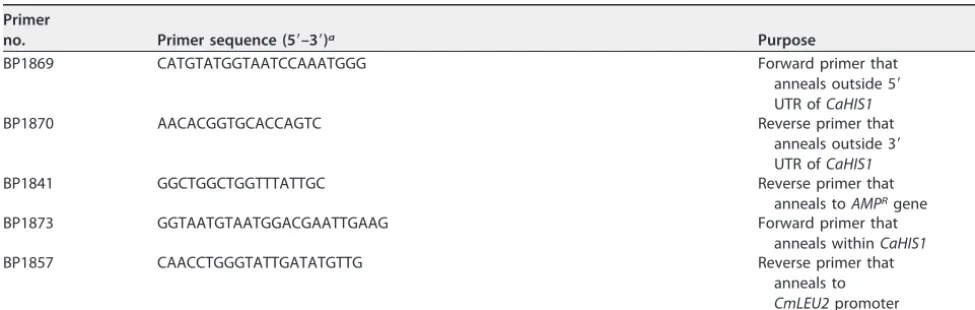
Strains, plasmids, primers, and growth conditions.Yeast strains and plasmids used are listed in Tables 2 and 3, respectively. Primers used are provided in Table 4.
C. albicansstrains were grown at 30°C in YPAD medium (60) or SD minimal medium or SD-Complete medium (60) containing leucine at 170 mg/liter and all other amino acids (Sigma-Aldrich, USA) at 85 mg/liter.
E. coliDH5␣was used for all cloning experiments and was grown in LB medium (60) at 37°C with ampicillin (Sigma-Aldrich, USA) at 100g/ml.
Cloning of selection markers and ORIs in plasmids.Selection markers and ORIs were amplified with primers (Table 4) carrying 15- to 40-bp homology to the vector and⬃20-bp homology to the marker
TABLE 2List of strains used in the study
Strain no. C. albicansstrain Genotype Reference Gene(s) used with YJB-T 45 BWP17 ura3::imm434/ura3::imm434his1::hisG/his1::hisG arg4::hisG/arg4::hisG 65 CaURA3
YJB-T 72 SN76 ura3-iro1::imm434/ura3-iro1::imm434his1::hisG/his1::hisG arg4Δ/arg4Δ 30 CaHIS1,CdARG4 YJB-T 736 SN152 ura3-iro1::imm434/URA3-IRO1 his1::hisG/his1::hisG arg4Δ/arg4Δleu2Δ/leu2Δ 66 CmLEU2 YJB-T 65 SN95 ura3-iro1::imm434/URA3-IRO1 his1::hisG/his1::hisG arg4Δ/arg4Δ 30 CaHIS1,CdARG4
TABLE 3List of plasmids used in the study
Plasmid no. Description Reference or source
BJB-T1 pGEM-URA3 65
BJB-T226 pGEM-URA3-ORI410 This study
BJB-T2 pGEM-HIS1 65
BJB-T140 pGEM-HIS1-ORI410 This study
BJB-T391 pGEM-CdARG4 This study
BJB-T234 pGEM-CdARG4-ORI410 This study
BJB-T230 pGEM-CmLEU2 This study
BJB-T231 pGEM-CmLEU2-ORI410 This study BJB-T398 pGEM-CmLEU2-ORI410_178 This study BJB-T399 pGEM-CmLEU2-ORI410_97 This study BJB-T400 pGEM-CmLEU2-proORI1088 This study BJB-T401 pGEM-CmLEU2-ORI246 This study BJB-T402 pGEM-CmLEU2-ORI1055 This study BJB-T403 pGEM-CmLEU2-ORI1046 This study BJB-T404 pGEM-CmLEU2-ARS1max This study BJB-T405 pGEM-CmLEU2-panARS This study BJB-T227 pGEM-URA3-ORI7-R1 This study BJB-T228 pGEM-URA3-ORI7-L1 This study
on September 8, 2020 by guest
http://msphere.asm.org/
TABLE 4List of primers used in the study
Primer
no. Primer sequence (5=–3=)a Purpose
BP196 aggcaatagcatttccatctggtttcttgtcgaccatatgGGAACATCTGAAATTGGTTC Primer to amplify ORI410to clone in pGEM-CaHIS1 BP197 gaatactcaagctatgcatccaacgcgttgggagctctccTTGATGATTGGATCGGGTTC Primer to amplify
ORI410to clone in pGEM-CaHIS1 BP1266 gcatgctcccggccgccatggccgcgggatGTAACGGCCGCCAGTGTG Primer to amplify
CdARG4andCmLEU2 for cloning in pGEM and pGEM-ORI410 BP1267 catccaacgcgttgggagctctcccatatgCCAGTGTGATGGATATCTGCAG Primer to amplify
CdARG4andCmLEU2 for cloning in pGEM and pGEM-ORI410 BP1262 CATATGGGAGAGCTCCCAACGCGTTG Forward primer to amplify
pGEMbackbone from pGEM-CaHIS1to clone CdARG4andCmLEU2 BP1265 CATATGGGAACATCTGAAATTGGTTCTTTGGTAGATCTGCC Forward primer to amplify
pGEM-ORI410backbone from pGEM-CaHIS1-ORI410to clone CdARG4andCmLEU2
BP1263 ATCCCGCGGCCATGGCGG Reverse primer to amplify
pGEMbackbone from pGEM-CaHIS1 and pGEM-CaHIS1-ORI410to clone CdARG4andCmLEU2
BP1246 GTCGACCTGCAGGCGGCC Primer to amplify
pGEM-CaURA3to clone ORI
BP1247 GGAGAGCTCCCAACGCGTTG Primer to amplify
pGEM-CaURA3to clone ORI
BP1248 aatcactagtgcggccgcctgcaggtcgacTTGTAGATTTCAAAAATGCTTC Primer to cloneORI7-L1 in pGEM-CaURA3 BP1249 gctatgcatccaacgcgttgggagctctccGATTTGTGTGTGCTTACTAGAG Primer to cloneORI7-L1
in pGEM-CaURA3 BP1250 aatcactagtgcggccgcctgcaggtcgacTTGTGTAGTAAAGGGTTGTTG Primer to cloneORI7-R1
in pGEM-CaURA3 BP1251 gctatgcatccaacgcgttgggagctctccAGTTAGGAAGAGTATAAATATGTGTAGTC Primer to cloneORI7-R1
in pGEM-CaURA3 BP1198 ttctgcagatatccatcacactggcatatgACAAAAAATCATTAGCAAAATATTC Primer to amplify
ORI410_178to clone in pGEM-CmLEU2 BP1199 gctatgcatccaacgcgttgggagctctccCCAGTGGAATTTGCAACC Primer to amplify
ORI410_178to clone in pGEM-CmLEU2 BP1200 ttctgcagatatccatcacactggcatatgACTTTCAGAAATTGGTTGG Primer to amplify
ORI410_97to clone in pGEM-CmLEU2 BP1201 gctatgcatccaacgcgttgggagctctccACACAAAAAATCATTAGCAAAATATTC Primer to amplify
ORI410_97to clone in pGEM-CmLEU2 BP1214 ttctgcagatatccatcacactggcatatgAGCAGTTTTAAAATAAATAGGG Primer to amplify
proORI1088to clone in pGEM-CmLEU2 BP1215 gctatgcatccaacgcgttgggagctctccTTGGATTATCAAAAAATCATTAG Primer to amplify
proORI1088to clone in pGEM-CmLEU2 BP1194 ttctgcagatatccatcacactggcatatgTGTTGCAAAATATGAGTAAAAAAA Primer to amplify
ORI246to clone in pGEM-CmLEU2
(Continued on next page) Bijlani et al.
on September 8, 2020 by guest
http://msphere.asm.org/
TABLE 4(Continued)
Primer
no. Primer sequence (5=–3=)a Purpose
BP1195 gctatgcatccaacgcgttgggagctctccACAACGGAGGGTAAGGTG Primer to amplify ORI246to clone in pGEM-CmLEU2 BP1192 ttctgcagatatccatcacactggcatatgTGGTTATGTACTTGATCACCC Primer to amplify
ORI1055to clone in pGEM-CmLEU2 BP1193 gctatgcatccaacgcgttgggagctctccTACAGAATGAGTAATATACAATGTTTG Primer to amplify
ORI1055to clone in pGEM-CmLEU2 BP1196 ttctgcagatatccatcacactggcatatgATATATTTGTGATTCAACCACAC Primer to amplify
ORI1046to clone in pGEM-CmLEU2 BP1197 gctatgcatccaacgcgttgggagctctccCAAAAATATCTCGTGAATCTTTTC Primer to amplify
ORI1046to clone in pGEM-CmLEU2 BP1186 ttctgcagatatccatcacactggcatatgCACATGTTAAAATAGTGAAGGAG Primer to amplify
ARS1maxto clone in pGEM-CmLEU2 BP1187 gctatgcatccaacgcgttgggagctctccAAAGCTTACATTTTATGTTAGCTG Primer to amplify
ARS1maxto clone in pGEM-CmLEU2 BP1188 ttctgcagatatccatcacactggcatatgTCAACATCTTTGGATAATATCAG Primer to amplify
panARSto clone in pGEM-CmLEU2 BP1189 gctatgcatccaacgcgttgggagctctccTAGTGCTGATTATGATTTGACG Primer to amplify
panARSto clone in pGEM-CmLEU2
BP1179 CATATGCCAGTGTGATGGATATCTG Primer to amplify
pGEM-CmLEU2to clone ORIs
BP1180 GGAGAGCTCCCAACGCGT Primer to amplify
pGEM-CmLEU2to clone ORIs
BP1204 ACTGGCCGTCGTTTTACA Primer to amplify
linear plasmids without TEL
BP1205 GAATTGTAATACGACTCACTATAGGG Primer to amplify
linear plasmids without TEL BP1252 CCGTACACCAAGAAGTTAGACATCCGTACACCAActtaagggatccgcatgctcccggccgccatg Primer to amplify
linear plasmids with 1.5⫻TEL repeat BP1253 CCGTACACCAAGAAGTTAGACATCCGTACACCAActtaagggatccgggcccaattcgccctatag Primer to amplify
linear plasmids with 1.5⫻TEL repeat BP1254 CCGTACACCAAGAAGTTAGACATCCGTACACCAAGAAGTTAGACATCCGTACACCAA
cttaagggatccgcatgctcccggccgccatg
Primer to amplify linear plasmids with 2.5⫻TEL repeats BP1255 CCGTACACCAAGAAGTTAGACATCCGTACACCAAGAAGTTAGACATCCGTACACCAA
cttaagggatccgggcccaattcgccctatag
Primer to amplify linear plasmids with 2.5⫻TEL repeats
BP1843 CAAGGCGAGTTACATGATCC Primer to amplify
AMPRfor qPCR
BP1844 GGATGGCATGACAGTAAGAG Primer to amplify
AMPRfor qPCR
BP285 TTTGTACTTAGCGGCTACCTG Primer to amplify
chromosome 1LCEN for qPCR
BP317 GAAAGAAGTGGGAGGAAAGGG Primer to amplify
chromosome 1LCEN for qPCR
(Continued on next page)
on September 8, 2020 by guest
http://msphere.asm.org/
or ORI fragment. Amplified vector and insert (1:3 ratio) were assembled in 20l Gibson reaction mixture (61) per the manufacturer’s instructions (New England BioLabs [NEB], USA), and 2l was transformed into chemically competent E. coli (NEB, USA). Following selection on LB plus ampicillin overnight, recombinants were detected by colony PCR using primers to the vector, outside the cloning sites. Putative positive clones were then confirmed by Sanger sequencing.
Construction of linear plasmids.Linearizing primers (BP1252, BP1253, BP1254, and BP1255; Table 4) contained (from 5=and 3=) a 34- or 57-nt telomere sequence (36), AflII and BamHI recognition sites, and then homology to the plasmid AatII site. Linear plasmids were amplified from circular plasmids (Fig. 2A) by two-step PCR using Kappa HiFi HotStart polymerase (Roche, Switzerland). Cycling conditions were as follows: 98°C denaturation step for 30 s, 30 cycles of 98°C (10 s) and 72°C (30 s/kb), and final extension of 72°C for 10 min.
To generate linear plasmids without telomeric ends, the circular plasmids were amplified with primers (BP1204 and BP1205; Table 4) using Phusion polymerase (Thermo Fisher Scientific, USA). Cycling conditions were as follows: 98°C denaturation step for 30 s; 25 cycles of 98°C (10 s), 60°C (30 s), and 72°C for (30 s/kb); and a final extension step at 72°C for 10 min.
Colony PCR.A small portion of the colony was resuspended in the PCR withTaqpolymerase (Hy-Taq
Ready Mix, Hy-labs, Israel). Cycling conditions were as follows: 95°C denaturation step for 5 min; 25 cycles of 95°C (30 s), annealing at a primer-dependent temperature (30 s), and 72°C (1 min/kb); and a final extension step at 72°C for 5 min.
High-efficiency transformation of C. albicans. C. albicans transformation was carried out as described previously (62) with the only difference being that DTT was added at a final concentration of 25 mM and that after a 45-min incubation with lithium acetate (LiAc)-TE, the cells were further incubated with DTT for 1.5 h.
Mitotic stability assay.Yeast transformants were inoculated into SDC(⫺AA) (selective) medium and grown overnight at 30°C. The cultures were 10-fold serially diluted, and an appropriate dilution to yield 100 to 200 colonies was plated onto both SDC(⫺AA) and SDC plates. The plates were incubated at 30°C, and the number of colonies was counted after 2 days. Mitotic stability was calculated as [no. of colonies on SDC(⫺AA)/no. of colonies on SDC]⫻100.
Plasmid loss assay.Yeast transformants grown overnight in SDC(⫺AA) for mitotic stability assay were diluted 100-fold into SDC medium and grown overnight at 30°C. The cultures were 10-fold serially diluted, and 5l of each dilution was spotted on both SDC(⫺AA) and SDC plates. The plates were incubated at 30°C for 2 days, and the number of colonies was counted from the highest dilution at which they were well separated. The proportion of cells that retained the plasmid without selection was calculated as [no. of colonies on SDC(⫺AA)/no. of colonies on SDC] from the same dilution. The plasmid loss rate was then determined as described in the work of Longtine et al. (47).
Southern blotting. The genomic DNA was extracted from 10-ml overnight-grown cultures in SDC(⫺AA) as described previously (62). Fifteen to 20g genomic DNA was digested overnight with ApaI and run on a 1% agarose gel for 16 to 20 h at 1.4 V/cm. Southern blotting was performed as described previously (63). A PCR fragment of theAMPRgene was used to probe the plasmids on the blot.
qPCR to determine plasmid copy number.qPCR was carried out with the genomic DNA from autonomous transformants using SYBR green master mix (Bio-Rad, USA) per the manufacturer’s protocol in a Bio-Rad CFX96 Touch real-time PCR detection system. Cycling conditions were as follows: 95°C (3 min), 40 cycles of 95°C (5 s) and 60°C (30 s), and melt curve from 65.0 to 95.0 for 5 s. TheAMPRgene was used to determine plasmid copy number, andCENof chromosome 1 was used as a reference gene. The two primer sets used had similar efficiencies in the reaction; therefore, fold change in the copy number of plasmids was determined relative to the genomic control. Copy number of plasmids was calculated as copy number⫽(fold change⫻2)/mitotic stability.
Growth rate determination. From fresh transformation plate, three independent colonies per colony size were inoculated into 2 ml SDC(⫺AA) and grown overnight at 30°C and 250 rpm. Fifty
TABLE 4(Continued)
Primer
no. Primer sequence (5=–3=)a Purpose
BP1869 CATGTATGGTAATCCAAATGGG Forward primer that
anneals outside 5=
UTR ofCaHIS1
BP1870 AACACGGTGCACCAGTC Reverse primer that
anneals outside 3=
UTR ofCaHIS1
BP1841 GGCTGGCTGGTTTATTGC Reverse primer that
anneals toAMPRgene
BP1873 GGTAATGTAATGGACGAATTGAAG Forward primer that
anneals withinCaHIS1
BP1857 CAACCTGGGTATTGATATGTTG Reverse primer that
anneals to CmLEU2promoter
aSequences in lowercase indicate regions homologous to the plasmid.
Bijlani et al.
on September 8, 2020 by guest
http://msphere.asm.org/
microliters of cell culture was washed with ddH2O and resuspended in 1 ml SDC(⫺AA); 10l was inoculated in 100l SDC(⫺AA) in a 96-well round-bottom sterile polystyrene plate (Corning). For tiny colonies that could not be propagated in liquid medium, three independent colonies were directly inoculated from the plate into 100l SDC(⫺AA). The plate was subsequently incubated at 30°C in a Tecan Infinite F200 Pro (Tecan, Switzerland) microplate incubator/spectrometer with a shaking duration of 900 s, and the OD600was collected every 15 min over a 24-h period. OD versus time was plotted to generate growth curves.
Recovery of pLin-CmLEU2-ORI410plasmid from autonomous transformants.The genomic DNA from the yeast transformants was digested with BamHI (NEB, USA) to cut the linear plasmid at both of the ends, resulting in removal of telomere repeats. The digested DNA was ligated overnight with T4 DNA ligase (Thermo Fisher Scientific, USA). The ligation product was transformed into electrocompetentE. coli
(64), and the clones obtained were confirmed by PCR primers flanking the ligation site followed by sequencing.
SUPPLEMENTAL MATERIAL
Supplemental material for this article may be found at https://doi.org/10.1128/ mSphere.00103-19.
FIG S1, PDF file, 0.1 MB. FIG S2, PDF file, 0.3 MB. FIG S3, PDF file, 0.2 MB. FIG S4, PDF file, 0.2 MB. FIG S5, PDF file, 0.2 MB. FIG S6, PDF file, 0.6 MB. TABLE S1, PDF file, 0.1 MB. TABLE S2, PDF file, 0.1 MB.
ACKNOWLEDGMENTS
We thank members of the Berman lab for stimulating discussions throughout the work; Anton Levitan for help with sequence analysis; and Ella Segal, Andre Maicher, Shay Bramson, and Sophia Hirsch for technical assistance. We thank Ella Segal, Laura Burrack, and Amnon Koren for helpful comments on the manuscript.
This work was supported by the Israel Science Foundation (314/13) and by the European Research Council Advanced Award (340087, RAPLODAPT) to J.B. and a PBC postdoctoral fellowship to M.A.T.
REFERENCES
1. Griffiths AJF, Wessler SR, Carroll SB, Doebley J. 2015. Introduction to genetic analysis, 11th ed, p 351–392. WH Freeman, New York, NY. 2. Gerbaud C, Guérineau M. 1980. 2m plasmid copy number in different
yeast strains and repartition of endogenous and 2m chimeric plasmids in transformed strains. Curr Genet 1:219 –228.https://doi.org/10.1007/ BF00390947.
3. Gunge N, Tamaru A, Ozawa F, Sakaguchi K. 1981. Isolation and characterization of linear deoxyribonucleic acid plasmids from
Kluyveromyces lactis and the plasmid-associated killer character. J Bacteriol 145:382–390.
4. Powell WA, Kistler HC. 1990. In vivo rearrangement of foreign DNA by
Fusarium oxysporumproduces linear self-replicating plasmids. J Bacteriol 172:3163–3171.https://doi.org/10.1128/jb.172.6.3163-3171.1990. 5. Samac DA, Leong SA. 1988. Two linear plasmids in mitochondria of
Fusarium solanif. sp.cucurbitae. Plasmid 19:57– 67.https://doi.org/10 .1016/0147-619X(88)90063-7.
6. Raghuraman MK, Liachko I. 2016. Sequence determinants of yeast rep-lication origin.InKaplan DL (ed), The initiation of DNA replication in eukaryotes. Springer International Publishing, Basel, Switzerland. 7. Diffley JF, Stillman B. 1988. Purification of a yeast protein that binds to
origins of DNA replication and a transcriptional silencer. Proc Natl Acad Sci U S A 85:2120 –2124.https://doi.org/10.1073/pnas.85.7.2120. 8. Srienc F, Bailey JE, Campbell JL. 1985. Effect of ARS1 mutations on
chromosome stability in Saccharomyces cerevisiae. Mol Cell Biol 5:1676 –1684.https://doi.org/10.1128/MCB.5.7.1676.
9. Broach JR, Li YY, Feldman J, Jayaram M, Abraham J, Nasmyth KA, Hicks JB. 1983. Localization and sequence analysis of yeast origins of DNA replication. Cold Spring Harb Symp Quant Biol 47(Pt 2):1165–1173.
https://doi.org/10.1101/SQB.1983.047.01.132.
10. Bouton AH, Smith MM. 1986. Fine-structure analysis of the DNA se-quence requirements for autonomous replication of Saccharomyces cerevisiaeplasmids. Mol Cell Biol 6:2354 –2363.https://doi.org/10.1128/ MCB.6.7.2354.
11. Celniker SE, Sweder K, Srienc F, Bailey JE, Campbell JL. 1984. Deletion mutations affecting autonomously replicating sequenceARS1of Saccha-romyces cerevisiae. Mol Cell Biol 4:2455–2466.https://doi.org/10.1128/ MCB.4.11.2455.
12. Liachko I, Bhaskar A, Lee C, Chung SC, Tye BK, Keich U. 2010. A com-prehensive genome-wide map of autonomously replicating sequences in a naive genome. PLoS Genet 6:e1000946.https://doi.org/10.1371/ journal.pgen.1000946.
13. Chuang RY, Kelly TJ. 1999. The fission yeast homologue of Orc4p binds to replication origin DNA via multiple AT-hooks. Proc Natl Acad Sci U S A 96:2656 –2661.https://doi.org/10.1073/pnas.96.6.2656.
14. Dai J, Chuang RY, Kelly TJ. 2005. DNA replication origins in the Schizo-saccharomyces pombegenome. Proc Natl Acad Sci U S A 102:337–342.
https://doi.org/10.1073/pnas.0408811102.
15. Maundrell K, Hutchison A, Shall S. 1988. Sequence analysis of ARS elements in fission yeast. EMBO J 7:2203–2209.https://doi.org/10.1002/ j.1460-2075.1988.tb03059.x.
16. Burrack LS, Berman J. 2012. Flexibility of centromere and kinetochore structures. Trends Genet 28:204 –212.https://doi.org/10.1016/j.tig.2012 .02.003.
17. Chan CS, Tye BK. 1980. Autonomously replicating sequences in Saccha-romyces cerevisiae. Proc Natl Acad Sci U S A 77:6329 – 6333.https://doi .org/10.1073/pnas.77.11.6329.
18. Struhl K, Stinchcomb DT, Scherer S, Davis RW. 1979. High-frequency transformation of yeast: autonomous replication of hybrid DNA