ISSN: 2231-5381 http://www.ijettjournal.org
Page 4361
Optimal Location of Multiple FACTS Device Using
Sensitivity Methods
S.Manikandan#1, P. Arul*2#1
PG scholar & Power System & Jayaram College of Engineering & Technology
#2
Associate Professor & HOD & EEE & Jayaram College of Engineering & Technology Thuraiyur & India
Abstract— In recent years, electric power systems, greater demands have been placed on the transmission network. Maintaining power system stability becomes difficult and challenging problem. FACTS technology have new opportunities for controlling power and enhancing the usable capacity of transmission line , FACTS Controllers to enable corresponding power to flow through such lines under normal and contingency conditions. A method to determine the optimal location of thyristor controlled series compensators (TCSC) and unified power flow control (UPFC) has been suggested based on real power performance index,reduction of total system reactive power loss and SOL index . The tested system is ieee 30 bus system.
Keywords— FACTS, Power flow, TCSC (Thyristor control series capacitor), Unified power flow control(|UPFC),Transmission system, stability and loadability.
I. INTRODUCTION
As electricity is an substantive in modern societies. In Power system delivery has a problem for insufficient transfer capability, stability and loadability etc. The secure operation is complex in power system. Introducing FACTS technology is used to controlling power and losses in transmission line.
FACTS devices can improve the stability of the power network, reduce the flows of heavily loaded lines by controlling their parameters, and maintain the bus voltages at desired levels. It may be absorb or generate a reactive power in the transmission line.
To achive minimum losses in transmission line find the optimal place of transmission line & locate the FACTS device. Sensitivity-based approach where each transmission loss calculate without FACTS device and sensitivity factor calculate with FACTS device.
TCSC is a series connected controller (connected in a line). Its major purpose is the increase in steady state power transfer. It contributes mainly control for voltage ,line
reactance and active power . It consists of passive elements only.
Thyristor Controlled Series Capacitor (TCSC) is a variable impedance type FACTS device and is connected in series with the transmission line to increase the power transfer capability, improve transient stability, and reduce transmission losses[6]. The UPFC can control both the active and reactive power flow in the line. It can also provide independently controllable shunt reactive compensation
The objective is to locate the FACTS device in optimal location based on the sensitivity method.
II.OVERVIEW OF FACTS CONTOROLLERS FACTS Controllers can be divided into four categories[1]:
Series Controllers
Shunt Controllers
Combined series-series Controllers
Combined series-shunt Controllers
A. Series Controllers:
Series Controllers inject voltage in series with the line. Even a variable impedance multiplied by the current flow through it, represents an injected series voltage in the line.
B.Shunt Controllers:
Shunt Controllers inject current into the system at the point of connection. Even a variable shunt impedance connected to the line voltage causes a variable current flow and hence represents injection of current into the line.
C.Combined series-series Controllers:
ISSN: 2231-5381 http://www.ijettjournal.org
Page 4362
multiline transmission system. In which series Controllers provide independent series reactive compensation for each line but also transfer real power among the lines.
D.Combined series-shunt Controllers:
Combined shunt and series Controllers inject current into the system with the shunt part of the Controller and voltage in series in the line with the series part of the Controller. However, when the shunt and series Controllers are unified, there can be a real power exchange between the series and shunt Controllers via the power link.
E.Shunt Connected Controllers
Static Synchronous Compensator (STATCOM): A Static synchronous generator operated as a shunt-connected static var compensator whose capacitive or inductive output.
F.Static Var Compensator (SVC):
A shunt-connected static Var generator or absorber whose output is adjusted. to exchange capacitive or inductive current so as to maintain or control specific parameters of the electrical power system
G.Static Synchronous Series Compensator (SSSC):
A static synchronous generator operated without an external electric energy source as a series compensator whose output voltage is in quadrature with, and controllable independently of, the line current for the purpose of increasing or decreasing the overall reactive voltage drop across the line and thereby controlling the transmitted electric power. SSSC is also a series connected controller.
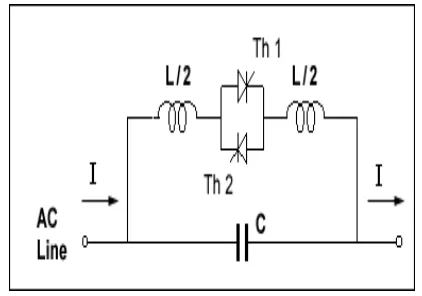
H.Thyristor Controlled Series Capacitor (TCSC):
A capacitive reactance compensator which consists of a series capacitor bank shunted by a thyristor-controlled reactor in order to provide a smoothly variable series capacitive reactance.
I.Unified Power Flow Controller (UPFC):
A combination of static synchronous compensator (STATCOM) and a static series compensator (SSSC) which are coupled via a common dc link, to allow bidirectional flow of real power between the series output terminals of the SSSC and the shunt output terminals of the STATCOM, and are controlled to provide concurrent real and reactive series line compensation without an external electric energy source[1].
III.MATHEMATICAL MODEL OF FACTS DEVICES In an interconnected power system network, power flows obey the Kirchoff’s laws. The resistance of the transmission line is small compared to the reactance. Also the transverse conductance is close to zero. The active power transmitted by a line between the buses i and j may be approximated by following relationships[2]:
Where:
Vi and Vj are voltages at buses i and j;
Xij: reactance of the line;
δij: angle between the Vi and Vj.
Under the normal operating condition for high
voltage line the voltage Vi =Vj and θij is small. The active power flow coupled with θij and reactive power
flow is linked with difference between the Vi-Vj. The control of Xij acts on both active and reactive power flows. The different types of FACTS devices have been choose and locate optimally in order to control the power flows in the power system network.
A.Modeling of TCSC
The reactance of the line can be changed by TCSC. Hence In this project, TCSC have been selected
i j
Fig.1Line with TCSC.
A capacitive reactance compensator which consists of a series capacitor bank shunted by a thyristor-controlled reactor in order to provide a smoothly variable series capacitive reactance[2].
.
fig 2: thyristor-controlled series capacior(tcsc)
ISSN: 2231-5381 http://www.ijettjournal.org
Page 4363
X c X lX l X C
X TCSC
(2)
Where
sin
2
X L
X TCSC (3)
is the firing angle
is the reactance of the inductor and is the
effective reactance of the inductor at firing angle and is limited thus:
X LX l
The model of a transmission line with a TCSC connected between the buses i and j is shown n fig: 1. the change in the line flows due to series reactance. The real power injection at buses i and bus j (Pi (c)) and Pj (c) can be
expressed as
G ij ij Bij ij
j i G ij V i
P ic 2
V
V
cos sin (4)
G ij ij B ij ij
j i G ij V j
P jc 2
V
V
cos sin(5)
Similarly, the reactance power injected at bus i and j (Qi (c)) can be expressed as
Gij ij Bij ij
j i Bij V i
Q ic 2
V
V
sin cos (6)
Gij ij Bij ij
j i Bij V j
Q jc 2
V
V
sin cos (7)Where
x c x ij r ij x ij r ij
rij x c x ij x c
G ij
2 2
2 2
2
(8)
xc xij rij xij rij
xij xc xij rij xc Bij
2 2
2 2
2 2
(9)
B.Modelling of UPFC
To obtain UPFC injection model, it is first essential to consider the series voltage source,
Fig. 3. The UPFC electric circuit
The reactance describes a reactance seen from terminals of the series transformer and is equal to (in p.u. base on system voltage and base power) [11]:
S l S B r
x k
x l 2max (10)
xl b s 1
That
: The series transformer reactance.
: The maximum value of injected voltage amplitude (p.u.).
: The system base power.
: The nominal rating power of the series converter.
Voltage source connected in series is modeled with an ideal series voltage ( ) the amplitude and phase is controlled.
r r 2max
0
ej rV m
V s
2
0
That
: The value of injected voltage amplitude (p.u.).
γ: The value of injected voltage angle.
The equations of the UPFC injection model (Fig.) are given as [8]:
rblV mV n m n
P lm sin (11)
Q convV m rb l
Q lm 2 cos 1 (12)
rblV mV n m n
Pln sin (13)
rblV mV n m n
Q cos
ln (14)
ISSN: 2231-5381 http://www.ijettjournal.org
Page 4364
m n
b lV mV n
m n
V n V m bl r
P m1 sin sin
Qconv b lV m b lV mV n
m n
V m b l r
Qm1 2cos 1 2 sin
m n
blV mV n
m n
V n V m bl r
P n1 sin sin
m n
b lV n b lV mV n
m n
V n V m b l r Q
n cos
2 cos
1
Fig.4. Injection model of the UPFC
The admittance Yum and Yuncan be written by [9]
,
Vum Qumi j Pumi Yum2
Vun Quni j Puni Yun2
IV.REDUCTION OF TOTAL SYSTEM REACTIVE POWER LOSS
Here we look at a method based on the sensitivity of the total system reactive power loss with respect to the control variable of the TCSC. For TCSC placed between buses i and j we consider net line series reactance as a control parameter[3]. Loss sensitivity with respect to control parameter of TCSC placed between buses i and j can be written as
r ij xij
xij rij ij V j V i V j V i aij 2 2 2 2 2 cos 2 2 2
(15)
V. REAL POWER FLOW PERFORMANCE INDEX
SENSITIVITY INDICES
The severity of the system loading under normal and contingency cases can be described by a real power line flow performance index as given below.
P LM P LM n NL m n W m PI max 21 2 (16) Where
Lm
P
is the real power flowmax Lm
P
is the rated capacity of line-m & n is the exponentm
W
a real non-negative weighting coefficient which may be used to reflect the importance of lines.The real power flow PI sensitivity factors with respect to the parameters of TCSC can be defined as
0 xck xck PI
bk (17)
The sensitivity of PI with respect to TCSC parameter connected between bus-i and bus-j can be written as:
xck Plm NL m Plm Plm W m xck PI
1 max 1 4 3 (18)The real power flow in a line –m can be represesnted in terms of real power injection using DC powerflow equations where is slack bus,as
k m for 1 1 k m for P j N s n
m S mnPn N
s n
m S mnPn
Plm (19)
k k m for x ck P j x ck P j Smi x ck P i Smi m for x ck P j Smj x ck Pi Smi xckPlm (20)
ISSN: 2231-5381 http://www.ijettjournal.org
Page 4365
rij xij
rij xij ij V j Vi xij rij
xij rij ij V j Vi Vi
2 2 2
sin 2
) cos 2
(
2
(21)
0 xck
P j
xck 0
xck P jc
xck
rij xij
rij xij ij V j Vi xij rij
xij rij ij V j Vi Vi
2 2 2 sin 2
) cos 2
(
2
(22)
Criteria for optimal location
The FACTS device should be placed on the most sensitive line. With the sensitivity indices computed for TCSC[2], following criteria can be used for its optimal placement
1. In reactive power loss reduction method TCSC should be placed in a line having the most positive loss sensitivity index.
2. In performance index method TCSC should be placed in a line having most negative sensitivity index.
In our project reactive power loss reduction method is used to calculate the sensitivity index of a line and TCSC is placed in line with most positive loss sensitivity index as mentioned above.
VI.SEVERITY OF OVER LOADABILITY INDEX (SOL) COMPUTATION
:
The location of FACTS devices in this work is decided based on the severity of overloading of that particular branch in which the device is incorporated. The process of ranking the branch in which the device is incorporated. The process of ranking the branches based on their load ability in the order of their severity involves the following .
Step1:Establish the criterion to be considered in formulating the ranking
Step2:For the criterion established in (step1), define a scalar mathematical function which has a larger value of branch load that which stress the system relative to that criterion, and a small value for those which do not this function is called a “SOL index”.
The SOL index is such that contingencies resulting in system conditions yielding large valued over load indices are considered more severe than system conditions with smaller overload indices.In overload ranker,the SOL index is defined as[7],
N
i
P
P
i
i
SOL
1
2
max
(23)
Where,
is the real power flow in line “I”,
is maximum of active power transfer over the line and
N is set of monitored lines contributing to SOL
VII.RESULT
Line Ak Pixck Pjxck
1
-141.248 4
-77.3487 -411.9166
2
-60.8319
-39.3644 13.9461
3
-77.4711
7.3287 -35.0484
4
-1.0939e +003
-886.6861 123.0955
5
-84.1094
-18.5428 5.4814 6 -3.5744 -18.0363 -35.3064
7
-1.0906e +003
-731.0757 192.7788
8
-63.2670
-7.6149 -96.4295
9
-260.432 6
-182.4450 36.0841
10
-224.193 1
-689.2616 -90.0753
11
-98.1041
-2.5948 2.5948 12 -7.4304 3.4063 -3.4063 13 -0.0222 -9.3383014 9.3383e-014
14
-184.969 0
-90.6967 90.6967
15 -6.5417 9.7881 -9.7881 16 -0.0095 -2.0527e-013 2.0527e-013 17 -6.3098 -20.8218 -7.2711
18
-26.6258
ISSN: 2231-5381 http://www.ijettjournal.org
Page 4366
20 0.0093 -18.1215 -18.226521 -1.6085 --31.7929 -21.2364 22 -3.9122 -26.5030 -13.7056 23 -0.8709 -65.4540 -54.9249 24 -4.3529 -195.3437 -239.9259 25 -8.8400 -30.7418 -10.1872 26 -2.6515 -148.8372 -115.7430
27
-19.8060
-220.5335 -130.0649 28 -4.3927 -54.7626 -33.9967 29 -0.1814 -1.8167e+003 -1.8441e+003 30 -1.8556 -29.3605 -19.4837 31 -1.3513 -34.8394 -27.2749 32 -0.2006 -14.9306 -12.4460 33 -0.5961 -7.6724 -10.5332 34 -0.3212 -7.4053 -5.7374 35 -2.7444 -16.8746 -27.5789
36
-23.2216
4.3266 -4.3266 37 -3.4701 -7.069 -1.9753 38 -3.6955 -2.4689 -0.2429 39 -1.5470 -5.8314 -2.466 40 -0.0634 -18.9648 -21.1737 41
-94.4030
-330.6767 -54.4531
Table 1.Loss sensitivity index
The Sensitive loss reduction method line 20 is more sensitive Lines TCSC should placed in that line.
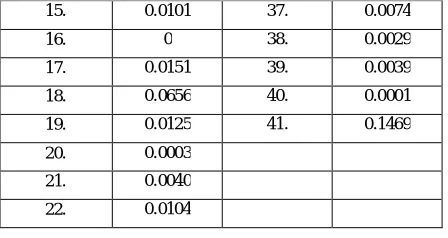
Line no SOL INDEX Line no SOL Index 1. 0.2503 23. 0.0025 2. 0.0452 24. 0.0128 3. 0.0452 25. 0.0517
4. 0.9998 26. 0
5. 0.0101 27. 0.0122
6. 0.0067 28. 0
7. 0.8067 29. 0.0005
8. 0.0918 30. 0.0053 9. 0.2006 31. 0.0063
10. 0.3460 32. 0
11. 0.0004 33. 0.0021
12. 0.0048 34. 0
13. 0 35. 0.0016
14. 0.1345 36. 0
15. 0.0101 37. 0.0074
16. 0 38. 0.0029
17. 0.0151 39. 0.0039 18. 0.0656 40. 0.0001 19. 0.0125 41. 0.1469 20. 0.0003
21. 0.0040 22. 0.0104
Table 2. Severity of load index
In the Severity of over load index computation method line 4,7,10 has maximum loadability, TCSC should placed in that line.
Without FACTS device With TCSC
MW MVAR MW MVAR
17.599 22.244 17.979 14.145 Table 3.simulation lose result TCSC
Without FACTS device With UPFC
MW MVAR MW MVAR
17.599 22.244 17.551 21.951
Table 4.simulation lose result UPFC
Fig 5. Effect of UPFC in power loss
ISSN: 2231-5381 http://www.ijettjournal.org
Page 4367
VIII.CONCLUSION:
In the powersystem has transmission loss will occur while transmiting the power, it is important to reduce the losses.FACTS device such as TCSC by controlling the network can help to reduce the flows in heavily loaded lines. Here two methods are considered sensitivity loss method and severity of over load index method.It is used to determine the optimal placement of FACTS device in transmission line.
IX.REFERENCE
[1] N.G.Hingorani, L.Gyugyi,Understanding the FACTS: Concepts and Technology of Flexible AC Transmission System,IEEE Press,New-York,2000
[2] Madhura Gad, PrachiShinde, Prof. S.U.Kulkarni”Optimal Location of TCSC by Sensitivity Methods” International Journal Of Computational Engineering Research, Volume2 Issue 6. 2012.
[3] PrakashBurade, JagdishHelonde., Optimal Location of FACTS Device on Enhancing System Security,International Journal of Scientific & Engineering Research. Volume 3, Issue 5, May-2012
[4] Aswini kumar, “Optimal location of UPFC and comparative Analysis of Maximum loadability with FACTS in Competitive Electricity Markets,” 7th
WSEAS international conference on Electric Power System , Nov., 2007.
[5] Mohd Wazir Mustafa,Wong Yan Chiew, Optimal placement of SVC using Genetic Alogorithm, V- 10., Faculty of Electrical Engineering, 2008
[6] Lijun cai and georgios stamtsis,yicheng luo, “Optimal choice and allocation of FACTS device in deregulated electricity market using Genetic Algorithm”
[7] M.Balasubba Reddy,Dr.Y.P.Obulesh,Dr.Sivanaga Raju,”A SOL algorithm and simulation of TCPST for optimal power flow solution using NR method,V-1,I-2,International journal of modern Engineering Reserch.
[8] Abouzar Samimi, Peyman Naderi, “A New method for optimal placement of TCSC based on sensitivity analysis for congestion managementt, SGRE. 2012.
[9] Mrinal Ranjan, B. Vedik,” Optimal Location of FACTS Devices in a Power System by Means of Sensitivity Analysis”Trends in Electrical and Computer Engineering,2011
[10] Jigar S.Sarada ,Vibhan .N.Parmer, Dhavel .G.Patel,Latik.K.Patel “Genitic Algorithm Approach for optimal location of FACTS device to improve system loadability and minimization of losses”International Journal of Advanced Electrical and Electronics and instrumentation Engineering Volume 1, Issue 3,September 2012