ISSN Print: 2327-6045
Characterization of Nickel Alloy 600 with
Ultra-Fine Structure Processed by Severe
Plastic Deformation Technique (SPD)
Waldemar Alfredo Monteiro, Silvio Luis Ventavele da Silva, Luciana Ventavele da Silva,
Arnaldo Homobono Paes de Andrade, Luis Carlos Elias da Silva
Nuclear and Energy Research Institute, IPEN, Cidade Universitária, São Paulo, Brasil
Abstract
High strength nickel based alloys are used in a multitude of advanced systems where lightweight, high power density mechanical power transmission sys-tems are required. Components such as gears, bearings and shafts could be made significantly smaller and more durable if a major improvement in nickel based alloy mechanical properties could be achieved. An important refine-ment in grain size (includes nanometric level) is thought to be a promising method for achieving fundamental improvements in mechanical properties. Grain size is known to have a significant effect on the mechanical behavior of materials. One of the most favorable methods of achieving extreme grain re-finement is by subjecting the materials to severe plastic deformation (SPD). The principal microstructural variations in superalloys are the precipitation amount and morphology, grain size and the distribution of carbide precipita-tion that could reduce the mechanical properties of the alloys. This work shows optical and transmission electron microscopy analysis and also hard-ness data after severe plastic deformation (pure shear stress).
Keywords
Nickel Based Alloys, Severe Plastic Deformation, Hardness, Microstructure, Microscopy
1. Introduction
Despite the physical and mechanical properties of metals are determined by sev-eral factors, the average size of grain of material usually plays a very important role and is often a dominant factor in determining the properties and the final application of metals. It is noteworthy that the increase of mechanical resistance How to cite this paper: Monteiro, W.A.,
da Silva, S.L.V., da Silva, L.V., de Andrade, A.H.P. and da Silva, L.C.E. (2017) Charac-terization of Nickel Alloy 600 with Ul-tra-Fine Structure Processed by Severe Plastic Deformation Technique (SPD). Journal of Materials Science and Chemical Engineering, 5, 33-44.
https://doi.org/10.4236/msce.2017.54004
Received: February 17, 2017 Accepted: April 27, 2017 Published: April 30, 2017
Copyright © 2017 by authors and Scientific Research Publishing Inc. This work is licensed under the Creative Commons Attribution International License (CC BY 4.0).
with the grain size reduction has produced increasing interest in the manufac-ture of materials with extremely small grain size. The grain sizes of commercial alloys are generally manufactured for specific applications, through predeter-mined thermo-mechanical treatments in which the alloys are subjected to spe-cific regimes of temperature and mechanical tests. However, these processes cannot be used to produce materials with sub-micrometric grain sizes because there is a fixed lower bound, on the order of a few microns, representing essen-tially the minimum grain size achieved using these procedures.
In practice, conventional methods of forming, such as rolling and extrusion, have restricted capacity to produce materials with ultra-fine grains for two portant reasons: first, there is a limitation on the total deformation can be im-posed on the material due to the reduction in cross-sectional dimensions of samples; Second, the deformations imposed by conventional methods are unsa-tisfactory to introduce ultra-fine structure due to low workability of alloys at room temperature and relatively low temperatures [1]. As a consequence of these limitations, alternative processing techniques are necessary for this pur-pose, based on the SPD application, where extremely high deformations are im-posed for manufacture of materials with grain size in the sub-micron range or nanoscale [2].
The technological application of nickel alloy 600 is associated to the high melting point (1726 K), adequate corrosion resistance, limited dissolution capa-bility, presence of metallic elements that serve to strengthen or improve its properties [3] [4] [5]. This alloy containing between 15% and 30% chromium is essential for corrosion resistance. Other elements are usually present on a small-er level, ranging from 3% to 20%, and are related to the increased resistance to deformation at high temperatures. The nickel alloy 600 is an austenitic alloy containing 76% nickel, 15% chromium, 8% iron and minor additions from other elements. With such high nickel content, this alloy has low carbon solubility, the excessive carbons precipitate as chromium carbides when this alloy is exposed to temperatures between 813 K and 1253 K. These carbides can appear dispersed in dislocation tangles and also in grain boundaries (secondary phases) [5].
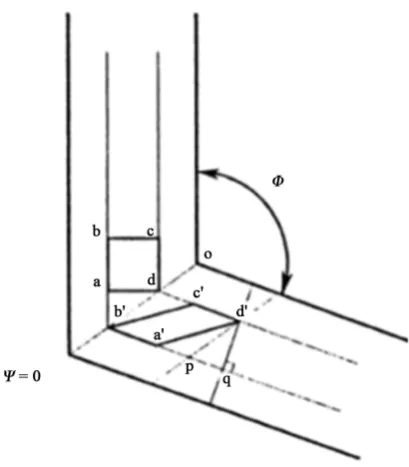
Figure 1. Schematic diagram showing the extrusion principle for SPD: two sequential channels, which intersect at an angle Ф = 120˚ and ψ = 0˚, which defines the arc of cur-vature of the junction (Valiev, 2000).
When the outer angle ψ = 0˚ and the inner angle Ф is arbitrary according to
[7] the shear strain value increment at each pass through the channels can be calculated by the equation
(
)
(
)
I 2 3 cot 2Ф
ε
∆ = ×
Figure 2(a) and Figure 2(b) are the two opened components of the die and figure (c) the closed die with plunger, sample inside the die. The sample test is inserted within the mold channel and pressed with a punch in a specific load.
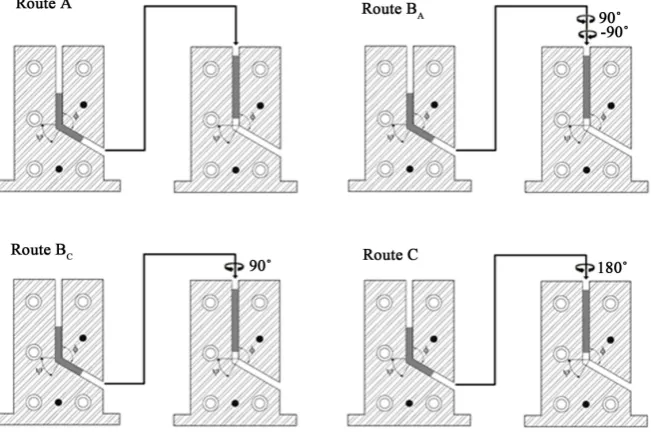
The repetitive mechanical process allows developing different microstructures by rotating the sample between consecutive passes. Figure 3 shows the four ba-sic processing routes (paths), where sample rotations between consecutive passes are 0˚, to the route; 90˚, to route B, and 180˚, to route c. The route B is still di-vided into routes BA and BC, with 90˚ rotations in opposite directions along the
same lines, or alternating after each pass, respectively. It is noticeable that route B produces the highest level of strength in comparison to routes A and C, as de-formation occurs in two orthogonal shear planes and directions. At each even numbered pass, shear bands nearly disappear and only subgrains are present in-side the original grains [1] [11] [12] [13] [14] [15].
2. Materials and Methods
The employed material of this research (Multialloy, São Paulo, Brazil) is a nick-el-based superalloy, nickel alloy 600 (samples with length of 1.6 m and diameter of 7 × 10⁻³ m). The chemical composition in percentage by weight is: 73.8% Ni;
(a) (b) (c)
Figure 2. The two opened components ((a) and (b)) of the die and (c) the closed die with plunger, sample inside the die.
Figure 3. Assortments for billet rotation between consecutive passes through SPD die [12].
were machined with dimensions close to the channel of the mold (6 mm × 6 mm × 60 mm), and submitted to a heat treatment at 673 K during 1800 s, followed by cold water quenching, and finally surface-polished using 1200 grit SiC paper.
The samples were processed using a two-part mold (D2 tool steel) with two rectangular channels of equal cross sections intersecting at an angle (Ф) of 120˚ to each other and with external elbow angle (ψ) of 60˚ (Figure 2 and Figure 3). The punch used in pressing operation was also manufactured in D2 tool steel to maintain a small clearance between the sample and the channel. After the extru-sion process, the pinhole is removed and the deformed billet is also removed from the second channel. The process can be repeatedly performed in the same tool with various alternatives and thus the intensity of total deformation will be N (number of passes) times a single shear deformation (Figure 1 and Figure 3).
[image:4.595.212.538.264.480.2]5 mm/min in order to reduce the effects of friction and grip and prevent prob-lems during processing, the channel and the specimens were lubricated with copper grease. During each step of the mechanical processing a few interrup-tions were necessary for lubrication.
Two routes were carried out via the SPD technique, in this paper is presented according to the results BC route, i.e., each pass the sample is rotated by 90˚ in
relation to the previous pass. The specimens were subjected to two, four and six passes using the BC path of deformation, in which the specimen is turned 90° in
the same direction in relation to the longitudinal axis after each pass.
Concerning Vickers microhardness tests a Buehler Micromet 2103 was uti-lized. The measurements were subjected with a load of 5.0 × 10⁻² kg on the
sur-face of the sample (with optical microscope). Each indentation adequately spaced out to avoid interference with each other. The results consist of the aver-age of the values obtained. All of these measurements were performed at ECAP plane perpendicular to the longitudinal axis of the samples over the line passing through the center.
For each condition of deformation processing, hardness tests, optical micro-scopy (OM), and transmission electron micromicro-scopy (TEM, accelerating voltage 200 kV) observations were performed. Thin foils for TEM were prepared from the flow plane using the standard technique of double jet electro polishing. For each specific condition of preparation, an average of six thin foils was observed to take into account statistical effects. EDS by scanning electron microscopy (SEM) was also utilized.
3. Results and Discussion
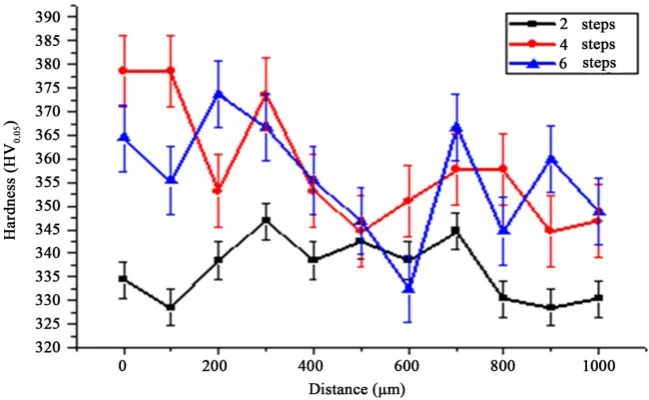
[image:5.595.210.535.503.703.2]The mechanical properties values (Vickers hardness) indicated a significant in-crease of mechanical strength of nickel alloy 600 (Figure 4). Vickers hardness tests carried out in the received material show mean value of (313 ± 4) HV0.05.
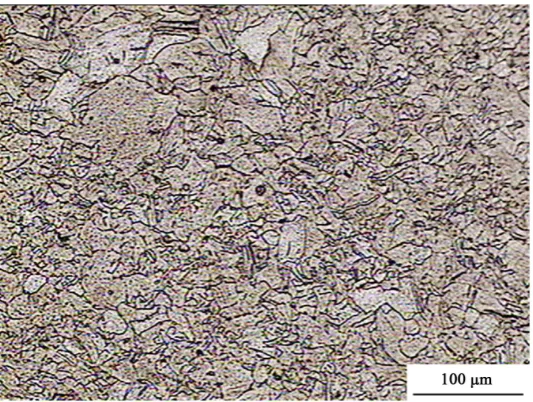
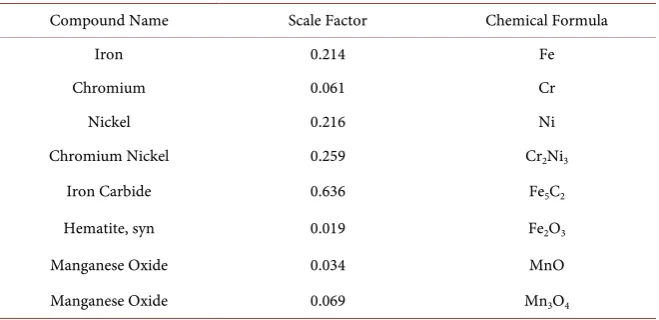
The optical microscopy (OM) observations in the samples of the as received 600 nickel alloy showed grain size variations and carbide and nitride precipita-tions (Table 1) identified by XRD (Figure 5) and EDS microanalysis (SEM). Af-ter heat treatment at 673K during 1800s it is observed grain size variation (grain growth has occurred) and presence of carbide precipitations (Figure 6). After the deformation processes there is a decrease in grain size with increase of ap-plied ECAP passes number (Figure 7). In some situations the particles (car-bides) show dimensions compared to the new ECAP induced grain. With the obtained data from the mechanical tests and with the microstructure during ob-servations by OM and TEM indicate that 600 nickel alloy after ECAP technique exhibited higher strength while maintaining enough ductility.
Figure 5. Micrograph by optical microscopy of as received nickel alloy 600 (varying sizes of grains and presence of precipitation).
[image:6.595.241.508.499.700.2]Figure 7. Optical micrograph of the nickel alloy 600 after heat treatment of 673 K during 1800s also after four ECAP passes, presence of elongated grains and precipitates identi-fied by EDS microanalysis-SEM, electron and x-rays diffraction results.
Table 1. Elements compositions obtained by RX diffraction of as received 600 nickel al-loy.
Compound Name Scale Factor Chemical Formula
Iron 0.214 Fe
Chromium 0.061 Cr
Nickel 0.216 Ni
Chromium Nickel 0.259 Cr2Ni3
Iron Carbide 0.636 Fe5C2
Hematite, syn 0.019 Fe2O3
Manganese Oxide 0.034 MnO
Manganese Oxide 0.069 Mn3O4
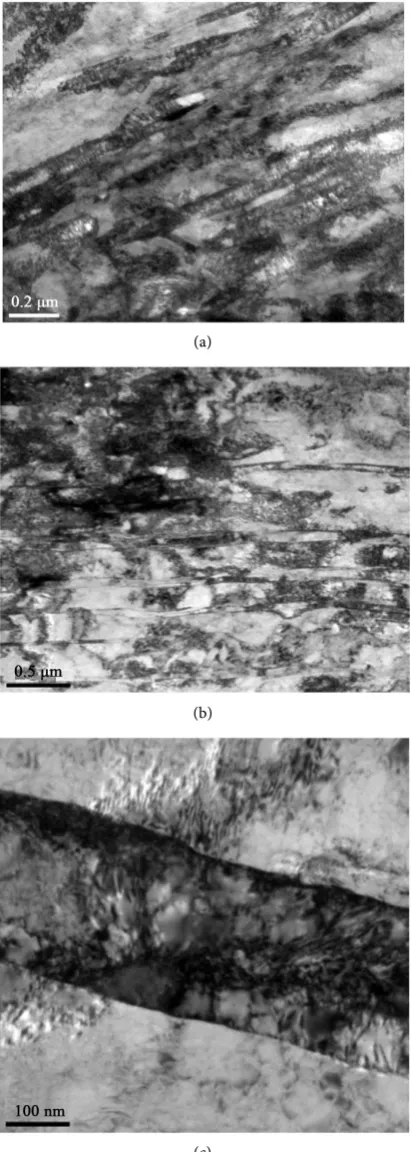
The observations carried out by TEM revealed that after a few ECAP steps, the structure of heat treated nickel alloy 600 (673K during 1800s) shows a mixture of grain subboundary and low and high angle boundary grains. Individual linear crystalline defects (dislocations) were induced already in the early stages of ex-trusion and reordered to form dislocation tangles presented in new grain boun-daries and grain subbounboun-daries during the deformation process (Figure 8).
[image:7.595.210.540.349.509.2](a)
(b)
[image:8.595.271.477.71.648.2](c)
Figure 8. Electron micrographs (TEM) of 600 nickel alloy heat treated at 673K during 1800 s followed by intense deformation–SPD process, route BC, two passes: (a), (b)
rise of the number of passes made in nickel alloy 600 and contributes to a sub-stantial number of activated slipping plans of the same family.
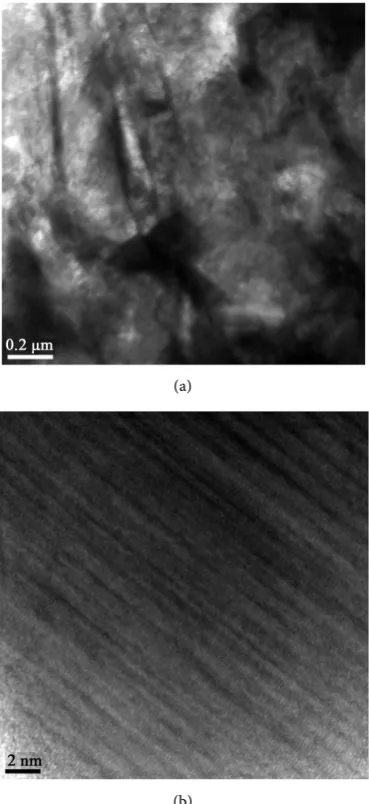
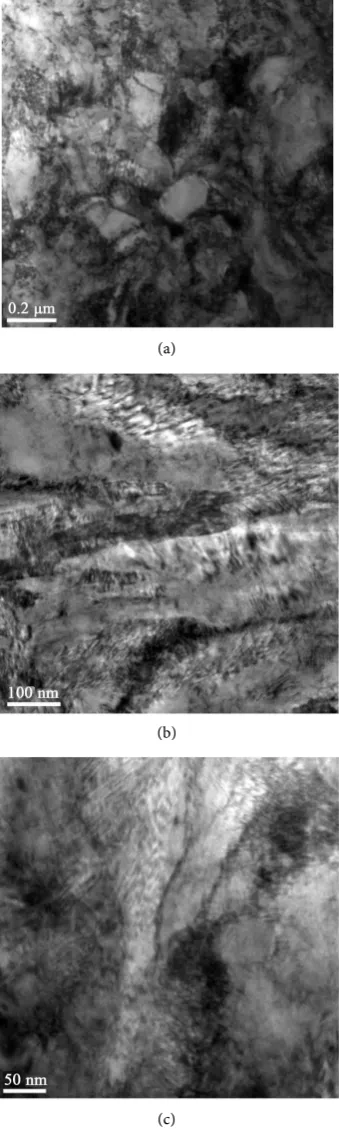
The microstructural characterization by TEM shows a possible explanation that parallel arrangement of microtwins formation inside the grains observed in addition to have in several regions intersections between them. There are also presence of some elongated grain and in some places along the boundaries of elongated grains are also observed embryos of new grains (nanograins of 200 nm). The presence of a large number of dislocations takes some difficult to this measure (Figure 9 and Figure 10). The analyzed diffraction patterns indicate polycrystalline material with random grains orientation. Comparing with others articles of this area [16] [17] it seems that these microtwins can act as new grains
(a)
[image:9.595.281.466.247.650.2](b)
Figure 9. Electron micrograph (TEM) of 600 nickel alloy heat treated in 673K during 1800s followed by the intense deformation processing (SPD). Route BC, four passes. (a)
(a)
(b)
[image:10.595.289.459.74.640.2](c)
Figure 10. Electron micrograph (TEM) of 600 nickel alloy heat treated at 400˚C during 1800 s followed by the intense deformation process (SPD-BC route after 6 passes). (a)
nuclei (supposed nanograins) due to the: (a) generation of a high density of dis-locations within the microtwins; (b) subsequent formation of deformation groups of inside the microtwins. Initially, during the SPD process, dislocations can pile-up near the walls of the microtwins giving possibility to produce new grain nuclei and also some atomic planes during rotation process divided the existing microtwins, producing new nano domains with a possible nanograins formation.
4. Conclusion
Regarding the microstructural observation of nickel alloy 600 subjected the PCE procedure (Bc route) it can be concluded that the intense deformation process produces a microstructural variation with respect to the size of the nanograins obtained after PCE process. The multiple deformations of the microtwins ac-commodating of plastic deformation applied and the presence of second phases cooperates to the nanograins mechanisms creating a large number of disloca-tions and also the interaction dislocadisloca-tions-precipitates.
Acknowledgements
The authors thank the CNEN by granting master’s degree scholarship (S. L. V. Silva); “SENAI School Frederick Jacob” (sample machining); MSc. M. Castagnet; N. A. M. Ferreira (TEM analyses); M. V. S. Martins (RX diffraction analysis); Mechanical Engineering Department-EPUSP (microhardness measurements); Madam Dr. S. M. C. Fernandes (paper review).
References
[1] Valiev, R.Z. and Langdon, T.G. (2006) Principles of Equal-Channel Angular Press-ing as a ProcessPress-ing Tool for Grain Refinement. Progress in Materials Science, 51, 881-981.
[2] Furukawa, M., Horita, Z., Nemoto, M. and Langdon, T.G. (2002) The Use of Severe Plastic Deformation for Micro-Structural Control. Materials Science and Engineer-ing: A, 324, 82-89.
[3] Donachie, M.J. (1984) Superalloys Source Book. American Society for Metals, Geauga County.
[4] Sims, C.T. and Hagel, W.C. (1972) The Superalloys. Willey, New York.
[5] Calvo, W.A.P and Monteiro, W.A. (1996) Evaluation and Characterization of Nick-el EMVAC600 Superalloy after Fusion WNick-elding Processes TIG, Laser and Plasma Arc. Proceedings of 9th Non- Ferrous Metals Seminar, São Paulo, 5-7 November 1996, 135-154. (In Portuguese)
[6] Nakashima, K., Horita, Z., Nemoto, M. and Langdon, T.G. (1998) Influence of Channel Angle on the Development of Ultrafine Grains in Equal-Channel Angular Pressing. Acta Materialia, 46, 1589-1599.
[7] Segal, V.M., Reznikov, V.I., Drobyshevskiy, A.E. and Kopylov, V.I. (1981) Plastic Working of Metals by Simple Shear. Russian Metallurgy, 1, 99-105.
[8] Langdon, T.G., Furukawa, M., Nemoto, M. and Horita, Z. (2000) Using Equal- Channel Angular Pressing for Refining Grain Size. JOM, 52, 30-33.
[9] Bowen, J.R., Gholinia, A., Roberts, S.M. and Prangnell, P.B. (2000) Analysis of the Billet Deformation Behaviour in Equal Channel Angular Extrusion. Materials Science and Engineering: A, 287, 87-99.
[10] Valiev, R.Z., Islamgaliev, R.K. and Alexandrov, I.V. (2000) Bulk Nanostructured Materials from Severe Plastic Deformation. Progress in Materials Science, 45, 103- 189.
[11] Ferrasse, S., Segal, V.M., Hartwig, K.T. and Goforth, R.E. (1997) Microstructure and Properties of Copper and Aluminum Alloy 3003 Heavily Worked by Equal Channel Angular Extrusion. Metallurgical and Materials Transactions A, 28, 1047-1057. https://doi.org/10.1007/s11661-997-0234-z
[12] Iwahashi, Y., Horita, Z., Nemoto, M. and Langdon, T.G. (1998)Influence of Chan-nel Angle on the Development of Ultrafine Grains in Equal-ChanChan-nel Angular Pressing. Acta Materialia, 46, 1589-1599.
[13] Iwahashi, Y., Furukawa, M., Horita, Z., Nemoto, M. and Langdon, T.G. (1998) De-fect Formation in β-Al2TiO5 and Its Influence on Structure Stability. Metallur- gic-al and Materigic-als Transactions A, 29, 2245-2249.
[14] Iwahashi, Y., Horita, Z., Nemoto, M. and Langdon, T.G. (1997)An Investigation of Micro-Structural Evolution during Equal-Channel Angular Pressing. Acta Materia-lia, 45, 4733-4741.
[15] Davenport, S.B., Higginson, R.L. and Sellars, C.M. (1999) The Effect of Strain Path on Material Behaviour during Hot Rolling of FCC Metals. Philosophical Transa -ctions of the Royal Society A, 357, 1645. https://doi.org/10.1098/rsta.1999.0394 [16] Shankar, M.R., Rao, B.C., Chandrasekhar, S., Compton, W.D. and King, A.H.
(2008) Thermally Stable Nanostructured Materials from Severe Plastic Deformation of Precipitation-Treatable Ni-Based Alloys. Scripta Materialia, 58, 675-678. [17] Villegas, J.C., Dai, K., Shawa, L.L. and Liaw, P.K. (2005) Nanocrystallization of a
Nickel Alloy Subjected to Surface Severe Plastic Deformation. Materials Science and Engineering A, 410-411, 257-260.
Submit or recommend next manuscript to SCIRP and we will provide best service for you:
Accepting pre-submission inquiries through Email, Facebook, LinkedIn, Twitter, etc. A wide selection of journals (inclusive of 9 subjects, more than 200 journals)
Providing 24-hour high-quality service User-friendly online submission system Fair and swift peer-review system
Efficient typesetting and proofreading procedure
Display of the result of downloads and visits, as well as the number of cited articles Maximum dissemination of your research work
Submit your manuscript at: http://papersubmission.scirp.org/