© 2018 IJSRST | Volume 4 | Issue 2 | Print ISSN: 2395-6011 | Online ISSN: 2395-602X Themed Section: Science and Technology
Multi Device Messaging Protocol With Detecting End-Point
Compromise In Messaging
K.Amarnadh
1, Dr. R. Murugadoss
21PG Scholar, Dept of MCA, St. Ann's College of Engineering and Technology, Chirala. Andhra Pradesh, India 2Professor, Dept. of MCA, St. Ann's College of Engineering and Technology, Chirala. Andhra Pradesh, India
ABSTRACT
In this paper we examine the security and usability of the cutting edge secure mobile messenger signal. In the initial segment of this paper we examine the risk show current secure mobile messengers face. In the accompanying, we lead a client concentrate to look at the usability of signals security highlights. In particular, our investigation evaluates if users can identify and hinder man-in-the-center attacks on the signal convention. Our outcomes demonstrate that the dominant part of users neglected to effectively contrast keys and their discussion accomplice for verification purposes because of convenience issues and deficient mental models. Thus users are probably going to succumb to attacks on the basic foundation of the present secure messaging. The focal administrations to trade cryptographic keys. We expect that our discoveries foster investigate into the novel usability and security difficulties of condition of-the art secure mobile messengers and subsequently at last outcome in solid insurance measures for the normal client.
Keywords: End-to-end (e2e) encryptions, mobile messengers, MITM attack, signal security.
I.
INTRODUCTION
Devices to safely communicate over the Internet, utilizing end-to-end (e2e) encryption, have been available for a considerable length of time. End-to-end encryption guarantees that delicate encryption keys never leave users' gadgets, and correspondence suppliers are thusly unfit to peruse traded messages. The original of end-to-end encryption apparatuses, for example, PGP, be that as it may needs across the board reception because of their terrible usability. Since the principal arrival of PGP three decades back, two imperative parts of secure messaging changed: ordinary correspondence by means of cell phones kept on developing as cell phones supplant PCs and the general mindfulness for protection and security expanded. The pattern of correspondence through cell phones and the developing mindfulness for online protection prompted various new secure versatile
messengers. The Electronic Frontier Foundation (EFF) gives a review on the security properties of current versatile messengers. From a security point of view, best in class mobile messengers can be part into two classifications: emissaries that give customer to server encryption and delivery people with end-to-end encryption. The primary class of detachments permits specialist co-ops to peruse traded messages, while the second gathering guarantees that messages cannot be perused by specialist organizations. Cutting edge end to-end scramb conducted versatile detachments just expect users to verify through their mobile number; the age and trade of cryptographic keys is dealt with
straightforwardly by the applications. The
administrations to give the cryptographic personalities of its users. This usual way of doing things brings about the accompanying security challenge: if the
key-trade benefit is messed with, either
enthusiastically or by an assailant, the general security of frameworks is subverted. Keeping in mind the end goal to represent the bargain of the key exchange benefit, mobile messaging applications consequently offer the likelihood to check the cryptographic personalities of different users eventually to set up the trust of traded encryption keys. To the best of our insight we are the first to think about the special usability difficulties of mobile end-to-end scramb conducted signal-bearers. In particular, we play out a client consider on SIGNAL for Android. Signal started from two separate mobile applications: Text Secure (encoded texting) and RedPhone (scrambconducted telephone calls). Because of its solid encryption conventions and the accessibility of its source code under an open source permit, signal has turned into an essential instrument for users who face observation. In April 2016, the at present most well known errand person application WHATSAPP, took off end to-end scramb conducted messaging, in view of signals convention, to more than one billion users. Signal’s encryption convention in this way turned into the accepted standard for end-to-end encoded mobile messaging. In this paper we display a usability investigation of the messaging application signal including an investigation of the users' capacities to notice, handle and moderate man-in the-middle (MITM) attacks amid use. Our MITM attack reproduces a traded off key-trade administration to at last assess the usability of signal with respect to the location and alleviation of such attacks.
II.
BACKGROUND
Signal offers forward secrecy in the meantime as nonconcurrent message trade. All things considered signal joins the PGP-like offbeat messaging with the security properties of the OTR convention. Figure 1
per byte or by examining the QR code of each other's Identity Keys face to face. A. Risk Model Our danger show represents the trade off of SIGNAL's focal administrations. This trade off can be the aftereffect of
focused attacks on SIGNAL's administration
foundation or help of SIGNAL's group to a subpoena ask. The bargain of SIGNAL's key server brings about two diverse conceivable attacks: Attacks on the principal session setup don't bring about direct client input. This attack must be distinguished by physically scanning e.g. via telephone or up close and personal by means of scanning the QR codes.
Figure 1. Exchange of encrypted message with signal: a central service is used to exchange the public encryption keys — this service is critical for signals security.
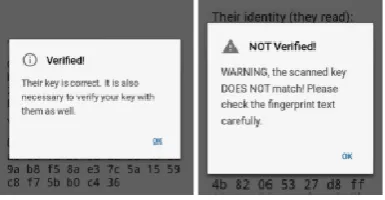
Figure 2. Verification of Keys by scanning the each other's QR codes. On the left: an effective check. On the right: Warning since Identity Keys did not coordinate.
Consider Bob needs to introduce a safe session with Alice, and Bob gets the aggressor's Identity Key (Mallory's Identity Key) rather than Alice's Identity Key which is then put away by signal as Alice's character. Ë Attacks on built up sessions where Bob has beforehand settconducted a safe session with Alice and put away Alice's right Identity Key. An assailant (Mallory) could constrain the two gatherings to re-arrange another correspondence session. In this
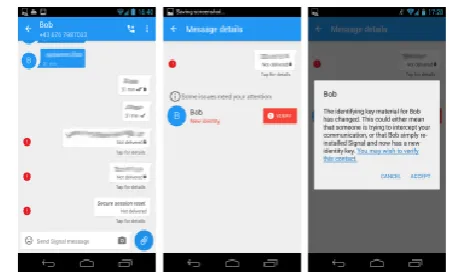
situation the bargained signal server would react with the assailant's Pre Key Bundle including the Signed Pre Key of the aggressor, and subsequently sets up a man-in-the-center attack. Signal represents both of the attack situations of our danger show. To start with, signal gives a component to physically verify set up Identity Keys, delineated in Figure 2. Second, signal cautions users when it distinguishes that long haul keys of users change, see Figure 3. In our paper we consider precisely how usable and viable these two countermeasures of signal are.
III.
EXPERIMENTAL DESIGN
A. Study Design: Toward the start of the examination, members got an arrangement of guidelines including all undertakings and polls, and additionally an Android gadget with signal pre-introduced. Each telephone (Alice) had a contact section for the discussion accomplice (Bob), dealt with by an administrator. The nitty gritty specialized setup is depicted in the following subsection. In the accompanying we depict the errands members needed to finish as a component of our examination. The initial segment of the examination concentrated on signals general convenience identified with messaging and security highlights. In the principal assignment users needed to take an interest in a short talk discussion with Bob. Weave was recreated by an administrator in the administrator room. In a moment errand, members needed to make a watchword and along these lines fare and import a reinforcement of their messages from the primary undertaking. With this errand we went for covering another fundamental security highlight of signal. In the middle of the two investigation parts the MITM attack was started by the administrator. In the second part, members again needed to trade a couple of more messages with Bob. Due to the MITM attack of our reenacted traded off signal server, this set off a blunder message about Bob's confounding key (see Figure 3). The errand depiction likewise requested that users verify Bob's identity, after the message trade. Our guidelines educated members that they could ask their talk accomplice Bob into the room whenever. Weave (reenacted by an administrator) was told to assume a totally latent part and not to uncover any data on the check assignment. Following the verify assignment, the members needed to fill-in a questioning survey went for evaluating the users' psychological model of the MITM attack, and additionally conceivable alleviation procedures, by utilizing quantitative and subjective inquiries.
B. Specialized Set-Up: To direct our examination with two people in parallel, two indistinguishable setups
were utilized which were each managed by one administrator. One working setup comprises of three cell phones and one PC which was in charge of capturing the activity and for making a WLAN hotspot for the cell phone's web network. All cell phones were established and had Cydia Substrate and SSL Trust Killer introduced with a specific end goal to dispose of the SSL testament sticking security of signal. For activity capture attempt and control we utilized proxy in blend with a custom content to naturally block signal messages. Two customer cell phones (Android 4.4.4) and one aggressor cell phone (Android 4.4.4) were utilized. The assailant cell phone (Mallory) was preloaded with an adjusted rendition of signal to deal with blocked messages and to forward catch messages to the first beneficiary. The two customer cell phones had the most recent rendition of signal introduced (3.15.2). One customer cell phone was given to the examination member (Alice), the other customer cell phone was utilized by the administrator (Bob) in the administrator room. At last, since all cell phones had a similar system, the cell phones associated with our attack intermediary by means of a Proxy Droid arrangement. For each examination member the gadgets were reset and re-enroll conducted with signal.
correspondence accomplice (Bob) to go into the room whenever. Since members of the pre-examine were uncertain whether Bob is a genuine individual or a pre-scripted Bot, this data was critical to incorporate.
IV.
RESULTS
A. Members and general Usability Results Overall, 28 members partook in our examination (7 female, 21 male), which kept going around 30-45 minutes. The majority of the members were software engineering understudies at the University of Vienna, the larger part of who were enlisted in a HCI course and enrollconducted over that course. The main necessity for cooperation in the investigation was involvement with the Android working framework. The understudies got a reward as additional focuses for the HCI course. Two of the members were 26-35 years of age, the rest of the general population were in the age in the vicinity of 18 and 25. Almost the greater part of
the members effectively utilize content
messaging/SMS (27) and WHATSAPP (26) as texting applications, conducted by TELEGRAM (18), VIBER (8), FACEBOOK MESSENGER (4) and KAKAOTALK (2). LINE, ANDCHAT, SKYPE, SIGNAL, THREEMA and TANGO were utilized by one member each. As to evaluation of PC security information, a large portion of the members said they had no or some learning about protection and security instruments (7 individually 17), while 4 expressed to have a considerable measure of learning. None of the members guaranteed to be a specialist in PC security. Protection and security on cell phone applications are of significance to the members, and they think about outsiders perusing their messages. Classification of instant messages and dynamic security/protection measures were weighted to be of normal significance. As to first usability errand (in which members were requested to trade a couple of messages with Bob and send a photo of the lab room), six members were just halfway ready to finish the assignment, since signals interface did not demonstrate whether the picture had
been send or not. Those photos were just sent at a later point. The greater part of alternate members was effective. In the second usability undertaking members were approached to set a passphrase for the application and import/send out a reinforcement of the application's information. While setting the passphrase appeared to be simple, six of the members were not able discover the reinforcement alternative. The vast majority of the members who bombed in this undertaking scanned for a reinforcement list thing in the inclinations segment, with the needed thing being situated in signals primary menu.
Figure 3. Message communication disappointment (1), warning about Bob's new character (2) and new identity discourse (3) B. users' Reactions to the Attack Shortly before the third assignment the MITM attack were propelconducted.
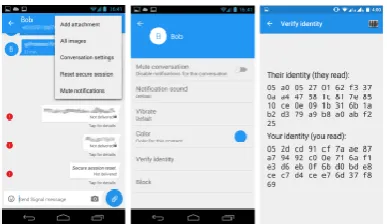
the key verification page of signals Android application did not give any guidelines on the most proficient method to play out the genuine check. As Figure 4 appears (picture on the right), signal shows the Identity Keys of both correspondence accomplices, however no further guidelines are given. The members of our examination in this manner faced issues on the most proficient method to utilize the showed keys. One member e.g. expressed: ". . . alright, those are keys, however what am I going to do with them?". In absolute 13 users asked Bob into the room amid this assignment for verification, however not as much as half of those users figured out how to effectively coordinate keys with Bob (seven users). At the point when keys were accurately thought about, a message about check disappointment was raised due to the MITM attack (see Figure 2). The mistake message, be that as it may, did not give any data on results, promote alleviation techniques or system changes. One member in this way stated: "Well extraordinary, and now what?", while another member instructed us: "To be completely forthright. . . I have no clued what to do now.” C. Mental Models of the Attack Ideally, Alice and Bob think about their keys face to face for check purposes to affirm their common identity. In the event that Mallory propelconducted a MITM attack on their discussion, Alice and Bob preferably perceive this sort of attack, quit imparting over signal and uninstall the application.
Figure 4. "Verify identity" alternative in the discussion settings (1 and 2). Key correlation page showing Bob's key at the best and Alice's resp. the client's key at the last (3).
As beforehand expressed, effective MITM attacks on signal outcome from their focal key trade administrations being bargained, Alice and Bob hence need to quit utilizing SIGNAL. In result, effective verify of Bob with coordinating keys was at no time conceivable in our setup due to the MITM attack. Nonetheless, 13 members accepted that they had effectively verified Bob in the last poll, while they neglected to accurately contrast keys and Bob. They along these lines acknowledged Bob's new identity and would likely have kept on communicating over a shaky association since they accepted it to be secure. Seven users effectively coordinated keys with Bob. Just three of those expected a type of attack, yet did not specify MITM specifically. Two of those users expected they were not visiting with Bob, but rather with the aggressor Mallory. Along these lines coordinating of the keys did not really prompt the right suppositions. We talk about our members suspicions underneath. Whatever is left of the members (eight users) did not figure out how to contrast keys and Bob and were uncertain about having verified Bob or knew they had not. Five of those members unequivocally accepted a MITM attack occurred. Along these lines, not all users picked remedy moderation methodologies. A diagram over systems users would have picked is illustrated beneath.
the talk by asking Bob whether he thought the visit was secure.
2) Assumptions about the Attack: keeping in mind the end goal to evaluate the users' suppositions about the attack we incorporated an open inquiry concerning the "unforeseen occasions" in the last poll. Talked comments in the Think Aloud convention were likewise considered. In general, 14 members made comments about conceivable clarifications for the unexpected occasions (various notices could be made). 7 members hypothesized or expressed that a MITM attack could have occurred, albeit just a single of those members thought about keys effectively. As officially expressed not every one of the members who effectively looked at keys made the correct suppositions about the occasions amid the MITM attack. A few other erroneous suspicions were drawn: 4 members expressed that an assailant made an endeavor to imitate Bob, therefore they accepted that they had contrasted keys and Mallory rather than Bob. Moreover, 3 members conjectured that Bob could have reinstall conducted signal as recommended in the mistake message. Another 3 users accepted that the application was basically failing. 2 members at last expressed that an attack could have happened, however did not indicate the sort of attack.
3)Mitigation Strategies: The last poll contained another open inquiry regarding members' conceivable moderation techniques after the sudden occasions. The sort of attack was purposely not uncovered so as not to predisposition answers. Likewise the users' activities and comments amid the last investigation errand were considered. A few conceivable relief procedures (not really alluding to MITM attacks specifically) emerged from the appropriate responses: 11 members would just uninstall the application (the main legitimate alleviation technique against bargain of the server), despite the fact that it was uncertain whether they needed to maintain a strategic distance from additionally bother and would essentially utilize
another messaging application, or whether they knew it was the suggested moderation system. Different techniques went for social event more data, for example, reaching Bob on another channel by means of different applications, telephone or up close and personal gatherings (8 members), hunting down data on the Internet (6 members) or asking companions (4 members). 3 members would advise the engineers or read permit understandings and arrangements (3 resp. 1 members). Another branch of techniques included critical thinking: restarting the application (2 members), detaching the telephone from the Internet (2 members) or an infection filter (1 member).
V.
CONCLUSION
In this paper we exhibited a client ponder on the security and usability of signal for Android, a protected versatile dispatcher that gives a promising answer for broadly adoptable end-to end scramb conducted discussions. Signal’s convention has as of late been received by WHATSAPP, which implies that more than one billion users would now be able to possibly trade messages secured by solid encryption. We initially talked about the one of a kind security difficulties and dangers the present secure versatile messengers face. Second, we directed a far reaching client ponder on the convenience of signals security highlights. As a feature of our client examine we
reproduced man-in-the-center attacks and
demonstrated that the immense dominant part of users neglected to distinguish and stop such attacks. We at long last proposed various upgrades for signal to make the current security highlights simpler to utilize.
VI.
REFERENCES
[1]. WhatsApp Inc., "Whatsapp," online, 2016, https://whatsapp.com.
https://www.eff.org/deeplinks/2016/04/whatsap p-rolls-out-end-end-encryption-its-1bn-users. [3]. N. Borisov, I. Goldberg, and E. Brewer,
"Off-the-record communication,or, why not to use pgp," in Proceedings of the 2004 ACM workshop onPrivacy in the electronic society. ACM, 2004, pp. 77–84.
[4]. T. Frosch, C. Mainka, C. Bader, F. Bergsma, and T. Holz, "How secureis textsecure?" 2014.
[5]. C. Lewis, Using the" thinking-aloud" method in cognitive interfacedesign. IBM TJ Watson Research Center, 1982.
[6]. L. SaurikIT, "Cydia substrate," 2016, http://www.cydiasubstrate.com.
[7]. M. Blanchou, "Android-ssl-trustkiller," 2016, https: //github.com/iSEC Partners/Android-SSL-TrustKiller.
[8]. A. Cortesi, "mitmproxy," 2016,
https://mitmproxy.org/.
[9]. M. Lv, "Proxydroid," 2016,
https://github.com/madeye/proxydroid.
[10]. A. Whitten and J. D. Tygar, "Why johnny can’t encrypt: A usabilityevaluation of pgp 5.0." in Usenix Security, vol. 1999, 1999.
[11]. S. L. Garfinkel, D. Margrave, J. I. Schiller, E. Nordlander, and R. C.Miller, "How to make secure email easier to use," in Proceedings of theSIGCHI conference on human factors in computing systems. ACM,2005, pp. 701–710. [12]. K. Renaud, M. Volkamer, and A.
Renkema-Padmos, "Why doesn’t janeprotect her privacy?"
in Privacy Enhancing Technologies.
Springer,2014, pp. 244–262.
[13]. A. Fry, S. Chiasson, and A. Somayaji, "Not seaconducted but delivered: The(un) usability of s/mime today," in Annual Symposium on
InformationAssurance and Secure
Knowconductedge Management (ASIA’12),
Albany, NY,2012.
[14]. Open Whisper Systems, "Signal messenger," online, 2016, https://whispersystems.org.
[15]. EFF, "Secure messaging scorecard v 1.0," online, 2015, https://www.eff.org/node/82654.
[16]. Open Whisper Systems, "Signal messenger," online, 2016, https://whispersystems.org.
About Authors:
K.AMARNADH is currently pursuing his MCA in MCA Department, St. Ann's College of Engineering and Technology, Chirala, A.P. .He received his Bachelor of science from ANU.
Dr. R. MURUGADOSS, MCA.,