© 2016 IJSRST | Volume 2 | Issue 6 | Print ISSN: 2395-6011 | Online ISSN: 2395-602X Themed Section: Engineering and Technology
Survey on Wireless Sensor Network with their remaining
Challenges
Pavankumar Naik
1, Nagaraj Telkar
2, Kiran Kotin
31,2
Department of Computer Science & Engineering, SKSVMACET, Laxmeshwar, Karnataka, India 3Department of Electronic Communication & Engineering, SKSVMACET, Laxmeshwar, Karnataka, India
ABSTRACT
The wireless sensor network (WSN) is a combination of sensing, computation, and communication into a single tiny device. A sensor network consists of an array of numerous sensor networks of diverse types interconnected by a wireless communication network Sensor data is shared between these sensor nodes and used as input to a distributed estimation system. The system extracts relevant information from the available data. Fundamental design objectives of sensor networks include reliability, accuracy, flexibility, cost effectiveness, and ease of deployment. Each node has at least a sensor with an embedded processor, and low power radius. It acts as information source, sensing and collecting data samples from the environment. Node can also act as information sink, receiving dynamic configuration information from other nodes or external entities. The end portion of a node can be an antenna. A chosen configuration is the microstrip structure which allows for planar circuitry to be integrated with the WSN node. WSNs use small, low-cost embedded devices for a wide range of applications. They do not rely on any pre-existing infrastructure. The WSNs need not communicate directly with the nearest high-power control tower or base station, but only with their local peers. In this paper we have discussed related to WSN,sensors, criteria to choose a sensor, classification of sensors, sensor utilization and also we have discussed about some real WSN applications with their remaining challenges.
Keywords: Wireless sensor network, Sensors, Classification of Sensors, Real sensor applications and challenges.
I.
INTRODUCTION
Wireless Sensor Networks A Wireless Sensor Network (WSN) is by hundreds of small, low-cost nodes that are fitted with limitations in memory, energy, and processing capacity. In this particular form of networks, several problems is to learn each node. Recent advances in wireless communications and electronics have enabled the roll-out of low-cost, low-power and multi-functional sensors that are small in dimensions and communicate in a nutshell distances. Cheap, smart sensors, networked through wireless links and deployed in vast quantities, provide unprecedented opportunities for monitoring and controlling homes, cities, along with the environment. Furthermore, networked sensors use a broad spectrum of applications within the defense area, generating new capabilities for reconnaissance and surveillance and various Tactical applications. Self-localization capability can be a highly desirable sign of wireless sensor networks. In environmental monitoring
applications for example bush fire surveillance, water quality monitoring and precision agriculture, the measurement data are meaningless lacking the knowledge of the placement from the location where the data are obtained. Moreover, location estimation may enable many applications for example inventory management, transport, intrusion detection, road traffic monitoring, health monitoring, reconnaissance and surveillance.
Why we Use Sensors
Sensors are sophisticated devices that are frequently used to detect and respond to electrical or optical signals. A Sensor converts the physical parameter (for example: temperature, blood pressure, humidity, speed, etc.) into a signal which can be measured electrically. Let’s explain the example of temperature. The mercury in the glass thermometer expands and contracts the liquid to convert the measured temperature which can be read by a viewer on the calibrated glass tube.
Criteria to choose a Sensor
There are certain features which have to be considered when we choose a sensor. They are as given below:
1. Accuracy
2. Environmental condition - usually has limits for temperature/ humidity
3. Range - Measurement limit of sensor
4. Calibration - Essential for most of the measuring devices as the readings changes with time
5. Resolution - Smallest increment detected by the sensor
6. Cost
7. Repeatability - The reading that varies is repeatedly measured under the same environment
Classification of Sensors
Generally Sensor are Classification as
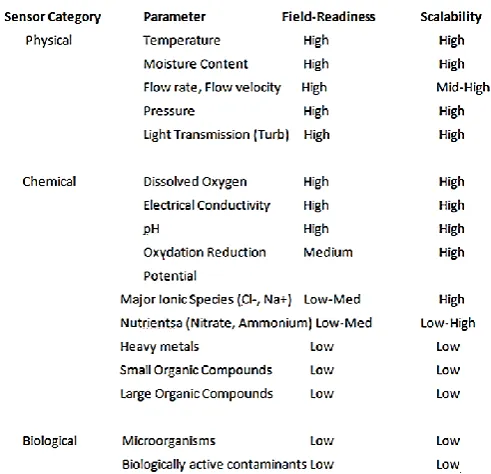
i) Readiness for field deployment : Measures maturity for field deployment in terms of economic and engineering efficiency.
ii) Scalability : a sensor’s scalability to distributed environmental monitoring tasks require that the sensors be small and inexpensive enough to scale up to many distributed systems.
iii) Cost : Sensors are deployed in thousands. It is expected that cost will drop but current generation sensors are still expensive to allow wide deployment.
Figure 1: Gives classification of sensors with respect to physical, chemical and biological
Sensors utilization
Libelium study involving a total of 283 interested users in terms of sensors preferences. The users include researchers and practioners (developers). The results are classified in the next 5 main fields: Environmental, gas, physical, optical and biometric.
Use of Environmental Sensors
Sensors: Temperature, Humidity (soil,leaf,ambient), Soil moisture, Wind (speed and direction), Pressure, Leaf, Ph, Redox.
Application
• Precision agricultural applications are one of the most required in the terms of temperature, humidity (soil, leaf, ambient) and wind (speed and direction). • Ph and Redox sensors being demanded for water
quality
Use of physical sensors
Sensors: accelerometer, presence, vibration, power, hall, ultrasound, water, sound, bend, flex, strain, stress.
Application:
• Motion of any kind using accelerometers, vibration, and presence sensors .
• security applications are waiting to be deployed. • world of objects: bend, flex, strain and stress sensors
let know how each object is interacting with the world and monitorize its state.
Figure 3: Shows the survey of physical sensor used for different application
Use of gas sensors
Sensors: Co2, Co, CH4, O2, NH3, SH2, NO2, Pollution.
Application
• Organic gases (carbone) derived from the "live
systems" such as respiration in humans (CO2), animals (CH4) and combustion (CO) of vegetable elements (fire forest) are the most required sensors.
• Other toxic gases which can be found in animal
farms (NH3, SH2) and the fabric and cars pollution gases (NO2) complete the list.
Figure 4: Shows the survey of gas sensor used for different application
Use of optical sensors
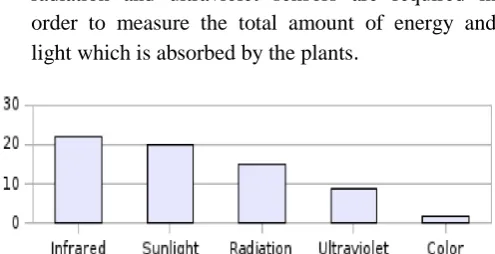
Sensors: Infrared, Sunlight, Radiation, Ultraviolet, color.
Application
• Optical sensors to detect human presence through the IR spectrum are the most voted sensors in this area.
• Agriculture applications where the sun light, radiation and ultraviolet sensors are required in order to measure the total amount of energy and light which is absorbed by the plants.
Figure 5: Shows the survey of optical sensor used for different application
Use of Biometric Sensors
Sensor types: Electrocardiogram ECG, Oximetry, Pulse, Fall, Sweat.
Application
• Prevent a possible attack or the fall of a elderly person (using an accelerometer) by monitoring his heart pulse, rate and other heart activities. Used in combination of SMS alarms using the GSM/GPRS module
• Requirements: a real time and redundant alarm system so that communication can always be established.
The sensors are specifically classified into the following criteria:
1. Primary Input quantity (Measurand)
2. Transduction principles (Using physical and chemical effects)
3. Material and Technology 4. Property
5. Application
Transduction principle is the fundamental criteria which are followed for an efficient approach. Usually, material and technology criteria are chosen by the development engineering group.
II.
METHODS AND MATERIAL
1. Classification based on property is as given below:
a) Temperature - Thermistors, thermocouples, RTD’s, IC and many more.
b) Pressure - Fibre optic, vacuum, elastic liquid based manometers, LVDT, electronic.
c) Flow - Electromagnetic, differential pressure, positional displacement, thermal mass, etc. d) Level Sensors - Differential pressure, ultrasonic
radio frequency, radar, thermal displacement, etc.
e) Proximity and displacement - LVDT,
photoelectric, capacitive, magnetic, ultrasonic. f) Biosensors - Resonant mirror, electrochemical,
surface Plasmon resonance, Light addressable potentio-metric.
g) Image - Charge coupled devices, CMOS.
h) Gas and chemical - Semiconductor, Infrared, Conductance, Electrochemical.
i) Acceleration - Gyroscopes, Accelerometers. j) Others - Moisture, humidity sensor, Speed
sensor, mass, Tilt sensor, force, viscosity.
Surface Plasmon resonance and Light addressable potentio-metric from the Bio-sensors group are the new optical technology based sensors. CMOS Image sensors have low resolution as compared to charge coupled devices. CMOS has the advantages of small size, cheap, less power consumption and hence are better substitutes for Charge coupled devices. Accelerometers
are independently grouped because of their vital role in future applications like aircraft, automobiles, etc and in fields of videogames, toys, etc. Magnetometers are those sensors which measure magnetic flux intensity B (in units of Tesla or As/m2).
Classification based on Application is as given below: a) Industrial process control, measurement and
automation.
b) Non-industrial use – Aircraft, Medical products, Automobiles, Consumer electronics, other type of sensors.
Sensors can be classified based on power or energy supply requirement of the sensors:
a) Active Sensor - Sensors that require power supply are called as Active Sensors. Example: LiDAR (Light detection and ranging), photoconductive cell.
b) Passive Sensor - Sensors that do not require power supply are called as Passive Sensors. Example: Radiometers, film photography.
In the current and future applications, sensors can be classified into groups as follows:
a) Accelerometers - These are based on the Micro Electro Mechanical sensor technology. They are used for patient monitoring which includes pace makers and vehicle dynamic systems.
b) Biosensors - These are based on the electrochemical technology. They are used for food testing, medical care device, water testing, and biological warfare agent detection.
c) Image Sensors - These are based on
the CMOS technology. They are used in consumer electronics, biometrics, traffic and security surveillance and PC imaging.
d) Motion Detectors - These are based on the Infra Red, Ultrasonic, and Microwave / radar technology. They are used in videogames and simulations, light activation and security detection.
What can Sensors do?
where it can be retrieved later for processing, analysis and presentation. Alternatively, sensor technology can display graphs of data in "real time", the graph is constructed as the data is being collected, and the graph is then modified on the screen as the data is processed.
2. Sensor Technology
Sensor technology may be used to gather, process and present scientific data. Sensor technology is a valuable resource for scientists. It integrates easily with conventional equipment to add a new dimension to experimentation. Sensor technology facilitates an investigative approach to science. Greater speed, accuracy, range of measurement and the capacity to store and retrieve results are good reasons to use sensors. In addition, the fact that the results are in digital form enable the scientist to present and communicate findings in the most modern and efficient manner.
Elements of a Sensor Technology
System Sensor technology systems vary, but generally speaking a sensor is connected to an interface called a data logger which can store and display results or transfer them to a computer. Alternatively, the sensor may be connected to a "hand-held" device like a "graphic calculator", where results are processed and displayed.
Sensors include limit switches, photoelectric, inductive, capacitive, and ultrasonic sensors.These products are packaged in various configurations to meet virtually any requirement found in commercial and industrial applications.
In addition to the advantages and disadvantages of each of these sensor types, different sensor technologies are better suited for certain applications. The following table lists the sensor technologies with its advantages, disadvantage and the applications.
Table 1 : lists the sensor technologies with its advantages, disadvantage and the applications
WSN Application Examples
a) Disaster relief operations
Drop sensor nodes from an aircraft over a wildfire each node measures temperature derive a “temperature map”
b) Biodiversity mapping
Use sensor nodes are placed to observe wildlife
c) Intelligent buildings (or bridges)
Reduce energy wastage by proper humidity, ventilation, air conditioning (HVAC) control needs measurements about room occupancy, temperature, air flow etc.
Monitor mechanical stress after earthquakes Bridge Monitoring
Figure 7 : shows the sensors are placed to check the stress and load and even to intimate if any damages arises from natural hazards
d) Machine surveillance and preventive maintenance
Embed sensing control functions into places no cable has gone before E.g., tire pressure monitoring
e) Precision agriculture
Bring out fertilizer, pesticides, irrigation only when and where needed
f) Medicine and health care Post-operative or intensive care
Long-term surveillance of chronically ill patients or the elderly.
g) Impacts of human presence on plants and animals
Minimal disturbance is crucial while monitoring especially seabird colonies 20% mortality of eggs due to a 15-min visit repeated disturbance birds may abandon Eg: ZebraNet: an application to track zebras on the field
The objective of the application is to gather dynamic data about zebra positions in order to understand their mobility patterns. What are the motivations for the zebras to move? water? food? weather? How do they interact?, to observe that the sensors are deployed in collars that are carried by the animals. The users are the biologists.
Challenges Encountered
Event detection: when to start collecting data?
High data rate sampling
Spatial separation between nodes
Data transfer performance: reliable transfer
Required Time synchronization: data has to be time-aligned for analysis by seismologists
3. Literature Survey
In [12], Security in Wireless Sensor Network is vital to the acceptance and use of sensor networks. Wireless Sensor Network product in industry will not get acceptance unless there is a full proof security to the network. In this paper discussed the attacks and their classifications in wireless sensor networks and also an attempt has been made to explore the security mechanism widely used to handle those attacks and also discussed about various security concern in WSN (confidentiality, integrity, authenticity, availability etc.) Then I discussed about the security in sensor networks, security issues and various DoS attacks on different layers.
Today, wireless sensor networks has become a key technology for different types of “smart environments”, and an intense research effort is currently ongoing to enable the application of wireless sensor networks for a wide range of industrial problems. Localization is important when there is an uncertainty of the exact location of some fixed or mobile devices. This paper provides different techniques used for localization of mobile node in wireless sensor network. This study can help to learn about efficient methods for localization in wireless sensor network [13].
passing across; 2) Let all of the waiting vehicles pass if possible, which reduces the waiting time.
A brief history on the research in Sensor network, but more interesting may be the overview within the technical challenges and issues is presented, from where we could cite several relevant items: WSN working in a harsh environment; the ability with the network (leastways the neighbors); the network control and routing; querying and tasking (should be as simple and intuitive as it can be); plus security issues (low latency, survivable, low probability of detecting communications, high reliability) [10].
The increasing complexity of Wireless Sensor Networks (WSNs) is leading towards the deployment of complex networked systems and the optimal design of WSNs can be a very difficult task because several constraints and requirements must be considered, among all the power consumption. This paper proposes a novel fuzzy logic based mechanism that according to the battery level and to the ratio of Throughput to Workload determines the sleeping time of sensor devices in a Wireless Sensor Network for environmental monitoring based on the IEEE 802.15.4 protocol. In [15], they tried to find an effective solution that achieves the target while avoiding complex and computationally expensive solutions, which would not be appropriate for the problem at hand and would impair the practical applicability of the approach in real scenarios. The results of several real test-bed scenarios show that the proposed system outperforms other solutions, significantly reducing the whole power consumption while maintaining good performance in terms of the ratio of throughput to workload. An implementation on off-the-shelf devices proves that the proposed controller does not require powerful hardware and can be easily implemented on a low-cost device, thus paving the way for extensive usage in practice.
In [16], the survey of various researches done in the field of wireless sensor networks to solve either black hole attack, or to reduce the power consumption by avoiding attacks caused due to the anti-node. The survey of existing system reveals that, it tries to increase the energy efficiency, and also increases the lifetime of WSN’s. Measures have to be taken in resolving the
drawbacks, and increasing the network efficiency by securing the network.
III.
RESULTS AND DISCUSSION
Challenges in Wireless Sensor Networks
1) Many Wireless sensor networks can produce vast amounts of raw data. It is necessary to develop techniques that convert this raw data into usable knowledge in an energy efficient manner. For example, in the medical area, raw streams of sensor values must be converted into semantically meaningful activities performed by or about a person such as eating, poor respiration, or exhibiting signs of depression. Main challenges for data interpretation and the formation of knowledge include addressing noisy, physical world data and developing new inference techniques. In addition, the overall system solution must deal with the fact that no inference method is 100% correct. Consequently, uncertainty in interpreted data can easily cause users not to trust the system. For example, in making decisions it is necessary to minimize the number of false negatives and false positives and guarantee safety; otherwise the system will be dismissed as unreliable. Location (the sensor node or base station) of the data processing is another critical issue: processing at the sensor node consumes energy and is limited by the device capacity, but it saves transmission energy and network contention. The correct tradeoffs on processing location seem system dependent.
must re-occur, this principle is much more general. For example, even in static WSN some nodes may be physically moved unexpectedly. More and more nodes may become out of place over time. To make system-wide node locations coherent again, node re-localization needs to occur (albeit at a much slower rate than for clock sync). These types of required coherence services must combine with many other approaches to produce robust system operation. This includes formal methods to develop reliable code, in-situ debugging techniques [3], on-line fault tolerance [4], in-field-maintenance [5], and general health monitoring services [6]. These problems are exacerbated due to the unattended operation of the system, the need for a long lifetime, the openness of the systems, and the realities of the physical world. The goal is for this collection of solutions to create a robust system [7] in spite of noisy, faulty and non-deterministic underlying physical world realities. 3) Traditionally, the majority of sensor based systems
have been closed systems. For example, cars, airplanes, and ships have had networked sensor systems that operate largely within that vehicle. However, these systems and other WSN systems are expanding rapidly. Cars are automatically transmitting maintenance information and airplanes are sending real-time jet engine information to manufacturers. WSN will enable an even greater cooperation and 2-way control on a wide scale: cars (and aircraft) talking to each other and controlling each other to avoid collisions, humans exchanging data automatically when they meet and this possibly affecting their next actions, and physiological data uploaded to doctors in real-time with real-time feedback from the doctor. WSN require openness to achieve these benefits. However, supporting openness creates many new research problems including dealing with heterogeneity. All of our current composition techniques, analysis techniques, and tools need to be re-thought and developed to account for this openness and heterogeneity. New unified communication interfaces will be required to enable efficient information exchange across diverse systems and nodes. Of course, openness also causes difficulty with security and privacy, the topics of the next two subsections. Consequently, openness must provide a correct balance between access to functionality and security and privacy.
geographical positions. Localization algorithms utilize location information of anchors and estimates of distances between neighboring nodes to discover the positions in the rest of the sensors [9].
5) Power-Consumption: A wireless sensor node can be a popular solution when it is difficult or impossible to perform a mains supply towards sensor node. However, because the wireless sensor node is normally positioned in a hard to reach location, changing the battery regularly will not be free and inconvenient [15]. An essential take into account the introduction of a wireless sensor node is making sure that there's always adequate energy accessible to power the system. The facility consumption rate for sensors in the wireless sensor network varies greatly good protocols the sensors use for communications. The Gossip-Based Sleep Protocol (GSP) implements routing and many MAC functions in a energy conserving manner. The effectiveness of GSP has already been demonstrated via simulation. However, no prototype system has
become previously developed. GSP was
implemented for the Mica2 platform and measurements were conducted to discover the improvement in network lifetime. Results for energy consumption, transmitted and received power, minimum voltage supply necessary for operation, effect of transmission power on energy consumption, and different methods for measuring time of a sensor node are presented. The behavior of sensor nodes when they're all around their end of lifetime is described and analyzed.
6) Deployment: Sensor networks provide capability to monitor real-world phenomena in more detail and also at large scale by embedding wireless network of sensor nodes in the environment. Here, deployment is anxious with establishing an operational sensor network inside a real-world environment. On many occasions, deployment is often a labor-intensive and cumbersome task as environmental influences trigger bugs or degrade performance in a way that is not observed during pre-deployment testing within a lab. The real reason for this really is that the real life features a strong influence for the function of your sensor network by governing the output of sensors, by influencing the existence and excellence of wireless communication links, and also by putting physical strain on sensor nodes. These influences are
only able to be modeled to your very restricted extent in simulators and lab test beds. Home the typical problems encountered during deployment is rare. You can only speculate for the grounds for this. On one side, a paper which only describes what actually transpired during a deployment seldom constitutes novel research and could possibly be hard to get published. However, people might often hide or ignore problems that are not directly related to their field of research. It is additionally often tough to discriminate desired and non-desired functional effects for the different layers or levels of detail [11].
7) Security: A fundamental problem that must be solved in WSN is dealing with security attacks [12,16]. Security attacks are problematic for WSN because of the minimal capacity devices being used in parts of the systems, the physical accessibility to sensor and actuator devices, and the openness of the systems including the fact that most devices will communicate wirelessly. The security problem is further exacerbated because transient and permanent random failures are commonplace in WSN and failures are vulnerabilities that can be exploited by attackers. However, the considerable redundancy in WSN creates great potential for designing them to continue to provide their specified services even in the face of failures. To meet realistic system requirements that derive from long lived and unattended operation, WSN must be able to continue to operate satisfactorily in the presence of, and to recover effectively from security attacks. The system must also be able to adapt to new attacks unanticipated when the system was first deployed. 8) Privacy: The ubiquity and interactions of WSN
privacy policies. Consequently, inconsistencies may arise across systems. Once again, on-line consistency checking and notification and resolution schemes are required.
9) Real-Time: Classical real-time analyses assume a rigorously defined and highly deterministic underlying system model, a set of tasks with known properties, a system that operates in a well controlled environment, and they abstract away from properties of the physical world. For WSN systems, none of these assumptions are true and stream models rather than tasks models are prevalent. Further, WSN often support many real-time sensor streams in noisy, uncertain, and open environments. In particular, a very difficult issue is that wireless communication packet delivery is subject to burst losses. New concepts of guarantees must be developed that will likely span a spectrum from deterministic to probabilistic depending on the application, the environment, and noise and interference models [12].
10)Control and Actuation Many WSN utilize feedback control theory when actuation is involved. The classical methodology includes creating a model of the system and then deriving a controller using well known techniques to meet stability, overshoot, settling time, and accuracy requirements. A sensitivity analysis is also performed. However, openness and scale create many difficulties for this methodology. Openness means that the model of the system is constantly changing. Human interaction is an integral aspect of openness and this makes modeling extremely difficult. In addition, scaling and interactions across systems also dynamically change the models and create a need for decentralized control. While some work has been performed in topics such as stochastic control, robust control, distributed control, and adaptive control, these areas are not developed well enough to support the degree of openness and dynamics expected in WSN. A new and richer set of techniques and theory is required. It is especially important to understand how large numbers of control loops might interact with each other. To date there have already been examples of WSN where control loops have competed with each other, one indicating an increase in a control variable while the other loop indicating a decrease in the same variable
at the same time. Such dependencies must be addressed in real-time and in an adaptive manner to support the expected openness of WSN.
IV.
CONCLUSION
From this paper we conclude that following issues are need to be resolved, in Networking • Physical design, MAC protocols in sense Power saving, collision avoidance and Routing protocols as Data aggregation, dissemination, where as in Network management some of the terms like Deployment, redeployment, topology control, Localization and positioning, Coverage and connectivity problems and even lost more improvements in Application as Intruders detection, tracking and also Event border detection and Energy Efficient are the important issues. Even though the researcher has done lots of work still every area has their own limitation which makes the researcher still busy.
V.
REFERENCES
[1] Cerpa, A., Estrin, D.: Ascent: Adaptive self-configuring sensor networks topologies. In: Proceedings of INFOCOM 2002.
[2] Chan, H., Perrig, A., Song, D.: Random key predistribution schemes for sensor networks. In: IEEE Symposium on Research in Security and Privacy, 2003 pp. 197–213.
[3] Ramanathan, N., Chang, K., Girod, L., Kapur, R., Kohler, E., Estrin, D.: Sympathy for the sensor network debugger. In: In Proceedings of the 3rd ACM International Conference on Embedded Networked Sensor Systems (SenSys) 2005. [4] Paradis, L., Han, Q.: A survey of fault
management in wireless sensor networks. Journal of Network and Systems Management 15(2) 2007. [5] Cao, Q., Stankovic, J.A.: An in-field maintenance framework for wireless sensor networks. In: Proc. of DCOSS 2008.
[6] Rost, S., Balakrishnan, H.: Memento: A health monitoring system for wireless sensor networks. In: Proceedings of IEEE SECON 2006.
[7] Gu, L., Stankovic, J.A.: t-kernel: Providing reliable os support for wireless sensor networks. In: Proc. of ACM Conf. on Embedded Networked Sensor Systems (SenSys’06) 2006.
Zhang,HaoWu, Mengxin Li, and CarstenMaple, Hindawi Publishing Corporation International Journal of Distributed Sensor Networks Volume
2012, Article ID 962523, 12 pages
doi:10.1155/2012/962523.
[9] New Technique of Wireless Sensor Networks Localization based on Energy Consumption,
Anouar Abdelhakim Boudhir Bouhorma
Mohamed Ben Ahmed Mohamed, International Journal of Computer Applications (0975 – 8887) Volume 9– No.12, November 2010.
[10] Challenges in Wireless Sensor Networks, Er. Barjinder Singh Kaler,Er. Manpreet Kaur
Kaler,RIMT-MAEC,Mandigobindgarh. url :
https://www.scribd.com/document/277788559/17 6.
[11] Deployment Techniques for Sensor Networks, Jan Beutel, Kay Romer, Matthias Ringwald, Matthias Woehrle.
[12] Security Issues in Wireless Sensor Network “, Dr. N. Krishna Murthy, Dr. R. Selvam. International Journal of Advanced Research in Computer Science and Software Engineering, Volume 6, Issue 3, March 2016, pp 233-237.
[13] Prashant Tiwari1 , Varun Prakash Saxena2 , Raj Gaurav Mishra3 , Devendra Bhavsar4 : A Survey of Localization Methods and Techniques in Wireless Sensor Networks” HCTL Open International Journal of Technology Innovations and Research (IJTIR) Volume 14, April 2015 pp 1-13.
[14] K. Swathi, V. Sivanagaraju, A.K.S. Manikanta, S. Dileep Kumar : Traffic Density Control and Accident Indicator Using WSN. International Journal for Modern Trends in Science and Technology, Volume: 2 | Issue: 04, April 2016 pp 18-21.
[15] Giovanni Pau : Power Consumption Reduction for Wireless Sensor Networks Using A Fuzzy Approach , International Journal of Engineering and Technology Innovation, vol. 6, no. 1, 2016, pp. 55 - 67.