© 2017 IJSRST | Volume 3 | Issue 3 | Print ISSN: 2395-6011 | Online ISSN: 2395-602X Themed Section: Science and Technology
Multi-Cloud Based Data Backup Services for Android Device
Roshan Pundlik Bhusal, Pankaj Gopal Mahajan, Mayur Balasaheb Gatkal,
Prof. Sheetal Vilas More, Prof. Bajirao Subhash Shirole
Department of Computer Engineering, Sanghavi College of Engineering, Nashik, India
ABSTRACT
Keyword search under the multi-tenancy setting is a more common scenario. In such a scenario, the data owner would like to share a document with a group of authorized users, and each user who has the access right can provide a trapdoor to perform the keyword search over the shared document, namely, the “multi-user searchable encryption” (MUSE) scenario. Some recent work focus to such a MUSE scenario, although they all adopt single-key combined with access control to achieve the goal. In, MUSE schemes are constructed by sharing the documents searchable encryption key with all users who can access it, and broadcast encryption is used to achieve coarse-grained access control. attribute based encryption (ABE) is applied to achieve fine-grained access control aware keyword search. As a result, in MUSE, the main problem is how to control which users can access which documents, whereas how to reduce the number of shared keys and trapdoors is not considered. Key aggregate searchable encryption can provide the solution for the latter, and it can make MUSE more efficient and practical. The aim of proposed work is to design an Extended Cryptographic Mechanism for Secured Data Sharing in Cloud using Multiple Keys. Data sharing is an important functionality in cloud storage. In this project, we show how to securely, efficiently, and flexibly share data with others in cloud storage. We describe new public-key crypto-systems that produce cipher texts such that efficient delegation of decryption rights for any set of cipher texts is possible.
Keywords : Searchable Encryption, Data Sharing, Cloud Storage, Data Privacy
I.
INTRODUCTION
Cloud storage is gaining popularity recently. In enterprise settings, we see the rise in demand for data outsourcing, which assists in the strategic management of corporate data. It is also used as a core technology behind many online services for personal applications. Nowadays, it is easy to apply for free accounts for email, photo album, file sharing and/or remote access, with storage size more than 25GB (or a few dollars for more than 1TB). Together with the current wireless technology, users can access almost all of their files and emails by a mobile phone in any corner of the world. Considering data privacy, a traditional way to ensure it is to rely on the server to enforce the access control after authentication, which means any unexpected privilege escalation will expose all data. In a shared-tenancy cloud computing environment, things become even worse. Data from different clients can be hosted on separate virtual machines (VMs) but reside on a single physical
course users can download the encrypted data from the storage, decrypt them, then send them to others for sharing, but it loses the value of cloud storage. Users should be able to delegate the access rights of the sharing data to others so that they can access these data from the server.
There is a rich literature on searchable encryption, including SSE schemes and PKES schemes. In contrast to those existing work, in the context of cloud storage, keyword search under the multi-tenancy setting is a more common scenario. In such a scenario, the data owner would like to share a document with a group of authorized users, and each user who has the access right can provide a trapdoor to perform the keyword search over the shared document, namely, the “multi-user searchable encryption” (MUSE) scenario. Some recent work focus to such a MUSE scenario, although they all adopt single-key combined with access control to achieve the goal. In, MUSE schemes are constructed by sharing the documents searchable encryption key with all users who can access it, and broadcast encryption is used to achieve coarse-grained access control. attribute based encryption (ABE) is applied to achieve fine-grained access control aware keyword search. As a result, in MUSE, the main problem is how to control which users can access which documents, whereas how to reduce the number of shared keys and trapdoors is not considered. Key aggregate searchable encryption can provide the solution for the latter, and it can make MUSE more efficient and practical.
The organization of this document is as follows. In Section 2 gives literature survey, Section 3 gives details of system architecture. In Section 4 presents research findings and your analysis of those findings. Section 5 concludes the paper.
II.
LITERATURE SURVEY
A.Identity Bases Encryption (IBE):
IBE is a type of a public-key encryption. Identity string is set for encryption which is nothing but users public key. In IBE, master secret keys are generated by the private key generator and here the secret key is provided based on users identity. Sender wants to share files. So sender will encrypt the files by making use of user
identity and public parameter and sends the files. Receiver will decrypt these files by making use of his secret key. But out of key-aggregation and IBE, only one assumes random oracles. Key aggregation is inhibited as keys to be aggregated will come from various identity. The disadvantages of this system is ciphertext size is non-constant and cost of storing ciphertext and transmitting it expensive.
B. Symmetric Key Encryption:
Benaloh proposed an encryption scheme, where a huge number of keys can be sent rapidly in a broadcast scenario. The key origin is as follows. Initially choose two prime numbers p and q for a composite module. At random, master secret key will be chosen. Dissimilar prime numbers will be allied with each class. A public system parameter is considered for which all the prime numbers will be put. The outcome of this is a constant size key. This method is designed for symmetric-key setting. So here the sender should encrypt files with corresponding secret keys which will not be feasible. The disadvantages of this system are both encryption and decryption is done by same key and encryptor should get corresponding key to encrypt files.
C.Attribute Based Encryption (ABE):
In Attribute Based Encryption method an attribute will be linked with cipher text. From master secret key, the secret key will be derived. This secret key is used to decrypt the files merely if all its connected attributes go after the rules. Before Attribute Based Encryption method was introduced, the user who wanted secret key must go to third party and proving he is real by providing his identity and then he was capable to decrypt the file. Later in ABE scheme the secret key of user was not allowed to a single centre. Instead it was authorized by independent authorities. But still this scheme has drawback i.e. no solidity on secret key. Here in this scheme there is linear increase in key size, with the increase in attributes. Disadvantages are
D.Attribute-Based Encryption for Fine-Grained Access Control of Encrypted Data:
Attribute-based encryption (ABE)allows each ciphertext to be associated with an attribute, and the master-secret key holder can extract a secret key for a policy of these attributes so that a ciphertext can be decrypted by this key if its associated attribute conforms to the policy. For example, with the secret key for the policy (2v3v6v8), one can decrypt ciphertext tagged with class 2, 3, 6, or 8. However, the major concern in ABE is collusion resistance but not the compactness of secret keys.Indeed, the size of the key often increases linearly with the number of attributes it encompasses, or the ciphertext-size is not constant.
E.Chosen-Ciphertext Secure Proxy Re-Encryption:
To delegate the decryption power of some ciphertexts without sending the secret key to the delegatee, a useful primitive is proxy re-encryption (PRE). A PRE scheme allows sender to delegate to the server(proxy) the ability to convert the ciphertexts encrypted under her public-key into ones for receiver. PRE is well known to have numerous applications including cryptographic file system. Nevertheless, sender has to trust the proxy that it only converts ciphertexts according to her in striction ,which is what we want to avoid at the first place. Even worse, if the proxy colludes with receiver, some form of senders secret key can be recovered which can decrypt senders(convertible) ciphertexts without receivers further help. That also means that the transformation key of proxy should be well protected. Using PRE just moves the secure key storage requirement from the delegatee to the proxy. It is, thus, undesirable to let the proxy reside in the storage server. That will also be inconvenient since every decryption requires separate interaction with the proxy.Using PRE just moves the secure key storage requirement from the delegatee to the proxy. It is thus, undesirable to let the proxy reside in the storage server.That will also be inconvenient since every decryption requires separate interaction with the proxy.
F. Dynamic and Efficient Key Management for Access Hierarchies:
G.Fuzzy Identity-Based Encryption. Theory and Applications of Cryptographic Techniques:
IBE is a type of public-key encryption in which the public-key of a user can be set as an identity-string of the user (e.g., an email address). There is a trusted party called private key generator in IBE which holds a master-secret key and is sues a secret key to each user with respect to the user identity. The encryptor can take the public parameter and a user identity to encrypt a message. The recipient can decrypt this ciphertext by his secret key. Guest tried to build IBE with key aggregation. One of their schemes assumes random oracles but another does not. In their schemes, key aggregation is constrained in the sense that all keys to be aggregated must come from different identity divisions. While there are an exponential number of identities and thus secret keys, only a polynomial number of them can b e aggregated. Most importantly, their key aggregation comes at the expense of On sizes for both ciphertexts and the public parameter, where is the number of secret keys which can be aggregated into a constant size one. This greatly increases the costs of storing and transmitting ciphertexts, which is impractical in many situations such as shared cloud storage. As we mentioned, our schemes feature constant ciphertext size, and their security holds in the standard model. In fuzzy IBE, one single compact secret key can decrypt ciphertexts encrypted under many identities which are close in a certain metric space.
There exist several expressive ABE schemes where the decryption algorithm only requires a constant number of pairing computations. Recently, Green et al. Proposed a remedy to this problem by introducing the notion of ABE with outsourced decryption, which largely eliminates the decryption overhead for users. Based on the existing ABE schemes Green et al. Also presented concrete ABE scheme with outsourced decryption. In this existing system, a user provides an untrusted server, say a proxy operated by a cloud service provider with a transformation key TK that allows the latter to transfer any ABE cipher text CT satisfied by that users attributes or access policies into a simple cipher text CT and it only incurs a small overhead for the user to recover the plain text from transformed cipher text CT. The security property of the ABE scheme with outsourced decryption guarantees that an adversary ( including the malicious
server) be not able to learn anything about the encrypted message; however, the scheme provides no guarantee on the correctness of the transformation done by the cloud server. In the cloud computing setting, cloud service providers may have strong financial incentives to return incorrect answers, if such answers requires less work and are unlikely detected by users.
Drawbacks of Existing System are Symmetric Key Encryption, Key-Policy Attribute based Encryption, Relation between class required, Single cloud is merged, No guarantee on staff.
III.
SYSTEM ARCHITECTURE
The proposed system is designed with an e cient public-key encryption. In this any number of subset of the ciphertext can be decrypted by the decryption key. The problem is solved by the introduction of key aggregate cryptosystem. In key aggregate cryptosystem user will encrypt message not merely in a public key but also beneath an identi er. These ciphertexts are more characterized into classes. The owner will have the master secret key. The secret keys are extracted from the master secret key, these secrets keys are used to encrypt the les. The extracted key can be aggregate key which is as compact as a single key. By this solution, sender shares the single aggregate key by means of a safe channel say email. The receiver downloads the encrypted les from senders drop box and then decrypts those les with single aggregate key. This scenario is shown in Figure below:
Figure 1: System Architecture
key pk and param are made public. Anyone can encrypt the data m and this data is uploaded on server. With the decrypting authority the other users can access those data. If Alice is wants to share a set S of her data with a friend Bob then she can perform the aggregate key KS for Bob by executing Extract (mk, S). As kS is a constant size key and the key can be shared through secure e-mail. When the aggregate key has got Bob can download the data and access it.
A.Algorithm:
1. Setup (1, n) The data owner establishes public system parameter via Setup. On input of a security level parameter 1 and number of cipher text classs n, it outputs the public system parameter param
2. KeyGen It is for generation of public or master key secret pair.
3. Encrypt (pk, i, m) It is executed by data owner and for message m and index i, it computes the cipher text as C.
4. Extract (msk, S) It is executed by data owner for delegating the decrypting power for a certain set of ciphertext classes and it outputs the aggregate key for set S denoted by Ks.
5. Decrypt (Ks,S,i,C)) When an appointee receives aggregate key Ks as exhibited by the previous step, it can execute Decrypt. The decrypted original message m is displayed on entering Ks, S, i, and C, if and only if I belongs to the set S
B. Aggregate Key Generation Algorithm
1. First Setup Data
2. All the key like k1,k2 ,k3 are in string format
then it will converted into bytes using Byte Encoder.
3. Then every string converted in string to number like, k1=12356, k2=5623, k3= 35641. 4. All set key combine then it can give separator for that di erent key like,12356 0 56423 0 35641 here no value consider as separator. 5. secrete key i.e, S.
6. key convolution : we are use the quardratic equation, f(x)=(n1x + n2x + S)/n1=94,n2/66 here the x is consider as 2 or any number.
7. Then it calculation getting the number like 254631 then that no again converted in String. 8. Display String format of key.
C. Implementation Details:
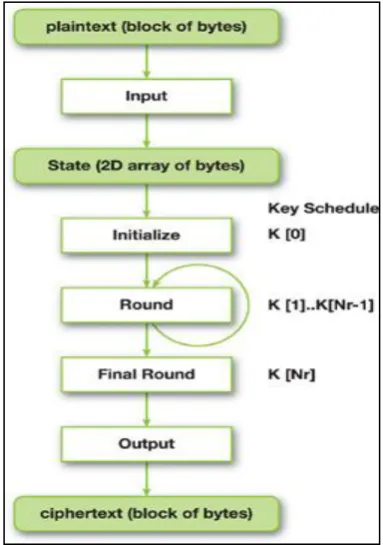
AES Encryption Algotithm:
After Files will be uploaded by a registered user will encrypted by using Improved AES Encryption technique then file will be stored on cloud.
First we process file using base64 encoder to convert it in byte array.
Then this byte array will be encrypted using AES technique.
IV.
RESULTS
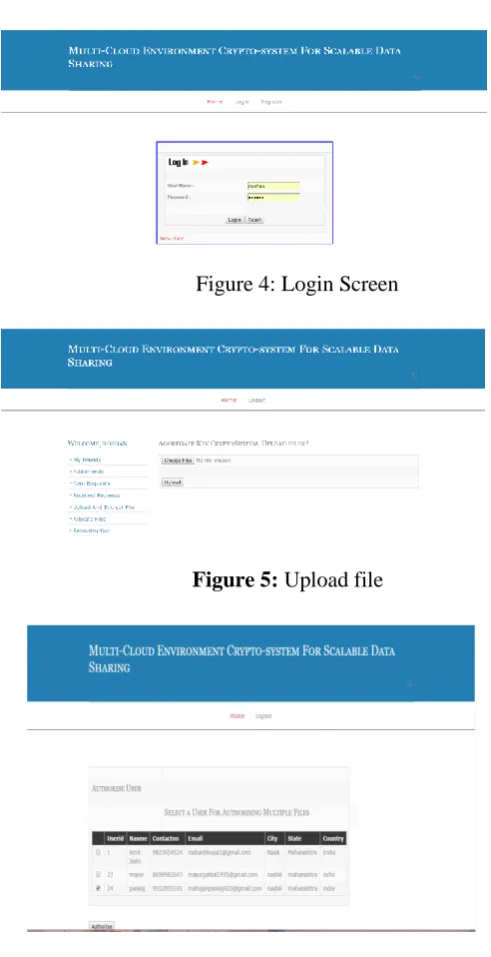
Figure 3: New User Registration
Figure 4: Login Screen
Figure 5: Upload file
Figure 6: Authorisation of User
Figure 6. Reconstruction File
V.
CONCLUSION
In this work we have reviewed three authentication techniques: Attribute based encryption (ABE), Identity Based Encryption (IBE) and Key Aggregate Cryptosystem (KAC). The major concern in ABE is collusion resistance but not compression of secret keys. Definitely, the ciphertext-size is not constant. In IBE, random set of identities are not match with our design of key aggregation. Key Aggregate Cryptosystem protects users data privacy by compressing the secret key in public key cryptosystem which supports delegation of secret key for different cipher text classes. For future extension it is necessary to reserve enough cipher texts classes because in cloud cipher texts grows rapidly and the limitation is that bound of the number of maximum cipher text classes.
To share data exibly is vital thing in cloud computing. Users prefer to upload there data on cloud and among different users. Outsourcing of data to server may lead to leak the private data of user to everyone. Encryption is a one solution which provides to share selected data with desired candidate. Sharing of decryption keys in secure way plays important role. Public-key cryptosystems provides delegation of secret keys for different ciphertext classes in cloud storage
VI.
REFERENCES
[1]. F. C. Chang and H. C. Huang, Key-Aggregate Cryptosystem for Scalable Data Shar-ing in Cloud Storage," Inf. Sci., vol. 192, no. 1, pp. 3949, Jun. 2012.
Cryptography and Network Security .,ACNS 2012, ser. LNCS, vol. 7341. Springer, 2012, pp. 526543. pp. 173184, 2011.
[3]. L. Hardesty, Secure computers arent so secure, \MIT
press,"2009,http://www.physorg.com/news176107 396.html..
[4]. V. Goyal, O. Pandey, A. Sahai, and B. Waters, \Attribute-Based Encryption for Fine-Grained Access Control of Encrypted Data,Proc ," 13th ACM Conf. Computer and Comm. Security (CCS 06),pp. 89-98, 2006.
[5]. S.S.M. Chow, Y. Dodis, Y. Rouselakis, and B. Waters, \Practical Leakage- Resilient Identity-Based Encryption from Simple Assumptions ," in Proc. ACM Conf. Com-puter and Comm. Security,pp. 152-161, 2010.
[6]. G. Ateniese, A.D. Santis, A.L. Ferrara, and B. Masucci, \Provably-Secure Time-Bound Hierarchical Key Assignment Schemes, ,"J. Cryptology.,vol. 25, no. 2, pp. 243-270, 2012. [7]. F. Guo, Y. Mu, Z. Chen, and L. Xug,
\Multi-Identity Single-Key Decryption without Random Oraclesl,",in Proceedings of Information Security and Cryptology (Inscrypt 07), ser. LNCS, vol. 4990. Springer, 2007, pp. 384398.