22 & 23.04.2017
In association with
I
nternational
J
ournal
of
S
cientific
R
esearch in
S
cience and
T
echnology
Effective Retrieval and Analysis of Uropathogens through NoSQL
Database
Dr. V.T. Meenatchi, Dr. M. Thangaraj
Department of CA & IT, Thiagarajar, College, Department of Computer Science, M.K University, Madurai, India
S. Padmavathy, N. K. AshaDevi, K. Vignesh
Department of Zoology & Microbiology, Thiagarajar College, Madurai, India
ABSTRACT
In the today’s web era, big data is emerging. The storage and retrieval of big data is becoming an issue. The database administrators are moving into new storage technology, the NoSQL database. This paper analyzes the predominant organisms causing the Urinary Tract Infection (UTI) based on gender wise and age-wise and also the antibiogram pattern of 3G and 4G antibiotics were analysed. The work is clinically proven using new methodologies and the data is then mapped into MongoDB, a NoSQL database. Through this type of mapping and analysis, the data retrieval becomes ease and simpler to manage huge data. The generated analytical report aids the medical practitioners to provide the needful therapy for UTI affected patients.
Keywords : NoSQL; MongoDB; Urinary Tract Infection; Antibiotics; Therapy
I.
INTRODUCTION
One of the most prevalent problems faced by healthcare services is the increasing prevalence of antimicrobial resistance. Urinary tract infections (UTI) are the most common bacterial infections affecting humans throughout their lifetime. UTI is a serious ailment in human due to increasing frequency, recurrence and difficulty in eradication; it poses stiff challenge to the medical professionals. It is much more common in women than in men, due to anatomical and physiological reasons by virtue of its position urinogenital tract is more vulnerable to bacterial infections caused by both internal and external flora [3].
Every year, the rate of people affected by urinary tract infections is increasing. when the infections are not treated, it leads to serious health problems. This work aims to identify the uropathogens causing the infection. From the urine specimens, it was noted that the following uropathogens like Escherichia coli, Klebsiella pneumoniae, Citrobacter sp., Enterobacter sp., and Staphylococcus aureus are responsible main cause for infection. The NOSQL databases were created as a mean to offer high performance and high availability. NOSQL
is an unstructured Query Language [11] and data stores are widely used to store and retrieve large amounts of data.
Our paper is organized as follows, Section II discusses the related literatures, Section III deals about the proposed system and Section IV presents the Results and Discussion and Section V ends with Conclusion.
II.
LITERATURE SURVEY
Urinary tract infection is one of a serious health problem affecting millions of people yearly. Infections of urinary tract are in the second most common type of infection in the body. Urinary tract infection has an important association in human female, the highest incidence of urinary tract infection occur in child bearing age and this has been linked to sexual activity and aging. Asymptomatic urinary tract infection occurs in 2 to 10% in women during pregnancy.
been reported between 2-13% however physiological changes in pregnancy lead to severe course of problem and also it has been reported that if untreated asymptomatic bacteriuria increase the frequency of premature delivery and neonates with low birth weights[7]. Urinary tract infection (UTI) is one of the most common and life threatening infection present in community practice.
Manifestations can vary from asymptomatic bacteriuria to symptomatic cystitis, pyelonephritis and blood stream
infection[8]. The most common symptoms
are pain, fever, or nausea and vomiting in addition to the classic symptoms of a lower urinary tract infection. Rarely the urine may appear bloody[9]. The general symptoms include a frequent urge to urinate a painful burning feeling during urination. These urinary infection are known to cause to a lot of problems in the physiological action of the urinary system. There are a number of reasons why bacterial resistance should be a concern for physicians. First resistant bacteria particularly Staphylococci, Enterococci, Klebsiella pneumoniae and Pseudomonas sp. are becoming common place in healthcare institutions. Bacterial resistance often results in treatment failure, which antibacterial therapy, defined as the initial use of an antibacterial agent to which the causative pathogen was not susceptible, has been associated with increased mortality rates in patients with bloodstream infections
due to resistant Pseudomonas aeruginosa,
Staphylococcus aureus, Klebsiella pneumoniae, Escherichia coli, Enterobacter sp., coagulase negative Staphylococci and Enterococci. Prolonged therapy with antimicrobial agents such as vancomycin or linezolid, may also lead to the development of low – level resistance that compromises therapy, but that may not be detected by routine susceptibility testing methods used in hospital laboratories. Many uropathogen are producing the Beta lactamase enzymes, so drugs resistant to particular pathogen for example Hydrolysis of beta lactam ring by beta lactamase enzymes produce by uropathogen.
During cystitis, Uropathogenic Escherichia coli subvert innate defenses by invading superficial umbrella cells and rapidly increasing in numbers to form intracellular bacterial communities [2]. By working together, bacteria in biofilms build themselves into structures that are more firmly anchored in infected cells and are more resistant to immune-system assaults and antibiotic treatments.
This is often the cause of chronic urinary tract infections. Antibiotics are the main treatment for all UTIs. A variety of antibiotics are available, and choices depend on many factors, including whether the infection is complicated or uncomplicated or primary or recurrent.
Worldwide reports of antibiotic resistant E. coli isolates indicate the unwise and excessive consumption of antimicrobial drugs which in turn has brought about failure in treatment, and consequently concerns about the related issues in all nations including the developed and developing ones. As an example, TMP-SXT was conventionally used for uncomplicated cystitis in most regions, however, due to the resistance to it, fluoroquinolon and cephalosporin took its place and unfortunately after sometime resistance to these two drugs was also recognized and reported [4][5].
Reports of uropathogens resistant to previously effective antibiotics have emerged globally in recent years. The situation is especially dire in Africa where irrational antibiotic practices are common. Variations in antibiotic resistance patterns are known to occur across different geographical regions, even within the same country. Such variations must be well documented so as to inform local empirical treatment as well as foster rational antibiotic use. The treatment of bacterial infections is increasingly complicated by the ability of bacteria to develop resistance to antimicrobial agents [6].
The development of resistance to all available antibiotics in some organisms then precludes the effectiveness of any antibiotic region. Organisms that are resistant to all known effective antimicrobials pose a serious threat to hospitalized patients. Indiscriminate use of antibiotics leads to the development of resistance of initially sensitive strains of organisms and possibly destruction of the normal flora [1].
own set of files on the file system. A single MongoDB server[13] typically has multiple databases.
III.
PROPOSED SYSTEM
An architecture named as UTI_framework in Fig. 1 has been constructed with 6 main components namely,
Sample collection
clinical analysis with three subcomponents: - Morphological characterization - Culture characterization - Biochemical characterization
Uropathogens Identification
Mining through NoSQL
Antibiogram Pattern
Analytical Report
Figure 1. UTI Framework
All the components in the framework are
interdependent. The collected urine samples were given for clinical analysis for uropathogen identification. The results were then mapped into MongoDB 3.2 document store environment for mining [14]. The Antibiogram patterns were assessed for specific organism. Finally the
reports were generated to depict organism
predominance, proper antibiotic for treatment, its sensitive level to organism, gender and age wise analysis.
IV.
RESULTS AND DISCUSSION
Following are the results derived through clinical
study. For analysis, 500 samples were collected
and major affected were female than male
as shown in Table 1.
TABLE I. Sex distribution of UTI Patients
Sex Total number
Male 150
Female 350
Total 500
Various organisms were identified and number of
uropathogens with their corresponding percentage
is shown in Table 2.
TABLE II. Percentage of Isolated Uropathogens using Selective and Differential Medium
Name of the organisms
Number of Uropathogens
Percentage of Uropathogens
E.coli 88 31.10
K.pneumoniae 55 19.43
Staphylococcus aureus
42 14.84
Enterobacter sp., 32 11.31
Pseudomonas sp.,
27 9.54
Streptococcussp., 20 7.07
Citrobacter sp., 13 4.59
Proteus sp., 6 2.12
Infected 283 -
Non infected 217 -
Total 500 100
The age wise and gender wise analysis were made and shown in Table 3.
From the table, one could identify the maximum percentage affected in male falls in 50 years and above, whereas in case of female, the maximum percentage falls under 30-39 years age group.
TABLE III. Distribution of the UTI Cases due to E.coli with reference to Age and Gender Status
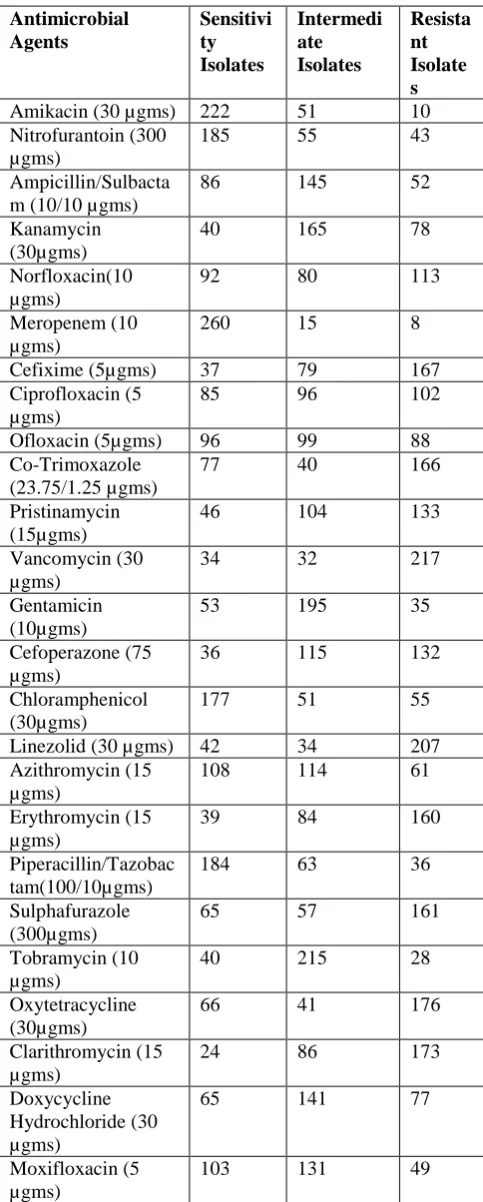
The antibiogram pattern for the infected organisms with their sensitivity levels are depicted in Table 4.
Age groups (in Years)
Male Female
Total Percentage Total Percentage
Less than 1
2 4.34 7 2.37
1-19 8 17.39 29 10.14
20-29 3 6.53 58 20.39
30-39 5 10.87 82 28.94
40-49 10 21.74 57 20.14
50 and above
TABLE IV. Antibiogram Pattern of Uropathogenic
E.coli before Plasmid Curing
Antimicrobial Agents
Sensitivi ty Isolates
Intermedi ate Isolates
Resista nt Isolate s
Amikacin (30 µgms) 222 51 10 Nitrofurantoin (300
µgms)
185 55 43
Ampicillin/Sulbacta m (10/10 µgms)
86 145 52
Kanamycin (30µgms)
40 165 78
Norfloxacin(10 µgms)
92 80 113
Meropenem (10 µgms)
260 15 8
Cefixime (5µgms) 37 79 167 Ciprofloxacin (5
µgms)
85 96 102
Ofloxacin (5µgms) 96 99 88 Co-Trimoxazole
(23.75/1.25 µgms)
77 40 166
Pristinamycin (15µgms)
46 104 133
Vancomycin (30 µgms)
34 32 217
Gentamicin (10µgms)
53 195 35
Cefoperazone (75 µgms)
36 115 132
Chloramphenicol (30µgms)
177 51 55
Linezolid (30 µgms) 42 34 207 Azithromycin (15
µgms)
108 114 61
Erythromycin (15 µgms)
39 84 160
Piperacillin/Tazobac tam(100/10µgms)
184 63 36
Sulphafurazole (300µgms)
65 57 161
Tobramycin (10 µgms)
40 215 28
Oxytetracycline (30µgms)
66 41 176
Clarithromycin (15 µgms)
24 86 173
Doxycycline Hydrochloride (30 µgms)
65 141 77
Moxifloxacin (5 µgms)
103 131 49
After clinical analysis, the results were mapped into MongoDB as shown in Fig. 2 , for effective retrieval.
Figure 2. Mapping of UTI data into NoSQL
After mapping the data is depicted as shown in Fig. 3.From the UTI dataset, out of 200, 138 number of female were affected from Escherichia Coli as shown in Fig. 4.
Figure 3. Display of documents
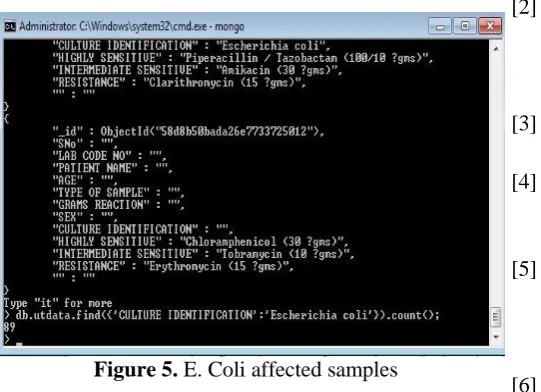
Fig.5 shows the number of isolates affected through E. Coli from 100 samples.
Figure 5. E. Coli affected samples
Thus the desired reports can be generated through NoSQL database and any useful information can be tracked anytime when needed.
V.
Conclusion
It is concluded from the present study that routine
microbiological analysis for antibiotics sensitivity
tests for urinary tract infected patients and other
patients to be carried out before administration of
drugs for treatment and management of urinary
tract infections, since resistance to these drugs are
developing in the community. This study appears to
suggest a need for a continuous monitoring of
bacterial antibiotics susceptibility before antibiotics
prescription in order to ensure adequate treatment
for urinary tract infection and reduction in the
spread of bacteria resistant strain. Identification and
proper treatment of UTI infections will lead to 10
fold decrease in the occurrence of acute
pyelonephritis. After clinical study, data is
computerized through NoSQL database. This
makes the overall retrieval and mining easier.
Moreover, self-medication should be avoided in
order to prevent spread of drug resistant strains of
bacteria.
VI.
References
[1] D.K.Chaturvedi, P.S.Satsangi , P.K. Kalra “Load frequency control:a generalized neural network
approach” Electrical Power and Energy Systems 21(1999)405-415 Elsevier
[2] Dola Gobinda Padhan,Somanath Majhi “ A new control scheme for PID load frequency controller for single area and multi area systems” ISA Transactions 52(2013)242-251 Elsevier
[3] O.I.Elgerd “Electric Energy System Theory;An introduction “Mc Graw Hill.1971
[4] M.K.Sherbiny El “Efficient fuzzy logic load frequency controller”Energy Conversion and Management 43(2002)1853-1863 Elsevier
[5] S.P.Ghosal “Optimizations of PID gains by particle swarm optimizations in fuzzy based automatic generation control”Electric Power Systems research 72(2004)203-212 Elsevier [6] Muwaffaq Irsheid Alomoush “Load frequency
cntrol and automatic generation control using
fractional order controllers” Electr
Engg(2010)91:357-3688 Springer
[7] Wen tan”tuning of PID load frequency controller for power systems” Energy Conversion and Management 50(2009(1465-1472 Elsevier
[8] V.soni.G.Parmar,M.Kumar and S.Panda “hybrid grey wold optimization-pattern search optimized 2DOF-PID controllers for load frequency control in interconnected thermal power plants”ICTACT journal on soft computing April 2016,volume 06, issue 03.
[9] RV Rao, VJ savsani,DP vakharia “Teaching learning based optimization: an optimization method for continuous non-linear large scale problems”Infinite science 2012;183(10:1-15
[10] P. Kundur.”Power system stability and
control”,Tata Mc Graw Hill,2009.
[11] J.Talaq,A.I.Fadel and Basri,”Adaptive Fuzzy Gain Scheduling for Load Frequency control”,IEEE
Transactions on Power
System,Vol.14.No.1,pp.145-150,1999