FACE DETECTION BY SMQT
FEATURES AND SNOW CLASSIFIER
USING COLOR INFORMATION
K SOMASHEKAR1 , PUTTAMADAPPA C 2 & D N CHANDRAPPA2
1
Electronics & Communication Department, RNS Institute Of Technology, Bangalore, India 2
Electronics & Communication Department, SJB Institute Of Technology, Bangalore, India
Abstract
:
The main objective of the face detection is to determine whether human faces exist in an image or not. If exists, return the spatial location of the image. Successive mean quantization transform is proposed for illumination and sensor insensitive operation. Sparse network of winnows is presented to speed up the original classifier. Finally SMQT features and SNoW classifier are combined with the chrom for the frontal face detection. Detection results are presented for the images collected using a web camera. This is very robust to the illumination, pose etc variations and suitable for real-time face detection system.
Keywords : SMQT , SNoW , Chrom , Front Detection , Classifier
1. Introduction
Face detection is the first step in any automated system that solves problems such as: face recognition, face tracking, and facial expression recognition. They work mainly with upright frontal faces. Most detection systems extract certain properties of a set of training images acquired at a fixed pose in an off line setting. To reduce the effects of illumination change, these images are processed and based on the extracted properties, these systems typically scan through the entire image at every possible. One common method to further improve the system is to bootstrap a trained face detector with test sets, and re-train the system with the positive as well as negatives. This process is repeated several times in order to further improve the performance of a face detector.
Up to now, much work has been done in detecting and locating faces in images and the methods like Neural network based[2], feature based [3], Ada boost based [4],Sparse network of winnows [5], combination of Ada boost and SNoW [6], have been well studied by many researchers . The Proposed method introduces a face luminance operation is being performed to get pixel information of an image and further implemented to detection purpose. For detection using local SMQT features which can be used as feature extraction for object and SNoW classifier requires for training.
This paper is organized as follows: Section II discusses face detection using SMQT features and SNOW classifier with color luminance, Section III discussing the Results of the proposed method and Section IV concludes the paper.
2. Proposed Method
2.1 Luminance
The RGB image when compared to other color models like YUV or HSI, has the disadvantage of not clearly separating the mere color (chrom) and the intensity of a pixel, which makes it very difficult to robustly distinguish skin colored regions, which often have large intensity differences due to lightning and shadows. In the RGB space, the triple component (r,g,b) represents not only color but also luminance. Luminance may vary across a person's face due to the ambient lighting and is not a reliable measure in separating skin from non-skin region. Chromatic colors, also known as "pure" colors in the absence of luminance, are defined by a normalization process shown below:
r = R/(R+G+B)
b = B/(R+G+B)
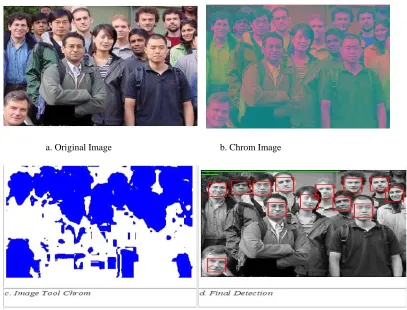
Also color green is redundant after the normalization because r+g+b = 1. Chromatic colors have been effectively used to segment color images in many applications. Although skin colors of different people appear to vary over a wide range, they differ much less in color than in brightness. As the image is acquired it is filtered by Prewitt to reduce the effect of noise in the samples. The image is then converted from RGB to YcbCr, Then it will read row pixel and column pixel and determine the face based on the RGB color value by checking the condition. (105<Chrom(i,j,1)<117 && 110<Chrom(i,j,2)<113 && Chrom(i,j,3)>128). If this condition is not met then it make those regions as white. From the pixel region tool we get pixel information of image at each point in an image.
2.2 Local SMQT Features
The SMQT[1] performs an automatic structural breakdown of information. These properties will be employed on local areas in an image to extract illumination insensitive features. Local areas can be defined in several ways. once the local area is defined it will be a set of pixel values.
SMQTL: D(x)→M(x) (1) Where x be one pixel and D(x) be a set of |D(x)| = D be pixels in local area in an image.
The resulting values are insensitive to gain and bias. These properties are desirable with regard to the formation of the whole intensity image I(x) which is a product of the reflectance R(x) and the luminance E(x) . Additionally, the influence of the camera can be modeled as a gain factor g and a bias term b [2]. Thus, a model of the image can be described by
I(x) = gE(x)R(x) + b (2)
In order to design a robust classifier for object detection the reflectance should be extracted since it contains the object structure. In general, the separation of the reflectance and the luminance is an ill posed problem. A common approach to solving this problem involves assuming that E(x) is spatially smooth. Architecture Further, if the luminance can be considered to be constant in the chosen local area then E(x) is given by
E(x) = E, x א D. (3)
Given the validity of Eq. 3, the SMQT on the local area will yield illumination and camera-insensitive features. This implies that all local patterns which contain the same structure will yield the same SMQT features for a specified level L.
2.3 Split up SNoW Classifier
The SNoW learning is a sparse network of linear units over a feature space . One of the strong properties of SNoW is the possibility to create lookup-tables for classification. Consider a Patch W of the SMQT features M(x), then a classifier
θ= ∑ (M(x)) - ∑ (M(x)) (4)
Can be achieved using the non face table , the face table and defining a threshold for θ. Since both tables work on the same domain, this implies that one single lookup-table
= - (5)
can be created for single lookup-table classification. The training database contain i = 1, 2. . . N feature patches with the SMQT features (x) and the corresponding classes (face or non face). The non face table and the face table can then be trained with the Winnow Update Rule. Initially both tables contain zeros. If an index in the table is addressed for the first time during training, the value (weight) on that index is set to one. There are three training parameters; the threshold γ, the promotion parameter α > 1 and the demotion parameter 0 < β < 1. If ∑ xאW (x) ≤γand is a face then promotion is conducted as follows
( (x))=α ( (x)), x א W (6) If is a non face and ∑ xאW (x) >γ then demotion takes place
( (x))= ( (x)), x א W (7) This procedure is repeated until no changes occur. Training of the non face table is performed in the same manner, and finally the single table is created according to Eq. (5).One way to speed up the classification in object recognition is to create a cascade of classifiers [8]. Here the full SNoW classifier will be split up in sub classifiers to achieve this goal. Note that there will be no additional training of sub classifiers instead the full classifier will be divided. Consider all possible feature combinations for one feature, Pi, i = 1, 2, . ,. ( ) D, then
( )|, x א W (8)
results in a relevance value with respective significance to all features in the feature patch. Sorting all the feature relevance values in the patch will result in an importance list. Let W׳ك W be a subset chosen to contain the features with the largest relevance values. Then
θ ' = ) (9)
can function as a weak classifier, rejecting no faces within the training database, but at the cost of an increased number of false detections. The desired threshold used on θ ' is found from the face in the training database that results in the lowest classification value from Eq. (9). Extending the number of sub classifiers can be achieved by selecting more subsets and performing the same operations as described for one sub classifier. Consider any division, according to the relevance values, of the full set W' ك W'' ك . . . ك W. Then W' has fewer features and more false detections compared to W'' and so forth in the same manner until the full classifier is reached. One of the advantages of this division is that W'' will use the sum result from W'. Hence, the maximum of summations and lookups in the table will be the number of features in the patch W.
2.5 Face detection Training and Classification
The face detector analyzes image patches 32×32 pixels is applied. This patch is extracted and classified by jumping Δx = 1and Δy = 1 pixels through the whole image. In order to find faces of various sizes, the image is repeatedly downscaled and resized with a scale factor = 1.2. To overcome the illumination and sensor problem, the proposed local SMQT features are extracted. Each pixel will get one feature vector by analyzing its vicinity. This feature vector can further be recalculated to an index
m = ( ) ( ) i−1 (10)
This setting will remove over 90% of the background patches in the initial stages from video frames recorded in an office environment. Overlapped detections are pruned using geometrical location and classification scores. Each detection is tested against all other detections. If one of the area overlap ratios is over a fixed threshold, then the different detections are considered to belong to the same face. Given that two detections overlap each other, the detection with the highest classification score is kept and the other one is removed. This procedure is repeated until no more overlapping detections are found
.
2.6 Face Database
Images are collected using a web camera containing a face, and are hand-labeled with three points; the right eye, the left eye and the center point on outer edge of upper lip (mouth indication). Using these three points the face will be warped to the 32×32 patch using different destination points for variation from the figure we see currently, a grand total of approximately one million face patches are used for training.
3.
Results & DiscussionIn this paper, the Matlab simulated experiments are performed to verify the effectiveness of the proposed scheme. Most of the input images consider different lighting conditions with uniform as well as non-uniform background. We tested the method with a set of 20 images. With respect to face detection the achieved classification rate is 78%. Most of the misses includes regions that have very similar to gray values regions that are present in an image which might detect them as face. Experimental results using the proposed method show that the new approach can detect face with high detection rate and low false acceptance rate.
Case1: Crowded Image
a. Original Image b. Chrom Image
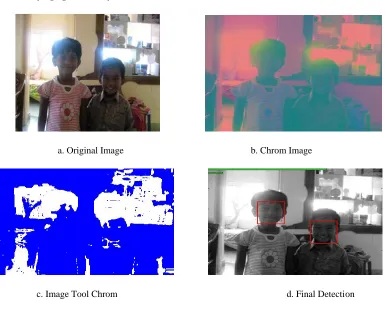
Case 2: Varying light intensity condition
a. Original Image b. Chrom Image
c. Image Tool Chrom d. Final Detection
Figure 2: Image processing sequence for face detection and recognition for the image "test11.jpg"
Case 3: Very bright light condition (eg: sunlight) under different background condition.
c. Image Tool Chrom d. Final Detection
Figure 3: Image processing sequence for face detection and recognition for the image "test11.jpg"
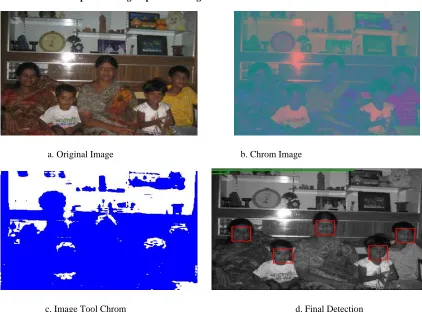
Case 4: Detection a person in a group when background is of same as the skin color
a. Original Image b. Chrom Image
c. Image Tool Chrom d. Final Detection Figure 4: Image processing sequence for face detection and recognition for the image "test10.jpg"
4. Conclusion
to detection purpose. For detection using local SMQT features which can be used as feature extraction for object detection. Properties for these features were presented. The features were found to be able to cope with illumination and sensor variation in object detection. Then, the split up SNoW is introduced to speed up the standard SNoW classifier. The split up SNoW classifier requires only training of one classifier network which can be arbitrarily divided into several weaker classifiers in cascade. Each weak classifier uses the result from previous weaker classifiers which makes it computationally efficient.
References
[1] Mikael Nilsson, Jorgen Nordberg,and Ingvar Claesson “Face detection using local SMQT features and split up SNOW classifier in IEEE International conference on Acoustics, Speech, and signal processing(ICASSP),2007,vol 2, pp. 589-592.
[2] Rowley, H.A., Baluja, S., Kanade, T. Neural Network-based Face Detection. IEEE Trans. Pattern Anal. Machine Intell., Vol. 20, No.1 Rowley
[3] J eng, S.H., Liao, H.M. Liu, Y.T., Chern, M.Y. An efficient approach for facial feature detection using geometrical face model. In: Proceedings of the ICPR 1996, pp. 426–430Jeng et al., 1996
[4] P. Viola and M. Jones, “Rapid object detection using a boosted cascade of simple features,” in In Proceedings of the 2001 IEEE Computer Society Conference on Computer Vision and Pattern Recognition (CVPR), 2001, vol. 1, pp. 511–518.
[5] D. Roth, M. Yang, and N. Ahuja, “A snow-based face detector,” in In Advances in Neural Information Processing Systems 12 (NIPS 12), pp. 855–861, MIT Press 2000.
[6] B. Froba and A. Ernst, “Face detection with the modified census transform,” in Sixth IEEE International Conference on AutomaticFace and Gesture Recognition, May 2004, pp. 91–96.
[7] Chiunhsiun Lin and Kuo-Chin Fan, "Triangle-based Approach to the Detection of Human Face," Pattern Recognition, Vol. 34, No. 6, 2001, pp. 1271-1283.
[8] Yin Jian-qin, Li Jin ping, Han Yan bin, et al. A New Color-Based Face Detection and Location Method by Using Support Vector Machine[C]//In Proc. IEEE Conf. Control, Automation, Robotics & Vision Kunming, China: [s. n.], 2004:838-841.
[9] Han Yan-bin, Liu Ming-jun, Li Jin-ping Face Detection and Location Based on Skin - color Modeling and Geometrical Features[J] Computer Science, 2006, 33 (s):311-313.
[10] Chiang J.Gray World Assumption[EB/OL] class/psych221/projects/99/jchiang/intro2.html., 1999-03-27 [11] Hsu R L. Face Detection in Color Images [J]. Pattern Analysis and Machine Intelligence.2002.24 (5):696-706.
[12] L. Fan and K. K. Sung. Face Detection and Pose Alignment Using Color, Shape and Texture Information. Proc. Visual Surveillance, 2000
[13] T.S Jebara and A.Pentland Parameterized Structure from Motion for 3D Adaptive Feedback Tracking of Faces. Proc.CVPR.1997 [14] Jae Y. Lee and Suk I. Yoo An Elliptical Boundary Model for Skin Color Detection School of Computer Science and Engineering,