©2013 JNAS Journal-2013-2-11/598-604 ISSN 2322-5149 ©2013 JNAS
Differential Transformation Method For Solving
Interval Differential Equations
Bahman Ghazanfaria
*and Parvin Ebrahimia
Department of Mathematics, Lorestan University, Khorramabad, 68137-17133, Iran
Corresponding author: Bahman Ghazanfaria
ABSTRACT: In this paper, we present Differential Transformation Method (DTM) for solving Interval Differential Equations (IDEs). The proposed method is also illustrated by some examples. And some error comparison is made with Runge-Kutta method of order 4 (RK4).
Keywords: Interval-valued functions, Interval differential equations, Hukuhara differentiability, Differential transformation method.
INTRODUCTION
The interval-valued analysis and interval differential equations (IDEs) are the particular cases of the set-valued analysis and set differential equations, respectively. Some systematic studies in these area are contained in (Aubin and Frankowska, 1990; Lakshmikantham et al., 2006; Moore, 1966). Stefanini and Bede (Stefanini and Bede, 2009) started the research of IDEs with two different concepts of the Hukuhara derivative. The first concept is a classical on, i.e, the derivative is taken from the paper of Hukuhara (Hukuhara, 1967), while the second one is a new form of differentiation of interval-valued mappings (Stefanini and Bede, 2009). The methods used in the study of interval differential equations are similar to those used to study fuzzy differential equations. However, some of the results are particular for IDEs, or have much simpler formulation in interval setting than corresponding theorems in fuzzy setting. The reason for this is that the space of intervals is separable, so it is locally compact, while the set of fuzzy numbers is non separable, so it is not locally compact. So, when we study fuzzy analysis we cannot be sure that a closed ball is compact, while, in the interval case this is obvious. In this paper, we apply DTM for solving IDEs, based on Hukuhara derivative.
Preliminaries
Definitions and notations
Let denote the family of all nonempty, compact and convex subsets of the real line (intervals). The addition and scalar multiplication in , we define as usual, i.e. for
, - , - and we have , - , - ( ) , - Note that for it holds:
( ) ( ) and ( ) The Hausdorff metric in is defined as follows: ( ) *| | | |+
for , - , - It is known (Stefanini and Bede, 2009) that ( )
is a complete, separable and locally compact metric space. For The metric the following properties hold (Lakshmikantham et al., 2006)
( ) ( )
( ) ( ) ( ) ( ) | | ( ),
599 For , - denote the length and the magnitude of by
len( ):= and ‖ ‖ ( * +) max *| | | | + respectively. It is known that exists in the case len ( ) len ( ) (Lakshmikantham et al., 2006; Stefanini and Bede, 2009). Also one can verify the following properties for :
If exists, then ( ) ( )
If exists, then ( ) ( )
If ( ) exists, then there exists ( ) ( ) and ( ) ( )
Definition 2.1. We say that the interval-valued mapping , - if for every there exists ( ) such that, for all , - such that | | one has ( ( ) ( )) If , - is continuous at every point , - then we will say that is continuous on , -
Definition 2.2. A mapping , - is Hukuhara differentiable at , - if there exists ( ) such that the limits
( ) ( ( ) ( )) ( ) ( ( ) ( ))
exist and are equal to ( ) The interval ( ) is said to be Hukuhara derivative of interval-valued mapping at the point .
2.2 Interval differential equations
In this section we consider an interval-valued differential equation ( ) ( )
where , - with ( ) , ( ) ( )- for , - , -
We consider only -differentiable solutions, i.e. there exists such that there are no switching points in , -
Defeential transformation method
The basic definitions and fundamental operations of the differential transform are introduced in (Chen and Ho, 1999). The differential transform of the function ( ) is the following form
( )
, ( )
-( ) (2.1)
where ( ) is the original function and ( ) is the transformed function. The inverse differential transform of ( ) is defined as
( ) ∑ ( )( ) (2.2)
When ( ) are taken as ( ) the function ( ) (2.2), is expressed as the following ( ) ∑
, ( ) -( )
(2.3)
Eq. (2.3) implies that the concept of differential transform is derived from Taylor series expansion.
In this paper, the lower case letters represent the original function and upper case letters stands for the transformed function (T-function). The fundamental mathematical operations performed by differential transform method can readily be obtained and are listed in Table 1.
By continuity condition, we define the differential transform of interval function ( ) ( ( ) ( ))as follows:
( )
, ( )
-( ) (2.4)
Table 1: The original function and transformed function
Transformed function Original function
( ) ( ) ( ) ( ) ( ) ( )
( ) ( ) ( ) ( )
( ) {
( )
( ) ( ) ( ) ( ) ( ) ( )
Ν
( ) ∑ ( ) ( )
600 ( )
, ( )
-( ) (2.5)
The inverse differential transform of ( ) and ( ) are defined respectively as ( ) ∑ ( )( ) (2.6)
and
( ) ∑ ( )( ) (2.7)
When are taken as ( ) the functions ( ) and ( ) of (2.4) and (2.5), are expressed
as the following ( )
, ( )
-( ) (2.8)
( )
, ( )
-( ) (2.9)
Eqs. (2.8) and (2.9) imply that the concept of differential transform is derived from Taylor series expansion. In this paper, the lower case letters represent the original function and upper case letters stands for the transformed function (T-function).
EXAMPLES
Example1. Consider interval differential equation
{ ( ) ( ) , - , - ( ) , -
We denote , - Or
( )
( ) (3.1)
( )
Taking differential transform of (3.1), we find ( ) ( ) ( ) ( )
( ) ( ) ( ) ( ) (3.2)
From the initial conditions, we can write
( ) (3.3)
Substituting Eqs. (3.3) in (3.2), all spectra can be found as
( )
( )
and we find the exact solution as follows:
( ) ( ) (3.4)
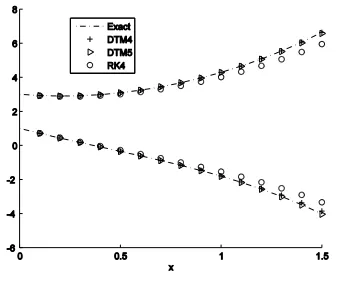
The exact and approximate solutions are compared and plotted for , - in Figure1. Bound of Error =max{Error of ( ) Error of ( )} is used in these examples.
601 Figure 1. The exact and approximate solutions for ,
-Example 2. Consider interval differential equation
{ ( ) ( ) , - [ ] ( ) , -
Or
( )
( ) (3.5) ( )
Taking differential transform of (3.5), we have ( ) ( ) ( )
(
)
( ) ( ) ( )
(
) (3.6)
From the initial conditions, we can write
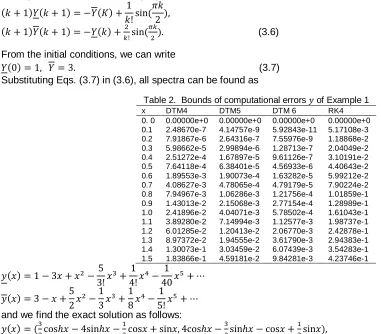
( ) (3.7) Substituting Eqs. (3.7) in (3.6), all spectra can be found as
Table 2. Bounds of computational errors of Example 1
x DTM4 DTM5 DTM 6 RK4
0. 0 0.00000e+0 0.00000e+0 0.00000e+0 0.00000e+0
0.1 2.48670e-7 4.14757e-9 5.92843e-11 5.17108e-3
0.2 7.91867e-6 2.64316e-7 7.55976e-9 1.18868e-2
0.3 5.98662e-5 2.99894e-6 1.28713e-7 2.04049e-2
0.4 2.51272e-4 1.67897e-5 9.61126e-7 3.10191e-2
0.5 7.64118e-4 6.38401e-5 4.56933e-6 4.40643e-2
0.6 1.89553e-3 1.90073e-4 1.63282e-5 5.99212e-2
0.7 4.08627e-3 4.78065e-4 4.79179e-5 7.90224e-2
0.8 7.94967e-3 1.06286e-3 1.21756e-4 1.01859e-1
0.9 1.43013e-2 2.15068e-3 2.77154e-4 1.28989e-1
1.0 2.41896e-2 4.04071e-3 5.78502e-4 1.61043e-1
1.1 3.89280e-2 7.14994e-3 1.12577e-3 1.98737e-1
1.2 6.01285e-2 1.20413e-2 2.06770e-3 2.42878e-1
1.3 8.97372e-2 1.94555e-2 3.61790e-3 2.94383e-1
1.4 1.30073e-1 3.03459e-2 6.07439e-3 3.54283e-1
1.5 1.83866e-1 4.59181e-2 9.84281e-3 4.23746e-1
( )
( )
and we find the exact solution as follows:
( ) ( )
602 Figure 2. The exact and approximate solutions for ,
-Table 3 shows the errors in the solution by the differential transformation method of various orders, along with the result obtained by the Runge-Kutta method of order 4.
Table 3. Bounds of computational errors of Example 2
x DTM4 DTM5 DTM 6 RK4
0.0 0.00000e+0 0.00000e+0 0.00000e+0 0.00000e+0
0.1 2.47321e-7 6.90550e-9 9.89666e-11 1.01753e-2
0.2 7.83486e-6 4.39554e-7 1.26391e-8 2.28956e-2
0.3 5.89405e-5 4.98055e-6 2.15497e-7 3.85623e-2
0.4 2.46233e-4 2.78425e-5 1.61126e-6 5.76265e-2
0.5 7.45517e-4 1.05693e-4 7.66928e-6 8.05956e-2
0.6 1.84184e-3 3.14122e-4 2.74353e-5 1.08040e-1
0.7 3.95554e-3 7.88543e-4 8.05914e-5 1.40599e-1
0.8 7.66877e-3 1.74948e-3 2.04951e-4 1.78995e-1
0.9 1.37529e-2 3.53219e-3 4.66874e-4 2.24036e-1
1.0 2.31973e-2 6.62060e-3 9.75102e-4 2.76632e-1
1.1 3.72403e-2 1.16857e-2 1.89850e-3 3.37804e-1
1.2 5.74019e-2 1.96280e-2 3.48826e-3 4.08700e-1
1.3 8.55205e-2 3.16254e-2 6.10502e-3 4.90612e-1
1.4 1.23792e-1 4.91847e-2 1.02515e-2 5.84986e-1
1.5 1.74815e-1 7.41983e-2 1.66114e-2 6.93452e-1
CONCULSION
In this work, we introduced differential transformation method for approximate solution of a interval differential equations and illustrated by some numerical examples. The results showed that the DTM is remarkably effective and very simple.
REFERENCES
Aubin JP and Frankowska H. 1990. Set-Valued Analysis, Birkh ̈user. Boston.
Bede B and Gal S. 2005. Generalizations of the differentiability of fuzzy-number-valued functions with applications to fuzzy differential equations, Fuzzy Sets Syst. 151: 581-599.
Chen CK and Ho SH. 1999. Solving partial differential equations by two-dimensional differential transform method. Appl. Math. Comput. 106: 171-179.
Hukuhara M. 1967. Integration des applications mesurables dont la valeur est un compact convexe. Funkcial. Ekvac. 10: 205-229.
Jang MJ, Chen CL and Liu YC. 2001. Two-dimensional differential transform for partial differential equations. Appl. Math. Comput. 121: 261-270.
Lakshmikantham V, Gnana Bhaskar T, Vasundhara Devi J. 2006. Theory of Set Differential Equations in Metric Space. Cambridge Scientific Publ. Cambridge.
Moore RE. 1966. Interval Analysis, Prentice-Hall, Englewood Cliffs, NJ.
603 Mostafa, Kh. M. and El-Sanabary, A. A. 2012. Harnessing of Novel Tailored Modified Pregelled Starch Derived Products in
Sizing of Cotton Textiles, Advances in Polymer Technology, Vol. 31, No. 1, 52–62.
Mostafa, Kh. M., Samarkandy, A. R. and El-Sanabary, A. A. 2011. Grafting onto Carbohydrate Polymer Using Novel Potassium Persulphate/Tetramethylethylene Diamine Redox System for Initiating Grafting, Advances in Polymer Technology, Vol. 30, No. 2, 138 –149.
Mostafa, Kh. M. 1995. Graft polymerization of acrylic acid onto starch using potassium permanganate acid (redox system), Journal of Appl. Polymer Sci., 56, 263-269.
Khalil, M. I., Mostafa, Kh. M. and Hebeish, A. 1993. Graft polymerization of acrylamide onto maize starch using potassium persulfate as initiator, Die Angewandte Macromolecular Chemie; 213, 14.
Clough, R. L. 2001. High-energy radiation and polymers: A review of commercial processes and emerging applications, Nuclear Instruments and Methods in Physics Research Section B: Beam Interactions with Materials and Atoms, 185, (1–4), 8–33.
Huq, T., Khan, A. , Dussault, D. , Salmieri, St. , Khan, R. A. , Lacroix, M. 2012. Effect of gamma radiation on the physico-chemical properties of alginate-based films and beads, Radiation Physics and Chemistry, 81, 8, 945–948.
Kiatkamjornwonga, S., Chomsaksakulb W., Sonsukc, M. 2000. Radiation modification of water absorption of cassava starch by acrylic acid/acrylamide, Radiation Physics and Chemistry, 59, 4, 413–427.
Mubarak, A. K., Bhattachariaa, S. K., Kaderb M. A., Baharic, K. 2006. Preparation and characterization of ultra violet (UV) radiation cured bio-degradable films of sago starch/PVA blend, Carbohydrate Polymers, 63, 4, 18, 500–506. Zhang X, Liu Z. 2012. Recent advances in microwave initiated synthesis of nanocarbon materials, Nanoscale, 4 (3) 707-714. Vandana Singha, Devendra Narayan Tripathia, Ashutosh Tiwaria, Rashmi Sanghib (2006). Microwave synthesized
chitosan-graft-poly(methylmethacrylate): An efficient Zn2+ ion binder, Carbohydrate Polymers, 65, 1, 10, 35–41. Wang, J. P., Chen, Y. Z., Zhang, S. J., Yu, H. Q. 2008. A chitosan - based flocculant prepared with gamma-irradiation-induced
grafting, Bioresour. Technol. 99, 3397–3402.
Vahdat, A., Bahrami, H., Ansari, N., Ziai, F. 2007. Radiation grafting of styrene onto polypropylene fibres by a 10 MeV electron beam, Phys. Chem. 76, 787–793.
Singha, V., Kumara, P. Sanghib, R. 2012. Use of microwave irradiation in the grafting modification of the polysaccharides – A review, Progress in Polymer Science, 37, 2, 340–364.
Sen G., Kumar, R., Kumar, S., Pal, S. 2009. A novel polymeric flocculants based on polyacrylamide grafted
carboxymethylstarch, Carbohydrate Polymer, 77, 822–831.
Sen, G., Pal, S. 2009. Microwave initiated synthesis of polyacrylamide grafted carboxymethylstarch (CMS-g-PAM):
Application as a novel matrix for sustained drug release, International journal of biological macromolecules, 45, 48–55.
Mostafa, Kh.M. and Samerkandy A. R. 2005. Synthesis of New Polymeric Composite Materials and its Application in sizing of Cotton Textiles, Research Journal of applied Sciences, 1 (5), 353-340.
Mostafa, Kh.M. and Samerkandy A. R. and El- Sanabary, A. A. 2009. Using Persulfate Oxidized Chitosan as a Novel Additives in Easy-Care Finishing for Cotton Textiles, Polymer Plastic Technology & Engineering, 48, 2,130-135.
Mostafa, Kh. M. and El- Sanabary, A. A. Synthesis and Characterization of Novel Smart Flocculant Based on Poly (MAam) – Pregelled Starch Graft Copolymers and Their Degraded Products. Advances in Polymer Technology, accepted for publication.
Vogel, A. I. 1975. Elementary Practical Organic Chemistry, 2nd ed.; Longman: London, Part 3, p 652).
Amal A. A. 2006. Preparation, Characterization and Evaluation of Anionic Starch Derivatives as Flocculants and for Metal Removal, Starch/ Stärke, 58, 391–400.
Khalil, M. I., Amal A. A. 2001. Preparation and Evaluation of Some Cationic Starch Derivatives as Flocculants, Starch/ Stärke, 53, 84–89.
Karmakar, G. P., Singh, R. P. 1998. Flocculation studies using amylase - grafted polyacrylamide, Colloids Surf. A, 733, 119-124.
Mostafa, Kh.M. El- Sanabary, A. A. and Samerkandy A. R. 2007. Modification of carbohydrate polymers: Part2: Grafting of Methacrylamide onto Pregelled Starch Using Vanadium-mercaptosuccinic acid redox pair, Journal of Applied Science Research, 3 (8), 641- 647 2007.
Mostafa, Kh. M. 2005. Grafting of Methacrylamide onto Cotton Yarn” Part 1: Tensile Strength, Journal of applied science, 5 (2), 341-346 2005.
604 Mostafa, Kh.M. and Samerkandy A. R. and El- Sanabary, A. A. 2010. Synthesis and characterization of (poly (N-vinyl Formamide) - Pregelled Starch-graft copolymer. Kh. M.Mostafa, Abdul Rahim Samarkandy and A.A.El-Sanabary, Journal of Polymer research, 17, 789 - 800.
Mostafa, Kh. M. and Morsy, M.S. 2004. Modification of Carbohydrate Polymers via Grafting of Methacrylonitrile onto Pregelled Starch using Potassium Monopersulphate /Fe2+ Redox Pair, Polymer International, 53, 7, 885-890.
Mostafa, Kh.M. and Samerkandy A. R. and El- Sanabary, A. A. 2011. Grafting onto Carbohydrate Polymer Using Novel Potassium Persulphate/Tetramethylethylene Diamine Redox System for Initiating Grafting, Advances in Polymer Technology, 30, 2, 138–149.
Sen, G., Kumar, R., Ghosh, S., Pal, S. 2009. A novel polymeric flocculant based on polyacrylamide grafted