S.M.Subhani et al., J. Sci. Res. Phar. 2014, 3(3), 110-114
J
ournal of
S
cientific
R
esearch in
P
harmacy
Research Article
Available online through
ISSN: 2277-9469
www.jsrponl
ine.com
Phytochemical and antidiabetic activity of
Piper betle against alloxan induced diabetic rats
S.M.Subhani*, Mohammad Mansoor and D. Srinivasa Rao K.C.Reddy Institute of Pharmaceutical Sciences, Guntur, Andhra Pradesh-522 348, INDIA.
Received on: 27-07-2014; Revised and Accepted on: 13-09-2014
ABSTRACT
T
he aim of the present study was to evaluate the antidiabetic activity of Piper betlein alloxan induced diabetic rats. The antidiabetic effect of Piper betlewas studied against Alloxan (140mg/k g b.w., i.p.) induced diabetes in wistar rats for doses 250 mg/kg b.w. and 500 mg/kg b.w. (p.o.) for four weeks and the effect was compared with standerd glibenclamide(10mg/kg, b.w). Diabetes caused by Alloxan treatment increases the level of glucose and biochemical parameter in blood sample but treatment with Piper betlesignificant decrease the elevated glucose and blood biochemical parameter. Hence, the results obtained in the present study indicate that Piper betleposse’s significantanti-diabetes activity.Key words: Piper betle, Alloxan, Biochemical parameter, Glibenclamide.
INTRODUCTION
D
iabetes Mellitus (DM) is a chronic metabolic disorder affecting approximately 4% population worldwide and is expected to increase by 5.4% in 2025. It is caused by deficiency or ineffective production of insulin by pancreas which results in increase or decrease in concentrations of glucose in the blood. It is found to damage many parts of the body system, particularly the blood vessels and nerves [1]. Several botanical neutraceuticals/supplements have been studied as potential therapeutic agents in the management of diabetes and its related complications.Piper betle Linn. (F: Piperaceae; Eng: Betel) is a perennial dioecious, semiwoody climber. P. betle is cultivated in Sri Lanka, India, Malaysia, Indonesia, Philippine Islands and East Africa. Betel leaves have a strong pungent flavor and is widely used as a masticatory. Betel juice is given to children for cough and administered to the eye for night blindness in adults. It is used to treat catarrh and diphtheria. The leaves are given for gastric and lung disorders in children and applied to purulent ulcers [2].Experimentally, Sri Lankan grown P. betle was shown to have effects on washed human spermatozoa [3], antiaphrodisiac activity [4], antifertility on male rats [5], antimicrobial activity [6], antidiabetic activity [7], antinociceptive activity [8]antioxidant activity [9]and wound healing properties [10].
In Asian countries people chew betel leaves. In a previous study, we have shown the antidiabetic activity of P.betle hot water extract. This was the first scientific report in the world on antidiabetic activity of P. betle in rats. However, no clinical trial was performed using P.betle to evaluate its antidiabetic activity in human beings. Therefore, an attempt is made to clinically investigate the antidiabetic activity of P. betle
MATERIALS and METHODS
Collection and Authentication of Plant Material:
The leaves of Piper betle were collected in the month of May from the surrounding fields of Acharya N.G. Ranga Agricultural University, Rajendra Nagar and Authenticated by Dr. A. Manohar Rao.
*Corresponding author:
S.M.SubhaniK.C.Reddy Institute of Pharmaceutical Sciences, Guntur, Andhra Pradesh-522 348, INDIA. *E-Mail:[email protected]
Preparation of plant extract:
100gram of Piper betle was powdered, dried and continuously extracted for 48hrs with ethanol in a Soxhlet apparatus. The collected extract was stored at 0-4°C until used. The plant extract was pooled and evaporated to dry at 60°C.
1. Preliminary Phytochemical Screening:
Preliminary phytochemical investigation was carried out on hydroalcoholic extract of Piper betle for detection of various phytochemicals by following standard methods described in practical Pharmacognosy by C.K. Kokate[11] and R.K. Khandelwal.[12]
2. Anti-Diabetic Activity:
Experimental Animals: Alloxan induced diabetic model [13, 14]: Rats were made diabetic by a single intraperitoneal injection of alloxan monohydrate (150 mg/kg). Alloxan was first weighed individually for each animal according to the body weight and then solubilized with 0.2 ml saline (154mM NaCl) just prior to injection. Two days after alloxan injection, rats with plasma glucose levels of >140 mg/dl were included in the study. Treatment with plant extracts was started 48 h after alloxan injection.
Experiment design:
Total of 30 rats were divided in to 5 groups (n=6) as follows
Group I : Served as normal control and did not receive any treatment.
Group II : Served as diabetic control and received alloxan monohydrate and vehicle
Group III : Alloxan + Glibenclamide (10 mg/kg p.o.) and served as standard.
Group IV : Alloxan monohydrate + Piper betle (250 mg/kg, p.o.) Group V : Alloxan monohydrate + Piper betle (500mg/kg, p.o.)
Treatment Schedule: -
Group-I nondiabetic animals: received only 1% gum acacia (1 ml/kg/day, p.o.) for four weeks, and served as control. Group-II to V were rendered diabetic by single intraperitonial dose of alloxan monohyderate 140 mg/kg, in citrate buffer (pH 4.5). Group II received 1 % gum acacia (1 ml/kg/day, p.o.) for four weeks and served as diabetic control. Group-III received glibenclamide (10 mg/kg/day, p.o.) for four weeks. Group-IV and V received two different doses of Piper betle (250 and 500 mg/kg/day, p.o.) for four weeks respectively.
Care of Diabetic Animals:
S.M.Subhani et al., J. Sci. Res. Phar. 2014, 3(3), 110-114
usually every day and in some circumstances, more than once perday. Diabetic rats should have sufficient food and water.
Collection blood and serum samples:
The blood was drawn from the retro orbital plexus of the rats (fasted for 14 h) under light ether anesthesia on different occasion, i.e., 0, 10th, 20th and 30th day. The blood samples were allowed to clot for 30mins at room temperature and then they were centrifuged at 3000 rpm for 10mins. The resulting upper serum layer was collected in properly labeled, clean and dry micro-centrifuge tubes. The serum samples were stored at -400 C and analyzed either immediately or within two weeks.The parameters studied were as follows: Biochemical parameters such as
a. Serum total cholesterol. b. Serum and creatinine. c. Serum urea.
d. Serum and Urine total protein.
• Body weight of an animal.
• Blood glucose
Statistical Analysis:
Results were expressed as mean ± SEM, (n=6). Statistical analyses were performed with one way analysis of variance (ANOVA) followed by Dunnett’s multiple comparison test by using Graph Pad Instat Software. P value less than 0.05 was considered to be statistically significant. *P<0.05, **<0.01 and ***<0.001, when compared with control and toxicant group as applicable.
RESULTS
Preliminary phytochemical screening:
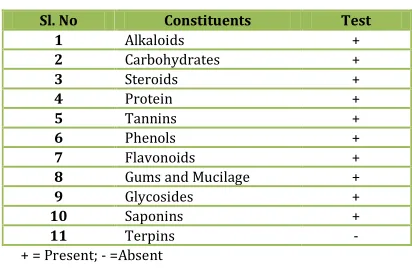
Results of the preliminary phytochemical investigation on Piper betle are shown in Table 1.
Table No. 1: Preliminary phytochemical screening
Sl. No Constituents Test
1 Alkaloids +
2 Carbohydrates +
3 Steroids +
4 Protein +
5 Tannins +
6 Phenols +
7 Flavonoids +
8 Gums and Mucilage +
9 Glycosides +
10 Saponins +
11 Terpins -
+ = Present; - =Absent
Table No. 2: Acute toxicity of Piper betle
Drug treatment
Dose Average weight of animal in gram Signs of toxicity Effects observed Death Before
treatment (1st day)
After treatment (3nd
day)
Piper betle 5mg /kg 165 170 No sign of toxicity No effect Nil
Piper betle 50mg/kg 160 165 No sign of toxicity No effect Nil
Piper betle 500mg/kg 167 171 No sign of toxicity No effect Nil
Piper betle 1000mg/kg 173 178 No sign of toxicity No effect Nil
Piper betle 2000mg/kg 155 160 No sign of toxicity No effect Nil
Piper betle 3000mg/kg 182 189 No sign of toxicity No effect Nil
No acute toxicity was observed for ethanol extract of Piper betle when it was administered orally at high dose level (3 g/kg body weight), which is higher than effective antihyperglycemic dose, and closely observed for 24 hrs for any mortality and next 10 days for any delayed toxic effects on gross behavioral activities(Table 2).
Anti-diabetic study of alloxan induced diabetic rats: a) Body weight:
The Diabetic control showed significant decrease in the body weight during the treatment period. The diabetic animals treated with Piper betle (250mg/kg) showed slight reduction in body weight but not much when compared to control. The group that received Piper betle 500mg/kg had shown significant results (Table 3 & Fig. 1).
Table No. 3: Effect of Piper betle on body weight in alloxan induced diabetic rats
Groups Body weight of the animal (gms)
Initial 10th day 20th day 30th day
Normal 152±2.06 162±4.02 171±3.36 176±2.32
S.M.Subhani et al., J. Sci. Res. Phar. 2014, 3(3), 110-114
0 20 40 60 80 100 120 140 160 180 200
No rma
l
Allo xan
+ve hicl
e
Allo xan
+Glib encl
am ide
10m g/k
g
Allo xan
+ Pip er b
etle 2
50m g/k
g
Allo xan
+ Pip er b
etle 5
00m g/k
g
Body weight of the animal (gms) Initial
Body weight of the animal (gms) 10th day
Body weight of the animal (gms) 20th day
Body weight of the animal (gms) 30th day
Fig. 1: Effect of Piper betle on body weight in alloxan induced diabetic rats
b) Blood glucose:
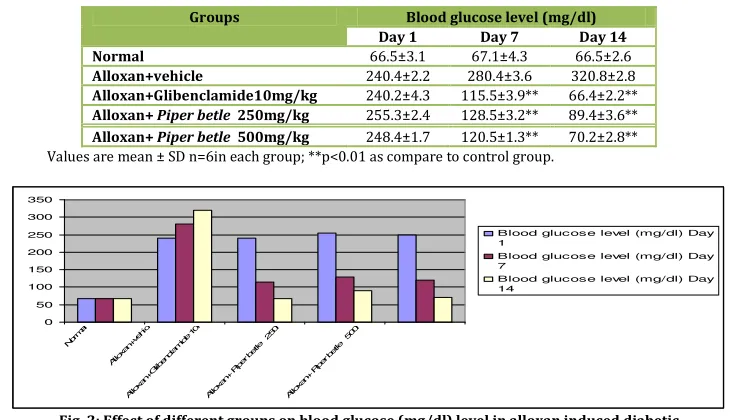
The Diabetic control showed significant increase in the blood glucose during the treatment period. The diabetic animals treated
with Piper betle (250mg/kg) showed slight reduction in blood glucose but not much when compared to control. The group that received Piper betle 500mg/kg had shown significant results (Table 4 & Fig. 2).
Table No. 4: Effect of different groups on blood glucose (mg/dl) level in alloxan induced diabetic
Groups Blood glucose level (mg/dl) Day 1 Day 7 Day 14
Normal 66.5±3.1 67.1±4.3 66.5±2.6
Alloxan+vehicle 240.4±2.2 280.4±3.6 320.8±2.8 Alloxan+Glibenclamide10mg/kg 240.2±4.3 115.5±3.9** 66.4±2.2** Alloxan+ Piper betle 250mg/kg 255.3±2.4 128.5±3.2** 89.4±3.6** Alloxan+ Piper betle 500mg/kg 248.4±1.7 120.5±1.3** 70.2±2.8** Values are mean ± SD n=6in each group; **p<0.01 as compare to control group.
0 50 100 150 200 250 300 350
Norm al
Allo xan
+ve hicle
Allo xan
+G libe
ncl amid
e 10 mg
/kg
Allo xan
+ P ipe
r be tle
25 0mg
/kg
Allo xan
+ P ipe
r be tle
50 0mg
/kg
Blood glucose level (mg/dl) Day 1
Blood glucose level (mg/dl) Day 7
Blood glucose level (mg/dl) Day 14
Fig. 2: Effect of different groups on blood glucose (mg/dl) level in alloxan induced diabetic
c) Biochemical parameters:
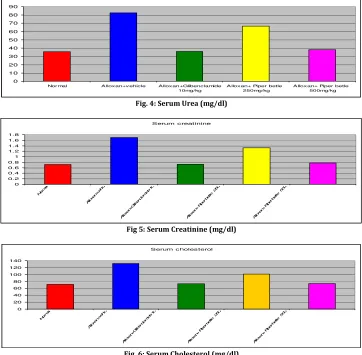
Diabetic animals treated with Piper betle showed significant decrease in serum creatinine (p<0.05), serum
cholesterol (p<0.01) and urea, and significant increase in serum albumin and total protein (p<0.01) when compared with diabetic control (Table 5 and Fig. 3-6).
Table No. 5: Effect of Piper betle on biochemical parameters in alloxan induced diabetic rats
Groups Serum protein(mg/dl) Serum urea(mg/dl) Serum creatinine Serum cholesterol
Normal 6.5±0.3 35.5±0.2 0.72±0.03 71.30±24.2
Alloxan+vehicle 4.1±0.6 82.6±4.2 1.7±0.02 132.23±1.2
Alloxan+Glibenclamide 10mg/kg 6.4±0.2** 36±1.2** 0.73±0.04*** 73.27±0.2*** Alloxan+ Piper betle 250mg/kg 4.8±6.8* 66.4±4.7* 1.32±0.01* 101.08±0.2* Alloxan+ Piper betle 500mg/kg 6.0±0.4** 38.2±0.2** 0.78±0.02*** 74.26±3.4*** Values are Mean ± S.E.M; n=6; * P<0.05, **P < 0.01 and ***P < 0.001 vs. Diabetic Control
Serum protein(mg/dl)
0 1 2 3 4 5 6 7
Normal A lloxan+vehicle Allox an+Glibenclamide
10mg/kg
Allox an+ Piper betle 250mg/kg
Allox an+ Piper betle 500mg/kg
S.M.Subhani et al., J. Sci. Res. Phar. 2014, 3(3), 110-114
Serum urea(mg/dl)
0 10 20 30 40 50 60 70 80 90
Normal A lloxan+v ehicle Alloxan+Glibenc lamide
10mg/kg
A lloxan+ Piper betle 250mg/kg
A lloxan+ Piper betle 500mg/kg Fig. 4: Serum Urea (mg/dl)
Serum creatinine
0 0.2 0.4 0.6 0.8 1 1.2 1.4 1.6 1.8
No rm
al
Alloxa n+ve
hicl e
Allo xa
n+G libe
nclam ide
10 mg
/kg
Allo xa
n+ P ipe
r be tle
25 0m
g/kg
Allo xa
n+ P ipe
r be tle
50 0m
g/kg
Fig 5: Serum Creatinine (mg/dl)
Serum cholesterol
0 20 40 60 80 100 120 140
Nor ma
l
Allox an+
vehi cle
Allox an+
Glib encl
am ide
10 mg/
kg
Allox an+
Pip er
be tle
250 mg/
kg
Allox an+
Pip er
be tle
500 mg/
kg
Fig. 6: Serum Cholesterol (mg/dl)
DISCUSSION
T
reatment of hyperglycemia in diabetes involves diet control exercise and the use of hypoglycemic diets and drugs. However, many oral antidiabetic medicines have a number of serious adverse effects. Herbal drugs are normally used as compound preparations called decoctions, powders and pastes to treat the patients with Type 2 diabetes in Ayurveda and traditional systems of medicine [15].Human diabetics and experimental diabetic animal models exhibit high oxidative stress due to persistent and chronic hyperglycemia, which may result in depletion of the antioxidant defense system and lead to an enhanced de novo free radical generation [16]. In addition, high glucose contents can simply inactivate antioxidant enzymes [17].Reaction of these free radicals with membrane lipids would result in an increased lipid peroxidation which can be prevented by antioxidants including plant phenolic compounds [18].
Diabetes mellitus ranks highly among the top ten disorders which cause mortality throughout the world. Diabetes mellitus being chronic disorder, treatment without side effect for long term control is important. Present antidiabetic agent possess side effect as risk of hypoglycemia, anemia, choestatic jaundice [19]. There has been growing public interest in herbal medication for treatment of diabetes.
In the present study the periodic estimation of plasma glucose revealed that Piper betle produced significant antihyperglycemic activity which began from 22nd day of treatment and it progressed throughout the study. The antidiabetic effect of the Piper betle could possibly be due to presence of glycosides, tannins and saponins. Substances like glycosides, alkaloids, terpenoids, tannins and saponins are frequently implicated as having antidiabetic effects [20].
Various reports suggest that there is reduction in the body weight in diabetic rats. Loss of body weight could be due
to, dehydration and catabolism of fats and protein seen during diabetes mellitus [21]. It is reported that the recovery in body weight is far less in the poorly controlled diabetic rats as compared to well-controlled diabetic rats. In the present study diabetic control group rats showed significant loss of body weight. All animals treated with Piper betle showed significant prevention of the loss in body weight throughout the study. This prevention of loss in body weight by Piper betle may be due to increasing glucose uptake in peripheral tissues or inhibiting catabolism of fat and protein or by glycemic control.
Diabetes produces qualitative and quantitative changes in the composition of the basement membrane and this altered material undergoes accelerated glycosylation and further rearrangement to form advanced glycation end-products (AGEs), which stimulate protein synthesis, further decrease degradability of the basement membrane, increase its permeability and cause endothelial dysfunction. Hyperglycemia increases the expression of transforming growth factor beta (TGFβ) in the glomeruli and of matrix protein specifically stimulated by cytokine. TGFβ may contribute to both the cellular hypertrophy and enhanced collagen synthesis is observed in diabetic nephropathy[22].
During diabetes, there is increased protein catabolism with inflow of amino acids to liver, which feed gluconeogenesis and accelerate ureagenesis, resulting in hypoproteinemia and hypoalbuminemia [23]. Diabetic hyperglycemia induces elevation of the levels of serum creatinine, urine total protein and urine albumin which are considered as significant markers of renal dysfunction [24].
S.M.Subhani et al., J. Sci. Res. Phar. 2014, 3(3), 110-114
or in combination may retard or even prevent the normalprogression of diabetic complications [25].
Hence, the results obtained in the present study indicate that Piper betle has the potential to treat diabetes mellitus and prevent diabetes mellitus associated renal damage.
CONCLUSION
In the present study the hydroalcoholic extract of Piper betle leaves shown better Anti-diabetic activities in experimental rat models, it may be due to the presence of flavonoids and other poly phenolic compounds. Hence, the research justifies that the extract of Piper betle leaves can be effectively used in treatment of diabetes by reducing the body weight and glucose levels. Further studies are needed to isolate and characterize the active component(s) responsible for the anti-diabetic properties of the test extract and findings should be confirmed by performing clinical studies.
REFERENCE:
1.
Kim SH, Hyun SH, Choung SY. Antidiabetic effect of cinnamon extract on blood glucose in db/db mice. J Ethnopharmacol., 2006; 104: 119 – 123.
2. Jayaweera DMA. Medicinal PlantsUsed in Ceylon. vol V. National Science Council of Sri Lanka, Colombo, 1982; p. 201.
3. Ratnasooriya WD, Jayawardena KGI, Premakumara GAS. Antimotility effects of Piperbetle (L) leaf extract on washed human spermatozoa. J Nat Sci Coun Sri Lanka 1990; 18: 53–60.
4. Ratnasooriya WD, Premakumara GAS. Piperbetle leaves impairs masculine sexual behavior of rats. Med. Sci. Res., 1996; 24: 303–306.
5. Ratnasooriya WD, Premakumara GAS. Piper betle leaves reversibly inhibits fertility of male rats. Vidyodaya J. Sci., 1997; 7: 15–21.
6. Kumaratunga KGA. Gaschromatographicaland AntimicrobialstudiesonAlpiniacalcarataandPiper betlefromSriLanka. M.Phil Thesis, University of Kelaniya, Sri Lanka. 2003.
7. Arambewela LSR, Arawwawala LDAM, Ratnasooriya WD. Antidiabetic activities of aqueous and ethanolic extracts of Piperbetle leaves in rats. J.
Ethnopharmacol., 2005; 102: 239–245.
8. Arambewela LSR, Arawwawala LDAM, Ratnasooriya WD. Antinociceptive activity of aqueous and ethanolic extracts of Piperbetle leaves. Pharmaceut. Biol., 2005; 43: 766-772.
9. Arambewela LSR, Arawwawala LDAM, Rajapaksa D. Piperbetle: A potential natural antioxidant. Int. J. Food Sci. Technol., 2006; 41: 10-14.
10. Arambewela LSR, Arawwawala LDAM, Withanage D,
Kulathunga S. Efficacy of betel cream on skin ailments. J. Complement Integr. Med., 2010; 7: Article 48.
11. Kokate CK, Purohit AP, Gokhale SB. Pharmacognosy. 14th ed. Pune: Nirali Prakash; 2007; p.297.
12. Khandelwal KR. Practical Pharmacognosy. 11th ed. Pune: Nirali Prakashan; 2004; 149.
13. Ragavan B, Krishnakumari S. Antidiabetic effect of T. Arjuna bark extract in alloxan induced diabetic rats. Indian Journal of Clinical Biochemistry, 2006; 21(2): 123-28.
14. Somani RS, Singhai AK. Hypoglycaemic and Antidiabetic activity of seeds of Myristica fragrans in normoglycaemic and alloxan-induced diabetic rats. Asian J. Exp. Sci., 2008; 22(1): 95-02. Tietz NW. Clinical guide to laboratory tests, Philadelphia, W.B. Saunders Co. 1976.
15. May LD, Lefkowitch JH, Kram MT, Rubin DE. Mixed hepatocellular cholestatic liver injury after pioglitazone therapy. Ann. Intern. Med., 2002; 136: 449-452.
16. Kamalakannan N, Prince PSM. Antihyperglycemic and antioxidant effects of rutin, a polyphenol flavonoid, in streptozotocin – induced diabetic wistar rats. Basic Clin. Pharmacol. Toxicol., 2006; 98: 97–103.
17. Davi G, Falco A, Patrono C. Lipid peroxidation in Diabetes Mellitus. Antioxidants Redo. Sig., 2005; 7: 256–268.
18. Coskun O, Kanter M, Korkmaz A, Oter S. Quercetin a flavonoid antioxidant, prevent and protects streptozotocin – induced oxidative stress and b - cell damage in rat pancreas. Pharmacol. Res., 2005; 51: 117–123.
19. Schimmer BP, Parker KL. Adrenocorticotropic Hormone; Adrenocortical Steroids and their Synthetic Analogs; Inhibitors of Synthesis and Actions of Adrenocortical Hormones. In: Hardman JG, Limbard LE, Gilman AG, Goodman-Gilman A, eds., Goodman & Gilman’s The Pharmacological Basis of Therapeutics. McGraw-Hill, 2001; 1658-1659.
20. Matsuda H, Morikawa T, Yoshikawa M. Antidiabetogenic constituents from several natural medicines. Pure Appl. Chem., 2002; 74: 1301-1308.
21. Hofteizer V, Carpenter AM. Comparison of STZ-induced diabetes in the rat, including volumetric quantitation of the pancreatic islets. Diabetologia. 1973; 9: 178-184. 22. Vishwanathan V. Prevention of diabetic nephropathy:A
diabetologist’s perspective. Indian J. Nephrol., 2004; 14: 157-162.
23. Bhavpriya V, Govindasamy S. Biochemical studies on the hypoglycaemic effect of Aegle marmelos corr Roxb in streptozotocin induced diabetic rats. Indian Drugs, 2000; 37: 474-477.
24. Bretzel RG. Prevention and slowing down the progression of the diabetic nephropathy through antihypertensive therapy. J. Diab. Compl., 1997; 11:112-122.
25. Sabu MC, Kuttan R. Anti-diabetic activity of medicinal plants and its relationship with their antioxidant property. J. Ethnopharmacol., 2002; 81: 155-160.
How to cite this article:
S.M.Subhani, Mohammad Mansoor and D. Srinivasa Rao: Phytochemical and antidiabetic activity of Piper betle against alloxan induced diabetic rats. J. Sci. Res. Phar, 2014; 3(3): 110-114.
Conflict of interest: The authors have declared that no conflict of interest exists.