TADL-V2: An Improved Trust-Aware Dynamic
Location-based Adaptation Protocol For Discovering
Multiple Paths in MANETs
Helen Bakhsh
University of Manchester, UK[email protected]
Dr. Ning Zhang
University of Manchester,UK[email protected]
Dr. Andy Carpenter
University of Manchester, UK[email protected]
ABSTRACT
Mobile ad hoc networks (MANETs) have a number of fea-tures that make the provisioning of Quality of Services (QoS) particularly challenging. One of the most challenging issues is how to discover more reliable paths for high priority traffic delivery in a highly mobile network and do so with minimum overhead costs. This paper attempts to address this issue by designing and evaluating a multi-path discovery protocol. This protocol, named as Trust-Aware Dynamic Location-based protocol version 2 (TADL-V2), is an improved version of our earlier published protocol, TADL. TADL-V2 has im-proved TADL in two aspects: (1) it uses a hybrid approach to node-disjoint path discovery based on the network mo-bility level and (2) it uses a momo-bility based approach to search area resizing. These measures enable TADL-V2 to discover more paths with reduced number of control packets injected into the network. Our simulation study shows that TADL-V2 outperforms TADL in terms of reducing control overheads when the network is highly mobile. This overhead reduction can have a positive effect on QoS provisioning. Keywords
Keywords
MANETs, QoS, Trust, Multiple path, Node-disjoint
1.
INTRODUCTION
A Mobile Ad hoc NETwork (MANET) [1] is formed by a collection of wireless mobile nodes that are spontaneously inter-connected to communicate among themselves without having any infrastructural support. The nodes are mobile, and this node mobility causes link failures and paths break-age, resulting in frequent changes in the network topology, which, in turn, will cause packet losses, the lost packets will then be retransmitted and the repeated retransmissions may lead to network congestions thus further packet delivery de-lays and losses. All of these will have detrimental effects on Quality of Services (QoS). Providing QoS in MANETs
is a challenging issue. One of the challenging issues is how to find more reliable paths to deliver high priority traffic so as to satisfy their QoS requirements and how to do so with minimum overhead costs.
TheTADL-V2 protocol is an improved version of our early designed Protocol, TADL[2]. TADL was designed to dis-cover the most reliable set of node-disjoint paths between a pair of source and destination nodes with minimum overhead costs. To achieve this goal,TADL has two novel measures embedded in its design. First, it uses an adaptive directional approach to path discoveries. That is, it defines a search area that covers the source and designation nodes and only broadcasts path discovery packets within this area. This can prevent unnecessary flooding of control packets across the entire network, but can also limit the number of paths that can be discovered. To maintain bandwidth cost low, while, at the same time, still being able to discover a sufficient number of paths,TADLadjusts the size of the search area dynamically in response to (a) the number of paths discov-ered in the previous discovery session, and (b) the underly-ing network conditions, namely neighbourunderly-ing nodes average mobility level, attacker ratio, and the time of the previous search attempt. The second measure taken in the design is that it uses trust values (measuring link reliability) to govern the selection of neighbours during path formations, aiming at finding the most reliable set of path to serve high prior-ity traffic. Reliabilprior-ity is measured in terms of the ratio of packets that are successfully delivered, as explained in [2].
Simulation results have shown thatTADLoutperforms other related protocols in a stationary network and a network with a low to medium level of mobility. However, when the net-work mobility level is high (e.g. when the netnet-work nodes move continuously, with 0 pause time), the performance of TADLdecreases significantly, producing worse results than related protocols. This means that some of the design mea-sures used inTADLis not cost-effective or even counterpro-ductive when the mobility level is high.
InTADL, the discovering of a set of node-disjoint paths be-tween a source and destination nodes is carried out using the method called the Source node Controlled Node-disjoint Path Discovery (SC-MNPD ) method. This is a two-step process. In step-1, the source node initiates a path discovery process by multicasting a path discovery packet in a speci-fied search area. Once step-1 is complete, i.e. once all the
MOBIQUITOUS 2015, July 22-24, Coimbra, Portugal Copyright © 2015 ICST
paths in the searching area are discovered, the source node executes step-2 to select (a sub-set of) node-disjoint paths from the path set. In a highly dynamic network, the paths discovered in step-1 or selected in step-2 would be highly likely obsolete when they are used. If this is the case, pack-ets transmitted along the paths will be lost, and the source node will be notified by the intermediate nodes involved, upon which the source node will initiate another path dis-covery process. Rediscovering the required number of paths will increase the number of control packets injected into the network, leading to degradation of protocol performance, as indicated in our simulation study.
To rectify this problem, this paper proposes an improved version of TADL, i. e. TADL-V2. The novelty of the TADL-V2 design lies in three aspects. The first is to use an integrated approach to node-disjoint path discovery at a high network mobility level. Instead of first discovering all the available paths, and then selecting node-disjoint paths from the discovered path set, this approach (which is called the Intermediate node Controlled Node-disjoint Path Dis-covery (IC-MNPD) performs the process in one step and is controlled by an intermediate node (rather than by the source node). That is, with this approach, the intermediate node will discover and determine node-disjoint paths during a path discovery process, thus preventing the transmissions of path discovery packets (i.e. control packets) along paths that are non-disjoint.
The second is to use the network mobility level to govern how node-disjoint paths should be discovered. In other words, TADL-V2 switches between the two node-disjoint path dis-covery methods based on the network mobility level. When the network mobility level is low or medium, it uses the SC-MNPD method, and when the network mobility level is high, it switches to the IC-MNPD method. The reason for still using theSC-MNPDmethod when the network mo-bility level is at a low or medium level is that, under such mobility levels, theSC-MNPD method can discover more node-disjoint paths than theIC-MNPDmethod.
The third is to take a different measure in resizing the search area dictated by the mobility level. When the network mo-bility level is low or medium, it uses the same method used in TADL, and when the network mobility level is high, TADL-V2 switches to a different method, where the source node starts the search from the largest searching area, Area-L, that covers the whole network.
We have used simulation studies to evaluate the effectiveness of the ideas used inTADL-V2. Simulation results show that, in a highly mobile network,TADL-V2 outperformsTADL in terms of reducing the number of control packets injected into the underlying network, decreasing the average end-to-end packet delivery delays and increasing the packet delivery ratios. TADL-V2 performs in exactly the same manner as TADLwhen the network mobility level is low or medium, so to avoid repetitions, in the remaining part of this paper, we only focus on evaluating theTADL-V2 protocol under high network mobility setting.
The rest of this paper is organised as follows. Section 2 crit-ically analyses related works. Section 3 gives the design
pre-liminary for TADL-V2. Section 4 describes theTADL-V2 design and its operations. Section 5 reports the simulation study of the protocol. Finally, Section 6 concludes the paper and outlines our future work.
2.
RELATED WORK
Most existing works in the area of MANET QoS provision-ing focus on the design of a multi-path routprovision-ing approach [3]. That is, they discover multiple paths between a given source and destination pair in a single path discovery process. How-ever, the protocols may differ in terms of how the discovered multiple paths are used. In some multi-path protocols, one of the discovered paths is used as a primary path, and the others are used as secondary or backup paths [4]. In this way, packets can be promptly delivered along the secondary paths if the primary path breaks, thus reducing end-to-end delivery delays. In other multi-path protocols, multiple dis-covered paths are used in parallel [5], each supporting the delivery of a fraction of the traffic flow to be delivered. Us-ing multiple paths in parallel can provide load balancUs-ing. It can also harvest the bandwidths of multiple paths to speed up the traffic delivery.
The multiple path discovery protocols may also differ in terms of the types of paths they are designed to discover. Basically, there are three types of paths, classified based on the level of disjointedness among nodes or links. They are node-disjoint paths, link-disjoint paths and non-disjoint paths. Node-disjoint paths are paths that have no common nodes except the source and destination nodes. During a path discovery process by such a protocol, the intermediate nodes reject all the duplicated copies of a RREQ (Route REQuest) packet. AODVM [6] is a protocol designed to discover node-disjoint paths.
Link-disjoint paths are paths that have common nodes but no common links between a source and destination pair. During a path discovery process by such a protocol, the in-termediate nodes typically accept some of the duplicated copies of aRREQ, which have better attribute values, e. g. lower hop counts. The acceptedRREQpackets must come from different upstream nodes. The Ad hoc On-demand Multi-path Distance Vector (AOMDV) routing protocol [7] is designed to discover link-disjoint paths.
Non-disjoint paths are paths that share both nodes and links. In protocols designed to discover non-disjoint paths, intermediate nodes only play the role of packet forwarding. They are not involved in any decision making process; they simply accept and pass on all the RREQpackets they re-ceive. The Split Multipath Routing (SMR) proposed in [5] and the TOpology-HIding multi-path Protocol (TOHIP) in [8] are designed to discover non-disjoint paths.
discovery process, an intermediate node will reject all the duplicated copies of the sameRREQpacket. However, the number of node-disjoint paths that can be discovered during a path discovery process is also the least among the three path types.
Conversely, protocols designed to discover multiple link-disjoint or non-disjoint paths do not reject duplicatedRREQ pack-ets at intermediate nodes. This allows the discovery of more paths. However, this also means that more RREQ pack-ets will be injected into the underlying network resulting in more control overheads.
With the above observations from the related works and from the simulation study of the TADL protocol [2], we have re-designed theTADLprotocol, producing TADL-V2 to further reduce control overheads in the discovery of mul-tiple node-disjoint paths and to make the discovery process even more efficient.
3.
TADL-V2: AN OVERVIEW
This section gives a high-level overview ofTADL-V2. In the TADL-V2 protocol, each node can know the mobility lev-els of its neighbouring nodes by using the HELLO packets. TheTADL-V2 classifies the mobility levels into two bands, low/medium mobility level and high mobility level.
At the low/medium mobility level, theTADL-V2 protocol (run at a source node) invokes the Source node Controlled Node-disjoint Path Discovery (SC-MNPD) method to dis-cover all available node-disjoint paths linking the source node and a destination node. This process is carried out in two phases. In the first phase, the source node initiates a path discovery process in which all the non-disjoint paths linking the source and the destination nodes in the specified search area are to be discovered. In this phase, no effort is made to differentiate or identify path types. Once this process is complete, i.e. once all the available paths are discovered, the source node identifies and selects all possi-ble sets of node-disjoint paths from the discovered paths [5]. This process is solely carried out by the source node, and the intermediate nodes are not involved. In other words, with this multiple node-disjoint path discovery method, all an intermediate node needs to do is to receive aRREQand forward it onto a set of selected neighbours. The set of neigh-bours are chosen based on their trust values. Any duplicated RREQ packets (i.e. multiple copies of the RREQ packet with the same sequence number) are also forwarded. For everyRREQpacket received, the destination node would re-turn aRREP packet to the source node. When the source node receives all the RREP packets from the destination node, it goes through all the paths discovered and identifies all the possible sets of node-disjoint paths and selects one set (which has the best trust values and has sufficient aggre-gated bandwidth as required by the traffic flow) for traffic delivery.
When the mobility level is high, the path information carried by theRREP packets will likely to be obsolete by the time when these packets are received, or paths selected, by the source node. If these paths are selected, packets received by the upstream intermediate node of a broken link will be discarded, and the node will return a route error (RRER)
packet to the source node. The source node, upon the receipt ofRRER, would restart another path discovery session if the source node cannot find an alternative path(s) in its routing table. So the higher the network mobility, the more likely the links would break, the moreRRERpackets will be returned to the source node, and more route discovery sessions will be initiated. As a result, the more control overheads will be generated. A higher level of control overheads would be more likely to make the network more congested, causing more packets to be dropped.
To prevent the network get into such a state,TADL-V2 uses a Mobility-based Adaptive Multiple Node-disjoint Path Dis-covery (MA-MNPD) method. With this method,TADL-V2 uses the Source node Controlled Multiple Node-disjoint Path Discovery (SC-MNPD) method (i. e. the method described above and used in TADL) at a low or medium network mobility level, but switches to the Intermediate node Con-trolled Node-disjoint Path Discovery (IC-MNPD) method if the network mobility level is high With this IC-MNPD method, it is not the source node, but every intermedi-ate node, which filters out any duplicintermedi-ated RREQ packets and selects node-disjoint pathsRREQduring the process of packet forwarding. In this way, the intermediate node will only need to forwardRREQpackets along the selected node-disjoint paths, and as mentioned above, the transmission of the RREQpackets along non-disjoint paths can be pre-vented, thus reducing the number of control packet poured into the network.
As mentioned in the Introduction section, reducing the num-ber of control packets in this way can be counterproductive to discovering a required set of node-disjoint paths between a pair of nodes. To offset any potential loss in the number of node-disjoint paths discovered, TADL-V2 uses a differ-ent approach to search area resizing. It uses the search area resizing method used in TADL (i.e. theAS2A method) in conjunction with the SC-MNPD method when the mobil-ity level is low or medium, but switches to the MA-AS2S method in conjunction with the IC-MNPD method when the network mobility level is high. In theAS2Amethod, the size of the search area is adjusted dynamically in response to the underlying network conditions. As shown in Figure 1, three distinctive sizes of the search area are specified, small (Area-S), medium (Area-M) and large (Area-L).
Area-S is the smallest one, which is defined by using the DSA method [2].TheDSA method defines the destination node searching area that used to forward control packets to the destination node. The searching area is a rectangular area that starts from the current location ofS and includes the predicted location of D at the current time Tcur, as
shown in Figure 2. Due to the frequent node mobility, S attempts to predict the location of D using the location information stored on its routing table.
Area-Lis the largest search area that covers the entire net-work. In other words, when Area-Lis used,RREQpackets will be broadcast to the entire network, defaulting to the use of the flooding path discovery protocol.
Each path search can start from any of the three search area sizes based on the number of discovered paths in the previous discovery session and observations on the channel conditions of neighbouring nodes.
(a) Area-S
(b) Area-M
(c) Area-L
Figure 1: Searching Area Sizes
Figure 2: Predicted Location and Searching Area of D
In methodAS2A, the discovery process starts with the small-est search area, i.e. Area-S, and then progressively moves to larger sizes if the number of paths discovered is less than
re-quired. Using Area-Swill lead to the least control overhead being generated, but also the fewest paths being discovered. If the number of discovered paths is less than the required number, method AS2A will move to Area-M in the next path discovery session, and so on.
With a higher mobility level, the discovered paths will be more likely to be void; in which case, another discovery session may have to be initiated causing more control over-heads. So, under such cases, it makes more sense to discover as many paths as possible, and in the event when more paths are required, the source node will have more paths available in the routing table as backups. Based on this consideration, the Mobility-based Adaptive Adjusting Searching Area Al-gorithm (MA-AS2A) is designed, i.e. it starts the search from the largest searching area, Area-L, which covers the whole network, in a higher mobility level network.
InMA-AS2A,AS2Ais used when the network mobility level is at a low to medium level. When the network mobility level is high,TADL-V2 switches to Area-L. The probability of finding a large number of valid paths is high with a large search area. Thus, when one set of path is invalid, there will be alternative sets to be used immediately without the need of reconstructing paths and starting a new path discovery process. TheMA-AS2Amethod is explained in detail in the next section.
4.
TADL-V2: LOW-LEVEL DESIGN
This section describes the TADL-V2 protocol, its compo-nents and operations
4.1
TADL-V2 Components
TADL-V2 consists of a number of components, which col-lectively perform the functions defined forTADL-V2. These components are executed on each node in the network . As shown in Figure 3, the components are threeTADL-V2 ta-bles, the Neighbouring Node Trust Value Estimation (TVE) method, the Mobility-based Adaptive Multiple Node-disjoint Path Discovery (MA-MNPD) method and the Mobility-based Adaptive Adjusting Searching Area Algorithm (MA-AS2A). This section describes these components in details.
Figure 3: TADL-V2 Components
Each node maintains three tables used during route discov-ery. These are a Routing table, a Neighbouring Node Infor-mation table, and aRREQSequence number (RSN) table.
The Routing table contains information to determine how to forward the data and control packets. For every discovered node in the network, there is an entry in the table, and the entry contains the Node Location Information and Path(s) to that node.
A neighbouring node information table stores attribute val-ues for each of its directly connected neighbours. The at-tributes are the Location information of the Neighbouring Node, and the Trust Value of the link connecting this node to the neighbouring node.
The RSN table records the sequence number of all the RREQ packets that has passed this node during the cur-rent path discovery process for a given source and destina-tion pair. TheRREQsequence number of aRREQpacket, RREQseq,RREQis used to distinguish thisRREQor copies
of thisRREQfrom otherRREQs.
4.1.2
Neighbouring Node Trust Value Estimation (TVE)
Method
T V E estimates a trust value for each of the Neighbouring nodes by using a local trust model. The trust value of a neighbouring node measures the reliability of the link con-necting this node to the neighbouring node. In other words, the trust value assigned to nodeNi actually reflects the
re-liability of the link linking this node and nodeNi.
4.1.3
Paths Selection Algorithm (PSA)
P SAis used to select a set of most trusted paths to forward traffic to the destination node. It is executed after the path discovery process.
4.1.4
Mobility-based Adaptive Multiple Node-disjoint
Path Discovery (
MA-MNPD) Method
The MA-MNPD method is used for discovering as many paths as possible between a pair of source and destination nodes and do so with as less control overheads as possi-ble under all network conditions, particularly when the net-work nodes are highly mobile. The method uses the Source node Controlled Multiple Node-disjoint Path Discovery ( SC-MNPD) method (i.e. the method used in TADL ) when the network mobility level is at a low to medium level, andTADL-V2 switches to the Intermediate node Controlled Nodedisjoint Path Discovery (IC-MNPD) method when the network mobility level is high.
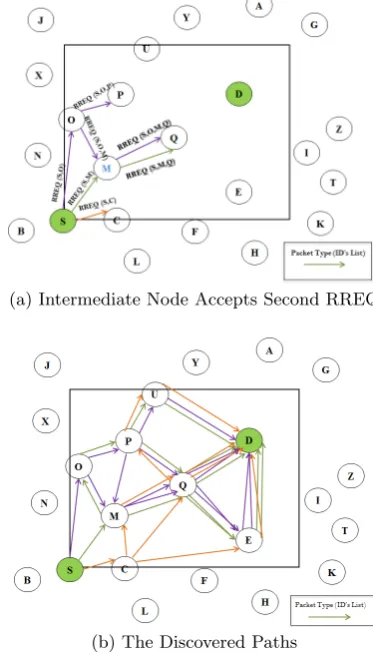
SC-MNPDis a source node controlled path discovery method that is used by the source node to first discover all the avail-able paths to a destination node, and then, the source node identifies a subset of paths that are node-disjoint from the set of paths discovered. An intermediate node, upon re-ceiving a RREQ packet, simply forwards it onto a set of selected neighbours by using the neighbours selection algo-rithm (NSA). This set of neighbours is chosen based on their trust values. MultipleRREQs with the same sequence num-ber are also forwarded on. Figure 4 uses an example to
illustrate the multiple path discovery process using the SC-MNPD method.
(a) Intermediate Node Accepts Second RREQ
(b) The Discovered Paths
Figure 4: SC-MNPD Method
As shown in Figure 4(a), the source node,S, sends aRREQ packet to a selected set of neighbouring nodes, O,M and C . When node M receives the RREQ packet from node S , it accepts the packet and passes it to a set of selected neighbouring nodes. Next,M receives another copy of the same RREQ coming from a different path, i. e. S->O , and it also accepts the packet and passes it on. As shown in Figure 4(b), for this single path discovery session, the destination node will eventually receives 14RREQpackets through different paths, and, for eachRREQit receives, the destination node sends aRREP back to the source node.
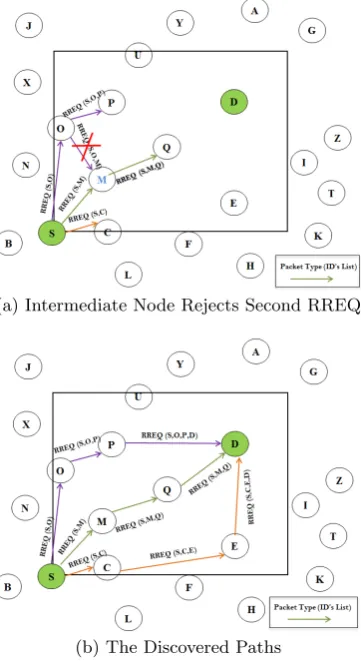
IC-MNPD discovers multiple node-disjoint paths with re-duced control overhead. IC-MNPDis executed by diate nodes during a path discovery process. An interme-diate node will only pass the RREQ once, filters out any duplicated RREQs. Each node stores the sequence num-bers carried in all theRREQs that pass through the node in aRREQSequence Number (RSN) table.
end of the discovery process, only one set of node-disjoint paths will be discovered. Figure 5 uses an example to illus-trate the working of theIC-MNPDmethod.
(a) Intermediate Node Rejects Second RREQ
(b) The Discovered Paths
Figure 5: IC−M N P D Method
As shown in Figure 5(a), the source nodeS sends aRREQ packet to a selected set of neighbouring nodes,O,M andC . NodeM filters out a duplicatedRREQ . It receives and accepts the first RREQ from node S . When M receives another copy of the same RREQ coming from a different path, i. e. S->O, it rejects it. As shown in Figure 5(b), in this way, only one set of node-disjoint paths is discovered, and the number of control packets propagated in the network is also reduced.
Algorithm 1The IC-MNPD method
procedureThe IC-MNPD method(RREQ) SearchRSN forRREQseq
if RREQseqis foundthen
RREQRejected .AvoidRREQDuplication
else
RREQAccepted
AddRREQseqto theRSN table
end if end procedure
InMA-MNPD , as shown in Algorithm 2, upon receiving
aRREQpacket, an intermediate node calculates the aver-age neighbouring nodes mobility level, AvrM obneighbouring
. If the calculated value is high (above a predefined mobil-ity level threshold,T HRmob,TADL-V2 uses theIC-MNPD
method for path discovery. Otherwise, i.e., when the cal-culated value is below this threshold value, it uses the SC-MNPD method. All the threshold values are proven exper-imentally.
Algorithm 2The MA-MNPD method
procedureThe MA-MNPD method(RREQ) Calculate theAvrM obneighbouring
if AvrM obneighbouring >=T HRmob then
Use SC-MNPD method
else
Use IC-MNPD method
end if end procedure
4.1.5
Mobility-based Adaptive Adjusting Searching
Area Algorithm (MA-AS2A):
MA-AS2Aadjusts the size of a searching area used in a path discovery process. It implements a set of rules to govern the selection of the start search area size for each route discovery process based on the neighbouring nodes mobility level.
As mention earlier, there are three searching area sizes (Area-S, Area-M, or Area-L). The path discovery protocol should start with any of these sizes in each path discovery session. Intuitively, this choice may be made based on the number of discovered paths in the previous search. For example, if the number of discovered paths in the previous search is equal to the required amount of paths, the current search may start from the same searching area size used in the previous search. If the number of paths discovered in the previous search is higher than the required number of paths, then the current search decrease the previous search area. If the num-ber of paths discovered in the previous search is less than the current required number of paths, the current search area uses larger searching area than the previous searching area.
However, the above decision rules may be adequate if the underlying network is static, which is typically not true in a mobile MANET. In addition, there are three other factors which should be considered when choosing a searching area size to start a search. These factors are the neighbouring nodes attacker ratio, the neighbouring nodes average mobil-ity level, and the time of the previous search attempt.
Factor 1 - neighbouring nodes attacker ratio: This is the ra-tio of the number of neighbouring nodes attackers over the total number of neighbouring nodes. When the neighbouring nodes attacker ratio is high, the possibility of finding trust-worthy paths in a small searching area is low. Conversely, the probability of finding a sufficient number of trustworthy paths in a larger searching area is higher.
pre-vious occasion would be more likely to become obsolete and the probability of finding a sufficient number of trustworthy paths in a larger searching area is higher.
Factor 3 - the time of the previous search attemptTprv: The
topology is not only affected by the node mobility, but it also changes with time. The longer the time elapses since the last search operation, the more likely the topology will change and the paths discovered in the previous search operation is considered as obsolete. The above discussed rules have been implemented in Algorithm 3.
Algorithm 3MA-AS2A Algorithm 1: procedureMA-AS2A
2: if AttackRatio >=T HRattthen
3: SAScur←Area−L
4: else
5: if AvrM obneighbouring>=T HRmob then
6: SAScur←Area−L
7: else
8: if Tcur−Tprv>=T HRT then
9: SAScur←Area−S
10: else
11: if N P Sprv=N P Sreq then
12: SAScur←SASprv;
13: else
14: if N P Sprv> N P Sreq then
15: SAScur←SASprv−1;
16: else
17: SAScur←SASprv+ 1;
18: end if
19: end if
20: end if
21: end if
22: end if
returnSAScur
23: end procedure
As shown in the Algorithm 3,MA-AS2Astarts by checking the attacker ratio of the neighbouring nodes. If the neigh-bouring nodes attacker ratio is above a predefined thresh-old value, T HRatt , MA-AS2A starts the search from the
largest searching area, Area-L, which covers the whole net-work. Otherwise,MA-AS2Achecks the mobility level of the neighbouring nodes. If the average mobility level is above a predefined threshold value, T HRmob , MA-AS2A starts
with the largest searching area, Area-L.
Otherwise, If the neighbouring nodes attacker ratio is less than T HRatt and the average mobility level is less than
T HRmob,MA-AS2Achecks the time of the previous search
attemptTprv . IfTprv is above a specified threshold value
for the time it elapses since the last search operation,T HRT
,MA-AS2Astarts from the smallest searching area, Area-S. Otherwise, the choice is made based on the number of dis-covered paths in the previous search,N P Sprv . IfN P Sprv
is equal to the required amount of paths, N P Sreq , the
current search may start from the same searching area size used in the previous search,N P Sprv. IfN P Sprv is higher
thanN P Sreq , then the current search will use a smaller
search area than the previous search. IfN P Sprvis less than
N P Sreqthe current search will use a larger search area than
the previous one.
4.2
The TADL-V2 Protocol Operation
This section describes the operation of the TADL-V2 pro-tocol and how it is used to discover node-disjoint multiple paths. The protocol consists of a TADL-V2 source node operations, a TADL-V2 intermediate node operations and aTADL-V2 destination node operations. We only focus on the source and intermediate node components, as the desti-nation component is identical to the one used inTADL[2] TADL-V2.
4.2.1
The TADL-V2 Source Node Operations:
This component searches the network to find as many num-ber of paths linking a source nodeS to a destination node D. As shown in Algorithm 4, TADL-V2 the source node, S, first searches its routing table for a valid set of paths to the destination node, D . IfS finds a valid set, S it uses these paths to transmit the high priority traffic. Otherwise, S reads D physical location from its routing table. If S does not know the location ofD,S defaults to use the ba-sic broadcast method to discovery paths. In this case, the source nodeSand all the intermediate nodes that receive the RREQ packet will broadcast theRREQpacket to all the neighbouring nodes, until the destination node is reached.
Algorithm 4The TADL-V2 source node Operation 1: procedureTADL-V2 Source Node(T raf f ic) 2: Search for valid set of paths toD
3: if Paths toDis foundthen
4: SelectedP aths←PSA(DiscoveredPaths) 5: Transmit traffic overSelectedP aths 6: else
7: Search forD’s physical location
8: if D’s physical location is not foundthen
9: SelectedN eighbours←Allneighbours 10: else
11: do
12: SAScur←MA-AS2A()
13: SelectedN eighbours←NSA(SAScur)
14: SendRREQto theSelectedN eighbours 15: Sinitiates aRDT imertimer
16: Wait for aRREP(s) fromD 17: if RREP(s) arrivedthen
18: SelectedP aths ←
PSA(DiscoveredPaths)
19: Transmit Traffic overSelectedP aths
20: else
21: if SAScur==Area−Lthen
22: Dis an unreachable destination
23: Exit
24: end if
25: SAScur←SAScur+ 1
26: end if
27: whileSAScur!=Area−L
28: end if
29: end if
30: end procedure
algo-rithm to identify the starting search area size (Section 4.1.5). In this case, theRREQwill be transmitted to a set of most trusted neighbours selected using the algorithmNSA (de-scribed in [2]).
Upon the transmission of theRREQpacket, nodeSinitiates a Route Discovery Timer (RDTimer). By the expiration of this timeout interval, if S does not receive a sufficient number of Route REPly (RREP ) packets, a newRREQ will be transmitted in a larger search area than the one just used (as explained in theMA-AS2Aalgorithm). If, by the expiration of RDTimer, S receives a sufficient number of RREP packets, S will invoke PSA algorithm ( explained in Section 4.1.3) to select a set of node-disjoint paths from the discovered paths. S then sends the data traffic via the selected paths to the destination node.
4.2.2
The TADL-V2 Intermediate Node Operations:
This component implements the novel solution, the MA-MNPD method, described in Section 3. MA-MNPD is ex-ecuted by intermediate nodes when the neighbouring nodes mobility level is high. Intermediate nodes are responsible for forwarding theRREQ packet towards the direction of the destination node until the destination node is reached. They do not reply to theRREQpacket back to the source node. They are also responsible for avoidingRREQ loop-ing. As shown in Algorithm 5,TADL-V2 intermediate node component operates as follows.
Upon receiving aRREQpacket, the intermediate node checks the path list in the RREQ, RREQpath−list. If the
inter-mediate node ID,N odeID, is listed in theRREQpath−list,
the intermediate node discards theRREQpacket to avoid RREQlooping, as this means that this copy of theRREQ has already passed through this intermediate node before. Then the intermediate node invokes theMA-MNPDmethod. Upon the receipt of an RREQpacket, the method checks the neighboring nodes mobility level. If the network mobil-ity level is high, theMA-MNPD method executes the IC-MNPDmethod which rejects any duplicatedRREQpackets and selects node-disjoint paths as it passesRREQpackets on. It accepts theRREQonly once. Otherwise, if the mo-bility level is medium to low, theMA-MNPD method exe-cutes theSC-MNPDmethod which accepts all theRREQs arrived. No effort is made to differentiate or identify path types. All the available paths are discovered.
Algorithm 5TADL-V2 Intermediate node Operation
procedureTADL-V2 Intermediate Node(RREQ) SearchRREQpath−listforN odeID
if N odeIDis foundthen
RREQRejected .Avoid Looping
else
MA-MNPD(RREQ)
end if
if TheRREQis accepted then
SelectedN eighbours←NSA(SAScur)
Add node’s information toRREQpath−list
SendRREQto theSelectedN eighbours
end if end procedure
Upon accepting the RREQ packet, the intermediate node adds the values of its attributes onto the RREQpath−list
in the RREQ header. These attributes are the node ID and location information, and the trust values of the se-lected down-stream neighbours. It then forwards theRREQ packet on to the chosen neighbours which have been selected using theN SAalgorithm (described in [2]).
5.
SIMULATION STUDY
This section presents the results of our simulation study of theTADL-V2 protocol and compare the results against those from theTADLprotocol.
5.1
Performance Metrics
The simulation study is carried out using four performance metrics, i. e. control overhead, packet delivery ratio, average end-to-end packet deliver delay and discovered paths.
Control Overhead [5] refers to the total number of control packets transmitted by all the nodes in the network divided by the total number of data packets successfully received by all the destination nodes.
Packet Delivery Ratiois the ratio of the total number of data packets successfully received by the destination nodes to the total number of data packets transmitted by the source nodes.
Average End-to-End Packet Delivery Delay is the average time difference between when a data packet is transmitted by the source node and when the data packet arrives at the destination node.
Discovered Pathsis the total number of the discovered paths during a path discovery process by all the source nodes in the network.
5.2
Simulation Model
The study is carried out using the network simulator NS-2 (version 2. 27. 2) [9]. The network consists of 50 nodes located in a 1000m x 1000m area. Nodes move according to the Random Waypoint Mobility model. They move with a minimum speed of 1 m/s, and a maximum speed of 19 m/s. The duration of each simulation run is 900 seconds. Constant bit rate (CBR) traffic is transmitted at a rate of 4 packets per second. The packet size is 512 bytes. The traffic load used is transmitted by 40% of the nodes. 30% of the source nodes transmits high priority traffic, and the remaining 70% of source nodes transmits low priority traffic. These parameter settings are commonly used in the relevant studies published in literature [10].
5.3
Simulation Results
This section describes the simulation results and compares the results of the TADL-V2 protocol with those from the TADL protocol. TADL-V2 performs in exactly the same manner as TADL when the network mobility level is low or medium, they differs only in how node-disjoint paths are discovered when the network mobility level is high. There are two foundational differences.
the source node and a destination node, TADL uses SC-MNPD method that discovers all the non-disjoint paths linking the source and the destination nodes in the speci-fied search area. Then the source node identifies and selects all possible sets of node-disjoint paths from the discovered paths. Whereas, TADL-V2 uses the MA-MNPD method that uses theSC-MNPD method at a low or medium net-work mobility level, but switches to theIC-MNPD method if the network mobility level is high. In IC-MNPD, inter-mediate node are involved during the process of packet for-warding. They filters out any duplicated RREQ packets and selects node-disjoint pathsRREQ.
Secondly,TADLusesAS2Amethod that starts the discovery process with the smallest search area and then progressively moves to larger sizes if the number of paths discovered is less than required. Whereas, to optimize the trade-off be-tween the number of discovered paths, and the level of traf-fic poured into the network,TADL-V2 uses theMA-AS2A method that usesAS2Awhen the network mobility level is at a low to medium level and when the network mobility level is high,TADL-V2 starts with the largest search area.
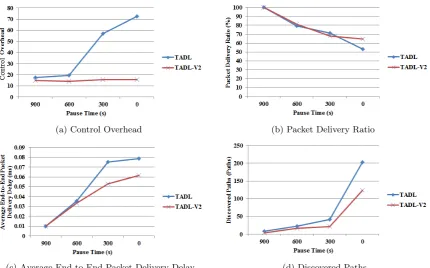
The study shows the effects of varying network node mobil-ity levels on control overheads, packet delivery ratios, av-erage end-to-end packet delivery delays and the number of discovered paths (Figure 6). Different pause times are used to reflect the mobility levels. These are 0, 300, 600, and 900 seconds. The 0 second pause time indicates that the network nodes move continuously, whereas the 900 second pause time indicates the network nodes are stationary. Results are av-eraged over 30 simulation runs, with a 2.86 confidence level.
The simulation results from Figure 6 show that theTADL andTADL-V2protocols are almost the same in a stationary network or a network with a low to medium level of mobil-ity. Whereas, TADL-V2 significantly outperforms TADL in a high mobility network. When the mobility level in-creases, links break very frequently causing packet deliv-ery to fail, and in this case, the sending node will return a route error (RRER) packet to the source node. For each RRERreceived, the source node restarts a new path dis-covery process if the source node did not find an alterna-tive path(s). The new path discovery process increase the number of control packets, thus increases the control over-head. From Figure 6(a), it can be seen that the number of control overhead increases slightly in TADL-V2, but in TADL, it increases sharply. The different levels in the con-trol overhead increase can be contributed to the fact that, in TADL, moreRREQwill be passing the intermediate nodes for each search leading to a higher level of control overhead. Whereas, inTADL-V2, when the network mobility level is high, the intermediate node only passes the RREQ once, filters out any duplicatedRREQ. Otherwise, when the mo-bility level is low to medium level,TADL-V2 acts the same asTADL, they pass all theRREQto allow discovering more paths. The control overhead reduction indicates that, to dis-cover multiple paths in a high mobility network, adjusting the injection of control packet in the network dynamically based on the node mobility level, can significantly reduce the control overhead in the network.
Figure 6(b) shows the effect of varying network node
mobil-ity levels on the packet delivery ratio. From the figure, it can be seen that, the PDR ratios decreases as the network mobility level increases. This observation is in line with our expectation - high mobility level means more links break and more path discovery needed, which requires more con-trol packets to discover alternative paths. This increase the chance of the network being congested, which can lead to PDR drops. From the figure, we can see that the PDR of TADL-V2 is better thanTADLin a high mobility network as the first produce less control overhead than the second. Less congested networks allow more packets to be delivered.
Figure 6(c) shows the effect of varying network node mo-bility levels on the average end-to-end packet delivery de-lay. The figure shows thatTADL-V2 performs better than TADLin a high mobility network with a greater difference in delay betweenTADL-V2 andTADLis 42.3% at 0s pause time. This is a consequence of the reduced control overhead ofTADL-V2; InTADL, the high control overhead congests the network; the data packets take a longer time at the con-gested intermediate nodes to be served.
Figure 6(d) shows the effect of varying network node mobil-ity levels on the number of discovered paths. When the mo-bility level increases more paths are being discovered. This is due to more frequent link breaks, and more paths are re-quired to be discovered as mentioned earlier. It also can be shown from the figure that, inTADL-V2, decreasing the RREQpackets during the path discovery process in a high mobility level, has no significant effects on the number of discovered paths. InTADL, searching for paths in a small searching area will cause fewer paths to be discovered; and in the high mobility level, more paths needed to be recon-structed, as the discovered paths will be no longer available and no alternative paths can be used immediately. Whereas, inTADL-V2, involving the intermediate node in the node-disjoint path decision in TADL-V2 reduces the number of control packet poured into the network (as shown in Fig-ure 6(a)). However, reducing the number of control packet in this way reduces the number of discovered paths. As, at the end of the discovery process, only one set of node-disjoint paths will be discovered. On the other hand, increasing the searching area, increases the probability of finding a large number of valid paths.
6.
CONCLUSIONS
This paper has presented the design and evaluation study of a novel multiple node-disjoint path discovery protocol, TADL-V2. It overcomes the limitations identified in an ear-lier published protocol, theTADLprotocol. TADL-V2 inte-grates two novel methods, an intermediate node controlled node-disjoint path discovery method and a mobility-based adaptive search area adjustment algorithm, into a trust-aware dynamic location-based multi-path discovery proto-col for MANETs. This integration enables multiple node-disjoint paths to be discovered with less control overheads in a highly mobile network. Simulation results show that TADL-V2 provides a better performance thanTADL in a high mobility network in terms of reducing control over-heads. This overhead reduction has a positive effect on packet delivery ratio and end-to-end packet delivery delay.
(a) Control Overhead (b) Packet Delivery Ratio
(c) Average End-to-End Packet Delivery Delay (d) Discovered Paths
Figure 6: Network Nodes Mobility Levels Vs control overhead, Packet Delivery Ratio, Average End-to-End Packet Delivery Delay and Discovered Paths forTADL-V2 and TADL
approaches, SC-MNPD and IC-MNPD. The former places less trust on intermediate nodes, but introduces more control overheads into the underlying network, whereas the latter TADL-V2assumes more trust on the intermediate nodes, but can reduce control overhead by 76.4% at 0s pause time. As our future work, we shall investigate how to identify and counter any misbehavior by the intermediate node during a path discovery process, and try to find out a solution to lower the level of trust on the intermediate node.
Acknowledgments
Helen Bakhsh gratefully acknowledges King Abdulaziz Uni-versity (KAU) and Saudi Ministry of Higher Education for their financial supports.
7.
REFERENCES
[1] M. Wang, “Manet global connectivity and mobility management using hmipv6 and olsr,” Ph.D. dissertation, Carleton University, 2003.
[2] H. Bakhsh, N. Zhang, and A. Carpenter, “Tadl: A trust-aware dynamic location-based protocol for discovering multiple paths in manets,” inProceedings of the 16th ACM International Conference on Distributed Computing and Networking, ser. ICDCN ’15. Goa, India: ACM, 2015.
[3] S. Mueller, R. Tsang, and D. Ghosal, “Multipath routing in mobile ad hoc networks: Issues and challenges,”Performance Tools and Applications to Networked Systems, pp. 209–234, 2004.
[4] M. Gerharz, C. Vogt, and C. De Waal, “Current approaches towards improved quality-of-service provision in mobile ad-hoc networks,”Computer Science Department, Communications Systems, 2003.
[5] S. Lee and M. Gerla, “Split multipath routing with maximally disjoint paths in ad hoc networks,” in Communications, 2001. ICC 2001. IEEE International Conference on, vol. 10. IEEE, 2001, pp. 3201–3205. [6] Z. Ye, S. V. Krishnamurthy, and S. K. Tripathi, “A
framework for reliable routing in mobile ad hoc networks,” inIEEE INFOCOM, 2003, pp. 270–280. [7] M. Marina and S. Das, “On-demand multipath
distance vector routing in ad hoc networks,” in Network Protocols, 2001. Ninth International Conference on, Nov 2001, pp. 14–23.
[8] Y. Zhang, T. Yan, J. Tian, Q. Hu, G. Wang, and Z. Li, “Tohip: A topology-hiding multipath routing protocol in mobile ad hoc networks,”Ad Hoc Networks, vol. 21, no. 0, pp. 109 – 122, 2014. [9] T. N. Simulator, “ns-2.
http://nsnam.isi.edu/nsnam/index. retrieved:,” May 2014. [Online]. Available:
http://nsnam.isi.edu/nsnam/index
[10] P. J. McNerney and N. Zhang, “A 2-dimensional approach to qos provisioning in adversarial mobile ad hoc network environments,” inProceedings of the 15th ACM International Conference on Modeling, Analysis and Simulation of Wireless and Mobile Systems, ser. MSWiM ’12. New York, NY, USA: ACM, 2012, pp. 143–150. [Online]. Available: