AND ACHIEVEMENT IN SCIENCE:
A STUDY OF SECONDARY SCHOOLS IN PORTUGAL
VOLUME ONE
Ana Maria Roseta Morais Delgado Domingos
Thesis submitted for the degree of Doctor of Philosophy
ABSTRACT
The thesis is concerned to investigate differential patterns of achievement in the sciences in middle and upper sections of eight Portuguese secondary schools selected according to location (city, country) and social class composition of pupils. The total sample of pupils is 1300. Achievement is measured by the scores obtained over a period of one year in science tests created and given by the eleven teachers of the classes of the pupils. These tests are
obliged by the Government to measure achievement in two ways. Firstly by questions testing the pupil's understanding of basic definitions and factual knowledge (A competencies) and secondly by questions testing pupil's powers to apply and generalise scientific knowledge to a range of problems (U competencies). The thesis presents an analysis of the teacher's competence in distinguishing between these two types of competencies and an analysis of the pedagogic class-room competence of the teachers in transmitting the required skills. The results show that the effectiveness of the
pedagogic practice of the teachers is related to the social class background of the pupils. Analysis of the pupils' scores (A and U) reveals a strong relation with social class and within social class to the gender of the pupil. These relations are especially strong in the case of U
competencies. A more delicate analysis was undertaken to examine the inter-relations between teacher's pedagogic
practice, location of school, social composition of school's pupils and gender in order to isolate the conditions under which the school exerts a stronger influence upon achieve-ment in science than the influence of the pupil's family background.
A model derived from Bernstein's theory of cultural reproduction is used to interpret the results and to
This thesis is dedicated to
ACKNOWLEDGEMENTS
I would like to thank a number of people who have helped me during the course of the research.
I have always found invaluable the support, encourage-ment and enthusiasm of my supervisor, Professor Basil
Bernstein. His critical insights, and willingness to over-come difficulties in crossing boundaries of established disciplines and conceptual frameworks, made an important contribution to deal with the many problems of the thesis.
I welcomed the advice of a number of people on the quantitative treatment of the data: Dr. Arnot of the
Department of Informatics of the New University of Lisbon, for overall discussions on the methodology of numerical treatment of data; the Technical University of Lisbon which made available all the computing resources needed and
Professor J.J. Delgado Domingos for discussions on the numerical treatment of data. To Professor A. Sedas Nunes and to Eduarda Cruzeiro of the GIS-Grupo de Investiga90es Sociologicas, I thank for the discussions on the problem of constructing the social class index.
This research was utterly dependent on the goodwill and help of teachers. I am most indebted to the teachers who worked with me in the collecting of data. They
generously gave up their free time in a task which was well beyond their normal duties. Although the findings are not always comforting I hope they will consider them as an attempt to solve problems we have shared.
I would also like to thank the Portuguese institutions who gave financial support and the permission for my
absence at the various stages of the research: in the
Ministry of Education, the Instituto Nacional de Investiga9~o Cientifica, the Direc90es Gerais do Pessoal e dos Ensinos Secundario e Superior, the Escola Secundaria Rainha D. Leonor; the Ministry of Culture and the Gulbenkian Founda-tion.
I am very grateful to Michele who typed the thesis so efficiently and who helped in the graphic representation.
Finally, to members of my family who, in different ways, made i t easier for me to carry out the research by sharing the many family responsibilities: to my husband, my three children, my mother and my dearest friend Lourdes. To
Maria, who helped to maintain a horne during my absence; she gave me the freedom I needed to complete the demanding work of the thesis. To my youngest child, Tiago, I owe a special thanks and a special excuse, for he is the one who was
CONTENTS
VOLUME ONE
Page 1 Abstract Acknowledgements 2 4 12 Figures: Tables and Diagrams
INTRODUCTION 17
CHAPTER ONE: THE CONTEXT OF RESEARCH 19
1. Introduction 20
2. Changes in Portuguese Science
Education 20
3. The New Curricula and Theories
of Acquisition and Transmission 27
3.1 3.2 3.3
Contribution of Piaget Contribution of Bruner Some Possible Causes of
Failure
4. Theoretical Orientation of the
Research
5. Analysis of a Modern Science
Course
5.1 Brief Characterization 5.2 A Summary Sociological
Analysis
6. Hypotheses
7. Notes and References
8. Bibliography
CHAPTER TWO: INTRODUCTION TO THE EMPIRICAL STUDY
27 33 38 45 53 53 55 58 59 63 71
1. Introduction 72
2. The Selection of Science Subjects
and the Procedures for their
Analysis 76
2.1 The Choice of Science Subjects 76 2.2 Achievement Assessed by
Teacher's Tests 77
2.3 Separation of Competencies in Two Groups and Teachers'
Power of Discrimination 78
3. The Sample - Choice and Distribution 81
4. The Role of the Teachers in the
Creation of the Pupils' Data 88
4.1 4.2 4.3
Information on Family Background
Pupils' Test Scores
Principles of the Distinction between A and U Competencies and of the Marking of
Pupils' Answers
88 89
Page 4.4 Special Teaching Programme 91 5. The Scaling of Social Class Indices 92
5.1 Introduction 93
5.2 Father's and Mother's Occupations 95 5.3 Father's and Mother's
Educa-tional Qualifications 103 6. Genera l Characteris tics of the
Sample 105
7.
8. 9.
6.1 Type of Primary School
6.2 Gender and Middle and Upper School 6.3 6.4 6.5 6.6 6.7 6.8 6.9 6.10 6.11
Years Repeated during School Life
Numbers of Pupils Per Type of Teacher
School Location, School Type and Pupils
Father's and Mother's Educa-tional Qualification
Father's and Mother's Occupations
Father's and Mother's Age Siblings
Sibling Position
Living with Both Parents or with One
Problems of the Sample 7.1 Selection of Teachers
7.2 Validity of Information Derived from the Questionnaire
Notes and References Bibliography
Appendix
PART I - THE TEACHERS
CHAPTER THREE: PATTERNS OF ACHIEVEMENT IN DIFFERENT
106 106 106 107 107 108 109 109 109 110 110 110
I I I
112 113 115 116
124
TYPES OF COMPETENCIES 125
1. In troduction 126
2. First Theoretical Model 127
2.1 Learning at the 'Minimum
Essentials Level' 127
2.2 Learning at the 'Developmental
Level' 129
3. Initial Hypothesis 4. Empirical Study
5. Final Model 155 5.1 Development of Competencies
Requiring a Low Level of 155 Abstraction
5.2 Development of Competencies Requiring a High Level of
Abstraction 157
6. Evaluation of the Objectives Model 162
7. Conclusion 165
8. Notes and References 166
9. Bibliography 169
CHAPTER FOUR: TEACHER'S PEDAGOGIC PRACTICE
1. Introduction
2. Teacher's Degree
of
Competencein Distinguishing A and U Competencies
2.1 First Stage of Procedure
-170 171
173
The Data 174
2.2 Second Stage of Procedure
-The Measure of Teachers' 176 Reliability
2.3 Additional Criterion for
the Assessment of Teachers'
Reliability 190
2.4 A Qualitative Assessment of
Teachers' Reliability 193 2.5 Final Interpretation 197
3. Teacher's Degree of Demand in the
Marking of Pupils' Answers 199
3.1 First Stage of Procedure
-The Data 199
3.2 Second Stage of Procedure -Analysis of Teachers Degree
of Agreement 202
3.3 Final Interpretation 212
4. Patterns of Achievement in A and
U Competencies in Different
Teachers' Pupils 217
4.1 Third Term Achievement in
A and U Competencies 218 4.2 Relationship between A and
U Competencies 226
4.3 Pupil's Progress During
the Year 228
4.4 Final Interpretation 232
5. The Characterising and Ranking of
the Teachers' Pedagogic Practice 233
6. Notes and References 240
PART II - THE PUPILS 244
CHAPTER FIVE: QUANTITATIVE ANALYSIS OF SOCIOLOGICAL
VARIABLES AND ACHIEVEMENT 245
1. Introduction 246
2. Analysis of Data by Stepwise
Regression 249
2.1 Some Theoretical Considerations 249
2.2 Results for Summary Statistics
and Correlations 252
2.3 Numerical Computation of
Stepwise Regression 253
2.4 Analysis of Results 256
;). Conclusion 267
4. Notes and References 269
5. Bibliography 272
CHAPTER SIX: GENDER AND ACHIEVEMENT 273
1. Introduction 274
2. Gender Differences in Achievement 275
3.
4.
5. 6. 7.
CHAPTER SEVEN:
1 .
2.
2.1 Data Organization and
Comparisons
2.2 First Stage
2.3 Second Stage
2.4 Third Stage
2.5 Final Stage
Questions Arising out of the Analysis
Changes in Teacher's Pedagogic Practice and Differential Gender Achievement
4.1 Procedure
4.2 Findings
4.3 Interpretation
Conclusion
Notes and References Bibliography
SOCIAL CLASS AND ACHIEVEMENT
Introduction
Analysis Based on Father's Educational Qualification
2.1 Choice of Index of Social
Class
2.2 Data Organization and
2.3 First Stage 319
2.4 Second Stage 325
2.5 Social Class and Achievement
as Mediated by Other Variables 333
3. Analysis Based on Other Social
Class Indices
3.1 Mother's Educational
349
Qualification 350
3.2 Father's and Mother's
Occupa-tions 351
3.3 Analysis of Discrete
Occupational Groups 358 3.4 Comparison of Different
Social Class Indices 362
4. Changes irr Teacher's Pedagogic
Practice and Social Class Differential Achievement
4.1 4.2 4.3 Procedure Data Interpretation
5. Conc lusion
6. Notes and References
7. Bibl£ography
CHAPTER EIGHT: CONCLUSION
Major Findings, Discussion and Policy
365 366 367 368 371 375 378
Implications 379
1. Introduction 380
2. Conclusions of the Empirical Study 3&2
2.1 Influence of Social Class
on Science Achievement 382 2.2 Influence of Gender on Science
Achievement 384
2.3 Influence of Teachers' Peda-gogic Practice and the
School Context 386
3. The Level of Demand of Science
Courses
3.1 Differential Achievement and
390
Conceptual Demand 390
3.2 Reduction of Differential
Achievement 393
4. Contribution of the Findings to
the Initial Problem
5. Introduction of a Theoretical
Model
6. Reflections on the Methods and
Research
7. Policy Implications
8. Notes and References
9. Bibliography
VOLUME TVJO
APPENDIX ONE:
APPENDIX TVJO:
APPENDIX THREE:
APPENDIX FOUR:
APPENDIX FIVE:
APPENDIX SIX:
APPENDIX SEVEN:
APPENDIX EIGHT:
APPENDIX NINE:
APPENDIX TEN:
APPENDIX ELEVEN:
CHARACTERISTICS OF SCHOOLS
INVOLVED IN THE EMPIRICAL STUDY SUMMARY CURRICULUM VITAE OF
TEACHERS INVOLVED IN THE EMPIRICAL STUDY
INSTRUMENTS
SAMPLE OF TESTS GIVEN BY TEACHERS TO THEIR PUPILS
QUESTIONS TO TEST SELECTED OBJECTIVES
MEASURES OF SELECTED OBJECTIVES MEASURES OF TEACHERS
SUMMARY STATISTICS AND MATRICES OF CORRELATIONS OF SOCIOLOGICAL VARIABLES AND ACHIEVEMENT
RESULTS OF THE STEPWISE REGRESSION ANALYSIS
BASE DATA
EDUCATIONAL SYSTEM IN PORTUGAL AND CURRICULUM ORGANISATION OF SECONDARY EDUCATION
GENERAL BIBLIOGRAPHY:
413
415
425
441
452
465
482
496
501
532
541
564
FIGURES: TABLES AND DIAGRAMS
CHAPTER ONE 1.1
1.2
1.3
Piaget's stages of cognitive development Distribution of pupils of different social
classes throughout the marks scale: pilot study
Distribution of pupils of different social classes by achievement in two types of competencies: pilot study
CHAPTER TWO 2.1
2.2
2.3
2.4
Distribution of the sample: Number of
classes within each year and each subject and referred to teachers, in relation to school areas
Drop-outs with reference to initial enrolments Distribution of the final sample: Middle
school
Distribution of the final sample: Upper
school
CHAPTER THREE 3.1 3.2 3.3 3.4 3.5 3.6
Final state of learning of a 'minimum level' objective
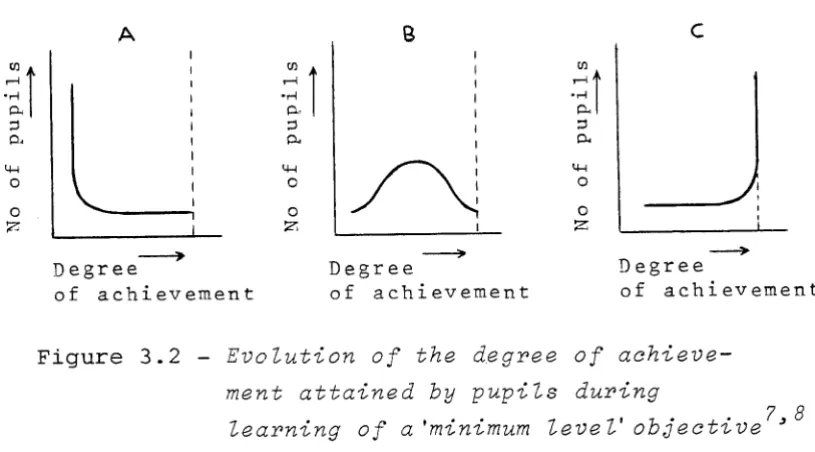
Evolution of the degree of achievement attained by pupils during learning of a 'minimum level' objective
Final state of learning for a development objective
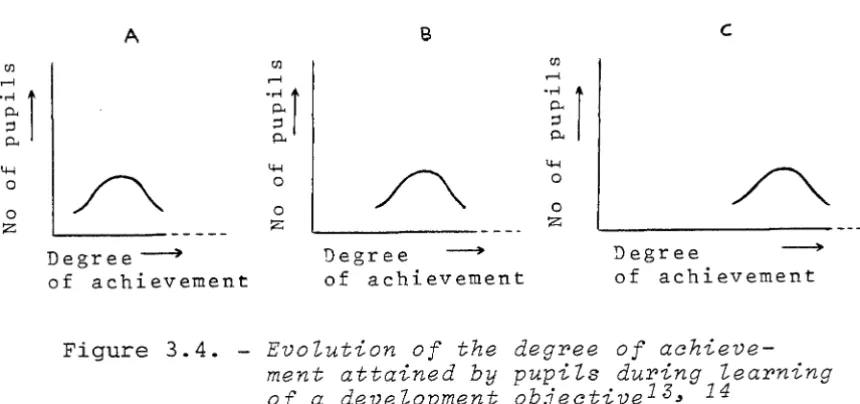
Evolution of the degree of achievement attained by pupils during learning of a development objective
Objectives assessed: questions in
different tests of Teacher X?' Year 7,
Classes A,B,E,M
Evolution of learning in different types
of competences: Results of Teacher X?'
Year 7, Classes A,B,E,M
CHAPTER FOUR
4.1 Mean Teacher and Standard Deviation
4.2 4.3 4.4 4.5 4.6 4.7 4.8 4.9 4.10 4.11 4.12 4.13 4.14 4.15 4.16 4.17 4.18 4.19 4.20 4.21 4.22 4.23 4.24
Ordering of teachers according to their global reliability (1st evaluation) Mean Teacher and Standard Deviation
according to different criteria (2nd evaluation)
Ordering of teachers according to their global reliability (2nd evaluation)
Skewness values - mean teacher as reference (1st and 2nd evaluations)
Correlation coefficients based on reliability
taking teachers X3 and X? as reference
Mean and Standard Deviation based on
reliability after normalization by standard deviation
Teachers' Means - Normalization by Standard Deviation
Teachers' Standard Deviations - Normalization by Standard Deviation
Teachers' Means - Normalization by Mean
Teachers' Standard Deviations - Normalization by Mean
Ordering of teachers by means according to their degree of demand on the marking of
pupils' answers - normalization by standard
deviation
Ordering of teachers by means according to their degree of demand on the marking of
pupils' answers - normalization by mean
Diagram of inter-relations between young teachers, and teachers working in the country and in working class schools
Marks given by teachers of middle school in
A and U competencies
Marks given by teachers of upper school in
A and U competencies
Relation between teacher and achievement: All sample, middle and upper school
Relationship between A and U competencies
Ranking of teachers according to A/U ratios
Pupils' progress of teacher X3
Pupils' progress of teacher X~
Ranking of teachers in three aifferent dimensions
Characterization of teachers through the use of three different measures
Teachers' ranking according to competence
CHAPTER FIVE
5.1
5.2
Summary of stepwise regression results: whole Middle school and Middle school separated by teacher
Summary of stepwise regression results: whole Upper school and Upper school separated by teacher
5.3
5.4
5.5
Conceptual framework for analysing the results of stepwise regression in the subsets of teachers
Classification of each teacher's
sub-sample on the basis of stepwise regression results: Middle school
Classification of each teacher's sub-sample on the basis of stepwise regression results: Upper school
CHAPTER SIX
6.1 6.2 6.3 6.4 6.5 6.6 6.7 6.8 6.9 6.10 6.11 6.12
Correlation between gender and achievement Relations between gender and achievement:
All sample, Middle and Upper School
Correlation between gender and achievement: pupils divided by teachers
Relation between gender and achievement: Middle school separated by teachers Relation between gender and achievement:
Upper school separated by teachers
Social Composition of each Teacher's Classes Relation between gender and achievement:
Middle school separated by father's academic qualification
Relation between gender and achievement: Upper school separated by father's academic qualification
Groups of teachers/schools according to increasing degree of gender differential achievement
Ratio between boys' and girls' achievement
in A and U competencies of teacher Xl's
pupils: whole sample of objectives
Ratio between boys' and girls' achievement
in A competencies (pass grade ~ 75%) of
teacher Xl'S pupils: selected objectives
Ratio between girls' and boys' achievement
in U competencies (failure grade
<
25%) ofteacher Xl's pupils: selected objectives
CHAPTER SEVEN
7.1
7.2
7.3
Correlation between father's educational qualification and achievement
Relation between father's educational qualification and achievement: All sample, Middle and Upper school
Correlation between father's educational qualification and achievement: Pupils
separated by teachers
7.4 Relation between father's educational qualification and achievement: Middle school separated by teachers
7.5 Relation between father's educational qualification and achievement: Upper school separated by teachers
7.6 Percentage of boys and girls in each teacher's sample of pupils
7.7 Relation between repetition and achievement: middle school
7.8 Relation between repetition and achievement: upper school
7.9 Relation between repetition and achievement: middle school separated by father's
educational qualification
7.10 Relation between repetition and achievement: upper school separated by father's
educational qualification
7.11 Percentage of non-repeaters and repeaters in each teacher's sample of pupils
7.12 Summary of the social composition of each teacher's sample as given by f.e.q. 7.13 Interrelationships between variables
likely to produce a higher differential achievement with social class
7.14 Interrelationships between variables likely to produce low differential achievement with social class
7.15 Relation between mother's educational
qualification and achievement: Middle and Upper school
7.16 Relation between father's occupation and achievement: Middle and Upper school 7.17 Relation between mother's occupation and
achievement: Middle and Upper school 7.18 Correlation between social class and
achievement taking four different indices of social class
7.19 Ratio between l.w.c. and m.c. children's achievement in A and U competencies of teacher Xl's pupils: whole sample of objectives
7.20 Ratio between l.w.c. and m.c. children's achievement in A competencies (pass grade ~ 75%) of teacher Xl's pupils: selected objectives
7.21 Ratio between l.w.c. and m.c. children's achievement in U competencies (failure grade
<
25%) of teacher Xl's pupils: selected objectivesCHAPTER EIGHT 8.1
8.2
8.3
Relation between level of conceptual demand and differential achievement
Influence of teachers' pedagogic practice in the decreasing of differential
achievement
Social class and pedagogic practice
391
INTRODUCTION
The thesis consists of two volumes, the first reports the empirical study and the second presents the appendices. The first volume contains an introduction to our study in which we briefly describe the context of science education in Portugal, its assumptions and limitations, together with the theoretical orientation which guided our research and the initial pilot study. Preceding the empirical study which is divided into two parts, there is one chapter con-cerned essentially with the sampling procedures, indices and their constraints. Part I of the empirical study focusses upon the teachers. In order to characterize the pedagogic practice of the teachers i t was necessary to carry out a detailed analysis of the differential patterns of the development of pupils' achievements in acquiring two
different types of competencies. This analysis, although essential, is, unfortunately, necessarily repetitive. We might suggest that the reader, if he/she wished, could read
this chapter (chapter three) when its findings are used in later analyses. Part II of the study presents the analyses and findings which refer to the pupils. Two analyses are carried out; one at the level of the whole sample and the second at the level of the specific teaching context in each school. We discuss our findings in the order in which they were generated by the focus of our analyses. Our
presentations, in general, begin with an initial, usually broad, hypothesis which during the course of its exploration leads to more delicate and specific analyses. In the
conclusion we summarise the main findings and offer our interpretation together with a brief discussion of what we take to be the major policy implications.
The second volume contains the biographies of teachers and description of schools, questionnaires, test questions, statistical tabulations, base data, and diagrams of the Portuguese educational system and its curriculum organiza-tion. We would like to explain why the second volume
CHAPTER ONE
1. INTRODUCTION
The central argument of this thesis is that the new paradigm for science education emphasised the understanding and application of general scientific principles through the use of pedagogic theories emphasising "learning by discovery" and "learning the structure of the subject". Such new curricula and pedagogic theories, stressing the active involvement of the child in his/her acquisition, were expected to increase the understanding of all children at a higher level of scientific literacy. We have reasons to believe that the benefits of the new paradigms, at least in Portugal, are not equally distributed to all children. Indeed we might wish to say that the gap between different groups of children could well have increased. More
specifically, we consider that social class, acting directly upon the family and indirectly upon the school, acts
selectively upon the process of transmission and acquisition
both in the official pedagogic context of the school and
the local pedagogic context of the family. We shall in this
initial chapter explore the grounds for this hypothesis. Firstly we shall give a brief description of changes in science education in Portugal and how they were influenced by changes in the U.S.A. Secondly, we shall examine the major pedagogic theories of transmission/acquisition and
some of their re-contextualisation. Thirdly, we shall discuss the role of the sociological context upon differ-ential acquisition. Our hypotheses will be based upon this discussion and upon an initial pilot study both of which are the basis of the major study to follow.
2. CHANGES IN PORTUGUESE SCIENCE EDUCATION
changes in science education have occurred. Changes in science education have broadly followed similar movements in other countries and were greatly influenced by changes in the U.S.A. In Portugal i t is the biological sciences
which have been the most affected by modern science teaching. The reasons and causes are complex and i t is not the aim
of this thesis to analyse this selective effect in detail of changes in science education. We will, however, to contextualize our research, give a short review of changes in science education/firstly from an international per-spective and secondly, from the perper-spective of education in Portugal.
A good summary of changes in science education and their causes is provided by the following quotation from
1
Mayer:
"The curriculum development movement initiated in 1957 with support from the National Science Foundation was a result of dissatisfaction on the part of both the scienti-fic and educational communities with the quality of science education at the secondary school level. Science was not, as taught, a list of names to be memorized nor a group of fixed answers to questions dealing with minutia. Further, the content of science did not reflect the current state of the discipline but lagged almost fifty years behind the time."
"In general, the curriculum movement concentrated on the development of materials for students on what science is, the major concepts on which i t depends, and the
presentation of contemporary content in the most effective matrix. For biology this meant an emphasis on science as a process - as a way of knowing about one's world. It
meant introducing general themes and theories that underlie the entire discipline, and i t meant a de-emphasis on
microbiology, evolution, ecology and major content blocks present by other than lectures. The emphasis on scientific investigation was reflected in the inquiry orientation of the materials and classroom presentation was organized around discussions, laboratories, and a wide variety of supplementary, student-centered activities rather than chalk and blackboard lectures".
In fact, biology and related fields were those which were most affected by the new curriculum movement. Firstly there had been major advances in the development of these scientific fields and secondly there was the successful
work of the B.S.C.S. - Biological Science Curriculum Studies.2 The U.S.A.ls B.S.C.S. was undoubtedly one of the curriculum developments which had massive impact on world science
education. As Mayer3 puts it: "The B.S.C.S. occupies a unique position in the educational world, we believe, because i t has endeavoured to incorporate modern content
in a delivery system involving the most advanced pedagogy". To assess the extent of the influence of B.S.C.S. i t should be said that adaptations of B.S.C.S. materials are being used in the schools of over sixty countries around the world and that the adapted materials have been printed in twenty languages, in addition to English-language adapta-tions.4 Referring to that influence MayerS says: "No other educational program developed in this country has such wide acceptance internationally as the B.S.C.S. materials and perhaps that is because they are in each
instance adapted locally to the particular flora, fauna, educational system and biological problems of the region concerned".
From these quotations i t is clear that the new move-ment in science curricula, especially in the biological sciences, carried the potential to make science in schools more meaningful and relevant and to develop important
schools/classes/subjects where the new science education was implemented. It was certainly the case in Portugal. Two major initiatives are responsible for the intro-duction of the new movement in science education in
Portugal which occurred in the late sixties and early
seventies. The first was the 'pilot-classes,6 which aimed at changing contents and methods in the last two years of the secondary school. The team in charge of introducing these innovations consisted of university teachers and secondary school teachers. The experiment had the support of the OEDC. An interesting (and apparently contradictory) feature of this development was that although use was made of curricula7 (contents and methods) imported from the U.S.A. and to a smaller extent from the U.K., advice was received from French expertise. However, the textbooks were written by the Portugese team.8 The number of classes
(originally only two in Lisbon) was slowly extended to other schools in the country. The experiment lasted for five
years. In 1975 i t was stopped because of pressure by groups of teachers who claimed the experiment was elitist
in character. Nevertheless the impact had already brought about change at national level in methods of teaching but especially in contents of science. The pilot-classes only functioned for the Natural Sciences (Biology and Geology) . Physics and Chemistry university teachers and secondary school teachers did not take part in these innovations which originally were intended to include all experimental
sciences.
The other major influence on science education was the in-service teacher training developed by the Gulbenkian Foundation9 which started in 1971 and was parallel for a period of time with the pilot-classes. The aim of this
was the change of methods of science teaching and this explains the focus on teacher training. It also explains why, contrary to many other countries which made
trans-lations and adaptations of textbooks and teaching materials, the Gulbenkian Foundation decided for the translation and adaptation of the booklO containing the basic philosophy of the B.S.C.S. Although the B.S.C.S. was the major
influence/the in-service training developed progressively materials of its own and in fact re-contextualized and integrated modern pedagogic methods and contents and pro-duced an original scheme.
We are not going to enter into details about the nature of these courses. However, i t seems important to
say that undoubtedly they constituted the most compre-hensive in-service teacher training which has ever been carried out in Portugal and that its characteristics made i t a unique development either by national or
inter-national standards.ll After the 1974 Revolution the courses were expanded and so a much larger number of
teachers were able to attend. However, these courses were discontinued in 1978 when those responsible in the
Gulbenkian Foundation determined that "the experience had proved its merits and should be taken up by the Ministry of Education". This never happened. Nevertheless the impact had made its mark. The new paradigms of science education had definitely made their way into the Portuguese
science classroom. From the curriculum development,
contents, methods and pupils' assessment to pre-service teacher training all showed the influence of the inter-national 'new science education' .12 It is important to note that here again, as with the pilot-classes, i t was
the biological sciences which were the focus of the changes. As before physics and chemistry researchers and teachers
on the whole were unresponsive to the new curricula
The causes of this unresponsiveness of physics and chemistry education as compared with the biological
sciences are complex and we cannot go into them here. From our pOint of view what is important to underline is that within the sciences the biological sciences are those which have undergone a comparatively much greater development. In physics and chemistry there has been no radical change in contents and methods, although some teachers have used original versions or translations of U.S.A. and U.K.
curricula13 as references and a few interesting experiments have occurred14 but with little impact on the process of teaching. Only very recently have some textbooks showed signs of the 'new science education' 15 If studies of the effects of the new curricula were to be carried out,then such studies would have to be made in the field of the biological sciences because i t was essentially in these
sciences that change took place at the level of the classroom.
We shall now briefly examine some overviews of the new
. . 1 V 16. . . h h .
SClence currlCU a. oss ln examlnlng t e researc ln
science education in 1981 concludes: "The studies indicate that science education is at the crisis stage. Many people are involved in meta-analysis attempting to determine those teaching practices that lead to effective learning and
positive attitude development. The science education
community is examining itself! It is to be hoped that new goals, direction, and support will become available".17
And Yager18 in an appraisal of the current status of science education in the U.S.A. gives some clues of the present
'crisis stage': "It is surprising in retrospect that so few questions had been raised during the twenty year period concerning the goals, the effectiveness of curriculum
about the aims of science education. We are uncertain whether to teach for the 'facts', the content of the subject, the conceptual structure of the subject, or the process of science which can be taught through scientific investigations. And i t is uncertain whether science does
develop thinking or, if i t does, which of the three aims would best assist that process" 20 The U.K./U.S.A. science education seminar in 198221 showed clearly that the
enthusiasm of the sixties and even of the seventies has disappeared and has left a general discontent with many questions to be answered and solutions to be found.
Portugal is no exception to these doubts. This sets the context in which our research began.
Essentially the new paradigms have their origin in psychology more specifically in theories of child develop-ment (Piaget, Bruner) especially concerned with cognitive development and in theories of the ordering and teaching of subjects in school (Gagne). Both of these groups of theories abstract the child from his/her institutional
and cultural context and the school/teacher from the social context regulating the processes of transmission and
acquisition. Our view is that the failure of the new
paradigm to recognise the sociological context of learning in school may well have affected the success of this
paradigm in improving the achievements of large numbers of pupils in school, more specifically of children of working-class backgrounds in Portugal.
We shall now examine the psychological theories which underpinned the new science curricula and created its
pedagogic practice. This will be followed by a discussion of aspects of Bernstein's theory which we consider has a bearing upon the sociological context of teaching and acquisition. We will derive our initial theoretical
3. THE NEW CURRICULA AND THEORIES OF ACQUISITION AND TRANSMISSION
We are going to confine ourselves here to what we take to be the basic theories underpinning the new science education. We shall place our emphasis on those theories which stress the importance of the pupil as active in his/ her acquisition.
3.1 CONTRIBUTION OF PIAGET
One of the major, if not the major influence upon science teaching (and upon teaching in general at the primary
level) is without doubt the work of Piaget. We shall now give a brief account of his work and the influence of Piaget's thought in science education.
3.1.1. Stages of Cognitive Development
Mental capacity increases progressively since the
child is born to adolescence. In devising science curricula the sequence of conceptual development in children needs to be known. Since the early twenties Piaget investigated many aspects of the development of children's thought. The work he did, or inspired, constitutes a very large proportion of all that has ever been done in this field. Piaget
demonstrated how a child's thinking progresses through three stages:
Stage 1 - Stage of Intuitive Thinking Stage 2 - Stage of Concrete Operations Stage 3 - Stage of Formal Operations
He also considered sub-stages: 2A and 2B within stage 2 and 3A and 3B within stage 3.
The U.K.'s science curriculum 'Schools Council 5/1322
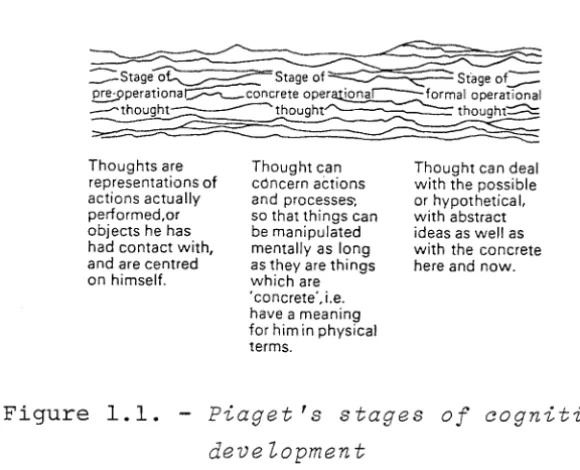
is one example of a curriculum devised on the basis of Piaget's stages of development. The way Piaget's thought
attractive (Figure 1.1).
:::::'Stage-C;-~ Stage of~ Stage of':::::::
£!!;.9perationa~ncrete oper~al operational
---thought~thought~ thought::::::=:::::
Thoughts are representations of actions actually performed,or objects he has had contact with, and are centred on himself.
Thought can concern actions and processeS', so that things can be manipulated mentally as long as they are things which are 'concrete', i.e. have a meaning for him in physical terms.
Thought can deal with the possible or hypothetical, with abstract ideas as well as with the concrete here and now.
Figure 1.1. - Piaget's stages of cognitive development
"Each wavy line might be thought of as indicating the development of a concept or the growth of an idea or the progress towards some skill or ability. There would be a very great many such lines, or strands of development; we show only a few here so that their form might indicate some of the characteristics we believe children's mental develop-ment has:
(a) The strands do not run in parallel straight lines; their waviness is meant to indicate that develop-ment does not always take place in what we think of as a forward direction.
(b) Two or more strands may meet, where separate ideas become amalgamated into a more general idea.
(c) One strand may divide into two or more, when ideas become more specific."23
rate which varies from child to child. The development is, of course, a continuous process with labels attached at certain points merely to make reference more easy. We will now look at each one of the three stages in a more detailed way.
In the first stage the child's mental work consists mainly of establishing relationships between experience and action; his concern is with manipulating the world through action. It corresponds roughly to the period from the first development of language to the fifth or sixth
year of age, and therefore, as far as schooling is concerned, this stage is characteristic principally of the kindergarten. What is principally lacking at this stage of development is what the Geneva school has called the concept of reversibi-lity. Because of this fundamental lack the child cannot understand some fundamental ideas that lie at the basis of mathematics and physics - the mathematical idea that one conserves quantity even when one partitions a set of things into sub-groups, or the physical idea that one conserves mass and weight even though one transforms the shape of an object.
The second stage is operational in contrast with the first which is merely active. The child develops an
internalized structure with which to operate. Concrete operations are guided by the logic of classes and the logic of relations but these only allow the structuring of
immediately present reality. The child is not yet readily able to deal with possibilities not directly before him/ her or not already experienced.
exaIT.ple of a test question:
Susana is taller than Sofia Susana is smaller than Rita Who is the tallest of the three?
It is not until both comparisons have been translated in the mind or on paper into verbal reasoning, that one establishes a relation between both relations and solves the problem. So a crude measure of the difference between the concrete and the formal operations stages is that, while in the former relationships can be seen (e.g. this is
bigger than that, etc.) in the latter relationships between relationships can be estahlished, and this must involve some form of symbolic representation.
3.1.2. Influence of Piaget's Thought in Science Curricula We can see then how ideas and competencies of children change enormously between the ages of 4 and 15, when they
are typically at school. If this line of thought is accepted, a number of consequences will follow with respect to science
d t · 24
e uca lon:
(a) Teachers will have great limitations in trans-mitting concepts to a child at the first stage, even in a highly intuitive manner.
(b) 'Learning by discovery' at stage 2 will be very limited as children at this stage: will only be able to make hypotheses in very simple situations; find difficulty in separating the effects of two or more variables; be satisfied when they have solved a particular problem and are unlikely to try to abstract from i t a principle which might apply in other situations, or to explain i t in terms of a generalisation; be able to reason logically but very dependent upon information from their senses, and they are unlikely to
(c) 'Learning by discovery' and the understanding of science in terms of principles will be only possible in the last two years of compulsory schooling (14-15) when children have reached the stage of formal operations. The preparatory school in Portugal when children are 10-12 years corresponds broadly to stage 2, although a few children will have already reached stage 3 in the last of these two years. The first year of
secondary school (7th year of schooling), when children are 13 still will correspond for most of them to stage 2. Teachers teaching these children must be aware that the children still need much work based on concrete material to consolidate concrete operations.
The devising of a science course should be such that its stages follow the same order of increasing logical complexity as is present in the pupils' own development. The age range over which the course is taught should match the age range over which these stages develop. The main direct consequence of Piaget's work in devising science courses is that some knowledge and some ways of aoquiring that knowledge oannot be taught to ohildren until the appropriate age is reaohed.
These ideas have already had direct influence upon the structure of some science curricula. In the U.K., for example, the 'Schools Council 5/13' is, as we have said before, essentially structured around Piaget's stages of development. Also the revision of the last editions of the Nuffield science courses was essentially based on the grounds of research into the conceptual demands of those curricula and their mismatch with the cognitive development of the children, based on Piaget's stages of development. This research has been mainly carried out
Shayer starts from Piaget's and Inhelder's ideas
about the sequence of conceptual development in children26 and tries to find out the statistical distribution of the stages, i.e. the proportions of children reaching a parti-cular level at different ages. He shows27 that in the general population only 20 per cent of children will have reached stage 3A (i.e. early formal operations), and less than 10 per cent stage 3B, at the age of 14; at the same age 100 per cent will have reached stage 2A (early concrete operational) and 80 per cent stage 2B. In a mixed ability class in a non-selective school, as i t is, in general, the case in Portugal, we should therefore expect numbers of that
28
sort in the 8th year classes. Further he shows that, also in the general population, the percentage of children able to perform formal operations will increase at the
ages of 15 and 16. About 30 per cent of the children reach stage 3A and about 10 per cent 3B. We should therefore expect numbers of that sort in the 9th and 10th years, in Portugal.
Although these findings are questionable in terms of the assumptions underlying the research and their applica-bility to other countries,29 they should not be ignored. They suggest that much of what is being taught in our 8th, 9th and 10th years of schooling cannot be learned by the majority of our pupils. One can therefore find here one cause for the fai lure chi ldren have experienced. In fact Shayer has also made an analysis of each sub-topic of the Nuffield O-level science courses30 to show that most of them require pupils to be at stage 3A considered the "minimum necessary for any interest (to make any sense of what he is doing)". If, however, the "minimum necessary for
appreciating the structure of the course" i.e. to "comprehend the course in a well-integrated way" is considered, still many topics require pupils to be at stage 3B. These courses are intended for pupils between 13-16 years of age.
learn. It is true that Nuffield Q-level science courses are intended for the top 20 per cent of the pupils and not for mixed ability classes. For such children Shayer shows31 that the stages of development occur earlier than for a
general population; e.g. in selective schools about 70 per cent of children reach stage 3A at the age of 15 and 90 per cent in super-selective schools. Even then, however many children will not be able to understand the course.
Thus Shayer concludes that a mismatch between curriculum demand and cognitive development is a major cause of failure
in the science classroom. As a solution he reco~~ends changes
in science curricula: "( ... ) until definite evidence is
obtained of the possibility of cognitive acceleration and the limits of its scope, the most substantial possibility of
improving the experience of science teaching for most pupils lies in the cognitive level matching POlicy ".32
3.2. CONTRIBUTION OF BRUNER
One of the major influences upon science teaching,
as i t has been conceived in the last two decades, is without doubt the work of Bruner. We shall now give a brief account of his thought relating i t to the work of the Geneva school we have analysed.
3.2.1. 'Learning by Inquirv' and 'Learning the Structure of the Subject'
textbooks and teacher's guides provenient from the U.S.A.) in other countries. Whether or not the book was a driving force, i t contained the basic ideas which, synthesised and conceptualised by Bruner have undoubtedly influenced science education as i t is at present in many countries. In this respect Portugal is no exception.
'Learning by inquiry' and 'learning the structure of the subject' have since then constituted fundamental para-digms in which most science curricula are predicated. In explaining the advantages of them Bruner says:
"There are at least four general claims that can be made for teaching the fundamental structure of a subject, claims in need of a detailed study. The first is that understanding fundamentals makes a subject more compre-hensible ( ... ). The second pOint relates to human memory. Perhaps the most basic thing that can be said about human memory, after a century of intensive research, is that unless detail is placed into a structured pattern, i t is rapidly forgotten ( . . . . ). Third, an understanding of fundamental principles and ideas ( . . . . ) appears to be the main road to adequate 'transfer of training' ( ... ). The fourth claim for emphasis on structure and principles in teaching is that by constantly re-examining material taught in elementary and secondary schools for its fundamental character, one is able to narrow the gap between 'advanced' knowledge and
34
'elementary' knowledge".
Before going any further, particular attention should be drawn to Bruner's statement "claims in need of detailed study". In fact, before such a study was carried out the approach was implemented.
to be in revealing the structure of science to pupils and moving in an upward spiral, returning several times to each principle progressively redefining and reforming and
eventually producing a well-woven fabric of knowledge. This is what Bruner calls the spiral curriculum. However, as he also pointed out, "much too little is known about how to teach fundamental structure effectively or how to provide learning conditions that foster it".36
3.2.2. To Facilitate Movement through the Various Stages
of Intellectual Development
We will now relate Bruner's and the Geneva school's ideas. In presenting the thought of Inhelder, Bruner shows that children can be moved faster through those stages of development if an appropriate way of teaching is
used:-"A teaching method that takes into account the natural thought processes will allow the child to discover such principles of invariance by giving him an opportunity to progress beyond his own primitive mode of thinking through confrontation by concrete data - as when he notes that liquid that looks greater in volume in a tall, thin receptacle is in fact the same as that quantity in a flat, low vessel. Concrete activity that becomes increasingly formal is what leads the child to the kind of mental mobility that approaches the naturally reversible operations of mathematics and
logic".37 "( ... ) i t is possible to draw up methods of teaching the basic ideas in science and mathematics to
children considerably younger than the traditional age. It is at this earlier age that systematic instruction can lay a groundwork in the fundamentals that can be used later and
- 38
with great profit at the secondary level".
According to him the task of teaching a subject to a child at any particular age is one of representing the structure of that subject in terms of the child's way of viewing things. When the child is still in the stage of concrete operations he/she
is capable of grasping intuitively and concretely a great many of the basic ideas of sciences, mathematics. But he can do so only in terms of concrete operations. Thus, as Inhelder points out40 basic notions in the field of sciences are accessible to children of seven to ten years of age, provided that they are divorced from their mathematical expression and studied through materials that the child can handle himself. "Later at the appropriate stage of development and given a certain amount of practice
in concrete operations, the time would be ripe for
intro-ducing them to the necessary formalism".4l However if the child has not had that early foundation he/she will not be able to understand the concepts and to use them in an
effective way. What seems important, therefore, is that the child be helped to pass progressively from concrete thinking to the utilization of more conceptually adequate modes of thought.
To sum up Bruner does not believe, and nor does the Geneva school, that children are unable to learn important concepts until they reach the age of formal thinking.
Rather he believes that such ideas can and should be grasped earlier on at an intuitive level, totally divorced from their mathematical expression. The ability to translate concepts
in a symbolic form is a sign of the stage of formal thinking when a child is able to construct abstract ideas and trans-mit them in a sYIDbolic way; at the stage of concrete
thinking he/she is able to understand those ideas in an intuitive manner.
42
As can be seen throughout the whole book, and as we have seen before, he also advocates that meaningful learning must be achieved through teaching the structure of the
of learning at an intuitive level. However, if one remembers the 'spiral curriculum' as Bruner sees it, one can understand that "moving in an upward spiral, returning several times to each principle, progressively redefining and reforming ... " may mean pupils starting to learn at an intuitive level and only performing concrete operations, and moving progressively to higher and higher levels of abstraction. Further,
learning by discovery advocated by Bruner seems contradictory to learning at an intuitive level. That learning is
obviously limited in
ZeveZ,
when the child is at the stage of concrete operations, because most of the steps involved require a high level of abstraction. Limited, however, does not mean that learning by discovery cannot be effected.Further, as Bruner points out, the important thing is to
represent the structure of the subject in terms of the child's way of viewing things. This does not imply that teaching
should be limited to that 'exact' measure thought as
appropriate for a certain stage: "experience has shown that i t is worth the effort to provide the growing child with problems that tempt him into next stages of development".43
Bruner places great emphasis on teaching methods, on the way children are taught. Appropriate teaching methods
(and of course appropriate curricula) would allow children not only to move faster but also to reach a full understanding of concepts later on.
From what was said above i t is clear that Bruner's thoughts do not contradict the Geneva school findings. How-ever, he does not use them in the 'passive' and limited way some curriculum developers and educationists have done.
children of different ages and in different subject
matters".44 This was written more than twenty years ago. Regrettably not too much has been done so far. Research like that of Shayer could be very useful provided i t did not create a basis, as i t seems to have done, for a narrow view of science courses planning and evaluation. Seen in the light of Bruner's thought, Shayer's findings would gain another dimension and would allow us to take a somehow
more optimistic view of teaching at the last years of com-prehensive schooling in Portugal (8th and 9th years) . For if Shayer tells us that 70-90 per cent of the general popu-lation will not be able to understand those concepts and conceptual schemes which give to all an integrated view of the subject and of the world in which we live, Bruner tells us that those pupils (even if those percentages are taken as fact) will be able to understand such ideas, provided they are divorced from their mathematical expression and provided they are learned at an intuitive level.
Based on these considerations i t could now be suggested that the devising of science courses should be such that, although tempting children to move to further stages of development and although allowing those children who are
able to, to grasp scientific concepts in the highest possible abstract way, could at the same time enable all children to understand scientific concepts in an intuitive way. This seems already a step further because we have been faced so far with two extremes: a few children who can understand science courses in the abstract they now demand and a large group of scientific illiterates who appear not to understand i t at all. If science education enabled all children to grasp fundamental ideas in an intuitive way, there would be some hope of having a scientifically educated population.
3.3 SOME POSSIBLE CAUSES OF FAILURE
leaves, however, fundamental gaps in the reasoning. One of them is related to causes of failure.
Why are some children able to achieve the level of formal operations much earlier than others? Why is i t that some children (according to Shayer) never attain that level during the period of compulsory schooling? Why do some children fail and other succeed so well? Why a gap between two groups of children?
With the Geneva school and Bruner i t is understood that "given a certain amount of practice in concrete
operations" children can be introduced to formalism. This can lead to the thought that children who, at the ages of fourteen or fifteen, are not yet able to grasp scientific concepts at the necessary degree of abstraction might be those who have not had that practice in concrete operations. To make the reasoning clearer let us analyse this suggestion made by Inhelder and presented by Bruner:
"One wonders in the light of all this whether i t might not be interesting to devote the first two years of school to a series of exercises in manipulating, classifying, and ordering objects in ways that highlight basic operations of logical addition, multiplication, inclusion, serial ordering and the like ( ... ). The effect of such an approach would be, we think, to put more continuity into science and mathematics and also to give the child a much better and firmer compre-hension of the concepts which, unless he has this early foundation, he will mouth later without being able to use them in any effective way".45 According to Bruner: "there is evidence to indicate that such rigorous and relevant early training [in the basic logical operations that underlie
instruction in mathematics and science] has the effect of making later learning easier".46
they point to a cause other than genetically inherited factors. Children who have experienced a certain kind of practice in concrete operations will perform better in
science subjects later on. If we look at the general
school population, such children would be identified as those who: (a) have attended two years in a pre-school
establishment (something that in Portugal exists essentially in the private school sector and therefore is essentially available to middle and upper middle-class children) between the ages of four and six; (b) and/or have attended a good primary school where practice in concrete operations is
likely to be obtained; (c) and/or have come from homes where that practice is also likely to be obtained through mother-child intercourse, games available, etc. Bruner seems to
give some importance to the 'environment'. However, he places the emphasis on the school environment rather than on the
family environment: "but the intellectual development of the child is no clockwork sequence of events: i t also responds to influences from the environment, notably the school environment".47
Further Bloom, widely known for his 'Taxonomy of educational objectives' places a great emphasis on the influence of the school environment.48 He presents the thesis that "variations in learning and the level of
learning of students are determined by the students' learning history and the quality of instruction they receive".49
The variables which have to be taken into account are three: cognitive entry behaviours, affective entry behaviours (that taken together constitute the students' learning history) and quality of instruction. The estimated effect of these on the variation in school achievement is: 25% for the
quality of instruction; 25% for affective entry behaviours; 50% for cognitive entry behaviours; 90% for all three combined.
Though one could be led to understand that some of these variables are related to 'something exterior' to
as far as saying that if one could control all these variables one would have 90% of achievement in school learning. How-ever, he concedes that since i t is difficult and often impossible for each teacher and even for each school to exert a direct influence on the children's history - which means to influence the two variables, cognitive entry
behaviours and affective entry characteristics - in the last instance "who can learn in the school is determined to a large extent by the conditions in the school; the quality of instruction is a major determiner of who will learn well
- the few or the many".50 In one way or another i t is clear
that, for him, school environment is the crucial determinant of children's achievement.
It is important to stress here that, as many other educationists, he places the focus of failure at school in
a deficit school rather than in a deficit child. He takes
the view that what one child can learn any other child can, all being a question of time in good school conditions, after the child enters the school. Therefore, i t seems,
individual characteristics, family environment, are of little importance except, may be, for those few 10% who, he concedes, cannot reach the normal degree of achievement. The tendency, shared by many educationists, to think that the school can
alone be made accountable for the achievement of a small
proportion of children seems to be shared by Bloom.
This tendency explains the development of the movement of the mastery learning spread in the U.S.A. and in some other countries in the last few years. For Gagne,51 as for Mager 52 (and Bloom) a child would learn provided the teaching
is divided in adequate learning episodes, a system of
feedback to the teacher and pupils is set, the learning pace is appropriate and so forth, irrespective of the level of
abstraction required. This assumption has led in extreme
cases to the reduction of all learning to a mastery level, something which is only possible for objectives of a very low level of abstraction. In other cases i t has led to a