Steven Bird
May 1997
1
Introduction
Dschang is one of about ten Bamileke languages,1spoken by over 300,000 people in Cameroon (Grimes 1988). The considerable interest in the language has focussed almost solely on tone, stemming from work by Hyman & Tadadjeu (1976). However, the language is also interesting for its syllable structure. The purpose of this chapter is to give a detailed description of the syllable in Dschang and show how syllable structure aids the understanding of a diverse range of diachronic, phonotactic and morphophonemic evidence.
A striking property of Dschang syllables is aspiration, which can accom-pany most segments (including voiced stops) and which, I shall argue, does not occupy a position in the syllable onset. Aspiration behaves in a curious way in the morphophonology of the language, as illustrated in (1). As an aid to the reader, verb roots have been underlined.2
1
Bamileke is a subgroup of Grassfields Bantoid in the Niger-Congo language family (Watters & Leroy 1989:435). The primary difference between Grassfields and Narrow Bantu is that Grassfields languages have a much simpler morphology. The name Dschang is pronounced [tMa8]. Data in this chapter comes from the main northern dialect, spoken
in Bafou and elsewhere.
2In this and subsequent displays, acute and grave accent symbolise high and low tone respectively. The exclamation point symbolises downstep. Final low tones are falling unless marked with a degree symbol. When referring to data in the text, I have avoided use of the // and [] marks in places where the phonemic status of the segments concerned is not at issue, or where I do not want to prejudge the status of the segments ahead of a later discussion.
(1) Infinitive Imperative Gloss
8
g
!k
gk
! be intelligent8
gh
gh
flynz
!t
z
t
!
be heavy
ntsh
!tsh
! transplantObserve that the nasal prefix which marks the infinitive is not present in the imperative, and instead a low vowel suffix is added. The situation becomes more complex when we examine the CV roots shown in (2). Note thatp andb are allophones.
(2) Infinitive Imperative Gloss
mb
!p
! smellmb
p
takeFrom (1) we would have expected to findp`ı!
´
smell! and p´´ take! but
we find instead that the suffix vowel is raised in p`ı!
´ı smell! while the root vowel is raised in p´ı´take!. From the perspective of (2), the form
tsh` !
´
transplant! now looks odd. Why do we not have tsh`ı !
´
instead? In
order to address such questions we shall first study the phonotactics of the language, using synchronic and diachronic evidence to construct a model of the syllable. Once syllable structure is understood it will be possible to explain a variety of segmental phenomena that arise in the imperative construction.
This chapter is structured as follows. Inx2 I present the segmental
inven-tory and give an overview of the basic distributional facts of the language, including a discussion of a range of segmental alternations. With this back-ground we shall be ready to move on to the structure of the syllable, first with the rhyme inx3 and then the onsetx4. Next I demonstrate inx5 how,
equipped with an understanding of syllable structure, we can understand the interesting morphophonological behaviour that appears in the impera-tive construction. Loanword phonology is considered in x6. Finally, the
major proposals of previous sections are harmonised inx7.
2
Segmental Inventory
2.1
Consonants
Dschang has six series of (phonetic) consonants with six places of articu-lation, as shown in (3).
(3) Plosives p/b t/d c/, k q b
Fricatives f/v s/z M/` K h
Affricates pf ts/dz Liquids l/r/D
Nasals m n 7 8
Glides w & j 6
Not all of these segments are phonemes, and one aim of this article will be to explain some of the alternations and distributional asymmetries in terms of syllable structure. The only consonant clusters which occur have the form (N)C(G)(h) where N is a homorganic nasal and G is a glide, or have the form (N)OL, where O is an obstruent and L is a liquid, as is characteristic of Niger-Congo languages in general (Maddieson 1981:89). Some complex articulations have not been entered into (3) since they are treated as sequences. The trillr only occurs in loanwords, while the flapD
is the intervocalic allophone oft . Unless accompanied by the h segment, voiceless stops are unaspirated. The uvular place of articulation arises only when a velar obstruent follows a low back vowel in the same syllable. Although the palatals 7, M, ` and , are just palatalised versions of their
alveolar counterparts, and the palatal stops are probably palato-alveolar affricates, we still need a palatal series for the sake ofc, since it patterns with the stops and not with the affricates. Other Bamileke languages also require a palatal series in addition to palatalisation rules (e.g. Fe’fe’, Hyman 1972:17,30).
2.2
Aspiration
It is a striking fact about Dschang, and Bamileke languages in general, that all (oral) obstruents can be aspirated. For example, in Dschang we find aspirated voiced stops in the wordsmbh` !
´
Tdog and`ndh`u descendents.
Aspirated nasals, attested in some dialects of Dschang, are rare in Bafou, and only one example has been found: l`nh `Tlay. Although referred to as
aspiration, it is widely noted that aspiration in Bamileke languages often appears as a homorganic fricative.3 In Dschang, aspiration is realised as
3
either a voiceless approximant, homorganic with a following high vowel (eg. /
mbh
T/ = [mby6T]), or simply by [h], when followed by a low vowel.In either case, when a fricative precedes, a voiceless version of the frica-tive is coarticulated with the aspiration (eg. /
afh
Tte
/ = [afyY y6Tte])Conse-quently, words likezh´ı´give birth! andzh´´ know! are both pronounced
[
zs
], but the difference in vowel quality (i vs.) is clearly discernable onthes. The presence of aspiration reduces the duration of voiceless stops, while leaving voiced stops unchanged. Aspiration on a voiceless fricative appears to lengthen the fricative (while sometimes still leaving a small amount of aspiration), e.g. /
sho
/ [sso
] fish, versus /so
/ [so
] friend. Inall cases, aspiration significantly reduces the length of the following vowel, so that a ChV syllable has similar duration to CVV syllables. Aspiration appears with a variety of vowels, always in open syllables, as shown in (4).4
(4)
l
ph
sow,l
ph
!Tpromise,
l
ph
!u
sky,l
sh
!y
resemble,l
vho
sew,l
zh
! know,l
zh
=achieveIt is reasonable to view Dschang aspiration in terms of vowel devoic-ing. However, unlike other languages having voiceless vowels (such as Japanese), vowel voicing in Dschang is lexically contrastive. Evidence for this is given in (5). The first group of four lines concerns voiceless onsets, and the second group concerns voiced onsets.
(5) Lexical contrastiveness of aspiration
Unaspirated Aspirated
le-pi
q smellle-phi
losele-tu
q intestinesle-thu
extremityle-cy
q takele-chy
growle-k
Tq fleele-kh
T trapm-bi
q smellm-bhi
losen-d
Tq raffia stringn-dh
T stomach ache 7-
,u
q debt 7-
,hu
nut8
-gi
q fertile ground 8-ghi
voice2.3
Vowels
At least superficially, the vowel inventory contains eight vowels, as dis-played in (6). A ninth vowel, the high front rounded vowel y, is also included although it plays a very marginal role.
(6) i/y T u
o
a =
Note that the high central unrounded vowel ' will everywhere be
rep-resented as T, following the orthography and the phonology literature
(e.g. Hyman 1985). Similarly, the semi-high back rounded vowel? will be
represented aso. In open syllables, the high vowels are often characterised by frication. A regular exception to this is the vowel i which cannot be fricated in some positions (e.g. in the verbal suffixes -ni and -ti ), an issue still requiring investigation.
Haynes (1989:214), following Anderson (1977:52f), analyses [T] as /iu/.
This is an extension of the way that [y] can be analysed as /ui/. However, treatingy on a par withTignores the fact thaty is in free variation with ui
(e.g.`nz`y`nzw`ı panther), whileTis stable.
5Furthermore, if we set up
Tas
a phoneme then we can show later how palatalisation and aspiration are in complementary distribution. IfT is analysed as /iu/ thenhTbecomes the
sole case of an aspirated palatalised vowel, and the analysis of aspiration as a kind of palatalisation breaks down.
2.4
Diphthongs
Dschang allows sequences of two vowels in a single syllable; a high vowel followed by a low vowel. Whether the sequence appears as a diphthong or as a glide-vowel sequence depends on the number of moras available. So the contrast between VV and GV will be treated as a structural property. (As pointed out above, the final vowel of (unsuffixed) disyllabic roots, such ask´ı´l´, must be treated as extrametrical so that the l is in the coda.) I have
written the glides using the IPA vowel symbols, since there is no symbol for the glide which corresponds to IPA ['] (orthographicT).
5Thisy
(7)
a
=i k
l
bowl
ka
plough —ak
t
x necklaceas
!akn
thanks —T
l
k
T wear —k
T= slopel
k
Tt
x penis —k
k
T=k
thinu aku
boneakua
choleraap
!u
= huntaku
t
x latrinel
k
!uap
catchap
!u
= b partObserve that there is a curious restriction between the place of articulation of the onset (labial vs non-labial) and the glide-vowel sequences which are allowed. This is explored in more detail inx3.4 andx4.2.
2.5
Some phonologically conditioned alternations
Since a number of segmental alternations affect the transcriptions and may cause confusion, they will be quickly dispensed with here. Other alterna-tions will be treated later on. Consider first the consonantal alternaalterna-tions shown in (8).
(8) Infinitive Imperative Gloss
mb
!p
! smellnd
l
sleep7,
u
`uu
uproot8
gap
apa
be poorly cooked8
gw
!u
wu
!u
rot8
gya
yaa
giveI shall not treat this as lenition of voiced stops, as Hyman (1972:22) did for Fe’fe’. Rather, I take the opposite approach, following Odden’s analysis of Kimatuumbi, which sets up p/l/w phonemes with rules for voicing of stops, delateralisation of l and post-nasal hardening of w to gw (Odden 1996:90, 89, 94). The fortition rules appear in (9).
(9) a. labial voicing p!b / N
b. delateralisation l!d / N
c. despirantisation !g / N
d. intrusive stop formation ;!d / N (
z
` )
e. post-nasal hardening ;!g / N (
w y
Each of these rules is assimilatory in nature. Rule (9a) involves the spreading of +voice, while the rest all involve the spreading of –cont. Rule (9e) merits further comment. In Dschang it is not possible to attribute the velar place of articulation to the glide as Odden (1996:95) proposes for Kimatuumbi, since this rule applies to y and not just w (as in Kimatuumbi). Rather, we take8 to be the default realisation of a coda nasal when the
following onset is not specified for place of articulation.
(10) Default Place of Articulation
ORAL
K
K
DORSAL
Now we can state a completely general version of the intrusive stop forma-tion rule (11), covering (9b-e), using the technique proposed by Clements (1987).
(11) Intrusive Stop Formation
Root
~ ~ ~
11
11
11
11
11 Root
+nas
–cont
–cons
Another consonant alternation is witnessed in the context of vowel rais-ing, wheno raises to u and raises toT, as shown in (12).
(12) Infinitive Imperative Gloss
nzo
`u
= buys
MT desireNote that despite this palatalisation, there still remains good evidence for a palatal series, given minimal pairs like´nz!
´
=insult, ´7`=´see and ´s !
´
=b raise,
´
palatalisation. However,i does condition the affrication of t to ts, despite the presence of thets africate in the phonemic inventory. High vowels are strongly spirantised in open syllables. Before u, consonants are rounded.
3
The Structure of the Rhyme
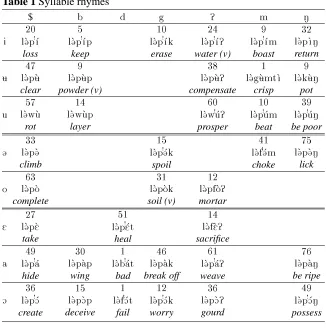
Dschang syllables may be either open, or closed by a single consonant. The coda inventory is p, t , k , b, m, and 8. This gives an inventory of
56 possible syllable rhymes.6 Examples are displayed in Table 1, where numbers indicate the lexical frequency of the rhymes.
Table 1 Syllable rhymes
$
b
d
g
bm
8i
l
20
p
!
loss5
l
p
!
p
keep10
l
p
!
k
erase24
l
p
!
bwater (v)
9
l
p
!
m
boast32
l
p
8return
T
47
l
p
Tclear
9
l
p
Tp
powder (v)
38
l
p
Tbcompensate
1
l
g
Tmt
crisp
9
l
k
T8pot
u
l
57
wu
rot
14
l
wup
layer
60
l
w
!
u
bprosper
10
l
p
!
um
beat39
l
p
!
u
8be poor
33
l
p
climb
15
l
p
!
k
spoil
41
l
f
!
m
choke
75
l
p
8lick
o
l
63
po
complete
31
l
pok
soil (v)
12
l
pfo
bmortar
27
l
p
take
51
l
p
!
t
heal
14
l
f
bsacrifice
a
l
49
p
!
a
hide30
l
pap
wing
1
l
b
!
at
bad46
l
pak
break off
61
l
p
!
a
bweave
76
l
pa
8be ripe
=
36
l
p
!
=create
15
l
p
=p
deceive
1
l
f
!
=t
fail
12
l
p
!
=k
worry
36
l
p
=bgourd
49
l
p
!
=8possess 6
The table also shows that there are many VC combinations which are unattested. The purpose of this section is to attempt to explain the gaps and arrive at a fuller understanding of the vowel inventory. In x3.1 andx3.2 I
argue thato andin closed syllables ought to be viewed as allophones of
u andT respectively, based on distributional evidence. This accords with
Voorhoeve’s approach to Bangangte, another Bamileke language, where ‘the distinction between closed and half-closed vowels ... is a slight degree of aperture, that might be less distinctive than the distinction between the allophones of the preceding consonants’ (Voorhoeve 1965:323). However, my approach (after Hyman 1972) will be to connect this allophony with the following rather than the preceding consonant.
Inx3.3 we see how this approach extends to open syllables. Finally, in
x3.4 I discuss the constraints on the rhyme which arise when a syllable
contains aspiration.
3.1
o as an allophone of u
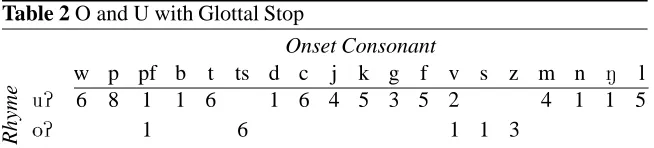
First, consider the rows of Table 1 which correspond to the vowelso and u. We begin by treating [ok] as underlying /uk/. Next we consider cases with glottal stop in coda position.
Table 2 O and U with Glottal Stop
Onset Consonant
w p pf b t ts d c j k g f v s z m n 8 l
Rhyme
u
b 6 8 1 1 6 1 6 4 5 3 5 2 4 1 1 5o
b 1 6 1 1 3From Table 2 we see that /u/ is realised as [o] after ts, s and z onsets, which we independently know to be phonemically distinct (see x4.1). The
pf and v onsets in Table 2 still indicate an ou contrast. The
correspond-ing words are listed in (13).
(13)
mpfu
bx blood pact (mpfo
b)l
pfo
bx mortar (lpfo
bx)mvo
bx space between bed and wallavu
bx remainder (avo
b)l
v
!u
bt
kitchen woodpile (lv
!o
bt
)dialect forms, given in parentheses in (13), add to the doubts about the phonemic status of the contrast. We shall leave these exceptional cases for further study and turn to the situation in open syllables, where a stronger case for phonemic contrast betweeno and u can be made. Some minimal pairs are shown in (14).
(14) o rhymes u rhymes
po
x weevilap
!
u
handl
to
sendl
tu
overturnndo
ratndu
streaml
ko
falsely accusel
ku
snorel
k
!o
enterl
k
!u
seizeSo we conclude that the only clear case for the o/u contrast is in open syllables. Before attempting an explanation for this inx3.3, we first turn to
the case of vsT.
3.2
as an allophone of
TConsider again the data in Table 1, this time focussing on those rows which correspond to the vowels andT. Observe that just as [
ok
] couldbe analysed as /
uk
/, we can treat [k
] as underlying /Tk
/. Unlike the caseofo/u, for/Tthe nasal codas seem to have a lowering effect. So we have
[
m
] from /Tm
/, with a single exceptionl`g `Tmt`ı crisp. However, if [8]comes from /T8/ there are still seven exceptional cases of [T8] rhymes to
account for. All of these occur with ak or g onset, as shown in (15).
(15)
l
k
T8x cooking potl
g
!T8 shore
l
k
T8n
refuse (v)l
g
!T8
n
twistedl
k
T8t
roll (v)l
g
T8t
skirt around8
k
T8x peace treeOne way to describe these exceptional forms is with the following con-straint on height across a syllable, where velar consonants are taken to be high.
(16) *
"
C +high
# "
V –high
#"
C +high
It is not clear why velar stops in the coda lower the vowel, but velar stops in the onset raise the vowel (for certain codas).
Again, as with o/u, there is a clear contrast between andT in open
syllables. Some minimal pairs are shown in (17).
(17) rhymes Trhymes
l
p
climbl
p
T clear (v)nd
vampirend
T raffia stringak
piecel
k
T flee8
g
!pasture
ag
T piece of calabashl
l
! sayl
l
!T rot
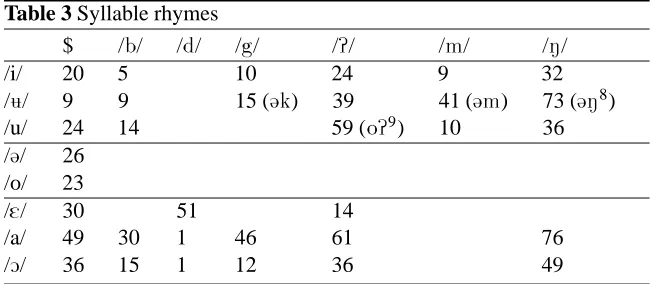
The discussion of the vowels up to this point has led us to the tentative conclusion that in closed syllables there is only a six-way contrast, involv-ingi ,T, u, , a, =. However, in open syllables there is a full eight-way
contrast, with the addition of ando. Table 3 summarises the findings so
far in the discussion.7
Table 3 Syllable rhymes
$ /
b
/ /d
/ /g
/ /b/ /m
/ /8//i/ 20 5 10 24 9 32
/T/ 9 9 15 (
k
) 39 41 (m
) 73 (88)
/u/ 24 14 59 (
o
b9) 10 36
// 26
/o/ 23
// 30 51 14
/a/ 49 30 1 46 61 76
/=/ 36 15 1 12 36 49
In the next section we shall turn to the problem of the eight-way contrast in open syllables.
7
Note that Haynes (1989:207) sets upand'as allophones (of /e/), while retainingT
as the realisation of /yu/. However, I do not see the need to distinguishTand'in this way.
Nor do I agree thatTshould be linked withu, as explained inx2.3. 8
except after k/g 9
3.3
Analysis of open syllables
According to Hyman, Proto-Bamileke morphemes generally had the struc-ture CVC (Hyman 1972:199). However, ‘for quite some time, Bamileke dialects have been modifying final vowels and consonants in VC sequences, often with the loss of the final consonant’ (Hyman 1972:197). Hyman’s reconstructed VC sequences are based on the segments shown in (18).
(18) a. PBke Vowels b. PBke Codas *i *T *u *b *d *g *b
*e *o *m *n *8
*a
Hyman began his analysis of sound change in Fe’fe’ with the assumption that in Proto-Bamileke, any of the vowels in (18a) could appear before any of the consonants in (18b). Although this assumption is not a priori necessary, since Proto-Bamileke may not have had a perfectly symmetrical system, I shall adopt it since it is convenient for the analysis of the observed distribution of segments in Dschang, and it helps in understanding some morphophonological phenomena to be discussed later. Moreover, as Cole-man reminds us, ‘the desire for system symmetry derives from the usual scientific goal of finding maximally general, exceptionless descriptions of the data ... [and] from the foundation of phonological analyses on combinatorial systems of oppositions or regular correspondences between classes of phonological units, and not just relations betwen isolated pairs of units, and is therefore to be expected, whereas asymmetries stand in need of explanation.’ (Coleman 1997).
(19) word gloss Proto Hyman Grassfields Number
8
go
gun *8gad
178nd
!o
husband *lum
206l
to
send *tum
252/322l
g
!o
ask help *ko-ti
/*gam-ti
190/191 (na ath
T)8go
porcupine *8gum
283m
k
!o
bean *kun
21ko
bed *kun
23ndo
rat *ndum
253l
k
!o
enter *kun
131l
po
x egg *bum
128We see that o in open syllables derives from *um and *un. Since um is attested in Dschang, I shall treat o as /
un
/, though in x5 this will bereanalysed non-segmentally. The same approach works for in open
syllables. Consider the forms in (20).
(20) word gloss Proto Hyman Grassfields Number
nt
!heart *
tm
186al
!tongue *
lm
392l
p
!breast *
ben
508
g
host *gen
363Here we see that in open syllables may derive from *im or *en. Since
im is already attested in Dschang and e is actually absent, I take in open
syllables to be /T
n
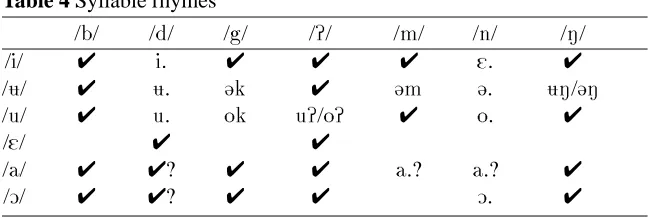
/. The syncronic function ofn codas will be simply tolower a high vowel, sincen is never attested in coda position. Accordingly, we can now create a column forn codas in our table, and drop the rows for ando. We have now completely eliminated ando, although there
are still just as many gaps in the table and the treatment of open syllables is not uniform. However, the process begun with ando can equally well
Table 4 Syllable rhymes
/
b
/ /d
/ /g
/ /b/ /m
/ /n
/ /8//
i
/ ✔i
. ✔ ✔ ✔ . ✔/T/ ✔ T.
k
✔m
. T8/8/
u
/ ✔u
.ok
u
b/o
b ✔o
. ✔// ✔ ✔
/
a
/ ✔ ✔? ✔ ✔a
.?a
.? ✔/=/ ✔ ✔? ✔ ✔ =. ✔
The open syllable forms are then related to these underlying forms by the rules shown in (21).
(21) a. d!;/ .
b.
"
V +high
#
!–high / n, n!;/ .
Two aspects of Table 4 require further comment. First, observe thatin
open syllables is analysed as /
in
/. The morphophonological ramifications of this will be discussed inx5. Second, observe that the row foris almostempty, and thatmight even be an allophone ofa. There is only one word
with anat rhyme, namely ´mb´at bad. Moreover,t is usually found as at
in the southern dialect, as the following examples show:
(22) Word Gloss Southern Dialect
8
k
t
x mortar 8kat
xam
t
x boubouamat
xl
kw
t
fightlkwat
v
t
x wildcatvat
xm
ta
bx snailmata
bxHowever, is still attested in the southern dialect, and it would be
pre-mature to collapse witha until the allophony in both dialects has been
studied, along with an assessment of the diachronic evidence for such a move.
3.4
Aspiration
There is another kind of open syllable, having the form ChV, which resists the approach taken above. Aspiration must properly be thought of as occupying a position in the rhyme rather than the onset for several reasons. First, the presence of aspiration in a syllable forces the syllable to be open. Thus aspiration is in complementary distribution with syllable codas, and we can say that aspiration helps to saturate the rhyme. Second, aspiration does not add to the complexity of the syllable onset, since the inventory of onset clusters is not reduced when aspiration is present. Finally, aspirated syllables behave durationally like CVV syllables.
In this section I shall claim that this aspiration is moraic, using evidence from the distribution of segments within a syllable in x3.4.1 and evidence
from reduplication data inx3.4.2.
3.4.1 Deriving aspiration from a high vowel
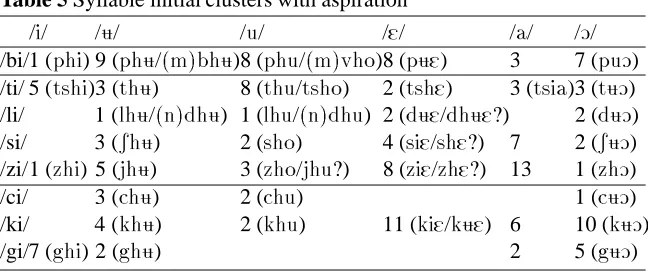
Aspiration in Bamileke probably derived historically from a high vowel (Anderson 1982). There is still good evidence for this in the phonotactics of Dschang. The following table is a summary of onset sequences (omit-ting most of the onsets which have just a single consonant, and omit(omit-ting the labialised onsets). These onset sequences are stops and fricatives, which may be optionally palatalised. Surface forms are given in parentheses where they differ from what we would expect. Where more than one form is given, it is to display allophones of the vowel (selected by the rhyme structure as already discussed). Question marks indicate forms whose position in the table is unclear.
Table 5 Syllable initial clusters with aspiration
/
i
/ /T/ /u
/ // /a
/ /=//bi/1 (
phi
) 9 (ph
T/(m)bh
T)8 (phu
/(m)vho
)8 (p
T) 3 7 (pu
=)/ti/ 5 (
tshi
)3 (th
T) 8 (thu
/tsho
) 2 (tsh
) 3 (tsia
)3 (t
T=)/li/ 1 (
lh
T/(n)dh
T) 1 (lhu
/(n)dhu
) 2 (d
T/dh
T?) 2 (d
T=)/si/ 3 (M
h
T) 2 (sho
) 4 (si
/sh
?) 7 2 (MT=)/zi/1 (
zhi
) 5 (jh
T) 3 (zho
/jhu
?) 8 (zi
/zh
?) 13 1 (zh
=)/ci/ 3 (
ch
T) 2 (chu
) 1 (c
T=)/ki/ 4 (
kh
T) 2 (khu
) 11 (ki
/k
T) 6 10 (k
T=)The distributional evidence in Table 5 is the basis for treating most ChV syllables on a par with CVV syllables, where the aspiration in ChV corresponds to the first vowel of CVV.10The distributional similarity will then be accounted for structurally, using the representation in (23).
(23)
bh
T
888
8
i
888
b T
This ‘palatal’ mora, symbolised
i, is introduced to account for the
com-plementary distribution of palatalisation and aspiration, which must in turn be kept distinct from the segment /i/ itself. Further support for this approach will be presentedx3.4.2. (It will be generalised inx7 in a manner
that avoids the use of a diacritic feature on the mora.)
Returning to Table 5 again, recall that the alternationstts, uo,T ,
sM andzj were dealt with inx2.5. However, if we are going to treat
ChV syllables as bimoraic, then there is no coda position available for storing the extra consonant that we need in order for rule (21) to work. In fact, theuo alternation in the /u/ column of Table 5 (and Table 6 inx4.1)
is best explained in terms of the syllable onset. The vowel /u/ appears as the [o] allophone in an aspirated syllable if and only if the onset contains a fricative or an affricate.
The only other alternations in Table 5 are dealt with in (24).
(24) a. i retraction i!+back / =
b. i devoicing i!h / 8 > <
> :
i
T
u?
9 > =
> ;
$
Note that (24a) does not account for pu= and will be replaced in x4.2.
Also, note that (24b) has the further requirement that the second vowel is
10
Note that the presence of a nasal (in parentheses) in Table 5 conditions the ‘voiced’ allophone of the onset consonant, as explained in x2.5. Note also that this approach to
syllable final. This is because there are forms involvingsiandziwhich
do not undergo devoicing, and this can be attributed to the fact that they are closed. See example (25).
(25) a.
s
t
squeezenz
!t
club v.b.
sh
!deep
nzh
knowPossible representations for the open and closed forms are given in (26).
(26) a.
s
jt
111 b.
sh
222
i
i
222
s t s
Thus, aspiration and palatalisation as taken to be complementary.11 Another problematic detail in Table 5 is the contrast between ki/kT.
However, thei /Tdistinction here seems to be subject to free variation.
3.4.2 Aspiration in reduplicated forms
There is an unproductive reduplication pattern which involves the prefix-ation of the minimal syllable to the word followed by transfer of enough segmental material to satisfy the template. We shall see that only segments – and not prosodic structure – are mapped onto the reduplicative prefix. We observe that syllable onsets are fully transferred, but that the rhyme is simplified. In example (27) we see cases which do not involve aspiration. The reduplicated syllable is underlined.
11
This approach seems to be at odds with Haynes’ treatment of aspiration and palatal-isation in Dschang (Haynes 1989:230f). She views the [hT] sequence as an aspirated,
palatalised /u/. However, inx2.3 I argued that treatingTas palatalisedu is undesirable and
thatTshould be set up as a phoneme in its own right. Therefore, the fact that Haynes did
(27) a.
s
s
squirrel,8a
8a
bell (ideophone)b.
ak
k
statue,asysy
bleeding,s
!s
! abdomen,akukulu
xmaizecereal
c.
akka
ceiling,atutuu
bird,a
7 ! 7 !a
raven,ssa
long d.a
Mu
Mu
8 elephant grass,fufu
bxscum,as
s
8 fern,apup
!
um
fruit (sp)e. 8
ku
8kum
cassava fufu,mbmbm
cockroach,mbumbum
albino,
ntuntu
t
xmaggots,ntuntu
8needle,8k
nk
hideousf.
ntsnts
8earthwormats
ts
8sillinesststsa
mouse7a
7al
sulphur
In (27a) we see the simplest pattern involving CV roots. Example (27b) shows that the noun prefix is extraprosodic. The next examples show that the segment of the second mora is lost in the transfer; this segment can be a vowel (27c) or consonant (27d). Nasal prefixes, though syllabic, are transferred with the root (27e) as if they were part of a complex onset. Other complex onsets are fully copied in reduplication (27f).
Returning to aspiration now, (28) shows how aspiration is lost in the reduplicative prefix. If aspiration formed part of the syllable onset then an additional restriction on reduplication would be required, so that it did not map aspiration onto the prefix. However, since aspiration is analysed as a non-segmental property of the first mora, we can maintain the idea of full onset copy.
(28)
kkh
breast of bird,nj
Tnjh
Tsheep,8gy
8ghy
condiment,syshy
vegetable (sp),MT M
h
T aubergine,ac
Tch
Tcaterpillar,aj
Tjh
T plant(sp),
aj
Tjh
Tplant (sp)An example of the operation of reduplication is shown in (29), where
c
andTare mapped onto the prefix while the aspiration is left behind.(29)
+
ach
T
ac
Tch
T+
99
99 !
111
i
~ ~~ ~ ~
i
This concludes the discussion of the syllable rhyme. I have established thatou andTare allophones and that aspiration is moraic. We have
seen how open syllables are systematically related to closed syllables. These properties of syllable structure go a long way towards explaining the asymmetries in the phonotactics of Dschang. In the next section we shall take a look at the syllable onset, exploring its interactions with the nucleus.
4
Onset-Nucleus Sequences
In this section we consider three kinds of onset-nucleus interactions. The first concerns fricatives and affricates and the second concerns rounding.
4.1
Fricatives and Affricates
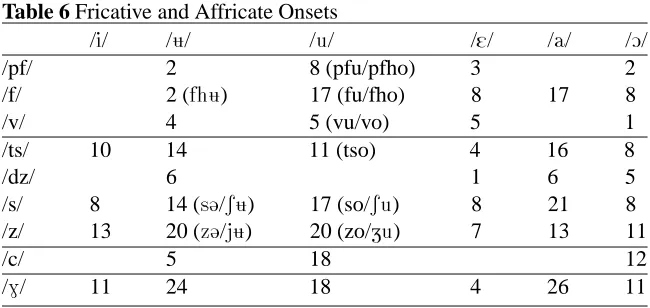
Table 6 shows the inventory of phonemic fricatives and affricates, and shows the alternations which account for the observed forms.
Table 6 Fricative and Affricate Onsets
/
i
/ /T/ /u
/ // /a
/ /=//pf/ 2 8 (pfu/pfho) 3 2
/f/ 2 (
fh
T) 17 (fu/fho) 8 17 8/v/ 4 5 (vu/vo) 5 1
/ts/ 10 14 11 (tso) 4 16 8
/dz/ 6 1 6 5
/s/ 8 14 (
s
/MT) 17 (so/Mu
) 8 21 8/z/ 13 20 (
z
/j
T) 20 (zo/`u
) 7 13 11/c/ 5 18 12
/ / 11 24 18 4 26 11
As in Fe’fe’, an aspirated fricative is treated as an allophone of a plain fricative when followed by a short high vowel in an open syllable (Hyman 1972:73). We see this in thepf and f rows in Table 6. This is a problem for the present analysis, since there is no clear mechanism whereby the aspi-rated allophones [
pfh
] and [fh
] can acquire a mora to host the aspiration. The phonetic data shows no clear juncture between the affricate and the h , since the h is usually fricated (seex2.2). Clarification of this problemObserve also how the ou and T alternations (conditioned by the
coda consonant as explained inx3) in turn condition onset alternations in
thepf , f , s and z rows.
4.2
Rounding
Observing Table 5 again, it will be noticed that [
pu
=] is analysed as /pi
=/.In fact, all cases of [
u
=] can be treated this way. By what mechanismdoes /i/ becomeu? Although we can attribute the backing of the /i/ to the second vowel=, as expressed in (24a), it is less clear where the rounding
comes from. Rounding does not come from the following vowel, given the numerous cases ofT= in Table 5. Nor does it come from the labial onset,
given the existence of pT. We could propose a highly specific rule of
regressive rounding assimilation in the presence of a labial onset, but this would not account for some other curious properties of labialisation given in (30). Here, a plus in the labiality column indicates a labial consonant or a round vowel.
(30) Onset
Labiality V1
Labiality V2
Labiality
Example Gloss a. + + +
ap
!u
= hunt n.b. + - -
ap
Tn
softc. - + -
aku
boned. - - +
k
T= slopee. - - -
m
8k
Tn
measles(30) shows a rather striking pattern of of labialisation across the syllable.12 Accordingly, we can make the descriptive generalisation in (31). It is not presently clear how such a constraint ought to be formalised.
(31) Labial dissimilation: Unless every segment in a syllable is labial, then at most one segment is labial.
12
This pattern of labialisation may even continue into the coda, since if a CVVC syllable has a labial coda, every other segment in the syllable must also be labial (e.g. mb` !
´u´=p billygoat,l`p
!
The only other cases of rounding permitted by (31) in VV sequences are u,ua andT=, since all sequences are high-low and the only round vowels
are u and =. Recall that T= has been analysed as /
i
=/ in Table 5 alongwith a rule ofi retraction (24). However, if we analyseT= as /
u
=/ instead,then we get a nearly complete paradigm for rounding in CuV sequences (where C is any consonant and V is any low vowel). Moreover, the highly specific rule (24a) can now be dropped, since /
u
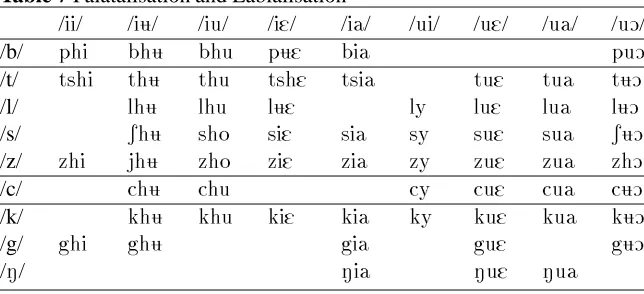
=/ will be subject to themore general dissimilation rule (31). With this treatment of rounding and the revision of Table 5, the new situation is shown in Table 7. Note that I have dropped the voicing and vowel height alternations from the entries.
Table 7 Palatalisation and Labialisation
/
ii
/ /i
T/ /iu
/ /i
/ /ia
/ /ui
/ /u
/ /ua
/ /u
=//b/
phi bh
Tbhu p
Tbia
pu
=/t/
tshi th
Tthu tsh
tsia
tu
tua t
T=/l/
lh
Tlhu
l
Tly
lu
lua
l
T=/s/ M
h
Tsho si
sia
sy
su
sua
MT=/z/
zhi
jh
Tzho zi
zia
zy
zu
zua zh
=/c/
ch
Tchu
cy
cu
cua c
T=/k/
kh
Tkhu ki
kia
ky
ku
kua k
T=/g/
ghi
gh
Tgia
gu
g
T=/8/ 8
ia
8u
8ua
Table 7 incorporates a new pattern for the high front rounded vowel y. It uses theui column, given that y is in free variation with ui (seex2.3).
An unresolved problem for this analysis is the set of aspirated forms listed in (32).
(32) a.
ach
!y
attitude,nchy
grow,nch
!y
name b.sh
!
y
new,shy
resemble,sh
!y
pull c.zhy
kill5
Vowel Alternations in the Imperative
In this section we shall examine some verb paradigms involving the imper-ative construction.13 Consider the data in (33). Each possible root-final
vowel is given on the left, after which there are two groups of three columns each, the first group involving stops and the second involving fricatives. Vowel alternations to be explained are underlined. We can take the imperative suffix to be an empty mora which receives +low by default, and which receives backness and roundness from the previous vowel.
(33) Inf Imp Gloss Inf Imp Gloss
i mb
!p
! smellnz
!z
! beginT
mb
!
T
p
T !T clear
nj
!T `T
!T steal
mb
p
takes
s
trim
mb
!
p
T!
climbs
MT desirea nta taa
divinenza zaa
be numerous=
f
=f
== be greasynz
!=
z
= ! = insulto mb
!o pu
! = be completenzo
`u
= buyu nt
!u tu
!u
overturnnju
`uu
dig upNotice the following alternations: ou=,i andT. Although this
looks like glide formation, the raised vowel is not noticeably shorter in the imperative form, as would be expected if the vowel had been devocalised through being moved into the onset. Furthermore, this approach does not explain whyparticipates in the alternation while= does not.
We have a rather different situation for closed syllables and aspirated syllables, as shown in (34). (Recall fromx2.2 that in ChVV syllables the
first vowel is coarticulated with the aspiration and appears as a voiceless vowel.)
(34) Closed Syllables Aspirated Syllables Inf Imp Gloss Inf Imp Gloss
i
8g
!
k gk
!be intelligent 8
gh gh
fly Tnc
!
Tb
c
T b !filter
mbh
Tph
T announce
nz
!
t z
t
!be heavy
ntsh
!tsh
! transplantf
m f
m
chokea
8k
!a
8ka
8 !a
choose=
nt
= 8t
=8= readnzh
!
=
zh
= ! = achieveo nzok zoko
pass the daymvh
!o vho
!= arrange
u
8gup wup
= barknth
!u thu
! = seasonObserve that for the roots which are closed or aspirated, the root vowel is stable. For the CVC roots this is hardly surprising. Why this should also be the case for aspirated roots is less clear. Note that whereas the imperative ofl`p
!
´
undress isp´ı´, an aspirated form with the same final vowel such as
l`tsh`transplant does not have tsh`ı !
´
buttsh` !
´
in the imperative.
Never-theless, the formtsh`ı!
´
would have been acceptable phonotactically given
the existence of parallel forms such asgh´ı´fly. To facilitate the discussion,
the vowel patterns of (33) and (34) are tabulated in (35).
(35) F inal V owel Infinitive Type
CV ChV CVC
i ii hi.
i.C
T TTh
T.
T.C
i
h
.
.C
T —
.C
a aa
—a.Ca
= ==
h
=.
= =.C
=o u
=ho.
=o.Co
u uu hu.
=u.C
=space. Each cell contains the infinitive followed by the imperative. The cells of particular interest contain underlined segments.
(36) Backness
Height
/N-
pi
/ [mbi
] /N-p
T/ [mb
T] /N-tu
/ [ntu
]/
pi
-V/ [pii
] /p
T-V/ [p
TT] /tu
-V/ [tuu
]/N-
p
Tn
/ [mb
] /N-pun
/ [mbo
]/
p
Tn
-V/ [p
T] /pun
-V/ [pu
=]/N-
pin
/ [mb
] /N-ta
/ [nta
] /N-f
=/ [f
=]/
pin
-V/ [pi
] /ta
-V/ [taa
] /f
=-V/ [f
==]Observe that the /CVn/ forms are characterised by a lowered vowel in the infinitive: /
in
/ = [], /Tn
/ = [] and /un
/ = [o
]. In the imperative, theseforms manifest a suffix vowel identical to imperative suffix for CVC roots (cf. the CVC column in (35)). Accordingly, the representation of these /Vn/ codas has to incorporate vowel lowering, and block the vowel height assimilation that would create ii ,TT anduu. Rather than treating n as a
real segment, I propose to represent its vowel lowering function as a higher level prosodic feature. For present purposes the syllable level will suffice. We shall adopt the following definition: is a syllable containing a –high
vowel. The interpretation of this device is illustrated in (37).
(37) a. [
p
] b. [p
T] c. [p
T] d. [p
TT]
;;;
;
;;;
;;
p T p T p T p T
The form in (37a) shows the lowering effect, whereby the –high allophone ofT is selected. In (37b) the –high is manifested as the vowel on the
second (empty) mora. How does this happen? By definition, one of the moras of (37b) must be linked to a –high vowel. Recall from x2.4 that
no diphthongs involve , and so the /T/ of (37b) must be realised as the
high allophoneT. Given the requirement (stated above) that the imperative
Example (37c) shows the representation of pT while (37d) gives the
corresponding imperative form. In (37d) the suffix mora can be linked to the previous vowel, giving rise to a long syllable. This was not an option in (37b) given the need to have a –high vowel and the non-existence of.
6
Loanword Phonology
In this section we take a brief look at the phonological readjustments that occur when a word (usually a noun) is borrowed from another language (usually pidgin English). We see the almost ubiquitous addition of a noun class prefix, although there is no particular gender reserved for loanwords. The noun class prefix comes through addition (e.g.`ak`al´=`=xt carrot)
replace-ment (m`t´ıt`axpotato) or reinterpretation (m`s´ı`ı8machine). The English
stress is usually preserved in the tone melody of the word (38a), though not always (38b).
(38) a.
akas
!ala
xcassava,al
!sa
razor,al
!aba
/al
!=
ba
rubber,k
s
8kitchen,
kapnda
carpenterb.
akal
==t
xcarrot,akalatus
xeucalyptus,afr
p
n
frypanGeneralising across these two cases, we can observe that high tone is assigned to the penultimate vowel.
Loanwords are responsible for the introduction of a new segment type, the apico-alveolar trill (39a), a new onset cluster (39b), putting r on a par with l, and a new syllable type CVqC (39c).
(39) a.
m
t
ras
mattress,mb
r
k
xbrickb.
akrata
xgrater,mbr
bread,mbrus
brush,ndrapo
flag (Fr:drapeau),
mbr
bread,afruwa
flowerc.
l
==8long trousers,maak
mark (scarification),sa
!laad
lettuce,j
==k
demijohn,laam
lamp,d
k
debt,p
n
pan,luum
room,kuum
comb,c
n
chainConcerning diphthongs, observe in (40a) that diphthongs are still possi-ble in an open syllapossi-ble, thoughe is mapped onto the more extremeia in
order to conform with the phonotactics of the language.
(40) a.
ba
beer (RP:bi
),pa
avocado pear (RP:pe
)b.
laa
garlic (Fr: l’ail [laj]),t
la
tailor,ak
!n
!However, we can observe that rising dipthongs cannot be so interpreted, and appear as monophthongs (40b). See also the final three words in (39c). We can observe a range of strategies for dealing with illegal coda con-sonants. First, we see the addition of vowel to allow the consonant to be syllabified into the onset (41a), which might be necessary more than once in the same word (41b).
(41) a.
l
s
xrice,m
ta
xmat,n
nas
pineapple (Fr: ananas),t
w
l
towel,
was
watch, 8glas
glass, 7jakas
jackass,mbrus
xbrush,
as
kuu
school,mbas
ku
bicycleb.
m
t
ras
mattress,m
ts
matchc. 8
goya
guava (Fr: goyave),z
8zinc,nubats
rheumatism,apl
8g
!blanket,
8g
!al
garden,s
sa
scissors,laam
lamp,d
k
debt,p
=k
pocketd.
t
bl
xtablee.
akl
s
8keroseneWe can also observe the loss of a final consonant (41c) or its metathesis into onset position (41d). Finally, in (41e) we see the loss of a vowel when a reduced form satisfies the syllable structure of the language, possibly in order to mimic the stress pattern of kerosene. We can be certain that thek in (41e) is in the onset, since it is not realised as [q] as would be expected in coda position following a low back vowel (cf. x2.1).
Other more marginal observations about loanwords are that the dark .
is reinterpreted as the vowelu (42a), while n (which is banned from the coda) is reinterpreted as8(42b). This is consistent with the default velar
place of articulation claimed in (10).
(42) a.
mbas
ku
bicycle,nd
=kfawu
duck fowl,as
kuu
schoolb.
akl
s
8keroseneAnother interesting source of information on the syllable structure is found in Bamileke French. In (43a,b) we see codar appearing as k (the nearest consonant toK), while in (43b) the nasalised vowel is interpreted
as a velar nasal. And in (43c) the finalwi appears as the high front rounded vowel (seex2.3).
(43) a. merci [
m
ksi
]b. version [
v
ksj
=8]This evidence from the loanword vocabulary and from Bamileke French demonstrates that the constraints on syllable structure (allowable codas, diphthongs, length, etc) are not only part of the diachrony, they are active in the synchrony of the language.
7
Harmonising the Proposals
Recall that aspiration was argued to be moraic because: (i) it does not contribute to the complexity of onsets; (ii) it is not copied along with the onset in reduplication; (iii) it restricts the possibilities for the rhyme, only permitting short vowels and open syllables; (iv) it originates from a high vowel; and (v) aspirated syllables pattern with bimoraic syllables in the imperative construction. So what is, phonetically, a voiceless fricative is best treated phonologically as a (devoiced) vowel. It is represented as a diacritic feature on the first mora node. Another prosodic diacritic was proposed in x5 to account for the vowel height alternations in the
imperative construction. This diacritic was represented on the syllable node as .
It is possible to harmonise these proposals for representing aspiration and vowel height, as shown in (44). As before, represents a syllable
with a –high feature, which percolates down to the rightmost mora.
(44) a. [
s
] b. [s
T] c. [s
jt
] d. [sh
]
:::
:
+
999
9
+
:::
:
s T s T s t s
The mora diacritic for palatalisation and aspiration has now been shifted up to the syllable, leaving the mora as a weight unit pure and simple. The symbol
+
represents a syllable with a +high feature which percolates down to the leftmost mora. Apart from producing a more symmetrical system, this puts the two properties in complementary distribution with each other. This is a substantive claim which we can check.
Now +
distribution of aspiration and palatalisation compare with that of lowering? Are there any cases of overlap? Table 5 demonstrates that palatalisation and lowering never cooccur; palatalisation only appears on the syllables withanda, while lowering only relates toTandu. We must also consider
aspiration vs. lowering. Where does aspiration cooccur with or o?
Observe in (35) that while there is a gap for h, the ho form is actually
attested. This would be a counterexample, since we would simultaneously have and
+
, a contradiction. But recall fromx3.4.1 that [
ho
] is justan allophone of /
hu
/ after onsets containing a fricative or an affricate. So aspiration and lowering are opposite sides of the same coin.8
Conclusions
The discussion of Dschang syllable data has shown how diachronic pro-cesses, such as the loss of final consonants and the devoicing of high vowels, are still in evidence in the synchronic system of the language. However, while the analysis incorporates insights from the history of the language, it does not recapitulate the historical processes directly. It is simpler to treat the distributional and morphophemic evidence as manifes-tations of an abstract contrast between two syllable types and
+
. The proposal of a distinctive feature on a non-terminal node (i.e. a prosodic feature) is plausible both theoretically and formally. As a the-oretical device, it connects with other proposals to decorate the non-terminal nodes of prosodic structure with distinctive features (Vincent 1986, McCarthy 1988, Coleman 1992), and has been heavily exploited outside of phonology in feature-based grammar formalisms (Pollard & Sag 1994). Formal methods for interpreting prosodic features and propagating the associated constraints down to the segments are described in (Bird & Klein 1994, Bird 1995). However, in this chapter the focus has been pri-marily empirical. I have shown how the use of a prosodic feature at the syl-lable level is able to explain some phonological and morphophonological phenomena which are manifested in the curious distribution of aspiration, palatalisation and lowering in Dschang.
Acknowledgements
informant, Blaise-Pascal Kemda, is a male speaker aged 26 who lived in the village until the age of 23 and whose parents grew up in the same neighborhood.
This material was first presented at the colloquium The Phonology of the World’s Languages: The Syllable held in Pezenas, France (June 1996) and organised by Jacques Durand. I am thankful to SIL Cameroon for funding my visit to the colloquium, to the participants for their helpful feedback, and especially to Larry Hyman for helping me see the central importance of the syllable rhyme in understanding the vowel inventory. I am grateful to the editors and to San Duanmu for comments on an earlier version of this chapter. I am also grateful to audiences at U. Edinburgh, U. Pennsylvania and Northwestern U. for insightful feedback on this material.
The data in the chapter draws heavily on a dictionary (Bird & Tadadjeu 1997) and a hypertext lexicon (Bird 1997) incorporating digitised speech files, available on the internet at http://www.cogsci.ed.ac.uk/hyperlex.
This work is supported by the UK Economic and Social Research Coun-cil, grant R00023 5540. My activities in Cameroon (January 1995 – June 1997) were covered by research permits with the Ministry of Scientific and Technical Research of the Cameroon government.
References
Anderson, S. C. (1977). A phonology of Ngyemb==n-Bamileke.
Unpub-lished manuscript.
Anderson, S. C. (1982). From semivowels to aspiration to long consonants in Ngyemb==n-Bamileke. Journal of West African Languages, 12,
58–68.
Bird, S. (1995). Computational Phonology: A Constraint-Based Approach. Studies in Natural Language Processing. Cambridge Uni-versity Press.
Bird, S. (1997). A lexical database tool for quantitative phonological research. In Proceedings of the Third Meeting of the ACL Special Interest Group in Computational Phonology . Association for Com-putational Linguistics.
Bird, S. & Tadadjeu, M. (1997). Petit Dictionnaire Y´emba-Franc¸ais (Dschang-French Dictionary). Cameroon: ANACLAC.
Clements, G. N. (1987). Phonological feature representation and the description of intrusive stops. In 23rd Annual Regional Meeting of the Chicago Linguistic Society. Part Two: Parassession on Autosegmen-tal and Metrical Phonology, (pp. 29–50). Chicago Linguistic Society.
Coleman, J. S. (1992). The phonetic interpretation of headed phonological structures containing overlapping constituents. Phonology, 9, 1–44.
Coleman, J. S. (1997). Phonological Representations — their names, forms and powers. Cambridge Studies in Linguistics. Cambridge University Press.
Grimes, B. F. (Ed.). (1988). Ethnologue — Languages of the World. Summer Institute of Linguistics.
Haynes, N. (1989). Esquisse phonologique du Yemba. In D. Barreteau & R. Hedinger (Eds.), Descriptions de Langues Camerounaises (pp. 179–238). Paris: ACCT/ORSTOM.
Hyman, L. M. (1972). A phonological study of Febfeb-Bamileke. Studies
in African Linguistics, (Supplement 4).
Hyman, L. M. (1979). Index of Proto-Grassfields Bantu Roots. Unpub-lished manuscript.
Hyman, L. M. (1985). Word domains and downstep in Bamileke-Dschang. Phonology Yearbook, 2, 45–83.
Hyman, L. M. & Tadadjeu, M. (1976). Floating tones in Mbam-Nkam. In L. M. Hyman (Ed.), Studies in Bantu Tonology (pp. 57–112). Univer-sity of Southern California. Occasional Papers in Linguistics, Volume 3.
Kouesso, J.-R. (1989). Analyse des Principes Orthographiques du Yemba. Master’s thesis, University of Yaound´e.
Maddieson, I. (1981). Unusual consonant clusters and complex segments in Eggon. In Leben, W. R. (Ed.), Pr´ecis from the 12th Conference on African Linguistics, Studies in African Linguistics, Supplement 8.
Nissim, G. M. (1981). Le bamil´ek´e-ghom´al´a’ (parler de Bandjoun Cam-eroon): Phonologie – Morphologie nominale – Comparison avec des parlers voisins, volume 45 of Tradition Orale. Paris: SELAF.
Odden, D. (1996). The Phonology and Morphology of Kimatuumbi . The Phonology of the World’s Languages. Oxford University Press. Pollard, C. & Sag, I. A. (1994). Head-Driven Phrase Structure Grammar.
Chicago University Press.
Vincent, N. (1986). Constituency and syllable structure. In J. Durand (Ed.), Dependency and Non-Linear Phonology (pp. 305–18). Lon-don: Croom Helm.
Voorhoeve, J. (1965). The structure of the morpheme in Bamileke (Ban-gangt´e dialect). Lingua, 13, 319–34.