Salp Swarm Algorithm Based Priority Scheduling
For Energy-Efficient Power Allocation In
MIMO-NOMA System
Shaik Khaleelahmed, Nandhanavanam VenkateswararaoAbstract : Large scale Multiple Input Multiple Output (MIMO) is a key technology used in the wireless networks of the next generation. It uses the
multiplexing of few antennas at the same frequency to serve few users for achieving high efficiency in the spectral based on the linear transmit and receive approach. However, the system using co-located antennas suffer from the correlated fading of small scale and identical fading of large scale. Non Orthogonal Multiple Access (NOMA) is a multiple access technology in the communication system for fifth generation (5G). The Energy Efficiency (EE) of MIMO-NOMA system needs to be improved, where an optimization method, called Salp Swarm Algorithm (SSA), schedules the user satisfying maximum power and QoS constraints to offer efficient energy and power allocation in the platform effectively. The scheduling is performed based on the SSA algorithm to prioritize the user using the objective function in an optimal way. The experimentation results are analyzed using the evaluation metrics, like spectral power, achievable rate, Bit Error Ratio (BER), and energy. The effectiveness of the SSA-based power allocation approach is exposed using the lower BER of 0.00054, and higher achievable rate, spectral power, and energy of 96.1985Mbps, 128.198dB, and 19.4672dB, respectively.
Index Terms : MIMO-NOMA, Energy Efficiency, Power Allocation, Salp Swarm Algorithm, Quality of Service .
————————————————————
1. INTRODUCTION
Energy efficiency attracted a growing interest in the research field. In order to satisfy the requirements of 5G, several technologies are used for user interference cancellation, power allocation, noise cancellation and broader coverage. The MIMO is one of the best capable approaches for deploying number of antennas. On the other side, a well suited technology is relayed in the present networks to progress the reliability and coverage and eliminate the deep lighten events . The pricing based mechanism is adopted to come up with distributed, energy-saving and power control algorithm. In general, the centralized approach is considered in the multi stream based MIMO system [1]. Massive MIMO is a key technology to enable the 5G networks. Due to the capability to beam the energy towards the spatial region, massive MIMO is very attractive in energy transfer [2]. The devices lifetime can be extended by recharging the battery or by replacing it. Another way to extend the device lifetime is to apprehend the Energy Harvesting (EH) capability and to intend the energy efficient mechanism to enhance their Energy Efficiency (EE) [10].
NOMA is a technique used in the wireless system for the next generation. NOMA enable the users to multiplexed with the same frequency band using the Successive Interference Cancellation (SIC). According to MIMO-NOMA, the user with less Channel State Information (CSI) uses more power than the user with better CSI. MIMO-NOMA guarantees the users by sequentially decoding the signals with power decreasing order
by the received signals [3]. It combines the beamspace of MIMO and the compensation of NOMA. NOMA is a potential access scheme to beamspace the MIMO using mmWave communication. With the usage of coding in the intra-beam superposition and SIC, the users can simultaneously support the beam. In the MIMO-NOMA approach, the achievable sum rate using the mmWave channel scheme is significantly improved [4]. In this system, the users are paired into clusters in the receiver, thus it may reduce the complexity of SIC [5].In [6] introduced a multi pair communication system to exchange the data with the usage of antennas. This approach eliminates the inter-pair interference in the imperfect channel information. However, it does not consider the energy efficiency and the spectral efficiency. Modeled an antenna selection algorithm [7] to exploit the closed form and determines the best antenna with the help of energy efficient value. It determines the optimum energy efficient based on the factor of the circuit power and noise power. In [8] introduced a payload power allocation and joint pilot approach in the multiple access system to decrease the trouble of error propagation. Developed layered transmission approach to increase the sum rate of the MIMO-NOMA system [9]. The closed form expression is derived to perform the power allocation. The challenges faced by the existing techniques are elaborated as In [2], the system developed requires more number of users for specifying the energy harvester. In [4], the beamspace MIMO and the NOMA are integrated to break the limit of the beamspace. The sophisticated pairing of the user
————————————————
Shaik Khaleelahmed is currently pursuing Ph.D degree in department of elctronics and communication engineering in VR Siddhartha Engineering College, Acharya Nagarjuna University, Andhra Pradesh, India, E-mail: [email protected]
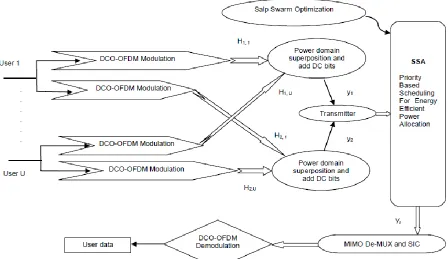
Figure 1. Block diagram of the Salp Swarm Algorithm based power allocation in MIMO-NOMA system
and the clustering in the beamspace are not considered in the ultra dense network. In [5], the energy efficiency of the user depends on the channel gain difference of the user and the transmit power level. The resource allocation is not focused for computing the optimal time and power allocation [10].This paper proposes a power allocation model with the intention to increase the EE based on SSA. The SSA selects the users optimally, so that the users are effectively allocated to gain the higher EE in the antennas. The fitness estimation is done based on the energy efficiency and the higher fitness measure indicates that the users are effectively allocated. The contribution of the paper is adopting SSA for the priority-based scheduling in the MIMO-NOMA system such that the energy efficient power allocation is done based on the optimally selected users.The paper is organized as: the introduction is described in section 1.In Section 2 describes the system model of the power allocation approach. The proposed SSA algorithm for the power allocation is described in section 3. Section 4 describes the results and discussions and finally, the conclusion is made in section 5.
2
SYSTEM
MODEL
AND
PROBLEM
FORMULATION
This section describes the system model and the problem formulation of the conventional power allocation approaches.
2.1 System Model
Let us consider the multi user downlink MIMO system using the Base Station (BS) connected with M number of antennas, which transfer the information to the number of receivers associated withX number of antennas. Let M be the number of users and the channel matrix of BS for the th
x user, 1, ...,
x M
is expressed as Ax BX M
, which is a quasi
static independent. The pre-coding matrix of BS is indicated
as, M M
W B , and the vector to detect the th
x user is
represented as X 1
x
a B . The conditions that are to be
satisfied are, (i) X KM , where KMdenotes the identity
matrix of sizeM M . (ii)
2
1
x
a , and axAA yx l 0, for all
l x , with l
y being the lthcolumn of X . To make the condition more feasible, the antenna used in this system must satisfy the order,X M . It is noted that, the scalar value
2
A x x l
a A y is required and is fed back to the BS from the th x
user. In this approach, for each user, the anticipated signals are multiplexed with the BS, hence, the transmitted signals, that is received from the BS are denoted as,
m X i (1)
where, i represents the information vector, iBM . Similarly, the signal received at the user x is denoted as,
x x x
p A X in
(2)
where, nxrepresents the independent Additive White Gaussian Noise (AWGN) vector and the identically distributed
vector,
2
0 ,
L K . The relation obtained with respect to the detection vector is,
m a x
1 ,
M
A A A
x x x x x x x x x l l x x
l l x A
a p a A y X i a A y i a n
(3)where, 1 ,
M A x x l l l l x
a A y i
denotes the interference occurrence and
l
i denotes the lth row of i. Due to the detection vector constraint, A
x x l
m ax
A A
x x x x x x x x x
A
a p a A y X i a n
(4)
Without the generality loss, the effective channel gain is ordered as in [11]. The SIC is transmitted to all the users at the receiver side, for removing the interference, which is formed by the user using poor channel gains. The data rate that is received at the th
x user is denoted as,
2
, 2 2
1
lo g 1
1
x j x j x j x
x j H
x j x j x j x j
A a A y
E
A a A y
(5)where, Xm a x
denotes the transmitted signal to the noise
ratioand j represents the transmitter.
3
PROPOSED
MODEL
OF
ENERGY
EFFICIENT
POWER
ALLOCATION
USING
SALP
SWARM
ALGORITHM
The proposed power scheduling method overcomes the existing method that undergoes the one by one arrangement in the sequential ascending order. The power scheduling method based on priority is progressed using the optimization algorithm, SSO that prioritizes the users of a transmitter concerning the Quality of service and power requirement of the user. The existing method uses Normalized Gain Difference Power Allocation (NGDPA), Gain Ratio Power Allocation(GRPA) and Maximum Energy Efficiency (Max-EE) that orders the users in ascending order. Generally, GRPA is employed in MIMO-NOMA systems such that the power allocation in the system is based on the optimal channel gain of the individual users. However, the optimal channel gain is replaced by the sum of the optimal channel gains such that the GRPA is employed for the MIMO-NOMA-based systems. On the other hand, the method NGDPA ensures the required sum-rate in the MIMO-NOMA based systems. It differs from GRPA in the computation of the optimal channel gain such that the optimal channel gain in NGDPA is computed as the difference in the channel gain between two users and the optimal channel gain in Max-EE is computed as the absolute value. Therefore, the existing methods are arranged in the ascending order based on the channel gain, but the proposed method prioritizes the users based on the SSA priority-based scheduling. The main aspire of the proposed power allocation approach is to increase the EE of the system using the SSA for the MIMO-NOMA system. When the NOMA is integrated with the MIMO, it produces an extensive gain in the energy efficient and power allocation. Figure 1 shows the block diagram of the SSA-based power allocation for the MIMO-NOMA system. Below are the algorithmic steps involved in the priority-based scheduling for Energy-Efficient Power Allocation.
3.1 Salp Swarm Algorithm (SSA)
The main goal of the optimizer is to compute the global optimum solution that selects the users appropriately for the allocation. SSA is a swarm intelligence algorithm inspired from the behavior of salps and their interaction. SSA determines the global optima for the multi-modal, unimodal and the benchmark functions to perform effective optimization.
3.1.1 Solution Encoding
The solution encoding used in the SSA algorithm is to signify the result in an effective manner. The size of the solution is similar to the number of users in this approach, and the SSA selects the users optimally, so that the users are allocated in the antennas using the power to gain the higher EE. Using the high power, the effective channels are obtained to enable the high EE with the MIMO-NOMA system. Let, be the number of users or solution, which ranges from 1tox.
3.1.2 Fitness Estimation
For the effective system, the optimal allocation of user is based on the power with higher EE and the fitness must be in maximum. The higher fitness measure indicates the allocation of the users effectively and is performed in an effective way. The fitness of the solution is determined based on the energy efficiency formulated in [12] as,
,
m a x
x k
, such that
m i n
, , , 1, ...,
x k x k
E E x M (6)
, 1 1 1 M S x k x k
(7)where, the above equation refers the minimum transmit power and minimum rate requirements. The energy efficiency for the system is represented as,
m e a n
c d
E
X X
(8)
where, ,
1 1
M S m e a n
x k x k
E
denotes the sum rate.The factors, like flexible transmit power, denoted as Xcand
the fixed circuit power consumption, Xd constitutes the total
power consumption. The term Xcis denoted as,
m a x ,
1 1
M S
c x k
x k
X X
(9)The objective function relies on increasing the energy efficiency , thus the user possess the minimum rate.
3.1.3 Algorithmic steps of the SSA algorithm
In the SSA [14] swarm approach, the follower salp follows the leading salp. The leading salp travel towards the source of food. When the food source is replaced with the global optimum, then the salp chain travel towards it automatically. In this approach, the food source and the global optimum is chase by the salp chain to determine the best solution. The salp chain chases the exact food source and the non-dominated solution is stored in the repository. SSA explores the most capable region of the search space by moving the salp immediately in the initial iteration and then, the salp moves gradually to the next iteration. Thus, it improves the fitness of the salp and also, improves the best solution. The steps involved in the SSA algorithm are discussed below: Step 1: Initializing the swarm population: The salp population is initialized in the search space as represented below,
1, 2, , c, , m;1
z z z z z c m (10)
where,zcdenotes the position of the salp in the th
c dimension.
Step 2: Fitness evaluation: The particle fitness is evaluated using the objective to solve the maximization problem in equation (6). The constraints are intended at meeting the QoS requirements and maximum power requirements of the user. Step 3: Compute the optimal position of the population: After evaluating the particle fitness for the population, the particle tracks the most favorable position of the swarm.
Step 4: Update the particle position: In this step, the position of the particles is computed. The position of the salp is represented using the t h
p dimensional space, where p
represents the number of variables. The target of the salp is the food source, denoted as P . The position is updated using the below equation,
1 2 3
1
1 2 3
0
0
u p p e r lo w e r lo w e r
a a a a
a
u p p e r lo w e r lo w e r
a a a a
P u B H u H u
z
P u B H u H u
(11)
where, Padenotes the food source with th
a dimension,
1
a
z represents the salp position with th
a dimension,
l o w e r a
H represents the lower bound with athdimension, u p p e r a B denotes the upper bound and u1 ,,u2 and u3are the random
numbers. The coefficient u1 balances the exploitation and exploration, defined as,
2 4 1 2 n N u e
(12)
where, N denotes maximum iteration and nrepresents the current iteration. The parameters u1and u2 are randomly generated at the interval [0, 1]. The position of the followers are updated using the equation,
1
1
2
c c c
a a a
z z z (13)
where, c2, and zxc denotes the position of the salp. Using the above equation the salp chain is determined.
Step 5: Finding the best solution: The fitness is computed for each updated solution of the salp and the solution having better fitness is replaced over the iterations.
Step 6: Check the stopping criterion: Once the velocity and the position of the particles are updated, the solution feasibility is verified. The optimal location of the particle is adapted with the new location of the particle, if the current solution is enhanced than the previous solution.
Step 7: Terminate: The process is continued for the maximum iteration until the best solution is obtained.
Table 1.Proposed Salp Swarm Algorithm (SSA)
1.
2.
3. 4. For j=1 to k=N 5. For x=1 to M 6. Calculate 7. End For 8. End For
9. Calculate and by Eq (11) and Eq (13) 10. End
11. Calculate
4
RESULTS
AND
DISCUSSION
This section describes the results and discussions of the SSA based power allocation system, and the comparative analysis is performed based on the evaluation metrics, namely Achievable rate, BER, Energy, and spectral power.
4.1 Evaluation metrics
The SSA based power allocation system is analysed based on the metrics, like BER, achievable rate, spectral power and energy.
4.2 Comparative Method
The methods considered are Gain Ratio Power Allocation (GRPA) [13], Normalized Gain Difference Power Allocation (NGDPA) [12] and Maximization Energy Efficiency (Max-EE) [5].
4.3 Comparative analysis
This section explains the comparative analysis of the power allocation system by evaluating the performance using the metrics, like spectral power, energy, BER and achievable rate.
4.3.1 Analysis based on transmitting antennas
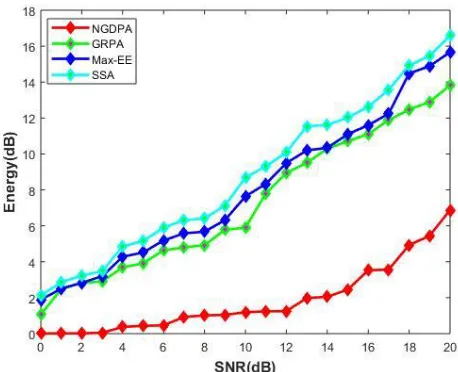
Fig.2.a. BER Performance analysis based on 64 transmitting antennas
Fig. 2.b. Achievable Rate performance analysis based on 64
transmitting antennas
Fig. 2.c. Spectral Power Performance analysis based on 64
transmitting antennas
Fig. 2.d. Energy Performance analysis based on 64
transmitting antennas
Figure 2.c shows the variation of achievable rate with respect to SNR. When the value of SNR is 0, then the achievable rate obtained by the methods, namely NGDPA, GRPA, Max-EE and SSA are 0.42797mbps, 0.429408mbps, 0.942778mbps and 1.134309mbps. When the value for SNR is 2, the achievable rate computed by the methods, NGDPA, GRPA, Max-EE and SSA are 2.71190mbps, 3.66939mbps, 3.67995mbps and 3.91294mbps, respectively. When the value for SNR is 10, the achievable rate obtained by NGDPA, GRPA, Max-EE and SSA are 21.86729mbps, 22.2128mbps, 36.00623mbps and 36.89369. Similarly, when the value for SNR is 20, then the achievable rate obtained by the methods, namely NGDPA, GRPA, Max-EE and SSA are 36.67224mbps, 84.9949mbps, 95.8098mbps and 96.1984mbps, respectively. It is shown that, increase in SNR value increases the achievable rate and thus, SSA achieves better achievable rate as 96.19845mbps. Figure 2.d shows the variation of energy based on the SNR value. When the value for SNR is 0, the energy computed by the methods, like NGDPA, GRPA, Max-EE and SSA is 0.00839dB, 1.0642dB, 1.8849dB and 2.1228dB. When the SNR value is 2, then the energy values computed by NGDPA, GRPA, Max-EE and SSA are 0.01819dB, 2.8149dB, 2.8317dB and 3.23911dB, respectively. When the SNR value is 10, then the energy obtained by the methods, namely NGDPA, GRPA, Max-EE and SSA is 1.19207dB, 5.8963dB, 7.6397dB and 8.6830dB. When the SNR value is 20, the energy values obtained using the methods, such as NGDPA, GRPA, Max-EE and SSA are 6.8727dB, 13.8174dB, 15.6635dB and 16.5895dB. Thus, the SSA achieves high energy value than the existing methods with the maximum energy of 16.5895dB.
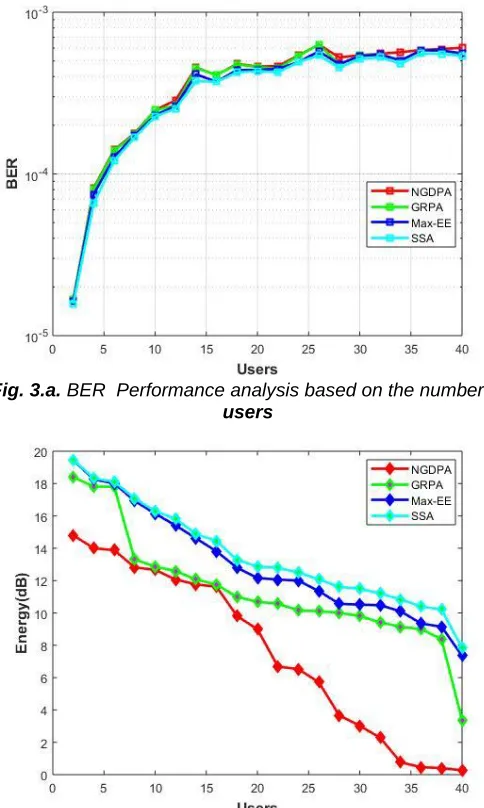
attained the BER rate as 6.58E-05, 7.49E-05, 8.04E-05, and 8.19E-05, respectively. Similarly, if the user is 40, then the BER rate obtained by the methods, SSA, Max-EE, GRPA, and NGDPA is 0.000536, 0.000556, 0.000558, and 0.000602. Thus, it clearly shows that SSA achieves better BER rate. Figure 3.b shows the variation of spectral power based on the number of users. When the number of user is 2, the spectral power obtained by the methods, NGDPA, GRPA, Max-EE and SSA is 70.5880dB, 98.3030dB, 110.202dB and 111.6849dB. If the number of user is 4, then the methods, SSA, Max-EE, GRPA, and NGDPA achieved the spectral power as 110.0653dB, 109.19166dB, 92.2160dB, 59.4264dB, respectively. If the number of user is 40, the methods, SSA, Max-EE, GRPA, and
Fig. 3.a. BER Performance analysis based on the number of
users
Fig. 3.b. Spectral Power Performance analysis based on the
number of users
Fig. 3.c. Achievable rate Performance analysis based on the
number of users
Fig. 3.d.Energy Performance analysis based on the number
of users
2, the energy values computed by the methods, namely NGDPA, GRPA, Max-EE and SSA are 14.80117dB, 18.3975dB, 19.44462dB and 19.46721dB. When the user is 4, the methods, SSA, Max-EE, GRPA, and NGDPA compute the energy as 18.3277dB, 18.2604dB, 17.81281dB, 13.9984dB, and respectively. Similarly, if the user is 40, then the energy values attained by SSA, Max-EE, GRPA, and NGDPA is 7.8463dB, 7.3559dB, 3.36399dB, and 0.2687dB, respectively. Thus, it clearly shown that SSA achieves better energy with the value of 7.8463dB.
4.4 Comparative discussion
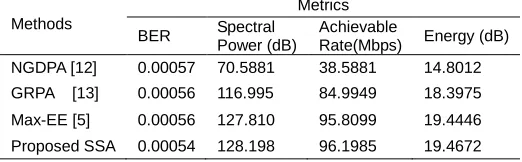
The comparative discussion of the power allocation methods, like NGDPA, GRPA, and Max-EE, and SSA using the metrics, such as BER, spectral power, achievable rate, and energy depends on the variation of number of users with SNR is shown in table 2. The BER rate obtained by the methods, NGDPA, GRPA, and Max-EE and SSA is 0.00057, 0.00056, 0.00056 and 0.00054, respectively. The spectral power achieved by NGDPA, GRPA, and Max-EE and SSA is 70.5881dB, 116.995dB, 127.81dB and 128.198dB, respectively. Similarly, the achievable rate obtained by the methods, NGDPA, GRPA, and Max-EE and SSA are 38.5881, 84.9949, 95.8099 and 96.1985. The energy computed by NGDPA, GRPA, and Max-EE and SSA are 14.8012dB, 18.3975dB, 19.4446dB and 19.4672db, respectively.
Table 2: Comparative discussion of the methods
Methods
Metrics BER Spectral
Power (dB)
Achievable
Rate(Mbps) Energy (dB) NGDPA [12] 0.00057 70.5881 38.5881 14.8012 GRPA [13] 0.00056 116.995 84.9949 18.3975 Max-EE [5] 0.00056 127.810 95.8099 19.4446 Proposed SSA 0.00054 128.198 96.1985 19.4672 From table.2, It is clearly depicted that achievable rate, spectral power and energy in the SSA algorithm increases with respect to the increase in SNR rate and BER reduces with increase in SNR value. Thus, it is clear that using the SSA algorithm, the energy, achievable rate and the spectral power are high and the BER rate is lower than the existing methods.
5
CONCLUSION
The MIMO is integrated with the NOMA system to utilize the energy efficiency effectively with better fitness estimation. In this paper, the power allocation system to the user based on the energy efficient ismade feasible using SSA in the MIMO-NOMA system. SSA achieves the solution optimally based on the fitness function that depends on the energy efficiency. Thus, the power scheduling is performed using the SSA algorithm to allocate the power effectively to the user. The experimentation of the SSA algorithm is evaluated using the metrics, such as BER, achievable rate, spectral power and efficiency. The SSA algorithm produces better results with increase in the spectral power, achievable rate and energy as 128.198dB, 96.1985Mbps and 19.4672dB and lower BER rate as 0.00054, respectively.
ACKNOWLEDGMENT
Authors like to express their gratitude towards the department of ECE and management of Velagapudi Ramakrishna Siddhartha Engineering College and Acharya Nagarjuna University College of Engineering for their support and encouragement during this work. Further Sk khaleelahmed likes to express his gratitude to DST through REACH grant TIFAC/REACH/SF/25515420 Nov 27, 2007.
REFERENCES
[1] M.Yemini, A.Zappone, E.Jorswieck and A.Leshem, ―Energy efficient bidirectional massive MIMO relay beamforming," IEEE Signal Processing Letters, vol.24,
no.7, pp.1010-1014, 2017, doi:
10.1109/LSP.2017.2703864.
[2] T.A.Khan, A.Yazdan and R.W.Heath, ―Optimization of Power Transfer Efficiency and Energy Efficiency for Wireless-Powered Systems With Massive MIMO," IEEE Transactions on Wireless Communications, vol. 17, no. 11, pp.7159-7172, 2018, doi: 10.1109/TWC.2018.2865727.
[3] H.Zhang, F.Fang, J.Cheng, K.Long, W.Wang and V.C.Leung, ―Energy-Efficient Resource Allocation in NOMA Heterogeneous Networks," IEEE Wireless Communications, vol. 25, no. 2, pp.48-53, 2018, doi: 10.1109/MWC.2018.1700074.
[4] B.Wang, L.Dai, Z.Wang, N.Ge and S.Zhou, "Spectrum and energy-efficient beamspace MIMO-NOMA for millimeter-wave communications using lens antenna array," IEEE Journal on Selected Areas in Communications, vol. 35, no. 10, pp.2370-2382, 2017, doi: 10.1109/JSAC.2017.2725878.
[5] M.Zeng, A.Yadav, O.A.Dobre and H.V.Poor, ―Energy-efficient power allocation for MIMO-NOMA with multiple users in a cluster," IEEE Access, vol. 6, pp.5170-5181, 2018, doi: 10.1109/ACCESS.2017.2779855. [6] D.D.Nguyen, Y.Liu, and Q.Chen, ―On the Energy Efficient
Multi-Pair Two-Way Massive MIMO AF Relaying With Imperfect CSI and Optimal Power Allocation," IEEE Access, vol. 6, pp.2589-2603, 2018, doi: 10.1109/ACCESS.2017.2784392.
[7] M.Eskandari, A.M.Doost-Hoseini, J.Jung and I.Lee, ―Antenna selection and power allocation for energy efficient MIMO systems," Journal of Communications and Networks, vol. 20, no. 6, pp.546-553, 2018, doi: 10.1109/JCN.2018.000087.
[8] Z.Wei, D.W.K.Ng and J.Yuan ―Joint Pilot and Payload Power Control for Uplink MIMO-NOMA with MRC-SIC Receivers," IEEE Communications Lett, Vol.22, no.4, 2018, doi: 10.1109/LCOMM.2018.2798658. [9] J.Choi, ―On the power allocation for MIMO-NOMA
systems with layered transmissions," IEEE Transactions on Wireless Communications, vol.15, no.5, pp.3226-3237, 2016, doi: 10.1109/TWC.2016.2518182.
[10] Z.Chang, Z.Wang, X.Guo, Z.Han and T.Ristaniemi, ―Energy-efficient resource allocation for wireless powered massive MIMO system with imperfect CSI," IEEE Transactions on Green Communications and Networking‖, vol.1, no.2, pp.121-130, 2017, doi: 10.1109/TGCN.2017.2696161.
Transactions on Wireless Communications, vol. 15, no. 1, pp. 537–552, 2016, doi: 10.1109/TWC.2015.2475746.
[12] C.Chen, W.D. Zhong, H.Yang, and P.Du, ―On the Performance of MIMO-NOMA Based Visible Light Communication Systems,‖ IEEE Photonics Technol. Lett., vol. 30, no. 4, pp. 1–1, 2017, doi: 10.1109/LPT.2017.2785964.
[13] H.Marshoud, V.M.Kapinas, G.K.Karagiannidis and S.Muhaidat, ―Non-orthogonal multiple access for visible light communications,‖ IEEE Photonics Technology Letters, Vol. 28, no. 1, pp. 51–54, 2016, doi: 10.1109/LPT.2015.2479600.