Themed Section: Science and Technology
Implementation of Pattern Matching Algorithm to Prevent
SQL Injection Attack
Apurva J. Iraskar1, Rushabh A. Mohite1, Anjali A. Singh1, Prasad P. Satpute1, Deepika G. Paunikar1, Prof. Moiz
Mirza Baig2
1BE Student, Department of Information Technology, J. D. College of Engineering and Management,
Maharashtra, India
2Assistant Professor, Department of Information Technology, J. D. College of Engineering and Management,
Maharashtra, India
ABSTRACT
Security of system structures is acquiring a ton of fundamental as client's private and individual information are being controlled on-line and get hacked efficiently. The insurance of a machine structure is changed off at the reason once a recess happens on the grounds that it may bring forth learning robbery or designer making the machine structures a considerable measure of defenceless. There are different calculations that ar utilized for the looking for the outcomes on net. Pattern matching framework is one in everything about. Scarcely any models mull over the recognition of cloud ambushes with limited false positives and bound overhead. This paper depicts a framework to keep up this kind of administration and subsequently murder vulnerabilities of SQL Injection. This paper also arranged a disclosure and levelling movement procedure for checking SQL Injection Attack (SQLIA) exploitation Aho–Corasick pattern matching calculation. Primary focal point of this paper is on positive polluting accordingly identification makes it direct. The govern objective is interruption recognition. Examinations show that arranged framework has higher acknowledgment rate than existing structure.
Keywords: SQL injection, database security, pattern matching, dynamic pattern, static pattern.
I.
INTRODUCTION
Associations and affiliations use web applications to give better help of the end customers. The Databases used as a piece of web applications routinely contain mystery and individual information. These databases and customer singular information is center to the ambushes.
Web applications are normally speak with backend database to recoup productive data and a while later show the data to the customer as logically made yield, for instance, HTML website pages. This correspondence is typically done through a low– level API by dynamically creating request strings with in
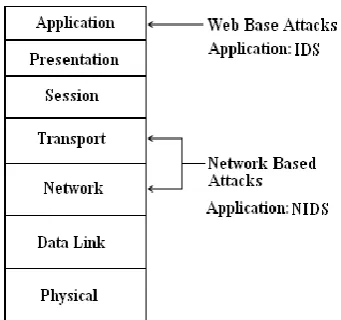
suggest a class of code– injection ambushes in which data gave by the customer is consolidated into a SQL request of such a course, to the point that bit of the customer's data is managed as SQL code. SQL mixture is a technique offer used to ambush a site. This is done by including fragments of SQL clarifications in a web application section field attempting to get the website to pass an as of late formed agitator SQL charge to the database. SQL Injection is a code mixture framework that undertakings security weakness in site programming. The feebleness happens when customer commitment of either incorrectly isolated for string demanding flight characters embedded in SQL announcements or customer data isn't particularly and all of a sudden executed. A champion among the best parts to shield against web attacks uses Intrusion Detection System (IDS) and Network Intrusion Detection System (NIDS). IDS use manhandle or peculiarity distinguishing proof to protect against ambush [8]. IDS that use idiosyncrasy disclosure methodology develops a standard of commonplace utilize plans. Mishandle area framework uses especially known cases of unapproved direct to envision and perceive resulting practically identical kind of ambushes. These sorts of cases are called as imprints [8, 9]. NIDS are not support for the organization arranged applications (web ambush), in light of the fact that NIDS are working lower level layers as showed up in figure [11]
II.
RELATED WORK
In the course of recent decades, distinctive investigates and methodologies have been exhibited and distributed numerous strategies for discovery and avoidance of SQL Injection Attack (SQLIA). In electronic security issues, SQLIA has the best generally need. Essentially, we can characterize the discovery and aversion strategies into two general classes. To begin with approach is attempting to recognize SQLIA through checking Anomalous SQL Query structure utilizing string matching, pattern matching and inquiry handling. In the second approach utilizes information conditions among information things which are less inclined to change for distinguishing noxious database exercises. In both the classes, a significant number of the scientists proposed diverse plans with incorporating information mining and interruption identification frameworks. These sorts of methodologies limit the false positive alarms, limiting human mediation and better recognition of attack [13]. Also, extraordinary interruption discovery systems are utilized either independently or other. Diverse work utilized abuse system other utilized inconsistency. A general system for recognizing malignant database exchange patterns utilizing information mining was proposed by Bertino et al [16, 17] to mine database logs to frame client profiles that can display typical practices and distinguish atypical exchange in database with part based access control component.
SQLIA by finding the plan of an inquiry dynamically and after that contrasting the structure of the recognized question with ordinary inquiries in light of the client contribution with the found expectation.
Halfond et al [21] built up a strategy that uses a model– based way to deal with recognize illicit inquiries previously they are executed on the database. William et al [20] proposed a framework WASP to avoid SQL Injection Attacks by a strategy called positive polluting. Srivastava et al [22] offered a weighted arrangement digging approach for identifying information base attacks. The commitment of this paper is to propose a procedure for distinguishing and counteracting SQLIA utilizing both static stage and dynamic stage. The proposed strategy utilizes static Anomaly Detection utilizing Aho– Corasick Pattern matching calculation. The irregularity SQL Queries are discovery in static stage. In the dynamic stage, if any of the questions is distinguished as inconsistency inquiry then new pattern will be made from the SQL Query and it will be added to the Static Pattern List (SPL).
III.
PROPOSED SCHEME
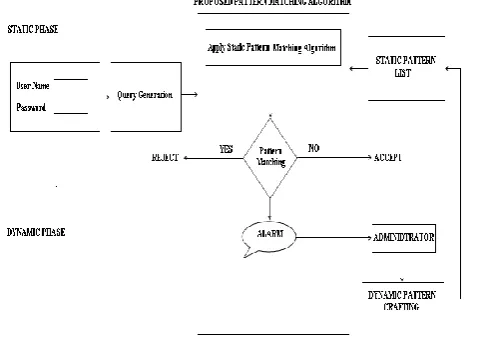
In this fragment, we display a capable count for perceiving and keeping away from SQL Injection Attack using Aho– Corasick Pattern planning figuring. The proposed configuration is given in figure 2 underneath. The proposed scheme has the going with two modules, 1) Static Phase and 2) Dynamic Phase. In the Static Pattern List, we keep up an once-over of known Anomaly Pattern. In Static Phase, the customer delivered SQL Queries is checked by applying Static Pattern Matching Algorithm. In Dynamic Phase, if any sort of new irregularity is happen then Alarm will appear and new Anomaly Pattern will be delivered. The new peculiarity case
will be invigorated to the Static Pattern List. The going with steps are performed in the midst of Static and Dynamic Phase,
Figure 2. System Architecture Static Phase
Step 1: User created SQL Query is send to the proposed Static Pattern Matching Algorithm
Step 2: The Static Pattern Matching Algorithm is given in Pseudo Code is given underneath
Step 3: The Anomaly cases are kept up in Static Pattern list, in the midst of the illustration planning strategy every case is differentiated and the secured Anomaly Pattern in the summary
Step 4: If the case is unequivocally organize with one of the set away case in the Anomaly Pattern List then the SQL Query is affected with SQL Injection Attack
Dynamic Phase
Step 1: Otherwise, Anomaly Score regard is figured for the customer made SQL Query, If the Anomaly Score regard is all the more than the Threshold regard, then an Alarm is given and Query will be go to the Administrator.
There are numerous approaches to manage seeing plans that incorporate using restricted automata. The Aho–Corasick figuring [2] is one such awesome estimation. The musing is that a constrained machine is created using the course of action of watchwords in the midst of the pre–computation time of the estimation and the planning incorporates the robot checking the SQL address declaration examining each character in SQL request definitely once and putting aside consistent time for each read of a character. Pseudo code of the Aho–Corasick different catchphrase planning estimation is given underneath, The AC computation uses a refinement of a tries to store the course of action of Anomaly Keywords in a case organizing.
IV.
ALGORITHM
A. Static Pattern Matching Step1: SPMA (Query, SPL [ ])
INPUT: Query → User Generated Query
SPL [] → Static Pattern List with m Anomaly Pattern Step2: For j = 1 to m do
Step3: If (AC (Query, String .Length (Query), SPL[j] [0]) ==ɸ))
Step4:
Step5: If (Anomolyscore≥ Threshold value) then
Step6: Return Alarm → Administrator Else
Step 7: Return Query → Accepted End if
Step 8: Return Query → Rejected End if
End For End Procedure
B. Aho - Corasick Algorithm Step 1: Procedure AC (y, n, q0) Step 2: Set of all Queries.
Step 3: For All Queries i = 1 to n do
Step 4: Check with Static pattern matching Step 5: If (Detected (True)) show result
Step 6: Else Send For Dynamic Pattern Matching Step 7: Tokenize the query.
Step 8: Convert token into pattern matching syntax by using syntax aware
Step 12: Reject Query
Step 14: Else Start Positive Tainting Step 15: Remove the attack pattern tokens Step 16: After token removal combine all tokens Step 17: Execute Query
Step 18: End for
Step 19: End Procedure
V.
CONCLUSIONS
This Structure keeps up an imperative detachment from strikes like SQL control and besides perceptible SQL injection. This paper furthermore propose important debasing changes from routine destroying, paying little respect to how it is secured around the attestation, checking, and duplicating of trusted, instead of non-put stock in, data. Other than sentence structure cautious assessment is utilizing the debase inscriptions to see honest to goodness from hazardous request. These papers in like way show an approach for preventive and certification activity of SQL injection attacks utilizing Aho-Corasick arrangement arranging estimation and Positive dirtying structure. In future it is conceivable to utilize graphical passwords for login, with the target that it will in like way not get hacked by attacker and can give more secure endorsement. Moreover it will be noteworthy to consider elective evading framework for SQL Injection Attack to make the application more reasonable.
VI.
REFERENCES
[1]. Amit Kumar Pandey, "SECURING WEB APPLICATIONS FROM APPLICATION-LEVEL ATTACK", master thesis, 2007
[2]. C.J. Ezeife, J. Dong, A.K. Aggarwal, "SensorWebIDS: A Web Mining Intrusion Detection System", International Journal of Web Information Systems, volume 4, pp. 97-120, 2007
[3]. S.Axelsson, "Intrusion detection systems: A survey and taxonomy", Technical Report, Chalmers Univ., 2000
[4]. Marhusin, M.F.; Cornforth, D.; Larkin, H., "An overview of recent advances in intrusion detection", in proceeding of IEEE 8th International conference on computer and information technology CIT, 2008
[5]. S. F. Yusufovna., "Integrating Intrusion Detection System and Data Mining", International Symposium on Ubiquitous Multimedia Computing, 2008
[6]. Low, W. L., Lee, S. Y., Teoh, P., "DIDAFIT: Detecting Intrusions in Databases Through Fingerprinting Transactions", in Proceedings of the 4th International Conference on Enterprise Information Systems (ICEIS), 2002
[7]. F. Valeur, D. Mutz, and G.Vigna, "A learning-based approach to the detection of sql injection attacks", in proceedings of the conference on detection of intrusions and Malware and vulnerability assessment (DIMVA), 2005
[8]. Bertino, E., Kamra, A, Terzi, E., and Vakali, A, "Intrusion detection in RBAC-administered databases", in the Proceedings of the 21st Annual Computer Security Applications Conference, 2005
[9]. Kamra A, Bertino, E., and Lebanon, G.,"Mechanisms for Database Intrusion Detection and Response", in the Proceedings of the 2nd SIGMOD PhD Workshop on Innovative Database Research, 2008
[10]. Kamra A, Terzi E., and Bertino, E.,"Detecting anomalous access patterns in relational databases", the VLDB Journal VoU7, No. 5, pp. 1063-1077, 2009
[12]. Bandhakavi, S., Bisht, P., Madhusudan, P., and Venkatakrishnan V., "CANDID: Preventing sql injection attacks using dynamic candidate evaluations", in the Proceedings of the 14th ACM Conference on Computer and Communications Security, 2007
[13]. Halfond, W. G. and Orso, A , "AMNESIA: Analysis and Monitoring for Neutralizing SQL-Injection Attacks", in Proceedings of the 20th IEEE/ACM international Conference on Automated Software Engineering, 2005
[14]. William G.J. Halfond, Alessandro Orso, and Panagiotis Manolios, "WASP: Protecting Web Applications Using Positive Tainting and Syntax- Aware Evaluation", IEEE Transactions on Software Engineering, Vol. 34, No. 1, pp 65-81, 2008