University of Pennsylvania
ScholarlyCommons
Publicly Accessible Penn Dissertations
2019
Detecting Ancient Balancing Selection: Methods
And Application To Human
Katherine Siewert
University of Pennsylvania, [email protected]
Follow this and additional works at:https://repository.upenn.edu/edissertations
Part of theBioinformatics Commons,Evolution Commons, and theGenetics Commons
This paper is posted at ScholarlyCommons.https://repository.upenn.edu/edissertations/3313 For more information, please [email protected].
Recommended Citation
Siewert, Katherine, "Detecting Ancient Balancing Selection: Methods And Application To Human" (2019).Publicly Accessible Penn Dissertations. 3313.
Detecting Ancient Balancing Selection: Methods And Application To
Human
Abstract
Balancing selection can maintain genetic variation in a population over long evolutionary time periods. Identifying genomic loci under this type of selection not only elucidates selective pressures and adaptations but can also help interpret common genetic variation contributing to disease. Summary statistics which capture signatures in the site frequency spectrum are frequently used to scan the genome to detect loci showing evidence of balancing selection. However, these approaches have limited power because they rely on imprecise signatures such as a general excess of heterozygosity or number of genetic variants. A second class of statistics, based on likelihoods, have higher power but are often computationally prohibitive. In addition, a majority of methods in both classes require a high-quality sequenced outgroup, which is unavailable for many species of interest. Therefore, there is a need for a well-powered and widely-applicable statistical approach to detect balancing selection. Theory suggests that long-term balancing selection will result in a genealogy with very long internal branches. In this thesis, I show that this leads to a precise signature: an excess of genetic variants at near identical allele frequencies to one another. We have developed novel summary statistics to detect this signature of balancing selection, termed the β statistics. Using simulations, we show that these statistics are not only computationally light but also have high power even if an outgroup is unavailable. We have derived the variance of these statistics, allowing proper comparison of β values across sample sizes, mutation rates, and allele frequencies - variables not fully accounted for by many previous methods. We scanned the 1000 Genomes Project data with β to find balanced loci in humans. Here, I report multiple balanced haplotypes that are strongly linked to both association signals for complex traits and regulatory variants, indicating balancing selection may be affecting complex trait architecture. Due to their high power and wide applicability, the β statistics enable evolutionary biologists to detect targets of balancing selection in a range of species and with a degree of specificity previously unattainable.
Degree Type
Dissertation
Degree Name
Doctor of Philosophy (PhD)
Graduate Group
Genomics & Computational Biology
First Advisor
Benjamin F. Voight
Keywords
Balancing selection, Natural selection, Selection scans
Subject Categories
DETECTING ANCIENT BALANCING SELECTION: METHODS
AND APPLICATION TO HUMAN
Katherine M. Siewert
A DISSERTATION
in
Genomics and Computational Biology
Presented to the Faculties of the University of Pennsylvania
in
Partial Fulfillment of the Requirements for the
Degree of Doctor of Philosophy
2019
Supervisor of Dissertation
Benjamin F. Voight, Ph.D., Associate Professor of Systems Pharmacology and Trans-lational Therapeutics and Genetics
Graduate Group Chairperson
Benjamin F. Voight, Ph.D., Associate Professor of Systems Pharmacology and Trans-lational Therapeutics and Genetics
Dissertation Committee:
Marcella Devoto, Ph.D., Professor of Pediatrics and Epidemiology Sarah A. Tishkoff, Ph.D., Professor of Genetics and Biology Junhyong Kim, Ph.D., Professor of Biology
Acknowledgments
I am lucky enough to have a large number of people to thank for making my time
in graduate school both enjoyable and fruitful. I would first and foremost like to
thank my advisor, Ben Voight. He is in large part responsible for turning me into the
scientist I am today, both by modeling science as a process driven by excitement and
curiosity and through viewing it as a question-driven endeavor. His support, trust
and patience allowed my PhD to be a happy six years. In addition, I am grateful for
my thesis committee: Marcella Devoto, Sarah Tishkoff, Junhyong Kim and Philipp
Messer for their time and gracious advice.
I have been lucky to have been a part of the amazing group of individuals that compose
the Voight Lab. Kelsey Johnson, you deserve an especially large shout-out, as it has
been both fun and motivating working towards our PhDs together. Thank you for all
of our conversations, whether it be about science or life, as well as for the occasional
well-deserved sass when I said something truly ridiculous! Thank you to Paul Babb
for being a constant source of support and encouragement, and for being a model of
encouraging my inquisitive and outspoken nature, even to the occasional exasperation
of our poor advisor and labmates.
Kat Gawronski – I thank you for being both a close friend and an amazing support
system – conversations with you seemed to either lead to laughter, me learning
some-thing interesting, or both! Onur Y¨or¨uk, the same goes for you. I would also like to
thank Kim Lorenz, Chris Thom, and Diana Cousminer for their wise feedback and
support throughout my PhD. Finally, I would like to thank Will Bone and Chris
Adams for making my last few years of PhD full of fun discussion, both scientific and
otherwise.
I owe much to the inspiring and supportive scientific community at Penn, including
my friends, professors, administrators and colleagues. I would like to give a special
acknowledgment to the GCB students in my year: Alex Amlie-Wolf, Lucy Shan,
Salika Dunatunga, Brett Beaulieu-Jones and Ian Mellis. I could not have asked to be
a part of a more intelligent, mature and supportive group of individuals.
I also thank my family for turning me into the person I am today. I am grateful
for my parents for modeling and encouraging curiosity, critical thinking and hard
work, for which I credit my PhD to more than anything else. Gretchen Siewert, you
are a never-ending source of laughter and support! Finally, I would like to thank
my partner Jason Rocks. You’ve been my rock throughout graduate school and
DETECTING ANCIENT BALANCING SELECTION: METHODS AND
APPLICATION TO HUMAN
Katherine M. Siewert
Benjamin F. Voight, Ph.D.
Balancing selection can maintain genetic variation in a population over long
evolu-tionary time periods. Identifying genomic loci under this type of selection not only
elucidates selective pressures and adaptations but can also help interpret common
genetic variation contributing to disease. Summary statistics which capture
signa-tures in the site frequency spectrum are frequently used to scan the genome to detect
loci showing evidence of balancing selection. However, these approaches have limited
power because they rely on imprecise signatures such as a general excess of
heterozy-gosity or number of genetic variants. A second class of statistics, based on likelihoods,
have higher power but are often computationally prohibitive. In addition, a majority
of methods in both classes require a high-quality sequenced outgroup, which is
un-available for many species of interest. Therefore, there is a need for a well-powered
and widely-applicable statistical approach to detect balancing selection. Theory
sug-gests that long-term balancing selection will result in a genealogy with very long
internal branches. In this thesis, I show that this leads to a precise signature: an
excess of genetic variants at near identical allele frequencies to one another. We have
developed novel summary statistics to detect this signature of balancing selection,
computationally light but also have high power even if an outgroup is unavailable. We
have derived the variance of these statistics, allowing proper comparison of β values
across sample sizes, mutation rates, and allele frequencies - variables not fully
ac-counted for by many previous methods. We scanned the 1000 Genomes Project data
with β to find balanced loci in humans. Here, I report multiple balanced haplotypes
that are strongly linked to both association signals for complex traits and regulatory
variants, indicating balancing selection may be affecting complex trait architecture.
Due to their high power and wide applicability, the β statistics enable evolutionary
biologists to detect targets of balancing selection in a range of species and with a
Contents
1 Introduction 1
1.1 A brief history of balancing selection . . . 2
1.1.1 Development of the theory of overdominance as a source of hybrid vigor . . . 2
1.1.2 Modern definitions of balancing selection . . . 3
1.1.3 Examples of balanced loci . . . 3
1.2 The effect of balancing selection on coalescence and patterns of variation 5
1.2.1 Effects of balancing selection on the coalescent process . . . . 5
1.2.2 Effects of extended time to most recent common ancestor on the site frequency spectrum . . . 7
1.3 Detecting balancing selection: statistics and scans . . . 9
1.3.1 Motivation for detecting balancing selection . . . 9
1.3.2 Classic methods for detecting balancing selection based on the site frequency spectrum . . . 10
1.3.3 Trans-species SNPs and haplotypes as a signature of balancing selection . . . 12 1.3.4 Recent statistics to detect balancing selection: Composite
like-lihood methods . . . 14 1.3.5 Power and applicability of existing method for detecting
bal-ancing selection . . . 15
1.4 Genome-wide impact of balancing selection . . . 17
1.4.1 Debate on the importance of balancing selection to evolution . 17 1.4.2 Effects of balancing selection on the deleterious mutation load 19 1.5 Motivation for a new method for detecting ancient balancing selection 21 2 Detecting ancient balancing selection using an excess of allele fre-quency similarity 22 2.1 Effects of balancing selection on the site frequency spectrum . . . 23
2.1.1 A forward in time perspective . . . 23
2.1.2 A coalescent perspective . . . 23
2.1.3 Effects of recombination on the signature of balancing selection 25 2.2 The β(1) statistics for detecting balancing selection . . . . 26
2.2.1 Framework for capturing excess allele frequency correlation . . 26
2.2.2 Capturing allele frequency correlation . . . 27
2.2.3 Choice ofp parameter . . . 28
2.2.4 Estimator of the mutation rate based on allele frequency corre-lation . . . 31
2.2.5 A summary statistic to detect balancing selection based on the site frequency spectrum . . . 32
2.2.6 Properties of β(1) in simulations . . . . 34
2.2.7 On the assumption of independence between basepairs . . . . 35
2.3 Standardization of the β(1) statistics . . . 36
2.3.1 Variance of the unfolded β statistic . . . 37
2.3.2 Variance of the folded β statistic . . . 37
2.3.3 Standardized β statistics . . . 39
2.4 Window size containing signature of balancing selection . . . 40
2.5.1 Simulations . . . 42
2.5.2 Method of power comparison . . . 44
2.5.3 Power comparison results . . . 47
3 Application of β(1) to detect balancing selection in humans 63 3.1 Overview of scan . . . 63
3.2 Methods for 1000 Genomes Analysis . . . 65
3.3 Characterization of signals . . . 67
3.4 A signature of balancing selection at the CADM2 locus . . . 69
3.5 A signature of balancing selection near the diabetes associated locus, WFS1 . . . 71
3.6 Discussion of top β loci . . . 72
4 Detecting ancient balancing selection using substitutions 76 4.1 Derivation of ˆθD and its variance . . . 77
4.2 Estimation of the speciation time . . . 82
4.3 Power analysis . . . 84
4.3.1 Power analysis ofβ(2) and standardized β statistics . . . 84
4.3.2 Techniques for power comparison . . . 88
4.3.3 Comparison with prior power analyses. . . 90
4.3.4 Comparison of β(2) and N CD2 statistics. . . . 91
4.4 Estimation of the background mutation rate . . . 93
5 Conclusions and future directions 96 5.1 The β statistic in perspective . . . 96
5.2 Potential improvements to the β statistics . . . 98
List of Figures
1.1 Coalescent trees: balanced versus neutral . . . 7
1.2 Site frequency spectrum under balancing selection . . . 8
2.1 Cartoon of allelic class-build up . . . 24
2.2 Coalescent look at alleleic class build-up . . . 25
2.3 Simulations demonstrate allelic-class build-up . . . 26
2.4 Similarity function visualized . . . 29
2.5 Power of Beta with differentp parameter values . . . 30
2.6 β(1) distribution in simulations . . . . 35
2.7 Power of conditional β statistic . . . 36
2.8 Power analysis using different window sizes . . . 43
2.9 Power ofT1 and T2 with different numbers of informative sites . . . 46
2.10 Power analysis with basic demography . . . 48
2.11 Power analysis with population expansion . . . 49
2.12 Power analysis with population bottleneck . . . 50
2.13 Power analysis with subdivided population . . . 52
2.14 Power analysis with introgression . . . 55
2.16 Power analysis with low mutation rate . . . 57
2.17 Power analysis with high recombination rate . . . 58
2.18 Power analysis with low recombination rate . . . 59
2.19 Power analysis by sample size, younger selection . . . 60
2.20 Power analysis by sample size, older selection . . . 60
2.21 Power of β(1) with sub-sampling of individuals across values of p . . . 61
2.22 Power analysis with frequency-dependent selection . . . 62
2.23 Power analysis with weak selection . . . 62
3.1 β(1) distribution in 1000 Genomes populations . . . . 64
3.2 Signal of balancing selection atCADM2 . . . 68
3.3 Signal of balancing selection atWFS1 . . . 70
4.1 Segments of coalescent tree . . . 78
4.2 Distribution of ˆθ statistics in simulations . . . 82
4.3 Distribution of β statistics in simulations . . . 83
4.4 Power ofβ(2) if speciation time is incorrect . . . . 84
4.5 Power comparison at a 1% false positive rate . . . 85
4.6 Power ofβ(2) compared to other methods . . . . 86
4.7 Power ofβ(2) without controlling for allele frequency . . . . 87
4.8 Power ofN CD2 statistic on different window sizes . . . 88
List of Tables
Chapter 1
Introduction
Overdominance is “due to the occurrence of a rather special class of mutations and
gene combinations, which confer on heterozygotes a higher adaptive value... Although
overdominance is, by and large, an exceptional situation, it is of particular interest
to a student of population genetics”.
1.1
A brief history of balancing selection
1.1.1
Development of the theory of overdominance as a source
of hybrid vigor
The concept of balancing selection arose from early discussions of hybrid vigor. This
phenomenon had been observed for centuries and has been of significant interest
due to its direct relevance to plant breeding (Crow, 1987). Indeed, it was noted by
Mendel, who observed that hybrid pea strains were larger and more vigorous than
parental strains (Mendel 1865). Charles Darwin also had an interest in the topic:
he wrote an entire book on inbreeding depression and hybrid vigor (Darwin, 1878).
Geneticists in the early 1900s, particularly George Shull and Edward East, suggested
that this hybrid vigor, or heterosis, was due to the increased diversity of alleles found
in an individual with higher heterozygosity. It was proposed that these alleles increase
fitness in a complementary fashion to one another (East, 1936; Shull, 1948). The term
overdominance was introduced by Fred Hull to refer to this phenomena. He defined
it as the situation in which the fitness of a heterozygote would be over the fitness
that would be observed if either allele was dominant (Hull, 1945, 1946). Although
overdominance fell out of favor as the reason for hybrid vigor (see section 1.4.1), it
1.1.2
Modern definitions of balancing selection
Throughout the next several decades, balancing selection became defined as natural
selection in which multiple alleles are maintained at a locus in a population (Levene,
1953). It can be due to overdominance as originally suggested, but further work
demonstrated that it can also be due to spatially, temporally, or negative-frequency
dependent selection. For instance, if multiple niches are present in an environment an
equilibrium can occur if alternate alleles are beneficial in the different niches (Levene,
1953; Haldane, J.B.S., Jayakar, 1963). Furthermore, if the fitness of an allele in a
population fluctuates with time, then under certain conditions, this can lead to
long-term maintenance of the alternately favored alleles (Hedricket al., 1976). Finally, the
fitness of an allele may be inversely proportional to its frequency, which will cause
the frequency of the allele to increase until it is no longer favored and has therefore
reached its equilibrium frequency (Takahata and Nei, 1990).
1.1.3
Examples of balanced loci
Throughout the last century, there has been an interest in finding genomic loci that
have experienced balancing selection. There are several classic sites long proposed
to be under this type of selection. Perhaps the most famous is the Hemoglobin-β
locus. Homozygotes for the sickle-cell allele have sickle-cell anemia, homozygotes for
the other alleles have an increased risk of malaria, while heterozygotes have resistance
2002). The major histocompatibility complex (MHC) region has also been long
hy-pothesized to be under selection for multiple reasons (Slade and McCallum, 1992).
The first is overdominance, as it could be advantageous for an immune system to be
able to respond to a wider diversity of pathogens. However, studies have shown that
the level of heterozygosity observed in the MHC in humans cannot be explained solely
by overdominance (De Boer et al., 2004). Frequency-dependent selection may be
re-sponsible for the additional signal of balancing selection in the MHC. The mechanism
for this type of selection would be that pathogens may not be adapted to overcome
rare human alleles that aid in resistance against them (Slade and McCallum, 1992).
There have also been a number of loci recently proposed to be under balancing
selec-tion with experimental or observaselec-tional evidence (Schweizer et al., 2018; Sanoet al.,
2018; Network, 2015; Wheat et al., 2010). One example is balancing selection on a
locus in North American wolves. Homozygotes and heterozygotes for the KB allele
have a black coat color, while homozygotes for the ky allele have a gray coat color
(Anderson et al., 2009). Interestingly, heterozygotes have the highest fitness in
Yel-lowstone populations, suggesting that coat color is not the only selective pressure
(Schweizer et al., 2018). Evidence suggests that overdominance may be acting at this
locus, possibly due to the K locus being involved with not only coat color, but also
immune response (Schweizer et al., 2018).
Another recently described example is spatially-dependent selection in a species of
extremophile cyanobacterium. A polymorphism which affects the function of
in this species (Fischerella thermalis) and has significantly different allele frequencies
between individuals living in two different temperatures. There is high gene flow
between the individuals living in the different temperatures, and very low population
differentiation elsewhere in the genome (Sano et al., 2018). This suggests that these
individuals are part of the same species and that this locus may be under long-term
spatially dependent selection due to adaptation to different temperature conditions.
1.2
The effect of balancing selection on coalescence
and patterns of variation
1.2.1
Effects of balancing selection on the coalescent process
Initially, a newly balanced allele will increase in frequency. This creates long
haplo-types of limited diversity, mimicking the effects of an incomplete positively selected
sweep (Charlesworth, 2006). The allele will then increase in frequency until it reaches
what is termed its equilibrium frequency – the frequency at which it is expected to
be maintained. This frequency is determined by the relative fitness of the different
genotypes. For instance, if the fitness of the two homozygote classes are equal, and
the fitness of the heterozygote is higher, then the equilibrium frequency will be 50%.
In the case of the sickle cell allele in populations in malaria-endemic regions, the
homozygotes for the sickle-cell alleles have much lower fitness than for the opposite
much lower than 50%. In malaria endemic regions estimates have found its frequency
to be no more than 18% in any population (Piel et al., 2010).
If the selective pressure is sustained, then balancing selection can maintain alleles in
populations for potentially very long time periods, given certain conditions.
Specif-ically, the selective coefficient must be high enough that the heterozygotes have a
significant fitness advantage over homozygotes (Robertson, 1962). In addition, the
equilibrium frequency must be of intermediate frequency (between about 20 and 80%)
(Takahata and Nei, 1990; Ewens and Thomson, 1970; Robertson, 1962), or genetic
drift will remove the variation after enough generations.
By maintaining polymorphism, balancing selection affects the structure of the
coa-lescent tree at the locus. Under neutrality, genetic drift will cause coalescence of all
lineages after a moderate amount of time. In contrast, neither allele can fix in the
population under balancing selection, so the time to most recent common ancestor
(TMRCA) will predate the start of balancing selection, making it potentially much
older than at a neutral locus (Fig. 1.1) (Kaplan et al., 1988). The genealogy of
each allelic class, defined as all haplotypes containing one of the two balanced alleles,
will be nearly identical to that of a neutral locus of sample size equal to the size of
the allelic class (Hey, 1991). The number of individuals in the two sub-trees is
de-termined by the equilibrium frequency. Although these characteristics will hold true
under all types of long-term balancing selection, the structure of the coalescent tree
under temporally-dependent selection may be more complex, due to the relative sizes
Figure 1.1: Balancing selection increases the time to most recent common ancestor at a locus. Circles represent haploid individuals.
1.2.2
Effects of extended time to most recent common
an-cestor on the site frequency spectrum
The long time to most recent common ancestor at a locus under balancing selection
results in old haplotypes. Due to their age, these haplotypes have had time to
accu-mulate large numbers of mutations (Charlesworth 2006). More specifically, balanced
haplotypes will accumulate their own unique alleles, but these alleles are not allowed
to fix in the population because selection constrains the frequency of the haplotype
class in which they arose (Hey, 1991). This results in the classic signature of
bal-ancing selection: an excess number of intermediate frequency alleles and a deficit of
substitutions (i.e. genomic positions in which the allele in all ingroup individuals
differs from the outgroup individual)(Fig. 1.2)(Hudsonet al., 1987; Tajima, 1989).
hap-Figure 1.2: Site frequency spectrum of derived alleles in balanced or neutral simula-tions, with core variant removed. Substitusimula-tions, i.e. positions in which the derived allele is fixed in the species under consideration, are displayed as SNPs of frequency 1.0. Window size is 500 base pairs on either side of the core site, with sample size 100 chromosomes. Based on simulations with an equilibrium frequency of 0.5.
loid two-island model (Hey, 1991). In this model, a population is split into two
isolated subpopulations. Mutations can arise on each island, but without migration
between the islands, the mutations will not reach the subpopulation on the other
island. Instead, these mutations build-up on the islands, causing an excess number
of intermediate frequency alleles when the sub-populations are combined into a site
frequency spectrum (Tajima, 1989). However, migration will allow alleles to transfer
between the two islands, reducing the number of unique alleles. Analogously,
un-der balancing selection, two haplotype classes are maintained in the population with
neither one allowed to fix due to selection. Mutations unique to each allelic class
mutations from the effects of selection (Hudson and Kaplan, 1988; Hey, 1991).
1.3
Detecting balancing selection: statistics and
scans
1.3.1
Motivation for detecting balancing selection
A number of fundamental questions in evolutionary biology can be addressed through
scans for natural selection. One key question is what selective pressures species have
experienced throughout their evolutionary history, and how they have adapted to
these pressures. If a balanced locus is detected in a scan for selection, then
compu-tational and/or experimental approaches may be used to figure out what phenotypes
the locus is associated with. In some cases, the causal selective pressures on the
locus can be inferred. This process has successfully uncovered multiple targets of
balancing selection and their associated phenotypes, as discussed in section 1.1.3,
though I note that only some of these began with a genome-wide scan for selection.
Scans for positive selection and follow-up have been more successful, possibly owing
to a larger history of methodological development for detecting positive selection.
Established sites under positive selection in humans with an established phenotype
include EDAR for hair follicle thickness (Kamberov et al., 2013), lactase persistence
(Bersaglieri et al., 2004; Tishkoff et al., 2007), alcohol dehydrogenase (Osier et al.,
et al., 2018). These successes in scans for positive selection bode well for the goal of
detecting and explaining sties under balancing selection.
In fact, one advantage of detecting balancing selection is that it leaves a much
nar-rower footprint in the genome than does positive selection (Section 2.4). This results
in a smaller number of possible causal variants, making the identification of the true
causal variant easier. Despite this factor, the number of balanced loci in humans
with an established phenotype and/or selective pressure is very limited, motivating
the need research on balancing selection.
A second key question scans for selection can help answer is the impact different types
of selection have had on patterns of variation in species. This is discussed more in
section 1.4. In short, in order to identify the prevalence of balancing selection, we
must first develop a better understanding of its effects on genomic loci under this
type of selection.
In order to answer both these questions, a highly specific signature of balancing
selection, and a corresponding high-powered test for its detection, is needed.
1.3.2
Classic methods for detecting balancing selection based
on the site frequency spectrum
By scanning population-level sequencing data for the signatures of selection, loci
meth-ods of doing so calculate a statistic sensitive to the effects of balancing selection on
the site frequency spectrum in a sliding window across the genome.
Tajima’s D is one such statistic. It is the difference of two unbiased estimators
of the mutation rate. Intuitively, these estimators estimate the mutation rate by
counting the number of SNPs, using the intuition that a higher mutation rate will
result in a higher number of mutations in a window. Accordingly, estimators of
the mutation rate will be higher if there are more SNPs. The first estimator which
comprises Tajima’sD, θπ, estimates the mutation rate using heterozygosity. Because
the number of intermediate frequency mutations on old haplotypes is expected to be
higher than on newer haplotypes (Fig. 1.2), this estimator will increase in windows
which have experienced long-term balancing selection. The second estimator, θW,
uses the total number of SNPs in a window to estimate the mutation rate. This
estimator is relatively insensitive to balancing selection and is used to correct for
the background mutation rate. Tajima’s D is the difference of these two estimators
divided by the standard deviation (Tajima, 1989):
D= θπ−θW
V ar[θπ−θW]
(1.3.1)
Therefore, values of D significantly above zero indicate potential long-term balancing
selection, while values close to zero indicate an absence of evidence of balancing
selection.
look at allele frequencies, but instead compares only the number of polymorphisms
and the number of substitutions to their expected number under neutrality. By
com-bining these terms in a chi-squared statistic, significant deviation from neutrality can
be detected (Hudson et al., 1987). Specifically, a higher number of polymorphisms,
and a lower number of substitutions are expected under balancing selection, as
pre-viously discussed.
Several other statistical tests have also been used to detect these signatures of
bal-ancing selection. The Mann-Whitney U test can be used to detect an excess number
of intermediate-frequency alleles. This test can be used in combination with a
mod-ified HKA test, which detects an excess number of variants at a locus. The union
of these tests produced a set of loci with both higher-frequency SNPs and a higher
total number of SNPs than the background levels in the human genome, indicating
balancing selection (Andres et al., 2009).
1.3.3
Trans-species SNPs and haplotypes as a signature of
balancing selection
An orthogonal signature of balancing selection is shared SNPs or haplotypes between
multiple species. Trans-species haplotypes are defined as two or more variants that are
found in tight linkage disequilibrium and are shared between humans and a primate
outgroup (in our case, chimpanzee). If a neutral SNP was present in a common
the population in one or both species, leading to a substitution. In contrast, if the
SNP is under balancing selection in both species, it can be maintained from the time
it arose until present (Takahata, 1990; Takahata and Nei, 1990). This leads to the
segregation of both alleles in both species. Therefore, if two species share one SNP
(a trans-species SNP) or more than one SNP at a locus (a trans-species haplotype),
this indicates potential balancing selection.
The presence of trans-species SNPs may be due to recurrent mutations (i.e. the same
mutation occurs in both species independently), so are not a test for selection with
high specificity. In contrast, due to the very low probability of two recurrent
muta-tions occurring in high linkage disequilibrium under human and chimp demography
(Gao et al., 2014), trans-species haplotypes are a very specific signature of
balanc-ing selection in humans. Multiple studies have used human and chimp sequencbalanc-ing
data to detect these shared SNPs and haplotypes (Leffler et al., 2013; Teixeira et al.,
2015). These scans have identified a number of balanced loci potentially involved
in immunity, including loci involved with recognizing plasmodium falciparum (Leffler
et al., 2013) or a missense change in LAD1, an autoantigen which causes linear IgA
disease (Teixeira et al., 2015). In addition, the ABO blood group has been proposed
to be under long-term balancing selection in humans on the basis of trans-species
1.3.4
Recent statistics to detect balancing selection:
Com-posite likelihood methods
An ideal statistic to detect balancing selection would be a full likelihood estimation of
a locus being under balancing selection as opposed to being neutral. Such a statistic
could be based on summary level information about the site frequency spectrum,
such as the probability of seeing a mutation at each frequency at each distance from
a balanced SNP. Alternatively, it could make use of individual-level genotype data,
calculating the likelihood of the observed haplotype structures at various distances
from the balanced SNP. These are in contrast to the early statistics designed to detect
balancing selection, which do not rely on likelihoods and instead use a summary
statistic to capture the general patterns caused by selection.
Recently, two composite likelihood methods were developed to detect balancing
se-lection (DeGiorgio et al., 2014) which utilize the site frequency spectrum. These
statistics are composite in that they consider each SNP independently of the other
SNPs at the locus. The Kaplan-Darden-Hudson model, which describes the genealogy
of a neutral SNP linked to a selected SNP (Kaplanet al., 1988; Hudson and Kaplan,
1988), is used to model the probability of seeing a segregating site or substitution
at each recombination-scaled distance from a balanced SNP. The background levels
of polymorphism and substitutions are used to generate the expected site frequency
spectrum near a SNP evolving neutrally. By comparing these two composite
likeli-hoods, a test for balancing selection, T1, is derived (DeGiorgio et al., 2014). The T1
consider allele frequencies.
DeGiorgio et al. then derive the T2 statistic, which does take into account allele
frequencies (DeGiorgio et al., 2014). However, because the site frequency spectrum
under balancing selection is unknown, simulations are used to generate
probabili-ties of seeing SNPs at various frequencies. These simulations are performed under
specified parameter values, including a large range of equilibrium frequencies and
recombination rates. By using simulations matched for equilibrium frequency and
re-combination rate at a locus, these simulation-generated likelihoods are incorporated
into a composite likelihood framework.
1.3.5
Power and applicability of existing method for
detect-ing balancdetect-ing selection
Using simulations, DeGiorgio et al. (2014) demonstrated that the power of their
T1 and T2 statistics are higher than the HKA test and Tajimas D. The power of
their T2 method is higher than T1, as would be expected because it considers allele
frequencies. However, T2 presents challenges in its applicability. Namely T2, like
the T1 and HKA test, requires an outgroup with which to call substitutions and
ancestral/derived allele states. In addition, prior to scanning the genome with the
T2 test, large numbers of simulations must be performed to generate expected site
frequency spectra. These simulations are computationally intensive, making wide
In some cases, a sequenced individual from an outgroup species is unavailable,
render-ing all these summary statistics inapplicable except Tajima’s D. However, Tajima’s
D has the lowest power to detect balancing selection in the analysis of DeGiorgio
et al. (2014). Furthermore, calling trans-species SNPs and trans-species haplotypes
requires multiple outgroup individuals. This suggests the need for new methods to
detect selection which do not require an outgroup but have the high power of theT2
method.
1.3.6
Coalescent methods
Recent methods seek to directly estimate the time to most recent common ancestor
(TMRCA), as opposed to using summary statistics. These methods are based on the
pairwise sequentially Markovian coalescent (PSMC) method (Li and Durbin, 2011).
This method models coalescent times between two individuals at a locus along the
genome using a hidden Markov model, with the hidden state being the TMRCA, and
emissions being whether the two haploid individuals match (produce a homozygote)
or have different alleles (produce a heterozygote). Transitions between states are the
result of recombination. The longer the coalescence time between the individual, the
more time there has been for mutations to build-up between them. Therefore, the
number of heterozygote sites will be proportional to the TMRCA of the individuals
at the locus. Specifically, the number of SNPs occurring on a branch is exponentially
lengths.
More recent methods have adapted the PSMC method to multiple genomes. One
such method, ARGweaver, was used to detect loci with extremely old TMRCAs,
indicative of balancing selection (Rasmussen et al., 2014). However, these methods
are computationally intensive, taking multiple days to weeks to estimate
genome-wide TMRCAs on a high-powered computer. Recent methods have continued to
improve on these methods, both in terms of speed and applicability, however, they
remain prohibitively computationally expensive for general use (Palamaraet al., 2018;
Speidel et al., 2019).
1.4
Genome-wide impact of balancing selection
1.4.1
Debate on the importance of balancing selection to
evo-lution
Since its conception, there has been an unanswered question about prevalence of
bal-ancing selection in the evolutionary history of both humans and other species. In the
early to mid 1900s, there was a debate as to why the increased number of
heterozy-gotes seen in hybrid individuals increases vigor. Many argued it was due to there
being less recessive deleterious alleles in the homozygote state in hybrids, termed
the dominance hypothesis (Bruce, 1910). Others favored the idea that it was due to
mutations in populations than would be expected, as would be expected due to long
term balancing selection (Crow, 1998). However, the overdominance explanation fell
out of favor, as it became clear that the mutation rate was higher than previously
thought and that some of the observed overdominance was due to deleterious
reces-sive alleles being linked to vigor-increasing dominant alleles (Moll et al., 1963). In
addition, experimental evidence showed that the dominance hypothesis better fit the
fitness patterns seen with various genetic crosses (Crow, 1998).
However, despite the general consensus that overdominance was not as widespread
as previously thought, the field still lacked an understanding of exactly how rare it
was. The availability of genome sequencing from humans and other primates allowed
a reconsideration of the debate decades later. An early scan for trans-SNPs using
expressed sequence tags and virtual transcripts found little evidence of trans-species
SNPs between human and chimpanzee (Asthana et al., 2005). A year later, a scan
for high polymorphism density found no loci showing significant evidence of ancient
balancing selection (Bubb et al., 2006).
However, more recent datasets, which contain whole-genome, high-quality genetic
variation data, enable a more comprehensive look into the prevalence of ancient
balancing selection. Multiple recent papers have looked for shared haplotypes
be-tween human and one or more primate outgroups and have found a number of shared
haplotypes. Leffler et al. (2013) found 125 shared haplotypes between human and
chimpanzee. A more recent paper looked for trans-species SNPs shared between
very conservative filters (Teixeira et al., 2015)
These trans-species SNPs and haplotypes are potentially only a small number of the
total balanced loci in the genome. This is because for a balanced locus to be
trans-species, the balancing selection must predate speciation, and the balanced haplotypes
must not have drifted out of the population in either species, which could occur either
because of a change in selective pressures or demography encouraging loss of variation.
Therefore, the presence of trans-species SNPs and haplotypes in the genome indicate
that balancing selection may have played a larger role in the evolution of humans than
previously thought. However, the extent to which balancing selection has shaped
patterns of variation in humans remains an open debate (Hedrick, 2012; Key et al.,
2014).
1.4.2
Effects of balancing selection on the deleterious
muta-tion load
One might predict that deleterious mutation which occur in a species will be quickly
removed by purifying selection. Therefore the number of deleterious mutations should
be low, and any deleterious mutations that do segregate should be of recent origin and
at low frequency. In contrast to this expectation, it has been suggested that there is
an excess number of intermediate frequency deleterious mutations segregating in the
human genome, termed the deleterious mutation load (Hennet al., 2015). One reason
effective (Keinan and Clark, 2012; Eyre-Walker and Keightley, 1999). However, there
is ongoing debate as to how much of the deleterious mutation load can be credited to
human demography (Doet al., 2015; Simons et al., 2014).
An alternative explanation for the deleterious mutation load in humans is balancing
selection, which can increase the deleterious mutation load via multiple mechanisms.
The first is that the deleterious mutation can be the direct target of balancing
se-lection, as is the case with the sickle cell allele at the human hemoglobin-β locus
(Allison, 1954). The second is that the deleterious mutation can be on the same
haplotype as the sweeping allele upon the start of balancing selection. The
delete-rious mutation will be swept up to intermediate frequency along with the balanced
haplotype and will be maintained in the population until being decoupled from the
balancing selection due to recombination. It has been proposed that this mechanism
is responsible for some fraction of the deleterious mutations in the MHC region (Lenz
et al., 2016). Therefore, if balancing selection is common throughout the genome, it
could be partly responsible for the deleterious mutation load in humans.
By increasing the number and frequency of deleterious variants, balancing selection
may raise the heritability of complex traits by increasing the variance in the trait
explained by genetics. This leads to the untested hypothesis that balanced loci may
have increased trait heritability. Furthermore, if this hypothesis is true, then balanced
loci should be prioritized in scans for disease-causing loci, as they have a higher
1.5
Motivation for a new method for detecting
an-cient balancing selection
In summary, understanding where balancing selection has acted on the genome is
of interest for multiple reasons: (1) it can reveal selective pressures, (2) adaptations
to those pressures, (3) identify loci which may be influencing risk for disease and
(4) help explain the deleterious mutation load. However, high power and
widely-applicable methods for detecting balancing selection are critical to answer all four of
these questions. As discussed in section 1.3, prior to this thesis, methods to detect
this type of selection suffered from at least one of the following drawbacks: (1) They
were of lower power, (2) they required an outgroup sequence or (3) they were too
computationally intensive for wide applicability. It is the aim of this thesis to develop
Chapter 2
Detecting ancient balancing
selection using an excess of allele
frequency similarity
The results of this chapter are presented in:
Siewert, K.M. and Voight B.F. 2017. Detecting Long-Term Balancing Selection Using
2.1
Effects of balancing selection on the site
fre-quency spectrum
2.1.1
A forward in time perspective
Consider a new neutral mutation that arises within an outcrossing, diploid population.
In a genomic region not experiencing selection, this mutation is expected to eventually
either drift out of the population, or become fixed (i.e., become a substitution).
However, if the SNP is under balancing selection, then the allele’s frequency can reach
no higher than the frequency of the balanced allele it arose in linkage with, assuming
no recombination. This is because the frequency is constrained by selection. Without
a recombination event and given enough time, variants that are fixed within these
allelic classes (defined by the selected variant) accumulate (Fig. 2.1). In addition
to this build-up of variants, there will be a corresponding reduction in the number
of substitutions, because the variants that may have fixed in the population without
balancing selection can instead reach a frequency no higher than that of the balanced
allele that they are linked to.
2.1.2
A coalescent perspective
As discussed prior (Section 1.2), balancing selection causes long internal branches on
a locus’s coalescent tree. These internal branches will be ancestral to all sampled
New Balanced SNP Arises
Balanced SNP Reaches Equilibrium Frequency
Fixation of Variation within Allelic Class
After Recombination
Figure 2.1: Model of allelic class build-up. (1) A new SNP (red star) arises in the population and is subject to balancing selection. (2) It sweeps up to its equilibrium frequency. (3) New SNPs enter the population linked to one of the two balanced alleles and some drift up in frequency. However, unlike in the neutral case, their maximum frequency is that of the balanced allele they are linked to, so variants build-up at this frequency (e.g., blue diamond or brown circle). (4) Recombination decouples SNPs (e.g., purple pentagon) from the balanced site, allowing them to experience further genetic drift.
class. Therefore, mutations occurring on these branches will be fixed within their
allelic class (i.e. at the frequency of the balanced allele that they are linked to)
(Fig. 2.2). This contrasts with a tree representing a neutral locus, in which all
lineages will have coalesced more recently. Any mutations occurring on the tree after
(going backwards in time) this coalescent event will have occurred in an ancestor
to all individuals at this locus and will therefore be a substitution when the locus
is compared to an outgroup species. Therefore, once again, our model of balancing
selection predicts that under balancing selection there will be an excess number of
variants at identical frequency to the balanced alleles and a deficit of substitutions,
Figure 2.2: Long internal branches cause build-up of alleles at identical frequencies under balancing selection. Branches are colored by allelic class, which here have frequencies 3/5 (blue) and 2/5 (red).
2.1.3
Effects of recombination on the signature of balancing
selection
Eventually, recombination decouples variants from the balanced allele, which allows
them to drift to loss or fixation within the population (Fig. 2.1). However, even
after recombination, the frequency of the genetic variants previously fixed in their
allelic class will remain close to that of their previous class until enough time has
passed for genetic drift to significantly change their frequencies. In our simulations
of balancing selection, a window expected to have experienced recombination since
selection’s start still has an excess number of variants at similar frequencies to the
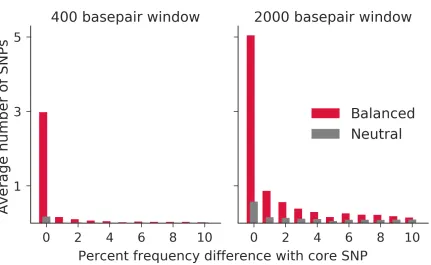
balanced variant. However, there is a smaller excess at identical frequencies relative
Figure 2.3: Simulations demonstrate the build-up of alleles at frequencies similar to balanced alleles as compared with selectively neutral counterparts. The 400 basepair window is not expected to have experienced recombination between allelic classes since the start of selection, whereas the 2000 basepair window is more likely to have.
2.2
The
β
(1)statistics for detecting balancing
se-lection
2.2.1
Framework for capturing excess allele frequency
corre-lation
To detect loci under ancient balancing selection we therefore want to develop a
sum-mary statistic which captures an excess number of SNPs at near identical frequencies
to one another. We will use several components to do this. The first is a measure
of allele frequency similarity. This allows one to weight SNP counts based on their
into an estimator of a mutation rate. Finally, we use this estimator in combination
with another estimator that measures the background mutation rate as our statistic.
In addition, we derive the variance of this statistic, so we can standardize it.
In this chapter I present two versions of this statistic. The first, the unfolded version,
takes into account the ancestral/derived state at each SNP. By doing so, it can give
more weight to SNPs of higher frequency, because they are less likely under neutrality.
The second version, the folded version, does not use allele ancestral/derived states.
Therefore, it is applicable even to species without a high-quality sequenced outgroup
species.
2.2.2
Capturing allele frequency correlation
To capture allele frequency correlation, we derive a measurement of frequency
simi-larity between a core variant and a second variant of interest. Let n be the number
of chromosomes sampled,f0 be frequency of the core SNP, fi be the frequency of the
second SNP, i, and p be the scaling constant. Finally, g(f) returns the folded allele
frequency and m is the maximum possible folded allele frequency difference between
the core SNP and SNP i, We then measure the similarity in frequency, di, by:
g(f) = min(f, n−f) (2.2.1)
m= maxg(f0), n
2 −g(f0)
(2.2.2)
di =
1− |g(f0)−g(fi)| m
p
Thus, g(f0)−g(fi) is the folded frequency difference between the core SNP and the
SNP under consideration. We then divide by m, the maximum folded frequency
difference possible with the core SNP, to get the percent of the maximum frequency
different the two SNPs have. We then take 1 minus the result to give a similarity
metric instead of a distance metric. We raise it to the power pso that we can weight
variants in a non-linear fashion with respect to this fraction. Therefore,di can range
from 0 if a SNP has the maximum frequency difference with the core SNP, to 1 if
SNP i is at the same frequency as the core SNP (Fig. 2.4). Guidance on the
choice of p is given in section 2.2.3. We use the folded site frequency spectrum in
calculating di, as the frequency difference between the core variant and the second
variant is independent of whether the derived or ancestral allele of the nearby allele
is in linkage with the derived or ancestral core allele.
In a region under long-term balancing selection, the average di between a core SNP
and the surrounding variants is expected to be elevated. However, di alone is not
op-timally powered to detect balancing selection, as its value will be sensitive to changes
in the mutation rate in the surrounding region, and it does not take into account the
probability of seeing each allele frequency under neutrality.
2.2.3
Choice of
p
parameter
The power of our method lies in capturing allele frequency correlations. The
Figure 2.4: Absolute value of allele frequency similarity with core SNP (|g(f0)−g(fi)|) versus allele frequency similarity (di) as used by the β statistics, by different values of the p parameter. The grey and red lines represent the value of di at the given frequency similarity, while the light red bars represent the number of SNPs at a given frequency difference away from the core SNP in simulations of balancing selection, based on the 2000 basepair window panel of Fig. 2.3.
approaches infinity, the only sites that contribute towards θB are those that exactly
match the frequency of the core SNP. Atp= 0, all SNPs contribute the same amount
to the estimate of ˆθB, and so ˆθB becomes equivalent to ˆθw. Simulations show that
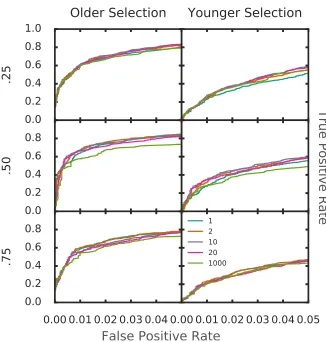
our method is fairly robust to choice of p (Fig. 2.5).
That said, the optimal p will depend on the data set at hand. If allele frequency
estimates are known to be inaccurate or sample sizes vary between SNPs, then a lower
p may be more optimal, because variants fixed in allelic class may not accurately be
called as being at identical frequency to the core SNP. In addition, by including SNPs
at very similar frequency to the core SNP in the calculation of ˆθB, SNPs that were
once fixed in class, but are no longer due to recombination followed by a small amount
of drift, are included. However, makingp too low will result in the inclusion of allele
0.0 0.2 0.4 0.6 0.8 1.0 .2 5
Older Selection
Younger Selection
0.0 0.2 0.4 0.6 0.8 .5 0
0.00 0.01 0.02 0.03 0.04 0.0 0.2 0.4 0.6 0.8 .7 5
0.00 0.01 0.02 0.03 0.04 0.05 1
2 10 20 1000
False Positive Rate
Tr
ue
P
os
itiv
e R
at
e
In this chapter, we chose a p = 20, which gives the most weight to exact frequency
matches, and a small amount of weight to very near, but not exact frequencies. If
varying sample sizes are used for each SNP, then a lower p value may be optimal
(Fig. 2.21).
2.2.4
Estimator of the mutation rate based on allele
fre-quency correlation
Derivation of Unfolded θB
Let n be the number of chromosomes sampled, di be the similarity measure and Si
be the number of variants at frequencyi in the sample.
E[
n−1
X
i=1
idiSi] =
n−1
X
i=1
E[idiSi] (2.2.4)
=
n−1
X
i=1
idiE[Si] (2.2.5)
=
n−1
X
i=1
idi 1
iθ (2.2.6)
ˆ
θβ =
n−1
P
i=1
idiSi
n−1
P
i=1
di
Derivation of Folded θB
E[
n−1
X
i=1
diSi] =
n−1
X
i=1
E[diSi] (2.2.8)
=
n−1
X
i=1
diE[Si] (2.2.9)
=
n−1
X
i=1
di 1
iθ (2.2.10)
ˆ
θ=
n−1
P
i=1
diSi
n−1
P
i=1
di1i
(2.2.11)
Let g(x) be the folded frequency of a SNP of frequency x, Sg(x) be the number of
SNPs at that folded frequency, h=.5(n−1) andm=.5n. Folding the site frequency
spectrum, we obtain:
ˆ
θ∗β =
Pm
i=1diSg(i)
Pm
i=1di(
1
i +
1
n−i)
1 1+δi,n−i
(2.2.12)
2.2.5
A summary statistic to detect balancing selection based
on the site frequency spectrum
We propose a statistic, β, that uses our measure of allele frequency correlation, di,
incorporated in θβ, combined with a measure of the overall mutation rate, to detect
balancing selection. Our approach is inspired by previous summary statistics of the
the difference between two estimators of θ, the population mutation rate parameter,
one of which is more sensitive to characteristics of the site frequency spectrum
dis-torted in the presence of natural selection. We propose to calculate β at each SNP
in a region of interest to identify loci in which there is an excess of variants near the
core SNP’s allele frequency, as evidence of balancing selection.
It has been previously shown that the mutation rate in a region can be estimated
as: ˆθi =Si∗i, where Si is the total number of derived variants found i times in the
window from a sample ofn chromosomes in the population (Fu, 1995). An estimator
of θ can then be obtained by taking a weighted average of θi. In our method, we
weight by the similarity in allele frequency to the core SNP, as measured by di. If
there is an excess of variants at frequencies close to the core SNP allele frequency,
then our new estimator, θβ, will be elevated. We propose:
β(1) = ˆθβ−θˆw (2.2.13)
β(1)∗ = ˆθ∗β−θˆw (2.2.14)
θw is simply Watterson’s estimator (Watterson, 1975). β is, in effect, a weighted sum
of SNP counts based on their frequency similarity to the core SNP. We exclude the
core site from our estimation of θw and θβ.
Under neutrality, the expected value of β is zero, because it is a difference of two
will be an excess number of SNPs at near identical frequencies to one another elevating
θβ substantially over the true mutation rate in the window, whileθW will be elevated
only slightly. Therefore, values of β significantly above zero are suggestive of
long-term balancing selection.
2.2.6
Properties of
β
(1)in simulations
To better understand the properties ofβ, we used simulations (for details see section
2.5.1) to examine its distribution with and without a balanced SNP.
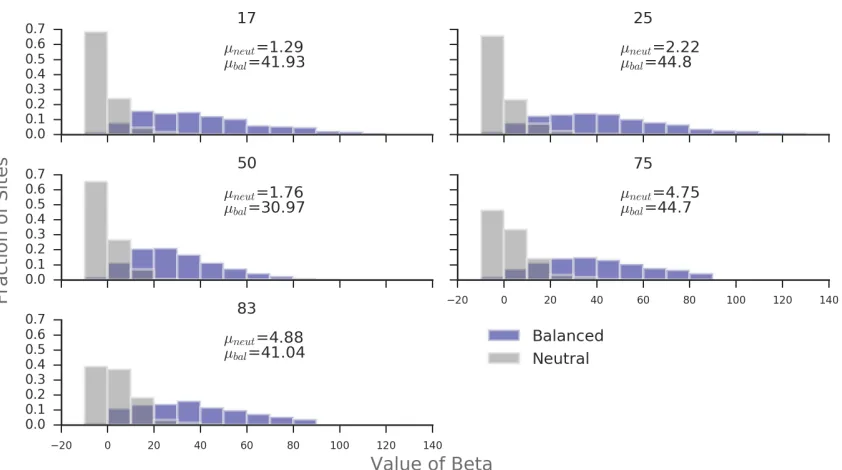
As expected, under long-term balancing selection β tends to be greater than 0, and
under neutrality it tends to be close, but slightly higher than, 0 (Fig. 2.6). Under
neutrality it is not exactly zero, because all the neutral windows β is actually
calcu-lated on will have at least one SNP, and the site frequency spectrum conditioned on
seeing a SNP of a certain frequency does not equal the unconditional site frequency
spectrum, as discussed in section 2.2.7 (Ferretti et al., 2018).
We note that the mean value of β in our neutral simulations generally increases
slightly with higher equilibrium frequencies. This behavior is expected because higher
frequency alleles will tend to have a longer TMRCA and therefore higher diversity.
The exception to this trend is neutral SNPs of frequency 0.5, which we posit is due
to the fact that this allele frequency requires the most time for mutations to drift up
Figure 2.6: Distribution of β(1) in 1kb windows around a core SNP at different equi-librium frequencies. Based on simulations using default parameters. µ refers to the mean value of β(1) in balanced or neutral simulations.
2.2.7
On the assumption of independence between basepairs
In our derivations of ˆθβ we do not use the conditional site frequency spectrum. In
other words, the formula we use for the expected value and variance in SNP counts
does not take into account the frequency of the core site. However, the conditional
and unconditional SFS are unequal, as conditioning on the core SNP’s frequency gives
some knowledge about which underlying tree structures are most likely. Recently, two
papers deriving the moments of the conditional SFS were published (Ferretti et al.,
2018; Klassmann and Ferretti, 2018). We used these moments to derive a modified ˆθβ
and ˆθW conditioned on the core SNP being at the observed frequency. However, doing
so decreased power (Fig. 2.7). We posit that this is because under the conditional
0.0 0.2 0.4 0.6 0.8 1.0
False Positive Rate
0.0 0.2 0.4 0.6 0.8 1.0
Tr
ue
P
os
it
iv
e
R
at
e
β(1) Conditional β(1)
Figure 2.7: Power ofβ(1) statistic when derived using the unconditional site frequency spectrum of Fu (1995) versus conditional of Ferretti et al. (2018).
core SNP is increased. Therefore, when an estimator of the mutation rate is derived
using this expected value, each SNP at that frequency is weighted less than if using
an unconditional site frequency spectrum. This behavior is opposite the ideal: we
want to give the most weight to SNPs at identical frequency to the core SNP, not
less. Therefore, the power of this statistic is reduced, so we use moments of the
unconditional site frequency spectrum to derive our β statistics and their variances.
2.3
Standardization of the
β
(1)statistics
We next derive the variance of our statistics, enabling normalization ofβ. This allows
distribution, including population size, survey sample size, equilibrium frequencies,
and mutation rate. This is a feature lacking from other summary statistics, with the
exception of Tajima’s D (Tajima, 1989).
2.3.1
Variance of the unfolded
β
statistic
The V ar[ˆθβ] can be obtained from the formula for variance of a general group of
estimators presented in (Achaz, 2009) for which ˆθβ is a member. σ is defined in
Achaz (2009) anddi is the measure of frequency similarity presented in section 2.2.2.
V ar[ˆθβ] =
Xn−1
i=1
di
−2
θ
n−1
X
i=1
d2ii+θ2
n−1
X
i=1
d2ii2σii+ 2
n−1
X
i=1
n−1
X
j=i+1
ijdidjσij
!
(2.3.1)
2.3.2
Variance of the folded
β
statistic
The formulation for β(1)∗ does not fall into the class of neutrality tests based on the
folded site frequency spectrum studied in Achaz (2009), because the folded frequency
of each SNP is not considered in our formulation. Therefore, we provide a derivation
below. φ and ρ are defined in Achaz (2009) and di is the measure of frequency
sim-ilarity. Sg(i) is the number of SNPs in the window of folded frequency g(i) and is
analogous toηi in Achaz (2009). Set m=dn2e, wherededenotes the ceiling. We refer
of β(1)∗ is:
V ar[ˆθβ∗ −θˆW] =V ar[ˆθβ∗] +V ar[ˆθW]−2Cov[ˆθ∗β,θˆW] (2.3.2)
First, we derive the variance of ˆθβ∗ to be:
V ar[ˆθ∗β] =V ar
" Pm
i=1diSg(i)
Pm
i=1di(
1
i +
1
n−i)
1 1+δi,n−i
# = m X i=1 di 1 i + 1
n−i
1
1 +δi,n−i
!−2
V ar
" m X
i=1
diSg(i)
# = m X i=1 di 1 i + 1
n−i
1
1 +δi,n−i
!−2 m
X
i=1
V ar[diSg(i)] +
X
i6=j
Cov[diSg(i)djSg(j)]
! = m X i=1 di 1 i + 1
n−i
1
1 +δi,n−i
!−2 m
X
i=1
d2i(φiθ+ρiiθ2) +
X
i6=j
didjρijθ2
! = m X i=1 di 1 i + 1
n−i
1
1 +δi,n−i
!−2 m
X
i=1
d2i(φiθ+ρiiθ2) + 2
X
1≤i≤j≤m
didjρijθ2
!
(2.3.3)
Next, the V ar[ˆθW] is taken from Achaz (2009):
V ar[ˆθW] =
Xm
i=1
n
i(n−i)(1 +δi,n−i)
−2 θ m X i=1 n
i(n−i)(1 +δi,n−i)
2
φ−i 1
+θ2
m
X
i=1
n
i(n−i)(1 +δi,n−i)
2
φ−i 2ρii
+ 2 m X i=1 m X
j=i+1
φ−i 1φ−j1 n
i(n−i)(1 +δi,n−i)
n
j(n−j)(1 +δj,n−j)
ρij
!
Finally, the covariance of ˆθβ∗ and ˆθW:
Cov[ˆθβ∗,θˆW] =Cov
"
Pm
i=1diSg(i)
Pm
i=1di(1i +n1−i)1+δ1i,n−i
,
Pm
i=1Sg(i)
Pm
i=1(
1
i +
1
n−i)
1 1+δi,n−i
#
= Pm 1
i=1di(1i +n1−i)1+δ1i,n−i
1
Pm
i=1(
1
i +
1
n−i)
1 1+δi,n−i
Covh
m
X
i=1
diSg(i),
m
X
i=1
Sg(i)
i
= Pm 1
i=1di(1i +n1−i)
1 1+δi,n−i
1
Pm
i=1(
1
i +
1
n−i)
1 1+δi,n−i
m X i=1 m X j=1
diCov[Sg(i), Sg(i)]
= Pm 1
i=1di(1i +n1−i)1+δ1i,n−i
1
Pm
i=1(
1
i +
1
n−i)
1 1+δi,n−i
m X i=1 m X j=1
diρijθ2
(2.3.5)
2.3.3
Standardized
β
statistics
The standardized β(1) statistics are given by:
βstd(1) = β
(1)
p
V ar[β(1)] =
ˆ
θβ −θˆW
q
α∗
nθˆ+βn∗θˆ2
(2.3.6)
βstd(1)∗ = β
(1)∗
p
V ar[β(1)∗] =
ˆ
θβ∗ −θˆW
q
V ar[ˆθ∗
β] +V ar[ˆθW]−2Cov[ˆθβ∗,θˆW]
2.4
Window size containing signature of balancing
selection
Although β can be calculated on any window size, previous work has suggested that
the effects of balancing selection are localized to a narrow region surrounding the
balanced site (Gaoet al., 2014). Ultimately, the optimal window size depends on the
recombination rate, as it breaks up alleleic classes.
If one uses too small of window size, then some of the signal of alleleic-class build
up will be excluded from the statistic, reducing power. It too large of window size
is used, then noise from regions beyond those which provide any signal of selection
will decrease power. Optimally, we could calculate β on the window which has not
experienced much, if any, recombination between alleleic classes. According to our
model, this region will contain all variants fixed in alleleic class, and potentially some
variants which were once fixed in alleleic class but have drifted slightly in frequency
due to recombination beginning to decouple them from selection.
The probability of recombination between allelic classes is equal to the total coalescent
branch length in the allelic class multiplied by the probability of recombination onto
the other allelic class. Because we are detecting long-term selection, most of the
coalescent branch length will fall into the portion between coalescence within each
allelic class and coalescence of the two allelic classes. We can, therefore, put an upper
bound on the size of the ancestral region. The probability of any recombination event